Physics › Thermal physics › What temperature means for a gas
What temperature means for a gas
Setting the derived kinetic-theory result beside pV = NkT gives the mean translational kinetic energy of one molecule as three halves kT. That energy depends on absolute temperature and on nothing else, so a lighter molecule must move faster to carry it. An ideal gas keeps no potential energy at all.
Choose your exam board to show the notes and questions relevant to your specification. You can change this setting at any time, and content for other boards remains available.
Watch What temperature means for a gas on the InkPhysics YouTube channel
Molecular kinetic theory, part 2 of 2. Part 1 is The kinetic theory model and its derivation.
IN THIS TOPIC
- Use ½m(crms)2 = 3kT/2 = 3RT/2NA, and read off what temperature means.
COMMON MISCONCEPTION
At the same temperature, all gas molecules move at the same speed.
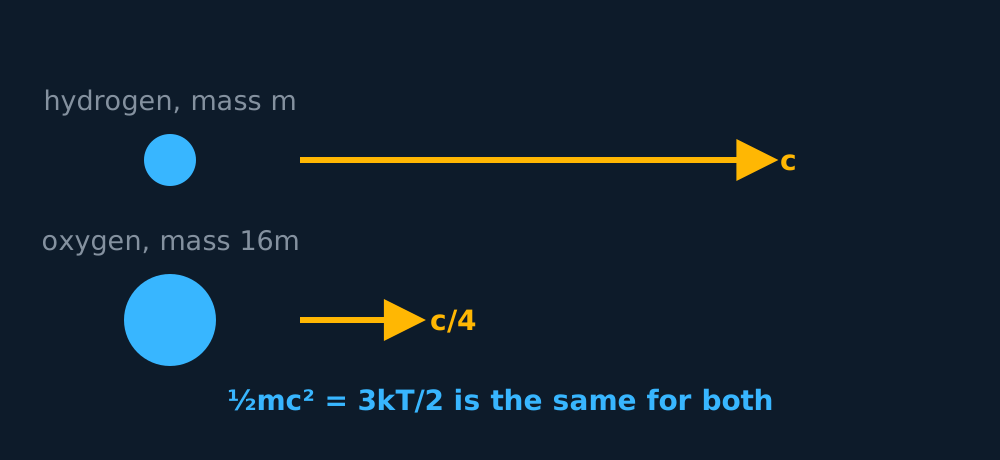
At one temperature every molecule has the same mean kinetic energy, three halves kT, not the same speed. Since that energy is half m c squared, a molecule sixteen times heavier moves at a quarter of the root-mean-square speed.
What temperature is
Set the derived equation beside the empirical pV = NkT and the meaning of temperature follows.
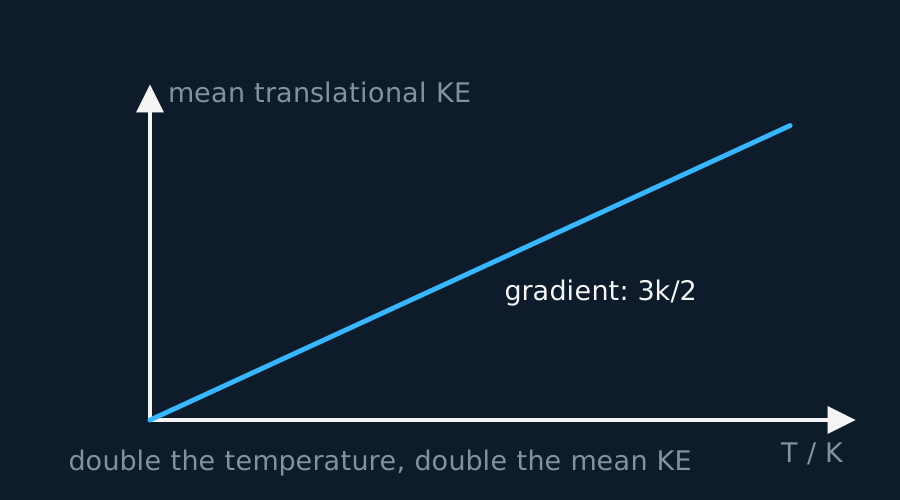
The average translational kinetic energy per molecule is proportional to absolute temperature and to nothing else. Not the gas, not the pressure, only T. Absolute temperature is the molecular measure of that energy, at (3/2)kT per molecule, though the two are proportional rather than the same quantity, as their units alone make plain. An ideal gas has no intermolecular forces, so it keeps no potential-energy account at all, which makes its internal energy entirely kinetic.
The weight of the overlying air does set how large sea-level pressure comes out, but the pushing itself is molecular bombardment, striking floor and walls and ceiling alike. That is what makes the pressure act in every direction at once instead of only downwards.
WORKED EXAMPLE
The same temperature, two different speeds
Find the mean kinetic energy of a gas molecule at 300 K, and explain which moves faster at that temperature: hydrogen or oxygen molecules.
Mean KE = (3/2)kT = 1.5 × 1.38 × 10−23 × 300 = 6.2 × 10⁻²¹ J, and that number is the same for every gas. Absolute temperature sets it and nothing else does.
Equal ½m(crms)2 with a sixteenth of the mass means hydrogen's speed squared is sixteen times oxygen's.
So hydrogen moves four times faster at the same temperature. A lighter molecule must move faster to carry the same kinetic energy, which is why hydrogen escapes through small gaps readily and why Earth's atmosphere retains so little of it.
GUIDED PRACTICE
Doubling the speed
A gas is at 300 K. To what temperature must it be raised to double the root mean square speed of its molecules? Reason through the proportionality.
Show the working
Temperature tracks the mean kinetic energy, which goes as the speed squared, so doubling crms quadruples the energy.
T must therefore quadruple, to 1200 K. An answer of 600 K would follow from treating T as proportional to the speed rather than to its square.
INDEPENDENT PRACTICE
Atmospheric pressure, from scratch
Air has density 1.2 kg m−3 and its molecules move with a root mean square speed of about 500 m s−1. Use the kinetic theory result p = ⅓ρ(crms)2 to estimate atmospheric pressure.
Show the working
p = ⅓ × 1.2 × 5002 = ⅓ × 3.0 × 105 = 1.0 × 10⁵ Pa.
That is atmospheric pressure, recovered from molecular bombardment alone. The derivation you can be asked to reproduce is a description of the air in this room, molecule by molecule.
ASSESSMENT FOCUS
- Doubling the kelvin temperature doubles the mean KE but multiplies crms by only √2. A square root sits between energy and speed.
- Mean kinetic energy per molecule is (3/2)kT and depends on absolute temperature alone. Naming the gas, or the pressure, in an answer to “what does it depend on” adds something the equation does not contain.
- Temperatures go in kelvin here without exception, because the relation is a proportionality through the origin. A Celsius value substituted straight in gives an answer that is wrong by 273 in the wrong place.
- An ideal gas has no intermolecular forces, so it keeps no potential-energy account and its internal energy is entirely kinetic. That is what makes the internal energy of a fixed mass of ideal gas a function of temperature and nothing else.
CHECK YOURSELF
Find the root mean square speed of nitrogen molecules (molar mass 0.028 kg mol−1) at 300 K. (R = 8.31 J K−1 mol−1.)
Show a hint
Write the average-KE equation with molar quantities, then solve for crms.
Show the answer
Work per mole. ½M(crms)2 = 3RT/2, so (crms)2 = 3RT/M.
That gives (crms)2 = 3 × 8.31 × 300 / 0.028 = 2.67 × 10⁵ m2 s−2, so crms = 520 m s−1.
Set that beside the speed of sound in the same gas, which is a separate result with an equation of its own, c = √(γRT/M), quoted here for the comparison rather than for the exam. For nitrogen γ = 1.4, giving c = 350 m s−1. The two are different quantities and neither one caps the other; what they share is their scaling, both going as √(T/M), so both climb with temperature and fall with molar mass. Their ratio is the fixed number √(γ/3), about 0.68 for any diatomic gas.
Mean molecular kinetic energy is proportional to absolute temperature, and equals (3/2)kT.
At one temperature a lighter molecule must move faster to carry the same energy.
An ideal gas keeps no potential energy at all.
Or read them with their mark schemes on the kinetic theory model and its derivation questions page.
CHECK YOUR PROGRESS
Rate how confident you feel with each objective for this lesson. Ratings are saved in this browser, on this device, unless you sign in.
- Use ½m(crms)2 = 3kT/2 = 3RT/2NA, and read off what temperature means.
Open the full revision checklist to track your progress across the whole unit.