Physics › Thermal physics › The kinetic theory model and its derivation
The kinetic theory model and its derivation
Where the gas laws are generalisations from measurement, kinetic theory derives them from molecules bouncing elastically off the walls. Brownian motion in a smoke cell is the evidence that molecules exist. The derivation of pV as one third Nm times the mean square speed starts from one molecule rebounding off a wall.
Choose your exam board to show the notes and questions relevant to your specification. You can change this setting at any time, and content for other boards remains available.
Molecular kinetic theory, part 1 of 2. Part 2 is What temperature means for a gas.
Builds on Ideal gases and the gas laws and Momentum and impulse.
IN THIS TOPIC
- Set the empirical gas laws against the kinetic theory model, with Brownian motion as the evidence for atoms.
- List the assumptions, then reproduce the derivation of pV = ⅓Nm(crms)2 from them.
COMMON MISCONCEPTION
Air pressure comes from air's weight pressing down.
Gas pressure is not weight acting downwards. It comes from molecules colliding with surfaces, each impact changing momentum and exerting a force, so pressure acts equally in all directions.
A theory, and its evidence
The spec draws the philosophical line itself. Gas laws are empirical, generalisations from measurement, while kinetic theory arises from theory and derives the same relationships from a molecular model. The derivation reproduces Boyle's law from first principles, which is evidence that the model's assumptions describe a real gas.

Brownian motion provides indirect evidence for molecular motion. Pollen grains in water, or smoke in air, jitter along ceaseless random walks. A grain vastly heavier than any molecule visibly trembles because the molecular bombardment is random and, instant by instant, uneven.
Einstein's 1905 analysis turned that jitter into a quantitative prediction, tying how far a grain wanders to the Avogadro constant, and so to the number of molecules doing the shoving. Jean Perrin spent the years that followed measuring exactly that, and got a value for the Avogadro constant out of it. Theory and experiment together moved the atom from a useful assumption to a measured object. No single experiment settled the question; the evidence accumulated as independent measurements of the Avogadro constant agreed.
The demonstration is worth being able to describe, because it is asked for. A smoke cell is a small glass box holding smoke from a smouldering waxed taper, closed and set on a microscope stage. Light it from the side, so that each smoke particle scatters light up into the objective and shows as a bright speck against a dark field, and focus on the specks. What you see is not the smoke drifting as a body. Each individual speck jerks about on its own, changing direction constantly, at random, and never settling.
Then read the inference off it. The specks are smoke particles, far too large to be single molecules and visible only because they are that large. Nothing in the sealed cell is stirring them. So the only thing left to jolt them is the air molecules, arriving from every side and, at any instant, more of them on one side than the other. Their random jitter is visible evidence of the random molecular motion the model assumes, and the smaller the particle you watch, the more violent the jitter, exactly as an uneven bombardment would predict.
The assumptions
The ideal-gas model rests on assumptions worth listing, since papers ask for them. The gas contains a very large number of identical molecules in random motion, and the molecules' own volume is negligible beside the container's. Collisions, with walls and each other, are elastic and of negligible duration, and no forces act between molecules except during collisions. Each assumption is an approximation to a real gas, and the approximations are closest, so the equation fits best, when a gas is hot and sparse.
The required derivation

Describe the drawing
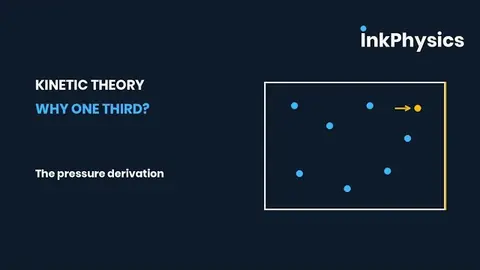
Left: the derivation, acted out. One molecule ping-pongs between the walls, and every round trip of 2L/v it delivers its 2mv kick to the flashing wall; many molecules doing this at once is pressure. Right: the visible consequence. A pollen grain far too big to see molecules is jolted by their uneven bombardment into a jitter you can see, the walk that convinced everyone atoms are real.
AQA, CIE and Edexcel all examine this derivation in full, so here it is in five moves, with momentum and impulse from Year 12 as the tools. One. A molecule of mass m travels at velocity component vx towards a wall of a box of side L, and each elastic bounce reverses that component, a momentum change of 2mvx. Two. It returns after a round trip of 2L, so hits arrive every 2L/vx seconds, giving an average force on the wall of 2mvx/(2L/vx) = mvx2/L.
Three. Sum over all N molecules, replacing each vx2 by its average. Four. Random motion shares speed equally among the three directions, so the mean of vx2 is one third of the mean square speed. Five. Pressure is that total force over the wall's area L2, and with volume V = L3,
where crms, the root mean square speed, is the square root of the mean of the squared speeds, the appropriate average for quantities that matter through their squares.
What temperature is has moved to the next part of this lesson.
ASSESSMENT FOCUS
- Empirical against theoretical is the specifications' own wording. Gas laws come from experiment; kinetic theory derives them from a model. One sentence covers it.
- Keep Brownian motion's inference chain in order. Visible random jitter of grains → uneven bombardment → by particles far too small to see → atoms exist.
- Describe the smoke cell fully, side lighting included, since it is the side lighting that makes each speck visible against a dark field. Smoke in a sealed glass cell, lit from the side, viewed under a microscope, and each speck seen jerking randomly and independently of the rest.
- The derivation is examined stepwise, so practise until the five moves are automatic. Momentum change 2mvx, hit interval 2L/vx, force mvx2/L, sum and average, then the factor ⅓ from three dimensions.
- crms means root-mean-square. Square, average, then root. Averaging the speeds first gives a different and smaller value.
CHECK YOURSELF
A sealed rigid container holds an ideal gas at constant temperature. (a) Explain, in terms of the molecules, why the gas exerts a pressure on the container walls. (b) State two assumptions of the kinetic theory model that the derivation of pV = ⅓Nm(crms)2 needs.
Show a hint
What happens to one molecule at one wall, and what does the wall feel because of it?
Show the answer
(a) The molecules move randomly and collide with the walls. Each collision reverses the molecule's momentum component perpendicular to the wall, so the wall exerts a force on the molecule and, by Newton's third law, the molecule exerts an equal force on the wall. Vast numbers of such collisions each second average out to a steady force, and pressure is that force per unit area.
(b) Any two of: the molecules are in continuous random motion; their volume is negligible compared with the volume of the container; collisions are perfectly elastic; the time of a collision is negligible compared with the time between collisions; and there are no intermolecular forces except during a collision.
Negligible molecular volume and no intermolecular forces are exactly what make the derived result an ideal gas law rather than a description of any real one.
Pressure is bombardment, derived from momentum.
crms is square, average, then root.
WORKBOOK
Printable practice for this topic: original exam-style questions with room to work, and a fully worked answer book. Free to use; please do not redistribute or sell.
Or read them with their mark schemes on the kinetic theory model and its derivation questions page.
WHERE TO GO NEXT
- Significant figures, units and checking is the maths this lesson leans on, worked through step by step.
USED LATER IN
CHECK YOUR PROGRESS
Rate how confident you feel with each objective for this lesson. Ratings are saved in this browser, on this device, unless you sign in.
- Set the empirical gas laws against the kinetic theory model, with Brownian motion as the evidence for atoms.
- List the assumptions, then reproduce the derivation of pV = ⅓Nm(crms)2 from them.
Open the full revision checklist to track your progress across the whole unit.