Physics › Turning points › Length contraction, mass and energy
Length contraction, mass and energy
The factor that slows a moving clock also shortens a moving object along its direction of travel, by l = l₀√(1 − v²/c²) from its proper length. Mass and energy are equivalent through E = mc², and c stands as a limiting speed. Bertozzi timed accelerated electrons and found their speed saturating just below it.
Choose your exam board to show the notes and questions relevant to your specification. You can change this setting at any time, and content for other boards remains available.
The consequences of special relativity, part 2 of 2. Part 1 is Time dilation and muon decay.
Builds on Time dilation and muon decay and Mass-energy and binding energy.
IN THIS TOPIC
- Use the length contraction equation with proper length.
- Describe how mass and kinetic energy vary with speed, and outline Bertozzi's direct test.
COMMON MISCONCEPTION
With a strong enough accelerator you could push an electron past the speed of light.
Nothing can be pushed past c: the energy needed grows without limit as speed approaches c, because in AQA's relativistic-mass convention the effective mass m₀/√(1 − v²/c²) grows without limit while the rest mass stays fixed, so electrons approach but never reach c.
Length contraction
The factor √(1 − v2/c2) that slows a moving clock also applies to length. The proper length l0 of an object is its length measured in its own rest frame; an observer it passes at speed v measures it shorter along the direction of motion:
Nothing is being crushed. Lengths, like durations, are relations between frames. The muon's own frame shows this. In the muon's rest frame its lifetime really is 2.2 μs, and the atmosphere is length-contracted from 10 km to under 900 m. At 0.996c that takes 3.0 μs, the same 1.4 lifetimes the ground observer counts. The two frames describe the descent differently and predict the same survival rate.
GUIDED PRACTICE
The travelling metre
A metre rule flies past at 0.80c, aligned with its motion. Find its measured length, and its measured length if instead it flies at the same speed aligned across its motion.
Show the working
Along the motion, l = 1.00 × √(1 − 0.802) = 1.00 × 0.60 = 0.60 m.
Across the motion, 1.00 m, unchanged. Contraction acts only along the direction of travel, and questions regularly test that.
Mass, energy, and Bertozzi's electrons
Speed changes the energy and the momentum, not the mass. Push on an object near light speed and the work done produces ever less increase in speed, as though the inertia itself were growing. The rest mass m0 is invariant, and the relativistic energy-momentum relation E2 = p2c2 + (m0c2)2 carries that growth instead. AQA's Turning points option keeps the older relativistic-mass convention, writing a relativistic mass m = m0/√(1 − v2/c2) above the rest mass, and examines it; both languages describe the same physics. Tying the AQA form to the equivalence of mass and energy gives the total energy of a moving object, and the booklet prints the whole chain as one line:
Subtract off the rest energy m0c2 and what remains is the kinetic energy, which the booklet does not print:
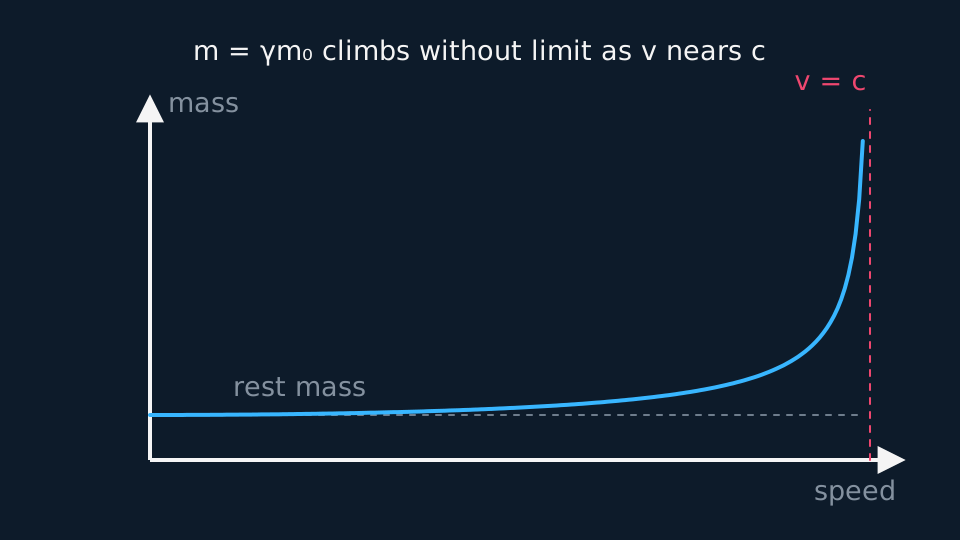
As v approaches c the denominator collapses towards zero, so the mass, and with it the kinetic energy, grows without limit. That is what stops any accelerator, however strong, from pushing an electron past c. It is also why the classical result in The specific charge of the electron fails. eV = ½mv2 assumes all the work becomes kinetic energy of a fixed mass, when past a few tenths of c it increasingly becomes mass-energy instead. An electron's rest energy m0c2 is 8.2 × 10⁻¹⁴ J, about 0.51 MeV, and beyond that most of the energy an accelerator supplies goes into mass-energy rather than speed.
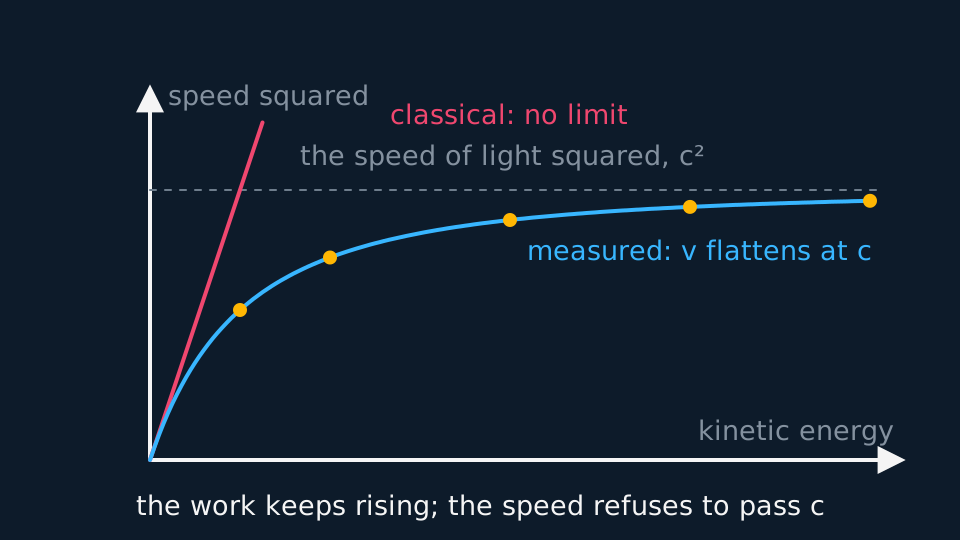
In 1964 William Bertozzi tested this about as directly as anyone could. Accelerate electrons through a known pd, so the kinetic energy is known from eV, then time their flight over 8.4 m to measure the speed outright. Classically v2 should climb in proportion to the energy forever. His electrons instead saturated just below c, their measured speed flattening while the energy, delivered as heat to the target, kept rising exactly as supplied. Kinetic energy varies with speed the relativistic way, by direct measurement.
INDEPENDENT PRACTICE
An impossible speed, corrected
An electron is given 2.0 MeV of kinetic energy. Show that classical physics predicts an impossible speed, and find the true speed (electron rest energy 0.51 MeV).
Show the working
Classically ½m0v2 = 2.0 MeV gives v = 8.4 × 10⁸ m s−1, which is 2.8 times the speed of light and therefore forbidden.
Relativistically the total energy is E = 2.0 + 0.51 = 2.51 MeV, so E/m0c2 = 4.9, and v/c = √(1 − 1/4.92) = 0.98: v = 2.9 × 10⁸ m s−1, just under c, exactly where Bertozzi's electrons sat.
ASSESSMENT FOCUS
- Choose the proper quantity first, and say why. Proper length is measured in the object's rest frame, at rest with respect to the rule; taking the wrong quantity as l0 inverts the whole calculation.
- Sanity-check the direction of every answer. Moving lengths measure shorter, so l0 is always the longest, and contraction acts only along the direction of travel.
- Do the muon the other way round too, since papers ask for it. In the muon's own frame the lifetime is unchanged and the atmosphere is contracted instead.
- Sketching mass or kinetic energy against speed, start at the rest value, stay near it out to a few tenths of c, then rise steeply towards a vertical asymptote at c, never touching it.
- Bertozzi scores on the method's directness. Kinetic energy known from the accelerating pd and checked calorimetrically, speed measured by time of flight, and the measured v2 flattening below c.
CHECK YOURSELF
A spacecraft of proper length 50 m passes Earth at 0.60c. Find its length as measured from Earth, and state which measurement, the crew's or Earth's, is "correct". An accelerator then gives an electron a total energy of five times its rest energy; find the electron's speed.
Show a hint
The root is √(1 − 0.36) = 0.80. For the electron, E/m₀c² = 5 fixes the root itself.
Show the answer
The 50 m is the proper length, measured at rest with the craft, and Earth measures l = 50 × 0.80 = 40 m, contracted along the motion.
Both are correct. Each observer's measurements are right in their own inertial frame; lengths, like durations, are frame-dependent, and the proper value belongs to the frame riding with the rule.
E = m0c2/√(1 − v2/c2) = 5m0c2 means the root is 1/5, so v2/c2 = 1 − 0.04 = 0.96 and v = 0.98c = 2.9 × 10⁸ m s−1, just under c however much more energy is supplied.
Moving lengths shrink along the motion by the same root that slows moving clocks, and proper length is measured at rest with the object.
Rest mass m₀ is invariant; the total energy follows E² = p²c² + (m₀c²)², and c is a limiting speed no amount of energy can reach.
Or read them with their mark schemes on the time dilation and muon decay questions page.
CHECK YOUR PROGRESS
Rate how confident you feel with each objective for this lesson. Ratings are saved in this browser, on this device, unless you sign in.
- Use the length contraction equation with proper length.
- Describe how mass and kinetic energy vary with speed, and outline Bertozzi's direct test.
Open the full revision checklist to track your progress across the whole unit.