Physics › Nuclear physics › Mass-energy and binding energy
Mass-energy and binding energy
A nucleus has less mass than its separated nucleons, and that mass difference, converted by E = mc², is the binding energy of the nucleus. One atomic mass unit is equivalent to 931.5 MeV. Binding energy per nucleon peaks at iron-56 near 8.8 MeV, with fusion to the left of the peak and fission to the right.
Choose your exam board to show the notes and questions relevant to your specification. You can change this setting at any time, and content for other boards remains available.
Builds on Antimatter and photons and Nuclear radius and density.
IN THIS TOPIC
- Convert between mass and energy using E = mc² and the 931.5 MeV value of the atomic mass unit.
- Calculate a mass difference and a binding energy from nuclear masses.
- Compare nuclei fairly using binding energy per nucleon.
- Sketch the binding energy per nucleon curve, and mark the fusion and fission release regions on it.
COMMON MISCONCEPTION
Mass is always conserved.
Mass alone is not conserved; total mass-energy is. A nucleus has less mass than its separated nucleons, the difference having been released as binding energy via E = mc².
Mass-energy equivalence
E = mc², met in the particles unit, is developed fully here.
A change in a system's energy corresponds to a change in mass, , and this applies to every energy change, however ordinary. Boil a kettle and the hot water is heavier by a few nanograms; a wound clock spring outweighs a slack one. The changes are immeasurably small because c2 is enormous. Only in the nucleus, where the energies are millions of electronvolts, does the missing mass become large enough to weigh.
Nuclear masses are quoted in the atomic mass unit, u, defined as one twelfth of the mass of a carbon-12 atom and printed in the booklet as 1.661 × 10⁻²⁷ kg. Run that mass through E = mc2 and out comes the conversion the booklet prints beside it, 1 u is equivalent to 931.5 MeV. Try the multiplication with the booklet's rounded u and c and you land on 934 MeV, which is close enough to show where the number comes from; the printed 931.5 uses unrounded values, so quote the printed one. Mass differences in u then multiply straight into energies in MeV, with no joules involved at all.
The missing mass
Now weigh a helium-4 nucleus against its ingredients, using the booklet's proton and neutron masses. Two protons and two neutrons apart come to 4.0319 u; the assembled nucleus is 4.0015 u. The difference, 0.0304 u, is the mass difference, and it did not vanish. It left as 0.0304 × 931.5 = 28.3 MeV of energy when the nucleus formed.
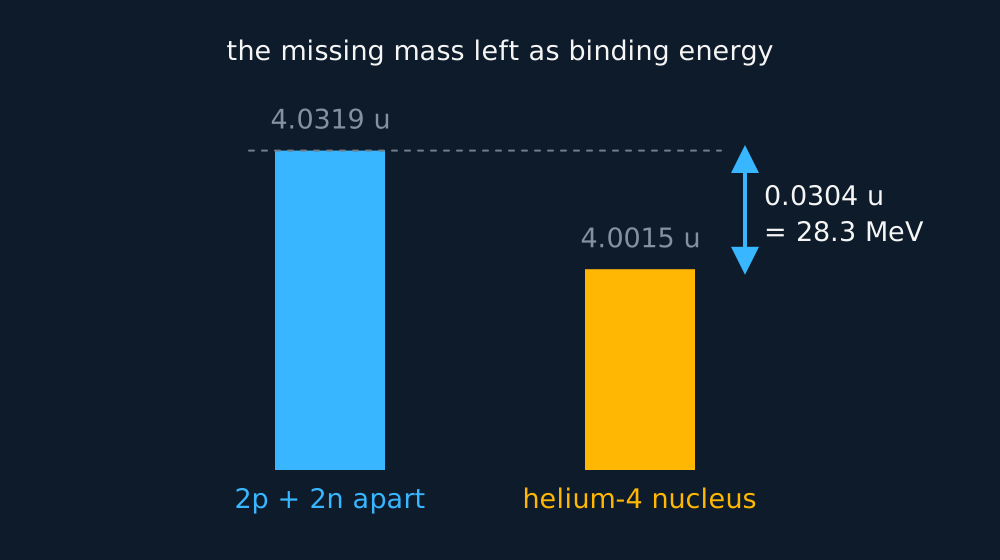
That energy is the binding energy: the energy required to separate a nucleus into free nucleons, and equally the energy released when it is assembled. The mass defect is Δm = (total mass of the separate nucleons) − (mass of the nucleus), and the binding energy is EB = Δmc2.
WORKED EXAMPLE
Helium-4, weighed against its parts
The nuclear mass of helium-4 is 4.00150 u. Using mp = 1.00728 u and mn = 1.00867 u, find its binding energy and binding energy per nucleon.
Parts first. 2 × 1.00728 + 2 × 1.00867 = 4.03190 u, so the mass difference is 4.03190 − 4.00150 = 0.03040 u.
Convert at the booklet rate, 0.03040 × 931.5 = 28.3 MeV of binding energy.
Per nucleon that is 28.3/4 = 7.1 MeV, unusually high for so light a nucleus. That is the helium-4 spike on the curve below, and the reason helium-4 is the main product of fusion in stars.
The binding energy per nucleon curve
To compare nuclei fairly, divide each binding energy by its nucleon number. The result, binding energy per nucleon, measures how tightly the average nucleon is held, and plotting it against A explains why fusion of light nuclei and fission of heavy nuclei can both release energy.
Describe the drawing
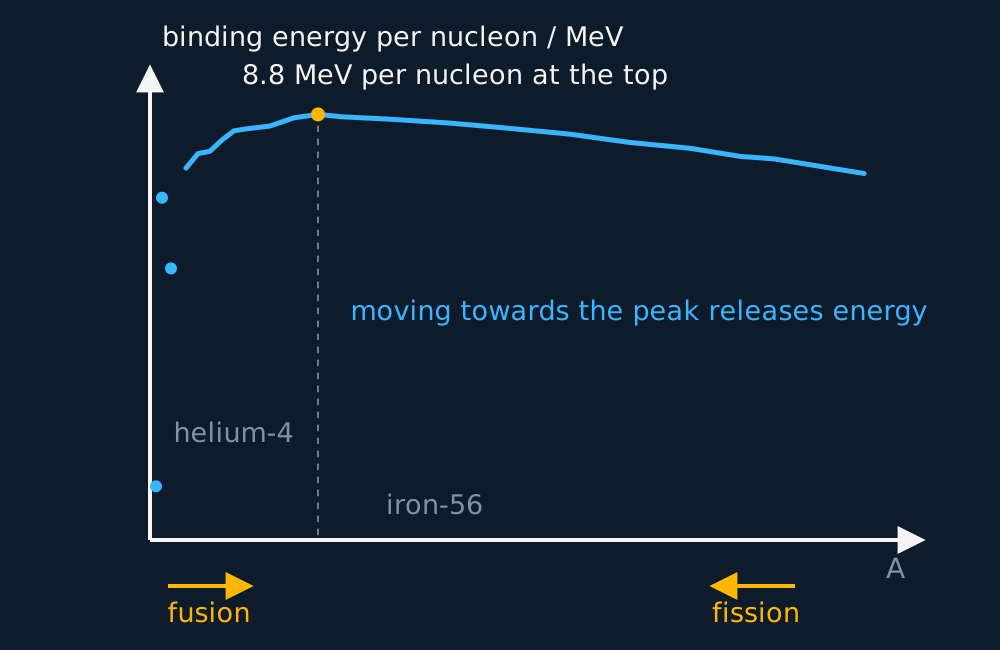
The binding energy per nucleon curve rises steeply through the light nuclei, with helium-4 spiking above its neighbours, peaks at iron-56 near 8.8 MeV, then falls gently to uranium; amber arrows beneath the axis show fusion driving light nuclei up towards the peak from the left and fission driving heavy nuclei towards it from the right.
The curve climbs steeply through the light nuclei, with helium-4 spiking above its neighbours, peaks near iron-56 at about 8.8 MeV per nucleon, then declines gently to uranium at 7.6. Any change that moves nucleons towards the peak leaves them more tightly bound, so the difference is released. Light nuclei move towards the peak from the left by fusion; heavy nuclei move towards it from the right by fission. Nuclei at the peak are already the most tightly bound, so neither route releases energy from them, which is why fusion in stars stops there. Be able to mark both release regions on the plot.
Iron-56 is the answer to give for the peak. The top of the curve is really a flat iron-nickel shelf a few nuclides wide, and nickel-62 edges above iron-56 by about a twentieth of one per cent, a margin too small to draw and too small to change any answer here.
GUIDED PRACTICE
Reading energy off the curve
A nucleus of A = 236 (binding energy per nucleon about 7.6 MeV) splits into fragments near A = 118, where the curve reads about 8.4 MeV. Estimate the energy released, working per nucleon.
Show the working
Each of the 236 nucleons becomes better bound by roughly 8.4 − 7.6 = 0.8 MeV.
Total ≈ 0.8 × 236 = 190 MeV, the textbook fission yield, read straight off the graph.
ASSESSMENT FOCUS
- Keep the units straight. A mass difference in u multiplies by 931.5 to give MeV. Convert to kilograms and joules only when a question demands SI, and say which route you took.
- Check whether you were given nuclear or atomic masses. Atomic masses include the electrons; in most AQA questions the electron masses cancel or the nuclear mass is supplied, but read the data line.
- Define binding energy as the energy needed to separate a nucleus into its individual nucleons, or the energy released on assembly. “The energy holding the nucleus together” names no measurable quantity and does not define it.
- Comparisons between nuclei always use binding energy per nucleon, never the total; a huge nucleus can have a large total yet sit low on the curve.
- Sketching the curve wants four features. A steep rise, the helium-4 spike, a broad peak near A = 56 labelled at about 8.8 MeV, and a gentle fall away to uranium. Mark fusion to the left of the peak and fission to the right, with both arrows pointing towards iron.
CHECK YOURSELF
The nuclear mass of iron-56 is 55.92066 u. Using mp = 1.00728 u and mn = 1.00867 u, find the mass difference, the binding energy, and the binding energy per nucleon.
Show a hint
Iron-56 has 26 protons and 30 neutrons; parts minus whole first.
Show the answer
Separate parts come to 26 × 1.00728 + 30 × 1.00867 = 56.44938 u, so Δm = 56.44938 − 55.92066 = 0.52872 u.
Binding energy = 0.52872 × 931.5 = 492.5 MeV.
Per nucleon that is 492.5 / 56 = 8.8 MeV, right at the top of the curve. Nothing in nature beats that by more than a rounding error.
A bound nucleus weighs less than its parts, and the gap is the binding energy.
Divide by A and iron-56 sits at the top of the curve, near 8.8 MeV per nucleon.
WORKBOOK
Printable practice for this topic: original exam-style questions with room to work, and a fully worked answer book. Free to use; please do not redistribute or sell.
Or read them with their mark schemes on the mass-energy and binding energy questions page.
WHERE TO GO NEXT
- Standard form and prefixes is the maths this lesson leans on, worked through step by step.
- Significant figures, units and checking is the maths this lesson leans on, worked through step by step.
USED LATER IN
CHECK YOUR PROGRESS
Rate how confident you feel with each objective for this lesson. Ratings are saved in this browser, on this device, unless you sign in.
- Convert between mass and energy using E = mc² and the 931.5 MeV value of the atomic mass unit.
- Calculate a mass difference and a binding energy from nuclear masses.
- Compare nuclei fairly using binding energy per nucleon.
- Sketch the binding energy per nucleon curve, and mark the fusion and fission release regions on it.
Open the full revision checklist to track your progress across the whole unit.