Biology › Exchange surfaces and gas exchange › Surface area to volume ratio: why size limits diffusion
Surface area to volume ratio: why size limits diffusion
Surface area grows as the square of length while volume grows as the cube, so the ratio between them falls as an organism gets larger. That ratio, together with the time diffusion takes over distance, determines why single-celled organisms need no exchange system and why larger organisms need specialised exchange surfaces and transport systems.
Before this Diffusion and Fick's law · Membrane structure and permeability
COMMON MISCONCEPTION
A large animal needs lungs because it has more cells to supply than a small one.
The problem is the ratio, not the total. Double an animal's length and its volume rises eightfold while its surface rises fourfold, so every gram of tissue has half the surface serving it.
What you should be able to do
- Calculate a surface area to volume ratio for a cube, a sphere and a flattened body, and say what happens to it as the body gets bigger.
- Explain why shape changes the ratio even when the volume is fixed.
- State Fick's law as a proportionality and use it to predict how a change in area, gradient or thickness changes the rate.
- Explain why diffusion works over micrometres and fails over millimetres.
- List the features shared by specialised exchange surfaces and account for each one in terms of Fick's law.
How the ratio changes with size
Take a cube of side L. Its surface area is 6L², its volume is L³, and the ratio between them is 6L² ÷ L³, which simplifies to 6 ÷ L. Nothing about that expression is biological. It says that the ratio of surface to volume depends on nothing except size, and that it falls as size rises, and it falls without limit.
A cube of side 1 cm has a ratio of 6 cm⁻¹. A cube of side 2 cm has a ratio of 3 cm⁻¹. A cube of side 10 cm has a ratio of 0.6 cm⁻¹. The 10 cm cube has a hundred times the surface of the 1 cm cube and a thousand times the contents, so each cubic centimetre inside it is served by a tenth as much outside. Every organism larger than about a millimetre across is constrained by that relationship, and the exchange surfaces and transport systems described below are the responses to it.
surface area to volume ratio = surface area ÷ volumeFor a cube this comes to 6 ÷ side; for a sphere it comes to 3 ÷ radius; for a cylinder it is 2 × (radius + length) ÷ (radius × length), close to 2 ÷ radius when the cylinder is long. All three fall as the object grows.
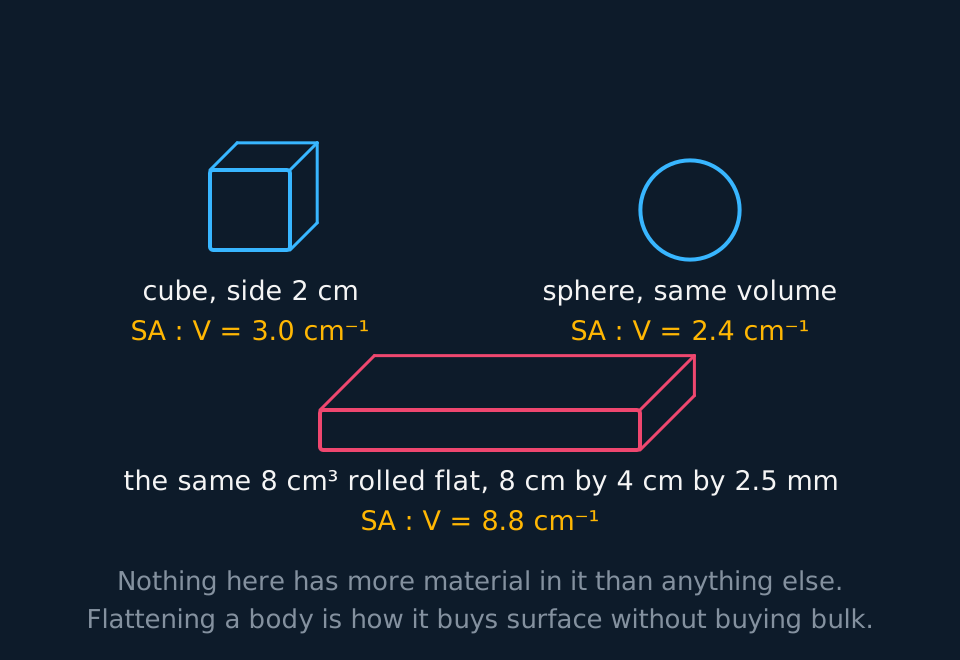
Shape changes the ratio as well as size. Volume can be held fixed while the ratio changes considerably, by flattening the body.
Describe the drawing
Three shapes each containing eight cubic centimetres: a cube of side two centimetres, a sphere of the same volume, and a thin sheet eight centimetres by four by two and a half millimetres. Each is labelled with its surface area to volume ratio, three per centimetre for the cube, two point four for the sphere and eight point eight for the sheet.
The sphere at 2.4 cm⁻¹ and the sheet at 8.8 cm⁻¹ contain identical amounts of material. What differs is how much of that material is close to the outside. This is why a tapeworm can be metres long and still manage without lungs, gills or blood: it is under a millimetre thick, so nothing inside it is ever far from its own outside. Its outer covering is not passive skin, though. The tegument is a specialised absorptive surface through which the worm takes up the host's digested food.
Working with the ratio
A cube-shaped organism has sides of 0.1 mm. A second organism of the same shape has sides of 1.0 mm. Calculate both ratios, and state how many times greater the demand per unit of surface is in the larger one.
Show the working
Work in the same units throughout. For the small one, surface = 6 × 0.1² = 0.06 mm² and volume = 0.1³ = 0.001 mm³, giving a ratio of 60 mm⁻¹. The shortcut 6 ÷ L gives the same answer in one step.
For the large one, 6 ÷ 1.0 = 6 mm⁻¹.
The ratio has fallen by a factor of ten, so each unit of surface is now supplying ten times as much tissue. The larger organism needs ten times the flux across every square millimetre of its surface to stay level, and there is no guarantee diffusion can supply it.
Give the unit. A ratio of surface to volume has units of one over length, so it is mm⁻¹ or cm⁻¹, and the value changes with the length unit used. A figure of 60 quoted without a unit does not identify the quantity.
Fick's law: three terms, three things to change
The rate at which anything crosses an exchange surface by diffusion depends on three quantities, and the relationship between them is usually named after Adolf Fick. At A-level it is used as a proportionality, not as an equation with a constant to substitute into.
rate of diffusion ∝ (surface area × difference in concentration) ÷ thickness of the surfaceThe first two multiply the rate. The third divides it, which is why a thin surface gives a faster rate of diffusion.
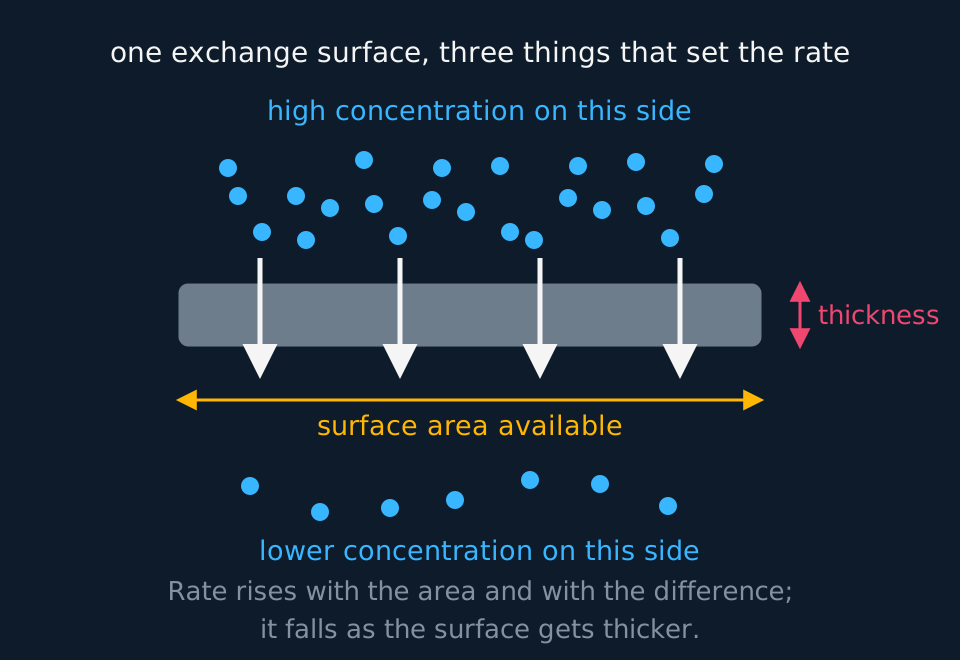
Each feature of an exchange surface corresponds to a term of the law. A large area means more molecules crossing per second. A large difference in concentration means a greater net flow across, which is why a surface that is not ventilated or not supplied with blood soon stops working: the gradient flattens as the substance accumulates on one side. A thin surface shortens the crossing.
- Diffusion
- The net movement of particles from a region of higher concentration to a region of lower concentration, down a concentration gradient, as a result of their random motion. It is passive and requires no metabolic energy.
- Exchange surface
- A surface across which substances move between an organism and its environment, or between two compartments within it.
- Diffusion distance
- The thickness of the barrier a substance has to cross, sometimes called the length of the diffusion pathway.
- Concentration gradient
- The difference in concentration between two points, divided by the distance between them.
One thing the law does not say is anything about time. It gives a rate, and a rate is only useful if the distance involved is short enough for that rate to matter. That is where the real limit on body size sits.
Why diffusion distance and surface area limit organism size
Diffusion does not proceed at a fixed speed over distance. A molecule moving randomly makes progress in proportion to the square root of the time it has been wandering, which means that the time it needs rises with the square of the distance. Ten times further takes a hundred times as long.
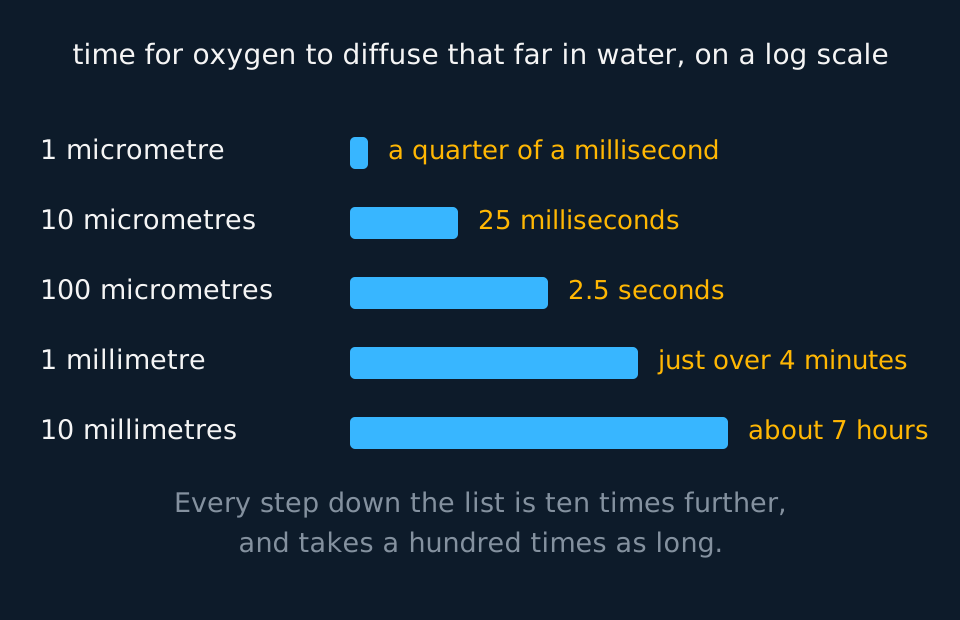
Those figures explain a lot at once. A bacterium 2 micrometres across is supplied throughout in under a millisecond. A human egg cell, around 120 micrometres, is at the far edge of what diffusion will serve, and it is one of the largest cells in the body. A block of tissue a centimetre thick could not be supplied by diffusion in any useful time at all, which is why every large organism has both a specialised exchange surface and a transport system to carry substances the rest of the way.
Small organisms escape all of this. An Amoeba or a Paramecium has a very high surface area to volume ratio and no part of its cytoplasm far from the outside, so oxygen diffuses in across the cell surface membrane fast enough to meet demand and carbon dioxide diffuses out the same way. No specialised exchange surface or transport system is needed; in an answer, state explicitly that the whole body surface acts as the exchange surface.
Flatworms use the other route. A planarian may be a centimetre long but is a fraction of a millimetre thick, so its flattened shape keeps every cell within diffusion distance of the outside while allowing the animal to be several millimetres across. Length is not limited by diffusion; thickness is.
Metabolic rate complicates the picture. A small mammal has a high ratio, so it loses heat quickly, so it has to respire faster per gram to stay warm, so its oxygen demand per gram is higher than an elephant's. The same high ratio that assists exchange also increases heat loss, which is why a shrew must feed almost constantly. This is the relationship behind data sets that pair body mass with breathing rate.
What every specialised exchange surface has in common
Once an organism is too large for its own outside to serve it, the answer is always the same in outline: grow a dedicated surface, make it enormous by folding it, keep it thin, and keep something moving on both sides of it so the gradient never flattens.
| Feature | Which term of Fick's law it serves | Example |
|---|---|---|
| Large surface area, usually by folding | Raises the area on top of the fraction | Alveoli, gill lamellae, root hairs, villi |
| A wall one cell thick | Cuts the thickness underneath the fraction | Squamous alveolar epithelium; a single layer on a gill lamella |
| A blood supply, or its equivalent | Removes the substance and holds the difference up | Alveolar capillary network; the capillary blood in each gill lamella |
| Ventilation, or another way of renewing the medium | Renews the supply on the outside and holds the difference up | Breathing; the buccal pump of a fish; abdominal pumping in insects |
| A permeable, usually moist surface | Lets the substance cross at all; gases dissolve before diffusing | The alveolar lining fluid; the moist walls of mesophyll cells |
Each adaptation should be linked to its effect. Stating that an alveolus is thin describes it; stating that an alveolus wall is one cell thick, so the diffusion pathway is short, so the rate of diffusion is higher, explains it.
The last row carries a cost. A surface thin enough and wet enough for oxygen to cross is also thin enough and wet enough for water to leave, which is why the gas exchange surface of a land animal is folded away inside the body rather than hung out in the air, and why a plant spends a good deal of its structure managing the same trade-off.
TRY IT: Predicting from the ratio
A spherical single-celled organism has a radius of 20 micrometres. A second species, also spherical, has a radius of 60 micrometres. Both rely on diffusion across the cell surface membrane. Using the ratio, explain which is more likely to be limited by oxygen supply, and suggest one change of shape that would help the larger one.
Check your answer
For a sphere the ratio is 3 ÷ radius. The small one gives 3 ÷ 20 = 0.15 per micrometre; the large one gives 3 ÷ 60 = 0.05 per micrometre, a third as much.
The larger species therefore has a third of the surface per unit of volume, while its oxygen demand goes with volume, so it is the one more likely to be limited by supply. Its centre is also three times further from the surface, and since diffusion time goes with the square of distance, oxygen takes about nine times as long to reach it.
Flattening or elongating the cell would raise the ratio without losing any volume, and would shorten the longest internal distance at the same time. A complete answer covers both the ratio and the internal diffusion distance.
In the exam
- Give the ratio with a unit and say what length unit you worked in. Surface area to volume ratio has units of one over length, and the number changes if you switch from millimetres to centimetres.
- Where a question fixes the volume and changes the shape, compare the ratios: a sphere has the lowest possible ratio, and flattening or folding raises it.
- Quote Fick's law with all three terms if the question is worth more than one mark. Area and difference in concentration multiply, thickness divides.
- For single-celled organisms, state both points: the whole body surface acts as the exchange surface, and the diffusion distance to any part of the cytoplasm is short.
- Explain the need for lungs from the ratio rather than from total demand: the ratio falls as size rises, so the surface can no longer supply the volume behind it.
Check yourself
A student claims that a large organism could avoid needing a gas exchange system by simply having a very large surface area. Evaluate this claim, using the ratio and the behaviour of diffusion over distance.
Answer
The claim is not wrong so much as incomplete. A large surface area on its own is no use; what matters is the surface area relative to the volume it has to supply, because demand rises with volume.
An organism can raise its ratio by changing shape, and flatworms and tapeworms do exactly that. So the strategy is genuinely available, and some large organisms use it.
It runs out for a second reason, though, which is distance. Even with plenty of surface, any cell buried deep inside is a long way from it, and diffusion time rises with the square of distance: a centimetre takes hours. So a body that stays thin can manage without an exchange system, and a body that is thick cannot, however large its surface is.
A complete answer therefore separates the two limits: the ratio limits how much can cross, and the diffusion distance limits how quickly it reaches the middle. Large active animals fail both tests, which is why they have a specialised exchange surface and a transport system to finish the delivery.
Questions
Question 14 marks
A cube-shaped organism has sides of 0.5 mm. A second organism of the same shape has sides of 2.0 mm. Calculate the surface area to volume ratio of each, giving a unit, and calculate how many times greater the smaller organism's ratio is.
Mark scheme
- M1 ratio is surface area divided by volume, which for a cube simplifies to 6 divided by the length of a side
- A1 smaller organism: 6 ÷ 0.5 = 12 mm⁻¹, with the unit given as one over length
- M1 larger organism: 6 ÷ 2.0, worked in the same length unit as the first
- A1 larger organism gives 3 mm⁻¹, so the smaller ratio is four times greater
Question 24 marks
A flatworm 0.3 mm thick supplies all of its cells with oxygen by diffusion across its body surface. A block of tissue one centimetre thick cannot. Explain the difference.
Mark scheme
- B1 surface area rises with the square of length while volume rises with the cube, so the surface area to volume ratio falls as an organism gets thicker
- B1 demand for oxygen goes with the volume of respiring tissue, so each unit of surface has more tissue to supply in the larger body
- B1 diffusion time rises with the square of the distance, so ten times further takes about a hundred times as long
- A1 over a centimetre diffusion would take hours and could never meet demand, whereas the flatworm's flattened shape keeps every cell a fraction of a millimetre from the outside
Question 34 marks
Diffusion of a substance over 10 micrometres takes about 5 milliseconds. Using the relationship that diffusion time rises with the square of distance, calculate the time diffusion would take over 100 micrometres, and calculate the time it would take over 1000 micrometres.
Mark scheme
- M1 increasing the distance by a factor of ten increases the time by a factor of ten squared, which is 100, since time rises with the square of distance
- A1 5 × 100 = 500 milliseconds, or 0.5 seconds, for 100 micrometres
- M1 increasing the distance from 100 to 1000 micrometres is another factor of ten, so the time increases by another factor of 100
- A1 500 × 100 = 50 000 milliseconds, or 50 seconds, for 1000 micrometres, one millimetre
Question 44 marks
A tapeworm can grow to several metres in length while remaining under a millimetre thick, and survives with no gas exchange system, gills or lungs. Explain how its shape allows this, and explain why its length is not limited by diffusion in the same way its thickness would be.
Mark scheme
- B1 the tapeworm's flattened, ribbon-like shape keeps every cell within a short diffusion distance of its outer surface, since the animal is thin however long it grows
- B1 diffusion distance depends on thickness rather than length, because oxygen crosses inwards from the surrounding surface rather than travelling the length of the worm
- B1 as long as the worm stays thin, adding length adds more surface and more volume in the same fixed ratio, so the surface area to volume ratio of a cross-section does not fall as the animal gets longer
- B1 growing thicker, by contrast, would increase the diffusion distance to the centre and reduce the surface area to volume ratio
Question 54 marks
A single sphere has a radius of 6 mm. Its total volume is divided equally among eight smaller spheres, each with a radius of 3 mm. Compare the total surface area of the eight small spheres with the surface area of the original single sphere, and compare their surface area to volume ratios.
Mark scheme
- M1 surface area of the original sphere = 4π × 6² = 144π mm², and its ratio = 3 ÷ 6 = 0.5 mm⁻¹
- M1 surface area of one small sphere = 4π × 3² = 36π mm², so the total surface area of the eight small spheres = 8 × 36π = 288π mm², twice that of the single original sphere
- A1 the ratio of each small sphere = 3 ÷ 3 = 1 mm⁻¹, also double the original sphere's ratio
- B1 dividing a fixed volume into many smaller units always raises the total surface area and the surface area to volume ratio, the same principle behind subdividing an exchange surface into alveoli or gill lamellae
Question 63 marks
A sphere and a flattened sheet contain identical volumes of tissue. The sphere has a surface area to volume ratio of 2.4 cm⁻¹ and the sheet one of 8.8 cm⁻¹. Compare the two shapes as exchange surfaces.
Mark scheme
- B1 the sheet's ratio is about 3.7 times the sphere's, even though the two contain the same volume of material
- B1 the sheet therefore has far more surface serving each unit of volume, while the sphere is the shape with the least surface possible for a given volume
- B1 the centre of the sphere is also much further from the nearest surface than any point in the sheet, so the diffusion distance is longer in the sphere as well
Question 73 marks
A hibernating dormouse curls its body into a tight ball. Suggest how this reduces the rate at which it loses heat to its surroundings.
Mark scheme
- B1 curling brings the body closer to a sphere, which is the shape with the smallest surface area for a given volume
- B1 the surface area to volume ratio is therefore lowered without any change in the volume of the animal
- A1 heat is lost across the body surface, so less surface per unit of body volume means a slower rate of heat loss
Question 83 marks
A shrew must eat almost constantly, and respires far faster per gram of body tissue than an elephant does. Explain why, using the surface area to volume ratio.
Mark scheme
- B1 a small mammal has a much higher surface area to volume ratio, because the ratio falls as size rises
- B1 heat is lost across the body surface, so each gram of a shrew has far more surface losing heat for it than each gram of an elephant
- B1 to stay warm the shrew must release heat faster per gram, so it must respire faster per gram, which raises its oxygen and food demand per gram
Question 93 marks
Describe three features shared by specialised exchange surfaces, pairing each with the term of Fick's law it serves.
Mark scheme
- B1 a large surface area, usually made by folding, as in alveoli or gill lamellae, which raises the area term on top of the fraction
- B1 a wall one cell thick, which cuts the thickness of the surface underneath the fraction
- B1 a blood supply, ventilation or another way of renewing the medium on each side, which carries the substance away or renews it and so holds up the difference in concentration
Question 103 marks
The time a substance takes to diffuse across a barrier rises with the square of the barrier's thickness. In pulmonary fibrosis, scar tissue thickens the barrier between the air in the alveoli and the blood. Calculate the factor by which the diffusion time for oxygen increases if the barrier becomes three times as thick, and suggest why this lowers the concentration of oxygen in the blood leaving the lungs.
Mark scheme
- M1 diffusion time is proportional to thickness squared, so the factor is 32
- A1 the diffusion time becomes 9 times as long
- B1 blood spends only a short time passing through an alveolar capillary, so with slower diffusion less oxygen crosses into it before it leaves the lung
Question 113 marks
Explain why an Amoeba, a single-celled organism, needs no specialised exchange surface and no transport system, referring to its surface area to volume ratio and to the distance oxygen must diffuse.
Mark scheme
- B1 an Amoeba is very small, so it has a high surface area to volume ratio, meaning a large area of cell surface membrane serves a small volume of cytoplasm
- B1 no part of its cytoplasm is far from the cell surface membrane, so the diffusion distance from outside to any point inside is short
- B1 the whole cell surface membrane acts as the exchange surface, so oxygen entering and carbon dioxide leaving by diffusion across it are fast enough to meet the cell's demand
Question 123 marks
A land animal's gas exchange surface must be both thin and moist to allow gases to diffuse across it. Suggest why this requirement creates a problem for a land animal that a water-dwelling animal does not face, and suggest how a mammal's lungs help to solve it.
Mark scheme
- B1 a surface thin and moist enough for gases to cross easily is also thin and moist enough for water vapour to diffuse out readily, a much greater risk in air than in water, where the surrounding medium is already saturated
- B1 a water-dwelling animal's gas exchange surface is surrounded by water, so it faces no equivalent drying risk
- B1 a mammal's lungs are folded away inside the body, in a cavity that stays warm and humid, rather than being exposed directly to the drying effect of the outside air, which limits water loss from the moist exchange surface
Question 133 marks
Explain why an exchange surface across which a gas is exchanged must be kept moist, referring to how a gas actually crosses a cell membrane.
Mark scheme
- B1 a gas must first dissolve in the thin film of moisture covering the exchange surface before it can diffuse across the cell membrane
- B1 a dry surface would not allow this dissolving step to happen, so the gas could not cross even if the surface were thin and well supplied with blood
- B1 this is why the alveolar lining, the moist walls of a leaf's mesophyll cells, and the surface of a gill lamella are all kept wet
Question 142 marks
State the relationship known as Fick's law, naming all three of the quantities on which the rate of diffusion across a surface depends.
Mark scheme
- B1 rate of diffusion is proportional to the surface area multiplied by the difference in concentration
- B1 and inversely proportional to the thickness of the surface, so a thinner barrier gives a faster rate
Question 152 marks
A spherical cell has a radius of 30 µm. Calculate its surface area to volume ratio, giving a unit.
Mark scheme
- M1 for a sphere the ratio is 3 ÷ radius, so 3 ÷ 30
- A1 0.1 µm⁻¹, and the unit is one over length because the ratio divides an area by a volume
Worth remembering
- Surface grows as the square of length and volume as the cube, so the ratio falls as size rises: 6 ÷ side for a cube, 3 ÷ radius for a sphere.
- Shape changes the ratio at fixed volume. A sphere is the worst case; a sheet is much better.
- Rate of diffusion goes up with area and with the difference in concentration, and down with the thickness of the surface.
- Diffusion time rises with the square of the distance, so it is excellent over micrometres and hopeless over millimetres.
- Every specialised exchange surface is large, thin, permeable, and kept supplied on both sides so the gradient does not flatten.
CHECK YOUR PROGRESS
Rate how confident you are with each objective for this lesson. Ratings are saved in this browser, on this device, unless you sign in.
- Calculate a surface area to volume ratio for a cube, a sphere and a flattened body, and say what happens to it as the body gets bigger.
- Explain why shape changes the ratio even when the volume is fixed.
- State Fick's law as a proportionality and use it to predict how a change in area, gradient or thickness changes the rate.
- Explain why diffusion works over micrometres and fails over millimetres.
- List the features shared by specialised exchange surfaces and account for each one in terms of Fick's law.
Open the full revision checklist to see every objective in the curriculum in one place.
Practise this lesson
WORKBOOK
The questions from this topic, on paper with room to work, and a separate book of mark schemes. Free to use; please do not redistribute or sell.
Used later in Diffusion and osmosis · Gas exchange in insects, fish and plants · The heart and cardiac cycle