Biology › Ecology, populations and environmental change › Nutrient cycles: nitrogen, phosphorus and eutrophication
Nutrient cycles: nitrogen, phosphorus and eutrophication
Energy passes through an ecosystem once and leaves as heat, while atoms cycle between living and non-living stores. Four bacterial processes move nitrogen between the atmosphere, the soil and organisms. The phosphorus cycle, fertiliser use, leaching and eutrophication are covered alongside them.
Before this Protein structure and function: the amino acid · DNA and RNA structure: nucleotides · Aerobic respiration and the electron transport chain · Gross and net primary productivity
COMMON MISCONCEPTION
Eutrophication kills fish because the algae are toxic.
During eutrophication, increased nutrients can produce an algal bloom. When algae and other plants die, decomposers respire aerobically and lower the dissolved-oxygen concentration. Fish and other aerobic organisms may then die from oxygen shortage.
What you should be able to do
- Explain why plants cannot use nitrogen gas and must take up nitrate, or some ammonium, instead.
- Name the four bacterial processes of the nitrogen cycle and state what each converts into what.
- Say which of the four need oxygen and which needs its absence, and use that to explain a farming practice.
- Describe the phosphorus cycle and explain why it has no gaseous stage.
- Set out eutrophication as a sequence of consequences and identify the step that actually removes the oxygen.
- Calculate the nitrogen applied to a field from the mass of fertiliser, and estimate what leaches from it.
Why nitrogen limits growth
Nitrogen is in every amino acid, so it is in every protein and every enzyme; in every nucleotide, so it is in DNA, RNA, ATP, NAD and NADP; and in the ring at the centre of chlorophyll. A plant short of nitrogen shows it as stunted growth and yellowing older leaves.
Nitrogen is also the commonest gas in the air, at about 78 per cent, and it is unavailable to plants and animals: the two atoms in N2 are held by a triple bond that requires a great deal of energy to break, and neither plants nor animals have the enzyme to do it. A plant therefore takes its nitrogen from the soil, as nitrate ions absorbed by active transport into the root hairs, and to a lesser extent as ammonium. Four groups of microorganisms carry out the conversions that keep nitrate available in the soil.
Processes in the nitrogen cycle
Nitrogen fixation and nitrification are distinct processes with similar names. Fixation starts with nitrogen gas; nitrification starts with ammonium already dissolved in the soil.
Describe the drawing
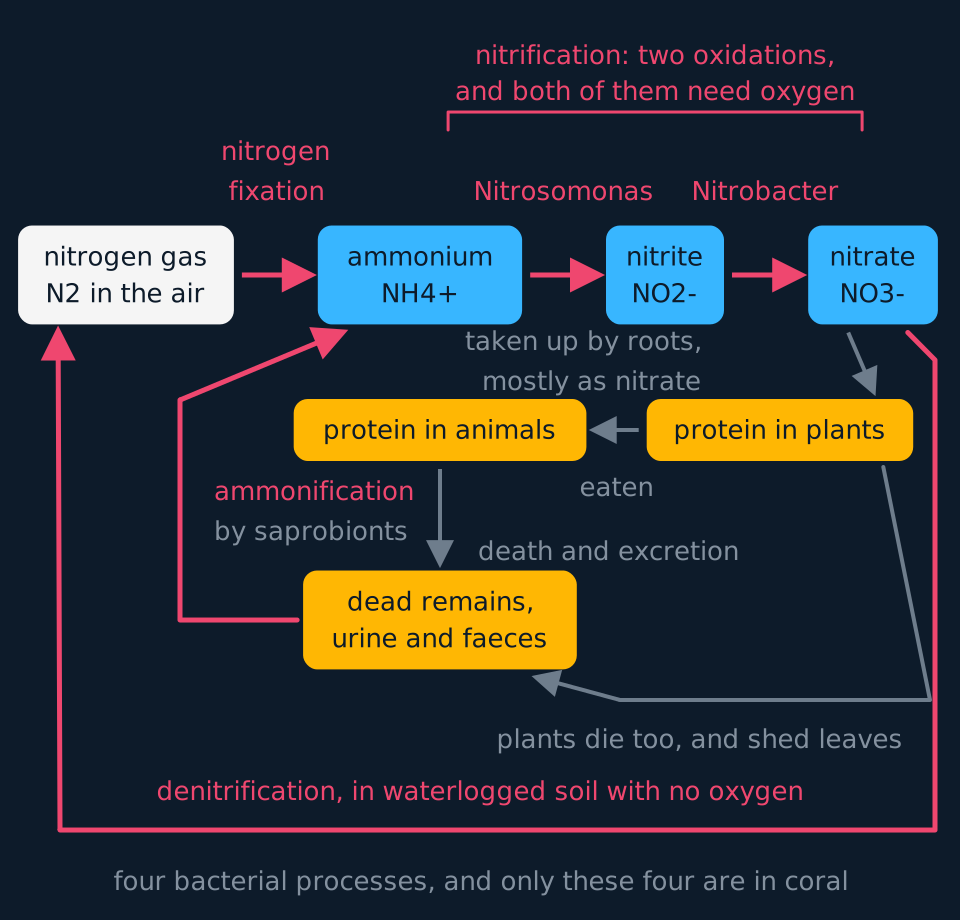
The nitrogen cycle laid out as a horizontal ladder instead of a ring. Along the top, four boxes: nitrogen gas in the air, reduced to ammonium ions, then oxidised to nitrite, then nitrate, joined by arrows. The first arrow is labelled nitrogen fixation; the second and third are the two oxidation steps of nitrification, bracketed together and named with the bacteria that carry them out. Below the ladder, nitrate is taken into plant protein, passed to animals by eating and passed on again to dead remains and waste, from which ammonification returns it to the ammonium box. A long arrow round the bottom returns nitrate to the air as denitrification. The four bacterial processes are the only labels drawn in the same warm colour.
Nitrogen fixation. Nitrogen gas is reduced to ammonia, which picks up a hydrogen ion in the soil to become ammonium. The enzyme, nitrogenase, is highly oxygen-sensitive, and nitrogen-fixing organisms use several mechanisms to protect it, which determines where fixation occurs. Rhizobium lives inside nodules on the roots of legumes such as peas, beans and clover, in a mutualistic relationship: the plant supplies carbohydrate and a protein, leghaemoglobin, that mops up oxygen, and the bacterium supplies fixed nitrogen. Free-living fixers include Azotobacter in soil and cyanobacteria in water and flooded rice fields. Lightning fixes a little, and the Haber process fixes an industrial quantity.
Ammonification. Saprobiotic bacteria and fungi break down the nitrogen-containing compounds in dead organisms, faeces and urine, releasing ammonium into the soil: proteins are hydrolysed to amino acids and deaminated, urea is hydrolysed by urease. Nothing here comes from the air. Ammonification returns nitrogen that was already in the ecosystem.
Nitrification. Two oxidations, one after the other, carried out by two different genera. Nitrosomonas oxidises ammonium to nitrite; Nitrobacter oxidises nitrite to nitrate. Both are chemoautotrophs, using the energy released by these oxidations to fix carbon dioxide, and both need oxygen, because oxygen is what they are oxidising with. Nitrification is the process that produces the ion plants actually take up in quantity.
Denitrification. In soil with no oxygen in it, certain bacteria such as Pseudomonas respire using nitrate as the final electron acceptor in place of oxygen. The nitrogen ends up as nitrogen gas and leaves the soil. This is the only one of the four that returns nitrogen to the atmosphere, and the only one that requires oxygen to be absent. It is not the only way nitrogen leaves an ecosystem, though: leaching and the removal of crops carry it out too, as the fertiliser section below shows.
| Process | Starts with | Ends with | Carried out by | Oxygen |
|---|---|---|---|---|
| Nitrogen fixation | Nitrogen gas from the air | Ammonium | Rhizobium in root nodules; free-living Azotobacter; cyanobacteria | Nitrogenase is highly oxygen-sensitive, so fixers protect it, for example with leghaemoglobin in root nodules or thick-walled heterocysts in cyanobacteria |
| Ammonification | Protein, urea and other nitrogen compounds in dead matter and waste | Ammonium | Saprobiotic bacteria and fungi | Faster when aerobic |
| Nitrification | Ammonium, then nitrite | Nitrite, then nitrate | Nitrosomonas, then Nitrobacter | Required: these are oxidations |
| Denitrification | Nitrate | Nitrogen gas | Denitrifying bacteria such as Pseudomonas | Required to be absent: nitrate is used instead of oxygen |
Three points separate the terms. Fixation combines nitrogen from the air with hydrogen, and it is the only route from the atmosphere into the soil. Nitrification starts and finishes with ions already in the soil, ammonium and nitrate. De-nitrification is the only route back to the atmosphere.
Oxygen accounts for two agricultural practices and fixation for a third. Ploughing and draining keep the soil aerated, favouring nitrification and suppressing denitrification, so nitrate builds up; compacted or waterlogged soil does the reverse and loses nitrogen as gas; and planting clover or beans in a rotation brings Rhizobium with them, adding fixed nitrogen without a bag of fertiliser.
TRY IT: Reading a soil experiment
A soil sample is divided into three. Sample A is left well-drained and aerated. Sample B is flooded and sealed so that no oxygen can reach it. Sample C is heated to 120 °C for twenty minutes and then cooled. Ammonium sulfate solution is added to all three and the nitrate concentration is measured over two weeks. Nitrate rises steadily in A, falls to nearly zero in B and does not change in C. Explain all three results.
Check your answer
In A the soil is aerated, so Nitrosomonas and Nitrobacter can carry out nitrification: the added ammonium is oxidised to nitrite and then to nitrate, and the nitrate concentration rises. Both steps are oxidations and both need oxygen, which is available.
In B there is no oxygen, so nitrification cannot proceed and no nitrate is made from the added ammonium. Any nitrate already present is used by denitrifying bacteria as an alternative electron acceptor in respiration, so it is reduced to nitrogen gas and the concentration falls towards zero.
In C the heating has killed the bacteria, and nitrification is a biological process, so nothing oxidises the ammonium and the nitrate concentration does not change. Sample C is the control: it shows that the changes in A and B were caused by organisms rather than by chemical reactions in the soil. State the purpose of the sterile sample explicitly.
The decomposers, and the fungi that trade with roots
Ammonification is done by saprobionts: organisms that feed on dead material by secreting enzymes onto it, digesting it outside themselves and absorbing the products. That extracellular digestion produces a zone of softened tissue around the hyphae in a rotting log. Without it, the nitrogen in dead organisms would not be returned to the soil.
Mycorrhizae are a separate association. A mycorrhiza is a mutualistic association between a fungus and a plant root: the fungal hyphae are far finer than root hairs and spread through a much larger volume of soil, greatly increasing the surface area available for absorbing water and mineral ions, and phosphate especially, which moves through soil very slowly. In return the fungus receives organic compounds the plant has made by photosynthesis. Mycorrhizae are named explicitly in AQA 7402's nutrient cycles content, and a plant with them typically takes up phosphate several times faster than one without.
- Saprobiont
- An organism that obtains its energy from dead material by secreting enzymes onto it and absorbing the soluble products.
- Mycorrhiza
- A mutualistic association between a fungus and a plant root, in which the fungus increases the surface area for absorbing water and mineral ions and receives organic compounds in return.
Phosphorus: the cycle with no gas in it
Phosphorus is in the phosphate groups of ATP, in the backbone of DNA and RNA, and in every phospholipid in every membrane. Plants take it up as phosphate ions from the soil solution, and animals get it by eating plants.
Describe the drawing
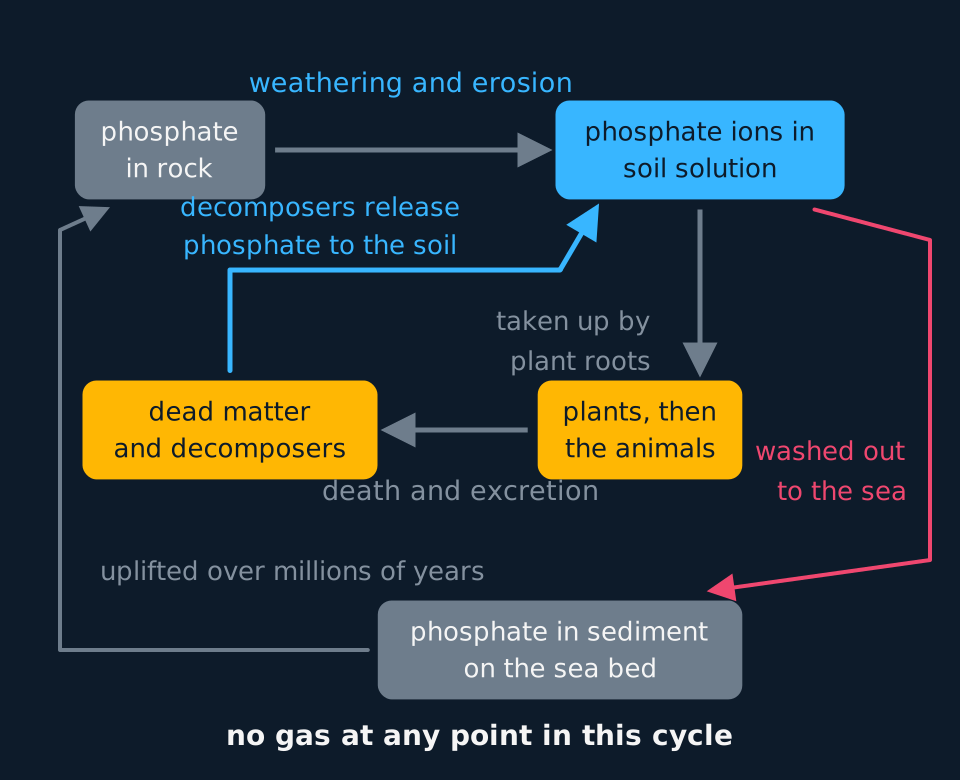
The phosphorus cycle drawn as a loop of four stores with a fifth hanging below it. Phosphate in rock is weathered into phosphate ions in the soil solution; those are taken up by plant roots and passed into animals; death and excretion move the phosphate into dead matter, where decomposers release it back to the soil. A separate pair of arrows leaves the loop: phosphate washed out to sea settles as sediment, and returns to rock only through geological uplift over millions of years. A note in the middle points out that no step in the cycle passes through a gas.
The structural difference from nitrogen is that no stage of the phosphorus cycle is gaseous. Phosphate has no volatile form under ordinary conditions, so the atmosphere plays no part, and the reservoir is rock rather than air. Phosphate is released from rock by weathering, dissolves in the soil solution, is taken into plants, passes into animals, and is returned to the soil by decomposers acting on dead material, urine and faeces.
Two consequences follow. The cycle is slow: the geological return, from sediment on the sea bed back to rock through uplift, takes millions of years, so phosphate washed into the ocean is lost from the land on any human timescale, and rock phosphate mined for fertiliser is a finite deposit. And phosphate is often the limiting nutrient in fresh water and on old, heavily weathered soils, precisely because there is no atmospheric source to top it up.
Bacteria matter here too, in one role rather than four: they decompose organic phosphorus compounds and release phosphate back into the soil. Mycorrhizal fungi then do much of the work of getting it into roots.
Exam-board note. AQA 7402 names the phosphorus cycle and requires the role of microorganisms in it. OCR Biology A H420 covers recycling through carbon and nitrogen. Cambridge International 9700 covers ecosystems, niche and the measurement of biodiversity.
Fertiliser loss and eutrophication
Every harvest removes nitrogen and phosphorus from a field in the crop. In an unharvested ecosystem the dead plant material decomposes in place and the nutrients return to the soil; in agriculture they are removed with the crop and must be replaced.
Natural fertilisers such as manure, slurry, compost and sewage sludge are organic matter, so their nitrogen is locked in protein and must be ammonified and then nitrified before a plant can use it. It becomes available slowly, over weeks, and the organic matter improves soil structure. The drawbacks are bulk and unknown composition. Artificial fertilisers are inorganic salts of known composition, whose nitrate is immediately available to the crop and equally available to be washed out of the soil by rain before the crop takes it up.
Leaching is what follows. Nitrate ions are very soluble and carry a negative charge, and clay particles and humus in soil also carry a net negative charge, so nitrate is not held and washes down through the soil with the rain into groundwater and streams. Ammonium, being positive, is held far more strongly, which is one reason it leaches less. Phosphate is much less soluble and travels mainly attached to eroded soil particles rather than in solution, so it reaches watercourses mostly when bare soil is washed off a field.
How much nitrogen, and how much of it leaves
A farmer spreads ammonium nitrate, NH4NO3, at 250 kg per hectare over a 12-hectare field. Take the relative formula mass of ammonium nitrate as 80 and the relative atomic mass of nitrogen as 14. Calculate the mass of nitrogen applied. If 30 per cent of it is leached into a stream that carries 5.0 × 10⁷ litres of water over the same period, calculate the concentration of nitrogen in the stream in milligrams per litre.
Show the working
First the percentage of nitrogen in the fertiliser. There are two nitrogen atoms in NH4NO3, so 2 × 14 = 28 out of 80, which is 28 ÷ 80 = 0.35, or 35 per cent.
Nitrogen applied per hectare is 250 × 0.35 = 87.5 kg, and over 12 hectares that is 87.5 × 12 = 1 050 kg of nitrogen.
Thirty per cent of that is leached: 1 050 × 0.30 = 315 kg, which is 315 000 g, or 3.15 × 10⁸ mg.
Divide by the volume: 3.15 × 10⁸ ÷ 5.0 × 107 = 6.3 mg of nitrogen per litre. Expressed as nitrate rather than as nitrogen this is 6.3 × (62 ÷ 14) = 28 mg of nitrate per litre, since the relative formula mass of the nitrate ion is 62.
Interpret the figure against two standards. It is below the 50 mg of nitrate per litre limit for drinking water set in the UK by the Water Supply (Water Quality) Regulations. It is also more than twenty times the concentration of an unpolluted upland stream, and sufficient to relieve the nitrate limitation on algal growth. A concentration can meet a drinking-water standard and still cause eutrophication.
Watch the units. Nitrate is quoted either as milligrams of nitrate per litre or as milligrams of nitrogen per litre, and the two differ by a factor of 4.4.
Eutrophication as a sequence
Eutrophication is nutrient enrichment of a body of water. It occurs naturally over centuries as lakes accumulate sediment; fertiliser runoff and treated sewage can produce the same enrichment within a season. The sequence below runs in order, and the oxygen is removed at step five.

Describe the drawing
Six stages of eutrophication animated over the same stretch of river. First, granules of fertiliser are spread on the bank while the water is clear, rooted plants stand on the bed, fish swim, and a bar at the top showing dissolved oxygen is full. Arrows then carry the fertiliser down through the soil into the water. A dense layer of algae spreads across the surface, and the oxygen bar has not moved. The rooted plants below the mat lose their light and die back to stumps. A swarm of bacteria fills the water as the dead material is decomposed, and the oxygen bar drops by half. In the last stage the swarm is denser still, the bar is empty and the fish are floating upside down.
One. Nitrate leaches off the land into the water, or phosphate arrives with eroded soil and treated sewage. In fresh water the nutrient in shortest supply is usually phosphate; in estuaries and coastal water it is usually nitrogen. Either way, the factor limiting the algae has just been relieved.
Two. Algae and cyanobacteria at the surface multiply rapidly in an algal bloom, because they already had light, carbon dioxide and warmth and now have the nutrient too.
Three. The bloom forms a dense mat and blocks the light. Submerged rooted plants and deeper algae are shaded, so photosynthesis falls below respiration and they die.
Four. Those dead plants, and the bloom itself once it exhausts the nutrient and dies back, are a vast supply of dead organic matter. Saprobiotic bacteria feed on it and their population grows enormously.
Five. Those bacteria respire aerobically, and this is the step at which oxygen is removed: they take dissolved oxygen out of the water faster than it can dissolve back in from the air, so the biochemical oxygen demand rises sharply and the dissolved oxygen concentration falls.
Six. Fish and invertebrates needing well-oxygenated water suffocate. Trout and the nymphs of mayflies and stoneflies go first; tolerant bloodworms and Tubifex worms survive and may become abundant, which is why stream invertebrates are used as indicator species. If the oxygen falls far enough, anaerobic bacteria take over and the water smells of hydrogen sulfide.
Two refinements follow. The algae themselves photosynthesise and release oxygen by day but only respire at night, so a living bloom makes the oxygen rise and fall between day and night; the large, sustained fall comes once the bloom dies and bacteria decompose it. And a mass mortality of fish is usually reported as sudden, because dissolved oxygen can fall past a lethal threshold within hours after weeks of change that is not visible at the surface.
The remedies follow the chain rather than the symptom: buffer strips of uncultivated land between field and watercourse; fertiliser applied in spring onto a growing crop rather than in autumn onto bare soil; soil tested first so that only what the crop needs is applied; and phosphate stripped at sewage works, since phosphate is usually the limiting nutrient in fresh water.
In the exam
- Use 'nitrogen fixation' for the conversion of nitrogen gas. Fixation is the only process that starts in the atmosphere, and denitrification is the only one that ends there.
- Name the organism where it is known: Rhizobium, Nitrosomonas, Nitrobacter, saprobiotic bacteria and fungi. Specifications differ on whether the genus is required.
- Answer a question about waterlogged, compacted or ploughed soil through oxygen availability: nitrification requires it, denitrification requires its absence.
- In eutrophication, name the decomposing bacteria as the organisms whose aerobic respiration removes the dissolved oxygen. The algae photosynthesise and release oxygen by day.
- State what is blocked and what dies as a result: light blocked by the surface mat, submerged plants die, bacteria decompose them. Give each as a separate step.
- State both parts: plants absorb nitrogen as nitrate, by active transport.
- Give the absence of a gaseous stage as the difference between the phosphorus cycle and the nitrogen cycle, and the slow turnover of the rock reservoir as the further point.
Check yourself
A river is sampled at four points below a farm. Point 1 is upstream of the farm; point 2 is immediately below a field drain; point 3 is two kilometres downstream; point 4 is ten kilometres downstream. Nitrate concentration is 2, 34, 30 and 11 mg per litre at the four points, and dissolved oxygen is 9.8, 9.4, 3.1 and 7.6 mg per litre. Explain the two patterns and explain why the lowest oxygen is not found at the point with the most nitrate.
Answer
Nitrate is low upstream because the water has not yet passed the farm. It rises sharply at point 2 because nitrate has leached from the fertilised field, since nitrate ions are very soluble and are not held by negatively charged soil particles, so rain washes them through into the drain. It falls downstream as the river is diluted and as algae and plants absorb it.
Dissolved oxygen is barely affected at point 2 although the nitrate is at its highest there. Nitrate does not consume oxygen, and nor do the algae, which photosynthesise and release it. No oxygen-consuming step has yet occurred.
By point 3 the enriched water has had time for the sequence to run. The algal bloom that the nitrate allowed has multiplied, matted over the surface and blocked light from the plants below, which have died; the bloom itself has begun to die back. Saprobiotic bacteria are decomposing all of that dead material and have multiplied enormously, and their aerobic respiration is taking dissolved oxygen out of the water faster than it can dissolve in. Hence the minimum at 3.1 mg per litre.
By point 4 most of the dead material has been decomposed, the bacterial population has fallen back and the oxygen demand with it, so oxygen dissolves in again from the air and the concentration recovers. Each step in the sequence takes time, so the oxygen minimum appears downstream of the point at which the nutrient entered, and the source of the enrichment can be some kilometres above the affected reach.
Questions
Question 15 marks
Describe the sequence of events by which nitrate leaching from a fertilised field leads to the death of fish in a lake.
Mark scheme
- B1 nitrate ions are very soluble and are not held by the negatively charged clay and humus particles, so rain washes them down through the soil into the water, relieving the shortage of the nutrient that was limiting the algae
- B1 algae and cyanobacteria at the surface multiply rapidly to form an algal bloom, because they already had light, carbon dioxide and warmth and now have the nutrient too
- B1 the bloom forms a dense mat that blocks the light, so submerged rooted plants and deeper algae photosynthesise below the rate at which they respire, and die
- B1 those dead plants, and the bloom itself once it exhausts the nutrient and dies back, are a vast supply of dead organic matter on which saprobiotic bacteria feed, so the bacterial population grows enormously
- B1 those bacteria respire aerobically and take dissolved oxygen out of the water faster than it can dissolve back in from the air, so the dissolved oxygen concentration falls and fish and invertebrates needing well-oxygenated water suffocate
Question 25 marks
A campaign calls for artificial nitrogen fertiliser to be banned within one kilometre of any river, in order to stop eutrophication. Evaluate this proposal.
Mark scheme
- B1 for: artificial nitrate is available for uptake immediately after spreading, so it is also immediately available to be washed out by rain before a crop takes it up, and restricting its use near a river removes this readily leached source close to the water
- B1 for: buffer strips of unfertilised, uncultivated land between a field and a watercourse already reduce how much nitrate reaches the water, so restricting fertiliser near rivers follows an already established remedy
- B1 against: natural fertilisers such as manure and slurry, and treated sewage, also add nitrogen and phosphate to water and would not be covered by a ban on artificial fertiliser, so a major source of enrichment near the river could remain unaffected
- B1 against: in fresh water phosphate is usually the nutrient in shortest supply and so the one limiting algal growth, and phosphate reaches water mainly attached to eroded soil rather than dissolved in it, so a ban aimed at nitrogen leaves the main route of the limiting nutrient largely open
- B1 judgement: a ban restricted to artificial nitrogen fertiliser addresses only one source of one nutrient, and would need to be combined with control of manure, sewage and soil erosion to make eutrophication significantly less likely rather than simply moving its source
Question 34 marks
Compare nitrogen fixation with nitrification, referring to what each starts with, what each produces, the organisms responsible and the part oxygen plays.
Mark scheme
- B1 fixation starts with nitrogen gas from the atmosphere, whereas nitrification starts with ammonium already present in the soil, so only fixation brings nitrogen into the ecosystem
- B1 fixation reduces nitrogen gas to ammonia, which takes up a hydrogen ion to become ammonium, whereas nitrification oxidises ammonium to nitrite and then nitrite to nitrate
- B1 fixation is carried out by nitrogen-fixing bacteria, some free-living in the soil and some in the root nodules of legumes, whereas nitrification is carried out by nitrifying bacteria, one kind oxidising ammonium and another oxidising nitrite; genus names such as Rhizobium or Nitrosomonas are not required
- B1 nitrogenase is destroyed by oxygen, so fixation happens where oxygen is kept away and leghaemoglobin mops it up inside a nodule, whereas nitrification requires oxygen because both of its steps are oxidations
Question 44 marks
Explain why a well-drained, ploughed soil holds more nitrate than a compacted, waterlogged one.
Mark scheme
- B1 ploughing and draining keep air in the spaces between the soil particles, so oxygen is available
- B1 nitrification is carried out by Nitrosomonas and Nitrobacter and both of its steps are oxidations requiring oxygen, so ammonium is oxidised through nitrite to nitrate and nitrate accumulates
- B1 in a compacted or waterlogged soil the spaces are filled with water and oxygen is absent, so nitrification stops and no further nitrate is produced
- B1 denitrifying bacteria such as Pseudomonas then respire using nitrate as the final electron acceptor in place of oxygen, converting it to nitrogen gas that leaves the soil, so the nitrate already there is lost as well
Question 54 marks
A 25-hectare field receives ammonium nitrate, NH4NO3, at 200 kg per hectare; take its relative formula mass as 80 and the relative atomic mass of nitrogen as 14. Over the following months a stream draining the field carries 8.0 × 10⁷ litres of water, and its nitrogen concentration is on average 5.6 mg per litre higher than upstream of the field. Calculate the mass of nitrogen applied and calculate what percentage of it reached the stream.
Mark scheme
- M1 there are two nitrogen atoms in NH4NO3, so nitrogen is 2 × 14 = 28 of the relative formula mass of 80, which is 28 ÷ 80 = 0.35, or 35 per cent by mass
- A1 nitrogen applied = 200 × 0.35 = 70 kg per hectare, and over 25 hectares that is 1750 kg
- M1 nitrogen carried by the stream = 5.6 × 8.0 × 107 = 4.48 × 10⁸ mg, which is 448 kg
- A1 448 ÷ 1750 = 0.256, so about 26 per cent of the nitrogen applied reached the stream
Question 64 marks
Describe how ammonification returns nitrogen to the soil as ammonium, naming the organisms responsible and what they act on.
Mark scheme
- B1 saprobiotic bacteria and fungi carry out ammonification, feeding on the nitrogen-containing compounds in dead organisms, faeces and urine
- B1 proteins in that dead material are hydrolysed to amino acids, which are then deaminated, releasing ammonium
- B1 urea is hydrolysed by the enzyme urease, also releasing ammonium into the soil
- B1 unlike nitrogen fixation, none of the nitrogen ammonification releases has come from the atmosphere; it was already present in the ecosystem, in the bodies and waste of organisms
Question 74 marks
Outline the pathway phosphorus follows through an ecosystem, from the rock in which it starts to its return to the soil.
Mark scheme
- B1 phosphate is released from rock by weathering and dissolves into the soil solution
- B1 plants take up phosphate ions from the soil solution, largely with the help of mycorrhizal fungi associated with their roots
- B1 phosphorus then passes along food chains as animals eat plants and other animals
- B1 decomposers acting on dead organisms, urine and faeces return phosphate to the soil, and at no stage does it pass through a gaseous form
Question 84 marks
Compare a natural fertiliser such as manure with an artificial fertiliser, referring to the chemical form of the nitrogen each supplies, how quickly that nitrogen becomes available to a crop, and how readily it is lost by leaching.
Mark scheme
- B1 a natural fertiliser holds its nitrogen locked in organic compounds such as protein, whereas an artificial fertiliser supplies nitrogen already as an inorganic salt such as nitrate
- B1 the nitrogen in a natural fertiliser must first be ammonified and then nitrified before a plant can absorb it, so it becomes available slowly over weeks, whereas the nitrate in an artificial fertiliser is available to the crop immediately
- B1 because artificial nitrate is available immediately it can also be washed out of the soil by rain before the crop has taken it up, whereas the slow release of a natural fertiliser matches uptake more closely and so is lost less readily
- B1 a natural fertiliser also adds organic matter that improves soil structure, which an artificial fertiliser, being purely inorganic salts, does not
Question 93 marks
Phosphate is usually the nutrient in shortest supply in fresh water, and the phosphorus cycle has no gaseous stage. Suggest why stripping phosphate from effluent at a sewage works reduces algal blooms in the river below it, and suggest why phosphate carried out to sea is not replaced on any useful timescale.
Mark scheme
- B1 the algae are limited by whichever nutrient is in shortest supply, so removing phosphate leaves that shortage in place and the bloom cannot develop even where other nutrients are plentiful
- B1 sewage effluent is a continuous point source of phosphate, so treating it at the works removes the input rather than treating the symptom, and one works serves a whole town
- B1 phosphate has no volatile form, so there is no atmospheric route back to the land; the return from sea-bed sediment to rock by uplift and weathering takes millions of years, so on any human timescale the phosphate is lost
Question 103 marks
Explain why nitrogen gas, which makes up about 78 per cent of the air, cannot be used directly by a plant, and explain which ion a plant absorbs instead.
Mark scheme
- B1 the two nitrogen atoms in N2 are joined by a triple bond that needs a great deal of energy to break, and neither plants nor animals possess an enzyme able to break it
- B1 nitrogen is needed to build amino acids and hence proteins and enzymes, nucleotides and hence DNA, RNA and ATP, and chlorophyll, so a plant cannot avoid needing a usable source of it
- B1 a plant absorbs nitrogen mainly as nitrate ions, taken up into the root hairs by active transport, with a smaller amount taken up as ammonium
Question 113 marks
Explain how a mycorrhizal association benefits both the fungus and the plant it is attached to.
Mark scheme
- B1 fungal hyphae are far finer than root hairs and spread through a much larger volume of soil, greatly increasing the surface area available for absorbing water and mineral ions such as phosphate, which moves through soil very slowly
- B1 the plant therefore takes up phosphate faster with the fungus present than it could using its root hairs alone
- B1 in return the fungus receives organic compounds that the plant has made by photosynthesis, which the fungus, lacking chlorophyll, cannot make for itself
Question 123 marks
Explain why nitrate is washed out of soil by rain far more readily than ammonium or phosphate are.
Mark scheme
- B1 nitrate ions carry a negative charge, and clay and humus particles in soil also carry a net negative charge, so the two repel and nitrate is not held onto them
- B1 ammonium ions carry a positive charge, so they are attracted to and held by the negatively charged soil particles instead of moving freely with the water
- B1 phosphate is much less soluble than nitrate, so it stays largely bound to soil particles rather than dissolving into the water draining through the soil
Question 133 marks
State two roles nitrogen plays in a living organism, and state one visible symptom of nitrogen deficiency in a plant.
Mark scheme
- B1 nitrogen is needed to build amino acids, and hence proteins and enzymes
- B1 nitrogen is needed to build nucleotides, and hence DNA, RNA and ATP, and to build chlorophyll
- B1 a nitrogen-deficient plant shows stunted growth and yellowing of its older leaves
Question 142 marks
Name the genus of bacteria that oxidises ammonium to nitrite, and name the genus that oxidises nitrite to nitrate.
Mark scheme
- B1 Nitrosomonas oxidises ammonium to nitrite
- B1 Nitrobacter oxidises nitrite to nitrate
Question 152 marks
Name the genus of bacteria that fixes nitrogen inside root nodules on the roots of legumes such as peas and beans, and name the protein that protects its enzyme from oxygen inside the nodule.
Mark scheme
- B1 Rhizobium fixes nitrogen inside the root nodules of legumes
- B1 leghaemoglobin, supplied by the plant, mops up oxygen inside the nodule and protects the bacterium's nitrogenase
Worth remembering
- Fixation is the only way nitrogen enters from the air; denitrification is the only way it leaves.
- Nitrification is two oxidations in the soil: ammonium to nitrite by Nitrosomonas, nitrite to nitrate by Nitrobacter.
- Ammonification returns nitrogen from dead matter and waste as ammonium.
- Nitrification needs oxygen; denitrification needs it absent.
- Plants take up nitrogen as nitrate, by active transport.
- The phosphorus cycle has no gaseous stage, and its rock reservoir turns over on a geological timescale.
- In eutrophication the oxygen is taken by bacteria respiring as they decompose, not by the algae.
CHECK YOUR PROGRESS
Rate how confident you are with each objective for this lesson. Ratings are saved in this browser, on this device, unless you sign in.
- Explain why plants cannot use nitrogen gas and must take up nitrate, or some ammonium, instead.
- Name the four bacterial processes of the nitrogen cycle and state what each converts into what.
- Say which of the four need oxygen and which needs its absence, and use that to explain a farming practice.
- Describe the phosphorus cycle and explain why it has no gaseous stage.
- Set out eutrophication as a sequence of consequences and identify the step that actually removes the oxygen.
- Calculate the nitrogen applied to a field from the mass of fertiliser, and estimate what leaches from it.
Open the full revision checklist to see every objective in the curriculum in one place.
Practise this lesson
WORKBOOK
The questions from this topic, on paper with room to work, and a separate book of mark schemes. Free to use; please do not redistribute or sell.
Used later in The carbon cycle and climate change