Biology › Gene regulation, genomics and biotechnology › Recombinant DNA technology
Recombinant DNA technology
Recombinant DNA technology joins DNA from different sources and introduces the construct into a host cell. The methods for obtaining an intron-free gene are compared, restriction enzymes and DNA ligase are explained, the required features of a vector are identified, and transformation, selection, PCR and gel electrophoresis are described.
Before this DNA and RNA structure: complementary base pairing · DNA replication: phosphodiester bonds and DNA polymerase · Introns, exons and splicing · The genetic code is almost universal
COMMON MISCONCEPTION
Cut the gene out, drop it into a plasmid, mix that with bacteria, and you have bacteria making your protein.
Four things stop it. A restriction enzyme cuts at its recognition sequence, not at the ends of a gene; a chromosomal gene carries introns and a bacterium cannot splice; the cut ends need ligase; and well under one bacterium in a hundred takes up a plasmid.
What you should be able to do
- Describe the three ways of obtaining a gene, and say which one suits which situation and why.
- Explain what a sticky end is, why the same restriction enzyme must be used on gene and vector, and what ligase does afterwards.
- Describe transformation and explain why marker genes are needed at all.
- State the three temperatures of the polymerase chain reaction and explain what each step needs its own temperature for.
- Calculate the number of copies produced by a given number of PCR cycles, and explain why a real reaction falls short of it.
- Explain how gel electrophoresis separates DNA fragments, in terms of charge and of the gel itself.
- Distinguish in vivo from in vitro amplification, and evaluate the ethical, financial and social issues genetic modification raises in a named application.
- Describe how viral vectors and the gene gun deliver DNA into cells, and say which kinds of cell each suits.
- Describe how a knockout mouse is produced, and explain how it is used as an animal model to investigate what a gene does.
- Describe how soya beans are genetically modified, and explain how altering the balance of fatty acids stops soya oil oxidising.
- Run a gel to separate DNA fragments, and find the length of a fragment from a DNA ladder.
Three methods of obtaining a gene
The first requirement is a copy of the gene as DNA without introns, since a bacterial host cannot splice. Three methods are used, each suited to different circumstances.
Reverse transcriptase, working from mRNA. Find a cell that makes a great deal of the protein you want, such as the β cells of the pancreas for insulin or an immature red blood cell for globin, and it will be full of the corresponding mRNA. Extract that mRNA and treat it with reverse transcriptase, an enzyme obtained from retroviruses, which builds a DNA strand against an RNA template. The product is a single strand of complementary DNA, and DNA polymerase then builds the second strand against it, giving double-stranded DNA. Because the mRNA had already been spliced, the cDNA contains no introns and can be expressed in a bacterium.
Restriction endonucleases, working from the chromosome. If a suitable recognition sequence occurs on each side of the gene, an enzyme can cut it out directly. This is quick and needs no mRNA, but it delivers the gene complete with its introns, so the product is only useful in a host that can splice: a yeast or a mammalian cell culture, not E. coli.
The gene machine. The sequence is looked up in a database, or worked backwards from the amino acid sequence of the desired protein using the codon table, and then the DNA is built chemically, a nucleotide at a time, in short lengths that are joined by PCR into the whole gene. Nothing biological is required at all. The gene has no introns because none were put in, and the codons can be chosen from among the synonymous alternatives to suit the host organism's preferences, which can raise the yield of protein substantially. This is now how most genes are obtained commercially.
- Reverse transcriptase
- An enzyme, obtained from retroviruses, which catalyses the synthesis of DNA from an RNA template.
- Complementary DNA (cDNA)
- DNA made from an mRNA template by reverse transcriptase, and therefore containing no introns.
- Recombinant DNA
- DNA made by joining together sequences from two different organisms.
- Transgenic organism
- An organism containing DNA transferred into it from another species.
The technique depends on the genetic code being nearly universal: a bacterium translates the codon CCU as proline, as a human cell does. Human insulin has been manufactured in genetically modified bacteria since 1982, and before that diabetic patients used insulin extracted from the pancreases of pigs and cattle, which differs slightly in sequence and provoked immune reactions in some people.
Restriction enzymes, sticky ends and DNA ligase
Restriction endonucleases are bacterial enzymes that cut DNA at a specific sequence, usually four to eight base pairs long. Their function in the bacterium is defence: they hydrolyse the DNA of invading bacteriophages, and the bacterium protects its own genome by methylating it.
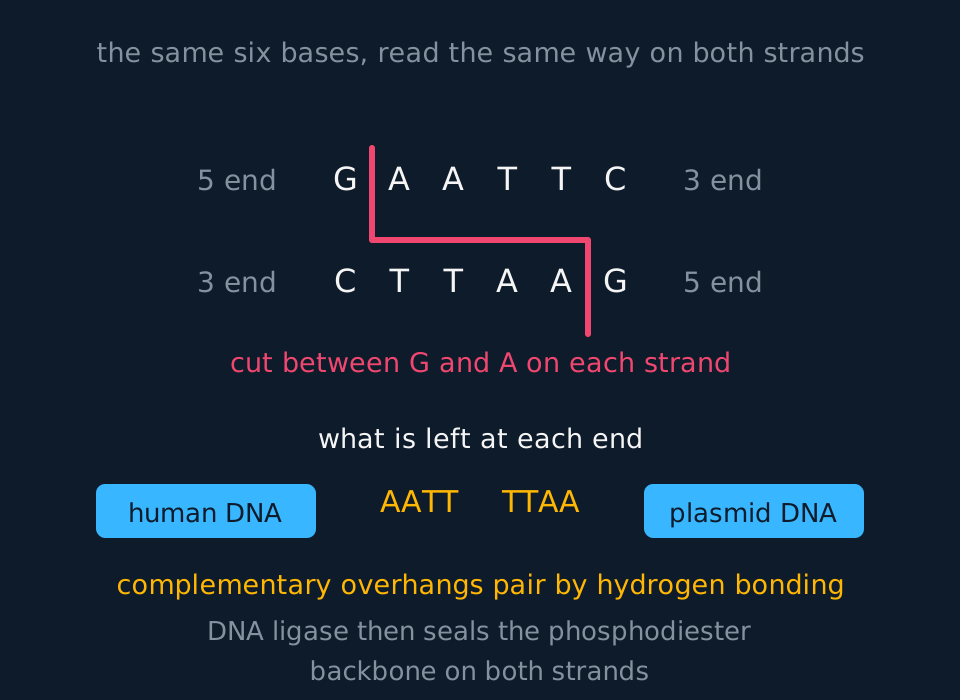
The recognition sequence is normally palindromic, meaning it reads the same 5′ to 3′ on both strands. EcoRI recognises GAATTC; the strand opposite reads GAATTC too, when read in its own direction. Some enzymes cut both strands at the same point, leaving blunt ends. The useful ones cut the two strands at different points, leaving each fragment with a short single-stranded overhang: a sticky end.
Describe the drawing
The recognition sequence of EcoRI, the six bases G A A T T C, written on the upper strand with its complement C T T A A G beneath it, so that both strands read the same way round. A bold line traces the cut, which falls between the G and the first A on the upper strand and at the mirror-image position on the lower one, so the two cuts are offset by four bases. Below, two separated fragments of DNA are drawn, one from a human chromosome and one from a plasmid, each carrying an exposed four-base overhang that reads A A T T, ready to pair with the other.
Sticky ends allow specific joining. Cut a human chromosome and a plasmid with the same enzyme and every fragment from both carries the same overhang, so the human fragment's exposed bases are complementary to the plasmid's. Mix them and the overhangs pair by hydrogen bonding. Those hydrogen bonds hold the two pieces in place but do not join the backbones, so the join is temporary until DNA ligase catalyses the formation of phosphodiester bonds along both strands. Name the two kinds of bond separately: hydrogen bonds between the paired overhangs, phosphodiester bonds along the backbones.
If no convenient site exists, the overhangs can be manufactured. Short single-stranded lengths of DNA carrying the wanted sequence are attached to the blunt ends of the fragment, and it then behaves as though it had been cut by that enzyme all along.
Vectors, transformation and the marker problem
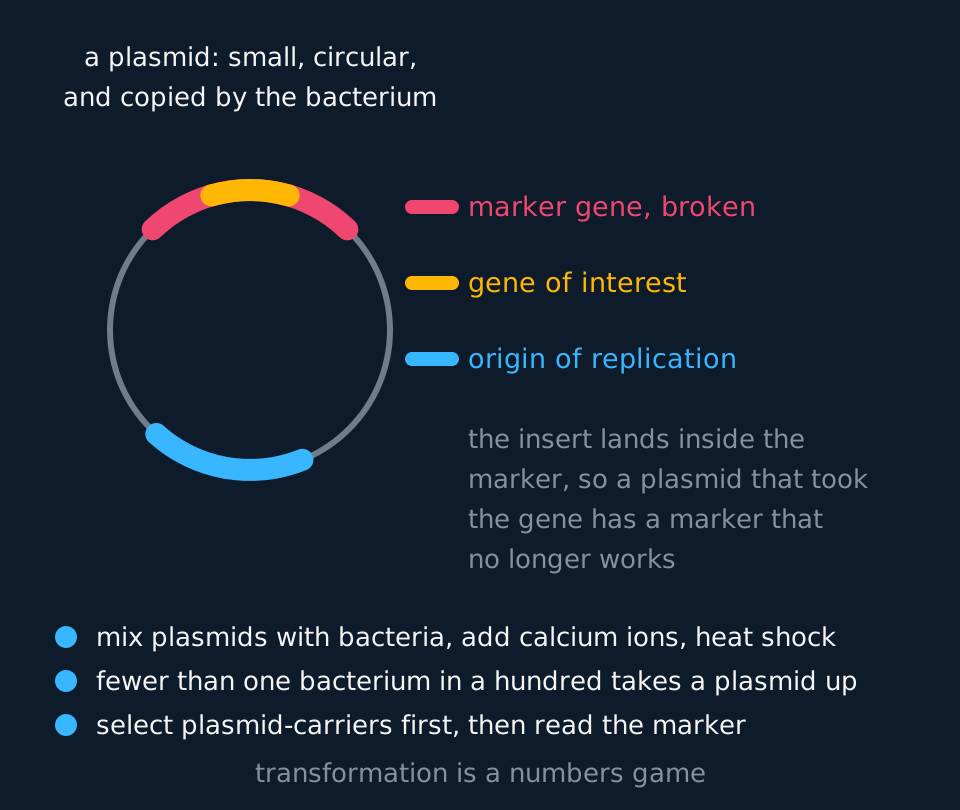
A gene by itself in a bacterium is lost at the first division. It needs a vector: a piece of DNA that will be replicated by the host and passed to daughter cells. The usual choice is a plasmid, a small circular DNA molecule separate from the bacterial chromosome, carrying an origin of replication so the host copies it.
Four features are required on the plasmid besides the gene. An origin of replication, without which the plasmid is not copied. A promoter the host recognises, placed in front of the inserted gene: a human promoter is not recognised by E. coli RNA polymerase, so without a host promoter the gene is not transcribed. A terminator region behind it: without one, RNA polymerase continues past the end of the gene and transcribes the plasmid sequence beyond it, so the mRNA carries additional sequence and the yield falls. And a marker gene, for the reason given below.
Describe the drawing
A plasmid drawn as a large ring with three regions picked out along it in different colours: the gene of interest inserted at the top, a marker gene that the insertion has broken, and an origin of replication. A key to the right names each region and explains that placing the insert inside the marker is what makes the marker informative. Along the bottom, three linked panels describe mixing the plasmids with bacteria under calcium ions and heat shock, the very low proportion of cells that take a plasmid up, and the use of the marker to separate the populations afterwards.
Transformation is the uptake of the plasmid by the bacterium. The cells are made permeable: the standard method is to suspend them in an ice-cold calcium chloride solution and then give them a brief heat shock at about 42 °C; electroporation, a short high-voltage pulse, is the alternative. Either way the efficiency depends heavily on the protocol and is usually low: often only a small fraction of the cells take up a plasmid, and among the plasmids themselves many have re-closed on their own sticky ends without accepting an insert at all.
So after transformation the culture contains three populations: cells with no plasmid, cells with a plasmid that closed on itself, and cells with the recombinant plasmid you actually want. They look identical. The marker gene distinguishes them, and several designs are in use.
| Marker | How it is read | Comment |
|---|---|---|
| Antibiotic resistance gene | Grow on agar containing the antibiotic; only cells with a plasmid survive | Separates plasmid from no plasmid, but not recombinant from self-closed |
| A second resistance gene, with the insert placed inside it | Replica plating: colonies that die on the second antibiotic are the recombinant ones | Works, but you have to grow the colonies twice |
| Fluorescent protein gene, insert placed inside it | Recombinant colonies fail to fluoresce under ultraviolet light | One step and non-destructive, but kills nothing |
| Enzyme marker such as lacZ, insert placed inside it | Recombinant colonies stay white on a substrate that others turn blue | Cheap and visible without special equipment |
Antibiotic resistance markers are being replaced in commercial work, because handling large volumes of bacteria carrying resistance genes creates a risk of transfer to other bacteria. A fluorescent marker can replace the second, screening marker, but it cannot kill the cells that took up no plasmid, so some other selection is still needed first.
Sorting three populations of cells
A plasmid carries a gene for ampicillin resistance and, separately, a gene for a green fluorescent protein. The gene of interest is inserted into the middle of the fluorescent protein gene. After transformation the bacteria are spread on agar containing ampicillin and the surviving colonies are examined under ultraviolet light. Explain what each observation shows.
Show the working
Start with what the ampicillin does. Only cells that have taken up a plasmid carry the resistance gene, so only those can make the enzyme that breaks the antibiotic down. Every cell that failed to take up a plasmid dies, and no colony forms. Every colony you can see therefore contains a plasmid of some kind.
Now the ultraviolet light. A plasmid that closed on itself without accepting the insert has an intact fluorescent protein gene, so it makes the protein and the colony glows. A plasmid that accepted the insert has that gene interrupted in the middle, so no functional protein is made and the colony does not glow.
The colonies you want are therefore the ones that grew on ampicillin and did not fluoresce: they survived, so they have a plasmid, and they are dark, so the plasmid carries the insert. A colony that grew and glowed has a self-closed plasmid and is discarded.
The marker does not detect the gene of interest. It detects the disruption of the marker gene caused by insertion at that site, which is why the insertion site is chosen deliberately.
Getting DNA into other cells: viruses and the gene gun
Calcium chloride and a heat shock suit a bacterium. Other cells need other routes, and Pearson Edexcel Biology B names two of them: viruses and the gene gun. The method is chosen to suit the cell that has to receive the DNA.
Viral vectors. A virus is a delivery system already: it binds to receptors on a host cell and gets its nucleic acid inside. To make a vector, the genes the virus needs to replicate and cause disease are removed and the gene to be delivered is put in their place, so a particle can enter a cell and deliver its DNA but cannot make new viruses. Bacteriophages, the viruses of bacteria, are used to carry DNA into bacterial cells, and there the phage is usually left able to replicate, since that multiplies the inserted gene. For animal and human cells, retroviruses and lentiviruses insert the gene into a host chromosome, so it is copied at every later division, but at a random site; adenoviruses and adeno-associated viruses deliver DNA that mostly stays separate from the chromosomes and is gradually lost as the cells divide. Each virus infects particular cell types, which is useful when only one tissue is the target. These are the vectors gene therapy relies on.
The gene gun. A plant cell has a cellulose wall, and many crop plants, the cereals especially, were hard to transform by any other route. The gene gun, also called particle bombardment or biolistics, goes through the wall by force. Microscopic particles of gold or tungsten, about a micrometre across, are coated with copies of the DNA. A burst of high-pressure helium fires them at plant tissue, usually immature embryos or a callus of undifferentiated cells, fast enough to pass through cell walls and membranes. In a small fraction of the cells hit, some of the DNA reaches the nucleus and is inserted into a chromosome at a random position.
Those few cells have to be found and grown into whole plants. The construct carries a marker gene, often for resistance to an antibiotic or a herbicide, and the bombarded tissue is grown on a medium containing that substance, so only transformed cells survive. Plant cells are totipotent: a surviving cell, given the right balance of plant hormones, divides into a callus that then forms shoots and roots. Every cell of the regenerated plant carries the new gene, including the cells that will form its pollen and ovules, so the gene is passed on in seed. Particle bombardment also works where no biological vector does, on chloroplasts for instance. The commonest alternative for plants is Agrobacterium tumefaciens, a soil bacterium that naturally transfers part of its Ti plasmid into plant chromosomes.
| Method | Cells it suits | How the DNA gets in |
|---|---|---|
| Plasmid, with heat shock or electroporation | Bacteria | The membrane is made briefly permeable and the plasmid is taken up |
| Viral vector | Bacteria (bacteriophage); animal and human cells | The virus binds the cell and delivers its nucleic acid |
| Liposome | Animal and human cells | A sphere of phospholipid fuses with the cell-surface membrane |
| Gene gun | Plant tissue, and chloroplasts | DNA-coated metal particles are fired through wall and membrane |
| Microinjection | Fertilised eggs | A fine glass needle injects DNA into the nucleus |
- Viral vector
- A virus with its replication and disease-causing genes removed and a chosen gene inserted, used to carry that gene into host cells.
- Gene gun
- A device that fires microscopic gold or tungsten particles coated with DNA into cells, used chiefly to transform plant tissue.
The polymerase chain reaction, temperature by temperature
PCR produces many millions of copies of a chosen stretch of DNA in a few hours, in vitro. The cycle has three steps, each carried out at a different temperature.
The tube contains the DNA sample, a large excess of the four free nucleotides, two primers, and a heat-stable DNA polymerase in a buffer. The primers are short single strands of DNA, usually about twenty bases, complementary to the sequences at each end of the target region. They do two jobs: they give DNA polymerase the free 3′ end it requires to start, and they define which stretch of the sample is amplified. Different primers amplify a different region.
The specifications name two methods of amplification. PCR amplifies DNA in vitro: faster, requiring no cells, and yielding DNA only. Replication of a vector in host cells amplifies DNA in vivo: slower, but the culture can be scaled to industrial volumes. Protein is produced only when the insert is expressed, and correct folding and post-translational modification depend on the expression host. The choice follows from the purpose: a diagnostic test that requires enough DNA to sequence uses PCR; production of kilogram quantities of human insulin uses transformed cells in culture.

Describe the drawing
The polymerase chain reaction animated through one complete cycle, with the temperature of each step shown on a card at the left and the number of target molecules counted at the bottom. The tube starts with one double-stranded target, primers, Taq polymerase and free nucleotides. At 95 degrees the hydrogen bonds break and the two strands are drawn apart. At 60 degrees a short primer binds to one end of each separated strand. At 72 degrees, the optimum for Taq polymerase, a new strand is drawn growing from each primer. The last stage shows two complete double strands where there was one, and the count doubling with every further cycle.
Denaturation, 95 °C for about thirty seconds. Heat this high breaks the hydrogen bonds between the paired bases and the two strands separate. It does not break the phosphodiester bonds along the backbones, which are covalent, so each strand survives intact and can be used as a template. Nothing cooler will reliably separate a long double helix, particularly one rich in guanine and cytosine, where every pair is held by three hydrogen bonds instead of two.
Annealing, 50 to 65 °C for about thirty seconds. On cooling, the primers bind to their complementary sequences on the separated strands. The exact temperature is set by the primers themselves, by their length and their guanine-cytosine content, and 55 to 60 °C is typical. The temperature has to be set within a range. Above it, the primers do not remain bound, so no extension occurs. Below it, they bind to sequences they only partly match, and the reaction amplifies unintended regions.
Extension, 72 °C. This is the optimum temperature for Taq polymerase, the enzyme used, and it is why the step has a temperature of its own rather than simply staying at the annealing temperature. Taq extends each primer in the 5′ to 3′ direction at roughly a thousand bases a minute, so the length of this step is set by the length of the target. At 37 °C, the optimum for a human polymerase, Taq works far more slowly.
The cycle depends on Taq polymerase being thermostable. It comes from Thermus aquaticus, a bacterium of hot springs, and its tertiary structure is not disrupted at 95 °C. Before it was adopted, the polymerase was denatured at every denaturation step and fresh enzyme had to be added to every tube in every cycle, which made the technique impractical to automate.
copies after n cycles = 2n × starting moleculeswhich is exact only in principle: yield plateaus once the reagents start to run out
How many copies, and how quickly
A reaction begins with a single molecule of double-stranded target DNA and runs for 30 cycles. Calculate the number of copies produced, state how long the run takes if each cycle lasts two minutes, and explain why the yield in a real tube is lower than your calculated figure.
Show the working
Each cycle doubles the number of molecules, because both strands of every molecule act as a template. After 30 cycles there are 2³⁰ molecules, which is 1 073 741 824, a little over a thousand million from one.
At two minutes a cycle, 30 cycles take 60 minutes. One hour turns a single molecule into more than a billion, which is why a trace of DNA at a crime scene, or from a single cell taken from an embryo, is enough to work with.
The real yield is lower because the reagents are finite. The free nucleotides and the primers are consumed, so later cycles have less substrate. Taq loses some activity over repeated cycles at 95 °C, however thermostable it is. And as the concentration of product rises, separated strands increasingly find each other and re-anneal before a primer can bind. In practice the amount of product levels off after around 30 to 35 cycles however long you leave it running.
Gel electrophoresis: sorting fragments by length
Gel electrophoresis separates DNA fragments by length. It depends on the charge of the molecule: every nucleotide carries a phosphate group, and phosphate groups are negatively charged.
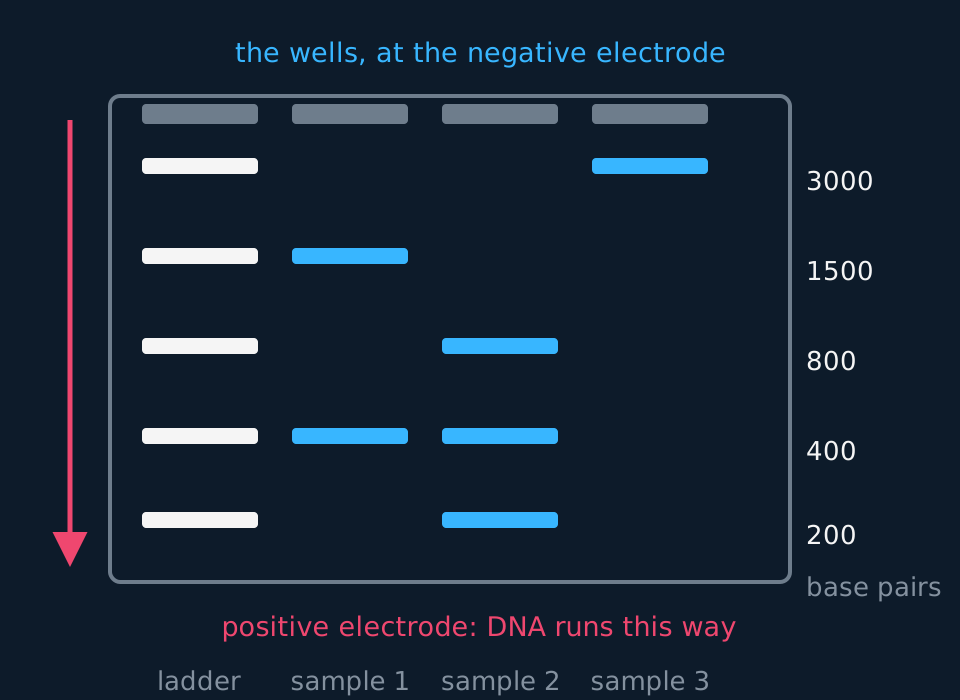
The samples are loaded into wells at one end of a slab of agarose gel covered in buffer, and a voltage is applied across it. Because all DNA is negatively charged, every fragment moves towards the positive electrode; charge does not distinguish them, since a longer fragment carries proportionately more charge. What distinguishes them is the gel. Agarose is a mesh, and a short fragment threads through it more easily than a long one, so in a given time the short fragments travel further. Distance moved falls roughly linearly with the logarithm of fragment length rather than with length itself, which is why size markers are run alongside.
Describe the drawing
A rectangular agarose gel drawn with four loading wells along its top edge and a long arrow down the left showing the direction the DNA travels, from the negative electrode at the wells towards the positive electrode at the far end. The first lane holds a ladder of five reference fragments of known length, 3000 down to 200 base pairs, each labelled at the right-hand edge. The other three lanes hold samples whose bands sit level with different rungs of that ladder, so their lengths can be read off directly.
DNA is colourless, so the gel has to be stained or the fragments labelled. Traditional practicals use methylene blue, which is safe but insensitive; research laboratories use fluorescent dyes that bind DNA and glow under ultraviolet light, or attach a fluorescent tag to a primer during the PCR that produced the fragments. Where the fragments have to be probed afterwards rather than merely measured, they are transferred from the gel onto a nylon membrane, a technique known as Southern blotting, and it is the membrane that meets the probe.
TRY IT: Explaining an experiment that went wrong
A student runs a gel and finds that every lane shows a single bright smear near the well and nothing further down, while a technician's gel of the same DNA, digested separately, gives clear bands. Suggest two possible explanations, and in each case say what the student should change.
Check your answer
The first possibility is that the electrodes were connected the wrong way round, or that the run was stopped almost immediately. DNA is negatively charged and moves towards the positive electrode, so if the wells were nearest the positive electrode the fragments would run off the end of the gel rather than into it, and what remains near the well would be whatever failed to move. The student should check that the wells sit at the negative end and that the voltage was applied for the full time.
The second is that the DNA was not cut. Uncut chromosomal DNA is enormously long and barely enters the gel at all, so it sits as a smear at the well, which is exactly what is described. The student should check that the restriction enzyme was added and that it was incubated at the right temperature for long enough.
The pattern of the failure indicates where to look. The same fault in every lane implicates something applied to the whole gel, such as the voltage, the buffer or the orientation; a fault in one lane implicates that sample.
Knockout mice: switching a gene off to find its function
A genome sequence lists the genes but does not say what most of them do. One direct test is to stop a gene working in a whole animal and see what changes. A knockout mouse is a mouse in which both alleles of one chosen gene have been deliberately inactivated, so that no functional product is made. Comparing it with normal mice of the same strain shows what the gene contributes. If the inactivated gene is one that is faulty in a human disease, the mouse becomes an animal model of that disease, in which its course can be followed and treatments tested before any reach a patient.
The classic method, developed in the 1980s and recognised by a Nobel Prize in 2007, works through embryonic stem cells in five steps.
| Step | What is done | Why |
|---|---|---|
| 1 | A length of DNA is built that matches the target gene but has a marker gene, for antibiotic resistance, inserted in the middle of it | The marker disrupts the gene and lets successful cells be selected |
| 2 | The DNA is put into mouse embryonic stem cells in culture, by electroporation | In a few cells it lines up with the matching sequence and replaces the working gene, by homologous recombination |
| 3 | The cells are grown with the antibiotic, and survivors are checked | Only cells carrying the marker survive; checking finds those where it went into the right gene |
| 4 | Selected cells are injected into a mouse blastocyst, which is implanted in a surrogate mother | Embryonic stem cells are pluripotent and join in forming every tissue, so the pups are chimaeras of modified and unmodified cells |
| 5 | Chimaeras are bred, and their heterozygous offspring are crossed with each other | A quarter of the offspring of two heterozygotes have both alleles knocked out |
Gene editing has made the process much quicker. The Cas9 nuclease and a guide RNA matching the target gene are injected into a fertilised egg; the cut is repaired with small errors that disrupt the gene, and founder mice with the knockout can be obtained in one generation, though they are still bred to give a stable line.
Mice are used because they are mammals, with the same organ systems and much the same development and physiology as humans, and most human genes have a counterpart in the mouse genome. They are small and cheap to keep, breed at about two months old and have large litters. Inbred strains, in which the mice are almost genetically identical, mean that a difference between knockout and normal mice can be put down to the one gene that was changed.
Two examples show what the method gives and where it falls short. Mice lacking the tumour suppressor gene p53 are born apparently normal, but most develop tumours within months, which confirmed that the gene protects against cancer rather than being needed for development. Mice with the CFTR gene knocked out were made in 1992 as a model of cystic fibrosis. They suffer severe intestinal blockage but do not develop the human lung disease on their own, because mouse airways differ from human ones in the ion channels they carry.
Three further limitations recur in questions. A knockout may be lethal to the embryo, which shows the gene is essential but hides anything it does later in life; conditional knockouts, which switch the gene off in one tissue or at a chosen time, get round that. Another gene may take over the function, so the knockout looks normal although the gene does have a role. And a result in mice may not hold in humans, so a treatment that works in the model can fail in a trial. The animals may also suffer: in the UK every such experiment needs a licence under the Animals (Scientific Procedures) Act 1986, and researchers are expected to replace animals where they can, reduce the numbers used, and refine procedures to reduce suffering.
TRY IT: A knockout with no visible effect
A gene is transcribed strongly in the mouse kidney. Researchers make mice homozygous for a knockout of the gene and find that they look, grow and breed normally. A colleague concludes that the gene has no function. Suggest three reasons why that conclusion may be wrong.
Check your answer
Another gene may do the same job. Many genes belong to families of similar genes, and if a related gene is also expressed in the kidney its product can take over, so losing this one changes nothing that can be seen.
The effect may appear only under conditions the researchers did not test. A gene needed when the mouse is short of water, eating a high-salt diet, ageing or fighting an infection could be lost without effect in well-fed young mice kept in a clean laboratory.
The effect may be one nobody measured. Looking, growing and breeding normally says nothing about the concentration of ions in the blood or the composition of the urine, and a kidney gene could alter either. It is also worth confirming that the knockout worked, by showing that no functional mRNA or protein is made.
- Knockout mouse
- A mouse in which both alleles of a chosen gene have been deliberately inactivated, so that the gene's function can be inferred from what changes.
- Animal model
- An animal with a condition that resembles a human disease, used to study the disease and test treatments.
Evaluating genetic modification
Specifications require candidates to evaluate the ethical, financial and social issues raised by this technology. An evaluation sets out the evidence on both sides and reaches a stated judgement.
In agriculture. A crop engineered for pest resistance can cut insecticide use, raise yield on the same land, and carry nutrients a deficient diet lacks. Against that: the resistance gene may spread by pollen to wild relatives, pests evolve resistance in their turn exactly as they do to a sprayed insecticide, and a farmer paying for patented seed each season is in a different economic relationship from one saving it.
Three named organisms illustrate different aspects of the argument. Insect-resistant cotton carries a gene from the soil bacterium Bacillus thuringiensis for a protein toxic to the caterpillars that eat the crop, so the plant makes its own insecticide: spraying falls, yields rise, and the against-case is that constant exposure selects for resistant caterpillars faster than occasional spraying would, so refuges of non-GM cotton have to be planted alongside to slow it. Herbicide-resistant soybean carries a bacterial version of an enzyme that the herbicide glyphosate normally inhibits, so a field can be sprayed and only the weeds die: weed control is cheaper and ploughing can be reduced, and against that sit glyphosate-resistant weeds, heavier total herbicide use where they appear, and the patented-seed economics above. GM salmon makes the argument about animals: it carries a growth hormone gene from a chinook salmon under a promoter from another fish that runs all year rather than only in summer, so the fish reaches market size in roughly half the time on less feed. The case against is escape: a fast-growing transgenic fish breeding with wild populations could not be recalled. The approved fish are therefore reared as predominantly sterile triploid females in land-based facilities, with multiple containment measures. Check the current approval conditions for the jurisdiction named in a question, since they differ and are revised; the only commercial producer announced in late 2024 that it was stopping fish farming.
In industry and medicine. Human insulin from transformed bacteria is chemically identical to the human protein, avoids the immune reactions some patients had to insulin extracted from pigs and cattle, and can be produced in quantity and without the ethical objections that animal extraction carries. Against that: the development cost is high enough that research goes where the paying market is, which is not always where the disease burden is.
OCR Biology A names three further cases. Insect-resistant soya carries the same Bacillus thuringiensis toxin gene as Bt cotton, with the same arguments for and against. Genetically modified pathogens are made for research, for example strains with one gene knocked out to find what it does, or carrying a fluorescent marker so an infection can be followed; the benefit is understanding how a disease works, and the risk is escape or misuse, which is why the work is licensed and contained. Technology transfer asks whether patented GM seed reaches poor farmers: some has been licensed to them free of royalties, while patents and buying seed each season can keep it out of reach.
Structuring an evaluation. Attach each point to a named application rather than arguing about genetic modification in general, and separate the ethical, financial and social objections the command word names. State the mechanism behind an objection: "the resistance gene can transfer to a wild relative by pollen, and cannot then be recovered" identifies a process, whereas "it is unnatural" does not.
Genetically modified soya beans
Soya beans are grown for protein, for animal feed and for oil, and most of the soya grown in the Americas is genetically modified. Pearson Edexcel Biology B asks for the process and for two kinds of improvement: to the way the crop is grown, and to the oil itself.
The process follows the steps of this lesson. The gene is joined to a promoter that plant cells recognise, together with a marker gene. The construct is introduced into soya tissue with a gene gun or with Agrobacterium tumefaciens; the first herbicide-tolerant soya was made with a gene gun. Transformed cells are selected on a medium containing the herbicide or antibiotic that the marker protects against, and regenerated into whole plants. These are tested to confirm that the gene is present, expressed and inherited, and then crossed into high-yielding varieties suited to local conditions before the regulatory trials that any GM crop has to pass.
Improving production. Herbicide-tolerant soya, described in the section above, lets a farmer spray glyphosate over the growing crop: the weeds die and the soya does not, weed control is simpler and cheaper, and less ploughing is needed. Insect-resistant soya carrying a Bacillus thuringiensis toxin gene loses less of its crop to caterpillars. Both raise yield or cut costs, and neither changes the bean.
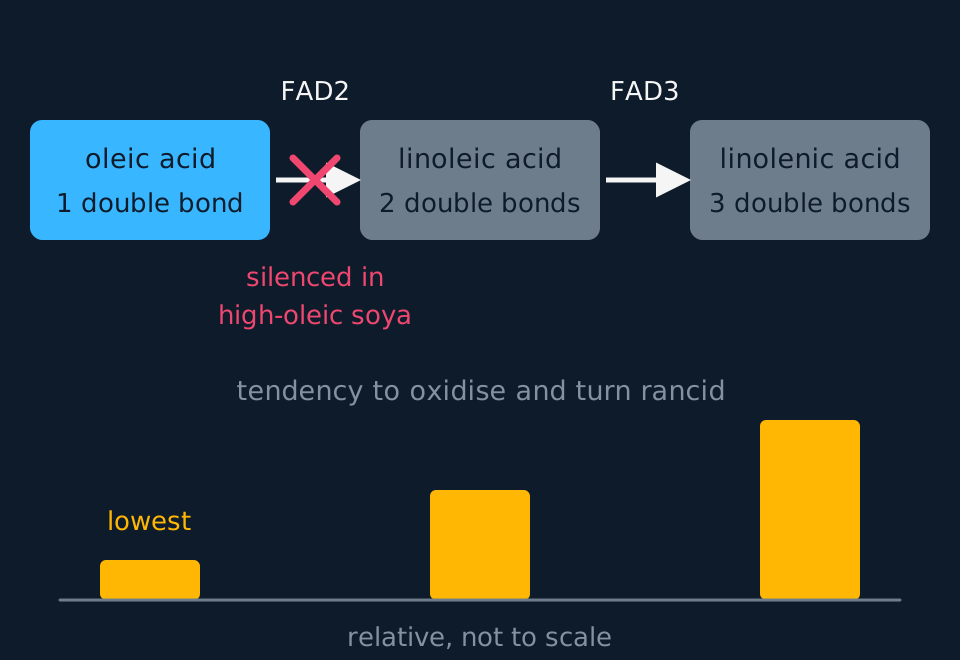
Changing the oil. Ordinary soya oil is rich in polyunsaturated fatty acids. About half of its fatty acid is linoleic acid, with two carbon-carbon double bonds, and about seven per cent is linolenic acid, with three. Oxygen attacks a fatty acid chain at the carbon atoms beside its double bonds, and the more double bonds a chain has, the faster it oxidises. Oxidised oil smells and tastes rancid, keeps poorly, and breaks down when it is heated repeatedly for frying. The traditional remedy was partial hydrogenation, adding hydrogen across some of the double bonds, but that process forms trans fatty acids, which raise the risk of heart disease and are now restricted in many countries.
Describe the drawing
A three-step pathway drawn left to right in a soya seed: oleic acid with one carbon-carbon double bond, converted by the enzyme FAD2 to linoleic acid with two, converted by FAD3 to linolenic acid with three. A coral cross on the FAD2 arrow marks the step silenced in high-oleic soya. Below each acid an amber bar shows its tendency to oxidise and turn rancid, shortest for oleic acid and tallest for linolenic acid, marked as relative and not to scale.
High-oleic soya deals with the problem in the seed. In the developing bean, an enzyme called fatty acid desaturase 2, FAD2, adds a second double bond to oleic acid, which has one, converting it to linoleic acid. In the genetically modified varieties FAD2 is silenced: an extra copy of part of the soya bean's own FAD2 gene is inserted, and its transcripts lead the cell to break down the normal FAD2 mRNA, a form of gene silencing related to the RNA interference met earlier in this unit. With little FAD2, oleic acid builds up instead of being converted. Over three-quarters of the fatty acid in the oil is then oleic acid, against roughly a fifth to a quarter in ordinary soya oil, with less linoleic and linolenic acid. The oil resists oxidation and stays stable in a fryer without hydrogenation, so no trans fatty acids are formed. A gene-edited high-oleic soya, with the FAD2 genes disrupted rather than silenced and no foreign DNA left in it, has been sold in the United States since 2019.
This modification improves the product rather than the farming. The benefit goes to food manufacturers and consumers, through longer shelf life and the removal of trans fats, rather than mainly to the grower, which is a different balance of benefit from the herbicide-tolerant crops at the centre of the public debate.
- High-oleic soya
- Soya genetically modified so that the enzyme converting oleic acid to linoleic acid is silenced, giving an oil with more monounsaturated fat that resists oxidation.
Core practical 14: use gel electrophoresis to separate DNA fragments of different length
optional
Pearson Edexcel Biology A (9BN0) sets Core Practical 14: Use gel electrophoresis to separate DNA fragments of different length, beside statements 6.3 and 6.4 on DNA profiling and PCR. Why the fragments separate is explained in the gel electrophoresis section above. This section is how the gel is run in a school laboratory.
The apparatus: a casting tray with its ends taped or blocked, and a comb to form the wells; agarose powder and running buffer, usually supplied in a kit; a gel tank with an electrode at each end and a lid; a low-voltage DC power supply of the kind school kits use; DNA samples, such as DNA cut with restriction enzymes, mixed with loading dye; a DNA ladder; a micropipette with a fresh tip for each sample, or the fixed-volume pipettes a kit provides; a DNA stain such as methylene blue; and a ruler.
| Step | What to do | Why |
|---|---|---|
| 1 | Heat the agarose in buffer until it is completely dissolved and clear, let it cool a little, and pour it into the tray with the comb in place. When it has set, lift the comb out gently | The comb leaves a row of wells; lifting it gently stops the wells tearing |
| 2 | Put the gel in the tank with the wells at the negative electrode, and pour in buffer until the gel is covered by a few millimetres | DNA is negatively charged and moves towards the positive electrode, so it has the whole gel to cross; the buffer conducts the current and keeps the pH steady |
| 3 | Load the same volume of each sample into its own well, with the tip just inside the well and below the buffer, without piercing the bottom. Load the ladder into one well, and record which sample went where | The dense loading dye makes the sample sink into the well; a pierced well lets the sample leak under the gel |
| 4 | Put the lid on, connect the leads, and switch on. Run the gel until the coloured dye front is near the far end, then switch off and disconnect before removing the lid | The visible dye shows how far the run has gone, so the smallest fragments are not run off the end |
| 5 | Cover the gel with the stain for the time the kit gives, then rinse with water until bands show against a paler background | DNA is colourless; the stain binds to it |
| 6 | Photograph the gel on a white surface beside a ruler, and measure the distance from the well to the centre of each band | Measuring every band to the same point makes the distances comparable |
If the gel is used to compare samples, the independent variable is the DNA sample and the dependent variable is the distance each band moves. Control the agarose concentration, the voltage, the running time, the buffer and the volume loaded. The distance a fragment moves depends on all of these, which is why a ladder is run on every gel rather than borrowed from another.
To find the length of an unknown fragment, plot log10 of the length of each ladder fragment against the distance it moved. Over the useful range of the gel the points lie close to a straight line. Read the unknown's distance across to the line and back to a length. Do this only within the range of the ladder: a band beyond the smallest or largest marker cannot be sized from it.
Sizing a fragment from a ladder
These results are invented to show the method. Ladder fragments of 10 000, 5000, 3000 and 1000 base pairs moved 18, 27, 34 and 48 mm from the well. An unknown band moved 39 mm. Estimate its length.
Show the working
Take logarithms of the ladder lengths: 4.00, 3.70, 3.48 and 3.00. Plotted against distance, they lie close to a line that drops by 1.00 in log10 length for every 30 mm moved, passing through 3.00 at 48 mm.
The unknown moved 48 − 39 = 9 mm less than the 1000 bp fragment, so its log10 length is 3.00 + 9 ÷ 30 = 3.30.
Length = 103.30 = about 2000 base pairs, which lies between the 1000 and 3000 bp markers, as its position between them requires.
| Source of error | Effect | Improvement |
|---|---|---|
| Sample floats out of the well | A faint band or none | Mix with loading dye; load slowly with the tip just inside the well |
| Run for too long | Small fragments run off the end | Stop when the dye front is near the end of the gel |
| Too much DNA, or DNA broken down by nucleases from skin | Smeared bands that are hard to measure | Load less; wear gloves; keep samples cold until loaded |
| Gel of uneven thickness | Lanes run at different speeds | Pour on a level surface |
| Broad bands | Distances are imprecise | Measure to the centre of each band on a photograph with a scale |
Risk assessment. The buffer conducts electricity: put the lid on before switching on, switch off and disconnect before taking it off, and keep spilt buffer away from the power supply. Molten agarose heated in a microwave can boil over suddenly when moved, so heat it in short bursts and handle it with heat-resistant gloves. DNA stains mark skin and clothing; check the CLEAPSS Hazcard for the stain in use and your school's risk assessment, and wear gloves and eye protection. This method uses a stain seen in ordinary light; a fluorescent stain or an ultraviolet viewer needs its own precautions and is used only where the school's risk assessment covers it.
- DNA ladder
- A mixture of DNA fragments of known lengths, run in one lane of a gel so that the lengths of fragments in the other lanes can be read against it.
- Loading dye
- A dense, coloured solution mixed with DNA samples so that they sink into the wells of a gel and their progress during the run can be seen.
In the exam
- State which method of obtaining the gene you would use and give the reason: 'reverse transcriptase on mRNA from a cell that expresses the gene heavily, because the mRNA has already had its introns removed'.
- Name both kinds of bond: sticky ends pair by hydrogen bonding, and ligase then forms phosphodiester bonds.
- Size an unknown band against a ladder run on the same gel, using the logarithm of fragment length, and only within the ladder's range.
- The same restriction enzyme must be used on the gene and on the vector, because that is what makes the overhangs complementary.
- Quote the PCR temperatures with the reason attached: 95 °C to break hydrogen bonds, 50 to 65 °C for the primers to anneal, 72 °C because that is the optimum for Taq polymerase.
- Taq polymerase is used because it is thermostable and survives the denaturation step.
- In electrophoresis, DNA moves towards the positive electrode because the phosphate groups are negatively charged, and short fragments move furthest because they pass through the gel mesh more easily.
- Give the reason marker genes are needed: transformation efficiency is low, so most cells take up no plasmid, and the marker identifies those that took up a recombinant one.
- For the gene gun, give the particles (gold or tungsten coated with DNA), the reason force is needed (the cellulose wall), and how transformed cells are then selected and regenerated into plants.
- A knockout mouse has both alleles inactivated. Say what is compared with what: knockout mice against normal mice of the same strain.
- For high-oleic soya, link fewer double bonds to slower oxidation, and name the enzyme whose silencing leaves oleic acid unconverted.
Check yourself
A company wants E. coli to manufacture a human protein. Describe, in order, how they would obtain the gene, insert it into the bacteria and identify the cells that will produce the protein, giving a reason for each choice you make.
Answer
Obtain the gene from mRNA rather than from a chromosome. Choose a human cell type that produces the protein in quantity, extract its mRNA, and use reverse transcriptase to make a single strand of complementary DNA against it; DNA polymerase then builds the second strand. The reason is introns: a bacterium has no spliceosomes, so a gene taken from a chromosome would be transcribed and translated complete with its intron sequence and would yield no functional protein. The gene machine would serve equally well, and would allow the codons to be chosen to suit E. coli.
Cut the cDNA and a plasmid with the same restriction endonuclease, so that both carry complementary sticky ends. Mix them, and the overhangs pair by hydrogen bonding; add DNA ligase to form the phosphodiester bonds that make the join permanent. The plasmid must already carry an origin of replication so that the bacterium copies it, a promoter the bacterium's own RNA polymerase recognises placed in front of the insertion site, and a marker gene.
Transform the bacteria: suspend them in ice-cold calcium chloride and give a brief heat shock, or use electroporation, to make the membranes permeable so that plasmids can enter.
Identify the successful cells with the marker. If the marker is an antibiotic resistance gene, grow the culture on agar containing that antibiotic and only cells carrying a plasmid survive. If the gene was inserted into the middle of a second marker, a fluorescent protein gene say, then among the survivors it is the colonies that do not fluoresce that carry the insert, because the insertion has interrupted that gene. Those colonies are cultured on a large scale in a fermenter and the protein extracted.
State the limitation of the bacterial host. A bacterium cannot carry out post-translational modification, so a protein needing particular sugars added in a Golgi apparatus has to be made in yeast or in mammalian cell culture instead, however well the transformation worked.
Questions
Question 15 marks
A regulator is asked to approve the farming of a genetically modified salmon which carries a growth hormone gene from a chinook salmon, placed under a promoter that runs all year rather than only in summer. Evaluate the case for approving it.
Mark scheme
- B1 in favour: the fish reaches market size in roughly half the usual time and on less feed, so a given mass of protein is produced from less feed, less water and less space, and the farm supplies a market that would otherwise be supplied by fishing wild stocks
- B1 against: an escaped transgenic fish could breed with wild salmon and pass the gene into a wild population, where it could not be recalled, and a fast-growing fish may compete with wild fish for food and for spawning grounds
- B1 against, financially and socially: the stock is patented, so a farmer buys new stock rather than breeding it and is in a different economic relationship with the supplier, and consumers who object to eating a modified animal need labelling if their choice is to mean anything
- B1 the conditions attached matter as much as the gene itself: the approved fish are reared as predominantly sterile females in tanks on land, which meets the escape argument twice over, by removing the route to the sea and by removing the ability to breed if one escapes
- B1 a judgement supported by those points, for example that approval is defensible so long as the containment conditions are enforced and the product is labelled, and that the case would be much weaker for the same fish reared in sea cages, where containment depends on a net; an objection that the fish is unnatural names no mechanism and carries no weight on its own
Question 25 marks
Describe how a knockout mouse is produced from embryonic stem cells, and explain how it can be used to investigate the function of a gene.
Mark scheme
- B1 a length of DNA matching the target gene is made with a marker gene, such as one for antibiotic resistance, inserted into it so the gene is disrupted
- B1 this is put into mouse embryonic stem cells, where in a few cells it replaces the normal gene by homologous recombination; cells carrying it are selected with the antibiotic
- B1 the selected cells are injected into a blastocyst, which is implanted into a surrogate mother, giving chimaeric offspring
- B1 chimaeras are bred, and heterozygous offspring are crossed so that a quarter of their young have both alleles inactivated
- B1 the knockout mice are compared with normal mice of the same strain, and whatever structure or process differs indicates the function of the gene
Question 34 marks
Explain why the same restriction endonuclease must be used to cut both the gene and the plasmid, and explain what DNA ligase then contributes.
Mark scheme
- B1 a restriction endonuclease cuts only at its own recognition sequence, and an offset cut through the two strands leaves each fragment with a short single-stranded overhang, a sticky end
- B1 using one enzyme on both means every fragment carries the same overhang, so the exposed bases of the gene are complementary to those of the cut plasmid
- B1 the overhangs pair by hydrogen bonding between complementary bases, which holds the pieces together but leaves the sugar-phosphate backbones unjoined
- B1 DNA ligase catalyses the formation of phosphodiester bonds along both strands, which makes the join permanent
Question 44 marks
A polymerase chain reaction begins with 5 molecules of double-stranded target DNA and runs for 20 cycles. Calculate the number of molecules present at the end, and calculate how long the run takes if each cycle lasts 90 seconds.
Mark scheme
- M1 the number of molecules doubles each cycle, so the number at the end is the starting number multiplied by 2 raised to the number of cycles
- M1 5 × 220 = 5 × 1 048 576
- A1 5 242 880 molecules
- A1 20 × 90 = 1800 seconds, which is 30 minutes
Question 54 marks
Well under one bacterium in a hundred takes up a plasmid, and many plasmids close on their own sticky ends without accepting an insert. Suggest why a marker gene is needed at all, and suggest how placing the gene of interest inside a gene for a fluorescent protein allows the recombinant cells to be picked out.
Mark scheme
- B1 after transformation the culture holds three populations: cells with no plasmid, cells with a self-closed plasmid and cells with the recombinant plasmid. They look identical
- B1 a marker gene gives an observable difference, so the very small proportion of cells that took up the plasmid wanted can be found without testing every colony
- B1 a plasmid that closed on itself has an intact fluorescent protein gene, so it makes the protein and its colony glows under ultraviolet light
- B1 a plasmid carrying the insert has that gene interrupted in the middle, so no functional protein is made and the colonies wanted are the ones that do not glow, but only among cells first selected for carrying a plasmid, for example on antibiotic agar, since cells with no plasmid do not glow either
Question 64 marks
Compare obtaining a gene by treating mRNA with reverse transcriptase with obtaining the same gene by cutting it out of chromosomal DNA using a restriction endonuclease, referring to the material each route starts from, to introns, and to the host in which each product can be expressed.
Mark scheme
- B1 the reverse transcriptase route starts from the mRNA of a cell that makes a great deal of the protein wanted, such as a β cell of the pancreas for insulin, whereas the restriction route starts from the chromosomal DNA of any cell at all, since every cell carries the gene whether it transcribes it or not
- B1 reverse transcriptase builds a DNA strand against the RNA template and DNA polymerase then adds the second strand, whereas a restriction endonuclease cuts the double-stranded gene out directly, which works only if its recognition sequence happens to lie on each side of the gene
- B1 the mRNA has already been spliced, so the complementary DNA carries no introns, whereas the fragment cut from the chromosome carries every intron the gene has
- B1 the complementary DNA can therefore be expressed in a prokaryote such as Escherichia coli, which has no spliceosomes, whereas the cut fragment yields a functional protein only in a host that can splice, such as a yeast or a mammalian cell culture
Question 74 marks
Describe how a recombinant plasmid is introduced into bacterial cells, and describe what the plasmid must carry if the inserted gene is to be copied as the culture grows.
Mark scheme
- B1 the bacteria are made permeable to DNA, the standard method being to suspend them in an ice-cold calcium chloride solution
- B1 a brief heat shock at about 42 °C then drives plasmids into the cells; electroporation, a short high-voltage pulse, is the alternative, and either way the process is called transformation
- B1 uptake is inefficient: only a small fraction of the cells take up a plasmid at all, and many plasmids have re-closed on their own sticky ends without an insert, which is why a marker gene is needed afterwards to find the cells wanted
- B1 the plasmid must carry an origin of replication, so the host copies it and passes copies to both daughter cells at every division, and the gene is amplified along with the culture; that is amplification in vivo, as against the in vitro amplification of the polymerase chain reaction
Question 84 marks
Different organisms use the synonymous codons for an amino acid at different frequencies, and a gene written in the codons its host uses most often is usually translated faster, giving a higher yield of protein. Explain why the gene machine method allows a gene's codons to be chosen for a particular host, while the reverse transcriptase method does not.
Mark scheme
- B1 the gene machine builds the gene from scratch, a nucleotide at a time, from a sequence designed in advance, so the codon at every position can be chosen
- B1 the genetic code is degenerate, so most amino acids have more than one codon, which is what makes a choice between codons possible at all
- B1 synonymous codons give the same amino acid sequence, so the primary structure of the protein, and so its folding and function, is unchanged by the choice
- B1 the reverse transcriptase method copies an existing mRNA by complementary base pairing, so the gene carries exactly the codons the original cell used, and they cannot be altered without further engineering
Question 94 marks
Compare in vivo amplification of a gene by a plasmid replicating inside host cells with in vitro amplification by the polymerase chain reaction, referring to speed, scale and what is produced.
Mark scheme
- B1 in vivo amplification by dividing cells is slower to reach a large number of copies than PCR, but the culture can be scaled up to industrial volumes, whereas PCR is very fast but is normally run at laboratory scale
- B1 PCR produces DNA only, whereas replication inside host cells can be followed by transcription and translation, so protein is also produced if the gene is expressed
- B1 PCR needs no living cells, only a thermostable polymerase, primers, nucleotides and a thermal cycler, whereas in vivo amplification needs a living, transformed host culture kept alive and fed
- B1 a diagnostic test that needs enough DNA to sequence or run on a gel uses PCR, while production of a protein such as human insulin in bulk uses transformed cells in culture
Question 104 marks
Bt cotton carries a bacterial gene coding for a protein toxic to the caterpillars that eat the crop. Suggest how this reduces insecticide use, and suggest one way its widespread use could undermine its own long-term effectiveness.
Mark scheme
- B1 the gene from Bacillus thuringiensis makes the toxin inside the plant's own tissues, so every plant in the field carries its own protection against the caterpillars continuously
- B1 because the toxin is always present, farmers do not need to spray insecticide against those caterpillars as often, cutting insecticide use and its cost
- B1 constant exposure to the same toxin in every plant selects strongly for any caterpillar that happens to carry resistance to it, more strongly than occasional spraying would
- B1 resistant caterpillars then survive and breed, so resistance can spread through the pest population and reduce the crop's protection over time, unless non-Bt refuge areas are planted to slow the process
Question 114 marks
Describe how a gene gun is used to produce a genetically modified crop plant.
Mark scheme
- B1 microscopic particles of gold or tungsten are coated with copies of the DNA, which includes the wanted gene and a marker gene
- B1 the particles are fired at high speed, for example by high-pressure helium, into plant tissue such as embryos or callus, passing through the cellulose cell walls
- B1 in a few cells the DNA reaches the nucleus and is inserted into a chromosome; these cells are selected by growing the tissue on a medium containing the antibiotic or herbicide the marker gene resists
- B1 plant cells are totipotent, so surviving cells are grown with plant hormones into whole plants, every cell of which carries the gene, including those that form pollen and ovules
Question 124 marks
Mice heterozygous for a knockout of gene G were crossed with each other. The table shows the genotypes of 152 pups examined at birth; the figures are constructed for this question. Calculate the number of pups of each genotype expected if all genotypes survive equally, and suggest what the results show about gene G and how its role in adult mice could still be studied.
| Genotype of pups at birth | Number of pups |
|---|---|
| both alleles working | 51 |
| heterozygous | 101 |
| both alleles knocked out | 0 |
Mark scheme
- M1 a cross between two heterozygotes gives a 1 : 2 : 1 ratio, so a quarter, a half and a quarter of 152 are expected
- A1 38 with both alleles working, 76 heterozygous and 38 with both alleles knocked out
- B1 no homozygous knockout pups were born, and the other two classes are close to a 1 : 2 ratio, so mice lacking gene G die before birth: the gene is essential for embryonic development
- B1 its adult role could be studied with a conditional knockout, in which the gene is inactivated only in one tissue or only after a chosen age
Question 134 marks
Ordinary soya oil goes rancid quickly and is unstable for frying. Explain how genetic modification of soya beans has produced an oil that resists oxidation.
Mark scheme
- B1 ordinary soya oil contains a high proportion of polyunsaturated fatty acids, linoleic and linolenic acid, with two and three carbon-carbon double bonds
- B1 oxygen reacts at the double bonds, so the more double bonds a fatty acid has, the faster it oxidises and the oil turns rancid
- B1 in high-oleic soya the gene for the desaturase enzyme FAD2, which converts oleic acid into linoleic acid, is silenced
- B1 so oleic acid, with only one double bond, accumulates and makes up most of the oil, which therefore oxidises more slowly and needs no hydrogenation, so no trans fats are formed
Question 143 marks
State the three temperatures used in a cycle of the polymerase chain reaction, and state what each of them is for.
Mark scheme
- B1 95 °C, at which the hydrogen bonds between paired bases break and the two strands separate
- B1 50 to 65 °C, at which the primers bind to their complementary sequences at each end of the target region
- B1 72 °C, which is the optimum for Taq polymerase as it extends each primer to build the new strand
Question 153 marks
Explain why DNA fragments move towards the positive electrode during gel electrophoresis, and explain why the shortest fragments travel furthest.
Mark scheme
- B1 every nucleotide carries a phosphate group and phosphate groups are negatively charged, so every fragment is attracted towards the positive electrode
- B1 charge does not separate the fragments, because a longer fragment carries proportionately more of it
- B1 the agarose gel is a mesh, and a short fragment threads through it more easily than a long one, so in a given time the short fragments travel further
Question 163 marks
Describe the three ways of obtaining a gene for genetic engineering, naming a situation that suits each one.
Mark scheme
- B1 reverse transcriptase acting on mRNA suits producing an intron-free gene when a cell that expresses it heavily, such as a pancreatic β cell for insulin, is available
- B1 a restriction enzyme cutting the gene directly from the chromosome suits a quick route when a suitable recognition sequence flanks the gene, though the product still carries its introns
- B1 the gene machine builds the gene chemically from known sequence data, needing no biological starting material at all and allowing the codons to be chosen to suit the host
Question 173 marks
Explain why a plasmid vector needs a promoter the host recognises, in addition to an origin of replication.
Mark scheme
- B1 a promoter is the region of DNA to which RNA polymerase binds to start transcription, and a host's RNA polymerase recognises only its own kind of promoter sequence
- B1 a human gene's own promoter, carried across with the gene, would not be recognised by a bacterium's RNA polymerase, so the gene would not be transcribed without a host promoter placed in front of it
- B1 an origin of replication only ensures the plasmid itself is copied and passed to daughter cells; it does nothing to make the inserted gene transcribed, which is a separate requirement met by the promoter
Question 183 marks
Explain why Taq polymerase, rather than a human DNA polymerase, is used in the polymerase chain reaction.
Mark scheme
- B1 the reaction is repeatedly heated to 95 °C to separate the DNA strands, and a human DNA polymerase's tertiary structure would be disrupted at that temperature, so the enzyme would be denatured
- B1 Taq polymerase comes from Thermus aquaticus, a bacterium of hot springs, and its tertiary structure is not disrupted at 95 °C
- B1 because Taq survives every denaturation step, one addition of it at the start works for all the cycles, instead of fresh enzyme having to be added after every one
Question 193 marks
Explain why a virus used as a vector to carry a gene into human cells is first modified, and explain why a gene gun rather than a viral vector or a heat shock is often used to transform cereal plants.
Mark scheme
- B1 the genes the virus needs to replicate and to cause disease are removed, so that it can deliver the gene into a cell but cannot make new viruses or harm the host
- B1 the removed genes are replaced by the gene to be delivered, using the virus's natural ability to bind to cells and get its nucleic acid inside
- B1 plant cells have a cellulose cell wall, and the gene gun forces DNA-coated particles through it, while heat shock works on bacteria and few suitable biological vectors infect cereals
Question 203 marks
A DNA ladder was run on a gel beside a sample. Ladder fragments of 6000, 3000, 1500 and 750 base pairs moved 20, 31, 42 and 53 mm from the well, and a band in the sample moved 36.5 mm; the results are invented for this question. Distance moved falls in a straight line with log10 of fragment length. Calculate the length of the fragment in the sample.
Mark scheme
- M1 log10 3000 = 3.48 and log10 1500 = 3.18, the markers either side of the band
- M1 36.5 mm is halfway between 31 and 42 mm, so log10 length = (3.48 + 3.18) ÷ 2 = 3.33
- A1 length = 103.33 = about 2100 base pairs; accept 2000 to 2200
Question 213 marks
When running a gel to separate DNA fragments, a student loaded the samples, mixed with loading dye, into wells at the end of the gel next to the negative electrode, and ran a DNA ladder in one lane of the same gel. Explain each of these three decisions.
Mark scheme
- B1 DNA is negatively charged because of its phosphate groups, so it moves towards the positive electrode and must start at the negative end to cross the gel
- B1 the loading dye is dense, so the sample sinks into the well instead of spreading into the buffer, and it is coloured, so the progress of the run can be seen
- B1 the ladder's fragments are of known length and are run under exactly the same conditions, so the lengths of the sample's fragments can be read against them
Question 222 marks
In Southern blotting, DNA fragments separated by gel electrophoresis are made single-stranded and transferred from the gel onto a nylon membrane, keeping their positions. A labelled probe, a short single strand of DNA whose base sequence is complementary to part of the target gene, is then added, and probe that has not bound is washed off. Explain why the fragments must be single-stranded for the probe to find its target, and explain why it matters that they keep their positions during the transfer.
Mark scheme
- B1 the probe binds by complementary base pairing, which needs the target's bases to be unpaired; in double-stranded DNA they are already paired with the other strand
- B1 a fragment's position shows how far it moved in the gel, which depends on its length, so keeping the positions lets the band the probe labels be matched to a fragment of known length
Worth remembering
- Three routes to a gene: reverse transcriptase from mRNA, restriction enzymes from the chromosome, or synthesis by the gene machine.
- Restriction enzymes cut at palindromic recognition sequences; an offset cut leaves sticky ends.
- Sticky ends pair by hydrogen bonds; ligase makes the phosphodiester bonds.
- A vector needs an origin of replication, a promoter the host recognises, a terminator behind the gene, and a marker gene.
- PCR: 95 °C to separate the strands, 50 to 65 °C for the primers, 72 °C for Taq polymerase, and the number of copies doubles each cycle.
- In a gel, DNA runs towards the positive electrode and the shortest fragments travel furthest.
- In vivo amplification is replication of a vector in dividing cells; in vitro amplification is PCR. Cells are used for bulk protein production and PCR for rapid amplification of small amounts of DNA.
- An evaluation gives both sides and a stated judgement, and states the mechanism behind each objection.
- Viral vectors carry genes into bacterial and animal cells; the gene gun fires DNA-coated metal particles through plant cell walls.
- A knockout mouse lacks a working copy of one gene, and what goes wrong shows what the gene does.
- High-oleic soya has FAD2 silenced, so its oil holds more oleic acid, fewer double bonds, and resists oxidation.
CHECK YOUR PROGRESS
Rate how confident you are with each objective for this lesson. Ratings are saved in this browser, on this device, unless you sign in.
- Describe the three ways of obtaining a gene, and say which one suits which situation and why.
- Explain what a sticky end is, why the same restriction enzyme must be used on gene and vector, and what ligase does afterwards.
- Describe transformation and explain why marker genes are needed at all.
- State the three temperatures of the polymerase chain reaction and explain what each step needs its own temperature for.
- Calculate the number of copies produced by a given number of PCR cycles, and explain why a real reaction falls short of it.
- Explain how gel electrophoresis separates DNA fragments, in terms of charge and of the gel itself.
- Distinguish in vivo from in vitro amplification, and evaluate the ethical, financial and social issues genetic modification raises in a named application.
- Describe how viral vectors and the gene gun deliver DNA into cells, and say which kinds of cell each suits.
- Describe how a knockout mouse is produced, and explain how it is used as an animal model to investigate what a gene does.
- Describe how soya beans are genetically modified, and explain how altering the balance of fatty acids stops soya oil oxidising.
- Run a gel to separate DNA fragments, and find the length of a fragment from a DNA ladder.
Open the full revision checklist to see every objective in the curriculum in one place.
Practise this lesson
Practise recombinant DNA technology with 22 original questions and point-by-point mark schemes
WORKBOOK
The written questions from this topic, on paper with room to work, and a separate book of mark schemes. The question that is set on a diagram stays on this page, where the diagram can be drawn. Free to use; please do not redistribute or sell.