Biology › Nucleic acids, genomes and protein synthesis › DNA replication
DNA replication
Each cell division requires two complete copies of about 3.1 billion base pairs, replicated with a very low error rate. Replication is semi-conservative: each new molecule contains one original strand and one newly synthesised strand, as the Meselson-Stahl experiment established.
Before this DNA structure and complementary base pairing · Enzymes and the induced fit model · ATP as an energy currency
COMMON MISCONCEPTION
Replication copies one strand, so you end up with the old molecule and a brand new one beside it.
Replication is semi-conservative. Both strands act as templates at once, so each daughter molecule is one original strand paired with one newly built one. No parent molecule survives intact and none is built entirely from scratch.
What you should be able to do
- Explain what semi-conservative replication means, in terms of what happens to the original strands.
- Describe the roles of helicase and DNA polymerase, naming the bonds each one deals with.
- Explain why one new strand is made continuously and the other in fragments.
- Describe the Meselson-Stahl experiment and explain how its results eliminated two competing models.
- Explain how a replication error becomes a mutation, and why most cause no harm.
- Describe how DNA is extracted and precipitated from tissue, giving the job of the detergent, the salt, the protease and the ice-cold ethanol.
The three models of replication
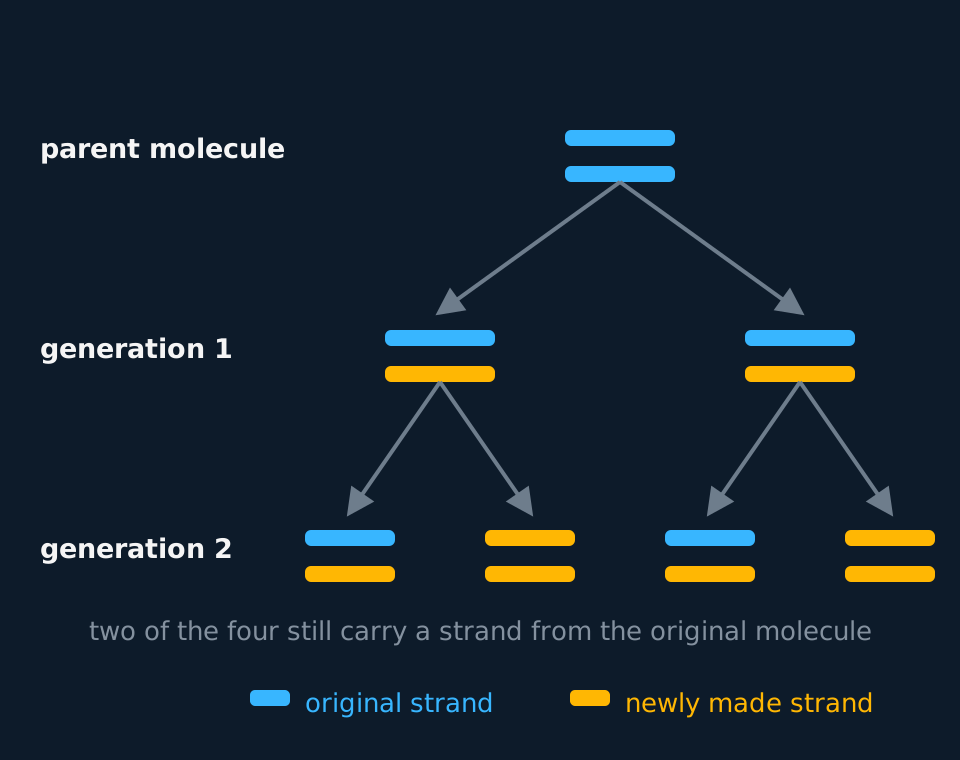
Before the mechanism was known, three models were proposed. The conservative model said the original double helix stayed intact and an entirely new one was built alongside it. The dispersive model said the new molecules were patchworks, with stretches of old and new sequence scattered along both strands. The semi-conservative model, which Watson and Crick put forward in 1953 alongside their double helix, said the two strands separate, each acts as a template, and each new molecule contains one original strand and one new one.
Describe the drawing
A family tree of DNA molecules over two rounds of replication. The parent molecule at the top is two original strands. Arrows lead to two granddaughter rows: each of the two molecules in generation one is one original strand paired with one new strand, and of the four molecules in generation two, two still contain an original strand while two are made entirely of new strands.
The term semi-conservative refers to each daughter molecule: half of each is conserved from the parent. State it that way rather than as 'half the DNA is conserved', which is imprecise and, after several generations, incorrect.
- Semi-conservative replication
- Replication in which the two strands of the parent molecule separate and each acts as a template, so every daughter molecule contains one original strand and one newly synthesised strand.
- Template strand
- A strand of DNA whose base sequence determines the sequence of the new strand built against it.
Strand separation and synthesis
In a eukaryotic cell, DNA is replicated during S phase of interphase, before the cell divides. Replication begins when DNA helicase travels along the molecule and breaks the hydrogen bonds between paired bases. The two strands separate and the helix unwinds, exposing the bases. Name the bonds broken: hydrogen bonds, between the paired bases. The phosphodiester bonds along each backbone are covalent and are not broken, which is why the strands separate intact.
Free DNA nucleotides, already present in the nucleoplasm, then align against the exposed bases by complementary base pairing. An adenine on the template attracts a thymine nucleotide and nothing else; a cytosine attracts a guanine. The specificity of the pairing is what makes the copy accurate; it follows from the chemistry of the bases.
DNA polymerase then catalyses the condensation reactions that join the aligned nucleotides into a continuous strand, forming a phosphodiester bond between each one and the next. The free nucleotides arrive as nucleoside triphosphates, so the energy for each bond comes from the two extra phosphates being released as the bond forms.
Describe the drawing
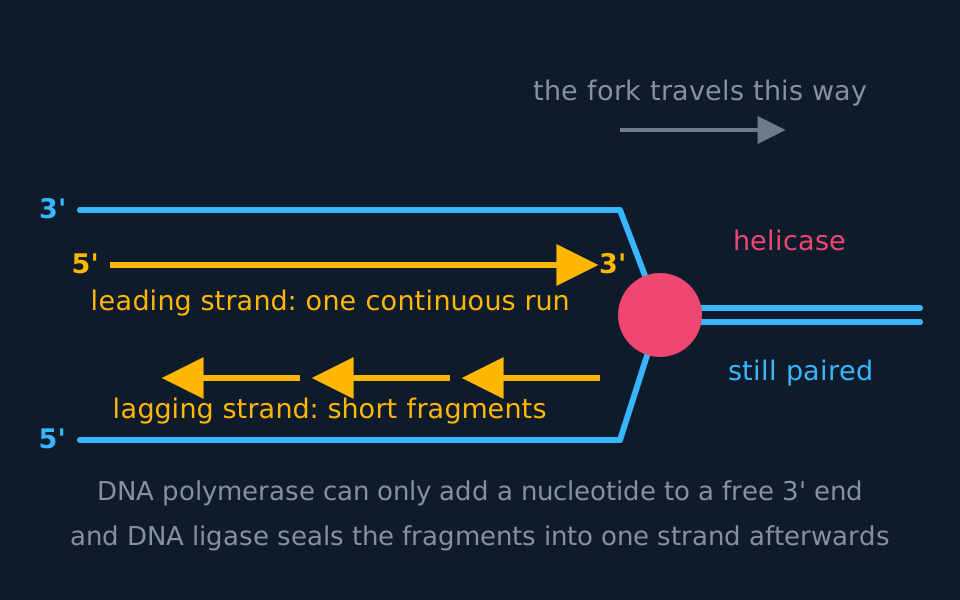
A replication fork drawn as a sideways Y. The still-paired double helix is on the right, with helicase marked at the junction and an arrow showing the fork moving into it. Along the upper separated template a single long arrow points toward the fork, labelled the leading strand, with its five prime end behind it and its three prime end at the tip. Along the lower template three short arrows point away from the fork, the Okazaki fragments of the lagging strand.
DNA polymerase can only build a strand in the 5′ to 3′ direction, because it can only attach a new nucleotide to a free 3′ hydroxyl group. The two template strands are antiparallel, so the enzyme cannot travel the same way along both. On one template it moves in the direction the fork is opening, and produces one long unbroken leading strand. On the other it must work away from the fork, so it waits for a stretch of template to be exposed, copies backwards along it, then jumps forward and does it again. The result is the lagging strand: a series of short pieces called Okazaki fragments, typically 100 to 200 nucleotides long in eukaryotes, which DNA ligase later joins into one continuous strand.
| Leading strand | Lagging strand | |
|---|---|---|
| Direction of synthesis | 5′ to 3′ | 5′ to 3′, the same, always |
| Relative to the fork | Toward it, following the opening | Away from it, working backwards |
| Continuity | One continuous piece | Short Okazaki fragments |
| Extra enzyme needed | None beyond polymerase, in the A-level account | DNA ligase, to seal the fragments |
The commonest confusion here is thinking the lagging strand is built 3′ to 5′. It is not. Both new strands are built 5′ to 3′ without exception. What differs is the direction of travel relative to the fork, and that is what forces one of them into fragments.
One footnote on an A-level simplification. DNA polymerase cannot start a strand from nothing, only extend one, so in the full account every new strand, the leading strand included, begins with a short RNA primer laid down by an enzyme called primase. On the lagging strand each fragment starts with its own primer, and the primers are removed and replaced with DNA before ligase seals the joins. Most courses leave the primers out; if yours names primase, this is where it fits.
The Meselson-Stahl experiment
In 1958 Matthew Meselson and Franklin Stahl found a way to tell the three models apart by weight. They grew E. coli for many generations in a medium whose only nitrogen source was the heavy isotope ¹⁵N. Nitrogen is in every base, so the bacteria built DNA that was measurably denser than normal. They then transferred the culture to a medium containing only ordinary ¹⁴N, so every nucleotide made from that point on was light, and sampled the DNA after each round of division.
Spinning the extracted DNA in a caesium chloride solution at very high speed sets up a density gradient, and each DNA molecule settles at the depth matching its own density. Heavy DNA sinks furthest. Light DNA stays highest. A hybrid molecule, one heavy strand and one light, settles halfway between.
Describe the drawing
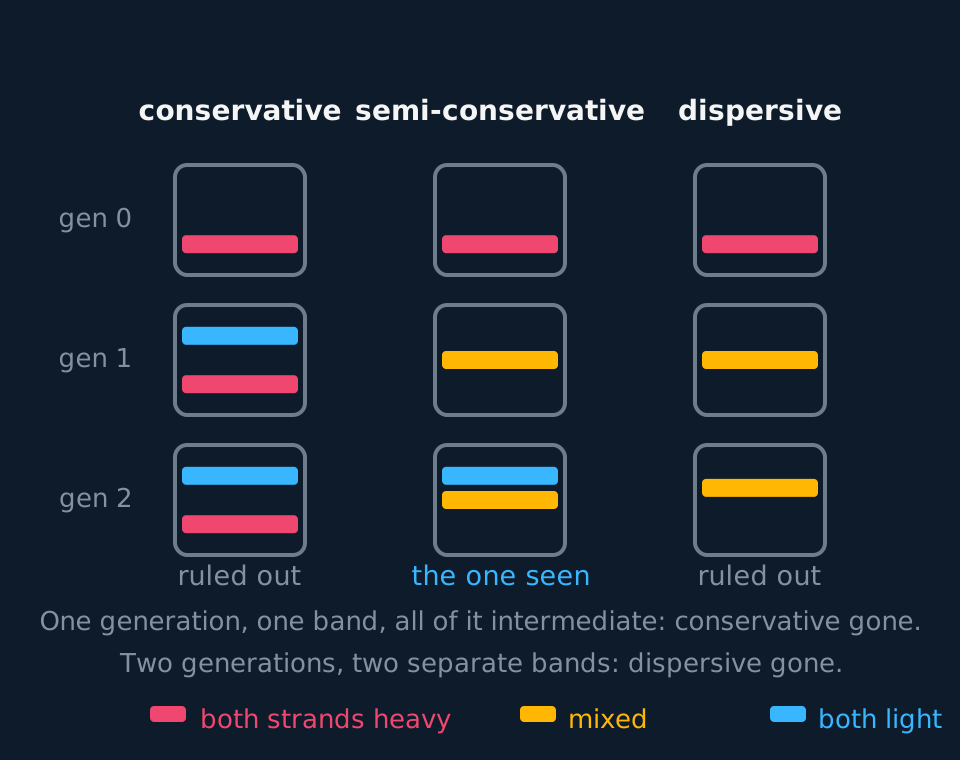
Three columns of centrifuge tubes, one column for each proposed model of replication, with three tubes down each column for the starting DNA and the first and second generations. The conservative column keeps a heavy band throughout. The semi-conservative column shows a single intermediate band after one generation and two bands, intermediate and light, after two. The dispersive column shows a single band that drifts upward and never splits.
After one generation there was a single band, and it sat exactly halfway between the heavy and light positions. That result eliminates the conservative model, which predicts that the original heavy molecule survives intact and an entirely light molecule is built beside it, giving two bands, one heavy and one light, and no intermediate band. A conservative mechanism cannot produce a molecule of mixed density, because it never places old and new material in the same molecule.
That result alone does not distinguish semi-conservative from dispersive, because a patchwork molecule of half-old, half-new sequence would also be of intermediate density. The second generation separates them. The semi-conservative model predicts two bands: half the molecules still contain one heavy strand and stay intermediate, while half are now entirely light. The dispersive model predicts one band again, this time three quarters of the way toward light, because every molecule is still an even mixture. Two distinct bands appeared, which eliminates the dispersive model.
Predicting the third generation
Continue the experiment for one more division. What proportion of the DNA would be in the intermediate band and what proportion in the light band after three generations in ¹⁴N medium, and why does the intermediate band never disappear?
Show the working
Count strands rather than molecules. There are two original heavy strands and they are never destroyed, so exactly two molecules in every generation contain one.
After three generations there are 2³ = 8 molecules. Two of them contain a heavy strand and are therefore intermediate; the other six are entirely light. The intermediate band holds 2/8, or 25%, of the DNA and the light band holds 6/8, or 75%.
The intermediate band becomes fainter each generation but does not disappear, because the two original strands persist indefinitely and are diluted among an increasing number of molecules. Complete disappearance of the intermediate band would be evidence against semi-conservative replication.
Replication errors and mutation
Human DNA replication leaves roughly one uncorrected error per billion base pairs copied, after DNA polymerase's own proofreading and the cell's mismatch repair have corrected most errors. Across 3.1 billion base pairs that still leaves several new errors in every cell division.
An uncorrected error is a mutation: a change in the base sequence of DNA. A base substitution swaps one base for another. An insertion or deletion adds or removes bases; within a coding region, adding or removing a number not divisible by three shifts the reading of every triplet downstream, which is usually far more damaging, while a whole number of triplets leaves the frame intact. Mutations also arise from mutagens such as ultraviolet light, some chemicals in tobacco smoke and ionising radiation, not only from errors in replication.
- Mutation
- A change in the base sequence of DNA.
- Substitution
- A mutation in which one base is replaced by another.
- Deletion
- A mutation in which a base is lost; within a coding region, losing a number of bases not divisible by three shifts the reading of every triplet that follows.
Most mutations have no effect. Some occur in non-coding stretches of DNA. Some change a triplet into another triplet coding for the same amino acid, a consequence of the degeneracy of the genetic code. Some change an amino acid in a region of the protein where the substitution does not alter the folded shape. A minority alter the protein's function, and a few of those are advantageous, which is one source of the variation on which natural selection acts.
The standard example, stated precisely: in sickle-cell anaemia a single base substitution in the gene for the β-globin chain of haemoglobin changes one triplet, one amino acid changes from glutamic acid to valine, and the altered haemoglobin polymerises at low oxygen concentrations and distorts the red blood cell. The gene sits on chromosome 11, so that is one base out of about 135 million on that chromosome.
TRY IT: Explaining why a control was necessary
Meselson and Stahl also ran a control in which they mixed extracted heavy DNA with extracted light DNA and spun the mixture. Suggest why this control was needed, and what result would have made their main conclusion unsafe.
Check your answer
The control shows that the centrifuge can resolve heavy DNA from light DNA as two separate bands in the same tube.
Without it, the single intermediate band seen after one generation could have been explained away as a mixture of heavy and light molecules that the technique was simply not sensitive enough to separate. The control removes that explanation: the two densities plainly do separate when both are present, so one band means one density.
If the mixture had produced a single band in the intermediate position, the method would have been shown incapable of telling the models apart, and no conclusion could have been drawn from the main result at all.
Extracting and precipitating DNA
DNA can be extracted from tissue in a standard bench practical using ordinary reagents, and each step depends on a property of the molecule described above. Kiwi fruit, strawberries, peas, onion and cheek cells are all suitable sources.
Mash the tissue first, which breaks open the plant cell walls, then mix it with a warm solution of salt and detergent and leave it for a few minutes. The two reagents do different jobs. The detergent disrupts the phospholipid bilayers of the cell surface membrane and the nuclear envelope, because membranes are lipid and dissolving lipid is what a detergent does; that releases the DNA into solution. The sodium ions of the salt are attracted to the negatively charged phosphate groups of the sugar-phosphate backbone and shield them, so the DNA molecules stop repelling one another and can later clump together. Filter the mixture to take out the debris of walls and organelles.
Next add a protease. In a eukaryotic nucleus the DNA is wound around histone proteins, and the extract is full of other protein besides; the protease hydrolyses them, leaving the DNA free. Then tilt the tube and pour ice-cold ethanol slowly down the side, so that it forms a separate layer floating on the extract rather than mixing in. DNA is insoluble in cold ethanol, so it comes out of solution at the boundary between the layers as a tangle of white fibres, which can be lifted out by winding them slowly onto a glass rod. That lifting-out is called spooling, and it only works because each molecule is so enormously long. The cold matters twice over: DNA is less soluble in cold ethanol than warm, and low temperature slows any enzymes in the extract that would otherwise be cutting the molecule up.
Each reagent has a distinct function, and each follows from the structure of the material. Detergent disrupts membranes because membranes are phospholipid; salt is required because the backbone carries a negative charge at every phosphate; protease is required because eukaryotic DNA is packaged with histones; and the fibres are visible without magnification because the molecules are millions of base pairs long.
- DNA precipitation
- The recovery of DNA from a filtered tissue extract as visible fibres, by layering ice-cold ethanol on top; the DNA, insoluble in cold ethanol, forms at the boundary and is spooled onto a rod.
In the exam
- State that each new molecule has one original strand and one new strand. 'Half the DNA is old' is not precise enough.
- Name the bonds separately. Helicase breaks hydrogen bonds between bases; DNA polymerase forms phosphodiester bonds along the backbone.
- Both new strands are built 5′ to 3′. The lagging strand is discontinuous because of its direction relative to the replication fork, not because the polymerase reverses.
- For Meselson-Stahl, state what each model predicts before stating what was observed, and use the comparison to eliminate two of the three models.
- Give the isotopes the right way round: ¹⁵N is the heavy one the bacteria were grown in first, ¹⁴N the light one they were moved to.
Check yourself
A student claims that after two generations in light medium, a conservative model and a semi-conservative model would give the same result, so the experiment proves nothing. Explain why the student is wrong, using the position and number of the bands.
Answer
The two models differ at the first generation, and they differ again at the second, so at no point do they predict the same thing.
After one generation the conservative model predicts two bands: the original heavy molecule intact at the bottom of the gradient and a completely new light molecule at the top, with nothing between them. The semi-conservative model predicts one band only, sitting midway, because every molecule is one heavy strand paired with one light one. A single intermediate band was what appeared, which eliminates the conservative model at that point.
After two generations the conservative model would still show a heavy band, since the original molecule is never taken apart under that model. The semi-conservative model predicts no heavy DNA at all: two intermediate molecules and two light ones, giving two bands, one midway and one at the light position. That is what was seen.
The student has confused 'both models predict some light DNA' with 'both models predict the same bands'. The persistence of a heavy band is the difference, and it was absent.
Questions
Question 15 marks
Describe how a molecule of DNA is copied semi-conservatively, naming the enzymes involved and the bonds that are broken and formed.
Mark scheme
- B1 DNA helicase breaks the hydrogen bonds between complementary bases, so the two strands separate and the helix unwinds
- B1 each of the two separated strands acts as a template
- B1 free DNA nucleotides align against the exposed bases by complementary base pairing, adenine to thymine and cytosine to guanine
- B1 DNA polymerase catalyses the condensation reactions that join the aligned nucleotides, forming phosphodiester bonds along the new backbone
- A1 each daughter molecule ends up with one original strand and one newly synthesised strand, which is what semi-conservative means
Question 24 marks
Explain why one of the two new DNA strands is built continuously while the other is built as a series of short fragments.
Mark scheme
- B1 DNA polymerase can only attach a nucleotide to a free 3′ hydroxyl group, so it can only build a strand in the 5′ to 3′ direction
- B1 the two template strands are antiparallel, so the enzyme cannot travel the same way along both of them
- B1 on one template it moves in the direction the replication fork is opening, producing one continuous leading strand
- B1 on the other it must work away from the fork, so it waits for template to be exposed and copies a short piece backwards each time, giving the Okazaki fragments of the lagging strand
Question 34 marks
Describe how detergent and salt are used to release DNA from tissue during a DNA extraction practical, and describe the specific job of each.
Mark scheme
- B1 the tissue is mashed and mixed with a warm solution of detergent and salt
- B1 the detergent disrupts the phospholipid bilayers of the cell surface membrane and the nuclear envelope, since a detergent dissolves lipid, which releases the DNA into solution
- B1 the sodium ions of the salt are attracted to and shield the negatively charged phosphate groups of the DNA backbone
- B1 shielding those charges stops the DNA molecules repelling one another, so they can later clump together rather than staying dispersed
Question 44 marks
Explain how the result of the second generation of the Meselson-Stahl experiment eliminated the dispersive model of replication, once the conservative model had already been ruled out.
Mark scheme
- B1 the dispersive model predicts that every molecule, in every generation, is an even patchwork of old and new sequence, so after the second generation it predicts a single band, this time three quarters of the way toward the light position, rather than two separate bands
- B1 the semi-conservative model instead predicts two distinct bands after the second generation: half the molecules still contain one original heavy strand and remain intermediate, while the other half are now entirely light
- B1 two distinct bands were observed rather than one shifted band, which matches the semi-conservative prediction and not the dispersive one
- B1 only after the second generation do the semi-conservative and dispersive models make different, testable predictions
Question 54 marks
A lagging strand 1500 nucleotides long is synthesised as Okazaki fragments each approximately 150 nucleotides long. Calculate the number of fragments produced, and calculate the number of phosphodiester bonds ligase must form to join them into one continuous strand.
Mark scheme
- M1 number of fragments = total length ÷ fragment length = 1500 ÷ 150
- A1 10 Okazaki fragments
- M1 joining n fragments into one continuous strand needs n − 1 new bonds, since each join is between one fragment and the next
- A1 ligase must form 10 − 1 = 9 phosphodiester bonds
Question 64 marks
A student says that replication copies just one strand of the original molecule, so you end up with the old molecule intact and a brand new molecule made entirely from scratch beside it. Discuss whether this is an accurate description of semi-conservative replication.
Mark scheme
- B1 what is right: the student is correct that one new molecule is produced from the old one, and that new material is synthesised during replication
- B1 against: this description is actually the conservative model, which predicts that the original double helix stays intact and an entirely new one is built alongside it; it is not what semi-conservative replication does
- B1 against: in semi-conservative replication both original strands separate and each acts as a template, so both of the two daughter molecules contain one original strand and one newly synthesised strand, rather than one molecule being entirely old and the other entirely new
- B1 judgement: no molecule after replication is entirely old; the Meselson-Stahl experiment's single intermediate band after one generation is exactly the evidence against this description
Question 73 marks
Bacteria whose DNA contains only ¹⁵N are transferred to a medium containing only ¹⁴N and allowed to divide four times. Calculate the percentage of the DNA molecules that still contain a ¹⁵N strand.
Mark scheme
- M1 the two original heavy strands are never destroyed, so exactly two molecules contain one
- M1 after four divisions there are 2⁴ = 16 molecules altogether, so the proportion is 2 ÷ 16
- A1 12.5 per cent of the molecules contain a ¹⁵N strand, the remaining 87.5 per cent being entirely light
Question 83 marks
DNA polymerase corrects most of its own copying errors, but a few substitutions survive in every cell division. Suggest three reasons why such a substitution often has no effect on the organism.
Mark scheme
- B1 the substitution may fall in a non-coding stretch of DNA, so no polypeptide is affected by it
- B1 the altered triplet may code for the same amino acid as the original, so the polypeptide is unchanged
- B1 the amino acid may change in a region of the protein where the substitution makes no difference to the folded shape, so the protein still functions
Question 93 marks
In the Meselson and Stahl experiment, a single band of intermediate density appeared after one generation in the light medium. Explain why this ruled out the conservative model of replication but could not rule out the dispersive model.
Mark scheme
- B1 the conservative model never puts old and new material in the same molecule, so it predicts one heavy band and one light band and no intermediate band at all
- B1 one intermediate band and no heavy band is therefore impossible under the conservative model, which is ruled out
- B1 a dispersive patchwork of half-old and half-new sequence would also settle at intermediate density after one generation, so the two remaining models predict the same first-generation result and only the second generation separates them
Question 103 marks
Explain why a protease is added to a DNA extract before it is precipitated, and explain why the ethanol used must be ice-cold.
Mark scheme
- B1 in a eukaryotic nucleus DNA is wound around histone proteins, and the extract also contains other protein besides, so a protease is added to hydrolyse this protein and leave the DNA free
- B1 DNA is less soluble in cold ethanol than in warm ethanol, so using ice-cold ethanol makes more of the DNA come out of solution as visible fibres
- B1 low temperature also slows any enzymes remaining in the extract that would otherwise break the DNA molecules up before they can be spooled out
Question 113 marks
Explain how a single base substitution in the gene for the β-globin chain of haemoglobin causes sickle-cell anaemia.
Mark scheme
- B1 a single base substitution changes one triplet in the gene, so the corresponding codon in the mRNA changes
- B1 that changed codon specifies a different amino acid, valine in place of glutamic acid, at one position in the polypeptide
- B1 the altered haemoglobin this produces polymerises at low oxygen concentrations, and that distorts the shape of the red blood cell containing it
Question 122 marks
State the role of DNA helicase and state the role of DNA ligase in the replication of a DNA molecule.
Mark scheme
- B1 helicase breaks the hydrogen bonds between the paired bases, so the two strands separate and the helix unwinds
- B1 ligase joins the Okazaki fragments of the lagging strand into one continuous strand, forming the phosphodiester bonds between them
Question 132 marks
After proofreading and mismatch repair, replication leaves about one uncorrected error per billion base pairs copied. The human genome is about 3.1 × 10⁹ base pairs. Calculate the expected number of new errors each time one copy of the genome is made.
Mark scheme
- M1 divide the base pairs copied by the error interval: 3.1 × 10⁹ ÷ 1 × 10⁹
- A1 about 3 new errors per copy, accepting 3.1
Question 142 marks
Give the type of bond broken by DNA helicase, and give the type of bond formed by DNA polymerase.
Mark scheme
- B1 helicase breaks the hydrogen bonds between paired bases, across the molecule
- B1 DNA polymerase forms phosphodiester bonds, which are covalent, along the backbone of the new strand
Question 152 marks
DNA polymerase cannot start a new strand on its own: it can only add nucleotides to the end of a strand that already exists, so each new stretch of DNA is begun on a short RNA primer made by another enzyme. At a replication fork one new strand is built continuously and the other as a series of short fragments. Explain why the strand built in fragments needs many primers, while the strand built continuously needs only one.
Mark scheme
- B1 each fragment is a separate stretch of DNA begun from nothing, and polymerase cannot begin one without an existing strand to extend, so every fragment needs its own primer
- B1 the continuous strand is extended without a break from its single starting point as the fork opens, so after the first primer the polymerase always has the end of the growing strand to add to
Worth remembering
- Semi-conservative: every daughter molecule is one old strand and one new one.
- Helicase breaks hydrogen bonds; DNA polymerase makes phosphodiester bonds; ligase seals the fragments.
- DNA polymerase adds nucleotides only to a free 3′ end, so synthesis is always 5′ to 3′.
- Antiparallel templates plus a one-way enzyme give one leading strand and one lagging strand.
- One intermediate band after one generation rules out the conservative model; two bands after two rules out the dispersive one.
CHECK YOUR PROGRESS
Rate how confident you are with each objective for this lesson. Ratings are saved in this browser, on this device, unless you sign in.
- Explain what semi-conservative replication means, in terms of what happens to the original strands.
- Describe the roles of helicase and DNA polymerase, naming the bonds each one deals with.
- Explain why one new strand is made continuously and the other in fragments.
- Describe the Meselson-Stahl experiment and explain how its results eliminated two competing models.
- Explain how a replication error becomes a mutation, and why most cause no harm.
- Describe how DNA is extracted and precipitated from tissue, giving the job of the detergent, the salt, the protease and the ice-cold ethanol.
Open the full revision checklist to see every objective in the curriculum in one place.
Practise this lesson
Practise DNA replication with 15 original questions and point-by-point mark schemes
WORKBOOK
The questions from this topic, on paper with room to work, and a separate book of mark schemes. Free to use; please do not redistribute or sell.
Used later in The cell cycle and mitosis · Meiosis and the sources of genetic variation · Recombinant DNA technology