Biology › Hormonal communication, plant responses and homeostasis › Hormonal communication and negative feedback
Hormonal communication and negative feedback
Endocrine glands secrete hormones into the blood. A hormone affects only target cells that possess the appropriate receptor. Endocrine and exocrine glands are compared here, signalling by steroid and peptide hormones is explained, and negative feedback is shown maintaining internal conditions within a normal range.
Before this Cell membranes: receptor proteins and complementary shape · Receptors and the nervous system: why a reflex is fast
COMMON MISCONCEPTION
Adrenaline gets into the liver cell and switches on the enzyme that breaks glycogen down.
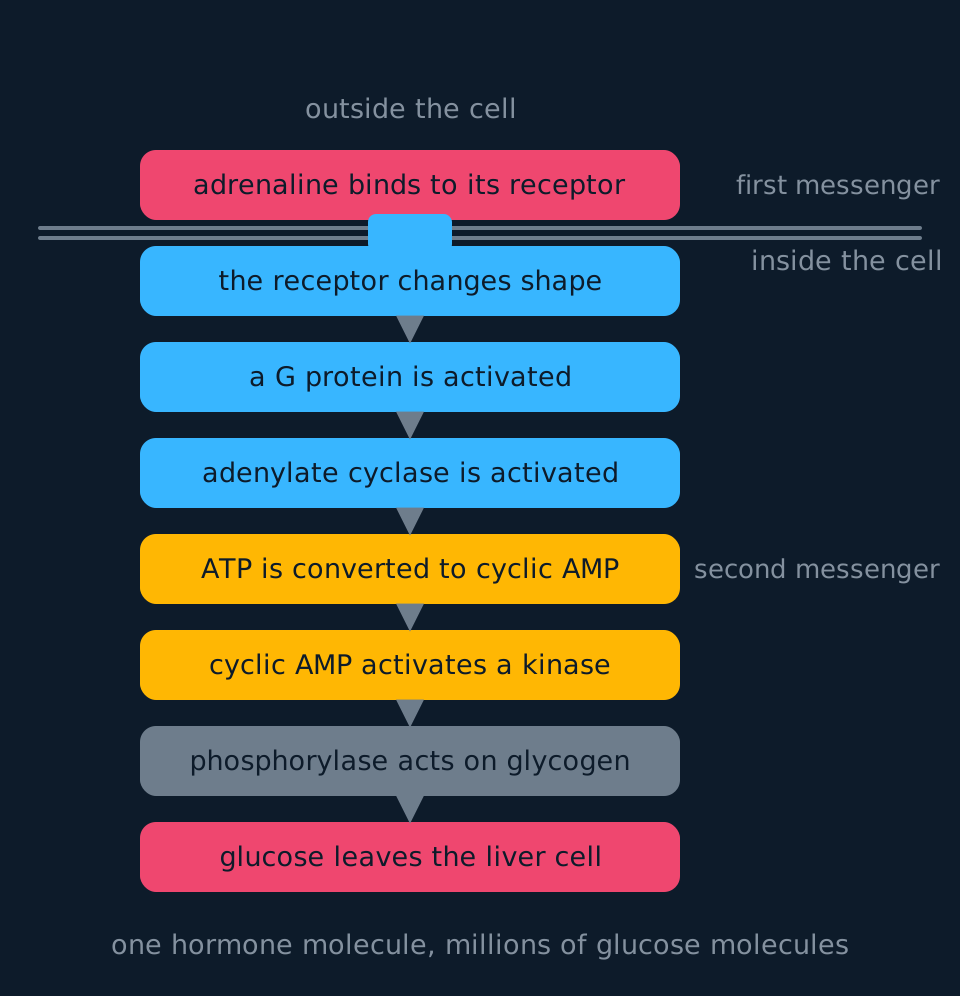
Adrenaline binds to a receptor on the hepatocyte membrane. A G protein activates adenylate cyclase, which produces cyclic AMP; the resulting enzyme cascade activates glycogen breakdown. Signal amplification allows one bound hormone molecule to affect many substrate molecules.
What you should be able to do
- Distinguish an exocrine gland from an endocrine gland by where its secretion goes.
- Describe the relationship between the hypothalamus and the two lobes of the pituitary.
- Explain why a peptide hormone needs a second messenger and a steroid hormone does not.
- Describe the adrenaline cascade in order, from binding to glucose leaving the liver cell.
- Explain negative feedback using receptor, coordinator and effector, and say what positive feedback does instead.
- Compare nervous and hormonal coordination on speed, route, duration and target.
Exocrine and endocrine glands
Glands are classified by where the secretion is released, not by what is secreted or what the secretion does.
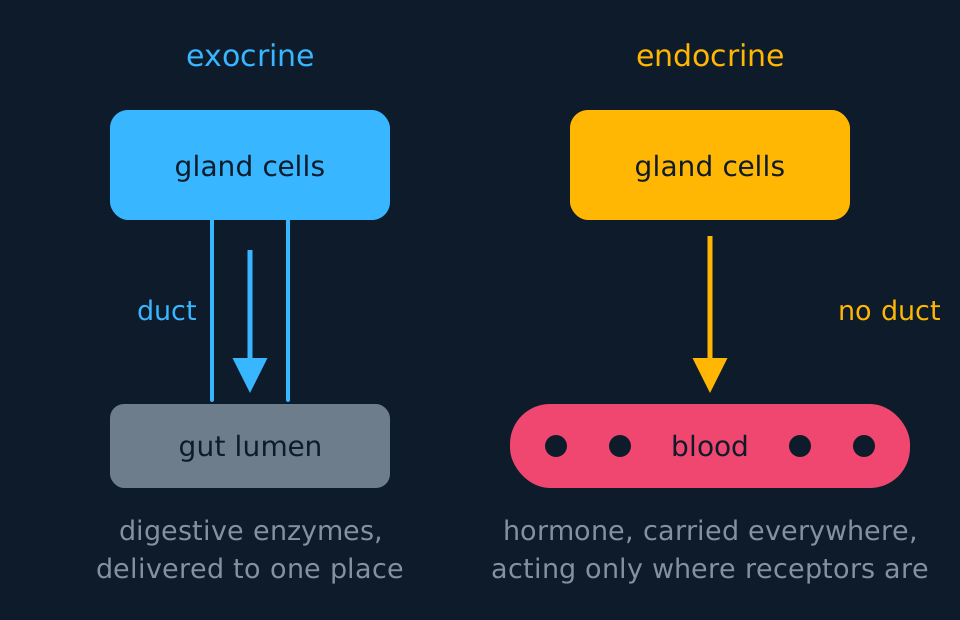
An exocrine gland releases its product into a duct that carries it to a surface such as the gut lumen, the skin or the mouth. Salivary glands, sweat glands and the enzyme-secreting cells of the pancreas are exocrine, and their product arrives at one place, in bulk.
An endocrine gland has no duct at all. It releases its product, a hormone, straight into the capillaries running through it, and the blood takes it everywhere. The thyroid, the adrenals, the pituitary and the islets of Langerhans are endocrine.
Describe the drawing
Two glands drawn side by side. On the left an exocrine gland: a block of secretory cells emptying through a duct into the gut lumen, so its product arrives at one surface. On the right an endocrine gland: an identical block of cells with no duct at all, releasing hormone straight into a capillary, so the product travels in the blood to every tissue and acts only where a complementary receptor exists.
The pancreas is both. Most of it is exocrine tissue making pancreatic juice, which leaves down the pancreatic duct into the duodenum; scattered through it are about a million patches of endocrine cells, the islets of Langerhans, which secrete insulin and glucagon into the blood and have no connection to the ducts at all. Next topic: blood glucose control, which depends on the endocrine tissue only.
A hormone carried in the blood reaches tissues throughout the body, yet affects only some of them. A cell responds only if the blood supply reaches it and it carries a receptor with a binding site complementary to the hormone. Specificity therefore depends on the receptor rather than on the route of delivery.
- Exocrine gland
- A gland that secretes its product into a duct, which carries it to a surface.
- Endocrine gland
- A ductless gland that secretes hormones directly into the blood.
- Hormone
- A chemical messenger, secreted by an endocrine gland into the blood, that acts on target cells carrying a complementary receptor.
- Target cell
- A cell with receptors complementary to a particular hormone, and therefore the only kind of cell that responds to it.
The hypothalamus and the pituitary gland
The pituitary gland hangs beneath the brain on a stalk and controls much of the endocrine system. Above it lies the hypothalamus, the region of the brain that monitors the blood passing through it: its temperature, its water potential and the hormones already circulating in it. The two lobes of the pituitary are connected to the hypothalamus by different routes.
The posterior pituitary is not really a gland. Its hormones, ADH and oxytocin, are made in the cell bodies of neurones in the hypothalamus and travel down the axons of those neurones into the posterior lobe, where they are stored and later released into the blood. So the posterior pituitary stores and releases what the hypothalamus makes.
The anterior pituitary makes its own hormones, and the hypothalamus controls it chemically: releasing factors travel the short distance in a dedicated set of blood vessels and stimulate secretion by the anterior lobe. Most of what it secretes acts on other glands: thyroid-stimulating hormone at the thyroid, ACTH at the adrenal cortex, FSH and LH at the ovaries and testes. Thyroxine in the blood then inhibits both the hypothalamus and the anterior pituitary, so a rise in thyroxine reduces the signal that produced it. This is negative feedback operating across three glands.
The adrenal glands, one on top of each kidney, are the other pair to know by name. The outer cortex secretes steroid hormones: cortisol, under the control of ACTH, and aldosterone, which acts on the kidney tubule and is controlled mainly by the renin-angiotensin system rather than by ACTH. The inner medulla secretes adrenaline under direct nervous control rather than hormonal control, which is why adrenaline is released rapidly. Exam-board note: OCR A examines the adrenal glands and the cortex and medulla distinction explicitly; AQA examines adrenaline within blood glucose control; Cambridge International 9700 does not name adrenaline and teaches the cyclic AMP cascade with glucagon.
- Hypothalamus
- The region of the brain that monitors the blood and controls the pituitary gland.
- Posterior pituitary
- The lobe that stores and releases ADH and oxytocin, both made in the hypothalamus.
- Anterior pituitary
- The lobe that makes its own hormones, under the control of releasing factors from the hypothalamus.
How the signal crosses the cell surface membrane
A hormone must alter processes inside its target cell, and the cell surface membrane lies between the hormone and those processes. Two mechanisms exist, and which one applies depends on whether the hormone is lipid-soluble.
Steroid hormones such as oestrogen, testosterone, cortisol and aldosterone are lipid-soluble. They diffuse straight through the phospholipid bilayer, bind to a receptor inside the cell, and the hormone-receptor complex acts in the nucleus as a transcription factor, switching genes on or off. Their effects are therefore slow to appear and long-lasting, because making a protein takes time and the protein persists.
Peptide and protein hormones such as insulin, glucagon, ADH and FSH, along with adrenaline, which is derived from an amino acid, are not lipid-soluble and cannot cross. They bind to a receptor on the outer surface of the membrane, and something else has to carry the message inwards. That something is the second messenger.
Adrenaline acting at a liver cell is the standard worked example. Adrenaline is the first messenger: it binds to a receptor on the membrane, and binding changes the receptor's tertiary structure. The changed receptor switches on a G protein, a relay inside the membrane, and the G protein in turn activates adenylate cyclase on the inner face. That enzyme converts ATP into cyclic AMP, the second messenger, which activates a protein kinase; the kinase phosphorylates the next enzyme, and a short chain later glycogen phosphorylase is breaking glycogen down. The phosphorylase does not hydrolyse it: it uses phosphate to snip off glucose-1-phosphate units, which the cell converts to glucose before it leaves.
Describe the drawing
The adrenaline cascade drawn as a stack of eight steps running down the figure, cut across near the top by the cell surface membrane with a receptor spanning it. Adrenaline binds outside and never enters; the receptor changes shape and activates a G protein, adenylate cyclase converts ATP into cyclic AMP inside the cell, that cyclic AMP activates a kinase, the kinase leads to phosphorylase breaking glycogen down, and glucose leaves. The first and second messengers are named beside their steps.
Glucagon acts through the same cascade in the same cells, which is why the two hormones have similar effects on the liver although they are secreted in response to different stimuli. The same sequence answers a question on either hormone.
The reason for the elaborate route is amplification. Every step is catalysed, so one molecule at one step produces many at the next, and a hormone present at nanomolar concentrations can change what a whole organ is doing within seconds.
Putting a number on amplification
In a liver cell one activated receptor causes about 100 molecules of cyclic AMP to be made. Each cyclic AMP molecule activates one kinase, and each activated kinase activates about 100 molecules of the next enzyme. If that last enzyme releases 1000 glucose molecules from glycogen before it stops, how many glucose molecules does one adrenaline molecule account for?
Show the working
Work along the chain, multiplying at each catalysed step. One receptor gives 100 cyclic AMP, so 100 kinases are activated.
Each kinase activates 100 of the next enzyme: 100 × 100 = 10 000 molecules of phosphorylase.
Each of those releases 1000 glucose molecules, so the total is 10 000 × 1000 = 10 million glucose molecules from one hormone molecule.
The arithmetic is idealised, since real cascades leak and enzymes are being switched off while others are switched on, but the order of magnitude is what matters. State not only that the second messenger amplifies the signal but that the amplification arises because each step is enzyme-catalysed.
Negative feedback and positive feedback
Homeostasis is the maintenance of a stable internal environment, a dynamic equilibrium in which each variable fluctuates within narrow limits, and the mechanism that maintains it is almost always negative feedback: a change in a variable triggers a response that reverses the change.
Every such loop has the same four parts. A receptor detects a deviation from the norm; a coordinator, hormonal, nervous or both, carries the information; an effector brings about a response; and that response moves the variable in the direction that removes the original deviation, which is what makes the feedback negative. Name all four parts when describing any homeostatic mechanism.
Describe the drawing
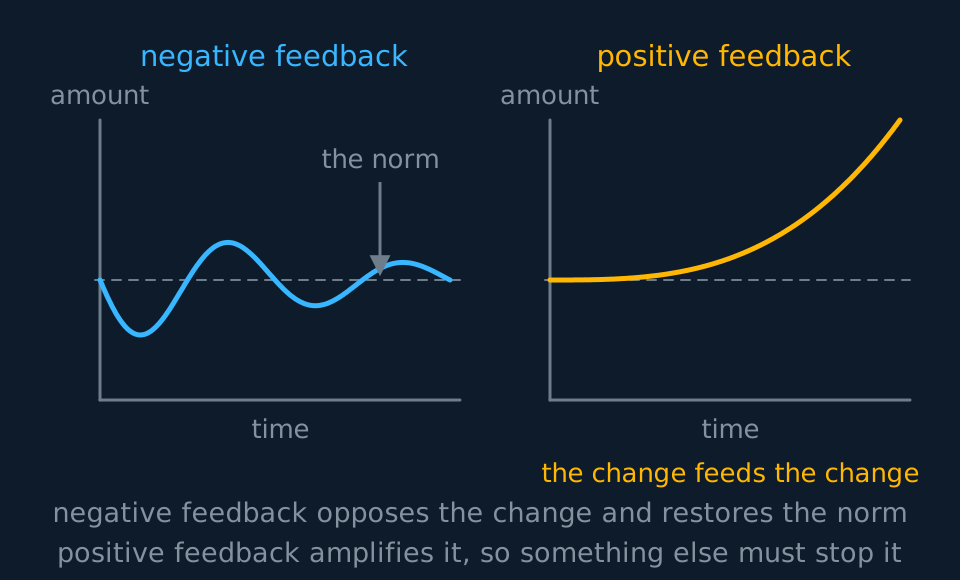
Two graphs of a variable against time. On the left, negative feedback: the line is displaced from a dashed norm, swings back across it and settles, each swing smaller than the one before. On the right, positive feedback: the line leaves the same dashed norm and climbs away from it faster and faster, never returning.
The left-hand graph does not show the variable held at the norm. It overshoots, returns, overshoots less, and oscillates within a narrow band. A system that acts only after a deviation has been detected must allow the deviation to occur, so blood glucose, core temperature and water potential all vary within limits through the day.
Blood pH is held within limits too, between about 7.35 and 7.45, because enzymes are sensitive to it. A change in hydrogen ion concentration alters the charges on the R groups of an enzyme, so the ionic and hydrogen bonds holding its tertiary structure change, the active site loses its complementary shape and fewer enzyme-substrate complexes form.
Two effectors working in opposite directions give tighter control than one. Insulin lowers blood glucose and glucagon raises it; sweating cools you and shivering warms you. One effector can push the variable one way and then wait for it to drift back, while two antagonistic effectors correct in both directions and correct faster.
Positive feedback is the opposite arrangement: the response increases the original change rather than reversing it. It is used when the body needs to commit to something quickly rather than hold it steady. In labour, the baby's head presses on the cervix, oxytocin is released, contractions strengthen and the head presses harder, and only birth ends the loop. In a neurone, the first sodium ions in open more sodium channels, which is why the rising phase of an action potential is so steep. In clotting, activated platelets activate more platelets.
Positive feedback is therefore a normal control mechanism rather than a malfunction: negative feedback maintains a variable and positive feedback drives a process rapidly to completion. It can also be harmful. In hypothermia, below about 33 °C the metabolic rate falls, which produces less heat, which lowers the core temperature further.
- Homeostasis
- The maintenance of a stable internal environment within narrow limits, despite changes in the external environment.
- Negative feedback
- A control mechanism in which a deviation from the norm triggers a response that reverses the deviation.
- Positive feedback
- A mechanism in which a deviation from the norm triggers a response that increases the deviation.
- Antagonistic
- Describes two effectors or hormones whose effects on a variable are opposite.
Nervous and hormonal coordination compared
Prerequisite: nervous coordination. Every row of the table below follows from two structural differences: the signal travels along a fixed pathway of neurones in one system and in the bloodstream in the other, and the messenger is removed within milliseconds in one and over minutes in the other.
| Nervous | Hormonal | |
|---|---|---|
| Signal | Electrical impulse, then a neurotransmitter at synapses | A chemical, the hormone itself |
| Route | Along neurones, to a defined destination | In the blood plasma, everywhere |
| Speed of transmission | Very fast, up to about 100 m per second | Slower: limited by circulation time |
| Target | Specific muscles or glands the neurone connects to | Any cell with a complementary receptor |
| Duration of effect | Short: the transmitter is broken down at once | Longer: the hormone persists until it is broken down |
| Nature of response | Usually rapid and localised | Often widespread, and sometimes permanent |
| Reversal | Rapid, when impulses stop | Slow, and often needs an antagonistic hormone |
The difference in reversal comes from how each messenger is removed. When a motor neurone stops firing, acetylcholinesterase clears the cleft within milliseconds; when a gland stops secreting, the hormone already in the blood keeps working until the liver removes it. That is why hormonal control relies on an antagonistic hormone to reverse a response quickly, while a nervous response ends when the impulses stop.
Some responses use both systems. A sudden stimulus triggers a reflex through motor neurones to skeletal muscle within a fraction of a second; at the same time impulses along sympathetic neurones reach the adrenal medulla, and the adrenaline released keeps heart rate and blood glucose raised for minutes afterwards.
TRY IT: Choosing the right system for a job
A person steps on a drawing pin and pulls their foot away, then stays shaky and alert for the next ten minutes. Explain why the withdrawal is coordinated by the nervous system and the shakiness by a hormone, referring to speed, route and duration.
Check your answer
The withdrawal has to happen in a fraction of a second to limit tissue damage. Impulses travel along a fixed pathway of neurones at up to 100 m per second, through the spinal cord and across only two synapses, so the response arrives almost immediately; a hormone would have to be secreted, enter the blood and be carried to the leg, which takes many seconds.
The response also needs to be localised. Only the muscles of that leg should contract, and a neurone reaches exactly the effector it connects to, while a hormone reaches every tissue.
The shakiness is caused by adrenaline from the adrenal medulla, and here the properties unsuited to the reflex are the useful ones. The effect must be widespread, reaching heart, liver, bronchioles and skeletal muscle together, and it must persist, which it does because the adrenaline remains in the blood until it is broken down. The adrenal medulla is where the two systems are linked.
In the exam
- Define an endocrine gland as ductless and secreting into the blood, rather than by what its hormone does.
- Explain specificity through receptors: a hormone affects only cells carrying a complementary receptor, not only cells the blood reaches.
- For the second messenger, name the molecules in order: adrenaline, receptor, G protein, adenylate cyclase, ATP to cyclic AMP, protein kinase, phosphorylase, glycogen to glucose. Adrenaline does not enter the cell, and cyclic AMP is made inside it.
- In a negative feedback answer, use the terms receptor, coordinator and effector, and state that the response reverses the change. Saying only that the level returns to normal gives the outcome rather than the mechanism.
- Compare nervous and hormonal control in paired statements: impulses travel along neurones, whereas hormones are carried in the blood and act more slowly.
Check yourself
A drug blocks adenylate cyclase in liver cells but leaves the adrenaline receptors, the protein kinase and glycogen phosphorylase intact. Predict the effect of the drug on the response of the liver to adrenaline, explain your prediction, and suggest why a drug blocking the receptor instead would have a similar outcome by a different route.
Answer
Adrenaline would still bind normally, because the receptors are unaffected, and the receptor would still change shape. The cascade would stop at the next step: with adenylate cyclase blocked, ATP is not converted into cyclic AMP.
With no cyclic AMP the protein kinase is never activated, so phosphorylase is not activated either, although both enzymes are present and working. No glycogen is broken down, so blood glucose would not rise in response to adrenaline.
Blocking the receptor gives the same end result by cutting the chain one step earlier: adrenaline could not bind, so the receptor would not change shape and adenylate cyclase would never be activated.
Both cases show the same property of a cascade. A pathway built from separate proteins acting in sequence fails wherever it is interrupted, which gives a drug several possible points of action.
Questions
Question 15 marks
Describe how adrenaline in the blood causes a liver cell to release glucose, naming the molecules involved in the order they act.
Mark scheme
- B1 adrenaline binds to a receptor on the outer surface of the cell surface membrane and does not enter the cell
- B1 binding changes the tertiary structure of the receptor, which activates adenylate cyclase on the inner face of the membrane
- B1 adenylate cyclase converts ATP into cyclic AMP, the second messenger
- B1 cyclic AMP activates a protein kinase, which phosphorylates and so activates the next enzyme in the chain
- A1 glycogen phosphorylase is activated and breaks glycogen down, releasing glucose, which leaves the cell
Question 24 marks
Explain why a steroid hormone such as oestrogen can act directly on the genes of its target cell while a peptide hormone such as insulin needs a second messenger.
Mark scheme
- B1 a steroid hormone is lipid-soluble, so it diffuses straight through the phospholipid bilayer of the membrane
- B1 inside the cell it binds to a receptor and the hormone-receptor complex acts in the nucleus as a transcription factor, switching genes on or off
- B1 a peptide hormone is not lipid-soluble and cannot cross the bilayer, so it binds to a receptor on the outer surface of the membrane instead
- A1 the message must therefore be carried inwards by a different molecule made in the cytoplasm, and because every step of that chain is enzyme-catalysed the signal is amplified as it goes
Question 34 marks
Explain how negative feedback holds a variable such as blood glucose close to a set point, and explain why two antagonistic hormones give tighter control than one.
Mark scheme
- B1 a receptor detects a deviation of the variable from the norm
- B1 a coordinator, which may be a hormone, a nerve or both, carries the information to an effector
- B1 the effector brings about a response that moves the variable in the direction that removes the original deviation, which is what makes the feedback negative
- A1 one effector can only push the variable one way and then wait for it to drift back, whereas two antagonistic hormones correct in both directions and so correct faster
Question 44 marks
Compare nervous coordination with hormonal coordination, writing paired statements about the route the message takes, its speed, its target and how long its effect lasts.
Mark scheme
- B1 a nervous message travels along neurones to a defined destination, whereas a hormone is carried in the blood plasma and reaches every tissue
- B1 impulses travel at up to about 100 m per second, whereas a hormone is limited by the time the blood takes to circulate, so it is much slower
- B1 a neurone stimulates only the muscles or glands it connects to, whereas a hormone acts on any cell carrying a complementary receptor
- B1 the nervous effect is short, because the neurotransmitter is broken down at once, whereas the hormonal effect lasts until the hormone itself is broken down and often needs an antagonistic hormone to reverse it
Question 54 marks
Describe how the hypothalamus controls the posterior pituitary and how it controls the anterior pituitary, naming one hormone released by each route.
Mark scheme
- B1 ADH and oxytocin are made in the cell bodies of neurones in the hypothalamus and travel down the axons of those neurones into the posterior pituitary, where they are stored
- B1 the posterior pituitary later releases them into the blood, so it stores and releases hormones rather than making its own
- B1 the anterior pituitary makes its own hormones, and the hypothalamus controls it chemically, by releasing factors carried in a short, dedicated set of blood vessels
- A1 one example is thyroid-stimulating hormone, released by the anterior pituitary in response to a releasing factor from the hypothalamus, which then acts on the thyroid gland
Question 64 marks
Compare negative feedback with positive feedback, referring to the direction of the response, whether the mechanism is self-limiting, and one named example of each.
Mark scheme
- B1 negative feedback produces a response that reverses a deviation from the norm, whereas positive feedback produces a response that increases the original deviation
- B1 negative feedback is self-limiting, because removing the deviation removes the stimulus for the response, whereas positive feedback is not self-limiting and continues until something outside the loop intervenes
- B1 blood glucose control is an example of negative feedback: a rise in glucose triggers insulin release, which lowers glucose and removes the stimulus that caused the release
- B1 blood clotting is an example of positive feedback: activated platelets release chemicals that activate more platelets, so the clotting response accelerates rather than being damped down
Question 73 marks
The hypothalamus secretes a releasing factor that stimulates the anterior pituitary to secrete thyroid-stimulating hormone (TSH), and TSH stimulates the thyroid gland to secrete thyroxine. Thyroxine in the blood inhibits secretion by both the hypothalamus and the anterior pituitary. A tumour of the anterior pituitary secretes TSH continuously, whatever else is in the blood. Suggest why the concentration of thyroxine in this person's blood is much higher than normal, and suggest what has happened to the releasing factor secreted by their hypothalamus.
Mark scheme
- B1 the continuous supply of TSH makes the thyroid secrete thyroxine continuously
- B1 the high concentration of thyroxine inhibits the hypothalamus, so it secretes very little releasing factor
- B1 the tumour does not respond to that inhibition, so negative feedback cannot lower the TSH, and thyroxine stays high even though the releasing factor has fallen
Question 83 marks
Explain why adrenaline can be released from the adrenal medulla within seconds of a stressful stimulus, while cortisol from the adrenal cortex takes several minutes to rise.
Mark scheme
- B1 the adrenal medulla is stimulated directly by sympathetic neurones, so adrenaline is released as soon as the nerve impulse arrives at the gland
- B1 the adrenal cortex has no equivalent direct nerve supply; it is controlled instead by ACTH, a hormone released from the anterior pituitary
- A1 a hormonal signal has to be secreted, enter the blood and be carried by the circulation to its target before the target can respond, which takes far longer than a nerve impulse reaching a gland directly
Question 93 marks
Give one example of a process in the body controlled by positive feedback rather than negative feedback, and give two ways in which its control differs from negative feedback.
Mark scheme
- B1 an example is the release of oxytocin during childbirth: pressure of the baby's head on the cervix causes contractions that press the head harder still
- B1 in positive feedback the response increases the original deviation rather than reversing it, unlike negative feedback, which brings the variable back towards a set point
- B1 positive feedback is not stopped by a return to normal; it continues until an event outside the loop ends it, such as the birth itself
Question 103 marks
One activated adrenaline receptor produces 50 molecules of cyclic AMP, each cyclic AMP activates one protein kinase, each kinase activates 60 molecules of the next enzyme, and each of those releases 500 molecules of glucose from glycogen. Calculate the number of glucose molecules released from one molecule of adrenaline.
Mark scheme
- M1 multiply along the chain: the number of cyclic AMP molecules by the number of next-enzyme molecules each kinase activates, 50 × 60 = 3000 molecules of active phosphorylase
- M1 multiply that by the glucose released per phosphorylase molecule: 3000 × 500
- A1 1 500 000 glucose molecules from one molecule of adrenaline
Question 113 marks
A drug used to treat high blood pressure blocks the receptors for adrenaline on the heart, but has no effect on receptors elsewhere in the body. Suggest why a person taking this drug feels less shaky and their heart beats more slowly during a stressful event, and suggest why they may still sweat heavily.
Mark scheme
- B1 with the adrenaline receptors on the heart blocked, adrenaline cannot bind there, so its usual effect of increasing heart rate is prevented, even though the hormone is still released and still circulating
- B1 the racing heartbeat that contributes to the shaky feeling no longer occurs, so the person feels calmer than they otherwise would
- A1 sweating is controlled directly by the nervous system rather than by adrenaline binding to a receptor on the heart, so a drug blocking only heart receptors leaves the sweat glands responding normally to the event
Question 122 marks
Name the hormone secreted by the adrenal medulla, and name the second messenger produced inside a liver cell when that hormone binds to its receptor.
Mark scheme
- B1 the hormone is adrenaline
- B1 the second messenger is cyclic AMP
Question 132 marks
State the structural difference between an exocrine gland and an endocrine gland, and state which type of gland the islets of Langerhans in the pancreas are.
Mark scheme
- B1 an exocrine gland secretes into a duct that carries the product to a surface, whereas an endocrine gland has no duct and secretes its product straight into the blood
- B1 the islets of Langerhans are endocrine gland tissue
Question 142 marks
Outline what is meant by a hormone's target cell, and outline why a hormone reaches cells that it does not affect.
Mark scheme
- B1 a target cell is a cell carrying receptors complementary in shape to a particular hormone, which is the only kind of cell able to respond to it
- B1 a hormone travels in the blood to every tissue the circulation reaches, but only cells with the complementary receptor respond, so specificity depends on the receptor rather than on where the blood goes
Question 152 marks
State what is meant by homeostasis, and state one variable in the body that is maintained by it.
Mark scheme
- B1 homeostasis is the maintenance of a stable internal environment within narrow limits, despite changes in the external environment
- B1 acceptable variables include blood glucose concentration, core body temperature or blood water potential
Worth remembering
- Exocrine glands secrete into a duct; endocrine glands secrete into the blood.
- A hormone is carried to tissues throughout the body; only cells with a complementary receptor respond.
- Steroid hormones cross the membrane and act on genes; peptide hormones cannot cross and use a second messenger.
- Adrenaline, receptor, G protein, adenylate cyclase, cyclic AMP, kinase, phosphorylase, glucose: in that order.
- Negative feedback reverses a change; positive feedback amplifies one, and something outside the loop has to stop it.
CHECK YOUR PROGRESS
Rate how confident you are with each objective for this lesson. Ratings are saved in this browser, on this device, unless you sign in.
- Distinguish an exocrine gland from an endocrine gland by where its secretion goes.
- Describe the relationship between the hypothalamus and the two lobes of the pituitary.
- Explain why a peptide hormone needs a second messenger and a steroid hormone does not.
- Describe the adrenaline cascade in order, from binding to glucose leaving the liver cell.
- Explain negative feedback using receptor, coordinator and effector, and say what positive feedback does instead.
- Compare nervous and hormonal coordination on speed, route, duration and target.
Open the full revision checklist to see every objective in the curriculum in one place.
Practise this lesson
WORKBOOK
The questions from this topic, on paper with room to work, and a separate book of mark schemes. Free to use; please do not redistribute or sell.
Used later in Organisation of the nervous system