Biology › Nucleic acids, genomes and protein synthesis › Translation and protein synthesis
Translation and protein synthesis
During translation, a ribosome moves along mRNA in the 5′ to 3′ direction. tRNA anticodons pair with successive codons, positioning amino acids so that peptide bonds can form. Translation ends at a stop codon; the polypeptide is then folded and may be modified in the endoplasmic reticulum and Golgi apparatus.
Before this The genetic code and transcription · Protein structure and function: folding · Cell ultrastructure: the Golgi apparatus and secretion · ATP as an energy currency
COMMON MISCONCEPTION
tRNA carries the codon to the ribosome, where it is matched against the mRNA.
The codon is on the mRNA; the tRNA carries the anticodon, the complementary triplet. Codon CCU is read by the tRNA whose anticodon is GGA, and that tRNA carries proline. Swap the two words and the mechanism described could not work.
What you should be able to do
- Describe the structure of a ribosome and say what its two binding sites hold.
- Explain the relationship between a codon and an anticodon, and say which molecule carries which.
- Describe initiation, elongation and termination in order.
- Explain where the energy for protein synthesis comes from and roughly how much is needed.
- Describe what happens to a polypeptide after it leaves the ribosome.
- Work from a given DNA sequence to the amino acid sequence it specifies.
Ribosome structure and tRNA-binding sites
A ribosome is built from ribosomal RNA and proteins, in two subunits of unequal size that enclose the mRNA. Eukaryotic ribosomes are 80S; those in prokaryotes and chloroplasts are the smaller 70S. Several antibiotics act by binding to 70S ribosomes and not to the 80S ribosomes of the eukaryotic cytoplasm. Mitochondrial ribosomes are of prokaryotic ancestry and are treated as 70S at A level, although mammalian mitochondrial ribosomes have been remodelled over evolutionary time and sediment nearer 55S. They retain enough structural similarity for some of those drugs to bind, which accounts for part of their toxicity.
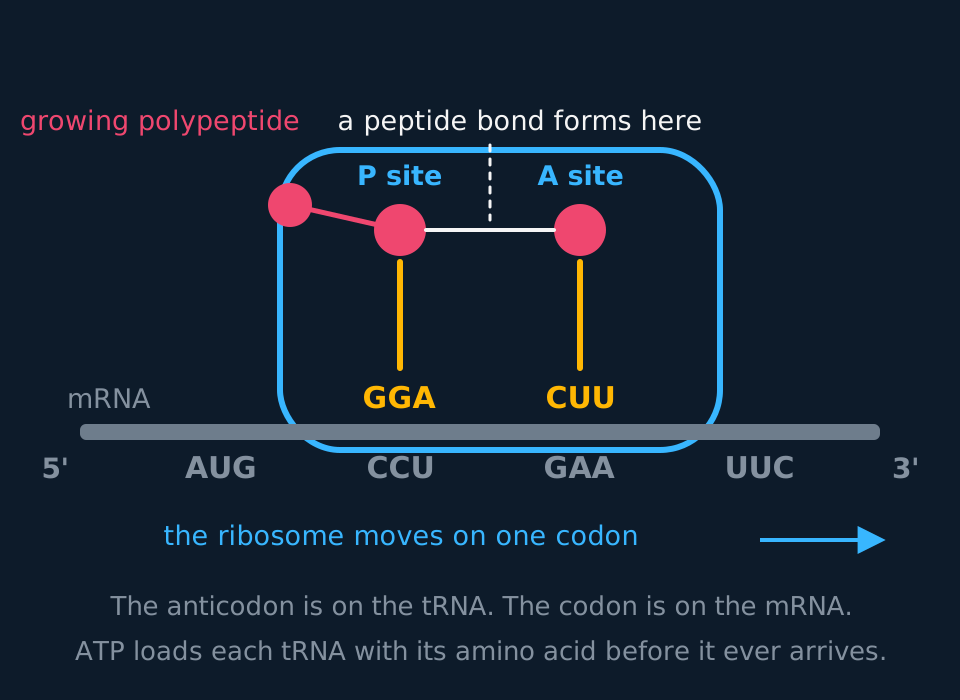
Describe the drawing
A ribosome drawn as a rounded outline sitting over a strand of messenger RNA whose codons read A U G, C C U, G A A and U U C from the five prime end. Two transfer RNAs stand inside it: one in the P site with anticodon G G A holding the growing polypeptide, one in the A site with anticodon C U U carrying the next amino acid, with the peptide bond about to form between the two amino acids.
The two binding sites A-level diagrams draw are the P site and the A site. The P site holds the tRNA carrying the growing polypeptide chain; the A site accepts the next tRNA, whose anticodon must match the codon underneath it. A real ribosome has a third position, the E (exit) site, occupied briefly by the unloaded tRNA before it leaves; drawing only A and P is acceptable in an examination answer. Because the ribosome moves along the mRNA in the 5′ to 3′ direction, the A site is always the one further along the message.
- Ribosome
- An organelle of ribosomal RNA and protein, in two subunits, which holds mRNA and tRNA in position while a polypeptide is assembled.
- Codon
- A triplet of bases on mRNA specifying one amino acid or a stop signal.
- Anticodon
- A triplet of bases on tRNA, complementary to a codon on mRNA.
How tRNA links codons to amino acids
A triplet of bases has no structural resemblance to an amino acid, so a molecule is required to link the two. Each tRNA molecule is about 80 nucleotides long, folded by hydrogen bonding between complementary parts of its own sequence into a clover-leaf shape with an anticodon at one end and a binding site for one specific amino acid at the other.
A set of enzymes, one for each amino acid, attaches the correct amino acid to each tRNA, using ATP. The pairing is specific: a tRNA with anticodon GGA is loaded with proline only. That specificity is what implements the genetic code. The ribosome matches triplets; which amino acid corresponds to which triplet is determined by which amino acid is attached to which tRNA.
Codon-anticodon pairing follows the standard base-pairing rules. Anticodon and codon are held together by hydrogen bonds between complementary bases, with adenine pairing to uracil and guanine to cytosine. Those bonds are weak, which allows the tRNA to dissociate once its amino acid has been transferred to the polypeptide chain.
Initiation, elongation, termination
Translation is described in three stages, and an answer should follow that order.
Initiation. The mRNA binds to the small subunit of a ribosome. The ribosome moves along to the start codon, AUG, and the tRNA with the complementary anticodon UAC, carrying methionine, binds in the P site. The large subunit joins, and the ribosome is assembled around the message.
Elongation. A second tRNA, whose anticodon matches the next codon, binds in the A site. The two amino acids are now adjacent, and the ribosome catalyses the formation of a peptide bond between them. Name the reaction as a condensation. At the ribosome itself the amino acid arrives already activated on its tRNA, so the no free water is released; the energy for the bond came from ATP when the tRNA was loaded. The first tRNA, now unloaded, leaves. The ribosome moves along exactly one codon, which shifts the remaining tRNA into the P site and leaves the A site free for the next one. That cycle repeats, once per amino acid.
Termination. When a stop codon, whether UAA, UAG or UGA, reaches the A site, no tRNA has a matching anticodon. Instead a release factor binds, the completed polypeptide is freed, and the ribosome separates into its subunits. Stop codons specify no amino acid, so an mRNA of 300 codons ending in a stop codon yields a polypeptide of 299 amino acids.
| Stage | What happens | What to name in an answer |
|---|---|---|
| Initiation | mRNA binds the small subunit; the start codon AUG is found | AUG, methionine, the P site |
| Elongation | tRNAs arrive in the A site; peptide bonds form; the ribosome shifts one codon | Codon-anticodon pairing, condensation, peptide bond |
| Termination | A stop codon reaches the A site and no tRNA matches | UAA, UAG, UGA; polypeptide released |
Several ribosomes commonly translate the same mRNA simultaneously, spaced along it. That assembly is called a polysome, and it allows a cell to synthesise many copies of one protein from a single transcript.
The ATP cost of protein synthesis
Protein synthesis has a high ATP requirement. Loading each amino acid onto its tRNA uses ATP, and each cycle of the ribosome requires further hydrolysis of nucleoside triphosphates to bring the tRNA in and to move the ribosome along. Roughly four high-energy bonds are spent per amino acid added, before any proofreading.
A polypeptide of 300 amino acids therefore requires approximately 1200 high-energy bonds. Cells with a high rate of protein secretion, such as the plasma cells producing antibodies and the acinar cells of the pancreas, contain many mitochondria as well as extensive rough endoplasmic reticulum. Use that ATP requirement when explaining why such a cell contains many mitochondria.
The same cost accounts for transcription being regulated rather than continuous. Producing an mRNA that will be translated thousands of times consumes ATP whether or not the protein is required, and the short lifetime of mRNA means that switching a gene off halts production within hours.
Folding and post-translational modification
The product of translation is a polypeptide, which is not yet a functional protein. It coils and folds into its secondary and tertiary structure, driven by hydrogen bonds along the backbone and interactions between the side chains, and folding begins while the chain is still being synthesised, with the endoplasmic reticulum completing it for proteins routed into it. Where the protein has quaternary structure the separate chains then assemble.
For proteins that will be secreted or inserted into a membrane, the ribosome is attached to the rough endoplasmic reticulum, and the polypeptide is fed into it as it is made. Vesicles then carry it to the Golgi apparatus, where post-translational modification continues; it begins in the endoplasmic reticulum, which attaches the first sugars. In the Golgi the sugar chains are trimmed and extended to finish glycoproteins, lipids are added to make lipoproteins, sections may be cut out, and the finished molecule is packaged into a vesicle for export.
Insulin is the standard example, and the residue counts should be given in full. It is synthesised as preproinsulin, a single chain of 110 amino acids. The signal sequence of 24 comes off as the chain enters the endoplasmic reticulum, leaving proinsulin at 86. A central connecting section is then cut out: 31 amino acids of connecting peptide plus the four basic residues that flank it and are removed with it, 35 in all. That leaves 86 − 35 = 51, which is exactly the two chains of 21 and 30 amino acids held together by disulfide bridges. The active hormone has fewer than half the residues of the original translation product.
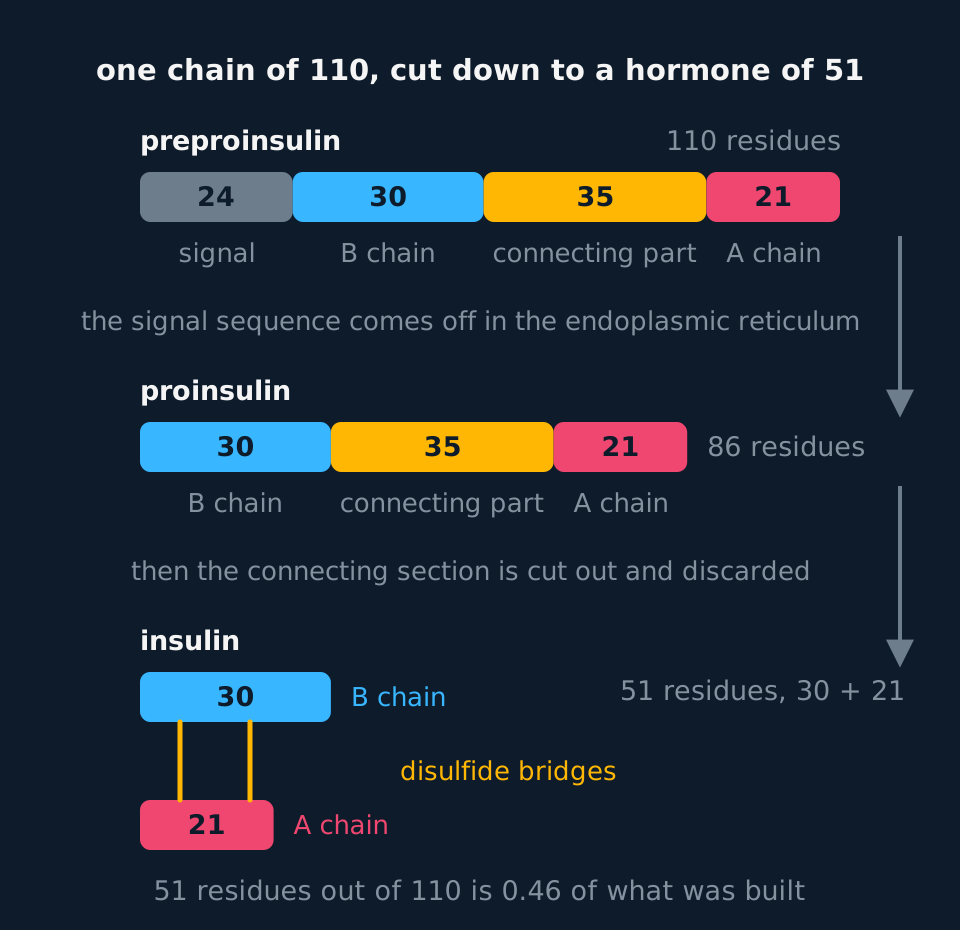
Describe the drawing
Preproinsulin drawn as one bar of a hundred and ten residues in four segments to scale: a signal sequence of twenty-four, a B chain of thirty, a connecting section of thirty-five and an A chain of twenty-one. Beneath it the same chain with the signal sequence gone, eighty-six residues long, and beneath that the finished hormone, the B chain and the A chain lying one above the other and joined by disulfide bridges, fifty-one residues in all and less than half the length of the first bar.
- Post-translational modification
- Changes made to a polypeptide after translation, such as cutting out sections or adding carbohydrate or lipid groups, carried out in the endoplasmic reticulum and the Golgi apparatus. Folding is not one of them: it begins on the ribosome and is finished in the endoplasmic reticulum.
Working a sequence from DNA to polypeptide
Examination questions require a sequence to be carried from DNA to polypeptide. Work through the steps in order.
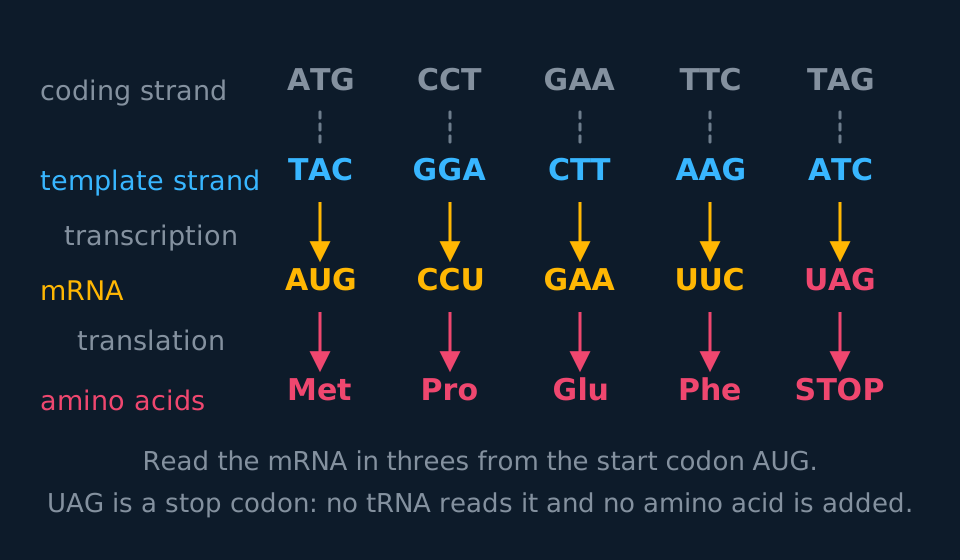
Describe the drawing
Four aligned rows of triplets. The top row is the DNA coding strand reading ATG CCT GAA TTC TAG; below it the template strand TAC GGA CTT AAG ATC; below that the messenger RNA AUG CCU GAA UUC UAG; and at the bottom the amino acids methionine, proline, glutamate and phenylalanine followed by a stop, with arrows linking each column down the page.
From a template strand to an amino acid sequence
The template strand of a short gene, written 3′ to 5′ so that it lines up with the mRNA it produces, reads TAC GGA CTT AAG ATC. Use the codons AUG = methionine, CCU = proline, GAA = glutamic acid, UUC = phenylalanine, UAG = stop. Give the mRNA sequence, the anticodon of the tRNA that delivers proline, and the number of amino acids in the finished polypeptide.
Show the working
Transcribe first. The mRNA is complementary to the template, with U wherever the template has A: TAC gives AUG, GGA gives CCU, CTT gives GAA, AAG gives UUC and ATC gives UAG. The mRNA is AUG CCU GAA UUC UAG.
The tRNA anticodon is complementary to the codon, not the same as it. Proline's codon here is CCU, so the anticodon is GGA, which happens to match the template triplet, since both are complementary to the same codon.
Now count. There are five codons, but UAG is a stop codon and specifies no amino acid. The polypeptide is therefore four amino acids long: methionine, proline, glutamic acid, phenylalanine. Four amino acids means three peptide bonds.
TRY IT: Following a substitution through the whole process
In the gene above, the seventh base of the template strand changes from C to A, so the third triplet reads ATT instead of CTT. The codon GAA codes for glutamic acid, and UAA, UAG and UGA are stop codons. Explain what happens to the mRNA, to the polypeptide, and to the protein's likely function.
Check your answer
Take the transcription step first. The template triplet CTT gave the codon GAA; the altered triplet ATT gives the codon UAA. Working from the template, A pairs with U, T pairs with A and T pairs with A, so the third codon of the mRNA becomes UAA.
UAA is one of the three stop codons. Translation therefore terminates at the third codon rather than the fifth, and the polypeptide released is only two amino acids long, methionine and proline, instead of four.
A polypeptide truncated this early cannot fold into a functional shape, so the protein has no activity. This is a nonsense mutation, and it shows that a single base substitution is not necessarily harmless. Degeneracy leaves many substitutions silent, but not where the new codon is a stop codon.
In the exam
- Codons are on mRNA and anticodons on tRNA. State them the right way round.
- Name the bond and the reaction: a peptide bond, formed by condensation, rather than 'the amino acids join'.
- Stop codons specify no amino acid, so n codons in a coding sequence give n − 1 amino acids once the stop codon is counted, and n − 2 peptide bonds.
- State where each stage occurs: transcription in the nucleus, translation at a ribosome in the cytoplasm or on the rough endoplasmic reticulum, modification in the endoplasmic reticulum and Golgi apparatus.
- The ribosome moves one codon at a time in the 5′ to 3′ direction along the mRNA. Direction refers to the mRNA, not to the tRNA.
- For energy questions, state both uses: ATP attaches each amino acid to its tRNA, and further nucleoside triphosphates are hydrolysed as the ribosome moves along the mRNA.
Check yourself
A cell is treated with a drug that prevents tRNA molecules from being loaded with their amino acids, while leaving transcription and the ribosome itself untouched. Predict what happens inside the cell over the next few hours, and explain each part of your prediction.
Answer
Transcription carries on, so mRNA continues to be produced and to leave the nucleus. The ribosomes are intact, so they still bind mRNA, but none can complete initiation, because that needs a tRNA loaded with methionine to pair with the start codon. What stops is the supply of loaded tRNA.
Only a tRNA carrying its amino acid is delivered to the A site, so with none being loaded the A site remains unfilled, no peptide bond can form and the ribosome cannot move on. Elongation stops almost immediately, and the polypeptides being made at the moment the drug arrives are left incomplete.
Existing proteins are not destroyed by the drug, so the cell keeps functioning at first. The decline comes over hours rather than seconds, as enzymes and other proteins reach the end of their working lives and are broken down without replacement. Proteins with short lifetimes disappear first.
The mRNA also degrades on its own timescale, since it is unstable and the drug does not affect that. The cell therefore has intact DNA, intact ribosomes, a falling concentration of mRNA and a falling concentration of protein. The loading step, rather than the ribosome, is the point at which the correspondence between codon and amino acid is established.
Questions
Question 15 marks
Describe what happens at a ribosome from the moment a second tRNA arrives until the ribosome has moved along the mRNA by one codon.
Mark scheme
- B1 a tRNA whose anticodon is complementary to the codon in the A site binds there, held by hydrogen bonds between the paired bases
- B1 that tRNA carries the one specific amino acid corresponding to its anticodon
- B1 the two amino acids are now adjacent, and the ribosome catalyses the formation of a peptide bond between them by condensation
- B1 the first tRNA, now without its amino acid, leaves the ribosome
- B1 the ribosome moves along the mRNA by exactly one codon, so the remaining tRNA shifts into the P site and the A site is left free
Question 24 marks
Explain why a plasma cell, which secretes large quantities of antibody, contains a great many mitochondria.
Mark scheme
- B1 the cell synthesises protein continuously and in very large quantities, so translation runs constantly
- B1 ATP is used to attach each amino acid to its tRNA, by the specific enzyme for that amino acid
- B1 further nucleoside triphosphates are hydrolysed to bring each tRNA into the ribosome and to move the ribosome along, roughly four high-energy bonds per amino acid added
- B1 mitochondria supply that ATP by aerobic respiration, so many are needed to keep pace with the demand
Question 34 marks
Some antibiotics stop bacterial protein synthesis by binding to 70S ribosomes, and have no effect on the 80S ribosomes in human cytoplasm. Suggest why such drugs can nevertheless produce side effects in the patient.
Mark scheme
- B1 mitochondria contain their own ribosomes, and these are 70S rather than 80S
- B1 the antibiotic can therefore bind to the ribosomes inside the patient's own mitochondria
- B1 protein synthesis within the mitochondria is inhibited, so the proteins they need cannot be made
- B1 aerobic respiration and the supply of ATP fall, which affects the tissues that demand most ATP
Question 44 marks
Describe what happens during the initiation and the termination of translation, naming the codons involved.
Mark scheme
- B1 in initiation, mRNA binds to the small ribosomal subunit, and the ribosome moves along the mRNA until it reaches the start codon, AUG
- B1 a tRNA with the complementary anticodon, UAC, carrying methionine, binds in the P site, and the large ribosomal subunit then joins to complete the ribosome
- B1 in termination, translation ends when one of the three stop codons, UAA, UAG or UGA, reaches the A site, and no tRNA has a matching anticodon to bind there
- B1 a release factor binds instead, the completed polypeptide is released, and the ribosome separates into its two subunits
Question 54 marks
Preproinsulin is a single polypeptide chain of 110 amino acids. A signal sequence of 24 amino acids is removed as the chain enters the endoplasmic reticulum, giving proinsulin. A connecting section of 35 amino acids in total is then cut out of proinsulin, leaving the two chains of the active hormone joined by disulfide bridges. Calculate the number of amino acids in proinsulin, and calculate the number of amino acids in the finished, active insulin molecule.
Mark scheme
- M1 proinsulin = preproinsulin − signal sequence = 110 − 24
- A1 86 amino acids in proinsulin
- M1 active insulin = proinsulin − connecting section removed = 86 − 35
- A1 51 amino acids in the finished, active insulin molecule
Question 64 marks
Explain why a cell regulates transcription of a gene rather than transcribing it continuously, and explain why switching transcription off stops production of its protein within hours.
Mark scheme
- B1 producing an mRNA molecule that will be translated many times consumes ATP whether or not the protein is actually needed by the cell at that moment, so continuous, unregulated transcription would be wasteful
- B1 mRNA molecules have a short lifetime compared with many proteins, being broken down within minutes to hours rather than persisting indefinitely
- B1 once transcription of a gene stops, no new mRNA for that gene is produced, and the existing molecules continue to degrade at their usual rate rather than being replaced
- B1 translation of that protein therefore falls as the supply of its mRNA runs out, so production stops within hours of the gene being switched off, rather than continuing for as long as the protein itself persists
Question 74 marks
A student states that tRNA carries the codon to the ribosome, where it is matched against the mRNA. Discuss whether this description correctly identifies which molecule carries which.
Mark scheme
- B1 what is right: the student is correct that matching occurs at the ribosome between a triplet on tRNA and a triplet on mRNA, held together by hydrogen bonds between complementary bases
- B1 against: it is the mRNA, not the tRNA, that carries the codon; the codon is the triplet on the mRNA that specifies an amino acid or a stop signal
- B1 against: the tRNA carries the anticodon, a triplet complementary to the codon, together with the one specific amino acid corresponding to that anticodon, and it is this anticodon that pairs with the mRNA's codon rather than the codon being carried by the tRNA
- B1 judgement: reversing which molecule carries which is not a minor slip, since codon and anticodon are defined by which strand they are on; stating that tRNA 'carries the codon' describes mRNA's role, not tRNA's
Question 83 marks
The coding sequence of a mature mRNA molecule contains 927 bases and ends with a stop codon. Calculate the number of amino acids in the polypeptide produced and the number of peptide bonds within it.
Mark scheme
- M1 divides the number of bases by three to give the number of codons: 927 ÷ 3 = 309
- M1 subtracts the stop codon, which specifies no amino acid
- A1 308 amino acids, joined by 307 peptide bonds
Question 93 marks
Describe what happens to a polypeptide destined for secretion after it has been released from the ribosome.
Mark scheme
- B1 it folds into its secondary and tertiary structure, a process that begins as the chain emerges and is completed in the endoplasmic reticulum
- B1 vesicles carry it to the Golgi apparatus, where post-translational modification takes place
- B1 carbohydrate or lipid groups may be added and sections may be cut out, and the finished protein is packaged into a vesicle for export
Question 103 marks
A ribosome has three tRNA-binding positions, called X, Y and Z here. Position X holds the tRNA carrying the growing polypeptide chain. Position Y accepts the next tRNA, whose anticodon must match the codon there. Position Z is occupied briefly by an unloaded tRNA before it leaves the ribosome. Describe the order in which a single tRNA molecule occupies X, Y and Z during translation, and describe what it carries at each position.
Mark scheme
- B1 it enters at Y, carrying its one specific amino acid, with its anticodon paired to the codon there
- B1 once a peptide bond has joined the growing chain to its amino acid it carries the whole chain, and when the ribosome moves along one codon it is in X
- B1 after the chain has been passed to the amino acid on the next tRNA it carries nothing, and the next move brings it to Z, from which it leaves to collect another molecule of its amino acid
Question 113 marks
Explain how the specific enzyme that attaches an amino acid to a tRNA molecule ensures that the genetic code is correctly translated.
Mark scheme
- B1 there is a separate activating enzyme for each amino acid, and each one recognises and attaches only its own specific amino acid to the correct tRNA, using ATP
- B1 the ribosome itself only checks that the anticodon of an incoming tRNA is complementary to the codon in the A site; it cannot check which amino acid that tRNA is carrying
- B1 because each tRNA is reliably loaded with the one amino acid that its anticodon corresponds to, matching a codon to its correct anticodon is what actually determines which amino acid is added, so the specificity of the loading enzymes is what makes the whole system accurate
Question 123 marks
Electron micrographs of active cells often show several ribosomes attached to and spaced along the same mRNA molecule, an arrangement called a polysome. Suggest what advantage this gives the cell.
Mark scheme
- B1 each ribosome in the polysome is independently translating the same mRNA molecule, at a different position along it
- B1 several copies of the same polypeptide are therefore being synthesised from the one transcript at the same time, rather than one ribosome finishing before the next begins
- B1 this lets the cell produce many copies of a protein rapidly from a single mRNA molecule, without needing to transcribe further copies of the mRNA to achieve the same output
Question 133 marks
The template strand of a short gene, written 3′ to 5′, reads TAC ACG TTC CGA ATC. Use the codons AUG = methionine, UGC = cysteine, AAG = lysine, GCU = alanine, UAG = stop. Give the mRNA sequence transcribed from this template, give the anticodon of the tRNA that delivers lysine, and give the number of amino acids in the finished polypeptide.
Mark scheme
- B1 the mRNA is complementary to the template strand, with U wherever the template has A: TAC gives AUG, ACG gives UGC, TTC gives AAG, CGA gives GCU and ATC gives UAG, so the mRNA is AUG UGC AAG GCU UAG
- B1 the anticodon is complementary to the codon rather than identical to it, so the anticodon that delivers lysine, whose codon is AAG, is UUC
- A1 there are five codons, but UAG is a stop codon and specifies no amino acid, so the polypeptide is four amino acids long
Question 142 marks
During translation, the P site of a ribosome holds the tRNA carrying the growing polypeptide chain, and the A site holds the tRNA bringing the next amino acid. Name the bond formed between the chain and that next amino acid, and name the type of reaction that forms it.
Mark scheme
- B1 a peptide bond
- B1 a condensation reaction, which releases a molecule of water
Question 152 marks
State the sedimentation coefficient of a eukaryotic ribosome, and state the sedimentation coefficient of a ribosome found in a bacterium.
Mark scheme
- B1 a eukaryotic ribosome is 80S
- B1 a ribosome in a bacterium is 70S
Worth remembering
- Codons are on mRNA; anticodons are on tRNA; the two pair by hydrogen bonding.
- AUG starts translation and codes for methionine; UAA, UAG and UGA stop it and code for nothing.
- The P site holds the growing chain, the A site accepts the next tRNA, and a peptide bond forms between them by condensation.
- ATP loads each tRNA with its amino acid, and more is spent moving the ribosome along.
- Cutting and the finishing of sugar chains happen after translation, in the endoplasmic reticulum and Golgi apparatus; folding begins on the ribosome.
CHECK YOUR PROGRESS
Rate how confident you are with each objective for this lesson. Ratings are saved in this browser, on this device, unless you sign in.
- Describe the structure of a ribosome and say what its two binding sites hold.
- Explain the relationship between a codon and an anticodon, and say which molecule carries which.
- Describe initiation, elongation and termination in order.
- Explain where the energy for protein synthesis comes from and roughly how much is needed.
- Describe what happens to a polypeptide after it leaves the ribosome.
- Work from a given DNA sequence to the amino acid sequence it specifies.
Open the full revision checklist to see every objective in the curriculum in one place.
Practise this lesson
WORKBOOK
The questions from this topic, on paper with room to work, and a separate book of mark schemes. Free to use; please do not redistribute or sell.
Used later in Pharming, recombinant medicines and synthetic biology