Chemistry › Alkanes and halogenoalkanes › Elimination from halogenoalkanes, and CFCs and the ozone layer
Elimination from halogenoalkanes, and CFCs and the ozone layer
Change the solvent from water to ethanol and heat harder, and the same hydroxide ion stops substituting and starts pulling off a hydrogen ion, so a halogenoalkane loses HBr and becomes an alkene. The second half follows another halogenoalkane, a CFC, up to the stratosphere, where its chlorine radicals break down ozone in a chain that took an international treaty to stop.
Key terms Every definition in alkanes and halogenoalkanes, lesson by lesson
Before this Halogenoalkanes: nucleophilic substitution and rates of hydrolysis – the polar C–X bond and the hydroxide mechanism · Free-radical substitution – initiation, propagation and the chain reaction · Structural isomerism and E/Z isomerism – position isomers and restricted rotation about C=C
COMMON MISCONCEPTION
Potassium hydroxide turns a halogenoalkane into an alcohol, whatever it is dissolved in.
The solvent chooses the reaction. In water, warmed, the hydroxide ion acts as a nucleophile and substitution gives the alcohol. In ethanol, heated under reflux, it acts as a base, takes a hydrogen from the carbon next to the C–halogen carbon, and elimination gives an alkene. Tertiary halogenoalkanes eliminate most readily.
What you should be able to do
- State the conditions for elimination of HBr from a halogenoalkane, and outline the mechanism with hydroxide acting as a base.
- Explain how the conditions and the type of halogenoalkane decide whether substitution or elimination is the main reaction.
- Deduce the alkenes formed by elimination from an unsymmetrical halogenoalkane such as 2-bromobutane, including E/Z isomers.
- Explain how ozone in the stratosphere is formed and why it matters.
- Write the equations by which chlorine radicals from CFCs catalyse the decomposition of ozone, and evaluate the replacements for CFCs.
Hydroxide as a base: elimination
Hydroxide ions do not always substitute. Heated under reflux with potassium hydroxide dissolved in ethanol, 2-bromopropane gives off a gas that decolourises bromine water: propene. The halogenoalkane has lost a hydrogen atom from one carbon and the bromine from the carbon next to it, and a double bond has formed between them. That is elimination: a small molecule, here HBr, is removed from a larger one.
There is no state symbol for a solution in ethanol, so the equation is written without them: CH₃CHBrCH₃ + KOH → CH₂=CHCH₃ + KBr + H₂O.
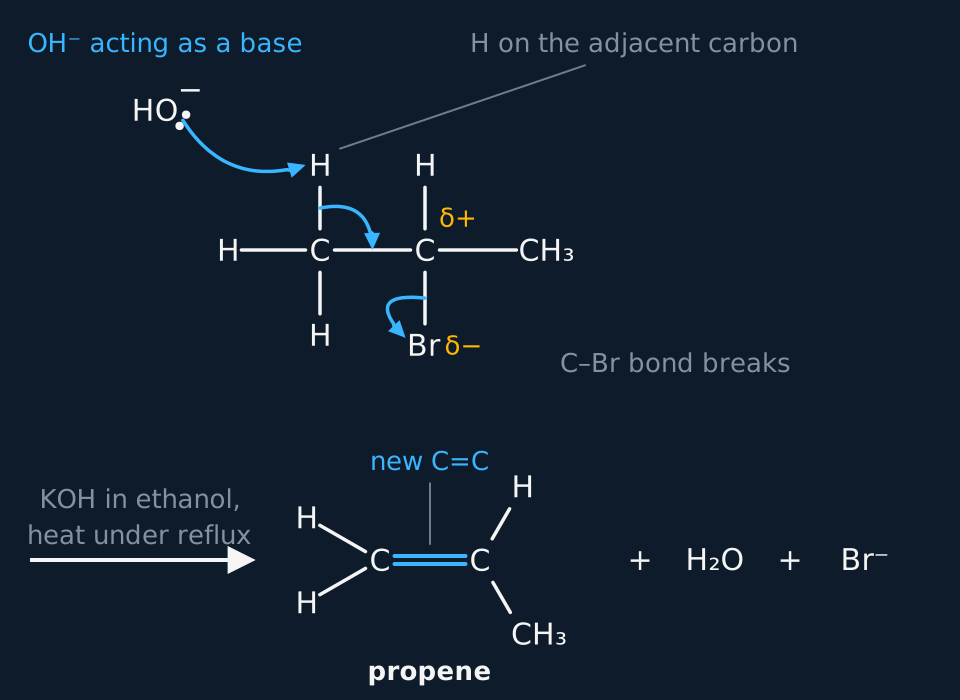
The hydroxide ion is the same species as in substitution, but here it acts as a base, a proton acceptor. Instead of attacking the δ+ carbon, its lone pair takes an H⁺ from the carbon next to the C–Br carbon. The electrons of that C–H bond move in between the two carbons to form the second bond of the C=C, and the C–Br bond breaks with both electrons going to bromine.
Describe the drawing
2-bromopropane with its three carbons displayed: C1 carrying three hydrogens, C2 carrying one hydrogen and the bromine, C3 a methyl group, with δ+ on C2 and δ− on Br. A hydroxide ion at the upper left, lone pair and negative charge on O, acts as a base. Arrow 1 runs from the lone pair to an H on C1; arrow 2 from that C1–H bond to the C1–C2 bond; arrow 3 from the C2–Br bond to the bromine. After KOH in ethanol, heated under reflux: propene with the new C=C between C1 and C2, water and a bromide ion.
All three arrows happen in one step, and each needs to start and end in the right place. The first starts on a lone pair of the hydroxide oxygen and ends on the hydrogen, not the carbon. The second starts on the C–H bond and ends between the two carbons. The third starts on the C–Br bond and ends on the bromine. The products are the alkene, water and a bromide ion.
The word for the role matters. Call the hydroxide ion a base in elimination, because it accepts a proton, and a nucleophile in substitution, because it donates its pair to carbon. 'Hydroxide attacks the halogenoalkane' fits both and explains neither.
- Elimination
- A reaction in which a small molecule is removed from a larger one, leaving a double bond.
- Base
- A proton acceptor: a species that accepts an H⁺ ion using a lone pair.
Propene boils at −48 °C, so it leaves the reflux condenser as a gas and can be collected over water. Bubbled through bromine water, it turns the orange solution colourless, the test for C=C. The alcohol that substitution would have given does not decolourise bromine water, so the test tells the two routes apart.
The yield of propene
12.29 g of 2-bromopropane (Mr 122.9) is heated with ethanolic potassium hydroxide and 1.62 dm³ of propene is collected at room temperature and pressure. Calculate the percentage yield. The molar gas volume is 24.0 dm³ mol⁻¹.
Show the working
Amount of 2-bromopropane = 12.29 ÷ 122.9 = 0.1000 mol.
One mole of 2-bromopropane gives at most one mole of propene, so the theoretical volume is 0.1000 × 24.0 = 2.40 dm³.
Percentage yield = 1.62 ÷ 2.40 × 100 = 67.5%.
Much of the remainder has gone the other way: substitution, which always runs alongside elimination, has turned it into propan-2-ol.
Substitution or elimination
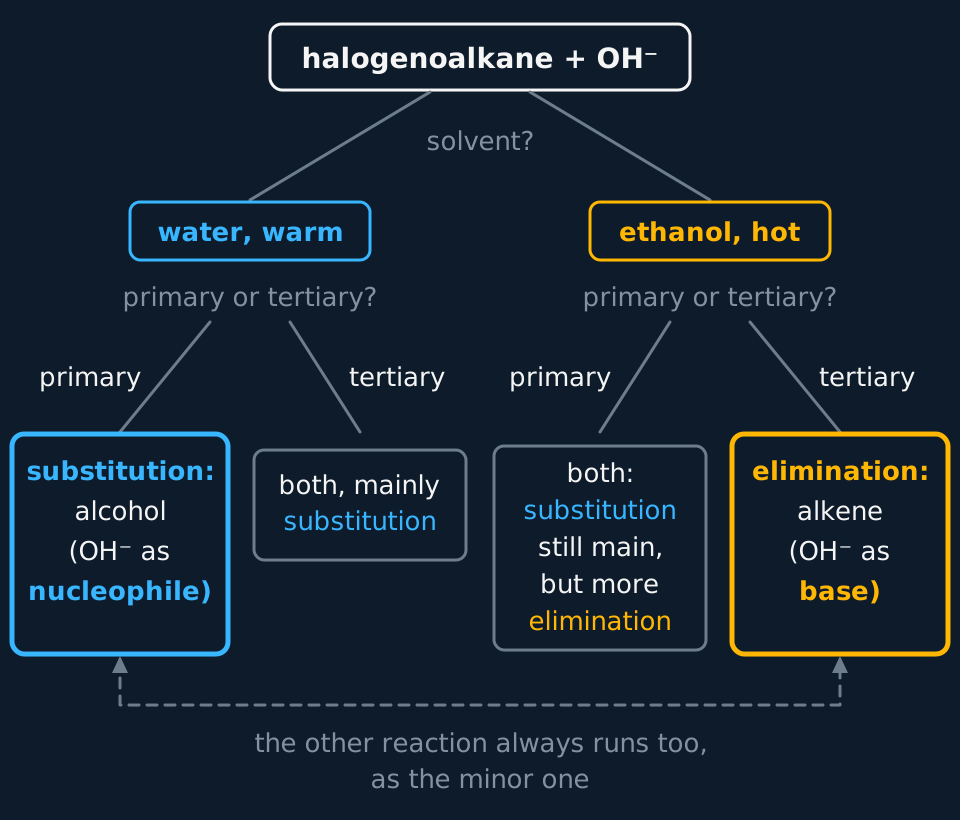
A halogenoalkane and hydroxide ions always have both reactions open to them, and both happen to some extent in any mixture. The conditions decide which is the main one. In water, the hydroxide ion is surrounded by water molecules and behaves mainly as a nucleophile; warm aqueous conditions favour substitution and give an alcohol. In ethanol, heated strongly, it behaves more as a base, and elimination gives an alkene.
The structure of the halogenoalkane matters too. At a primary carbon there is room for the hydroxide to reach the δ+ carbon, and substitution is the main reaction even in ethanol. At a tertiary carbon three alkyl groups crowd round the δ+ carbon, so the hydroxide ion finds the hydrogens on the neighbouring carbons easier to reach, and elimination wins.
| Substitution favoured | Elimination favoured | |
|---|---|---|
| Solvent | Water (aqueous KOH or NaOH) | Ethanol (ethanolic KOH) |
| Temperature | Warm | Hot, heated under reflux |
| Halogenoalkane | Primary | Tertiary |
| Role of OH⁻ | Nucleophile: attacks the δ+ carbon | Base: removes H⁺ from the next carbon |
| Organic product | Alcohol | Alkene |
Describe the drawing
A decision diagram starting from halogenoalkane plus hydroxide. The first question, the solvent, splits into water, warm, and ethanol, hot; under each the second question is primary or tertiary. Water with a primary halogenoalkane leads to a large box, substitution giving an alcohol with hydroxide as nucleophile. Ethanol with a tertiary one leads to a large box, elimination giving an alkene with hydroxide as base. The mixed cases lead to smaller boxes: both, mainly substitution; and both, substitution still main but more elimination. A dashed arrow joining the two large boxes says the other reaction always runs too, as the minor one.
Temperature pushes in the direction the solvent does. Elimination turns two reactant particles into three product particles, the alkene, water and a halide ion, and a higher temperature favours it over substitution, which turns two into two. A hot, concentrated solution of potassium hydroxide in ethanol is the condition for elimination; a warm, dilute aqueous solution is the condition for substitution.
Applied to particular compounds, the two sets of conditions give these main products. Secondary halogenoalkanes sit between the two extremes, so the conditions decide more for them than for a primary or a tertiary compound.
| Halogenoalkane | Reagent and conditions | Main reaction | Main organic product |
|---|---|---|---|
| 1-bromobutane (primary) | Aqueous NaOH, warm, reflux | Substitution | Butan-1-ol |
| 2-bromopropane (secondary) | Aqueous KOH, warm, reflux | Substitution | Propan-2-ol |
| 2-bromopropane (secondary) | KOH in ethanol, hot, reflux | Elimination | Propene |
| 2-bromobutane (secondary) | KOH in ethanol, hot, reflux | Elimination | But-1-ene, E- and Z-but-2-ene |
| 2-bromo-2-methylpropane (tertiary) | KOH in ethanol, hot, reflux | Elimination | 2-methylpropene |
Elimination matters in synthesis because it turns a saturated compound into an alkene, which can then be built on. Substitution by hydroxide gives an alcohol directly. The conditions are chosen to match the product wanted, and some of the other is expected.
TRY IT: Two products from one bottle
A technician has a bottle of 2-bromopropane and wants propan-2-ol on Monday and propene on Tuesday. State the reagent and conditions for each, and give the role of the hydroxide ion in each reaction.
Check your answer
Monday: aqueous sodium or potassium hydroxide, warmed under reflux. The hydroxide ion acts as a nucleophile, attacking the δ+ carbon, and the product is propan-2-ol, CH₃CH(OH)CH₃.
Tuesday: potassium hydroxide dissolved in ethanol, heated under reflux. The hydroxide ion acts as a base, removing H⁺ from a carbon next to the C–Br carbon, and propene, CH₂=CHCH₃, is given off.
2-bromopropane is secondary, so neither reaction is clean: each product will contain some of the other, and has to be separated.
The alkenes from 2-bromobutane
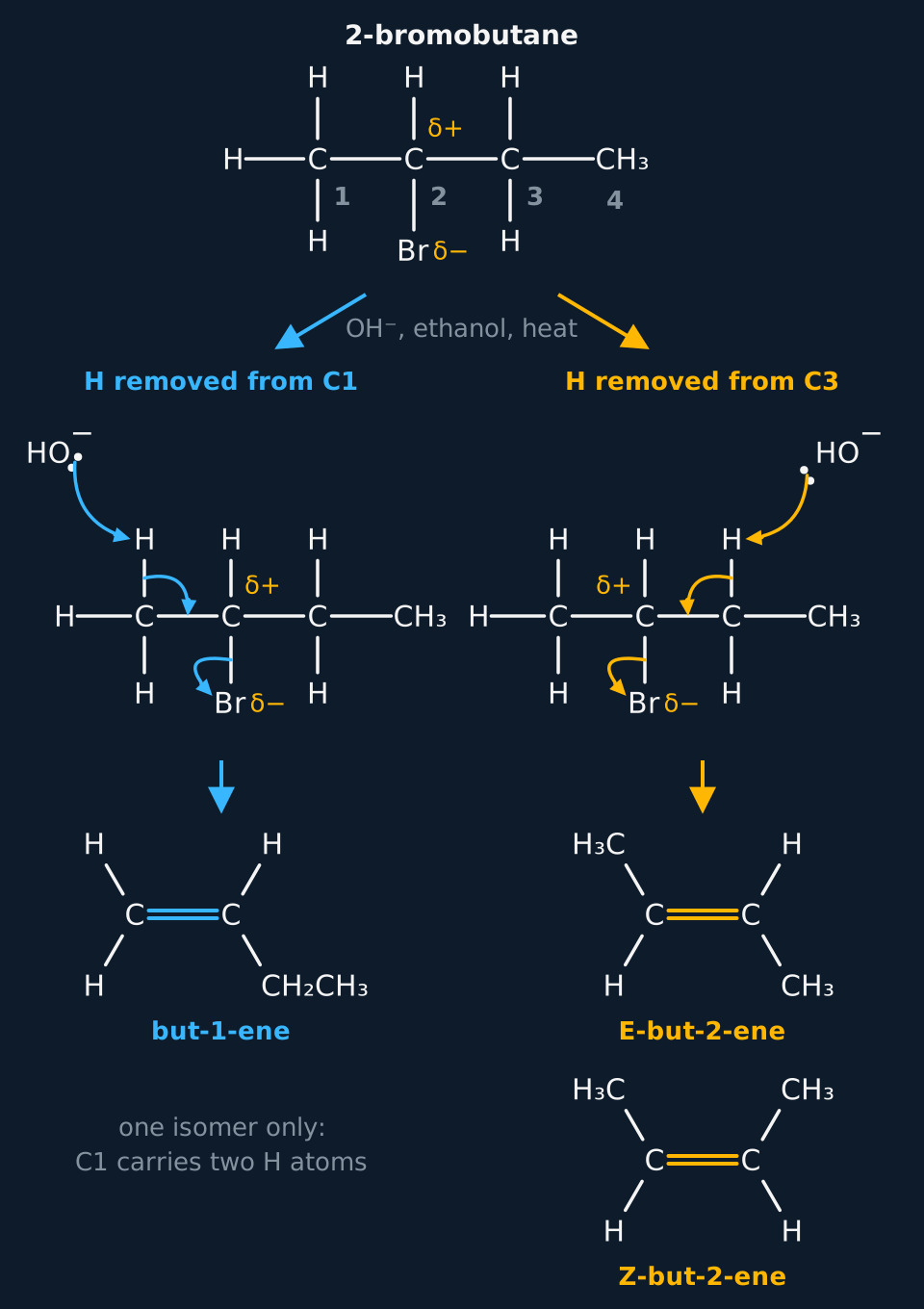
Bromoethane and 2-bromopropane each give only one alkene, because every hydrogen that can be removed sits in an equivalent position. 2-bromobutane, CH₃CHBrCH₂CH₃, is different. The bromine is on carbon 2, and carbon 2 has two neighbours with hydrogens on them: carbon 1, the CH₃ at the end, and carbon 3, the CH₂ in the chain.
Describe the drawing
2-bromobutane drawn at the top with its carbons numbered 1 to 4, the bromine on carbon 2, δ+ on C2 and δ− on Br. Below, two copies of the mechanism. On the left, a hydroxide ion's lone pair arrows onto an H on carbon 1, the C1–H bond arrows into the C1–C2 bond and the C–Br bond arrows onto bromine, giving but-1-ene. On the right the same three arrows take an H from carbon 3 and form the double bond between C2 and C3, giving but-2-ene, drawn twice: E with the two CH₃ groups on opposite sides of the double bond and Z with them on the same side.
Every alkene from 2-bromobutane
Deduce every alkene formed when 2-bromobutane is heated with ethanolic potassium hydroxide.
Show the working
Removing H from carbon 1 puts the double bond between carbons 1 and 2: CH₂=CHCH₂CH₃, but-1-ene.
Removing H from carbon 3 puts the double bond between carbons 2 and 3: CH₃CH=CHCH₃, but-2-ene. These are position isomers of each other.
But-2-ene has two different groups, H and CH₃, on each carbon of the C=C, and the double bond cannot rotate, so it exists as E-but-2-ene and Z-but-2-ene.
So three alkenes form: but-1-ene, E-but-2-ene and Z-but-2-ene. Two are structural isomers; counting the stereoisomers gives three.
The three do not form in equal amounts. More but-2-ene forms than but-1-ene, and more of the E isomer than the Z, because an alkene with more alkyl groups on its double bond, held further apart, is more stable. A question that asks which alkenes form wants all three named, with the E and Z isomers counted separately.
A tertiary halogenoalkane can be symmetrical too. 2-bromo-2-methylpropane has three identical CH₃ groups round the C–Br carbon, so whichever one loses a hydrogen the product is the same, 2-methylpropene.
TRY IT: Alkenes from 3-bromopentane
Deduce every alkene formed when 3-bromopentane, CH₃CH₂CHBrCH₂CH₃, is heated with ethanolic potassium hydroxide.
Check your answer
The bromine is on carbon 3. Its neighbours, carbons 2 and 4, are both CH₂ groups, and the molecule is symmetrical about carbon 3, so removing H from either gives the same product, CH₃CH=CHCH₂CH₃, pent-2-ene. Carbon 1 is not next to the C–Br carbon, so no pent-1-ene forms.
In pent-2-ene, carbon 2 carries H and CH₃, and carbon 3 carries H and C₂H₅. Each carbon of the C=C has two different groups, so there are E and Z isomers.
Two alkenes form: E-pent-2-ene and Z-pent-2-ene, stereoisomers with the same structural formula.
- Position isomers
- Structural isomers with the same carbon skeleton and the same functional group at a different position on the chain.
- E/Z isomers
- Stereoisomers that exist because rotation about a C=C bond is restricted and each carbon of the double bond carries two different groups.
Ozone in the stratosphere
Between about 15 and 35 kilometres up, in the stratosphere, ozone, O₃, is formed and broken down continuously. Ultraviolet light of short wavelength splits oxygen molecules into atoms, and an oxygen atom joins an oxygen molecule to make ozone:
O₂(g) → 2O(g)ultraviolet light
O(g) + O₂(g) → O₃(g)
Ozone itself absorbs ultraviolet light of slightly longer wavelength, UV-B, and splits back into O₂ and O. The two processes balance, and the ozone they maintain absorbs most of the Sun's UV-B before it reaches the ground. UV-B damages DNA: more of it reaching the surface means more skin cancer and more cataracts, and harm to crops and plankton.
Ozone at ground level is a different matter: there it is a pollutant that irritates the lungs. The benefit belongs to the stratospheric layer, and an answer about the ozone layer says where it is and what it absorbs.
- Ozone layer
- The region of the stratosphere where ozone is concentrated, which absorbs most of the ultraviolet radiation from the Sun.
CFCs and the chlorine radical cycle
Chlorofluorocarbons, CFCs, are halogenoalkanes that contain only carbon, chlorine and fluorine, such as CCl₂F₂ and CCl₃F. They are non-toxic, non-flammable, volatile and very unreactive, which made them ideal refrigerants, aerosol propellants, foam-blowing agents and cleaning solvents through the twentieth century. Being unreactive, they are not broken down in the lower atmosphere, and they drift up into the stratosphere over years.
There, ultraviolet light breaks the C–Cl bond homolytically. The C–F bond, at 467 kJ mol⁻¹ against 346 kJ mol⁻¹ for C–Cl, is too strong for the ultraviolet light that reaches that height, and survives. This is the same order of bond enthalpies that makes fluoroalkanes the slowest to hydrolyse.
CCl₂F₂(g) → •CClF₂(g) + Cl•(g)ultraviolet light
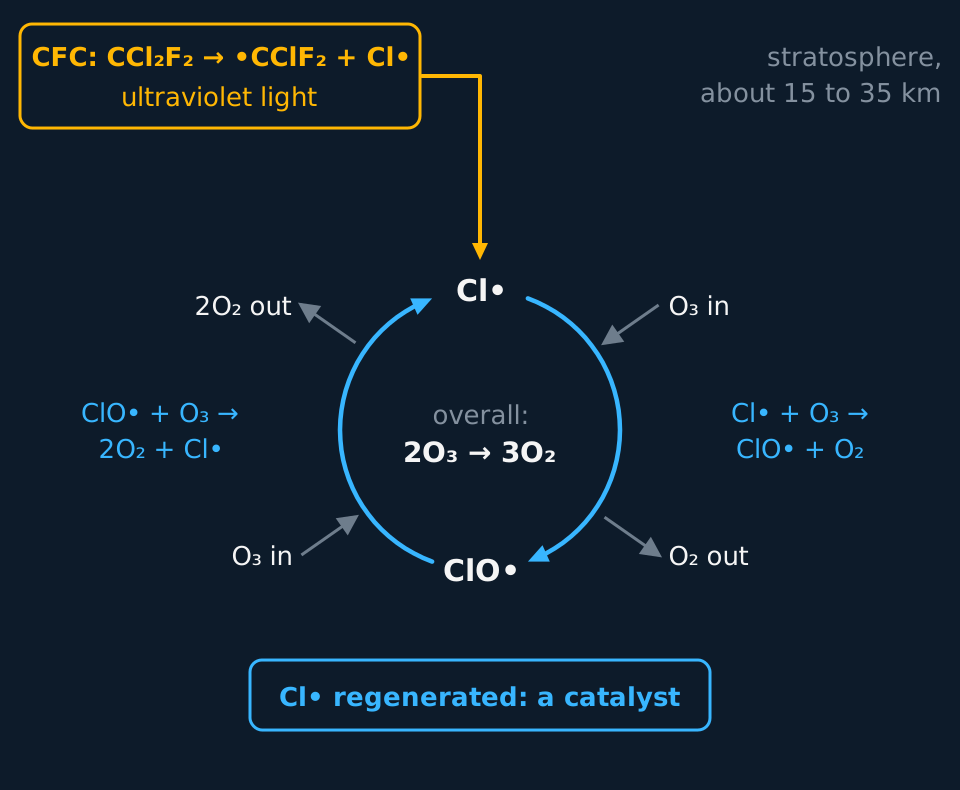
The chlorine radical then catalyses the decomposition of ozone in two propagation steps:
Cl•(g) + O₃(g) → ClO•(g) + O₂(g)
ClO•(g) + O₃(g) → 2O₂(g) + Cl•(g)
2O₃(g) → 3O₂(g)overall: add the two steps
Describe the drawing
A circular catalytic cycle. A box at the top left shows a CFC, CCl₂F₂, splitting in ultraviolet light to give a chlorine radical, which is fed into the cycle at the top. Down the right-hand arc Cl• reacts with ozone, which enters, to give ClO•, at the bottom, and oxygen, which leaves. Up the left-hand arc ClO• reacts with a second ozone to give two oxygen molecules and Cl• again. The centre reads overall 2O₃ to 3O₂, and a box below says Cl• is regenerated, so it is a catalyst.
The chlorine radical is used in the first step and regenerated in the second, so it is a catalyst: it speeds up the breakdown of ozone and is not used up. ClO• appears in the first step and is used in the second, so it is an intermediate and does not appear in the overall equation. One radical can go round the cycle many thousands of times before termination removes it, so a small amount of CFC breaks down a very large amount of ozone.
| Step | Equation | What happens to the chlorine |
|---|---|---|
| Initiation | CCl₂F₂ → •CClF₂ + Cl• | Released by homolytic fission of C–Cl in ultraviolet light |
| Propagation 1 | Cl• + O₃ → ClO• + O₂ | Used: takes an oxygen atom from ozone |
| Propagation 2 | ClO• + O₃ → 2O₂ + Cl• | Regenerated: ready to start the cycle again |
| Termination | ClO• + NO₂ → ClONO₂ | Removed into a reservoir compound |
Most of the chlorine in the stratosphere is not free radicals at any moment. It is held in two reservoir compounds: hydrogen chloride, made when Cl• takes a hydrogen from methane, and chlorine nitrate, made when two radicals meet:
ClO•(g) + NO₂(g) → ClONO₂(g)a termination step
The thinning is worst over Antarctica in the southern spring. Through the polar winter, ice clouds form in the stratosphere, and on their surfaces HCl and ClONO₂ react to give Cl₂ and nitric acid, which stays in the ice. When sunlight returns in September it splits the Cl₂ into radicals all at once, and the ozone over the continent can fall by more than half within weeks.
The case against CFCs rests on three kinds of evidence from different research groups, each of which would have been weak on its own. Laboratory measurements of how unreactive CFCs are, and of how fast chlorine radicals react with ozone, predicted that CFCs would survive to reach the stratosphere and that their chlorine would break down ozone there. Measurements from the ground then found the loss: springtime ozone over the British Antarctic Survey's station at Halley Bay had fallen by about a third, and satellite records showed a hole over the whole continent.
Aircraft flown into the hole found ClO• at high concentration exactly where the ozone was missing. A mechanism, a measured loss and the radical caught where the damage was: together they made the case that CFCs were to blame.
The Montreal Protocol, which committed governments to phasing out CFCs, then served as a test of that case. If CFCs were the cause, stopping them should make stratospheric chlorine fall and the ozone recover, slowly, because CFC molecules already up there survive for decades. Both have been measured: chlorine in the stratosphere has been falling since the late 1990s, and the Antarctic ozone layer is on course to recover to its 1980 level around the 2060s.
The main replacements are hydrofluorocarbons, HFCs, such as CH₂FCF₃ in car air conditioning. They contain no chlorine, and the C–F bond is too strong for ultraviolet light in the stratosphere to break, so they release no radicals that attack ozone. They are, however, powerful greenhouse gases, and the 2016 Kigali Amendment to the Montreal Protocol now phases them down too, in favour of hydrocarbons such as 2-methylpropane and newer fluorinated alkenes.
TRY IT: How much ozone one gram can remove
Each molecule of CCl₃F that reaches the stratosphere releases one chlorine radical, and each radical breaks down 1.0 × 10⁵ ozone molecules before termination. Calculate the mass of ozone broken down by the chlorine from 1.0 g of CCl₃F. Ar: C 12.0, O 16.0, F 19.0, Cl 35.5.
Check your answer
Mr(CCl₃F) = 12.0 + (3 × 35.5) + 19.0 = 137.5, so 1.0 g is 1.0 ÷ 137.5 = 7.27 × 10⁻³ mol, which releases 7.27 × 10⁻³ mol of Cl•.
Amount of O₃ broken down = 7.27 × 10⁻³ × 1.0 × 10⁵ = 727 mol.
Mass = 727 × 48.0 = 3.5 × 10⁴ g, about 35 kg, to two significant figures: thirty-five thousand times the mass of the CFC.
- CFC
- A chlorofluorocarbon: a halogenoalkane containing only carbon, chlorine and fluorine.
- HFC
- A hydrofluorocarbon: a compound of hydrogen, fluorine and carbon with no chlorine, used to replace CFCs.
- Catalyst
- A substance that increases the rate of a reaction without being used up, by providing an alternative route with a lower activation energy.
Other boards: reagents, the oxygen-atom cycle and NO radicals
Cambridge gives the reagent for elimination as sodium hydroxide in ethanol, heated, and the chemistry is the same as with potassium hydroxide. OCR examines CFCs and the ozone layer but not elimination from haloalkanes; its elimination reaction is the dehydration of alcohols with an acid catalyst.
OCR writes the second propagation step with an oxygen atom in place of a second ozone molecule, because oxygen atoms are present in the stratosphere from the photolysis of O₂ and O₃:
ClO•(g) + O(g) → Cl•(g) + O₂(g)
O₃(g) + O(g) → 2O₂(g)overall, OCR's version
The chlorine radical is regenerated either way, so it is a catalyst in both versions. OCR also asks how nitrogen monoxide radicals, made in aircraft engines and by lightning, catalyse the breakdown of ozone by the same pattern: NO• + O₃ → NO₂• + O₂, then NO₂• + O → NO• + O₂, with NO• regenerated.
In the exam
- For the elimination mechanism the scheme awards the arrow from the lone pair on the oxygen of OH⁻ to an H on the carbon next to C–X, the arrow from that C–H bond to the C–C bond, and the arrow from C–X to X.
- The role of OH⁻ is 'base' in elimination and 'nucleophile' in substitution, and the conditions need both solvent and temperature: 'KOH, heat' alone does not earn the conditions mark.
- A CFC answer gives the C–Cl homolytic fission, both propagation equations and the overall equation 2O₃ → 3O₂, and says that Cl• is regenerated; calling Cl• a catalyst without the regeneration is not enough.
- An evaluation of HFCs needs the advantage (no C–Cl bond, so no chlorine radicals) and the drawback (they are greenhouse gases).
Check yourself
2-bromo-2-methylbutane, (CH₃)₂CBrCH₂CH₃, is heated under reflux with potassium hydroxide in ethanol. Explain why elimination rather than substitution is the main reaction, and deduce the alkenes that form.
Answer
Two conditions favour elimination: the solvent is ethanol, in which hydroxide acts mainly as a base, and the mixture is heated strongly. The halogenoalkane is tertiary as well, so three alkyl groups crowd the C–Br carbon and the hydroxide ion more easily removes an H⁺ from a neighbouring carbon than attacks that carbon.
The C–Br carbon, carbon 2, has three neighbours with hydrogens: two identical CH₃ groups (carbon 1 and the branch) and the CH₂ of carbon 3. Removing H from either CH₃ gives the same product, CH₂=C(CH₃)CH₂CH₃, 2-methylbut-1-ene.
Removing H from carbon 3 gives (CH₃)₂C=CHCH₃, 2-methylbut-2-ene. Its carbon 2 carries two identical CH₃ groups, so it has no E/Z isomers. Two alkenes form in all.
Questions
Question 16 marksAQA · OCR A · CAIE
Explain how CFCs released at ground level lead to the breakdown of ozone in the stratosphere, and why a small amount of CFC breaks down a very large amount of ozone.
Mark scheme
Indicative content
- CFCs are unreactive, so they are not broken down in the lower atmosphere and drift up into the stratosphere over years
- there, ultraviolet light breaks the weaker C–Cl bond homolytically, releasing chlorine radicals, while the stronger C–F bond survives
- a chlorine radical takes an oxygen atom from ozone: Cl• + O₃ → ClO• + O₂
- the ClO• radical reacts with a second ozone molecule, ClO• + O₃ → 2O₂ + Cl•, so overall 2O₃ → 3O₂
- the chlorine radical is regenerated in the second step, so it is a catalyst and is not used up by the cycle
- each radical goes round the cycle many thousands of times before termination, such as ClO• + NO₂ → ClONO₂, removes it
Levels
- Level 3 (5–6 marks) the whole chain is explained: the inertness that lets CFCs reach the stratosphere, homolysis of the C–Cl bond rather than C–F, both propagation equations giving the overall 2O₃ → 3O₂, and the regeneration of the chlorine radical as the reason a little CFC destroys a great deal of ozone, which makes chlorine a catalyst
- Level 2 (3–4 marks) ultraviolet light forms chlorine radicals and both ozone equations are given; how the CFC survives to reach the stratosphere, the regeneration of the radical, or the overall equation is not there
- Level 1 (1–2 marks) CFCs are said to destroy ozone directly, or the C–F bond is said to break; one equation or none, and nothing explains why a small amount does so much damage
Question 24 marksAQA · Edexcel · CAIE
State the reagent and conditions for the elimination of hydrogen bromide from 2-bromopropane, and describe a test that shows the organic product is an alkene and not an alcohol.
Mark scheme
- B1 potassium hydroxide dissolved in ethanol; reject aqueous KOH
- B1 the mixture is heated under reflux
- B1 bromine water is added to the product, or the gas is bubbled through it
- B1 an alkene turns the orange bromine water colourless; an alcohol leaves it orange; reject 'clear' for colourless
Question 34 marksAQA · Edexcel · CAIE
Draw the mechanism for the elimination reaction of 2-bromopropane with hydroxide ions.
Mark scheme
- B1 the dipole: δ+ on the carbon bonded to bromine and δ− on the bromine
- B1 a curly arrow from a lone pair on the oxygen of OH⁻ to an H atom on a carbon next to the C–Br carbon; reject an arrow that ends on the carbon
- B1 a curly arrow from that C–H bond to the C–C bond, forming the C=C
- B1 a curly arrow from the C–Br bond to the bromine, giving propene, water and Br⁻
All 19 questions with mark schemes, the other 16 set out in full on the question page.
Worth remembering
- KOH without 'in ethanol' and 'heated under reflux' is read as substitution: the solvent decides which reaction happens.
- Aim the hydroxide's arrow at a hydrogen on the carbon next to the C–X in elimination; an arrow to the carbon is substitution.
- Hydroxide acts as a base here; 'nucleophile' in an elimination answer loses the role mark.
- Two alkenes from 2-bromobutane is one short: but-2-ene forms as both E and Z isomers, so three are credited.
- End an ozone mechanism with a step that gives Cl• back; one that stops at ClO• shows no catalyst.
CHECK YOUR PROGRESS
Rate how confident you are with each objective for this lesson. Ratings are saved in this browser, on this device, unless you sign in.
- State the conditions for elimination of HBr from a halogenoalkane, and outline the mechanism with hydroxide acting as a base.
- Explain how the conditions and the type of halogenoalkane decide whether substitution or elimination is the main reaction.
- Deduce the alkenes formed by elimination from an unsymmetrical halogenoalkane such as 2-bromobutane, including E/Z isomers.
- Explain how ozone in the stratosphere is formed and why it matters.
- Write the equations by which chlorine radicals from CFCs catalyse the decomposition of ozone, and evaluate the replacements for CFCs.
Open the full revision checklist to see every objective in the curriculum in one place.
Practise this lesson
WORKBOOK
The written questions from this topic, on paper with room to work, and a separate book of mark schemes. The 2 questions that are set on a diagram stay on this page, where the diagram can be drawn. Free to use; please do not redistribute or sell.