Chemistry › Alkenes and alcohols › Alkenes: structure, electrophilic addition and Markovnikov's rule
Alkenes: structure, electrophilic addition and Markovnikov's rule
The double bond in an alkene is a σ bond with a π bond above and below it, and that exposed pair of electrons is the part that reacts. Hydrogen bromide, bromine and sulfuric acid all add across it by the same two-step mechanism, and the stability of the carbocation formed in between decides which product is the major one.
Key terms Every definition in alkenes and alcohols, lesson by lesson
Before this Reaction types, curly arrows and how a mechanism is written – heterolytic fission, electrophiles and what a curly arrow means · Structural isomerism and E/Z isomerism – restricted rotation about the double bond · Electronegativity, polarity and intermolecular forces – why H–Br is polar
COMMON MISCONCEPTION
Bromine adds to alkenes because Br₂ is a polar molecule, so its positive end is pulled towards the double bond.
Br₂ has no permanent dipole; both atoms are the same. As it approaches the double bond, the electron-rich π bond repels the electrons in the Br–Br bond, inducing a dipole, and the δ+ bromine nearest the alkene becomes the electrophile. The bond then breaks heterolytically, giving a carbocation that Br⁻ then attacks.
What you should be able to do
- Describe the C=C double bond as a σ bond and a π bond, and explain why it makes an alkene attract electrophiles.
- Outline the electrophilic addition mechanism for the reactions of alkenes with hydrogen bromide, bromine and concentrated sulfuric acid, with every curly arrow, dipole, lone pair and charge.
- Explain how a bromine molecule, which is non-polar, becomes an electrophile as it approaches a double bond.
- Explain the order of stability of primary, secondary and tertiary carbocations, and use it to predict the major product from an unsymmetrical alkene.
- Describe the bromine water test for unsaturation and state its result.
- Describe the oxidation of alkenes by cold dilute and by hot concentrated acidified potassium manganate(VII).CAIE · Edexcel
The double bond: one σ bond and one π bond
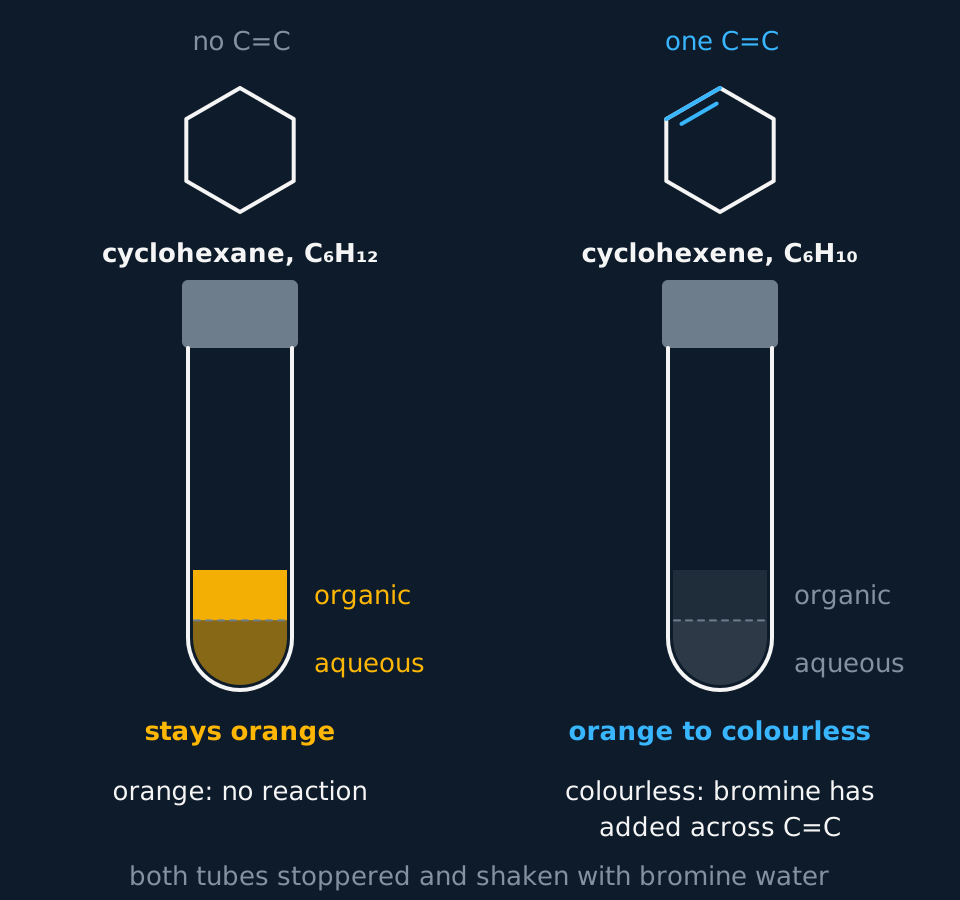
An alkene reacts at its carbon–carbon double bond, and the rest of the molecule behaves much like an alkane. Cyclohexene, C₆H₁₀, and cyclohexane, C₆H₁₂, are both rings of six carbon atoms and differ by two hydrogen atoms and one double bond. Shaken with orange bromine water, cyclohexene turns it colourless within seconds; cyclohexane leaves it orange.
Describe the drawing
Two stoppered test tubes, each a third full and shaken with bromine water. Left, cyclohexane, drawn above as a six-membered ring with no double bond: two layers, the upper organic layer deep orange and the lower aqueous layer pale orange, so the colour stays. Right, cyclohexene, drawn as a ring with one double bond: both layers colourless, because bromine has added across the carbon-carbon double bond.
An alkene is a hydrocarbon with at least one C=C double bond. Alkenes with one double bond and no ring have the general formula CₙH₂ₙ: ethene, C₂H₄; propene, C₃H₆; but-1-ene and but-2-ene, both C₄H₈. They are unsaturated. Each carbon of the double bond could hold more atoms than it does, and in every reaction here the double bond opens and each of its two carbons gains a new single bond.
The two bonds in C=C are not the same. The first is a σ bond, made by the direct overlap of an orbital from each carbon, with its electron density on the line between the two nuclei. The second is a π bond, made by the sideways overlap of a p orbital on each carbon. Its electron density lies in two lobes, one above the plane of the molecule and one below it, and none of it lies on the line between the nuclei.
Each carbon of the double bond has three regions of electron density around it, so the arrangement is trigonal planar, with bond angles of about 120°. The two carbons and the four atoms joined to them lie in one plane. The p orbitals overlap only while they stay parallel, so one end cannot twist relative to the other without breaking the π bond. That restricted rotation is why but-2-ene exists as E and Z isomers.
Two facts make the π bond the reactive part of an alkene. Its electrons are exposed, above and below the plane and further from the nuclei than the σ pair, so the double bond is a region of high electron density. And it is the weaker of the two bonds. The mean bond enthalpy of C=C is 612 kJ mol⁻¹ against 347 kJ mol⁻¹ for C–C, so the π bond adds only about 265 kJ mol⁻¹. Breaking it and making two new σ bonds in its place releases energy overall.
A region of high electron density attracts a species that is short of electrons. That species is an electrophile, an electron pair acceptor: a positive ion such as H⁺, or the δ+ end of a polar molecule such as H–Br. Alkanes have only σ bonds, with their electrons held between the nuclei, and they do not react with electrophiles.
- Alkene
- A hydrocarbon containing at least one carbon–carbon double bond; with one double bond and no ring, the general formula is CₙH₂ₙ.
- Unsaturated
- Containing at least one carbon–carbon multiple bond, as the C=C bond of an alkene, so that further atoms can be added to the molecule.
- π bond
- A bond formed by the sideways overlap of p orbitals, with its electron density above and below the line between the two nuclei.
- Electrophile
- An electron pair acceptor, attracted to a region of high electron density.
Bromine water is the test that follows from this. An alkene decolourises it at room temperature, orange to colourless; an alkane leaves it orange. In bromine water, water molecules compete with bromide ions in the second step of the mechanism, so the main product with cyclohexene is 2-bromocyclohexan-1-ol rather than 1,2-dibromocyclohexane. The colour change is the same either way. Write the result as 'decolourised' or 'orange to colourless'; 'goes clear' does not describe a colour.
Hydrogen bromide and propene
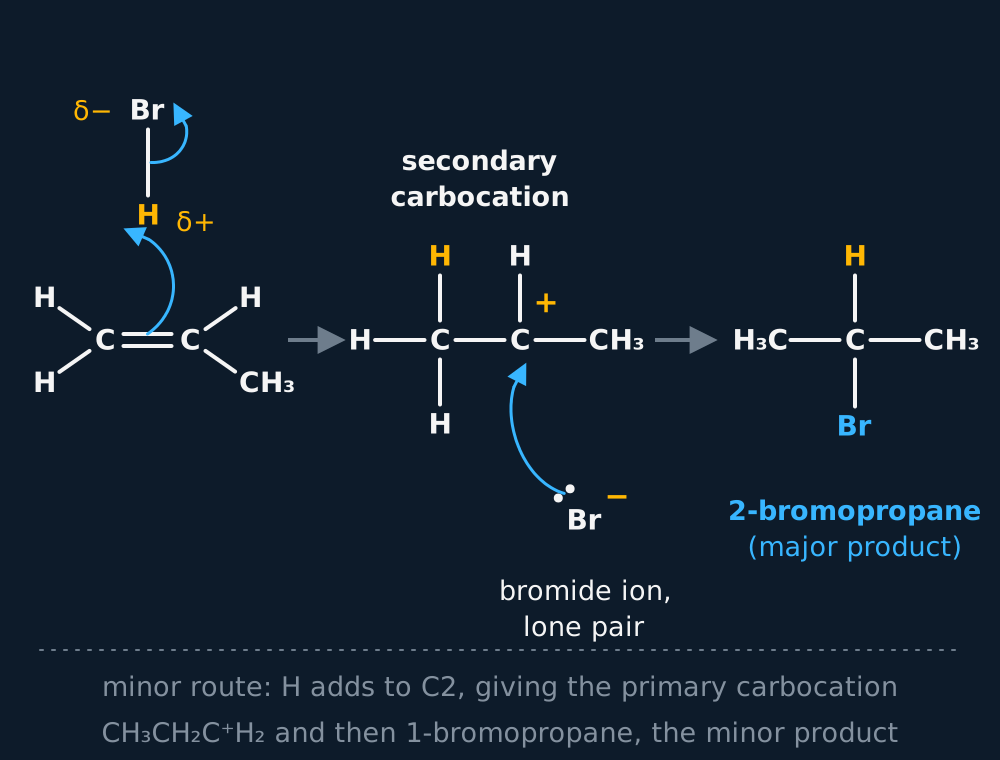
Hydrogen bromide is a polar molecule. Bromine is more electronegative than hydrogen, so the bonding pair sits nearer the bromine, and the molecule is Hδ+–Brδ−. When it meets propene, the hydrogen end is drawn towards the π electrons. The reaction that follows is an electrophilic addition: the double bond attacks the electrophile, and two groups end up added across it with nothing lost.
In the first step, the pair of electrons in the π bond moves to form a new bond between one carbon of the double bond and the hydrogen atom. Hydrogen can hold only one pair, so at the same moment the H–Br bond breaks heterolytically. Both its electrons go to bromine, which leaves as a bromide ion, Br⁻. The other carbon of the old double bond has lost its share of the π pair. It now has only three bonds and a positive charge: it is a carbocation.
In the second step, the bromide ion uses one of its lone pairs to form a bond to the positive carbon. The charges cancel and the product is a bromoalkane. Say that the H–Br bond breaks heterolytically; 'the bond breaks' alone does not say where the electrons go, and that is the point being tested.
CH₃CH=CH₂(g) + HBr(g) → CH₃CHBrCH₃(l)2-Bromopropane is the major product. 1-Bromopropane forms by the same two steps through a different carbocation, as the minor product.
Describe the drawing
Three stages of the electrophilic addition of hydrogen bromide to propene. First, propene with its double bond and a hydrogen bromide molecule above it, hydrogen delta plus and bromine delta minus; one curly arrow runs from the double bond to the hydrogen and a second from the H–Br bond to the bromine. Second, the secondary carbocation with the positive charge on the middle carbon and the new hydrogen on the end carbon, and a bromide ion whose lone pair sends a third curly arrow to the positive carbon. Third, the major product 2-bromopropane. A grey note records the minor route through the primary carbocation to 1-bromopropane.

Describe the drawing
The electrophilic addition of hydrogen bromide to propene in three stages. First propene, with its C=C double bond, sits below an H–Br molecule marked H δ+ and Br δ−; curly arrow 1 runs from the double bond to the hydrogen and arrow 2 from the H–Br bond onto the bromine. Second, the secondary carbocation, with the positive charge on the middle carbon and the new hydrogen on the end carbon, and a bromide ion whose lone pair sends arrow 3 to the positive carbon. Third, the product 2-bromopropane.
Every curly arrow shows a pair of electrons moving, so it starts where the pair is now and ends where the pair goes. The tail sits on a bond or on a lone pair, never on an atom's symbol or on a positive charge. The head points at the atom that gains the pair, or between two atoms where a new bond will form.
AQA's mark schemes give a mark for each of four things: the arrow from the double bond to the hydrogen; the arrow from the H–Br bond to the bromine; the structure of the carbocation, with the + on the right carbon; and the arrow from a lone pair on the bromide ion to that positive carbon. The δ+ and δ− on H–Br are worth drawing too, because they show why the first arrow goes to the hydrogen.
- Electrophilic addition
- A reaction in which the double bond of an alkene attacks an electrophile, and two groups add across the double bond to give one saturated product.
- Carbocation
- An ion in which a carbon atom has only three bonds and carries a positive charge.
- Heterolytic fission
- The breaking of a covalent bond in which both electrons of the bonding pair go to the same atom.
Bromine: a dipole made on arrival
Bromine is harder to explain. A Br₂ molecule is two identical atoms sharing a pair of electrons equally, so it has no permanent dipole, yet liquid bromine decolourises a gas jar of ethene. The reason is what the double bond does to the bromine molecule as it approaches.
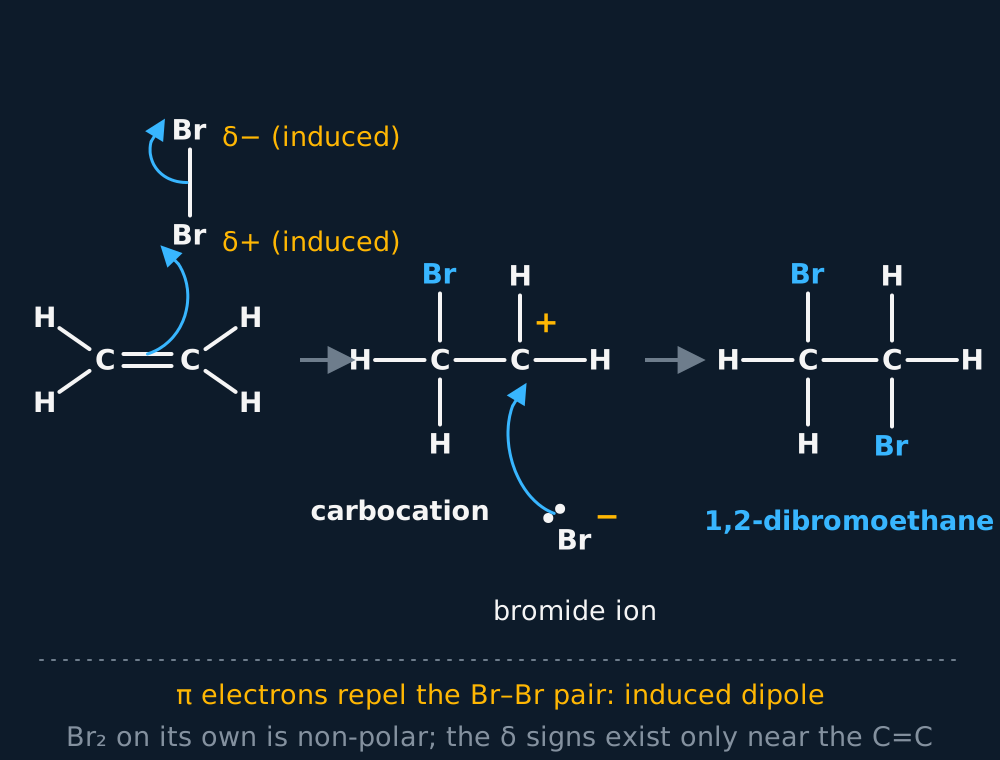
As a Br₂ molecule comes close to the C=C bond, the high electron density of the π bond repels the electrons in the Br–Br bond and pushes them towards the far bromine atom. The near bromine becomes δ+ and the far one δ−. That induced dipole lasts only while the molecule is close to the double bond, but it is enough: the δ+ bromine is now an electrophile, and the mechanism runs as it did with H–Br.
The π pair forms a bond to the near bromine atom. The Br–Br bond breaks heterolytically and its pair leaves with the far bromine as Br⁻. The carbocation has a bromine on one carbon and the + on the other. A lone pair on the bromide ion then forms a bond to that positive carbon, and the product has a bromine on each carbon of the old double bond.
CH₂=CH₂(g) + Br₂(l) → CH₂BrCH₂Br(l)1,2-Dibromoethane, the only product: ethene is symmetrical, so either carbon can take the first bromine.
Describe the drawing
Three stages of the electrophilic addition of bromine to ethene. First, ethene with a bromine molecule pointing end-on at one carbon from above; the nearer bromine is marked delta plus and the far one delta minus, both induced by the double bond. A curly arrow runs from the double bond to the near bromine and another from the Br–Br bond to the far bromine. Second, an open carbocation with bromine on one carbon and the positive charge on the other, and a bromide ion whose lone pair sends a third arrow to the positive carbon. Third, 1,2-dibromoethane.
Two errors appear in drawings of this mechanism. One is to call Br₂ polar in its own right: the dipole is induced, by the π electrons repelling the Br–Br pair, and has to be described that way. The other is to start the last arrow on the carbocation. The electrons that form the new C–Br bond come from the bromide ion, so the arrow starts on its lone pair and ends on the positive carbon.
- Induced dipole
- A temporary separation of charge in a molecule caused by a nearby region of charge; the π electrons of an alkene repel the Br–Br bonding pair, making the nearer bromine δ+.
Which carbocation forms: Markovnikov's rule
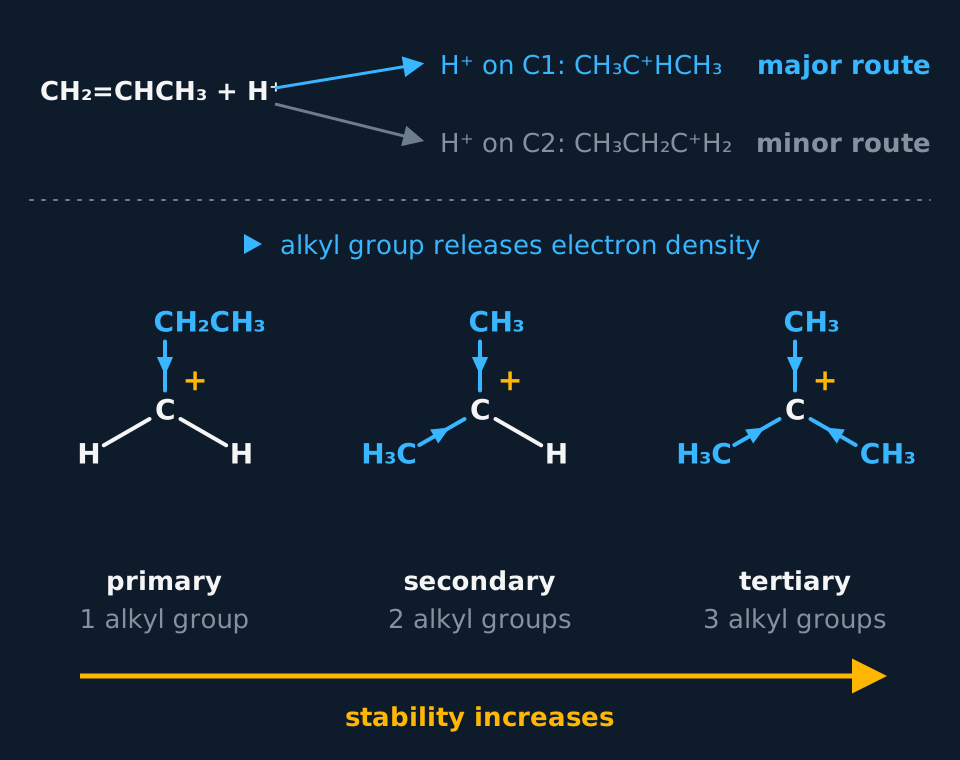
Ethene and but-2-ene are symmetrical, so it does not matter which carbon the electrophile bonds to: the product is the same either way. Propene is not symmetrical. If the hydrogen from H–Br bonds to the end carbon, the CH₂, the positive charge is left on the middle carbon, which is joined to two other carbons: a secondary carbocation, CH₃C⁺HCH₃. If the hydrogen bonds to the middle carbon, the charge is left on the end carbon, joined to one other carbon: a primary carbocation, CH₃CH₂C⁺H₂.
Both routes happen. The secondary carbocation leads to 2-bromopropane and the primary one to 1-bromopropane, and the mixture is mostly 2-bromopropane. It is the major product because the secondary carbocation is more stable than the primary one, so it forms faster.
Describe the drawing
Three carbocations side by side, each with the positive carbon in the centre: primary with one alkyl group and two hydrogens, secondary with two methyl groups and one hydrogen, tertiary with three methyl groups. Small solid arrowheads on each carbon-carbon bond point towards the positive carbon, showing electron release, and a long arrow beneath reads stability increases from left to right. An inset above shows H⁺ adding to C1 of propene to give the secondary ion by the major route, or to C2 to give the primary ion by the minor route.
The reason is the inductive effect. An alkyl group such as CH₃ releases electron density along the σ bond that joins it to the positive carbon. That partly offsets the positive charge and spreads it over more of the ion, and a charge that is spread out is more stable than one concentrated on a single atom. A tertiary carbocation has three alkyl groups doing this, a secondary two and a primary one, so the order of stability is tertiary > secondary > primary.
Stability matters because of rate. The step that makes the more stable carbocation has the lower activation energy, so at the same temperature more collisions succeed by that route and more of the product comes through it. The stability of the carbocation is the reason to give, not the stability of the product: 1-bromopropane and 2-bromopropane are close in energy.
Markovnikov's rule is the shortcut. When H–X adds to an unsymmetrical alkene, the hydrogen goes to the carbon of the double bond that already has more hydrogen atoms. It gives the major product correctly in every case at this level, because putting the hydrogen there leaves the positive charge on the carbon with more alkyl groups. The rule names the answer and the carbocation explains it, and an Explain question asks for the carbocation.
- Inductive effect
- The release of electron density along a σ bond by an alkyl group, which stabilises a positive charge on the carbon it is joined to.
- Markovnikov's rule
- When a hydrogen halide adds to an unsymmetrical alkene, the hydrogen bonds to the carbon of the double bond that already carries more hydrogen atoms.
2-Methylpropene and hydrogen bromide
2-Methylpropene, (CH₃)₂C=CH₂, reacts with hydrogen bromide. Name the major product, outline how it forms, and explain why it is the major product.
Show the working
The double bond joins the CH₂ carbon to the central carbon, which carries two CH₃ groups. Two carbocations are possible, one for each carbon the hydrogen could bond to.
If the hydrogen bonds to the CH₂ carbon, the positive charge sits on the central carbon, now joined to three carbons: (CH₃)₃C⁺, a tertiary carbocation. If it bonds to the central carbon, the charge sits on the end carbon, joined to one carbon: (CH₃)₂CHC⁺H₂, a primary carbocation.
The mechanism: an arrow from the C=C bond to the H of Hδ+–Brδ−; an arrow from the H–Br bond to Br; the tertiary carbocation (CH₃)₃C⁺ with the + on the central carbon; an arrow from a lone pair on Br⁻ to that carbon.
The tertiary carbocation has three alkyl groups releasing electron density towards the positive carbon, against one for the primary, so it is much more stable and forms faster. The major product is 2-bromo-2-methylpropane, (CH₃)₃CBr, and the minor product is 1-bromo-2-methylpropane. Markovnikov's rule agrees: the hydrogen goes to the CH₂ carbon, which already had two hydrogens against none.
Sulfuric acid, water and steam
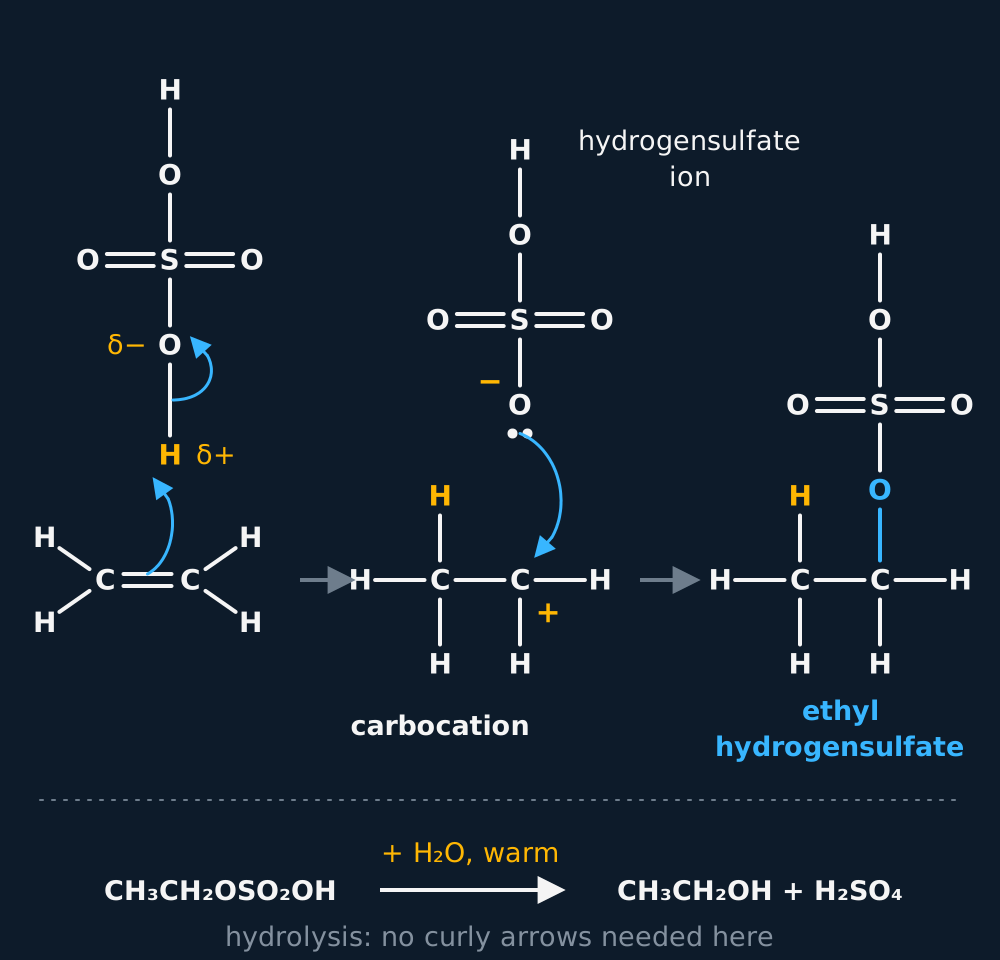
Ethene bubbled through cold concentrated sulfuric acid is absorbed. The acid is H–O–SO₂–O–H, and each O–H bond is polar, with the hydrogen δ+ and the oxygen δ−. The δ+ hydrogen is the electrophile. The π pair forms a bond to it, the O–H bond breaks with its pair going to the oxygen, and a carbocation and a hydrogensulfate ion, HSO₄⁻, are left. A lone pair on the negatively charged oxygen of the hydrogensulfate ion then forms a bond to the positive carbon. The product is ethyl hydrogensulfate, CH₃CH₂OSO₂OH.
CH₂=CH₂(g) + H₂SO₄(l) → CH₃CH₂OSO₂OH(l)
Describe the drawing
Electrophilic addition of concentrated sulfuric acid to ethene in three stages. First, ethene below a sulfuric acid molecule whose lower O–H points at the double bond, the hydrogen delta plus and the oxygen delta minus; one curly arrow runs from the double bond to that hydrogen and another from the O–H bond to the oxygen. Second, the carbocation with the positive charge on the carbon not bonded to the new hydrogen, and a hydrogensulfate ion whose negative oxygen sends a curly arrow from its lone pair to the positive carbon. Third, ethyl hydrogensulfate. Below, a plain equation shows warm water hydrolysing it to ethanol and sulfuric acid.
Adding water and warming hydrolyses the ethyl hydrogensulfate to ethanol and gives the sulfuric acid back. Over the two stages the acid is a catalyst, and the overall change is the addition of water across the double bond.
CH₃CH₂OSO₂OH(l) + H₂O(l) → CH₃CH₂OH(aq) + H₂SO₄(aq)
Industry adds water to ethene directly, as steam over a phosphoric acid catalyst at about 300 °C and 60 to 70 atm, the acid supplying the H⁺ electrophile. The mechanism is the same three arrows: the π pair to H⁺, a lone pair on water to the carbocation, and the O–H bond of the protonated alcohol back to the oxygen as H⁺ returns to the catalyst.
CH₂=CH₂(g) + H₂O(g) ⇌ CH₃CH₂OH(g)ΔH = −45 kJ mol⁻¹
TRY IT: Propene, sulfuric acid and water
Propene is passed into cold concentrated sulfuric acid, then water is added and the mixture warmed. Name the major organic product of the two stages, and explain why it is the major product rather than its isomer.
Check your answer
In the first stage the δ+ hydrogen of an O–H group in H₂SO₄ is the electrophile. If it bonds to the CH₂ end of propene, the positive charge is left on the middle carbon, giving the secondary carbocation CH₃C⁺HCH₃. If it bonds to the middle carbon, the primary carbocation CH₃CH₂C⁺H₂ forms.
The secondary carbocation has two alkyl groups releasing electron density towards the positive carbon, against one, so it is more stable and forms faster. The hydrogensulfate ion bonds to the middle carbon, and water then replaces the OSO₂OH group with OH.
The major product is propan-2-ol, CH₃CH(OH)CH₃. Propan-1-ol is the minor product.
Other boards: hybridisation, hydrogenation and manganate(VII)
Cambridge describes the bonds of the double bond through hybridisation. Each carbon of the double bond mixes its 2s orbital with two of its 2p orbitals to make three sp² hybrid orbitals, which lie in one plane at 120° and form the three σ bonds. The third 2p orbital is left unhybridised, at right angles to that plane, and the sideways overlap of two of them is the π bond. A carbon with four single bonds is sp³, at 109.5°; a carbon in a triple bond is sp, at 180°, with two π bonds.
Hydrogen also adds across the double bond, at about 150 °C over a nickel catalyst, giving the alkane. OCR, Edexcel and Cambridge teach it with the other additions, and it is how vegetable oils are hardened into spreads. AQA uses it only in the enthalpies of hydrogenation that are the evidence for the structure of benzene.
CH₂=CH₂(g) + H₂(g) → CH₃CH₃(g)Nickel catalyst, about 150 °C.
Edexcel and Cambridge also set the oxidation of alkenes by acidified potassium manganate(VII). Shaken cold and dilute with an alkene, the purple solution turns colourless and an OH group adds to each carbon of the old double bond, giving a diol: ethene gives ethane-1,2-diol. The colour change is a second test for C=C.
CH₂=CH₂(g) + [O] + H₂O(l) → HOCH₂CH₂OH(aq)Cold, dilute, acidified KMnO₄: purple to colourless.
Cambridge adds the hot, concentrated reagent, which breaks the double bond completely. Each carbon of the old C=C becomes a C=O. A carbon carrying two alkyl groups ends as a ketone, one carrying a hydrogen ends as a carboxylic acid, and a CH₂ at the end of a chain is oxidised to carbon dioxide and water. 2-Methylbut-2-ene, (CH₃)₂C=CHCH₃, gives propanone and ethanoic acid, and the two fragments show where the double bond was.
| Acidified KMnO₄ | Cold and dilute | Hot and concentrated |
|---|---|---|
| What happens to C=C | π bond opens; σ bond stays | Both bonds break |
| Organic product | A diol, one OH on each carbon | Ketones, carboxylic acids or CO₂, one fragment per carbon |
| Ethene gives | Ethane-1,2-diol | Carbon dioxide and water |
| Colour change | Purple to colourless | Purple to colourless |
- Diol
- A compound with two OH groups; cold dilute acidified manganate(VII) adds one to each carbon of a C=C bond.
In the exam
- AQA's scheme for an addition mechanism awards one mark for each of four things: the arrow from the double bond to the δ+ atom, the arrow from the breaking bond to the δ− atom, the carbocation with its + on the correct carbon, and the arrow from a lone pair on the anion to that carbon. An arrow that starts on an atom rather than a bond or lone pair loses its mark.
- With bromine, the answer must say that the π electrons repel the electrons in the Br–Br bond and induce a dipole. 'Br₂ is polar' is rejected: it has no permanent dipole.
- Markovnikov's rule alone earns no credit in an Explain question about a major product. The marks are for naming the carbocation, secondary or tertiary, and saying it is more stable because more alkyl groups release electron density towards the positive carbon.
- For the test with bromine water, schemes accept 'decolourised' or 'orange to colourless', and ignore the name of the product: the mark is for the colour change, and the product with water present is a bromoalcohol anyway.
- Define an electrophile as an electron pair acceptor. 'Attracted to a negative charge' describes its behaviour and does not earn the definition mark.
Check yourself
But-1-ene, CH₂=CHCH₂CH₃, reacts with hydrogen bromide. Name the two products, say which is the major product, and explain why, naming the type of mechanism.
Answer
The mechanism is electrophilic addition. The δ+ hydrogen of H–Br accepts the π pair from the double bond, and the H–Br bond breaks to give Br⁻.
If the hydrogen bonds to carbon 1, the CH₂ end, the positive charge is on carbon 2, joined to two carbons: a secondary carbocation, CH₃CH₂C⁺HCH₃. If it bonds to carbon 2, the charge is on carbon 1: a primary carbocation, CH₃CH₂CH₂C⁺H₂.
The secondary carbocation has two alkyl groups releasing electron density towards the positive carbon against one, so it is more stable and forms faster. Br⁻ bonds to it to give 2-bromobutane, the major product. 1-Bromobutane is the minor product.
Questions
Question 16 marks
Draw the mechanism for the reaction of 2-methylbut-1-ene, CH₂=C(CH₃)CH₂CH₃, with hydrogen bromide to form the major product, and explain why this product, rather than its isomer, is the major one.
Mark scheme
Indicative content
- H–Br drawn with δ+ on H and δ− on Br, and a curly arrow from the C=C double bond to the H atom; allow the dipole to be omitted if the arrow is correct
- a curly arrow from the middle of the H–Br bond to the Br atom, showing heterolytic fission and the formation of the bromide ion
- the tertiary carbocation (CH₃)₂C⁺CH₂CH₃, drawn with the positive charge on the carbon carrying the methyl and ethyl groups
- a curly arrow from a lone pair on Br⁻ to the positive carbon, giving 2-bromo-2-methylbutane, (CH₃)₂CBrCH₂CH₃, as the major product
- if the hydrogen bonds to the other carbon of the double bond, a primary carbocation forms instead, leading to 1-bromo-2-methylbutane as the minor product
- the tertiary carbocation is more stable because three alkyl groups release electron density towards the positive carbon, so it forms faster by the route of lower activation energy
Levels
- Level 3 (5–6 marks) every curly arrow, charge and intermediate of the mechanism is correct, the major product is drawn and named, the alternative primary carbocation is identified, and the preference is explained through carbocation stability from the inductive effect of alkyl groups
- Level 2 (3–4 marks) the dipole, the first two arrows and the tertiary carbocation are right and the major product is given; the bromide arrow is absent or starts from the wrong place, or the two carbocations are not compared
- Level 1 (1–2 marks) one correct arrow or the correct product, typically with the primary carbocation drawn as the intermediate or the positive charge on the CH₂ carbon, and no reason for the major product
Question 24 marks
Outline the mechanism for the reaction of propene with hydrogen bromide to form 2-bromopropane.
Mark scheme
- B1 a curly arrow from the C=C double bond to the H atom of H–Br; allow the arrow to the δ+ H if dipoles are shown
- B1 a curly arrow from the H–Br bond to the Br atom, the bond breaking heterolytically to give Br⁻
- B1 the structure of the secondary carbocation, CH₃C⁺HCH₃, with the positive charge on the middle carbon
- B1 a curly arrow from a lone pair on the bromide ion to the positively charged carbon; reject an arrow starting at the minus sign rather than a lone pair
Question 34 marks
Outline the mechanism for the reaction of ethene with bromine to form 1,2-dibromoethane.
Mark scheme
- B1 the induced dipole on Br₂, δ+ on the bromine nearer the double bond, with a curly arrow from the C=C double bond to that bromine atom
- B1 a curly arrow from the Br–Br bond to the further bromine atom
- B1 the structure of the carbocation, CH₂BrC⁺H₂, with a bromine on one carbon and the positive charge on the other
- B1 a curly arrow from a lone pair on Br⁻ to the positively charged carbon
All 21 questions with mark schemes, the other 18 set out in full on the question page.
Worth remembering
- The π electrons, not the σ pair, are the part that attacks: the first arrow starts on the double bond.
- Every curly arrow starts on a bond or a lone pair; one that starts on an atom or on a + charge loses its mark.
- Br₂ is not polar; an answer that says it is gets no credit. Its dipole is induced by the π electrons.
- Explain a major product by the stability of the carbocation, not of the product and not by Markovnikov's rule alone.
- Start the second arrow on the bromide ion's lone pair and end it on the carbocation's positive carbon.
CHECK YOUR PROGRESS
Rate how confident you are with each objective for this lesson. Ratings are saved in this browser, on this device, unless you sign in.
- Describe the C=C double bond as a σ bond and a π bond, and explain why it makes an alkene attract electrophiles.
- Outline the electrophilic addition mechanism for the reactions of alkenes with hydrogen bromide, bromine and concentrated sulfuric acid, with every curly arrow, dipole, lone pair and charge.
- Explain how a bromine molecule, which is non-polar, becomes an electrophile as it approaches a double bond.
- Explain the order of stability of primary, secondary and tertiary carbocations, and use it to predict the major product from an unsymmetrical alkene.
- Describe the bromine water test for unsaturation and state its result.
- Describe the oxidation of alkenes by cold dilute and by hot concentrated acidified potassium manganate(VII).CAIE · Edexcel
Open the full revision checklist to see every objective in the curriculum in one place.
Practise this lesson
WORKBOOK
The written questions from this topic, on paper with room to work, and a separate book of mark schemes. The question that is set on a diagram stays on this page, where the diagram can be drawn. Free to use; please do not redistribute or sell.
Used later in Alcohols: hydration, fermentation and classification · Test-tube reactions for functional groups, and high-resolution mass spectrometry · Benzene: its structure and the evidence for delocalisation · Electrophilic substitution: nitration and Friedel–Crafts acylation