Chemistry › Alkanes and halogenoalkanes › Halogenoalkanes: nucleophilic substitution and rates of hydrolysis
Halogenoalkanes: nucleophilic substitution and rates of hydrolysis
The carbon attached to a halogen carries a small positive charge, and anything with a lone pair to offer will attack it. Hydroxide gives an alcohol, cyanide gives a nitrile with one more carbon, and ammonia gives an amine. Which halogenoalkane reacts fastest is decided by the strength of the bond that breaks, not by its polarity, and a silver nitrate test shows it in a row of test tubes.
Key terms Every definition in alkanes and halogenoalkanes, lesson by lesson
Before this Reaction types, curly arrows and how a mechanism is written – nucleophiles, heterolytic fission and where an arrow starts and ends · Electronegativity, polarity and intermolecular forces – δ+ and δ− on a polar bond · Halide ions, the silver nitrate test, concentrated sulfuric acid, and chlorine in water – the colours of AgCl, AgBr and AgI
COMMON MISCONCEPTION
The C–F bond is the most polar, so fluoroalkanes react with nucleophiles fastest.
The rate is set by the bond that has to break, not by the size of the δ+. C–F is the strongest carbon–halogen bond, 467 kJ mol⁻¹, and C–I the weakest, 228 kJ mol⁻¹, so iodoalkanes hydrolyse fastest and fluoroalkanes hardly at all. Silver nitrate gives a yellow precipitate from an iodoalkane in seconds and nothing from a fluoroalkane.
What you should be able to do
- Explain why the carbon of a C–X bond is attacked by nucleophiles, and define a nucleophile.
- Outline the mechanisms for the reactions of a primary halogenoalkane with hydroxide ions, cyanide ions and ammonia, with the conditions for each.
- Name the alcohol, nitrile or amine formed, and explain why excess ammonia is used.
- Explain why the rate of hydrolysis depends on the C–X bond enthalpy rather than the bond polarity.
- Describe how silver nitrate in ethanol is used to compare rates of hydrolysis, with the colour of each precipitate.
- Explain why tertiary halogenoalkanes are hydrolysed fastest, and how optical activity distinguishes SN1 from SN2.CAIE · Edexcel
The polar C–X bond and the mechanism
A halogenoalkane is an alkane with one or more hydrogen atoms replaced by halogen atoms. Every halogen is more electronegative than carbon, so the C–X bond is polar: the carbon carries a partial positive charge, δ+, and the halogen a partial negative charge, δ−. The δ+ carbon is open to attack by a nucleophile, a species with a lone pair of electrons it can donate to form a new covalent bond.
The nucleophile's lone pair forms a bond to the carbon, the C–X bond breaks heterolytically, and the halogen leaves as a halide ion taking both electrons of the bond. One group has replaced another, and the attacking species was a nucleophile, so the reaction is nucleophilic substitution. The hydroxide ion is the simplest nucleophile: its oxygen carries three lone pairs and the negative charge, and warm aqueous sodium hydroxide turns bromoethane into ethanol.
CH₃CH₂Br(l) + OH⁻(aq) → CH₃CH₂OH(aq) + Br⁻(aq)aqueous NaOH or KOH, warm, under reflux
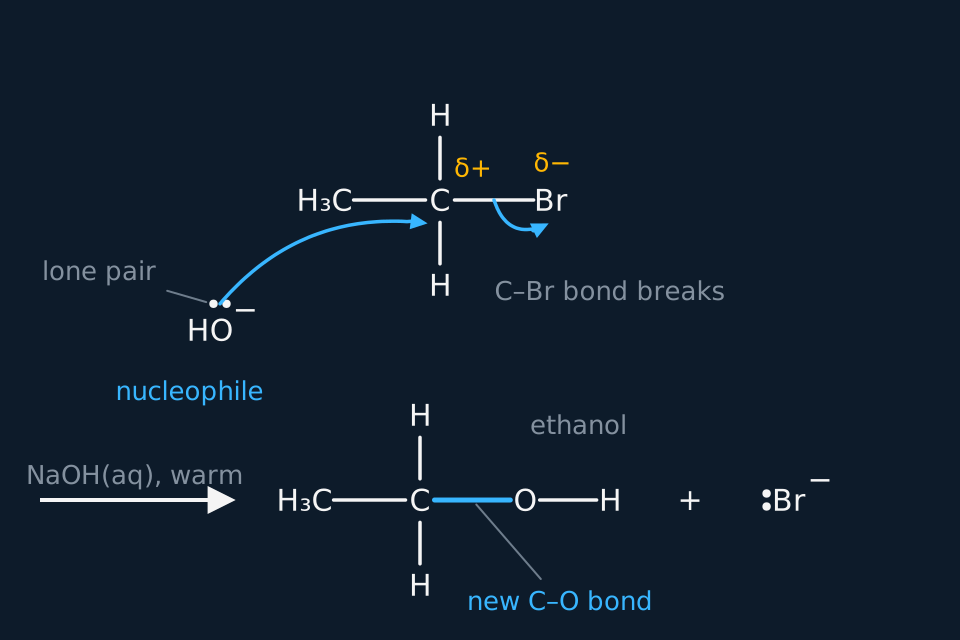
Describe the drawing
Bromoethane drawn with the carbon bonded to bromine displayed, δ+ on that carbon and δ− on the bromine. A hydroxide ion, HO with a lone pair and a negative charge on the oxygen, sits below left. One curly arrow runs from the oxygen's lone pair to the δ+ carbon; a second runs from the middle of the C–Br bond to the bromine. After the reaction arrow: ethanol with the new C–O bond highlighted, and a bromide ion with a lone pair and a negative charge.
Each part of the drawing carries a meaning. The dipole, δ+ on carbon and δ− on bromine, shows why the carbon is attacked. The first curly arrow, from a lone pair on the oxygen to the carbon, is the new C–O bond forming. The second, from the middle of the C–Br bond to the bromine, is that bond breaking with both electrons going to bromine. The products are ethanol and a bromide ion with a full octet. An arrow that ends on the bromine's δ− in place of the carbon shows electrons moving somewhere they do not go. Start the first arrow on a lone pair; the mark scheme also accepts it from the minus sign on the oxygen, but never from the hydrogen.
- Halogenoalkane
- A compound in which one or more hydrogen atoms of an alkane have been replaced by halogen atoms.
- Heterolytic fission
- The breaking of a covalent bond in which one atom takes both electrons of the bonding pair, forming two ions.
- Nucleophile
- An electron pair donor: a species with a lone pair of electrons that attacks an electron-deficient atom to form a new covalent bond.
- Nucleophilic substitution
- A reaction in which a nucleophile attacks an electron-deficient carbon and replaces an atom or group attached to it.
Hydroxide ions: making an alcohol
Halogenoalkanes are classified by the carbon the halogen sits on. In a primary halogenoalkane that carbon is bonded to one other carbon, as in 1-bromopropane; in a secondary, to two, as in 2-bromopropane; in a tertiary, to three, as in 2-bromo-2-methylpropane. The mechanisms here are drawn for primary halogenoalkanes, which react in the single step shown.
The mixture is heated under reflux: the flask carries a vertical condenser, so the vapour of the volatile bromoethane and ethanol condenses and runs back into the flask instead of escaping. The reaction can then be kept warm for as long as it needs without losing reactant or product. Bromoethane does not mix well with water, so a little ethanol is often added as a common solvent.
Because a halogen atom has been replaced by an OH group, this is also called hydrolysis. Water does the same job as hydroxide ions, much more slowly, because a water molecule is neutral and a weaker nucleophile than the negatively charged ion.
- Primary halogenoalkane
- A halogenoalkane in which the carbon bonded to the halogen is bonded to only one other carbon atom.
- Hydrolysis
- The splitting of a bond in a molecule by reaction with water or hydroxide ions.
The yield of an alcohol
5.48 g of 1-bromobutane is heated under reflux with excess aqueous sodium hydroxide, and 2.22 g of pure butan-1-ol is obtained. Calculate the percentage yield. Mr: 1-bromobutane 136.9, butan-1-ol 74.0.
Show the working
Amount of 1-bromobutane = 5.48 ÷ 136.9 = 0.04003 mol.
The equation is 1 : 1, so the maximum amount of butan-1-ol is 0.04003 mol, and the theoretical mass is 0.04003 × 74.0 = 2.962 g.
Percentage yield = 2.22 ÷ 2.962 × 100 = 74.9%.
The missing quarter is not a failure of the mechanism. Some 1-bromobutane eliminates instead of substituting, giving but-1-ene, and some product is lost in separating and distilling it.
Cyanide ions: adding a carbon
The cyanide ion is a nucleophile as well. A halogenoalkane heated under reflux with potassium cyanide dissolved in ethanol and water gives a nitrile, a compound with the C≡N group. The solvent is mainly ethanol, so the equation is written without state symbols: CH₃CH₂Br + CN⁻ → CH₃CH₂CN + Br⁻.
The nucleophile is the lone pair on the carbon of the cyanide ion, and that carbon is where the negative charge is drawn. Its curly arrow starts on that lone pair and ends on the δ+ carbon of the halogenoalkane; the second arrow, as before, runs from the C–Br bond to the bromine. The new bond is C–C, which is the point of the reaction: the carbon chain grows by one.
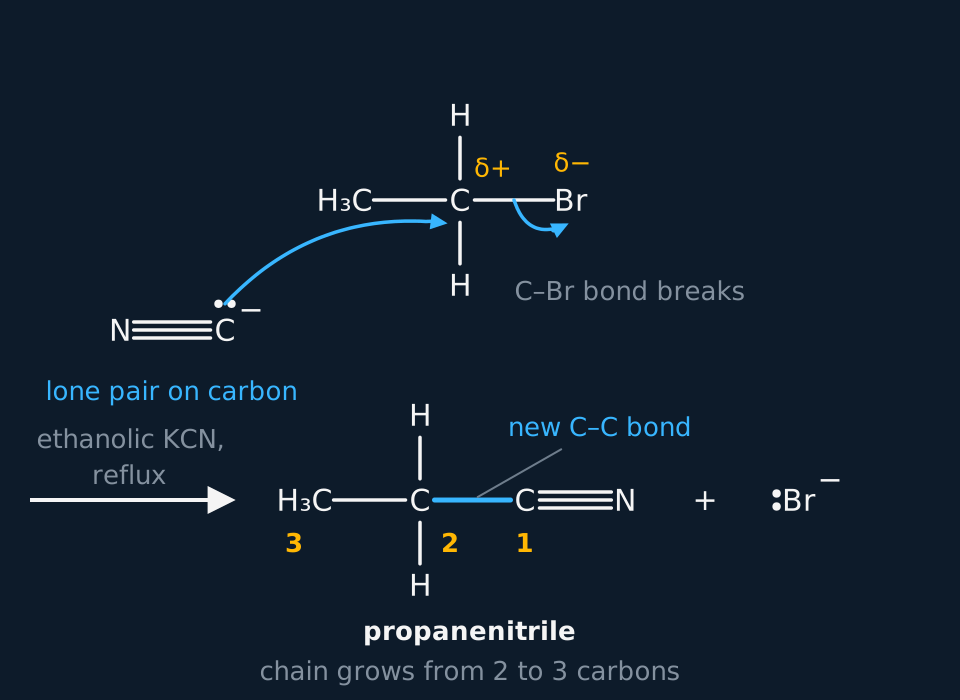
Describe the drawing
Bromoethane with δ+ on the carbon bonded to bromine and δ− on the bromine. A cyanide ion, N triple-bonded to C, sits below left with a lone pair and the negative charge on its carbon. One curly arrow runs from that carbon's lone pair to the δ+ carbon; a second from the C–Br bond to the bromine. After ethanolic KCN under reflux: propanenitrile, its carbons numbered 1 to 3 from the nitrile carbon, with the new C–C bond highlighted, and a bromide ion. The chain has grown from two carbons to three.
A nitrile is named from the whole chain, counting the carbon of the C≡N. Bromoethane gives CH₃CH₂CN, which has three carbon atoms, so it is propanenitrile, not ethanenitrile. 1-bromopropane gives butanenitrile. The extra carbon is useful in synthesis, because a nitrile can be turned into a carboxylic acid or an amine later in the A-level course.
- Nitrile
- A compound containing the C≡N group, named from the whole carbon chain including the carbon of the C≡N.
Potassium cyanide is very toxic, and it releases hydrogen cyanide gas with acid. The reaction is run in a fume cupboard, and the mixture is never acidified while cyanide remains.
Outlining the mechanism with cyanide
Outline the mechanism for the reaction of 1-bromopropane with potassium cyanide, and name the organic product.
Show the working
Draw 1-bromopropane with the C–Br carbon displayed and mark the dipole: δ+ on that carbon, δ− on bromine.
Draw the cyanide ion as :C≡N with the lone pair and the negative charge on the carbon. Draw a curly arrow from that lone pair to the δ+ carbon.
Draw a second curly arrow from the middle of the C–Br bond to the bromine atom.
Draw the products: CH₃CH₂CH₂CN and Br⁻. The product has four carbon atoms in its chain, so it is butanenitrile.
Ammonia: making an amine
Ammonia is the third nucleophile, through the lone pair on its nitrogen. A halogenoalkane heated with an excess of ammonia dissolved in ethanol, in a sealed tube so the ammonia cannot escape, gives an amine: bromoethane gives ethylamine.
Ammonia is neutral, so the mechanism needs a second step. In step 1 the nitrogen lone pair attacks the δ+ carbon and bromide leaves, as with hydroxide. The nitrogen now has four bonds and no lone pair, so it carries a positive charge: the intermediate is the ethylammonium ion, CH₃CH₂NH₃⁺. In step 2 a second ammonia molecule uses its lone pair to remove an H⁺ from that nitrogen, and the electrons of the broken N–H bond return to the nitrogen as a lone pair.
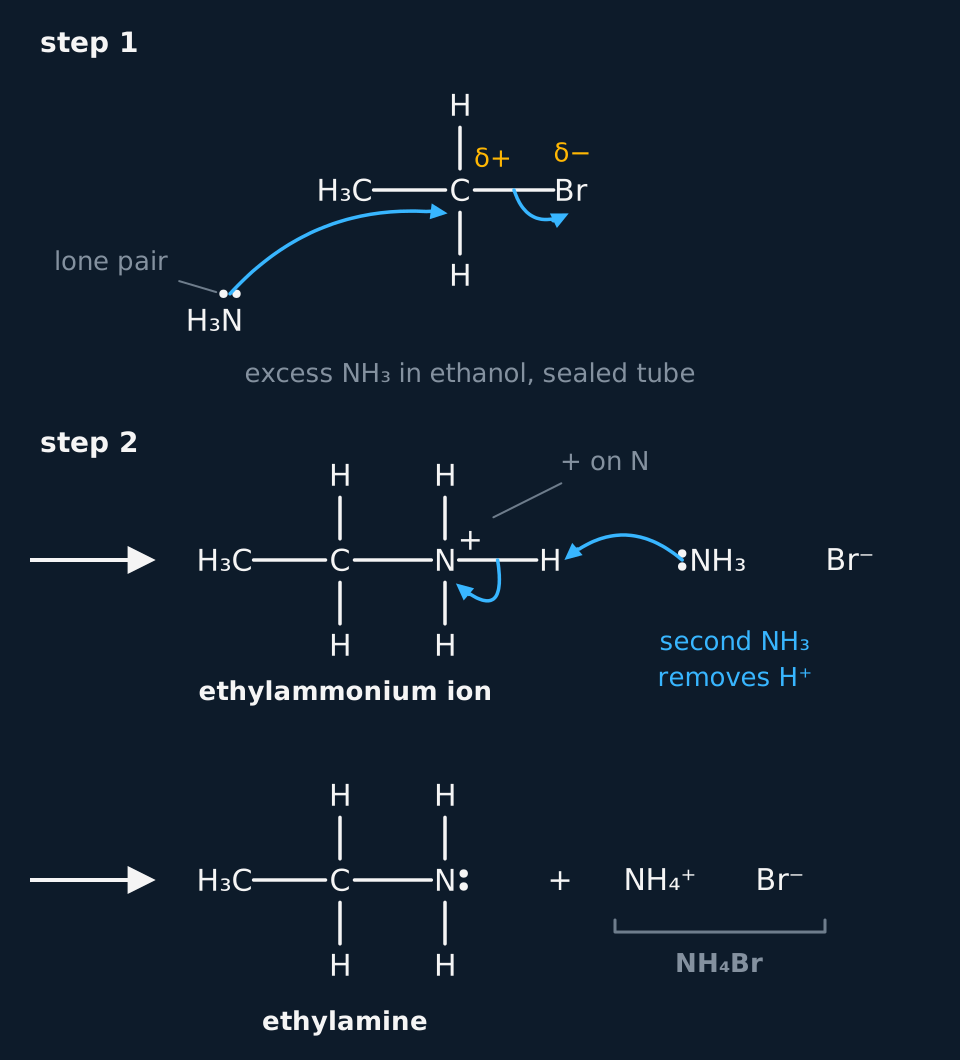
Describe the drawing
Two steps. Step 1: ammonia with a lone pair on nitrogen attacks the δ+ carbon of bromoethane, a second curly arrow taking the C–Br bond onto the δ− bromine; conditions are excess ammonia in ethanol in a sealed tube. The intermediate is the ethylammonium ion, nitrogen displayed with three hydrogens and a positive charge on N, with a bromide ion. Step 2: a second ammonia's lone pair arrows onto one H of the NH₃⁺ group and the N–H bond arrows back onto the N. Products: ethylamine with its lone pair restored, and NH₄⁺ with Br⁻, together ammonium bromide.
The overall equation, written without state symbols because the solvent is ethanol, is CH₃CH₂Br + 2NH₃ → CH₃CH₂NH₂ + NH₄Br. Two moles of ammonia are used for every mole of product: one becomes part of the amine and the other ends up as ammonium bromide.
The excess matters for a second reason. Ethylamine also has a lone pair on nitrogen, so it is a nucleophile too, and it can attack another molecule of bromoethane to give diethylamine, which can react again. With ammonia in large excess, a bromoethane molecule is far more likely to meet ammonia than ethylamine, so the primary amine is the main product.
- Amine
- A compound in which one or more hydrogen atoms of ammonia have been replaced by alkyl groups.
Which halogenoalkane reacts fastest
Polarity suggests one answer. Fluorine is by far the most electronegative halogen, so the C–F carbon carries the largest δ+ and should attract a nucleophile most strongly; iodine has almost the same electronegativity as carbon, so C–I is barely polar. If polarity decided the rate, fluoroalkanes would hydrolyse fastest and iodoalkanes slowest. The experiment shows the reverse.
| Bond | Electronegativity of X (C is 2.5) | Bond enthalpy / kJ mol⁻¹ | Rate of hydrolysis |
|---|---|---|---|
| C–F | 4.0 | 467 | No reaction |
| C–Cl | 3.0 | 346 | Slow |
| C–Br | 2.8 | 290 | Faster |
| C–I | 2.5 | 228 | Fastest |
What decides the rate is the bond enthalpy of C–X, because the reaction cannot happen without that bond breaking. The C–I bond is the longest and weakest, so less energy is needed to break it, the activation energy is lower and iodoalkanes react fastest. The C–F bond is so strong that fluoroalkanes are not hydrolysed under these conditions at all.
Write 'bond enthalpy' or 'bond strength' in the explanation, and say which bond: the C–X bond. 'Iodine is a better leaving group' describes the result without the reason.
Rates of hydrolysis: the silver nitrate method
Edexcel assesses this comparison as core practical 4. The chemistry it shows, a rate set by the C–X bond enthalpy, is examined by every board, and its results can be set as data to interpret.
The rates are compared with aqueous silver nitrate and ethanol. Equal volumes of 1-chlorobutane, 1-bromobutane and 1-iodobutane go into three tubes with ethanol, which dissolves both the halogenoalkane and the aqueous reagent so that they mix. The tubes, and a tube of silver nitrate solution, stand in a water bath at about 50 °C until they reach its temperature. Equal volumes of silver nitrate solution are added to each, and a clock is started.
Water is the nucleophile. As each halogenoalkane is hydrolysed, halide ions are released and precipitate at once with silver ions, so the time for a precipitate to appear measures how fast the C–X bond is breaking.
The comparison is fair only if the halogen is the one thing that changes. All three compounds are primary and have the same four-carbon chain; the volumes, the concentration of silver nitrate and the temperature of the bath are the same in every tube. Water is used rather than hydroxide ions as the nucleophile because hydroxide would precipitate silver oxide with the silver ions and hide the halide precipitate.
CH₃CH₂CH₂CH₂Br(l) + H₂O(l) → CH₃CH₂CH₂CH₂OH(aq) + H⁺(aq) + Br⁻(aq)
Ag⁺(aq) + Br⁻(aq) → AgBr(s)cream precipitate
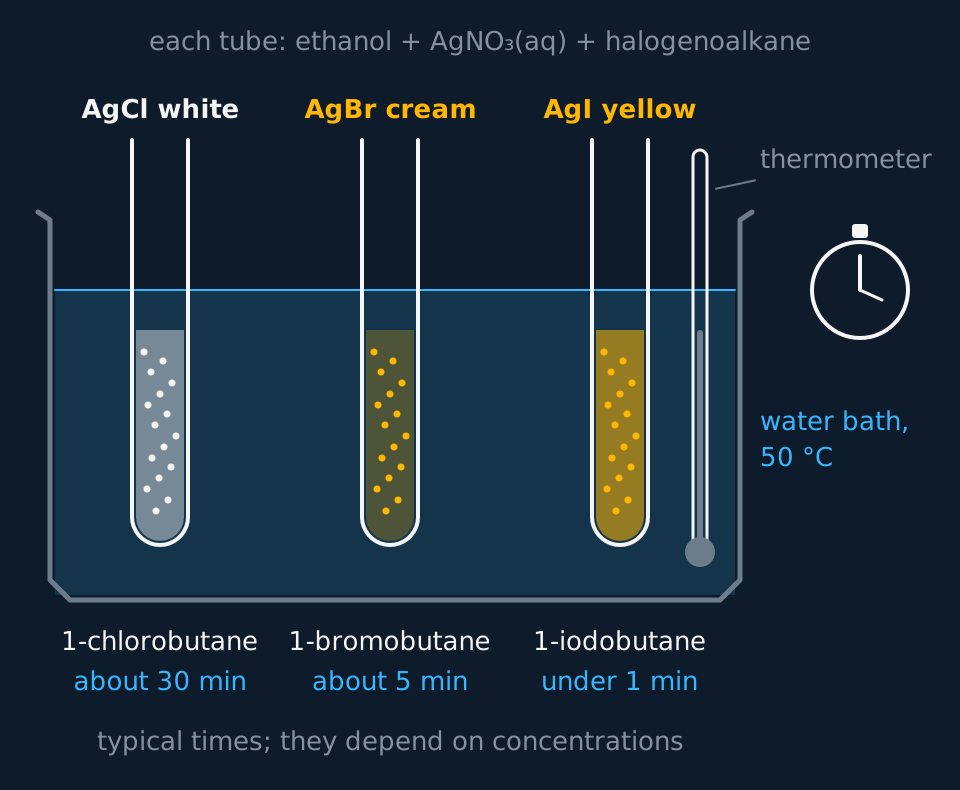
Describe the drawing
Three test tubes standing in a 50 °C water bath with a thermometer, and a stopclock beside the beaker. Each tube holds ethanol, aqueous silver nitrate and a halogenoalkane, drawn at the moment a cloudy precipitate first appears: white silver chloride with 1-chlorobutane after about 30 minutes, cream silver bromide with 1-bromobutane after about 5 minutes, and yellow silver iodide with 1-iodobutane in under a minute.
The end point is a judgement, the first cloudiness seen, so it is read against a black card or a printed cross under the tube and by the same person each time. Rate is taken as proportional to 1/time, which assumes the same amount of precipitate is formed in each tube at the moment the cloudiness is seen.
TRY IT: Reading the silver nitrate results
In the silver nitrate test, a precipitate appears after 40 s with 1-iodobutane and after 300 s with 1-bromobutane. Taking the rate as 1/time, calculate how many times faster 1-iodobutane is hydrolysed, and explain the difference.
Check your answer
Rate is proportional to 1/t, so the ratio of rates is (1/40) ÷ (1/300) = 300 ÷ 40 = 7.5. 1-iodobutane is hydrolysed about 7.5 times faster.
The C–I bond enthalpy, 228 kJ mol⁻¹, is lower than the C–Br bond enthalpy, 290 kJ mol⁻¹, so less energy is needed to break it and the activation energy is lower. A greater proportion of collisions have enough energy to react.
Other boards: preparations, nitrile hydrolysis, SN1 and SN2
OCR calls these compounds haloalkanes; the chemistry is the same. OCR, Edexcel and Cambridge also examine how a halogenoalkane is made in the laboratory. It is made from an alcohol, not from an alkane, because free-radical substitution gives a mixture. A bromoalkane is made by heating the alcohol under reflux with sodium or potassium bromide and sulfuric acid, which react in the flask to give hydrogen bromide: CH₃CH₂OH + HBr → CH₃CH₂Br + H₂O. Edexcel specifies 50% concentrated acid, because fully concentrated acid oxidises some of the bromide to bromine.
Edexcel and Cambridge make a chloroalkane with phosphorus(V) chloride, PCl₅, which gives misty fumes of HCl at room temperature. Cambridge adds phosphorus(III) chloride, PCl₃, on heating, thionyl chloride, SOCl₂, and potassium chloride with concentrated sulfuric or phosphoric acid. Thionyl chloride is the tidiest, because both by-products are gases that leave the flask:
CH₃CH₂OH(l) + SOCl₂(l) → CH₃CH₂Cl(g) + SO₂(g) + HCl(g)
Edexcel makes an iodoalkane by heating the alcohol under reflux with red phosphorus and iodine. The two react in the flask to give phosphorus(III) iodide, which converts the alcohol: 3CH₃CH₂OH + PI₃ → 3CH₃CH₂I + H₃PO₃.
OCR, Edexcel and Cambridge examine the next step for a nitrile. Heated under reflux with dilute hydrochloric acid, a nitrile is hydrolysed to a carboxylic acid, and its nitrogen leaves as ammonium ions, so bromoethane, with two carbon atoms, becomes propanoic acid, with three, in two steps:
CH₃CH₂CN(l) + 2H₂O(l) + HCl(aq) → CH₃CH₂COOH(aq) + NH₄Cl(aq)propanenitrile to propanoic acid
Edexcel and Cambridge go further with the mechanism. The silver nitrate test can be turned round to hold the halogen fixed and change the carbon: 1-bromobutane, 2-bromobutane and 2-bromo-2-methylpropane are all C₄H₉Br, primary, secondary and tertiary. The tertiary tube clouds cream almost as soon as the silver nitrate goes in, the secondary next and the primary last. Edexcel's core practical makes both comparisons, halogen and carbon.
Every tube breaks a C–Br bond, so bond enthalpy cannot explain that order. The tertiary compound reacts by a different mechanism. Three methyl groups crowd its δ+ carbon and block a nucleophile approaching from the side opposite the bromine. Instead the C–Br bond breaks first, on its own and heterolytically, leaving a tertiary carbocation, (CH₃)₃C⁺, and Br⁻. Water or hydroxide bonds to the carbocation in a fast second step.
The carbocation forms readily because each of its three alkyl groups pushes electron density towards the positive carbon, spreading the charge. A primary carbocation, with only one alkyl group to help, is too unstable to form, so a primary halogenoalkane reacts in one step, as bromoethane does with hydroxide. Secondary halogenoalkanes can go either way.
The one-step route is SN2, with two species in its rate-determining step, and its rate depends on both concentrations; the two-step route is SN1, with one, and its rate depends on the halogenoalkane alone.
| SN2 | SN1 | |
|---|---|---|
| Typical halogenoalkane | Primary | Tertiary |
| Steps | One: C–Nu forms as C–X breaks | Two: C–X breaks, then Nu bonds to C⁺ |
| Intermediate | None | A planar carbocation |
| Rate equation | rate = k[RX][OH⁻] | rate = k[RX] |
| Nucleophile arrives | Opposite the halogen | On either face, equally |
| One enantiomer of a chiral RX gives | One enantiomer: optically active | A racemic mixture: inactive |
The last row is how optical activity is used as evidence for the mechanism. Start with one enantiomer of a chiral halogenoalkane, which rotates plane-polarised light. By SN2 the nucleophile enters opposite the leaving halogen and the other three groups flip over, like an umbrella in the wind, so one enantiomer gives one enantiomer of the product, and the solution still rotates the light.

Describe the drawing
The SN2 mechanism for hydroxide and 2-bromobutane in three stages. First the carbon carries Br on its right, δ+ on carbon and δ− on bromine, with H, CH₃ and C₂H₅ all pointing left; HO⁻ approaches from the left, a curly arrow running from its lone pair to the carbon and a second from the C–Br bond to bromine. Second, in square brackets with a minus charge, the transition state has HO and Br joined to carbon by dashed partial bonds on opposite sides and the three groups spread flat. Third, butan-2-ol with the three groups now pointing right, inverted like an umbrella in the wind, and a bromide ion.
By SN1 the carbocation is planar, the nucleophile attacks its two faces equally often, and equal amounts of the two enantiomers form: a racemic mixture, which does not rotate the light. An optically active product points to SN2, an inactive one to SN1.
TRY IT: Reading a polarimeter
A single enantiomer of 3-bromo-3-methylhexane is warmed with water. The alcohol formed does not rotate plane-polarised light. Deduce the mechanism, and explain the observation.
Check your answer
The bromine is on a carbon bonded to three other carbons, so the compound is tertiary, which points to SN1. The product, 3-methylhexan-3-ol, is still chiral: its carbon 3 carries OH, CH₃, C₂H₅ and C₃H₇.
In SN1 the C–Br bond breaks first and leaves a planar carbocation. Water attacks either face equally, so the two enantiomers of the alcohol form in equal amounts. Their rotations cancel, and the racemic mixture is optically inactive.
- SN2
- Nucleophilic substitution in one step, with two species, the halogenoalkane and the nucleophile, in the rate-determining step.
- SN1
- Nucleophilic substitution in two steps, in which the C–X bond breaks to form a carbocation in the rate-determining step, with one species in that step.
In the exam
- For an outline of the mechanism the scheme awards the curly arrow from the lone pair on the nucleophile to the δ+ carbon, and the arrow from the C–X bond to X. The dipole and the lone pair are drawn as well.
- For ammonia, the scheme also awards the structure of the alkylammonium intermediate with its positive charge on nitrogen, and the arrow showing H⁺ removed by a second NH₃.
- The cyanide arrow starts on the lone pair on carbon; an arrow from the nitrogen is not credited. The nitrile is named by counting the C of the C≡N in the chain.
- The order of rates is explained by bond enthalpy: the C–I bond is the weakest, so it is the easiest to break. An answer built on polarity predicts the opposite order and does not earn the mark.
Check yourself
A student says that 1-chloropropane will react with ammonia faster than 1-iodopropane does, because chlorine is more electronegative than iodine and so the carbon is more positive. Explain why the student is wrong, and outline the first step of the mechanism for the faster reaction.
Answer
It is true that the C–Cl bond is more polar than C–I, so the carbon in 1-chloropropane carries a larger δ+. But the rate is not decided by how strongly the carbon attracts the nucleophile.
The rate is decided by the C–X bond enthalpy, because that bond must break for substitution to happen. C–I (228 kJ mol⁻¹) is much weaker than C–Cl (346 kJ mol⁻¹), so the activation energy is lower and 1-iodopropane reacts faster.
Step 1 for 1-iodopropane: draw the dipole δ+ on the carbon bonded to iodine and δ− on iodine; a curly arrow from the lone pair on the nitrogen of NH₃ to that carbon; a curly arrow from the C–I bond to the iodine. The intermediate is CH₃CH₂CH₂NH₃⁺ with I⁻, and a second NH₃ then removes H⁺ from the nitrogen to give propylamine.
Questions
Question 16 marks
Explain the mechanism by which hydroxide ions hydrolyse a primary halogenoalkane, and use the data in the table to explain the order of the rates of hydrolysis of 1-chlorobutane, 1-bromobutane and 1-iodobutane.
| Bond | Electronegativity of X (C is 2.5) | Bond enthalpy / kJ mol⁻¹ |
|---|---|---|
| C–Cl | 3.0 | 346 |
| C–Br | 2.8 | 290 |
| C–I | 2.5 | 228 |
Mark scheme
Indicative content
- the C–X bond is polar because the halogen is more electronegative than carbon, so the carbon is δ+ and the halogen δ−
- a lone pair on the oxygen of OH⁻ is donated to the δ+ carbon, shown by a curly arrow from the lone pair to that carbon, forming the C–O bond
- the C–X bond breaks heterolytically, shown by a curly arrow from the bond to X, and X leaves as a halide ion, giving the alcohol
- the rate increases from chloro to bromo to iodo although the bond becomes less polar in that order, so polarity does not decide the rate
- the bond enthalpy falls from 346 to 290 to 228 kJ mol⁻¹, so the C–I bond is the weakest and the easiest to break
- less energy is needed to break the weaker bond, so the activation energy is lower, more collisions succeed and 1-iodobutane is hydrolysed fastest
Levels
- Level 3 (5–6 marks) the polar C–X bond, the attack by the hydroxide lone pair and the heterolytic loss of the halide are all described as the mechanism would be drawn, the rate order is read from the table, bond polarity is rejected as the explanation and bond enthalpy is used to account for the order through activation energy
- Level 2 (3–4 marks) the hydroxide attacks the δ+ carbon and the halide leaves, and the rate order is put down to bond enthalpy; the answer does not dismiss polarity, use the table, or connect the weaker bond to a lower activation energy
- Level 1 (1–2 marks) fragments of the mechanism, with the rate order explained by bond polarity, so that 1-chlorobutane is predicted to react fastest
Question 25 marks
Outline the mechanism for the reaction of 1-bromopropane with an excess of ammonia.
Mark scheme
- B1 the dipole: δ+ on the carbon bonded to bromine and δ− on the bromine
- B1 a curly arrow from the lone pair on the nitrogen of NH₃ to the δ+ carbon
- B1 a curly arrow from the C–Br bond to the bromine atom
- B1 the intermediate CH₃CH₂CH₂NH₃⁺ drawn with the positive charge on the nitrogen
- B1 a curly arrow from the lone pair of a second NH₃ to an H on the N⁺, and an arrow from that N–H bond to the nitrogen, giving CH₃CH₂CH₂NH₂ and NH₄⁺
Question 34 marks
Explain why the carbon atom bonded to bromine in 1-bromopropane is attacked by nucleophiles, and identify the nucleophile in its reactions with aqueous sodium hydroxide, with potassium cyanide in ethanol and with ammonia.
Mark scheme
- B1 bromine is more electronegative than carbon, so the C–Br bond is polar, with the carbon δ+ and the bromine δ−
- B1 a nucleophile is an electron pair donor, and its lone pair is attracted to the δ+ carbon and forms a new bond to it
- B1 with aqueous sodium hydroxide the nucleophile is the hydroxide ion, OH⁻
- B1 with potassium cyanide it is the cyanide ion, CN⁻, through the lone pair on carbon, and with ammonia it is NH₃, through the lone pair on nitrogen
All 20 questions with mark schemes, the other 17 set out in full on the question page.
Worth remembering
- A nucleophile drawn attacking the halogen, or arriving without its lone pair, loses the first arrow's mark.
- Name the reagent with its condition, KCN and not HCN, ammonia in excess, or the product changes or a mixture forms.
- 'C–F is the most polar, so it reacts fastest' reverses the trend: rate follows bond enthalpy, and C–I is the weakest bond.
- The silver nitrate comparison needs ethanol as the solvent and the same temperature and concentrations; without ethanol the method mark goes.
- Finish the ammonia mechanism with a second ammonia molecule taking H⁺ from the N⁺, giving the amine and NH₄⁺.
CHECK YOUR PROGRESS
Rate how confident you are with each objective for this lesson. Ratings are saved in this browser, on this device, unless you sign in.
- Explain why the carbon of a C–X bond is attacked by nucleophiles, and define a nucleophile.
- Outline the mechanisms for the reactions of a primary halogenoalkane with hydroxide ions, cyanide ions and ammonia, with the conditions for each.
- Name the alcohol, nitrile or amine formed, and explain why excess ammonia is used.
- Explain why the rate of hydrolysis depends on the C–X bond enthalpy rather than the bond polarity.
- Describe how silver nitrate in ethanol is used to compare rates of hydrolysis, with the colour of each precipitate.
- Explain why tertiary halogenoalkanes are hydrolysed fastest, and how optical activity distinguishes SN1 from SN2.CAIE · Edexcel
Open the full revision checklist to see every objective in the curriculum in one place.
Practise this lesson
WORKBOOK
The written questions from this topic, on paper with room to work, and a separate book of mark schemes. The 3 questions that are set on a diagram stay on this page, where the diagram can be drawn. Free to use; please do not redistribute or sell.
Used later in The Arrhenius equation and the rate-determining step · Acylation: acyl chlorides and acid anhydrides · Amines: preparation, basicity and nucleophilic reactions · Planning a synthetic route