Chemistry › Introduction to organic chemistry › Structural isomerism and E/Z isomerism
Structural isomerism and E/Z isomerism
Ethanol and methoxymethane are both C₂H₆O, but one is the liquid in wine and the other a gas used in aerosols. Isomers have the same molecular formula and different structures: structural isomers join their atoms in a different order, and E/Z isomers join them in the same order but cannot rotate about a C=C to turn one into the other.
Key terms Every definition in introduction to organic chemistry, lesson by lesson
Before this Naming and representing organic molecules – IUPAC names, structural and skeletal formulae · Shapes of molecules and ions – three bonding regions around a carbon give a trigonal planar arrangement at 120° · Electronegativity, polarity and intermolecular forces – van der Waals forces and permanent dipoles
COMMON MISCONCEPTION
A chain bent into a different shape on paper is an isomer of the straight version.
Isomers have the same molecular formula and different structures, meaning a different order of bonds. Single bonds rotate freely, so a zigzag and a straight drawing of butane are one molecule caught in two positions. Only a change in connectivity, such as a branch, or restricted rotation about a C=C, makes a different compound.
What you should be able to do
- Define structural isomers and stereoisomers, and tell the two apart from a pair of formulae.
- Identify chain, position and functional group isomers, and draw all the structural isomers of a small molecular formula.
- Explain how restricted rotation about a C=C bond gives rise to E/Z isomerism, and state the condition each carbon must meet.
- Apply the Cahn–Ingold–Prelog priority rules to assign E or Z to an alkene, including one where the first atoms tie.
- Explain why cis and trans agree with Z and E only in simple cases, and describe how the shape of an isomer changes its physical properties.
Same formula, different molecule
Ethanol and methoxymethane are both C₂H₆O. Ethanol, CH₃CH₂OH, is the liquid in wine and boils at 78 °C. Methoxymethane, CH₃OCH₃, is a gas at room temperature, boiling at −24 °C, and is used as an aerosol propellant. The difference is where the oxygen sits. In ethanol it is at the end of the chain with a hydrogen on it, so the molecules hydrogen-bond to each other. In methoxymethane it sits between the two carbons and has no hydrogen to offer.
Compounds like these are isomers: the same molecular formula, a different arrangement of atoms. There are two families. In structural isomers the atoms are joined in a different order, so the structural formulae differ. In stereoisomers the atoms are joined in the same order and the structural formula is identical; only the arrangement in space differs.
E/Z isomerism is one kind of stereoisomerism. Optical isomerism, the other, depends on a carbon with four different groups, whose two mirror-image arrangements cannot be superimposed. Both kinds keep the structural formula and change only the arrangement in space, so a definition of stereoisomers has to say both things: same structural formula, different arrangement of atoms in space.
- Isomers
- Compounds with the same molecular formula but a different arrangement of atoms.
- Structural isomers
- Compounds with the same molecular formula but a different structural formula.
- Stereoisomers
- Compounds with the same structural formula but a different arrangement of the atoms in space.
Chain, position and functional group isomers
Chain isomers have the same functional group and a different carbon skeleton. C₄H₁₀ has two: butane, CH₃CH₂CH₂CH₃, an unbranched chain, and 2-methylpropane, CH₃CH(CH₃)CH₃, a chain of three with a methyl branch. Both are alkanes and react in the same way. The branched molecule is more compact, so neighbouring molecules touch over a smaller surface, the van der Waals forces between them are weaker, and it boils at −12 °C against −1 °C for butane.
Position isomers have the same carbon skeleton and the same functional group, with the group on a different carbon. On an unbranched chain, C₄H₉Br gives 1-bromobutane, CH₃CH₂CH₂CH₂Br, and 2-bromobutane, CH₃CH₂CHBrCH₃. There is no 3-bromobutane or 4-bromobutane: numbered from the correct end, they are the same two molecules.
Functional group isomers have the same molecular formula and different functional groups, so they belong to different homologous series and react differently. C₃H₆O includes propanal, CH₃CH₂CHO, an aldehyde, and propanone, CH₃COCH₃, a ketone. Warmed with acidified potassium dichromate(VI), propanal is oxidised and the solution turns from orange to green; propanone leaves it orange. Ethanol and methoxymethane are functional group isomers of the same sort, an alcohol and an ether.
Some general formulae always cover two series. CₙH₂ₙ fits the alkenes and the cycloalkanes, so propene and cyclopropane are both C₃H₆. CₙH₂ₙO fits the aldehydes and the ketones. CₙH₂ₙO₂ fits the carboxylic acids and the esters: butanoic acid, which smells of rancid butter, and ethyl ethanoate, which smells of nail-varnish remover, are both C₄H₈O₂.
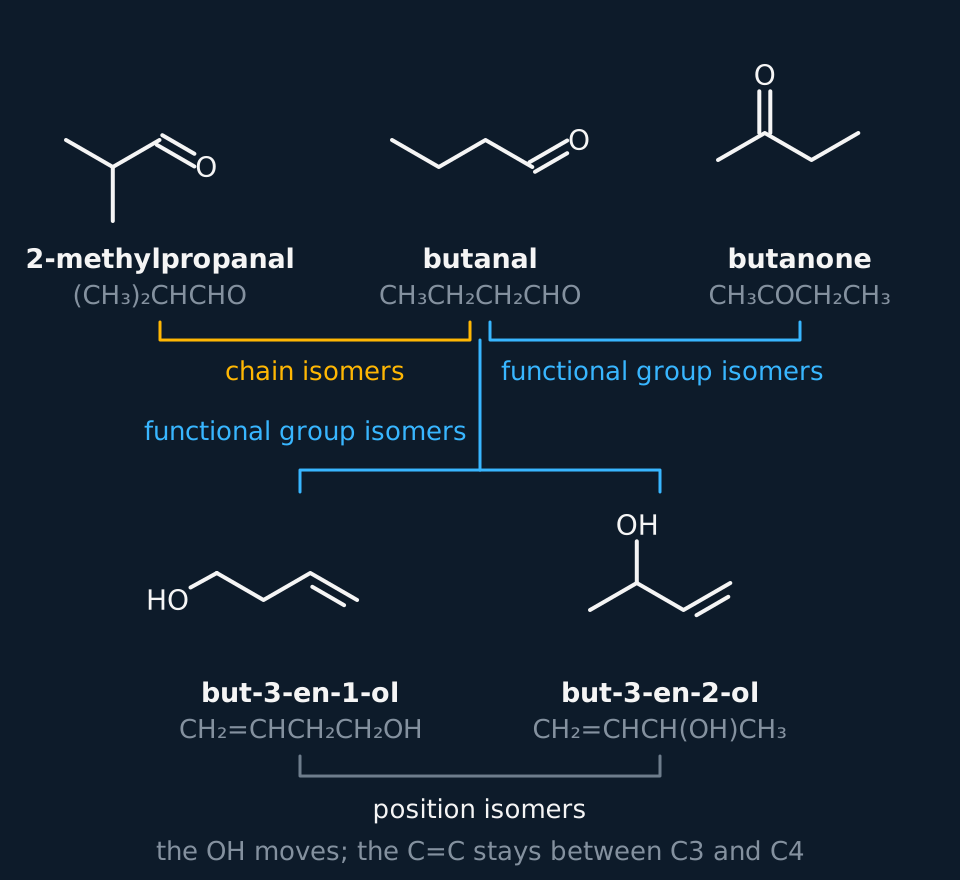
Describe the drawing
Five skeletal formulae of C₄H₈O. Butanal sits in the centre of the top row, linked on the left to 2-methylpropanal as chain isomers and on the right to butanone as functional group isomers. Below, but-3-en-1-ol and but-3-en-2-ol are linked to each other as position isomers, the OH moving from carbon one to carbon two, and as a pair to butanal as functional group isomers.
| What is different | What stays the same | Example pair | |
|---|---|---|---|
| Chain | The carbon skeleton | The functional group | butane and 2-methylpropane |
| Position | The carbon the group is on | The skeleton and the functional group | 1-bromobutane and 2-bromobutane |
| Functional group | The functional group | The molecular formula only | propanal and propanone |
- Chain isomers
- Structural isomers with the same functional group but a different arrangement of the carbon skeleton.
- Position isomers
- Structural isomers with the same carbon skeleton and functional group, the functional group being attached to a different carbon atom.
- Functional group isomers
- Structural isomers with the same molecular formula but different functional groups.
All the structural isomers of C₄H₉Br
Draw and name every structural isomer of C₄H₉Br, and state how each is related to 1-bromobutane.
Show the working
Start with the skeletons. Four carbons can be an unbranched chain, C–C–C–C, or a chain of three with a branch on the middle carbon. There is no other way to join four carbons without a ring.
Put the Br on each different carbon of each skeleton. On the unbranched chain the end carbons are equivalent and so are the middle two, giving 1-bromobutane and 2-bromobutane. On the branched skeleton the three end carbons are equivalent and the middle one is different, giving 1-bromo-2-methylpropane, (CH₃)₂CHCH₂Br, and 2-bromo-2-methylpropane, (CH₃)₃CBr.
Name each drawing to check for repeats; a second drawing with the same name is the same molecule. Four names, so four isomers.
Relative to 1-bromobutane, 2-bromobutane is a position isomer and 1-bromo-2-methylpropane is a chain isomer. 2-bromo-2-methylpropane differs in both skeleton and position, and is a chain isomer of 2-bromobutane.
The same method finds the chain isomers of an alkane. Start with the unbranched chain, then shorten it by one carbon and put that carbon as a methyl branch on each inner carbon in turn, then shorten it by two. For C₆H₁₄ this gives hexane; 2-methylpentane and 3-methylpentane; and 2,2-dimethylbutane and 2,3-dimethylbutane: five isomers. A methyl group on carbon 1, or an ethyl group on carbon 2, only lengthens the chain again and gives a name already on the list.
Bending a chain on paper changes nothing. The two ends of a C–C single bond rotate freely at room temperature, so CH₃CH₂CH₂CH₂Br drawn in an L shape is still 1-bromobutane. The name settles it: two drawings with the same correct name are the same compound.
Why a double bond does not rotate
A C=C double bond is different. It is made of two bonds: a σ bond, formed by overlap of orbitals directly between the two carbons, and a π bond, formed by the sideways overlap of a p orbital on each carbon, above and below the plane of the molecule. Twisting one end relative to the other would pull the p orbitals out of line and break the π bond. That costs about 265 kJ mol⁻¹, the difference between the mean bond enthalpies of C=C, 612 kJ mol⁻¹, and C–C, 347 kJ mol⁻¹, and collisions at room temperature come nowhere near supplying it.
The phrase that carries the idea is restricted rotation about the planar C=C double bond. Use it in full: 'the double bond is rigid' or 'the molecule cannot move' does not say what is restricted. The two carbons of the double bond and the four atoms joined to them lie in one plane, at about 120° to each other, and a group on one side of the double bond stays on that side.
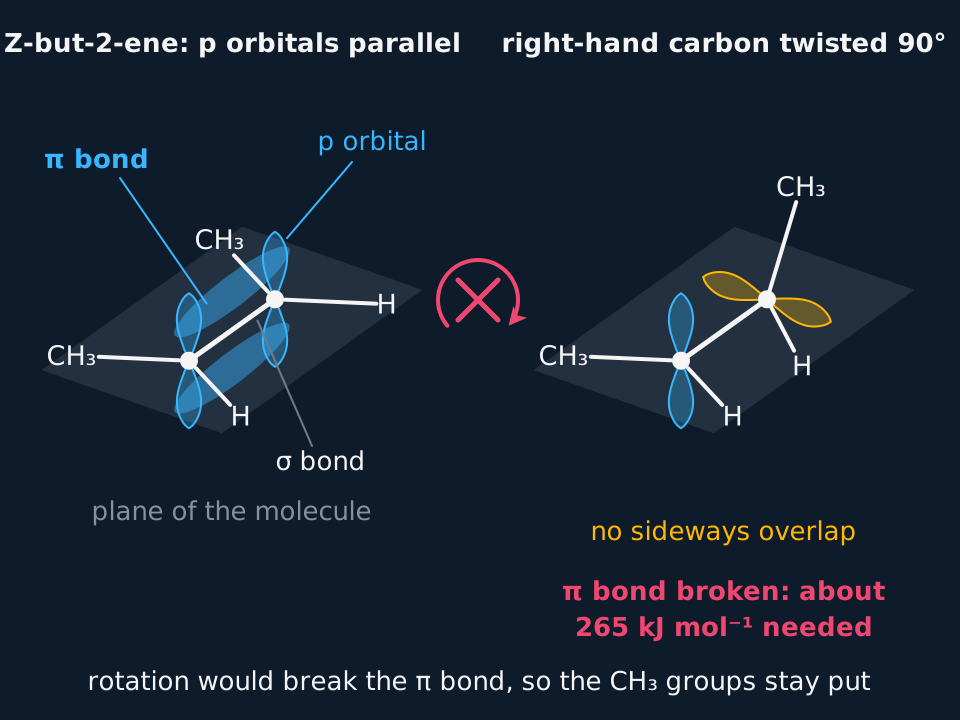
Describe the drawing
Two three-dimensional drawings of but-2-ene. On the left the two carbons of the double bond and their four groups lie in a grey plane with both CH₃ groups on the same side, a σ bond joins the carbons, and a vertical p orbital on each carbon overlaps sideways with the other to give a π bond drawn as one lobe above the plane and one below. On the right the right-hand carbon has been twisted by ninety degrees, its p orbital now lies at right angles to the other, there is no overlap, and the π bond is marked broken at a cost of about 265 kilojoules per mole. A crossed rotation arrow sits between the panels.
Restricted rotation is necessary for E/Z isomerism but not enough on its own. Each carbon of the C=C must also carry two different groups. But-2-ene, CH₃CH=CHCH₃, qualifies: each carbon carries a CH₃ and an H, so the two methyl groups can be on the same side of the double bond or on opposite sides, and those are two different compounds that cannot turn into each other.
But-1-ene, CH₂=CHCH₂CH₃, does not qualify. Carbon 1 carries two hydrogen atoms, and swapping two identical groups produces the same molecule. Nor does 2-methylpropene, (CH₃)₂C=CH₂, which has two identical groups on both carbons. One carbon with a matching pair is enough to rule out E/Z isomers.
Every isomer of C₃H₅Cl
Deduce every isomer, structural and E/Z, with the molecular formula C₃H₅Cl, and say which of them show E/Z isomerism.
Show the working
C₃H₅Cl has two hydrogen atoms fewer than the saturated C₃H₇Cl, so the molecule contains either a C=C or a ring. Three carbons make only one chain and one ring.
With the C=C between carbons 1 and 2, the Cl can go on carbon 1, 2 or 3: 1-chloroprop-1-ene, CHCl=CHCH₃; 2-chloroprop-1-ene, CH₂=CClCH₃; and 3-chloroprop-1-ene, CH₂=CHCH₂Cl. In the ring every carbon is equivalent, giving chlorocyclopropane.
Test each alkene for two different groups on each carbon of the C=C. In 1-chloroprop-1-ene carbon 1 carries Cl and H and carbon 2 carries CH₃ and H, so it has E and Z forms. In the other two, carbon 1 carries two hydrogen atoms, so neither has.
That makes four structural isomers and five compounds: E-1-chloroprop-1-ene, Z-1-chloroprop-1-ene, 2-chloroprop-1-ene, 3-chloroprop-1-ene and chlorocyclopropane.
- E/Z isomerism
- A form of stereoisomerism caused by restricted rotation about a C=C double bond, where each carbon of the double bond carries two different groups.
Assigning E and Z by priority
When the groups on a C=C are all different, 'same side' needs a rule saying which groups to compare. The Cahn–Ingold–Prelog (CIP) priority rules give it. Look at each carbon of the double bond separately. Of the two atoms attached directly to that carbon, the one with the higher atomic number has the higher priority.
If the two higher-priority groups are on the same side of the double bond, the isomer is Z, from the German zusammen, together. If they are on opposite sides it is E, from entgegen, opposite. The letter goes at the front of the name, joined by a hyphen: Z-but-2-ene. IUPAC prints it in brackets, as (Z)-but-2-ene, and both forms mean the same isomer.
When the atoms attached directly are the same element, look one atom further out. List the atoms attached to each, highest atomic number first, and decide at the first point of difference. CH₃ carries (H, H, H) and CH₂CH₃ carries (C, H, H). Carbon beats hydrogen at the first position, so ethyl outranks methyl. CH₂OH carries (O, H, H) and outranks both.
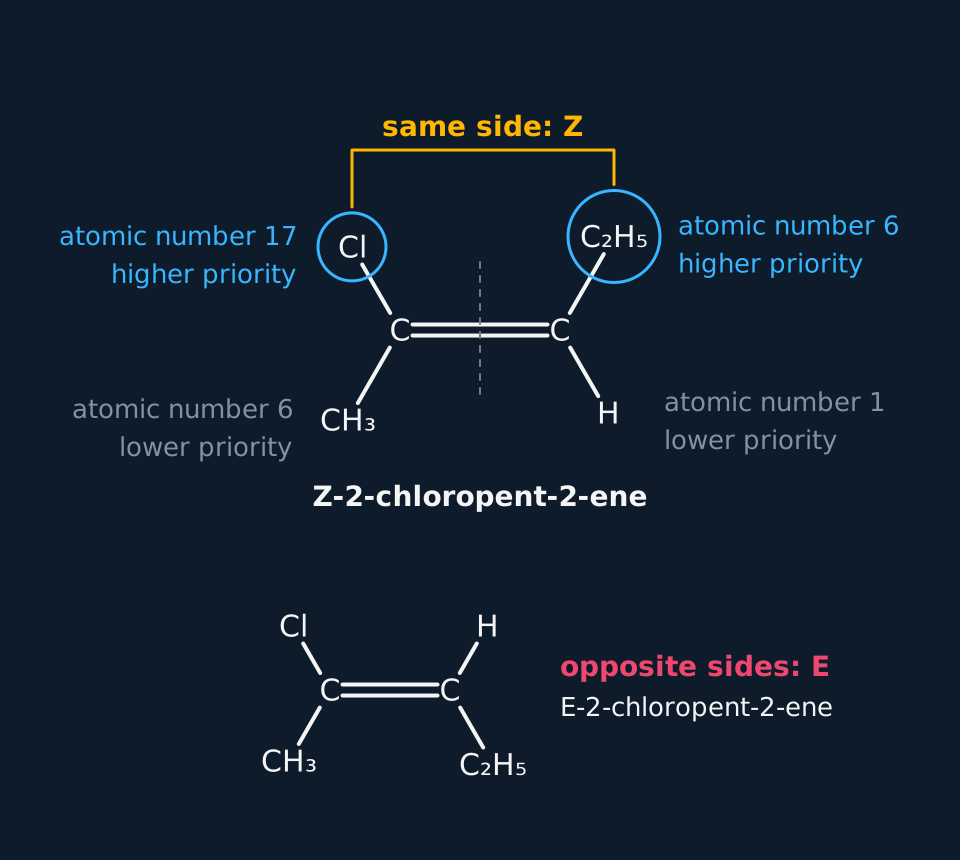
Describe the drawing
Z-2-chloropent-2-ene drawn with its double bond horizontal and a dashed line dividing the two carbons. On the left carbon chlorine, atomic number 17, is ringed above as higher priority over CH₃, atomic number 6, below. On the right carbon C₂H₅, atomic number 6, is ringed above over H, atomic number 1, below. A bracket over the top joins the two ringed groups and reads same side: Z. Beneath, the E isomer is drawn smaller with chlorine up and C₂H₅ down, labelled opposite sides: E.
Assigning E or Z to 2-chloropent-2-ene
In one isomer of CH₃CCl=CHCH₂CH₃, the Cl and the C₂H₅ group are on the same side of the double bond. Decide whether it is E or Z, and name it.
Show the working
Carbon 2 carries Cl and CH₃. The atoms attached directly are Cl, atomic number 17, and C, atomic number 6, so Cl has the higher priority.
Carbon 3 carries H and C₂H₅. The atoms attached directly are H, atomic number 1, and C, atomic number 6, so C₂H₅ has the higher priority.
The two higher-priority groups, Cl and C₂H₅, are on the same side, so the isomer is Z: Z-2-chloropent-2-ene. Its stereoisomer, with Cl and C₂H₅ on opposite sides, is E-2-chloropent-2-ene.
Cis and trans are the older names, and they describe the same idea for a simple case. When each carbon carries one hydrogen, cis means the two other groups are on the same side, so for but-2-ene cis is Z and trans is E. The two systems part company once a carbon carries no hydrogen. In CH₃CCl=CHCH₃, the isomer with both methyl groups on the same side is cis by its carbon chain. On carbon 2, though, Cl outranks CH₃, so the higher-priority groups are on opposite sides and the same isomer is E. Where a question gives a cis or trans name, work out the priorities before converting it to E or Z.
- Cahn–Ingold–Prelog priority rule
- On each carbon of the double bond, the group whose first atom has the higher atomic number has the higher priority.
- Cis–trans isomerism
- A special case of E/Z isomerism in which the two carbons of the C=C carry one identical group each, such as H; cis has those groups on the same side, trans on opposite sides.
TRY IT: When the first atoms tie
3-methylpent-2-ene is CH₃CH=C(CH₃)CH₂CH₃. In one isomer, the H on carbon 2 and the CH₂CH₃ group on carbon 3 are on the same side of the double bond. Decide whether this isomer is E or Z.
Check your answer
Carbon 2 carries H and CH₃. Carbon outranks hydrogen, so CH₃ has priority on carbon 2.
Carbon 3 carries CH₃ and CH₂CH₃, and both are attached through a carbon, so look one atom further. CH₃ carries (H, H, H) and CH₂CH₃ carries (C, H, H); C beats H at the first difference, so CH₂CH₃ has priority on carbon 3.
The H on carbon 2 is on the same side as CH₂CH₃, so the CH₃ on carbon 2 is on the opposite side. The priority groups are opposite: the isomer is E-3-methylpent-2-ene, although the two groups named in the question were on the same side.
Why the shape matters
E and Z isomers have the same bonds, so they take part in the same reactions, but their shapes differ, and so do the properties that depend on shape. Z-1,2-dichloroethene boils at 60 °C and E-1,2-dichloroethene at 48 °C. In the Z isomer both C–Cl dipoles point in the same direction and the molecule is polar, so permanent dipole–dipole forces add to the van der Waals forces. In the E isomer the dipoles point in opposite directions and cancel.
Butenedioic acid, HOOCCH=CHCOOH, shows a larger effect. The E isomer melts at about 287 °C and the Z isomer at 135 °C. The E molecules are symmetrical and pack closely, held by hydrogen bonds between neighbours. In the Z isomer the two COOH groups are on the same side, close enough to hydrogen-bond to each other inside one molecule. Heated, the Z isomer loses water and closes into a five-membered ring; the E isomer cannot, because its COOH groups point away from each other and the double bond will not rotate to bring them together.
The same effect decides whether a fat is solid or liquid. Most unsaturated fatty acids in plant oils have Z double bonds, and each one puts a kink in the hydrocarbon chain. Kinked chains cannot pack closely, the van der Waals forces between them are weaker, and olive oil is a liquid. Partial hydrogenation, once used to harden oils into margarine, turns some of the double bonds into the E form. E chains are nearly straight and pack like saturated chains. These trans fats raise the level of LDL cholesterol in the blood, and their use in food has been cut back sharply for that reason.
Other boards: the π bond, cis–trans names and optical isomers
OCR, Edexcel and Cambridge expect the reason for restricted rotation to be given in terms of the π bond: sideways overlap of p orbitals above and below the plane, which twisting would break. An answer on those papers that says only 'restricted rotation' has named the effect without its cause. AQA's statement stops at restricted rotation about the planar double bond, and the π bond explanation is extra there, not wrong.
Cambridge calls this kind of stereoisomerism geometrical isomerism and names the isomers cis and trans, with the same two conditions: a C=C that cannot rotate, and two different groups on each of its carbons. For the alkenes Cambridge sets, each carbon usually carries one hydrogen, and cis and trans then agree with Z and E. Where they would not agree, as in CH₃CCl=CHCH₃, the CIP rules are the safer way to decide.
Cambridge also teaches optical isomerism in the first year, alongside geometrical isomerism, as the second kind of stereoisomerism: a carbon bonded to four different groups gives two non-superimposable mirror-image forms. The other three boards keep it for the second year.
In the exam
- An explanation of E/Z isomerism earns one mark for each condition: restricted rotation about the C=C, and two different groups on each carbon of it. One condition alone scores one.
- Assigning E or Z, give the priority on each carbon separately with atomic number as the reason, then say whether the two higher-priority groups are on the same side or opposite sides.
- A definition of structural isomers needs 'same molecular formula, different structural formula'. 'Different arrangement of atoms' alone does not earn the mark, because it also describes stereoisomers.
- In a list of all the isomers of a formula, two drawings with the same name are the same compound and count once; a repeat is not credited as a further isomer.
- Where a question names cis or trans, check the CIP priorities before assuming cis is Z.
Check yourself
Explain why pent-2-ene, CH₃CH=CHCH₂CH₃, has E and Z isomers while 2-methylbut-2-ene, (CH₃)₂C=CHCH₃, does not, and name the two isomers of pent-2-ene.
Answer
Both have a C=C, so in both there is restricted rotation about the double bond. The difference is in the groups each carbon carries.
In pent-2-ene, carbon 2 carries CH₃ and H, and carbon 3 carries H and C₂H₅. Each carbon has two different groups, so the CH₃ and the C₂H₅ can be on the same side or on opposite sides, and the two arrangements are different compounds.
In 2-methylbut-2-ene, carbon 2 carries two CH₃ groups. Swapping two identical groups gives the same molecule, so there is only one compound.
On each carbon of pent-2-ene the carbon group outranks H, so the isomer with CH₃ and C₂H₅ on the same side is Z-pent-2-ene and the one with them on opposite sides is E-pent-2-ene.
Questions
Question 16 marks
Discuss the isomerism shown by the alkenes with molecular formula C₄H₈: but-1-ene, but-2-ene and 2-methylpropene.
Mark scheme
Indicative content
- but-1-ene and but-2-ene are position isomers, the C=C starting on a different carbon of the same unbranched chain
- 2-methylpropene has a branched skeleton, so it is a chain isomer of both butenes
- but-2-ene is the only one of the three to show E/Z isomerism, existing as E-but-2-ene and Z-but-2-ene
- this is because rotation about the C=C is restricted and each carbon of the C=C carries two different groups, CH₃ and H
- but-1-ene and 2-methylpropene show no E/Z isomerism, because one carbon of the C=C carries two identical groups
- the cycloalkanes cyclobutane and methylcyclopropane are also C₄H₈ and are functional group isomers of these alkenes
Levels
- Level 3 (5–6 marks) all three kinds of structural isomerism in the set are identified with the pairs that show them, E/Z isomerism is explained for but-2-ene through restricted rotation and two different groups on each carbon, and the answer says why the other two alkenes show no E/Z isomerism
- Level 2 (3–4 marks) position and chain isomerism are identified and but-2-ene is said to show E/Z isomerism; restricted rotation and two different groups on each carbon, or why the other two alkenes do not show it, are not explained
- Level 1 (1–2 marks) one kind of isomerism is named; but-1-ene is often said to show E/Z isomerism too because it has a C=C bond
Question 25 marks
Give the names of the five structural isomers with the molecular formula C₆H₁₄.
Mark scheme
- B1 hexane, CH₃CH₂CH₂CH₂CH₂CH₃, the unbranched chain
- B1 2-methylpentane, (CH₃)₂CHCH₂CH₂CH₃, a chain of five with a methyl branch on carbon 2
- B1 3-methylpentane, CH₃CH₂CH(CH₃)CH₂CH₃, a chain of five with a methyl branch on the middle carbon
- B1 2,2-dimethylbutane, (CH₃)₃CCH₂CH₃, a chain of four with two methyl branches on carbon 2
- B1 2,3-dimethylbutane, (CH₃)₂CHCH(CH₃)₂, a chain of four with one methyl branch on each inner carbon
Question 34 marks
State what is meant by structural isomers and by stereoisomers, and state which kind of isomerism each of these pairs shows: butan-1-ol and butan-2-ol; E-but-2-ene and Z-but-2-ene.
Mark scheme
- B1 structural isomers have the same molecular formula but a different structural formula
- B1 stereoisomers have the same structural formula but a different arrangement of the atoms in space; reject 'same molecular formula' alone
- B1 butan-1-ol and butan-2-ol are structural isomers, position isomers with the OH on a different carbon
- B1 E- and Z-but-2-ene are stereoisomers, E/Z isomers about the C=C, with the same structural formula
All 20 questions with mark schemes, the other 17 set out in full on the question page.
Worth remembering
- Compare what is bonded to what before counting isomers; one chain bent two ways on paper is one compound.
- Define a stereoisomer as the same structural formula with a different arrangement of atoms in space; 'different arrangement' alone is too little.
- Giving but-1-ene E and Z isomers is wrong: one carbon of its C=C carries two hydrogens.
- 'The molecule cannot rotate' is not the reason: rotation about C=C would break the π bond, and that is the sentence credited.
- Priority goes by the atomic number of the atom bonded to the C=C carbon, not the size of the group: Br beats CH₂CH₃.
CHECK YOUR PROGRESS
Rate how confident you are with each objective for this lesson. Ratings are saved in this browser, on this device, unless you sign in.
- Define structural isomers and stereoisomers, and tell the two apart from a pair of formulae.
- Identify chain, position and functional group isomers, and draw all the structural isomers of a small molecular formula.
- Explain how restricted rotation about a C=C bond gives rise to E/Z isomerism, and state the condition each carbon must meet.
- Apply the Cahn–Ingold–Prelog priority rules to assign E or Z to an alkene, including one where the first atoms tie.
- Explain why cis and trans agree with Z and E only in simple cases, and describe how the shape of an isomer changes its physical properties.
Open the full revision checklist to see every objective in the curriculum in one place.
Practise this lesson
WORKBOOK
The questions from this topic, on paper with room to work, and a separate book of mark schemes. Free to use; please do not redistribute or sell.
Used later in Elimination from halogenoalkanes, and CFCs and the ozone layer · Alkenes: structure, electrophilic addition and Markovnikov's rule · Oxidation and elimination of alcohols · Proton and carbon-13 NMR spectroscopy