Chemistry › Alkanes and halogenoalkanes › Free-radical substitution
Free-radical substitution
Methane and chlorine sit together in the dark for days without reacting, and react within minutes in sunlight. Ultraviolet light splits chlorine into radicals, and each radical starts a chain that substitutes chlorine for hydrogen thousands of times before it stops. The chain cannot be told when to stop, so the product is always a mixture.
Key terms Every definition in alkanes and halogenoalkanes, lesson by lesson
Before this Reaction types, curly arrows and how a mechanism is written – homolytic fission, radicals and the fishhook arrow · Mean bond enthalpies – ΔH from bonds broken minus bonds made · Alkanes: fractional distillation, cracking and combustion – why alkanes do not react with ions
COMMON MISCONCEPTION
The ultraviolet light breaks the C–H bonds in methane, and the chlorine then joins on where the hydrogen was.
Ultraviolet light breaks the Cl–Cl bond, which is weaker, not the C–H bond. Homolysis gives two chlorine radicals, and it is a chlorine radical that takes a hydrogen from methane, making HCl and a methyl radical. The methyl radical then attacks a Cl₂ molecule to give chloromethane and a new chlorine radical, so the chain continues.
What you should be able to do
- State the conditions for the reaction of methane with chlorine, and explain why ultraviolet light is needed.
- Write equations for the initiation, propagation and termination steps, with the radical dot on the correct atom.
- Explain why the reaction is a chain reaction, using the enthalpy changes of the two propagation steps.
- Explain why a mixture of products forms, and why free-radical substitution is a poor way to make one halogenoalkane.
- Apply the mechanism to another alkane or another halogen, including the termination products it predicts.
- Use bond enthalpies to explain why fluorine reacts explosively with methane, bromine slowly and iodine not at all.
Chlorine and methane in ultraviolet light
Methane and chlorine do not react in the dark: a mixture of the two keeps the pale green colour of chlorine for days. In sunlight, or under an ultraviolet lamp, the colour fades within minutes, misty fumes of hydrogen chloride appear, and oily droplets form on the glass: dichloromethane, trichloromethane and tetrachloromethane, with chloromethane, a gas, mixed in with the rest. Light is the only thing that has changed, so light starts the reaction.
The simplest product is made from one molecule of each reactant:
CH₄(g) + Cl₂(g) → CH₃Cl(g) + HCl(g)in ultraviolet light
A hydrogen atom has been replaced by a chlorine atom, so the reaction is a substitution. It runs through radicals, species with an unpaired electron, so it is called free-radical substitution. Alkanes have almost non-polar bonds and no lone pairs, so an ion finds nothing to attack in them. A radical needs no polar bond: it reacts by pairing its odd electron with one taken from a bond it collides with.
Other alkanes and other halogens follow the same pattern. Ethane gives chloroethane, and bromine gives bromoalkanes, more slowly than chlorine. Fluorine reacts with alkanes explosively, even in the dark. Iodine hardly reacts at all: the H–I bond is so weak that an iodine radical taking a hydrogen from methane would need far more energy than it gets back, so the chain never starts to run.
- Radical
- A species with an unpaired electron.
- Homolytic fission
- The breaking of a covalent bond in which each atom takes one electron from the bonding pair, forming two radicals.
- Free-radical substitution
- A reaction in which an atom in a molecule is replaced by another, by way of a chain of steps involving radicals.
Initiation: splitting the chlorine molecule
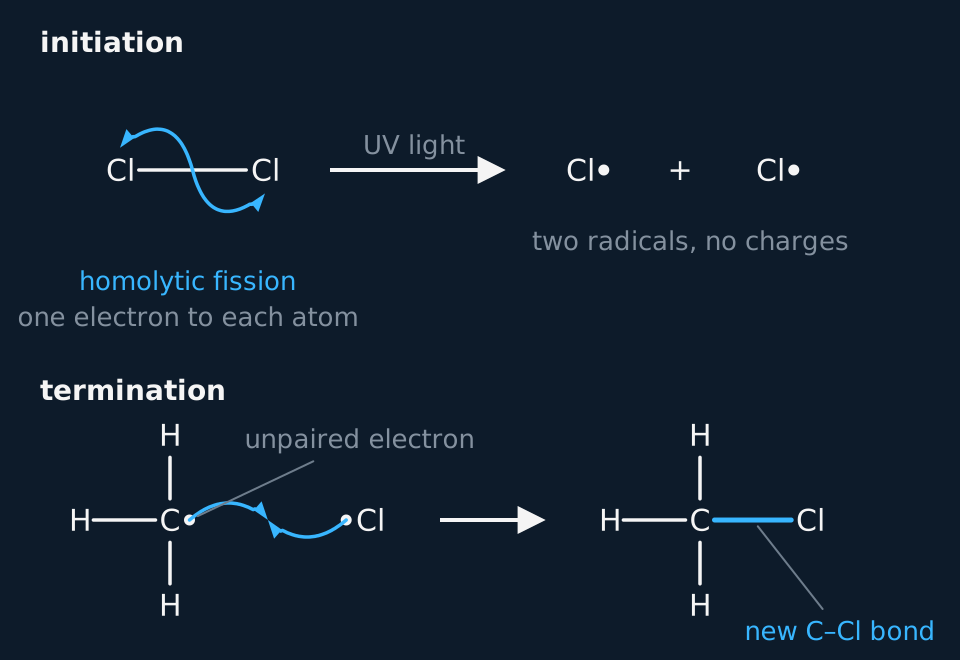
Ultraviolet light supplies the energy to break the Cl–Cl bond. It is the weakest bond in the mixture, 243 kJ mol⁻¹ against 413 kJ mol⁻¹ for C–H, and it breaks by homolytic fission: one electron of the bonding pair goes to each atom, and two chlorine radicals form. The light does not touch the methane.
Cl₂(g) → 2Cl•(g)initiation, in ultraviolet light
Describe the drawing
Two mechanisms. Initiation: a Cl–Cl molecule with two half-headed arrows starting on the middle of the bond, one curving up to the left chlorine and one curving down to the right chlorine; under ultraviolet light it splits into two chlorine radicals, each with its dot on the chlorine. Termination: a methyl radical with its dot on carbon and a chlorine radical, each sending a half-headed arrow from its dot to the space between them, forming chloromethane with a new C–Cl bond.
The dot stands for the unpaired electron and goes on the atom that carries it. A chlorine radical is not a chloride ion: it has seven outer electrons, one of them unpaired, and no charge, where Cl⁻ has eight and a negative charge. It is very reactive, because forming almost any bond pairs its odd electron and releases energy.
A mechanism like this can be drawn with fishhook arrows, curly arrows with half a head, each moving a single electron, or written as equations with the radical dot. AQA mark schemes award the equations: each must balance in atoms, and the dot must sit on the atom with the unpaired electron, so •CH₃ has it on the carbon.
- Fishhook arrow
- A curly arrow with half a head, showing the movement of a single electron.
Propagation: the two steps that make the chain
A chlorine radical that hits a methane molecule takes a hydrogen atom from it, making hydrogen chloride and leaving a methyl radical with the unpaired electron on the carbon. The methyl radical then hits a chlorine molecule and takes one of its atoms, making chloromethane and a new chlorine radical.
Cl•(g) + CH₄(g) → HCl(g) + •CH₃(g)propagation step 1
•CH₃(g) + Cl₂(g) → CH₃Cl(g) + Cl•(g)propagation step 2
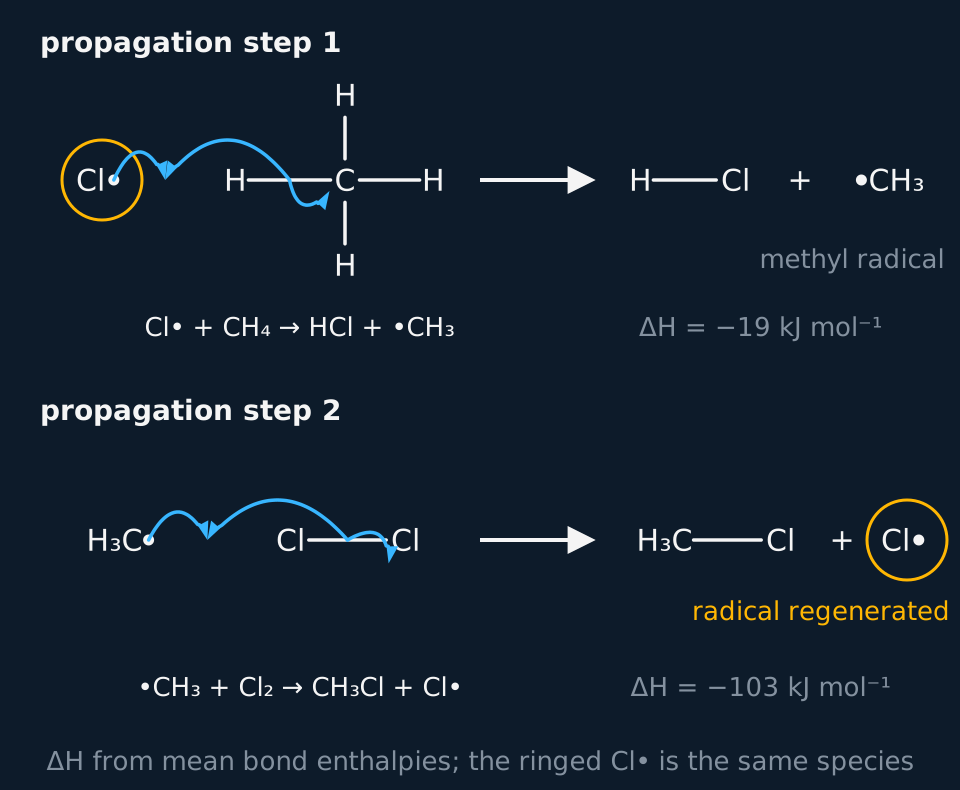
Describe the drawing
Two propagation steps drawn with half-headed arrows. Step 1: a chlorine radical, ringed, approaches a C–H bond of methane; one fishhook runs from its dot to the space between Cl and H, a second from the C–H bond to the same space, and a third from the C–H bond onto the carbon, giving HCl and a methyl radical. Step 2: the methyl radical attacks Cl–Cl in the same way, giving chloromethane and a chlorine radical, ringed in the same colour as the one that started step 1. Each step is written beneath as an equation with its enthalpy change, −19 and −103 kJ per mole.
Add the two steps and the radicals cancel, leaving the overall equation. The chlorine radical used in step 1 comes back out of step 2, ready to start again. Each step uses one radical and makes one, so the number of radicals does not change, and a single chlorine radical can convert thousands of methane molecules before it is removed. That is a chain reaction, and it is why a short burst of light converts so much of the mixture.
Drawn with fishhook arrows, step 1 needs three. One runs from the dot of Cl• to the space between Cl and H, one from the C–H bond to the same space, and one from the C–H bond to the carbon, which keeps the other electron and becomes the radical. Step 2 follows that three-arrow pattern on the Cl–Cl bond.
Switch the lamp off and the reaction stops within a fraction of a second. No new radicals are being made, and the ones already present find each other and terminate. The light is needed only to start chains, not to drive each step, which is why a mixture of hydrogen and chlorine, whose chain is faster still, can explode when a camera flash goes off beside it.
Why the chain keeps going
Use the bond enthalpies C–H 413, Cl–Cl 243, C–Cl 346 and H–Cl 432 kJ mol⁻¹ to calculate ΔH for each propagation step and for the overall reaction.
Show the working
Step 1 breaks one C–H bond and makes one H–Cl bond: ΔH = +413 − 432 = −19 kJ mol⁻¹.
Step 2 breaks one Cl–Cl bond and makes one C–Cl bond: ΔH = +243 − 346 = −103 kJ mol⁻¹.
The overall reaction breaks C–H and Cl–Cl and makes C–Cl and H–Cl: ΔH = (413 + 243) − (346 + 432) = −122 kJ mol⁻¹, which is the sum of the two steps, as it must be.
Both propagation steps are exothermic, so once the light has made the first radicals the chain needs no further energy. A chlorine radical cannot instead swap places with the hydrogen, Cl• + CH₄ → CH₃Cl + H•: that breaks C–H and makes C–Cl, ΔH = +67 kJ mol⁻¹, so it is not the route taken.
The same arithmetic explains the order of the halogens. Step 2 is exothermic for all four, because a C–X bond is always stronger than the X–X bond it replaces. Step 1 is where they differ. The halogen radical has to pull a hydrogen atom off carbon, and that releases energy only if the H–X bond it makes is stronger than the C–H bond, 413 kJ mol⁻¹, that it breaks.
| Halogen | X–X / kJ mol⁻¹ | H–X / kJ mol⁻¹ | C–X / kJ mol⁻¹ | With methane |
|---|---|---|---|---|
| Fluorine | 158 | 562 | 467 | Explosive, even in the dark |
| Chlorine | 243 | 432 | 346 | Fast chain in ultraviolet light |
| Bromine | 193 | 366 | 290 | Slower chain in ultraviolet light |
| Iodine | 151 | 298 | 228 | No useful reaction |
TRY IT: Why bromine is slower
Use the bond enthalpies in the table, with C–H 413 kJ mol⁻¹, to calculate ΔH for both propagation steps when bromine reacts with methane. Explain why the reaction is slower than with chlorine.
Check your answer
Step 1, Br• + CH₄ → HBr + •CH₃, breaks C–H and makes H–Br: ΔH = 413 − 366 = +47 kJ mol⁻¹. Step 2, •CH₃ + Br₂ → CH₃Br + Br•, breaks Br–Br and makes C–Br: ΔH = 193 − 290 = −97 kJ mol⁻¹.
Step 1 is endothermic, where chlorine's is exothermic (−19 kJ mol⁻¹). Its activation energy is higher, so a smaller fraction of collisions between Br• and CH₄ react, and each chain turns over more slowly.
Iodine's step 1 is ΔH = 413 − 298 = +115 kJ mol⁻¹. An iodine radical almost never manages it, and meets another iodine radical first, so the chain ends before it starts. Fluorine's steps are −149 and −309 kJ mol⁻¹, and the F–F bond is weak enough for a few molecules to split without light; the chain that follows releases heat so fast that it runs away.
- Chain reaction
- A reaction in which each propagation step regenerates a radical, so that one initiation step leads to many cycles of reaction before termination.
- Initiation
- The step in which radicals are first formed, here by homolytic fission of Cl₂ in ultraviolet light.
- Propagation
- A step in which a radical reacts with a molecule to give a product and another radical, so the number of radicals is unchanged.
- Termination
- A step in which two radicals combine to form a molecule, removing both radicals from the chain.
Termination
The chain stops when two radicals meet. Their unpaired electrons pair up to form a covalent bond, and two radicals become one molecule with none. In the methane mixture there are three possible pairings:
Cl•(g) + Cl•(g) → Cl₂(g)
•CH₃(g) + Cl•(g) → CH₃Cl(g)
•CH₃(g) + •CH₃(g) → C₂H₆(g)
Termination is rare compared with propagation. Radicals are a tiny fraction of the particles present, so a radical is far more likely to hit a molecule than another radical, and the chain runs many times before it ends.
Drawn with fishhook arrows, a termination step needs two: one from the dot of each radical to the space between the two atoms, where the two single electrons become the new bonding pair.
The third equation explains a small surprise in the product: ethane, a molecule with more carbon atoms than the methane the reaction started from, together with chloroethane made when ethane itself joins the chain. Ethane in the product is evidence that methyl radicals exist.
Where a question asks for one termination step, any of the three equations is correct. The second makes the wanted product, but it is still termination, because two radicals go in and none come out.
TRY IT: Termination with ethane
Ethane reacts with chlorine in ultraviolet light. Give the three termination steps, and identify the one whose product shows that the reaction went through ethyl radicals.
Check your answer
The two radicals in the chain are Cl• and •CH₂CH₃. Pair them in every way: Cl• + Cl• → Cl₂; •CH₂CH₃ + Cl• → CH₃CH₂Cl; •CH₂CH₃ + •CH₂CH₃ → CH₃CH₂CH₂CH₃.
The third gives butane, which has four carbon atoms. Only two ethyl radicals joining could make it from a two-carbon alkane, so butane in the product is the evidence for ethyl radicals.
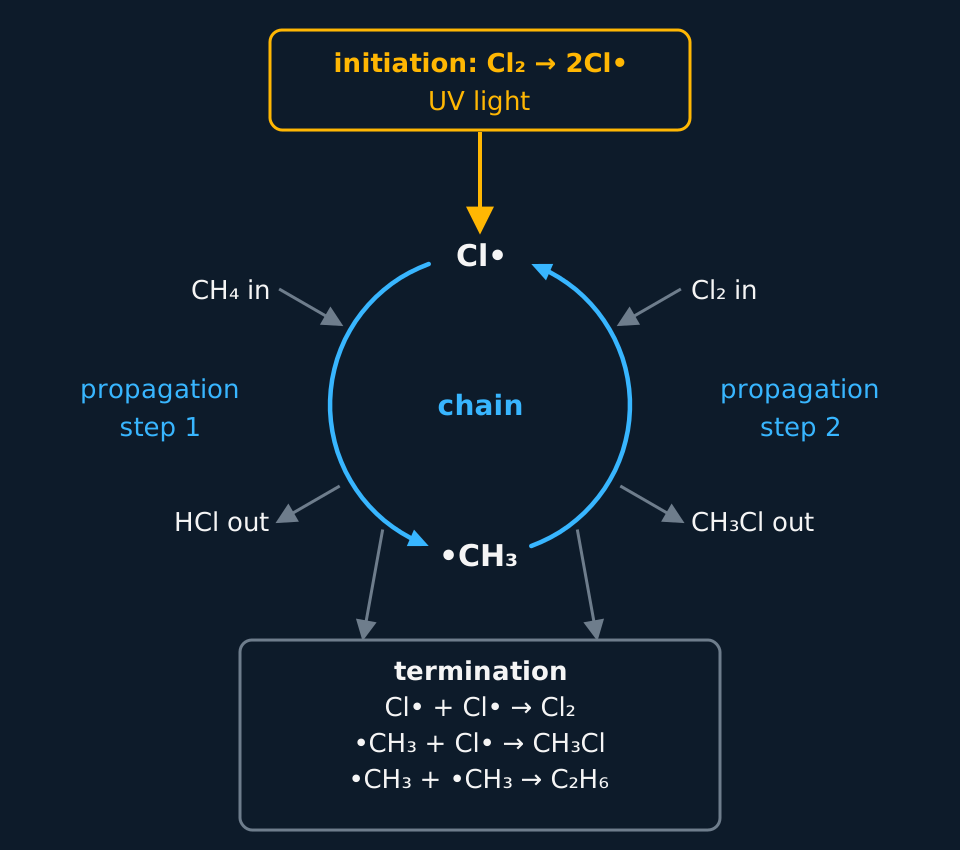
Describe the drawing
A closed loop of two arcs. Cl• sits at the top and •CH₃ at the bottom. The left arc, propagation step 1, carries Cl• down to •CH₃, with methane entering and hydrogen chloride leaving. The right arc, propagation step 2, carries •CH₃ back up to Cl•, with chlorine entering and chloromethane leaving. An initiation box above, Cl₂ to 2Cl• in UV light, feeds radicals in at the top, and arrows below lead out of the loop to a termination box listing the three ways two radicals pair up.

Describe the drawing
The chlorination of methane animated as four steps, each equation shown large above a row of four boxes, initiation, propagation 1, propagation 2 and termination, with the current box lit. Initiation: ultraviolet light splits Cl₂ into two chlorine radicals. Propagation 1: Cl• takes a hydrogen from methane, giving HCl and a methyl radical. Propagation 2: the methyl radical takes a chlorine atom from Cl₂, giving chloromethane and a new Cl•, which an amber loop carries back to step 1. Termination: two radicals join and the chain stops.
Why the product is a mixture
Chloromethane still has three C–H bonds, and a chlorine radical cannot tell them from those in methane. Once some chloromethane has formed, a chlorine radical may take a hydrogen from it instead, and the chain carries on to dichloromethane:
Cl•(g) + CH₃Cl(g) → HCl(g) + •CH₂Cl(g)
•CH₂Cl(g) + Cl₂(g) → CH₂Cl₂(g) + Cl•(g)
The same pair of steps goes on to trichloromethane and tetrachloromethane, and termination adds ethane and its chlorinated derivatives. With longer alkanes the problem grows. Propane has hydrogens on its end carbons and on its middle one, so even its first substitution gives two isomers, 1-chloropropane and 2-chloropropane.
Counting hydrogens predicts the split if every hydrogen were equally likely to go. Propane has six hydrogens on its two end carbons and two on the middle carbon, so 6 in 8, or 75%, of the substitutions would give 1-chloropropane. The measured figure at room temperature is nearer 45%. Each hydrogen on the middle carbon is replaced more readily than each on an end carbon, because the C–H bonds on a carbon joined to two other carbons are slightly weaker. Either way, the product is a mixture of isomers with similar boiling points, which are hard to separate.
How much more readily a middle hydrogen goes
Monochlorination of propane at room temperature gives 45% 1-chloropropane and 55% 2-chloropropane. Calculate how many times more readily each hydrogen on the middle carbon is replaced than each hydrogen on an end carbon.
Show the working
1-chloropropane comes from the six hydrogens on the end carbons, so each of them accounts for 45 ÷ 6 = 7.5% of the product.
2-chloropropane comes from the two hydrogens on the middle carbon, so each of them accounts for 55 ÷ 2 = 27.5%.
Ratio = 27.5 ÷ 7.5 = 3.7 to two significant figures: each middle hydrogen is replaced about 3.7 times as readily as each end one.
A chlorine radical's step 1 is exothermic and it reacts with almost any C–H bond it hits, so it is not very selective. A bromine radical, whose step 1 is endothermic, is far more selective, and bromination of propane gives almost entirely 2-bromopropane.
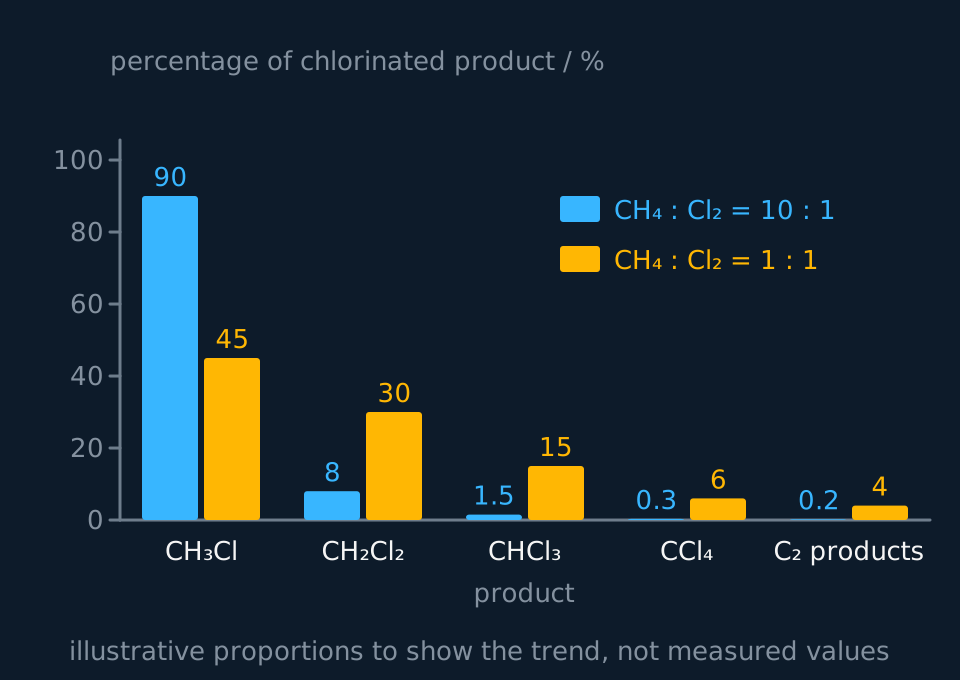
Describe the drawing
Grouped bar chart of the chlorinated products of methane and chlorine in ultraviolet light, as percentages. With a tenfold excess of methane the bars are chloromethane 90, dichloromethane 8, trichloromethane 1.5, tetrachloromethane 0.3 and C2 products 0.2. With equal amounts they are 45, 30, 15, 6 and 4. A note says the proportions are illustrative, not measured.
The proportions can be shifted but not fixed. A large excess of methane makes a chlorine radical far more likely to meet methane than chloromethane, so chloromethane becomes the main product; a large excess of chlorine pushes the substitution through to tetrachloromethane. Neither gives one pure product, so the mixture must be separated by fractional distillation, and every product not wanted is waste. Free-radical substitution is a poor way to make one particular halogenoalkane.
Further substitution, step by step
Write the two propagation steps that turn dichloromethane into trichloromethane, and a termination step that gives a product with the formula C₂H₂Cl₄.
Show the working
Step 1: a chlorine radical takes a hydrogen atom from dichloromethane. Cl• + CH₂Cl₂ → HCl + •CHCl₂.
Step 2: the new radical takes a chlorine atom from Cl₂, and a chlorine radical is regenerated. •CHCl₂ + Cl₂ → CHCl₃ + Cl•.
Termination: two of the •CHCl₂ radicals combine. •CHCl₂ + •CHCl₂ → CHCl₂CHCl₂, which is C₂H₂Cl₄.
TRY IT: The atom economy of chloromethane
Calculate the atom economy for making chloromethane from methane and chlorine, and comment on the answer. Ar: H 1.0, C 12.0, Cl 35.5.
Check your answer
Mr(CH₃Cl) = 12.0 + 3.0 + 35.5 = 50.5. The reactants are CH₄, 16.0, and Cl₂, 71.0, so their total is 87.0.
Atom economy = 50.5 ÷ 87.0 × 100 = 58.0%.
Even if every methane molecule became chloromethane, 42% of the mass of the reactants would leave as hydrogen chloride. In practice the yield of chloromethane is lower still, because some of it reacts on to dichloromethane and beyond.
The same chain in the stratosphere
The pattern of initiation, propagation and termination turns up again fifteen to thirty-five kilometres up. Chlorofluorocarbons, CFCs, drift into the stratosphere, where ultraviolet light breaks their C–Cl bonds homolytically and releases chlorine radicals.
Each chlorine radical takes an oxygen atom from an ozone molecule, and the ClO• formed then reacts with a second ozone molecule to give the chlorine radical back. Two propagation steps, one radical used and one made in each: it is the methane chain with ozone in place of methane, and a single chlorine radical can break down thousands of ozone molecules. The two steps are Cl• + O₃ → ClO• + O₂ and ClO• + O₃ → 2O₂ + Cl•. The chlorine radical comes out of the second unchanged, so it is a catalyst for the overall change, 2O₃ → 3O₂.
In the exam
- For 'name and outline the mechanism', the scheme awards the name, free-radical substitution, and one mark each for initiation, the two propagation steps and a termination step, with ultraviolet light as the condition.
- The radical dot goes on the atom that carries the unpaired electron, •CH₃ on carbon, and every step balances in atoms. A charge on Cl• turns it into a chloride ion, and the step is not credited.
- Why the product is impure: further substitution (a chlorine radical attacks CH₃Cl as well as CH₄) and the termination products. 'Side reactions' alone does not earn the mark.
- The chain is explained by the propagation steps: each uses one radical and produces another, so the radical is regenerated.
- Where a question asks for the steps to be drawn, each fishhook arrow moves one electron, from a bond or a radical's dot; a full-headed arrow in a radical step shows a pair moving and is wrong.
Check yourself
Ethane reacts with bromine in ultraviolet light. Write equations for the initiation step, the two propagation steps that form bromoethane, and every termination step, and use the termination steps to explain why butane is found among the products.
Answer
Initiation: Br₂ → 2Br•. Ultraviolet light breaks the Br–Br bond homolytically.
Propagation: Br• + CH₃CH₃ → HBr + •CH₂CH₃, then •CH₂CH₃ + Br₂ → CH₃CH₂Br + Br•. The bromine radical is regenerated.
Termination: Br• + Br• → Br₂; •CH₂CH₃ + Br• → CH₃CH₂Br; •CH₂CH₃ + •CH₂CH₃ → CH₃CH₂CH₂CH₃.
The last termination step joins two ethyl radicals, each with two carbon atoms, into butane, C₄H₁₀. Butane in the product shows that ethyl radicals were present, and that termination can make carbon chains longer than the alkane that went in.
Questions
Question 16 marks
Outline the mechanism by which propane reacts with chlorine in ultraviolet light to form 1-chloropropane, and explain why 1-chloropropane is only one of many products.
Mark scheme
Indicative content
- initiation: ultraviolet light breaks the Cl–Cl bond homolytically, Cl₂ → 2Cl•, each atom taking one electron of the bonding pair
- first propagation step: Cl• + CH₃CH₂CH₃ → HCl + •CH₂CH₂CH₃, the chlorine radical taking a hydrogen from an end carbon
- second propagation step: •CH₂CH₂CH₃ + Cl₂ → CH₃CH₂CH₂Cl + Cl•, so the chlorine radical is regenerated and the chain continues
- termination when two radicals combine, for example •CH₂CH₂CH₃ + Cl• → CH₃CH₂CH₂Cl, or two propyl radicals giving hexane, C₆H₁₄
- a chlorine radical can also take a hydrogen from the middle carbon, giving 2-chloropropane, a position isomer with a similar boiling point that is hard to separate
- further substitution of the chloropropanes gives dichloropropanes and beyond, so the product is a mixture and the yield of 1-chloropropane is low
Levels
- Level 3 (5–6 marks) all three stages are named and each has a correct equation with radicals shown, the regeneration of the chlorine radical is pointed out, and both reasons for the mixture are given, substitution at the middle carbon and further substitution
- Level 2 (3–4 marks) initiation and both propagation steps are correct; termination is thin, a radical dot or a species is missing from one equation, or only one of the two reasons for the mixture of products is given
- Level 1 (1–2 marks) ultraviolet light is said to split chlorine, sometimes into ions rather than radicals, or one step is written; the chain is not followed and the other products are not accounted for
Question 24 marks
State the condition needed for methane to react with chlorine and name the type of mechanism, then state what is meant by a radical and describe how homolytic fission forms one.
Mark scheme
- B1 ultraviolet light, or sunlight; reject 'heat' or a catalyst
- B1 the mechanism is free-radical substitution
- B1 a radical is a species with an unpaired electron; reject 'a charged atom'
- B1 in homolytic fission a covalent bond breaks with one electron of the bonding pair going to each atom
Question 34 marks
Outline the mechanism for the reaction of methane with chlorine to form chloromethane, using equations.
Mark scheme
- B1 initiation: Cl₂ → 2Cl•
- B1 first propagation step: Cl• + CH₄ → HCl + •CH₃
- B1 second propagation step: •CH₃ + Cl₂ → CH₃Cl + Cl•
- B1 a termination step, such as •CH₃ + Cl• → CH₃Cl, or 2Cl• → Cl₂, or 2•CH₃ → C₂H₆
All 20 questions with mark schemes, the other 17 set out in full on the question page.
Worth remembering
- Cl₂(g) → Cl⁺ + Cl⁻ for initiation is heterolysis and is rejected: ultraviolet light gives two Cl•(g) by homolytic fission.
- Have the chlorine radical take a hydrogen, giving HCl(g) and •CH₃(g); Cl• + CH₄ → CH₃Cl + H• is not a propagation step.
- Write the two propagation steps, not the overall CH₄(g) + Cl₂(g) → CH₃Cl(g) + HCl(g), which is their sum.
- Put the dot on the carbon of •CH₃, not floating after the formula; a dot on another atom is a different species.
- 'Excess chlorine' to make chloromethane is backwards: excess methane limits further substitution, excess chlorine gives CH₂Cl₂, CHCl₃ and CCl₄.
CHECK YOUR PROGRESS
Rate how confident you are with each objective for this lesson. Ratings are saved in this browser, on this device, unless you sign in.
- State the conditions for the reaction of methane with chlorine, and explain why ultraviolet light is needed.
- Write equations for the initiation, propagation and termination steps, with the radical dot on the correct atom.
- Explain why the reaction is a chain reaction, using the enthalpy changes of the two propagation steps.
- Explain why a mixture of products forms, and why free-radical substitution is a poor way to make one halogenoalkane.
- Apply the mechanism to another alkane or another halogen, including the termination products it predicts.
- Use bond enthalpies to explain why fluorine reacts explosively with methane, bromine slowly and iodine not at all.
Open the full revision checklist to see every objective in the curriculum in one place.
Practise this lesson
Practise free-radical substitution with 20 original questions and point-by-point mark schemes
WORKBOOK
The written questions from this topic, on paper with room to work, and a separate book of mark schemes. The 2 questions that are set on a diagram stay on this page, where the diagram can be drawn. Free to use; please do not redistribute or sell.
Used later in Elimination from halogenoalkanes, and CFCs and the ozone layer