Chemistry › Transition metals › Ligands, the shapes of complexes, isomerism and ligand substitution
Ligands, the shapes of complexes, isomerism and ligand substitution
Concentrated hydrochloric acid turns blue copper(II) sulfate solution yellow-green, and ammonia turns it deep blue. In both, new ligands have replaced water around the Cu²⁺ ion, and in one of them the complex has changed shape. The size of the ligands decides the shape, the shape decides which isomers can exist, and a count of the particles explains why a ligand such as EDTA⁴⁻ is so hard to remove.
Key terms Every definition in transition metals, lesson by lesson
Before this Transition metal characteristics and complex formation – ligands, coordinate bonds and coordination number · Shapes of molecules and ions – bond angles of 90°, 109.5° and 180° · Entropy and Gibbs free-energy change – ΔG = ΔH − TΔS
COMMON MISCONCEPTION
A bidentate ligand pushes water out of a complex because its bonds to the metal are stronger.
The bonds are much the same; the driving force is entropy. [Cu(H₂O)₆]²⁺ and three ethane-1,2-diamine molecules, four particles, give [Cu(en)₃]²⁺ and six waters, seven particles, so ΔS is large and positive, ΔH is close to zero, and ΔG is negative. This is the chelate effect.
What you should be able to do
- Describe the octahedral, tetrahedral, square planar and linear shapes of complexes, with a named example and the bond angle of each.
- Write equations for ligand substitution by ammonia and by chloride ions, with the colours and any change in coordination number.
- Explain the chelate effect in terms of the number of particles and the entropy change.
- Write the expression for a stability constant and use log₁₀ Kstab values to compare the stabilities of complexes.CAIE
- Draw cis and trans isomers of octahedral and square planar complexes, and the optical isomers of a complex with three bidentate ligands.
- Describe how cisplatin acts against cancer, and weigh its benefit against its side effects.
Four shapes
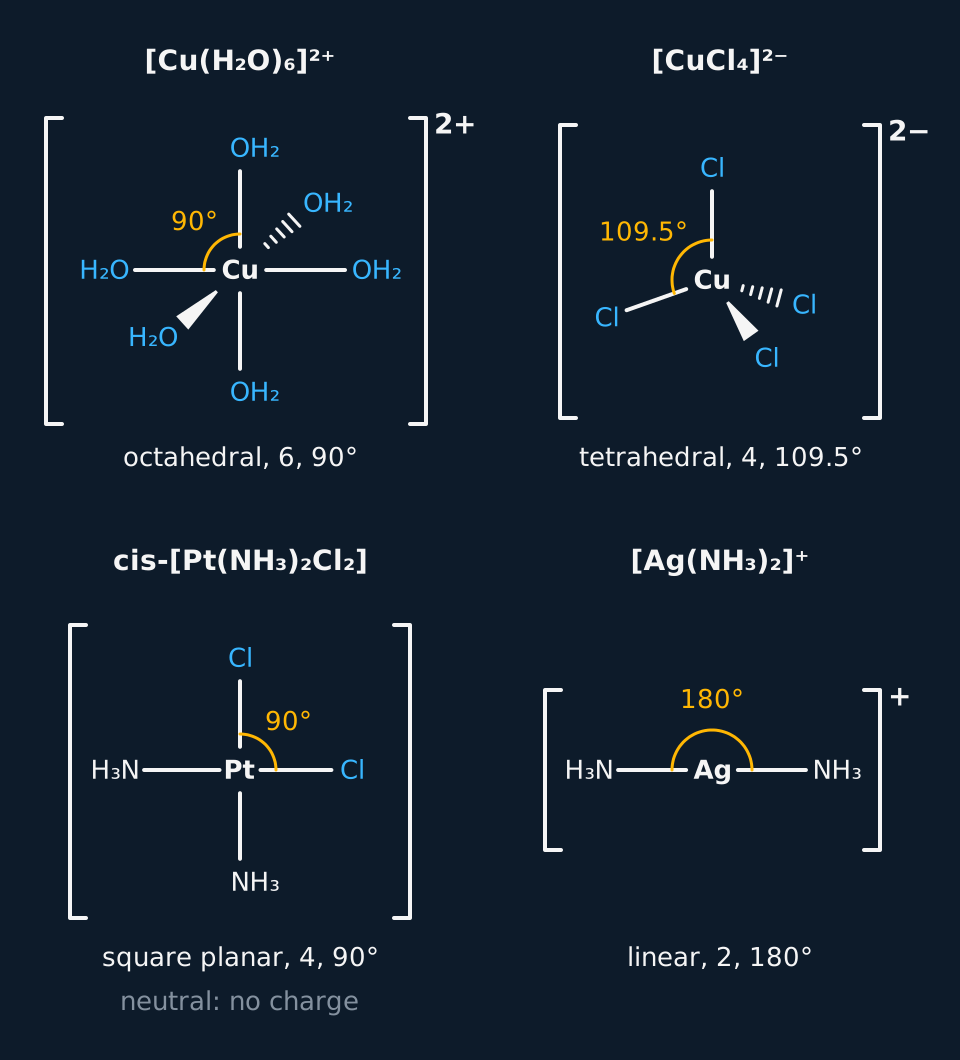
The shape of a complex depends on how many ligands fit round the metal ion, and that depends mostly on the size of the ligands. Small, neutral ligands such as water and ammonia fit six round a Period 4 ion, and the six coordinate bonds point to the corners of an octahedron, with bond angles of 90°. Every hexaaqua ion is octahedral: [Fe(H₂O)₆]²⁺, [Co(H₂O)₆]²⁺, [Cu(H₂O)₆]²⁺.
Chloride ions are larger, and being negative they repel one another. Only four fit round Cu²⁺ or Co²⁺, and four bonds as far apart as possible point to the corners of a tetrahedron, 109.5° apart. [CuCl₄]²⁻ and [CoCl₄]²⁻ are tetrahedral.
Two other shapes complete the set. Platinum(II) forms square planar complexes, with four ligands at the corners of a square round the metal and bond angles of 90°; the anticancer drug cisplatin, [Pt(NH₃)₂Cl₂], is one. Silver(I) forms the linear ion [Ag(NH₃)₂]⁺, with a bond angle of 180°. That ion is the active species in Tollens' reagent, which an aldehyde reduces to a silver mirror.
Describe the drawing
Four complexes drawn in three dimensions with wedge and hashed bonds. Octahedral hexaaquacopper(II), six waters bonded through oxygen at 90 degrees. Tetrahedral tetrachlorocuprate(II), four chlorides at 109.5 degrees. Square planar cisplatin, two ammonias and two adjacent chlorides all in the plane of the page at 90 degrees, with no charge. Linear diamminesilver(I), two ammonias at 180 degrees. Each is labelled with its shape, coordination number and bond angle.
| Shape | Coordination number | Bond angle | Example |
|---|---|---|---|
| Octahedral | 6 | 90° | [Cu(H₂O)₆]²⁺ |
| Tetrahedral | 4 | 109.5° | [CuCl₄]²⁻ |
| Square planar | 4 | 90° | [Pt(NH₃)₂Cl₂] |
| Linear | 2 | 180° | [Ag(NH₃)₂]⁺ |
A complex is drawn in three dimensions the way any molecule is. Bonds in the plane of the page are plain lines, a bond towards the reader is a solid wedge, and a bond away from the reader is a dashed wedge. Each ligand is joined to the metal through its donor atom, so ammonia is bonded through N and water through O, and the overall charge is written outside square brackets that enclose the whole complex. A drawing with the hydrogen of ammonia touching the metal is wrong, because hydrogen has no lone pair to give.
- Octahedral complex
- A complex with six coordinate bonds pointing to the corners of an octahedron, with bond angles of 90°.
- Tetrahedral complex
- A complex with four coordinate bonds pointing to the corners of a tetrahedron, with bond angles of 109.5°.
- Square planar complex
- A complex with four coordinate bonds pointing to the corners of a square round the metal, with bond angles of 90°.
Ligand substitution, with and without a change of shape
In a ligand substitution one ligand replaces another round the metal ion. Water and ammonia are similar in size and both are uncharged, so when ammonia replaces water the number of ligands stays at six and the complex stays octahedral. The colour changes because the new ligand splits the d orbitals by a different amount, so a different band of visible light is absorbed.
With excess concentrated ammonia, all six water ligands on cobalt(II) are replaced. The pink solution becomes a pale straw-coloured solution of [Co(NH₃)₆]²⁺, which darkens on standing as oxygen from the air oxidises it to cobalt(III).
[Co(H₂O)₆]²⁺(aq) + 6NH₃(aq) → [Co(NH₃)₆]²⁺(aq) + 6H₂O(l)Pink solution to pale straw-coloured solution; coordination number 6 throughout.
Copper stops part of the way. With excess ammonia only four of the six water ligands are replaced, and the product is [Cu(NH₃)₄(H₂O)₂]²⁺, with the four ammonia ligands in a square round the copper and the two water molecules above and below it. The pale blue solution becomes a deep blue solution. Ammonia added a drop at a time first gives a pale blue precipitate of copper(II) hydroxide, [Cu(H₂O)₄(OH)₂], because ammonia is also a base; the precipitate dissolves in excess ammonia to give the deep blue solution. Write 'deep blue solution' for the product: 'dark blue' is accepted, but 'goes blue' does not say whether a solution or a precipitate is meant.
[Cu(H₂O)₆]²⁺(aq) + 4NH₃(aq) → [Cu(NH₃)₄(H₂O)₂]²⁺(aq) + 4H₂O(l)Pale blue solution to deep blue solution; the substitution is incomplete.

Describe the drawing
Ligand substitution on the hexaaquacopper(II) ion in three stages, drawn as an octahedron in square brackets with a 2+ charge, beside a swatch of the solution's colour. First six water ligands, each bonded through oxygen, and a pale blue swatch. Then the two in-plane waters on the left and right are replaced by cyan ammonia ligands bonded through nitrogen and the blue deepens. Finally four ammonia ligands form a square round the copper with the two waters above and below: [Cu(NH₃)₄(H₂O)₂]²⁺, a deep blue solution, still six ligands.
- Ligand substitution
- A reaction in which one or more ligands in a complex are replaced by different ligands.
Concentrated hydrochloric acid supplies chloride ions at about 10 mol dm⁻³. Chloride is larger than water and charged, so four chloride ions replace six water molecules, the coordination number falls from 6 to 4, and the octahedral complex becomes tetrahedral. With copper(II) the blue solution turns green and then yellow-green. The green is a mixture of the blue aqua ion and the yellow chloro complex, partway through the change.
[Cu(H₂O)₆]²⁺(aq) + 4Cl⁻(aq) ⇌ [CuCl₄]²⁻(aq) + 6H₂O(l)Blue solution to yellow-green solution; octahedral to tetrahedral.
[Co(H₂O)₆]²⁺(aq) + 4Cl⁻(aq) ⇌ [CoCl₄]²⁻(aq) + 6H₂O(l)Pink solution to blue solution; ΔH positive for the forward reaction.
Both are equilibria. Adding water dilutes the chloride ions and moves the position back to the left, so the aqua colour returns. The cobalt reaction is endothermic in the forward direction, so a solution of cobalt(II) chloride in fairly concentrated acid turns blue when warmed and pink again when cooled. Iron(III) does the same with chloride ions, giving the yellow solution of [FeCl₄]⁻.
The same exchange of one ligand for another runs in the blood. In haemoglobin an oxygen molecule bonds to the sixth position on the Fe²⁺ of each haem group in the lungs and leaves it again in the tissues, a reversible ligand substitution. Carbon monoxide substitutes at the same position and forms a much stronger coordinate bond that breaks only very slowly: haemoglobin that has bound carbon monoxide carries no oxygen, which is why the gas is toxic at low concentrations.
Following the cobalt equilibrium
A tube of cobalt(II) chloride in concentrated hydrochloric acid is purple, a mixture of [Co(H₂O)₆]²⁺ and [CoCl₄]²⁻. Predict the colour after each of three changes: adding water, adding more concentrated hydrochloric acid, and standing the tube in ice. ΔH for the forward reaction is positive.
Show the working
Adding water lowers the concentration of chloride ions and raises that of water, a product. The position of equilibrium moves to the left, more [Co(H₂O)₆]²⁺ forms, and the solution turns pink.
Adding concentrated hydrochloric acid raises the chloride concentration, a reactant. The position moves to the right and the solution turns blue as [CoCl₄]²⁻ forms.
The forward reaction is endothermic, so cooling moves the position in the exothermic direction, to the left, and the tube in ice turns pink. Each time, the cobalt moves between coordination number 6 in the pink octahedral ion and 4 in the blue tetrahedral one.
Isomers of complexes
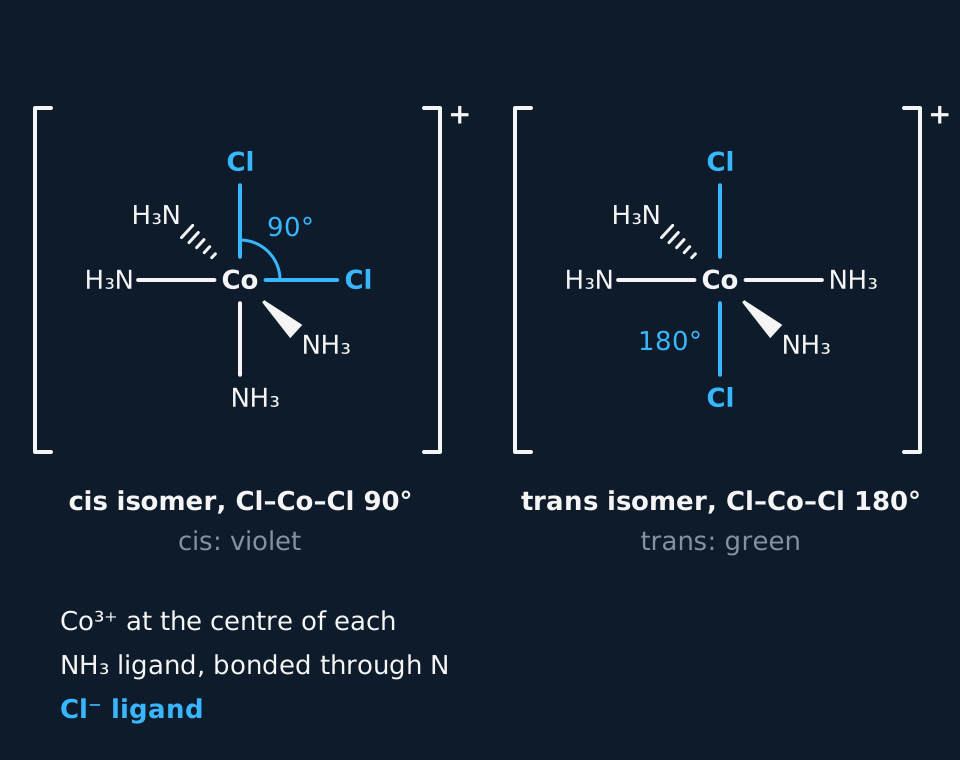
Once a complex has a fixed shape, the same ligands can be arranged round it in more than one way. [Co(NH₃)₄Cl₂]⁺ is octahedral, with four ammonia ligands and two chloride ligands on a cobalt(III) ion. The two chloride ligands can sit next to each other, 90° apart, in the cis isomer, or opposite each other, 180° apart, in the trans isomer. They are different compounds with different colours: as their chloride salts, the trans isomer is green and the cis isomer violet.
Describe the drawing
Two octahedral tetraamminedichlorocobalt(III) ions side by side, drawn with wedge and hashed bonds and each in square brackets with a single positive charge. In the cis isomer on the left one chloride is at the top and the other in the plane to the right, with a 90 degree arc between them. In the trans isomer on the right the chlorides are at the top and the bottom, 180 degrees apart in a straight line through the cobalt. Four ammonia ligands fill the other corners of each.
Cis–trans isomerism in complexes is a special case of E/Z isomerism. Square planar complexes show it too: in [Pt(NH₃)₂Cl₂] the two chloride ligands are either side by side, cis, or across the square, trans. A tetrahedral complex has no cis and trans isomers, because every corner of a tetrahedron is next to every other.
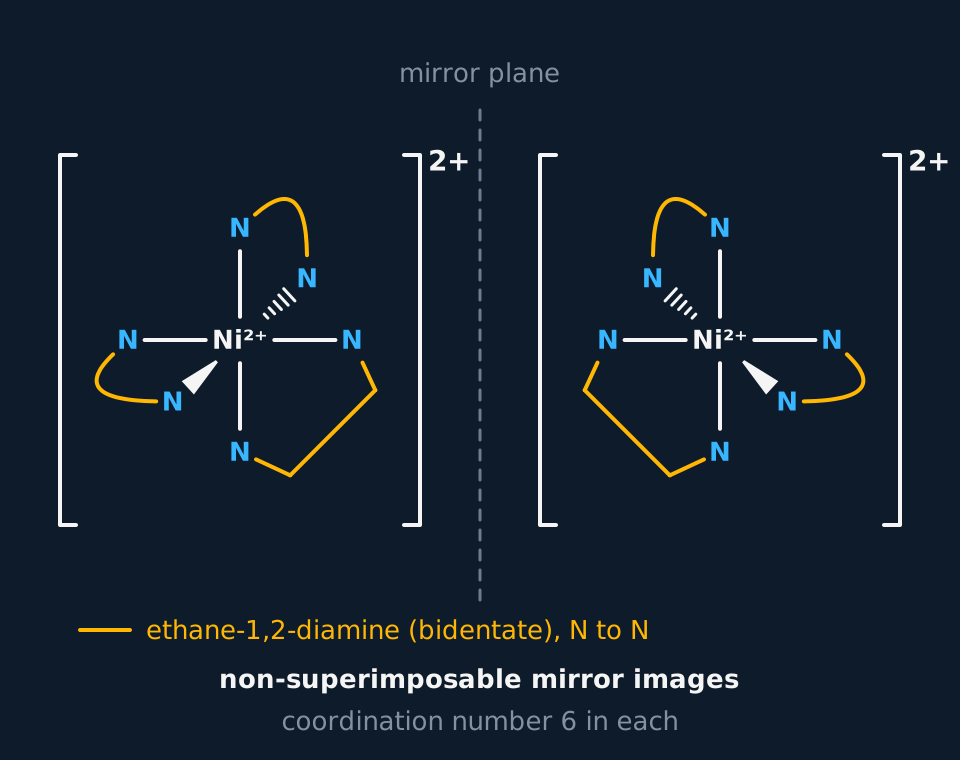
Three bidentate ligands on an octahedral ion give a different kind of isomer. In [Ni(H₂NCH₂CH₂NH₂)₃]²⁺ the three ligands wrap round the nickel like the blades of a propeller, and the propeller can turn either way. The two forms are non-superimposable mirror images, so they are optical isomers, and they rotate the plane of plane-polarised light in opposite directions. The cis isomer of [Co(en)₂Cl₂]⁺ is optically active as well; its trans isomer has a plane of symmetry and is not.
Describe the drawing
Two tris(ethane-1,2-diamine)nickel(II) ions drawn in three dimensions on either side of a vertical dashed mirror line. Each is octahedral with Ni²⁺ at the centre and six nitrogen donor atoms. Three curved diamine ligands each span two adjacent corners, one drawn in full with its two carbon atoms. The right-hand ion is the reflection of the left-hand one, so its three rings twist the opposite way and the two cannot be superimposed.
- Stereoisomers
- Compounds with the same structural formula but a different arrangement of their atoms in space.
- Cis–trans isomers
- Stereoisomers of a complex in which two identical ligands are adjacent, 90° apart, in the cis isomer and opposite, 180° apart, in the trans isomer.
- Optical isomers
- Stereoisomers that are non-superimposable mirror images of each other.
The chelate effect
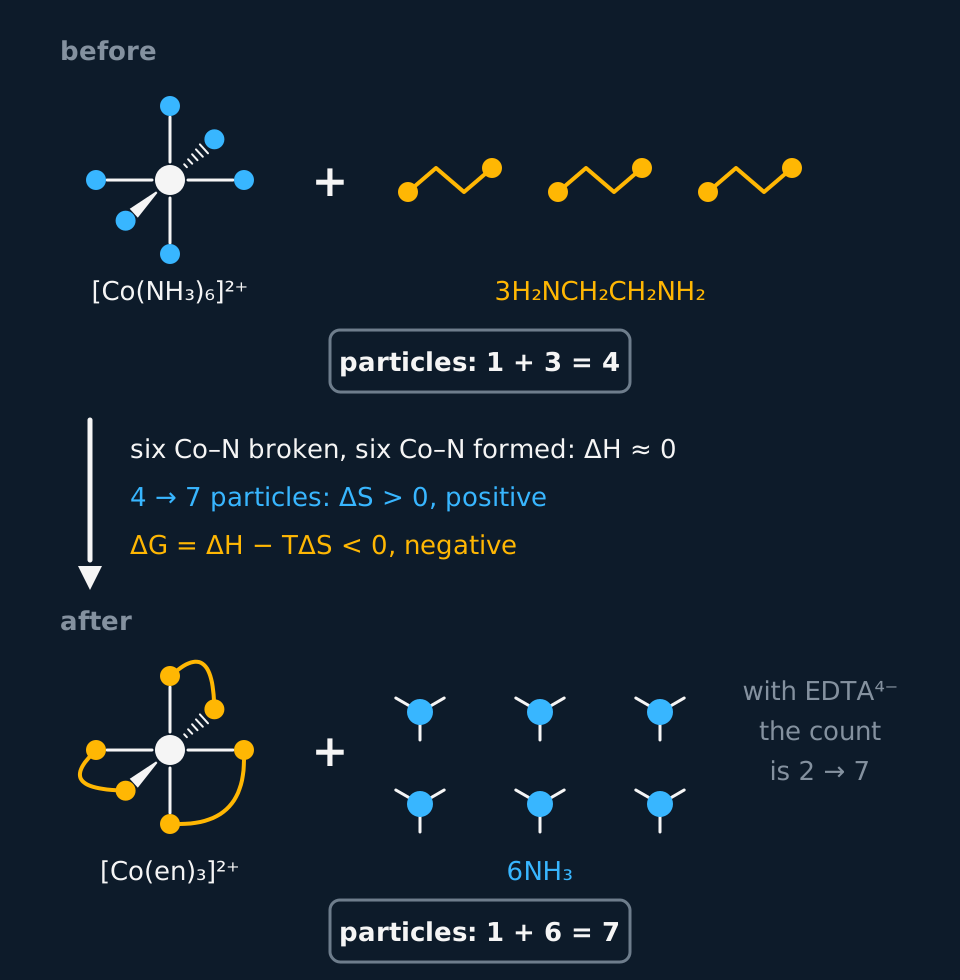
Ethane-1,2-diamine replaces the ammonia ligands of [Co(NH₃)₆]²⁺, three bidentate ligands taking the place of six monodentate ones. The reverse does not happen to any measurable extent, even with ammonia in large excess. This preference for bidentate and multidentate ligands is the chelate effect, from the Greek for a crab's claw.
[Co(NH₃)₆]²⁺(aq) + 3H₂NCH₂CH₂NH₂(aq) → [Co(H₂NCH₂CH₂NH₂)₃]²⁺(aq) + 6NH₃(aq)Four particles on the left, seven on the right.
The explanation is entropy, not bond strength. Six Co–N bonds break and six Co–N bonds form, each from a nitrogen lone pair of much the same kind, so the enthalpy change is close to zero. But four particles in solution become seven. More particles can be arranged in more ways, so the entropy of the system increases and ΔS is positive. With ΔH near zero and ΔS positive, ΔG = ΔH − TΔS is negative and the substitution is feasible. The reverse would mean fewer particles, and a positive ΔG.
Describe the drawing
A substitution drawn as particles. Before: one octahedral hexaamminecobalt(II) ion and three separate ethane-1,2-diamine molecules, tallied as one plus three, four particles. After: one cobalt(II) ion held by three diamine rings and six free ammonia molecules, tallied as one plus six, seven particles. Beside the arrow: six cobalt–nitrogen bonds broken and six formed so the enthalpy change is about zero, four particles become seven so the entropy change is positive, and the free energy change is therefore negative.
With EDTA⁴⁻ the effect is larger still. One ligand replaces six water molecules, and two particles become seven. Its complexes are stable enough to hold metal ions in solution and keep them from reacting with anything else.
[Cu(H₂O)₆]²⁺(aq) + EDTA⁴⁻(aq) → [Cu(EDTA)]²⁻(aq) + 6H₂O(l)Two particles become seven.
- Chelate effect
- The replacement of monodentate ligands by bidentate or multidentate ligands, favoured because the number of particles increases and so the entropy increases.
The ΔG of a chelate substitution
For the substitution of six ammonia ligands on a nickel(II) ion by three ethane-1,2-diamine ligands, ΔH = −12 kJ mol⁻¹ and ΔS = +150 J K⁻¹ mol⁻¹. Calculate ΔG at 298 K, and identify the term that makes the reaction feasible.
Show the working
Convert ΔS to kJ so that the units match: +150 J K⁻¹ mol⁻¹ = +0.150 kJ K⁻¹ mol⁻¹.
TΔS = 298 × 0.150 = 44.7 kJ mol⁻¹.
ΔG = ΔH − TΔS = −12 − 44.7 = −56.7 kJ mol⁻¹, which is −57 kJ mol⁻¹ to two significant figures, the precision of ΔH.
ΔG is negative, so the substitution is feasible. The enthalpy term contributes −12 kJ mol⁻¹ and the entropy term −44.7 kJ mol⁻¹, nearly four times as much: the increase in the number of particles drives the reaction.
Cisplatin
Only one of the two isomers of [Pt(NH₃)₂Cl₂] treats cancer. Cisplatin, the cis isomer, enters a cell, where the chloride concentration is low, and its two chloride ligands are replaced by water. The platinum then bonds to nitrogen atoms on two guanine bases next to each other on the same strand of DNA. The DNA bends at that point, the enzymes that copy it cannot get past, and the cell cannot divide; the cell then dies by programmed cell death.
Cisplatin acts on any rapidly dividing cell, healthy or not. Patients lose hair, the lining of the gut is damaged, and the kidneys can be harmed. Doses are kept as low as will work and given in short courses, and the patient is told the risks before agreeing to treatment. The decision is a balance between the side effects and the chance of a cure: for testicular cancer, cisplatin raised survival above 90%.
The drug is made and given as the pure cis isomer. The trans isomer cannot form the cross-link that stops replication, so in a mixture it would add nothing to the treatment. It is still a platinum compound, though, able to bind to proteins and other molecules in the body, so it would add to the toxicity: a dose of the mixture would carry the side effects of both isomers for the benefit of one. Stereoisomers are different compounds, and each is tested as a drug on its own.
TRY IT: Why cis and not trans
Suggest why the trans isomer of [Pt(NH₃)₂Cl₂] has no anticancer activity, and explain why the tetrahedral complex [Zn(NH₃)₂Cl₂] has no cis–trans isomers.
Check your answer
In cisplatin the two chloride ligands, which leave when the drug binds DNA, are adjacent, 90° apart. The two positions they free can bond to two neighbouring guanine bases on one strand. In the trans isomer those positions are 180° apart, on opposite sides of the platinum, so they cannot both reach neighbouring bases and the bend in the DNA does not form.
In a tetrahedron every corner is adjacent to every other, at 109.5°. The two chloride ligands are next to each other whichever corners they take, so only one arrangement exists.
Other boards: stability constants, polar isomers and cobalt(II) hydroxide
Cambridge measures how stable a complex is with a number, the stability constant, Kstab. AQA, OCR and Edexcel do not examine it. Kstab is the equilibrium constant for forming the complex from the aqua ion in water. Water is left out of the expression, because it is the solvent and its concentration hardly changes.
Kstab = [[Cu(NH₃)₄(H₂O)₂]²⁺] ÷ ([[Cu(H₂O)₆]²⁺] × [NH₃]⁴)Units dm¹² mol⁻⁴: four concentrations below the line, one above.
The values span so many powers of ten that they are quoted as log₁₀ Kstab. A larger value means the equilibrium lies further to the right and the complex is more stable, and a ligand replaces another when the complex it forms has the larger Kstab. Chloride ions replace water round Cu²⁺ only in concentrated acid, while EDTA⁴⁻ replaces ammonia from the deep blue ammine. The nickel pair puts a number on the chelate effect: the same six Ni–N bonds, ten powers of ten apart.
| Complex | Ligand | log₁₀ Kstab |
|---|---|---|
| [CuCl₄]²⁻ | Monodentate Cl⁻ | 5.6 |
| [Cu(NH₃)₄(H₂O)₂]²⁺ | Monodentate NH₃ | 13.1 |
| [Cu(EDTA)]²⁻ | Hexadentate EDTA⁴⁻ | 18.8 |
| [Ni(NH₃)₆]²⁺ | Monodentate NH₃ | 8.6 |
| [Ni(en)₃]²⁺ | Bidentate en | 18.3 |
- Stability constant
- The equilibrium constant for the formation of a complex ion from the aqua ion in aqueous solution; the larger the value, the more stable the complex.
Using stability constants
log₁₀ Kstab is 13.1 for [Cu(NH₃)₄(H₂O)₂]²⁺, 8.6 for [Ni(NH₃)₆]²⁺ and 18.3 for [Ni(en)₃]²⁺. Calculate the ratio of [Cu(NH₃)₄(H₂O)₂]²⁺ to [Cu(H₂O)₆]²⁺ in a solution in which the free ammonia concentration is 0.10 mol dm⁻³, and the equilibrium constant K for [Ni(NH₃)₆]²⁺ + 3en ⇌ [Ni(en)₃]²⁺ + 6NH₃.
Show the working
For copper, Kstab = antilog 13.1 = 1.26 × 10¹³ dm¹² mol⁻⁴.
Rearranging the expression, [complex] ÷ [aqua ion] = Kstab × [NH₃]⁴ = 1.26 × 10¹³ × (0.10)⁴ = 1.26 × 10⁹, which is 1.3 × 10⁹ to two significant figures. Almost no copper is left as the aqua ion.
For nickel, write K for the exchange and multiply its top and bottom by [[Ni(H₂O)₆]²⁺]: K is Kstab of [Ni(en)₃]²⁺ divided by Kstab of [Ni(NH₃)₆]²⁺. In logs, log₁₀ K = 18.3 − 8.6 = 9.7.
K = antilog 9.7 = 5 × 10⁹ mol³ dm⁻⁹. The equilibrium lies far to the right, in line with a ΔG of about −55 kJ mol⁻¹ for the same exchange.
Cambridge also asks about the polarity of the two isomers of [Pt(NH₃)₂Cl₂]. In the trans isomer the two Pt–Cl bond dipoles point in opposite directions and cancel, and so do the two Pt–N dipoles, so the molecule has no overall dipole. In the cis isomer both chlorine atoms are on the same side of the platinum, the dipoles do not cancel, and the molecule is polar. The cis isomer is the more soluble in water as a result.
Edexcel examines cobalt(II) with sodium hydroxide as well as with ammonia. Before any substitution, cobalt(II) reacts with hydroxide ions as a base. Sodium hydroxide, or ammonia added a drop at a time, removes two protons from the water ligands and gives a blue precipitate of cobalt(II) hydroxide. On standing it turns pink, and then darkens to brown as air oxidises it to cobalt(III). Excess sodium hydroxide leaves the precipitate undissolved; excess concentrated ammonia dissolves it, because ammonia is a ligand as well as a base, and gives the straw-coloured [Co(NH₃)₆]²⁺.
[Co(H₂O)₆]²⁺(aq) + 2OH⁻(aq) → [Co(H₂O)₄(OH)₂](s) + 2H₂O(l)Pink solution to blue precipitate; no change in excess sodium hydroxide.
Other boards: Edexcel core practical 12, preparing a complex
Edexcel's core practical 12 prepares a transition metal complex as a solid and finds the percentage yield. The usual choice is tetraamminecopper(II) sulfate, made from copper(II) sulfate and concentrated ammonia. In solution the complex is [Cu(NH₃)₄(H₂O)₂]²⁺. The deep blue crystals that separate are tetraamminecopper(II) sulfate monohydrate, [Cu(NH₃)₄]SO₄·H₂O, the formula Edexcel's method uses. Its Mr is 245.6 from the Ar values used here; Edexcel, with Ar to two decimal places, prints 245.7.
Apparatus: a 50 cm³ beaker, a 10 cm³ measuring cylinder, a glass rod, a balance reading to 0.01 g, an ice bath, and a Büchner funnel and flask for filtration under reduced pressure. Chemicals: copper(II) sulfate-5-water, concentrated (0.880) ammonia, ethanol and distilled water.
| Step | What to do | Why |
|---|---|---|
| 1 | Weigh about 2.5 g of copper(II) sulfate-5-water accurately into the beaker and dissolve it in 5 cm³ of distilled water | The mass sets the theoretical yield |
| 2 | In a fume cupboard, add 4 cm³ of concentrated ammonia a little at a time, stirring | The first drops act as a base; the rest replace the water ligands |
| 3 | Add 8 cm³ of ethanol slowly down the side of the beaker, and stand the beaker in ice for ten minutes | The complex is much less soluble in ethanol than in water, so it crystallises |
| 4 | Filter under reduced pressure and wash the crystals with a little cold ethanol | Ethanol removes the solution without dissolving the product, as water would |
| 5 | Dry the crystals between filter papers, then weigh them | Wet crystals give a yield that is too high |
What is observed: the pale blue solution gives a pale blue precipitate of copper(II) hydroxide with the first of the ammonia, which dissolves as more is added to give a deep blue solution. Ethanol brings down deep blue crystals, and the liquid above them becomes paler as the complex leaves it.
CuSO₄·5H₂O(s) + 4NH₃(aq) → [Cu(NH₃)₄]SO₄·H₂O(s) + 4H₂O(l)One mole of copper(II) sulfate-5-water gives at most one mole of product.
Percentage yield of tetraamminecopper(II) sulfate
A student uses 2.50 g of CuSO₄·5H₂O (Mr 249.6) and collects 1.84 g of dry [Cu(NH₃)₄]SO₄·H₂O (Mr 245.6). Calculate the percentage yield.
Show the working
Moles of copper(II) sulfate = 2.50 ÷ 249.6 = 1.002 × 10⁻² mol, and the equation gives the same amount of product.
Theoretical mass = 1.002 × 10⁻² × 245.6 = 2.46 g.
Percentage yield = 1.84 ÷ 2.46 × 100 = 74.8%, to three significant figures. Some complex stays dissolved in the water and ethanol, and some is lost on the filter paper.
Safety: concentrated ammonia is corrosive and its vapour irritates the eyes and lungs, so it is used in a fume cupboard with eye protection. Ethanol is highly flammable, so no flame is lit nearby. Copper compounds go in the waste container, not the sink.
In the exam
- A ligand substitution is marked in parts: the equation, the colour of each solution, and the coordination number. [Cu(H₂O)₆]²⁺, a blue solution, gives [Cu(NH₃)₄(H₂O)₂]²⁺, a deep blue solution, with coordination number 6 throughout; a missing colour loses its mark even when the equation is right.
- The chelate effect is an entropy argument. The answer must count the particles on each side, say that entropy increases, and say that ΔH is close to zero because the same number and type of bonds are broken and made. The scheme rejects 'the new bonds are stronger'.
- Chloride gives coordination number 4 because Cl⁻ is larger than H₂O or NH₃. Repulsion between the negative ligands supports that point but does not replace it.
- Isomer drawings lose marks for a ligand bonded through the wrong atom, such as the H of ammonia, and for a charged complex drawn without its charge. Use wedges and dashes, the metal at the centre and the charge outside square brackets, and mark the 90° or 180° angle.
- For cisplatin the scheme looks for three things: it binds to guanine (accept 'to nitrogen atoms on DNA bases'), it stops DNA replication, and it also harms healthy dividing cells, so the dose is limited.
Check yourself
A student adds concentrated hydrochloric acid to pale blue copper(II) sulfate solution and sees it turn yellow-green. She writes that the six water ligands have been replaced by six chloride ligands. Evaluate her account.
Answer
The colour change is right, and so is the idea of ligand substitution, but the number is wrong. Four chloride ions replace the six water molecules, giving [CuCl₄]²⁻.
Chloride ions are larger than water molecules and carry a negative charge, so they repel each other and only four fit round the Cu²⁺ ion. The coordination number falls from 6 to 4 and the shape changes from octahedral to tetrahedral.
The equation is [Cu(H₂O)₆]²⁺(aq) + 4Cl⁻(aq) ⇌ [CuCl₄]²⁻(aq) + 6H₂O(l). Diluting the yellow-green solution with water turns it blue again, which shows that the reaction is an equilibrium.
Questions
Question 16 marks
Explain, with equations, what is seen when excess concentrated ammonia and, separately, concentrated hydrochloric acid are added to copper(II) sulfate solution, and why the two products have different shapes.
Mark scheme
Indicative content
- [Cu(H₂O)₆]²⁺(aq) + 4NH₃(aq) → [Cu(NH₃)₄(H₂O)₂]²⁺(aq) + 4H₂O(l), with only four of the six water ligands replaced
- the blue solution becomes a deep blue solution; a pale blue precipitate may form first, before the ammonia is in excess
- ammonia and water are similar in size and both uncharged, so the coordination number stays at 6 and the complex stays octahedral
- [Cu(H₂O)₆]²⁺(aq) + 4Cl⁻(aq) ⇌ [CuCl₄]²⁻(aq) + 6H₂O(l), with all six water ligands replaced by four chloride ions
- the blue solution turns yellow-green (accept green, then yellow), and adding water reverses the change, so it is an equilibrium
- chloride ions are larger than water molecules and repel one another, so only four fit round Cu²⁺: coordination number 4, tetrahedral
Levels
- Level 3 (5–6 marks) both equations are correct with the right number of ligands replaced, both observations are given, and the two shapes are explained from the size and charge of the ligands: ammonia replacing water without changing the coordination number, and the larger chloride ions fitting only four round the copper
- Level 2 (3–4 marks) both observations and one equation are right and the shapes are named; the second equation has the wrong number of ligands or does not balance, or the shapes are not tied to ligand size
- Level 1 (1–2 marks) one colour change or one complex is given; six ammonia ligands are often shown replacing all six waters, and the change of shape is not explained
Question 24 marks
Give the shape and one bond angle of each of these complexes: [Cu(H₂O)₆]²⁺, [CuCl₄]²⁻, cisplatin [Pt(NH₃)₂Cl₂] and [Ag(NH₃)₂]⁺.
Mark scheme
- B1 [Cu(H₂O)₆]²⁺ is octahedral, with bond angles of 90°
- B1 [CuCl₄]²⁻ is tetrahedral, with Cl–Cu–Cl bond angles of 109.5°; allow 109°
- B1 cisplatin is square planar, with bond angles of 90°
- B1 [Ag(NH₃)₂]⁺ is linear, with an N–Ag–N bond angle of 180°
Question 34 marks
Explain why [Co(NH₃)₆]²⁺ reacts with ethane-1,2-diamine to form [Co(H₂NCH₂CH₂NH₂)₃]²⁺.
Mark scheme
- B1 four particles (one complex and three diamine molecules) become seven (one complex and six ammonia molecules)
- B1 the number of particles increases, so the entropy increases and ΔS is positive
- B1 ΔH is close to zero, because six Co–N bonds are broken and six similar Co–N bonds are formed
- B1 so ΔG = ΔH − TΔS is negative and the substitution is feasible
All 20 questions with mark schemes, the other 17 set out in full on the question page.
Worth remembering
- Put four chloride ligands round Cu²⁺, not six: they are larger, so the complex is tetrahedral.
- Copper with excess ammonia keeps two water ligands: [Cu(NH₃)₆]²⁺ is not the product.
- 'The new bonds are stronger' does not explain the chelate effect; the rise in the number of particles does.
- Keep cis–trans isomerism for square planar and octahedral complexes; every corner of a tetrahedron is next to every other.
- Bond ammonia to the metal through nitrogen, whose lone pair forms the coordinate bond.
CHECK YOUR PROGRESS
Rate how confident you are with each objective for this lesson. Ratings are saved in this browser, on this device, unless you sign in.
- Describe the octahedral, tetrahedral, square planar and linear shapes of complexes, with a named example and the bond angle of each.
- Write equations for ligand substitution by ammonia and by chloride ions, with the colours and any change in coordination number.
- Explain the chelate effect in terms of the number of particles and the entropy change.
- Write the expression for a stability constant and use log₁₀ Kstab values to compare the stabilities of complexes.CAIE
- Draw cis and trans isomers of octahedral and square planar complexes, and the optical isomers of a complex with three bidentate ligands.
- Describe how cisplatin acts against cancer, and weigh its benefit against its side effects.
Open the full revision checklist to see every objective in the curriculum in one place.
Practise this lesson
WORKBOOK
The written questions from this topic, on paper with room to work, and a separate book of mark schemes. The question that is set on a diagram stays on this page, where the diagram can be drawn. Free to use; please do not redistribute or sell.
Used later in Reactions of aqua ions with hydroxide, ammonia and carbonate · Amino acids, proteins, enzymes and DNA