Chemistry › Ions in aqueous solution › Metal-aqua ions and the acidity of their solutions
Metal-aqua ions and the acidity of their solutions
A metal ion in water is never bare: six water molecules bond to it through their oxygen atoms, and the colour of the solution is the colour of that hexaaqua ion. One of those water molecules can lose a proton, so solutions of metal salts are acidic. A 3+ ion pulls on its water molecules harder than a 2+ ion does, so iron(III) chloride solution fizzes with sodium carbonate and iron(II) sulfate solution does not.
Key terms Every definition in ions in aqueous solution, lesson by lesson
Before this Transition metal characteristics and complex formation – ligands, coordinate bonds and the octahedral hexaaqua ion · Brønsted–Lowry acids and bases, pH and strong acids – an acid as a proton donor, and pH = −log₁₀[H⁺] · Weak acids, Ka and pKa; Kw and strong bases – the pH of a weak acid from Ka
COMMON MISCONCEPTION
A solution of a salt is neutral, because a salt is what is left once an acid has been neutralised.
A dissolved metal ion holds water ligands, and a small, highly charged ion polarises their O–H bonds. [Fe(H₂O)₆]³⁺ releases H⁺ to the water, so iron(III) chloride solution has a pH near 2, and solutions of 2+ ions are weakly acidic. Only ions of low charge density leave the water neutral.
What you should be able to do
- Write the formulae of the hexaaqua ions of iron(II), copper(II), iron(III) and aluminium, and give the colour of each solution.
- Write the hydrolysis equilibrium of a metal-aqua ion with state symbols, identifying the aqua ion as a Brønsted–Lowry acid.
- Explain, in terms of charge/size ratio, why [M(H₂O)₆]³⁺ is more acidic than [M(H₂O)₆]²⁺.
- Calculate the pH of a metal salt solution from Ka, Ka from a measured pH, and the change in pH when the solution is diluted.
- Describe and explain the reactions of 2+ and 3+ aqua ions with sodium carbonate, and use them to tell the two charges apart.
Six water molecules round every ion
Iron(III) chloride is a salt, yet its yellow-brown solution is acidic. At 0.100 mol dm⁻³ the pH is about 2, nearer 1.7: universal indicator paper turns red in it, and it is more acidic than lemon juice. Nothing that went into the solution was an acid. The acid comes from what water does to the iron(III) ion.
No metal ion in water is bare. A small positive ion attracts the δ− oxygen atoms of the water molecules around it, and six of them bond to it, each oxygen donating one of its lone pairs to form a coordinate bond. The result is a metal-aqua ion, written [M(H₂O)₆]²⁺ or [M(H₂O)₆]³⁺. It is octahedral, with the six oxygen atoms at the corners and the metal at the centre. Water is neutral, so the complex carries the charge of the metal ion.
Four of these ions are examined: two with a 2+ charge, iron(II) and copper(II), and two with a 3+ charge, iron(III) and aluminium. The colour of each solution is the colour of the aqua ion in it, and the table gives the words the mark scheme uses.
| Ion | Aqua ion | Colour of the solution |
|---|---|---|
| Iron(II) | [Fe(H₂O)₆]²⁺ | Green (pale green) |
| Copper(II) | [Cu(H₂O)₆]²⁺ | Blue |
| Iron(III) | [Fe(H₂O)₆]³⁺ | The ion is pale violet; the solution usually looks yellow-brown |
| Aluminium | [Al(H₂O)₆]³⁺ | Colourless |
The colour belongs to the complex, not to the metal alone. Anhydrous copper(II) sulfate is a white powder. Drop water on it and it turns blue at once, because water molecules bond to the copper ions; that is the test for water. The blue crystals, CuSO₄·5H₂O, and the blue solution both owe their colour to water ligands round copper(II).
Aluminium is not a transition metal. Al³⁺ has no d electrons, so its aqua ion absorbs no visible light and the solution is colourless. It sits beside iron(III) here because its aqua ion is an acid in the same way, and because its hydroxide dissolves in excess alkali, which none of the other three hydroxides does.
- Metal-aqua ion
- A complex ion in which water molecules are the ligands, each bonded to the central metal ion by a coordinate bond from a lone pair on its oxygen atom.
- Ligand
- A molecule or ion that donates a lone pair of electrons to a central metal ion to form a coordinate bond.
- Coordinate bond
- A covalent bond in which both electrons of the shared pair come from the same atom.
- Coordination number
- The number of coordinate bonds from the ligands to the central metal ion; six in a hexaaqua ion.
Hydrolysis: the aqua ion as an acid
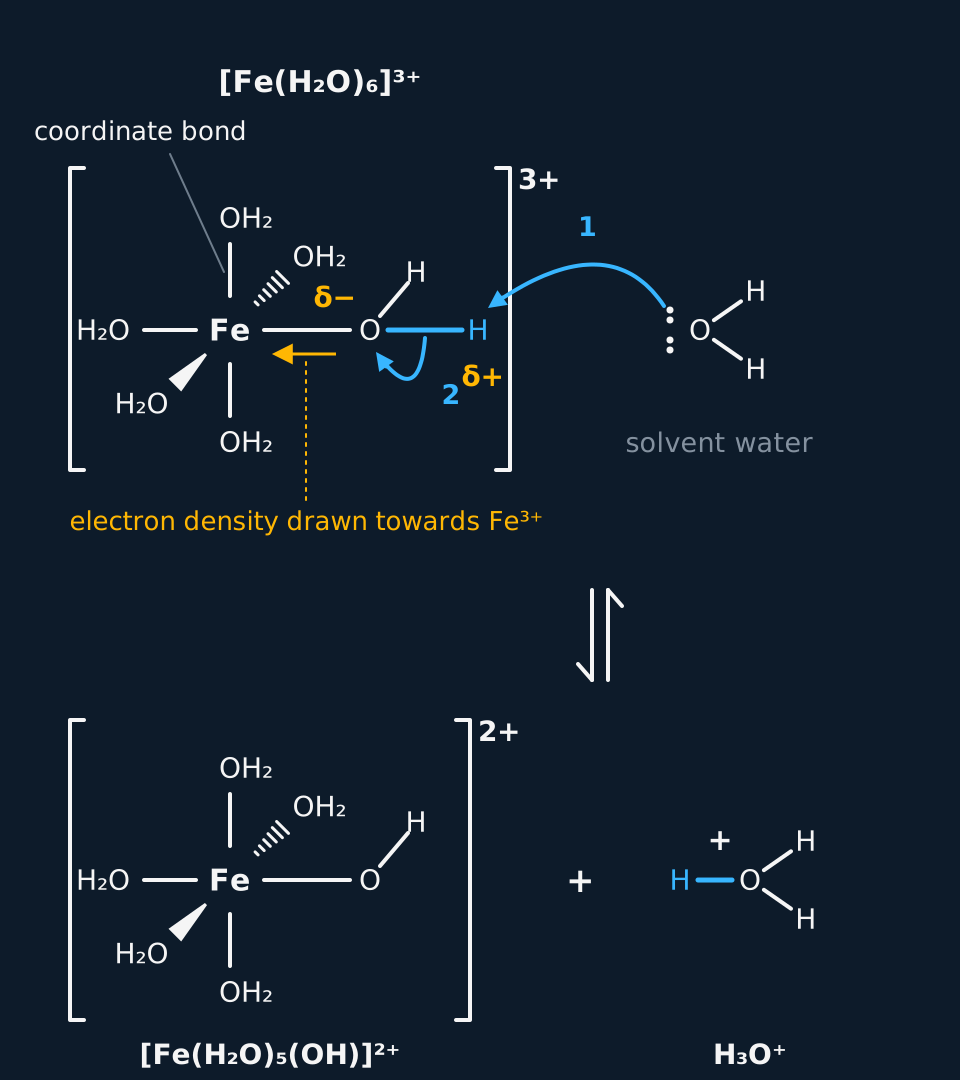
Bonding to the metal changes each water molecule. Its oxygen has given a lone pair to the metal ion, so electron density in the molecule is drawn towards the metal, and the oxygen draws on the electrons of its own two O–H bonds in turn. Those bonds become more polar and the hydrogen atoms more δ+. One of them can now be lost as a proton to a water molecule in the solvent.
[Fe(H₂O)₆]³⁺(aq) + H₂O(l) ⇌ [Fe(H₂O)₅(OH)]²⁺(aq) + H₃O⁺(aq)The aqua ion donates a proton, so it is a Brønsted–Lowry acid; the solvent water molecule accepts it.
Describe the drawing
A mechanism in two rows. Above, the octahedral hexaaquairon(III) ion in square brackets with charge 3+: iron at the centre bonded to six water ligands by coordinate bonds, one of them on a wedge and one on a hashed bond. The right-hand water ligand is drawn atom by atom, its oxygen marked delta minus and one hydrogen marked delta plus, with an arrow along the iron–oxygen bond showing electron density drawn towards the iron(III) ion. A solvent water molecule to the right has two lone pairs. Curly arrow 1 runs from a lone pair to the delta plus hydrogen; curly arrow 2 runs from the O–H bond onto the coordinated oxygen. An equilibrium arrow leads down to the products: the 2+ ion with one hydroxide ligand, and H₃O⁺.
This reaction is hydrolysis. The complex that forms has one hydroxide ligand in place of a water ligand, so its charge drops by one, from 3+ to 2+. The other product is the oxonium ion, H₃O⁺, which is what the indicator paper detects. AQA accepts H⁺(aq) on the right in place of H₃O⁺, provided the water on the left-hand side is dropped too.
The equation for any aqua ion is written by the same three moves. Take one water ligand and turn it into a hydroxide ligand, so the complex keeps six ligands but has one H fewer. Lower the charge on the complex by one. Put the lost proton on a water molecule, as H₃O⁺, and use ⇌, because the reaction is an equilibrium. A 2+ ion hydrolyses by the identical route, to a lesser extent.
[Cu(H₂O)₆]²⁺(aq) + H₂O(l) ⇌ [Cu(H₂O)₅(OH)]⁺(aq) + H₃O⁺(aq)
Both equilibria lie to the left, so the aqua ions are weak acids. [Al(H₂O)₆]³⁺ has a Ka of about 1 × 10⁻⁵ mol dm⁻³, close to that of ethanoic acid, and in a 0.100 mol dm⁻³ solution about one aqua ion in a hundred has lost a proton at any moment. [Cu(H₂O)₆]²⁺ is a few hundred times weaker.
The pale violet of [Fe(H₂O)₆]³⁺ is rarely seen in a bottle, because iron(III) hydrolyses far enough for [Fe(H₂O)₅(OH)]²⁺ to be a large part of what is present, and that complex absorbs violet light. Add dilute nitric acid and the extra H₃O⁺ pushes the equilibrium to the left, by Le Chatelier's principle: the yellow-brown fades towards very pale violet. Crystals of hydrated iron(III) nitrate, which hold the unhydrolysed hexaaqua ion, are pale violet too.
The [Fe(H₂O)₅(OH)]²⁺ ion can lose a second proton and then a third, each step harder than the last because the complex is less positive. In water alone those later steps hardly happen. Add a base that removes H₃O⁺ and they are pulled to completion: the complex ends with no charge and comes out of solution as a precipitate. That is the first step whenever hydroxide or ammonia is added to an aqua ion, and whenever carbonate is added to a 3+ aqua ion.
- Hydrolysis (of a metal-aqua ion)
- The reaction of a metal-aqua ion with water in which a coordinated water molecule loses a proton to a solvent water molecule, forming H₃O⁺.
- Brønsted–Lowry acid
- A species that donates a proton (an H⁺ ion) to another species.
- Weak acid
- An acid that is only partially dissociated in solution, so the equilibrium lies to the left.
Why a 3+ ion is the stronger acid
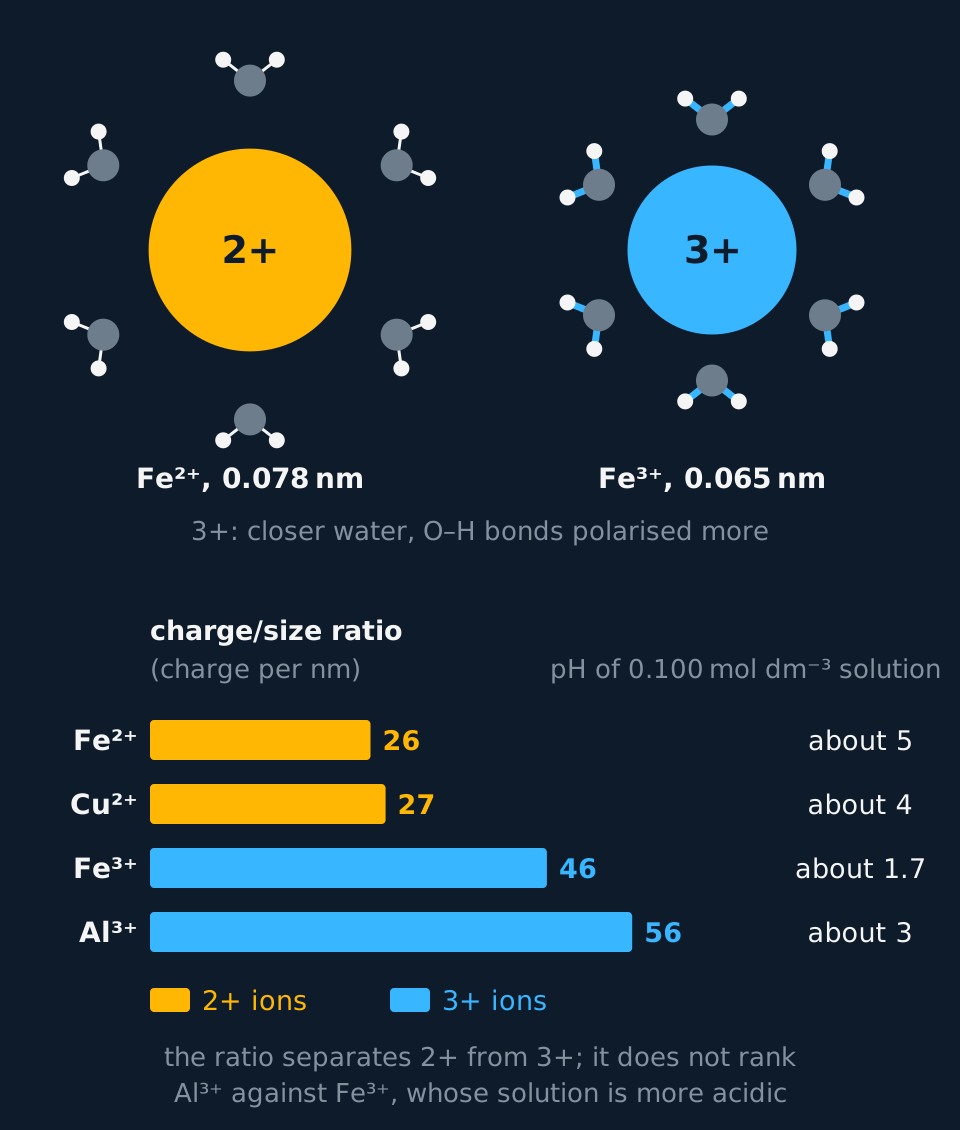
Compare the two ions of iron. Fe²⁺ and Fe³⁺ sit in the same octahedron of six water molecules, but Fe³⁺ has one more positive charge and is smaller, with a radius of about 0.065 nm against 0.078 nm, because losing a third electron lets the nucleus pull the rest in. Its charge/size ratio is therefore much higher: 3 ÷ 0.065 is 46 against 2 ÷ 0.078, which is 26.
Describe the drawing
Above, two spheres drawn to scale: Fe²⁺ of radius 0.078 nanometres in amber and the smaller Fe³⁺ of radius 0.065 nanometres in cyan, each with its charge printed in the centre and six water molecules around it with oxygen facing in; the water round Fe³⁺ sits closer and its O–H bonds are drawn thicker. Below, a horizontal bar chart of charge/size ratio: Fe²⁺ 26 and Cu²⁺ 27 in amber, Fe³⁺ 46 and Al³⁺ 56 in cyan, with the pH of a 0.100 mol dm⁻³ solution beside each bar: about 5, 4, 1.7 and 3. Al³⁺ has the longest bar but not the lowest pH.
The explanation is a chain, and the mark scheme credits each link. The 3+ ion has the higher charge/size ratio, so it attracts the lone pairs of its coordinated water molecules more strongly. That polarises the O–H bonds of those water molecules more, weakening them, so H⁺ is released more readily. The hydrolysis equilibrium lies further to the right, [H₃O⁺] is higher and the pH is lower.
Size matters as much as charge. A smaller ion lets the oxygen atoms of its ligands come closer, and the attraction between the ion and the lone pair grows as the distance shrinks. So the same 3+ charge on a larger ion would polarise less. AQA's term is charge/size ratio; many textbooks say charge density, which means the same thing.
For scale, a 0.100 mol dm⁻³ solution of hydrochloric acid, a strong acid, has a pH of 1.0. Iron(III) solution of the same concentration is not far behind it. Copper(II) solution, at about pH 4, holds a thousandth of the acid's hydrogen ion concentration.
| Aqua ion | Charge/size ratio (charge per nm) | Ka / mol dm⁻³ | pH of a 0.100 mol dm⁻³ solution |
|---|---|---|---|
| [Fe(H₂O)₆]²⁺ | 26 | about 3 × 10⁻¹⁰ | about 5 |
| [Cu(H₂O)₆]²⁺ | 27 | about 3 × 10⁻⁸ | about 4 |
| [Al(H₂O)₆]³⁺ | 56 | about 1 × 10⁻⁵ | about 3 |
| [Fe(H₂O)₆]³⁺ | 46 | about 6 × 10⁻³ | about 1.7 |
The table shows the rule and its limit. Every 3+ ion is a stronger acid than every 2+ ion, as the charge/size argument predicts. Within the 3+ pair, though, Al³⁺ is the smaller ion with the higher ratio, and yet iron(III) solution is the more acidic.
The reason is the metal's electrons. Fe³⁺ has five 3d electrons, and d electrons shield the nuclear charge poorly, so Fe³⁺ is more electronegative than Al³⁺ (1.83 against 1.61 for the elements). It bonds more covalently to the water oxygen and draws more electron density from the O–H bonds than charge/size predicts. Al³⁺ has no d electrons and gets only the charge/size effect. Charge/size explains the difference between 2+ and 3+; ranking ions of the same charge needs the second idea, and no question asks for it.
Sodium chloride solution is neutral because its cation is too weakly polarising to hydrolyse. Na⁺ carries a single charge and is larger than any ion in the table, so its charge/size ratio is far too low to polarise the water molecules around it.
- Charge/size ratio
- The charge on an ion divided by its radius; also called charge density. A small, highly charged ion has a high ratio.
- Polarisation
- The distortion of the electron density in a bond by a nearby charge, which makes the bond more polar and here weakens it.
- Acid dissociation constant, Ka
- The equilibrium constant for the dissociation of a weak acid, Ka = [H⁺][A⁻] ÷ [HA]; a larger Ka means a stronger acid.
The pH of an aluminium salt solution
Calculate the pH of a solution in which the concentration of [Al(H₂O)₆]³⁺ is 0.100 mol dm⁻³. Ka = 1.0 × 10⁻⁵ mol dm⁻³.
Show the working
Write Ka for the hydrolysis, with H⁺ for H₃O⁺: Ka = [Al(H₂O)₅(OH)²⁺][H⁺] ÷ [Al(H₂O)₆³⁺].
Each aqua ion that reacts gives one of each product, so [Al(H₂O)₅(OH)²⁺] = [H⁺]. So little of the aqua ion reacts that its concentration is taken as 0.100 mol dm⁻³. Ka = [H⁺]² ÷ 0.100.
[H⁺]² = 1.0 × 10⁻⁵ × 0.100 = 1.0 × 10⁻⁶, so [H⁺] = 1.0 × 10⁻³ mol dm⁻³.
pH = −log₁₀(1.0 × 10⁻³) = 3.00. The assumption holds: 1.0 × 10⁻³ is 1% of 0.100, so the aqua ion concentration has barely changed.
Ka from a measured pH, and what it shows
A 0.200 mol dm⁻³ solution of copper(II) sulfate has a pH of 4.10. Calculate Ka for [Cu(H₂O)₆]²⁺, and compare it with the value of 1.0 × 10⁻⁵ mol dm⁻³ for [Al(H₂O)₆]³⁺.
Show the working
[H⁺] = 10 to the power −4.10 = 7.94 × 10⁻⁵ mol dm⁻³.
As before, [Cu(H₂O)₅(OH)⁺] = [H⁺] and the aqua ion concentration stays at 0.200 mol dm⁻³, so Ka = [H⁺]² ÷ 0.200.
Ka = (7.94 × 10⁻⁵)² ÷ 0.200 = 6.31 × 10⁻⁹ ÷ 0.200 = 3.2 × 10⁻⁸ mol dm⁻³, to two significant figures, since a pH to two decimal places carries two.
1.0 × 10⁻⁵ ÷ 3.2 × 10⁻⁸ is about 310. The aluminium aqua ion is a few hundred times stronger as an acid than the copper one, which is the 2+ against 3+ difference put as a number.
Dilution changes the pH of an aqua ion solution by less than it changes a strong acid. Since [H⁺] = √(Ka × c), a tenfold dilution divides [H⁺] by √10, about 3.16, and raises the pH by 0.5. A 0.100 mol dm⁻³ aluminium solution at pH 3.00 becomes pH 3.50 at 0.0100 mol dm⁻³. Hydrochloric acid diluted tenfold goes from pH 1.0 to pH 2.0, because every HCl was already ionised.
The reason is the equilibrium. Dilution lowers every concentration, and the expression for Ka has two concentrations on top and one below, so the quotient falls below Ka. The hydrolysis shifts right until it is restored: at 0.0100 mol dm⁻³, about 3% of the aluminium aqua ions are hydrolysed, against 1% at 0.100 mol dm⁻³.
Sodium carbonate tells 2+ from 3+
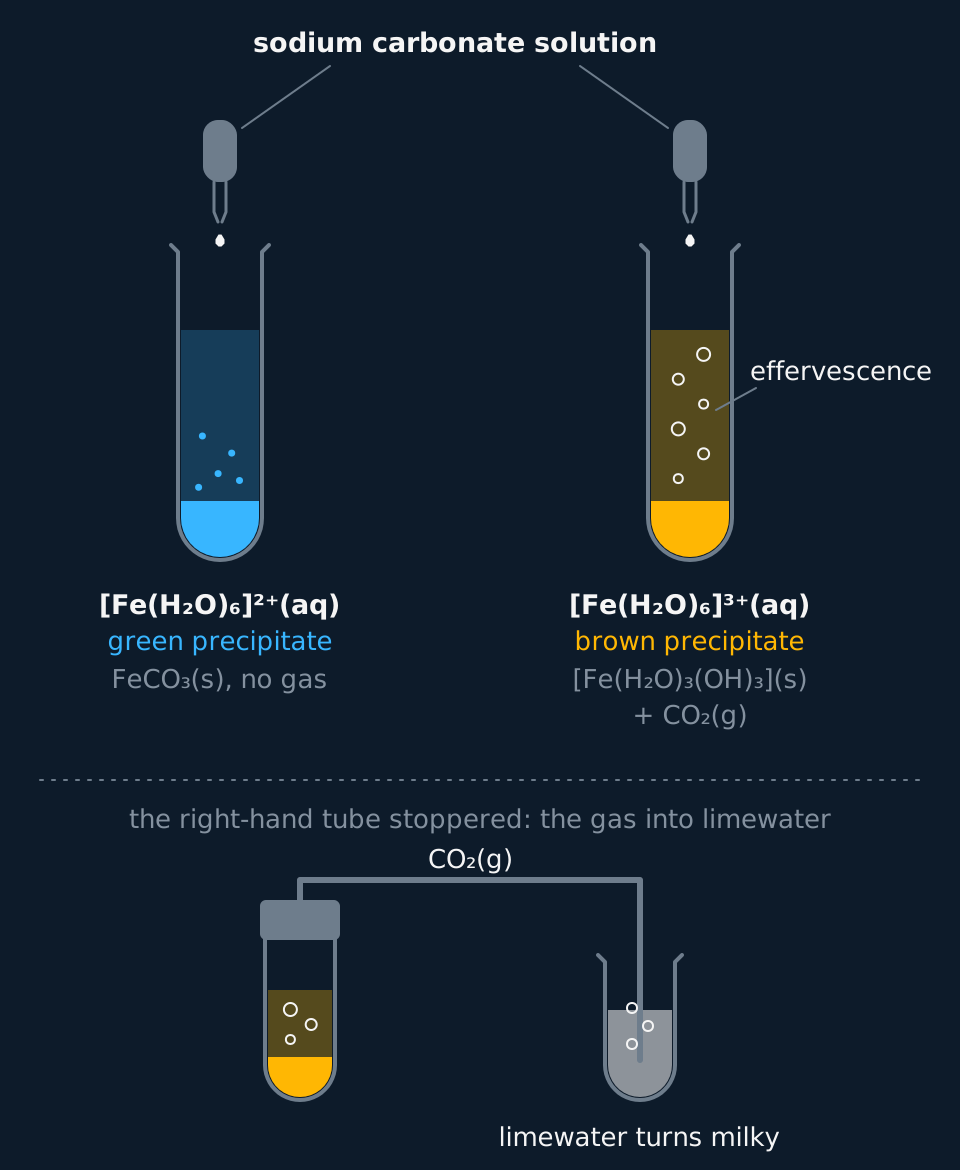
Sodium carbonate solution tells a 2+ aqua ion from a 3+ one. With iron(III) chloride solution it fizzes and a brown precipitate forms; with iron(II) sulfate solution there is no fizzing, only a green precipitate. Both are iron. The difference is the acidity of the aqua ion.
A solution of a 3+ aqua ion holds enough H₃O⁺ to react with carbonate ions as any acid does, giving carbon dioxide. Removing H₃O⁺ pulls the hydrolysis to the right, and each aqua ion goes on losing protons until it has lost three and is neutral. The neutral hydroxide is insoluble and precipitates.
2[Fe(H₂O)₆]³⁺(aq) + 3CO₃²⁻(aq) → 2[Fe(H₂O)₃(OH)₃](s) + 3CO₂(g) + 3H₂O(l)Brown precipitate and effervescence. [Al(H₂O)₆]³⁺ reacts in the same ratio to give a white precipitate and effervescence.
The reaction goes all the way because one product leaves. Carbon dioxide escapes as a gas, so the H₃O⁺ it took is not returned, and the hydrolysis keeps shifting right to replace it until no aqua ion is left. The ratio follows from the charges: two 3+ ions lose six protons between them, and three carbonate ions take two protons each.
A 2+ aqua ion is too weak an acid for that. Its solution holds too little H₃O⁺ to release carbon dioxide, so the carbonate ions meet the metal ions instead and the metal carbonate precipitates.
[Fe(H₂O)₆]²⁺(aq) + CO₃²⁻(aq) → FeCO₃(s) + 6H₂O(l)Green precipitate. Copper(II) gives CuCO₃(s), a blue-green precipitate.
Describe the drawing
Two test tubes, each with a dropping pipette adding sodium carbonate solution. The left tube holds pale green iron(II) solution, [Fe(H₂O)₆]²⁺, with a green precipitate of FeCO₃ settling and no bubbles. The right tube holds yellow-brown iron(III) solution, [Fe(H₂O)₆]³⁺, with a brown precipitate of [Fe(H₂O)₃(OH)₃] and bubbles rising, labelled effervescence. Below, the right-hand reaction in a stoppered tube sends its gas along a delivery tube into limewater, which turns milky: the gas is carbon dioxide.
So the test is the gas. Bubbles that turn limewater milky mean a 3+ ion, and a precipitate with no gas means a 2+ ion. The brown solid from iron(III) is not iron(III) carbonate, which is never formed in this reaction; the mark scheme wants [Fe(H₂O)₃(OH)₃], or Fe(OH)₃. The copper precipitate is in reality a basic carbonate with some hydroxide in it, but mark schemes write CuCO₃ and that is the formula to give.
TRY IT: Two colourless solutions
The labels have come off two bottles of colourless solution. One is 0.1 mol dm⁻³ aluminium sulfate and the other 0.1 mol dm⁻³ magnesium sulfate. Mg²⁺ forms [Mg(H₂O)₆]²⁺, and magnesium carbonate is insoluble. Suggest how sodium carbonate solution tells them apart, with an equation for each.
Check your answer
Both give a white precipitate, so the colour of the solid does not decide it. The gas does. [Al(H₂O)₆]³⁺ is a 3+ ion with a high charge/size ratio, so its solution is acidic enough to release carbon dioxide: effervescence and a white precipitate. 2[Al(H₂O)₆]³⁺(aq) + 3CO₃²⁻(aq) → 2[Al(H₂O)₃(OH)₃](s) + 3CO₂(g) + 3H₂O(l).
[Mg(H₂O)₆]²⁺ is a 2+ ion and too weak an acid to release carbon dioxide, so it gives a white precipitate of the carbonate with no effervescence. [Mg(H₂O)₆]²⁺(aq) + CO₃²⁻(aq) → MgCO₃(s) + 6H₂O(l).
The bottle that fizzes is aluminium sulfate. Bubbling the gas through limewater, which turns milky, confirms it is carbon dioxide.
Other boards: Period 3 chlorides, salt solutions and dilution
Cambridge examines the reactions of the Period 3 chlorides with water and the pH of the solutions they give, and the aqua ion explains the pattern. AQA does not ask for it, and OCR does not examine the acidity of aqua ions at all.
The same argument sorts the chlorides across Period 3. Sodium chloride solution has a pH of 7. Magnesium chloride solution is about pH 6.5: Mg²⁺ is a small 2+ ion, so [Mg(H₂O)₆]²⁺ hydrolyses, but only slightly. Aluminium chloride solution is about pH 3, from [Al(H₂O)₆]³⁺. The aqua ion is the reason aluminium chloride is the first of them to give a strongly acidic solution.
AlCl₃(s) + 6H₂O(l) → [Al(H₂O)₆]³⁺(aq) + 3Cl⁻(aq)In plenty of water. The aqua ion then hydrolyses, and the solution is about pH 3.
Anhydrous aluminium chloride meets water violently. The solid hisses and the mixture gets hot. With only a few drops of water, there is too little water to hold the hydrogen chloride the hydrolysis makes: the heat drives it off as steamy fumes and a white solid is left. In a beaker of water the hydrogen chloride stays dissolved, and what remains is the partly hydrolysed aqua ion.
Edexcel asks for the pH of salt solutions and the effect of dilution in its acid and base statements. The working is the weak-acid working used for the aluminium ion: [H⁺] = √(Ka × c), with the same two assumptions, and a tenfold dilution raising the pH by 0.5.
In the exam
- The acidity of a 3+ aqua ion is marked as a chain: higher charge/size ratio (accept 'charge density'), so the O–H bonds in the water ligands are polarised more and weakened, so H⁺ is released more easily. An answer that stops at 'Fe³⁺ is more charged' gets one mark of three.
- Write hydrolysis with ⇌ and state symbols, and check that the charge falls by one: [Fe(H₂O)₆]³⁺ becomes [Fe(H₂O)₅(OH)]²⁺. Schemes accept H⁺(aq) for H₃O⁺(aq) only when the water on the left is left out too.
- For carbonate with a 3+ ion, both observations are needed for the marks, effervescence and the colour of the precipitate. The scheme rejects Fe₂(CO₃)₃ or Al₂(CO₃)₃ as the solid; it wants [Fe(H₂O)₃(OH)₃] or Fe(OH)₃.
- A Ka calculation for an aqua ion needs its two assumptions stated: [H⁺] equals the concentration of the hydrolysed complex, and the aqua ion concentration is unchanged. Give pH to two decimal places.
Check yourself
A student adds sodium carbonate solution to iron(III) chloride solution, sees fizzing and a brown precipitate, and writes that the precipitate is iron(III) carbonate. Explain why the student is wrong, and give the equation for the reaction.
Answer
The fizzing is carbon dioxide, and carbon dioxide comes from carbonate reacting with an acid. The acid is the aqua ion itself: [Fe(H₂O)₆]³⁺ has a high charge/size ratio, polarises the O–H bonds of its water ligands and releases H₃O⁺.
Each H₃O⁺ that reacts with carbonate pulls the hydrolysis equilibrium further right, until each aqua ion has lost three protons and become the neutral, insoluble [Fe(H₂O)₃(OH)₃]. The brown solid is that hydroxide, not a carbonate.
2[Fe(H₂O)₆]³⁺(aq) + 3CO₃²⁻(aq) → 2[Fe(H₂O)₃(OH)₃](s) + 3CO₂(g) + 3H₂O(l). Only a 2+ ion, too weak an acid to release carbon dioxide, gives the carbonate.
Questions
Question 16 marksAQA · Edexcel · CAIE
Explain, with equations, why a 0.100 mol dm⁻³ solution of [Fe(H₂O)₆]³⁺ has a lower pH than a 0.100 mol dm⁻³ solution of [Fe(H₂O)₆]²⁺. Refer to charge density in your answer.
Mark scheme
Indicative content
- [Fe(H₂O)₆]³⁺(aq) + H₂O(l) ⇌ [Fe(H₂O)₅(OH)]²⁺(aq) + H₃O⁺(aq), the charge on the complex falling by one as a proton is lost
- [Fe(H₂O)₆]²⁺(aq) + H₂O(l) ⇌ [Fe(H₂O)₅(OH)]⁺(aq) + H₃O⁺(aq), the same hydrolysis for the 2+ ion, to a lesser extent
- Fe³⁺ has a higher charge and a smaller radius than Fe²⁺, so it has the higher charge density; accept charge/size ratio
- Fe³⁺ therefore attracts the lone pairs of its water ligands more strongly, so the O–H bonds in those ligands are polarised more
- the O–H bonds are weakened more, so H⁺ is released more readily and the hydrolysis equilibrium lies further to the right
- [H₃O⁺] is higher in the iron(III) solution, so its pH is lower: about 1.7, against about 5 for the iron(II) solution
Levels
- Level 3 (5–6 marks) both hydrolysis equations are correct with state symbols, the higher charge density of Fe³⁺ is explained through its charge and radius, the stronger polarisation and weakening of the O–H bonds is linked to the position of the equilibrium, and the lower pH is stated with approximate values
- Level 2 (3–4 marks) one hydrolysis equation is right and the higher charge density of Fe³⁺ explains the stronger polarisation of the water ligands; the second equation, the shift in the equilibrium or the pH comparison is not there
- Level 1 (1–2 marks) Fe³⁺ is said to be more acidic, often because it 'has more H⁺' to release; no correct equation and no mention of the O–H bonds in the ligands
Question 26 marksAQA · Edexcel · CAIE
Explain, with equations, how sodium carbonate solution can be used to decide whether an unknown solution contains [M(H₂O)₆]²⁺ or [M(H₂O)₆]³⁺ ions, and why the two charges behave differently.
Mark scheme
Indicative content
- a 3+ ion gives effervescence of carbon dioxide and a hydroxide precipitate; a 2+ ion gives a carbonate precipitate and no gas
- for the 3+ ion, 2[M(H₂O)₆]³⁺(aq) + 3CO₃²⁻(aq) → 2[M(H₂O)₃(OH)₃](s) + 3CO₂(g) + 3H₂O(l), balanced with state symbols
- for the 2+ ion, [M(H₂O)₆]²⁺(aq) + CO₃²⁻(aq) → MCO₃(s) + 6H₂O(l), the metal carbonate precipitating with no gas
- the 3+ ion has a higher charge/size ratio, so it polarises the O–H bonds of its water ligands more strongly
- H⁺ is released more readily, so the 3+ solution is acidic enough to react with carbonate and release carbon dioxide
- the 2+ ion is too weak an acid to release carbon dioxide, so its metal carbonate precipitates; the gas can be confirmed by limewater turning milky
Levels
- Level 3 (5–6 marks) both observations are given and matched to the right charge, both equations are correct and balanced, and the difference is explained through the charge/size ratio polarising the water ligands so that only the 3+ solution is acidic enough to release carbon dioxide from carbonate
- Level 2 (3–4 marks) effervescence with the 3+ ion and a carbonate precipitate with the 2+ ion are described and one equation is right; the other equation, or the explanation through polarisation and acidity, is thin
- Level 1 (1–2 marks) one observation is given, typically carbon dioxide from both ions or a carbonate precipitate from the 3+ ion; no correct equation and no reason for the difference
Question 35 marksAQA · Edexcel · CAIE
Compare what is seen, and the products formed, when sodium carbonate solution is added to separate solutions of iron(II) sulfate and iron(III) chloride. Give the equation, with state symbols, for the iron(III) reaction.
Mark scheme
- B1 both solutions give a precipitate, green with iron(II) and brown with iron(III)
- B1 only the iron(III) solution gives effervescence, of carbon dioxide
- B1 the iron(II) precipitate is the carbonate, FeCO₃
- B1 the iron(III) precipitate is the hydroxide, [Fe(H₂O)₃(OH)₃], not a carbonate; reject Fe₂(CO₃)₃
- B1 2[Fe(H₂O)₆]³⁺(aq) + 3CO₃²⁻(aq) → 2[Fe(H₂O)₃(OH)₃](s) + 3CO₂(g) + 3H₂O(l)
All 18 questions with mark schemes, the other 15 set out in full on the question page.
Worth remembering
- 'A salt solution is neutral' fails for every 3+ aqua ion: they are weak acids.
- Lower the complex's charge by one for each proton lost in a hydrolysis equation.
- 'Fe³⁺ is more charged' is one link of three; the polarised O–H bond and the release of H⁺ are the other two.
- The brown solid from iron(III) and carbonate is the hydroxide; Fe₂(CO₃)₃ is never formed.
- Square [H⁺] when working out Ka from pH; without the square the value is out by orders of magnitude.
CHECK YOUR PROGRESS
Rate how confident you are with each objective for this lesson. Ratings are saved in this browser, on this device, unless you sign in.
- Write the formulae of the hexaaqua ions of iron(II), copper(II), iron(III) and aluminium, and give the colour of each solution.
- Write the hydrolysis equilibrium of a metal-aqua ion with state symbols, identifying the aqua ion as a Brønsted–Lowry acid.
- Explain, in terms of charge/size ratio, why [M(H₂O)₆]³⁺ is more acidic than [M(H₂O)₆]²⁺.
- Calculate the pH of a metal salt solution from Ka, Ka from a measured pH, and the change in pH when the solution is diluted.
- Describe and explain the reactions of 2+ and 3+ aqua ions with sodium carbonate, and use them to tell the two charges apart.
Open the full revision checklist to see every objective in the curriculum in one place.
Practise this lesson
WORKBOOK
The questions from this topic, on paper with room to work, and a separate book of mark schemes. Free to use; please do not redistribute or sell.