Chemistry › Introduction to organic chemistry › Naming and representing organic molecules
Naming and representing organic molecules
Butanoic acid, the smell of rancid butter, can be written six ways, from C₂H₄O to a short zigzag line, and each way answers a different question about it. Every organic compound at A level is named by the same few IUPAC rules: find the longest chain, number it from the correct end, and build the name from a stem, prefixes and a suffix.
Key terms Every definition in introduction to organic chemistry, lesson by lesson
Before this Empirical and molecular formulae – the simplest whole-number ratio and the actual number of atoms · Covalent, dative covalent and metallic bonding – carbon forms four covalent bonds
COMMON MISCONCEPTION
The longest chain is the one drawn straight across the page, so the name can be read off from left to right.
The parent chain is the longest continuous chain of carbon atoms that contains the functional group, whichever way it bends on paper. A chain can turn a corner through what looks like a branch. Find it by counting along every route, then number from the end that gives the functional group, and after it the branches, the lowest numbers.
What you should be able to do
- Write the empirical, molecular, general, structural, displayed and skeletal formula of the same compound, and state what each one shows.
- Define a homologous series and a functional group, and identify the functional group in a compound from its formula.
- Apply the IUPAC rules to name alkanes, alkenes, halogenoalkanes and alcohols with up to six carbons in the main chain.
- Name aldehydes, ketones, carboxylic acids, esters, nitriles, amines, acyl chlorides and amides, including a molecule with two functional groups.
- Draw a structure from a name, and use it to correct a name that does not follow the rules.
Six ways to write one molecule
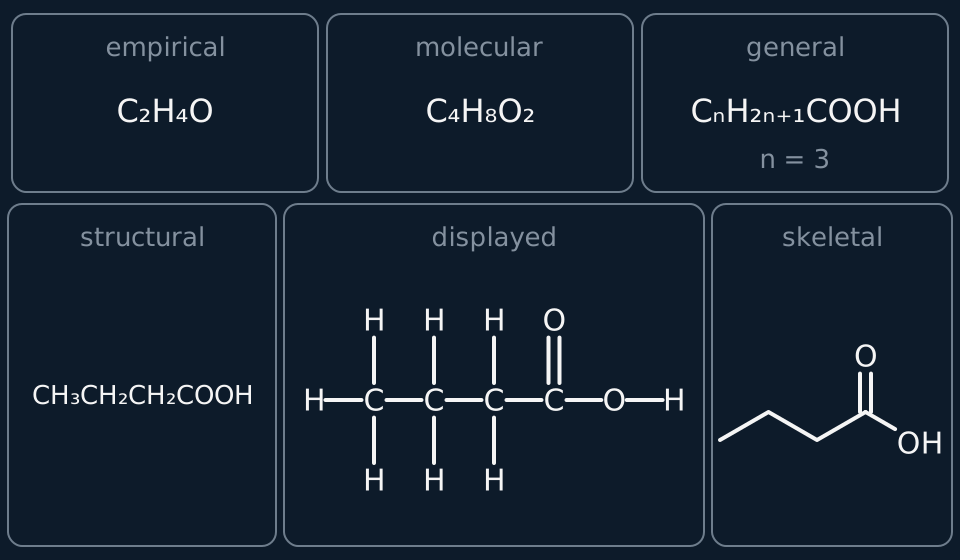
Rancid butter smells of butanoic acid. A chemist writing about it might put C₄H₈O₂ on one line, CH₃CH₂CH₂COOH on the next and a short zigzag ending in a C=O on the third, and all three mean the same molecule. Each formula answers a different question: what the ratio of atoms is, how many of each there are, what is joined to what, and what the molecule looks like when drawn quickly.
Describe the drawing
Six boxes describing butanoic acid. The top row gives the empirical formula C₂H₄O, the molecular formula C₄H₈O₂ and the general formula CₙH₂ₙ₊₁COOH with n equal to three. The bottom row gives the structural formula CH₃CH₂CH₂COOH; a displayed formula with four carbons in a row, seven C–H bonds, a C=O double bond and an O–H at the end; and a skeletal zigzag of three lines ending in a double bond to O and a single bond to OH.
The molecular formula, C₄H₈O₂, gives the actual number of atoms of each element in one molecule. Dividing through by the highest common factor gives the empirical formula, C₂H₄O, the simplest whole-number ratio. Ethyl ethanoate, the solvent in nail-varnish remover, is also C₄H₈O₂ and also C₂H₄O, so neither formula separates it from butanoic acid. Organic chemistry needs the other four for that reason.
A general formula is the algebraic formula that fits every member of a series. The carboxylic acids are CₙH₂ₙ₊₁COOH, so butanoic acid has n = 3. The alkanes are CₙH₂ₙ₊₂, the alkenes CₙH₂ₙ and the alcohols CₙH₂ₙ₊₁OH. A general formula gives the molecular formula of any member once n is chosen, and says nothing about how the atoms are arranged.
A structural formula shows, with the minimum of detail, the arrangement of atoms carbon by carbon: CH₃CH₂CH₂COOH. CH₃(CH₂)₂COOH is the same formula with the repeated unit bracketed. A group hanging off the chain goes in brackets after the carbon it is joined to, so propan-2-ol is CH₃CH(OH)CH₃. A structural formula fits one compound only, which C₄H₈O₂ does not.
A displayed formula shows every atom and every bond as a line: all four carbons, all eight hydrogens, the C=O as a double line and the O–H as a single line. Writing OH at the end of a bond is a structural shorthand, and where a question asks for the displayed formula the O–H bond has to be drawn. Bond angles are not required, so a flat drawing with right angles is accepted.
A skeletal formula reduces the drawing to the carbon skeleton. Each line is a C–C bond, each end and each corner is a carbon atom, and the hydrogens on carbon are left out: every carbon makes four bonds, and the bonds not drawn are to hydrogen. Atoms other than carbon and hydrogen are written in, with any hydrogen attached to them, so the acid group appears as a line to a double-bonded O and a line to OH. Benzene is drawn as a hexagon with a circle inside it.
The command decides which formula to write. 'Give the molecular formula' wants C₄H₈O₂. 'Draw the structure' accepts a structural, displayed or skeletal formula, provided it is unambiguous, while 'draw the displayed formula' accepts only that. In a mechanism the bonds the arrows touch are drawn displayed and the rest of the molecule can be written structurally.
- Empirical formula
- The simplest whole-number ratio of atoms of each element in a compound.
- Molecular formula
- The actual number of atoms of each element in one molecule of a compound.
- General formula
- An algebraic formula that can describe any member of a homologous series, such as CₙH₂ₙ₊₂ for the alkanes.
- Structural formula
- The minimal detail that shows the arrangement of atoms in a molecule, such as CH₃CH₂CH₂COOH.
- Displayed formula
- A formula showing the relative positioning of all the atoms in a molecule and every bond between them.
- Skeletal formula
- A simplified formula showing the carbon skeleton as lines, with hydrogen atoms on carbon removed and functional groups shown.
Homologous series and functional groups
Methane, ethane, propane and butane burn with the same clean blue flame, and none of them reacts with acid, alkali or bromine water in the dark. Their boiling points climb steadily, from −162 °C for methane to about −1 °C for butane. They are four members of one homologous series: they share a general formula, each differs from the next by CH₂, and they react in the same way because they have the same functional group.
The functional group is the atom or group of atoms that decides how a molecule reacts. In ethanol it is the OH. Ethanol and propan-1-ol both react with sodium, both burn, and both oxidise first to an aldehyde and then to a carboxylic acid, because the reactions happen at the OH and the carbon it is joined to; the length of the chain behind them makes little difference. Physical properties do change along a series. Each extra CH₂ adds electrons, so the van der Waals forces between molecules are stronger and the boiling point is higher.
Describe the drawing
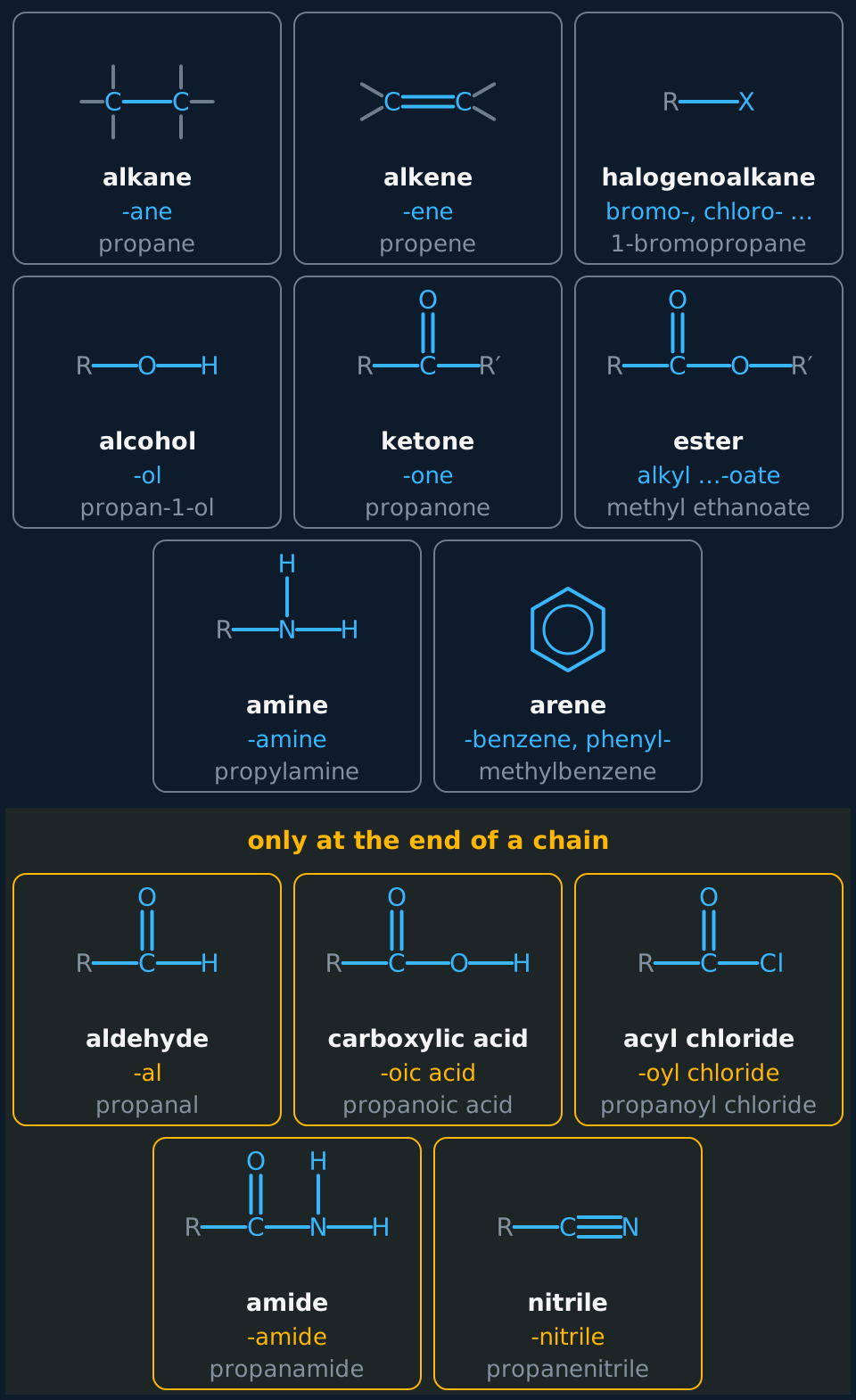
Thirteen tiles, one for each homologous series, each showing its functional group drawn with bonds and the rest of the molecule as R, then the series name, its name ending or prefix and a three-carbon example. The alkane, alkene, halogenoalkane, alcohol, ketone, ester, amine and arene tiles come first; the aldehyde, carboxylic acid, acyl chloride, amide and nitrile tiles sit together on an amber band headed only at the end of a chain.
| Homologous series | Functional group | Name ending or prefix | Example |
|---|---|---|---|
| Alkane | C–C and C–H only | -ane | propane, CH₃CH₂CH₃ |
| Alkene | C=C | -ene | propene, CH₂=CHCH₃ |
| Halogenoalkane | C–X, where X is F, Cl, Br or I | fluoro-, chloro-, bromo-, iodo- | 1-bromopropane, CH₃CH₂CH₂Br |
| Alcohol | C–OH | -ol | propan-1-ol, CH₃CH₂CH₂OH |
| Aldehyde | CHO at the end of a chain | -al | propanal, CH₃CH₂CHO |
| Ketone | C=O between two carbons | -one | propanone, CH₃COCH₃ |
| Carboxylic acid | COOH | -oic acid | propanoic acid, CH₃CH₂COOH |
| Ester | COO between two carbons | alkyl ...-oate | methyl ethanoate, CH₃COOCH₃ |
| Amine | C–NH₂ | -amine | propylamine, CH₃CH₂CH₂NH₂ |
| Nitrile | C≡N | -nitrile | propanenitrile, CH₃CH₂CN |
| Acyl chloride | COCl | -oyl chloride | propanoyl chloride, CH₃CH₂COCl |
| Amide | CONH₂ | -amide | propanamide, CH₃CH₂CONH₂ |
| Arene | benzene ring | -benzene or phenyl- | methylbenzene, C₆H₅CH₃ |
An alkyl group is an alkane with one hydrogen removed, and R stands for one in a general formula: methyl, CH₃, ethyl, C₂H₅, propyl, C₃H₇. A compound is saturated if it has only single bonds between its carbon atoms and unsaturated if it has at least one C=C or C≡C. Bromine water tells the two apart: an unsaturated compound turns it from orange to colourless, and a saturated one leaves it orange.
A definition of a homologous series needs all three of its parts: the same functional group, the same general formula, and each member differing from the next by CH₂. 'A family of similar compounds' names none of them. A functional group is defined by what it does, the part of the molecule responsible for its characteristic reactions, not by where it sits in the chain.
- Homologous series
- A series of organic compounds with the same functional group and general formula, in which each member differs from the next by CH₂.
- Functional group
- An atom or group of atoms in a molecule that is responsible for its characteristic chemical reactions.
- Hydrocarbon
- A compound containing carbon and hydrogen only.
- Saturated
- Containing only single bonds between carbon atoms.
- Unsaturated
- Containing at least one carbon–carbon double or triple bond.
Chains, rings and the shape around each carbon
Alkanes, alkenes and cycloalkanes are hydrocarbons, compounds of carbon and hydrogen only, and their skeletons come in three forms. In a straight-chained molecule such as pentane each carbon is joined to no more than two others. In a branched one, such as 2-methylbutane, at least one carbon is joined to three or four. In a cyclic one, such as cyclohexane, the carbons close into a ring. Straight describes the connections, not the shape: the bonds round each carbon of pentane are at 109.5°, so the chain is a zigzag, as the skeletal formula draws it.
The shape round each carbon follows from the number of regions of electron density. Four single bonds point to the corners of a tetrahedron, 109.5° apart. A carbon in a C=C has three regions, the double bond counting as one, and is trigonal planar at 120°. A carbon in a C≡C or C≡N has two and is linear, 180°. One molecule can hold all three. In but-3-enenitrile, CH₂=CHCH₂CN, carbon 1, the nitrile carbon, is linear, carbon 2 is tetrahedral, and carbons 3 and 4 are trigonal planar.
| Carbon with | Regions of electron density | Shape and bond angle | Example |
|---|---|---|---|
| Four single bonds | 4 | tetrahedral, 109.5° | each carbon of ethane |
| One double bond | 3 | trigonal planar, 120° | each carbon of ethene |
| One triple bond | 2 | linear, 180° | the carbon of a C≡N |
A skeletal formula draws these shapes without saying so. The zigzag of a chain is the 109.5° angle drawn flat, and benzene's hexagon is flat because each of its carbons is trigonal planar. Count the regions round a carbon, not the atoms joined to it: the carbon of a C=O is joined to three atoms and has three regions, and a double bond counts once.
Building a name
Every IUPAC name is built from three parts. The stem counts the carbons in the longest chain that contains the functional group. The suffix names the main functional group. Prefixes name the branches and any group that is not the suffix, each with a number, its locant, giving the carbon it is attached to.
| Carbons in the chain | Stem | Alkane | Alkyl group |
|---|---|---|---|
| 1 | meth | methane | methyl |
| 2 | eth | ethane | ethyl |
| 3 | prop | propane | propyl |
| 4 | but | butane | butyl |
| 5 | pent | pentane | pentyl |
| 6 | hex | hexane | hexyl |
Describe the drawing
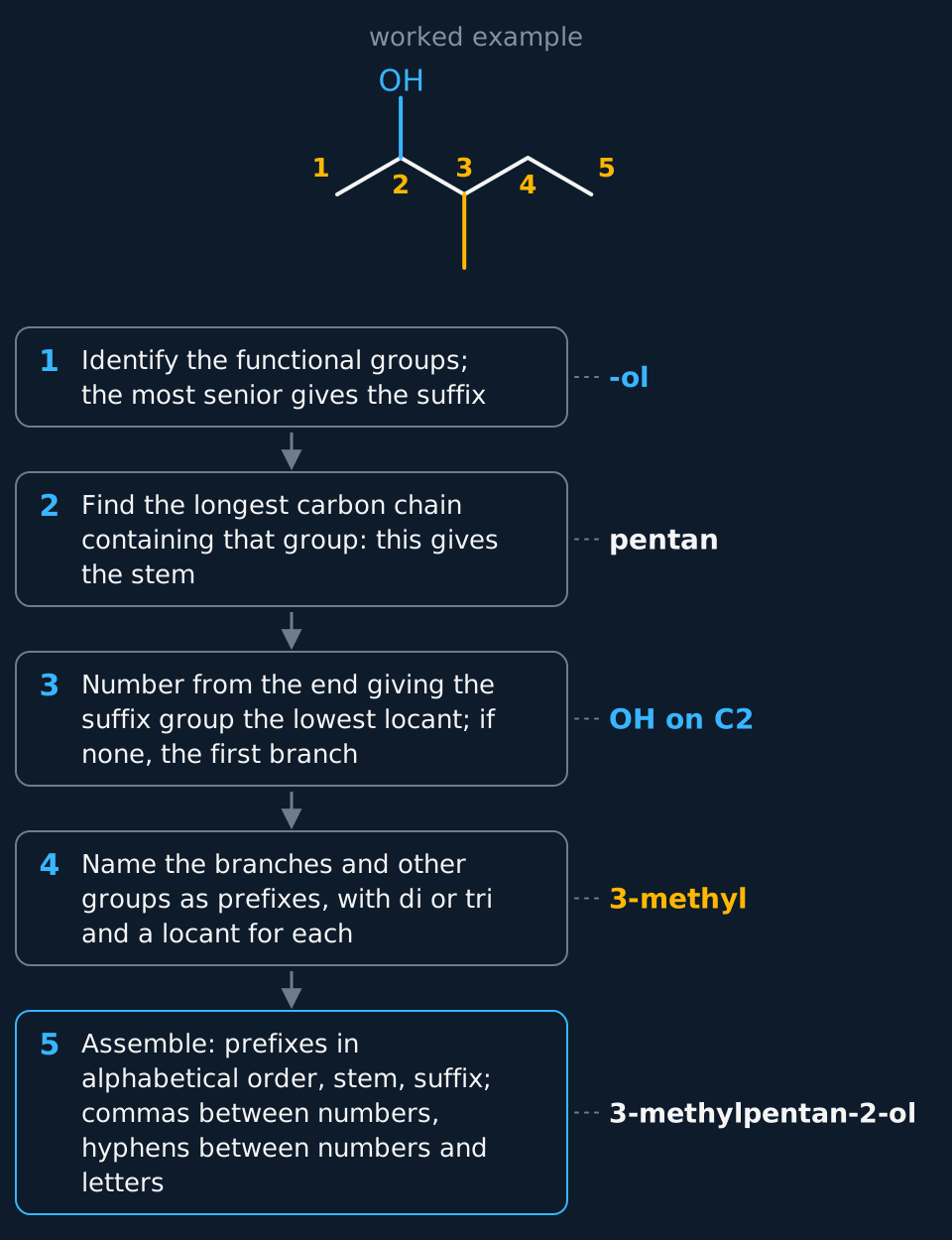
A flow chart of five boxes joined by downward arrows: identify the functional groups and take the suffix from the most senior; find the longest chain containing it for the stem; number from the end that gives the suffix group the lowest locant; name branches as prefixes with locants; assemble the name. Above it the skeletal formula of 3-methylpentan-2-ol is drawn with its carbons numbered one to five from the OH end, and beside each box is the result of that step: -ol, pentan, OH on C2, 3-methyl, and finally 3-methylpentan-2-ol.
Start with the longest continuous chain of carbon atoms that contains the functional group. It need not run straight across the page. CH₃CH(CH₂CH₃)CH₃ looks like a three-carbon chain with an ethyl branch on the middle carbon, but the branch continues the chain: the longest run is four carbons, so the compound is a butane with a methyl group on carbon 2, 2-methylbutane.
Number the chain from the end that gives the suffix group the lowest number. Where no suffix group settles it, number from the end nearer the first branch or halogen. The general rule is the lowest set of locants at the first point of difference: 2,2,4 beats 2,4,4, since at the second number 2 is lower than 4. If the two ends still tie, the prefix that comes first in the alphabet takes the lower number, so CH₃CHBrCH(CH₃)CH₃ is 2-bromo-3-methylbutane.
Write the prefixes in alphabetical order. Two identical groups take di and three take tri, each with its own locant, and di and tri are ignored when alphabetising. Numbers are separated from each other by commas and from letters by hyphens, and the whole name is one word: 3-ethyl-2,2-dimethylpentane, with ethyl filed under e and dimethyl under m.
The suffix carries the functional group, with its locant immediately in front of it: propan-2-ol, pent-1-ene, pentan-3-one. Some groups never need a number. An aldehyde, carboxylic acid, acyl chloride, amide or nitrile can only sit at the end of a chain, so its carbon is always carbon 1: butanal, butanoic acid. In a nitrile the carbon of the C≡N counts in the stem, so CH₃CH₂CN is propanenitrile. Propanone and butanone need no number either, because the C=O has nowhere else to go without becoming an aldehyde.
A ring takes the prefix cyclo- on the stem for its number of carbons: cyclohexane, C₆H₁₂, drawn skeletally as a plain hexagon. Every carbon of a ring is equivalent, so one group needs no number: methylcyclohexane, chlorocyclohexane, cyclohexanol. The carbon carrying the suffix group is carbon 1, and in cyclohexene the two carbons of the C=C are 1 and 2. Numbering then runs round the ring in the direction that gives the next group the lower number, so a methyl group on a C=C carbon gives 1-methylcyclohexene and one on the carbon beside the double bond gives 3-methylcyclohexene.
The e at the end of the stem is dropped before a suffix beginning with a vowel and kept before a consonant: propan-1-ol and propanal, but propanenitrile. A molecule with two C=C bonds is a diene, and an a is added to the stem so the name can be said: buta-1,3-diene.
Where a molecule carries two functional groups, the more senior one takes the suffix and the other becomes a prefix. A carboxylic acid outranks an aldehyde, an aldehyde outranks a ketone, and a ketone outranks an alcohol, so lactic acid, CH₃CH(OH)COOH, is 2-hydroxypropanoic acid. Halogens and alkyl groups are only ever prefixes. A C=C stays in the stem as -en- whatever else the molecule carries.
Esters are named in two words from the alcohol and the acid they are made from: the alkyl group of the alcohol first, then the acid with -oic acid changed to -oate. CH₃COOCH₂CH₃ is ethyl ethanoate. The carbon chain that contains the C=O gives the second word. Primary amines are named from the alkyl group joined to the nitrogen: CH₃CH₂NH₂ is ethylamine and CH₃CH₂CH₂NH₂ is propylamine.
Naming 3-methylpentan-2-ol
Name the alcohol CH₃CH(OH)CH(CH₃)CH₂CH₃.
Show the working
The functional group is OH, so the compound is an alcohol and the suffix is -ol.
The longest chain that contains the carbon carrying the OH runs from the CH₃ on the left to the CH₃ on the right: five carbons, so the stem is pentan.
Numbered from the left, the OH is on carbon 2; from the right it would be on carbon 4. The suffix group takes the lower number, so carbon 1 is on the left, and the methyl branch is then on carbon 3.
The name is 3-methylpentan-2-ol. The molecular formula, C₆H₁₄O, matches the structural formula given, so no atom has been lost.
Naming 2,2-dimethylbut-3-enal
Name CH₂=CHC(CH₃)₂CHO, which has a C=C and an aldehyde group.
Show the working
The aldehyde outranks the alkene, so the suffix is -al and the carbon of the CHO is carbon 1.
The chain from the CHO carbon to the far end of the C=C is four carbons long: but. The two methyl groups on the carbon next to the CHO are branches, not part of the chain.
Counting from the CHO, the double bond starts at carbon 3, so the stem becomes but-3-en, and both methyl groups are on carbon 2, giving 2,2-dimethyl.
The name is 2,2-dimethylbut-3-enal, C₆H₁₀O.
TRY IT: A tie broken by the alphabet
Name CH₃CHBrCH₂CH(CH₃)CH₃, and then name (CH₃)₂CHCH₂OH.
Check your answer
The first is a five-carbon chain with Br and CH₃ as branches, so it is a pentane. Numbered from the left the branches are at 2 and 4; from the right they are also at 2 and 4.
The tie goes to the prefix earlier in the alphabet. Bromo comes before methyl, so bromo takes carbon 2: 2-bromo-4-methylpentane.
The second is an alcohol. The longest chain containing the CH₂OH carbon has three carbons, numbered from the OH end, with a methyl group on carbon 2: 2-methylpropan-1-ol.
Reading a name back into a structure
Questions ask for the reverse as often: draw the skeletal formula of 2-methylbutan-2-ol. Work from the end of the name. The stem but gives a chain of four carbons, -an-2-ol puts an OH on carbon 2, and 2-methyl puts a CH₃ on carbon 2 as well. Draw the chain, add the groups, then fill every carbon to four bonds with hydrogen. The structural formula is CH₃C(OH)(CH₃)CH₂CH₃, and the molecular formula, C₅H₁₂O, is a check that nothing has been dropped.
Drawing out a name is also how a wrong name is caught. '2-ethylbutane' sounds possible, but drawn out it is CH₃CH(CH₂CH₃)CH₂CH₃, whose longest chain runs through the ethyl group: five carbons with a methyl on the middle one, 3-methylpentane. An ethyl group on carbon 2, or a methyl group on carbon 1, always means the longest chain was missed. '1-methylpropane' is butane, and 'pentan-4-ol' is pentan-2-ol numbered from the wrong end.
Names matter because formulae repeat. Pentan-1-ol, pentan-2-ol, pentan-3-ol and 2-methylbutan-2-ol are all C₅H₁₂O, and they differ in boiling point, in smell and in what acidified dichromate(VI) does to them. The name is the shortest exact way to say which of them is in the bottle.
Other boards: hybridisation, skeleton words and amine names
Cambridge explains the shape round each carbon by hybridisation, and its papers ask for it by name. The 2s orbital of carbon mixes with one, two or three 2p orbitals to give equivalent hybrid orbitals, each of which forms a σ bond by end-on overlap. Mixing 2s with all three 2p orbitals gives four sp³ orbitals at 109.5°. Mixing it with two gives three sp² orbitals in a plane at 120°, and the p orbital left over, at right angles to that plane, overlaps sideways with its neighbour to form the π bond of a C=C. Mixing it with one gives two sp orbitals at 180°, and the two p orbitals left over form the two π bonds of a triple bond.
| Carbon with | Hybridisation | Shape and bond angle | Bonds it forms | Example |
|---|---|---|---|---|
| Four single bonds | sp³ | tetrahedral, 109.5° | four σ | each carbon of ethane |
| One double bond | sp² | trigonal planar, 120° | three σ and one π | each carbon of ethene |
| One triple bond | sp | linear, 180° | two σ and two π | the carbon of a C≡N |
Each carbon of benzene is sp², σ-bonded to two carbons and one hydrogen at 120°, so the ring is a flat hexagon. The six leftover p orbitals overlap all round the ring into one delocalised π system, the circle in the skeletal formula. In but-3-enenitrile, CH₂=CHCH₂CN, the nitrile carbon is sp, carbon 2 is sp³, and carbons 3 and 4 are sp².
OCR uses three words for the shape of a skeleton: aliphatic for straight and branched chains, alicyclic for rings that are not aromatic, such as cyclohexane, and aromatic for compounds with a benzene ring. OCR also calls the halogenoalkanes haloalkanes; the series and its naming are the same, so 1-bromopropane is a haloalkane on an OCR paper.
Amines have two naming styles in print. The alkyl-group names, ethylamine and propylamine, are the ones taught here. The systematic IUPAC forms put the chain in the stem and -amine as the suffix, with a locant where one is needed: ethanamine, propan-1-amine and propan-2-amine. Textbooks and question papers use both styles, and Edexcel's specification itself writes butylamine, so either form should be read back into a structure without hesitation.
In the exam
- A displayed formula must show every bond, each C–H and the O–H included. OH written on the end of a line is a structural formula and loses the displayed-formula mark; a flat drawing at 90° is accepted.
- A name earns its mark only with the right locants. Pentan-4-ol for pentan-2-ol, or 1-methylpropane for butane, is not credited, because the name describes a different molecule or none.
- Hydrogens on carbon are the only atoms a skeletal formula leaves out, so the H of an OH or NH₂ group is written in.
- Draw a name out to check it. An ethyl group on carbon 2 or a methyl group on carbon 1 means the longest chain has been missed.
- Count the carbon of the C≡N in a nitrile's stem: CH₃CN is ethanenitrile, and CH₃CH₂CN is propanenitrile.
Check yourself
A student names CH₃CH(C₂H₅)CH₂CH₂OH as 2-ethylbutan-4-ol. Give the correct name and explain each error the student made.
Answer
Draw it out first. The OH is on the CH₂ at the right-hand end, and the ethyl group on the second carbon continues the chain: from the CH₂OH carbon through to the end of the ethyl group there are five carbons.
The longest chain containing the OH carbon is therefore five carbons long, a pentanol, and the CH₃ at the left-hand end becomes a methyl branch. The ethyl group on carbon 2 was the sign that the chain had been missed.
Numbering must give the OH the lowest number, so the CH₂OH carbon is carbon 1 and the methyl branch is on carbon 3. The name is 3-methylpentan-1-ol. The student made two errors: the wrong chain, and numbering from the end away from the suffix group.
Questions
Question 16 marks
Explain, step by step, how the IUPAC name of the compound HOCH₂CH₂CH(CH₃)CH(Br)CH₃ is worked out, and give the name.
Mark scheme
Indicative content
- the functional groups are OH and Br; halogens are only ever prefixes, so the alcohol gives the suffix -ol
- the longest chain containing the carbon that carries the OH runs from the CH₂OH carbon to the CH₃ beyond the CHBr, five carbons, so the stem is pentan
- the CH₃ on the third carbon of that chain is a branch, because counting through it gives a chain of only four carbons
- the chain is numbered from the CH₂OH end so that the suffix group has the lowest locant, 1, rather than 5
- with that numbering the methyl branch is on carbon 3 and the bromine on carbon 4, and the prefixes go in alphabetical order, bromo before methyl
- the e of pentane is dropped before -ol, giving 4-bromo-3-methylpentan-1-ol, C₆H₁₃BrO, with hyphens between numbers and letters
Levels
- Level 3 (5–6 marks) every step is present and justified: the suffix chosen from the OH, the longest chain through the OH carbon, the methyl identified as a branch, the numbering from the OH end for the lowest locant, the alphabetical order of prefixes, and the correct name with its punctuation
- Level 2 (3–4 marks) the name is right and most steps are explained; why the chain is numbered from the OH end, why that chain is the longest, or why bromo comes before methyl is asserted
- Level 1 (1–2 marks) the -ol suffix or the five-carbon chain is found; the chain is usually numbered from the bromine end, which gives the wrong locants
Question 25 marks
Deduce the molecular formula, the structural formula and the name of compound Q, an alcohol with a branched carbon chain whose OH group is on a carbon atom at the end of the chain. Its composition by mass and relative molecular mass are given in the table.
| Element or quantity | Value |
|---|---|
| Carbon | 64.9% |
| Hydrogen | 13.5% |
| Oxygen | 21.6% |
| Relative molecular mass | 74.0 |
Mark scheme
- M1 moles in 100 g: C 64.9 ÷ 12.0 = 5.41, H 13.5 ÷ 1.0 = 13.5, O 21.6 ÷ 16.0 = 1.35
- M1 dividing by 1.35 gives 4.01 : 10.0 : 1, so the empirical formula is C₄H₁₀O
- B1 C₄H₁₀O has Mr 74.0, equal to the relative molecular mass, so the molecular formula is also C₄H₁₀O
- B1 the branched four-carbon skeleton with OH on an end carbon is (CH₃)₂CHCH₂OH; allow a displayed or skeletal formula
- B1 Q is 2-methylpropan-1-ol; error carried forward from a wrong structure only if it is a branched C₄ alcohol
Question 34 marks
Give the molecular formula and the empirical formula of hexane, CH₃(CH₂)₄CH₃, the general formula of the homologous series it belongs to, and the molecular formula of the member of that series with eight carbon atoms.
Mark scheme
- B1 the molecular formula of hexane is C₆H₁₄
- B1 the empirical formula is C₃H₇, the ratio 6 : 14 divided by the highest common factor, 2
- B1 hexane is an alkane, and the general formula of the alkanes is CₙH₂ₙ₊₂
- B1 with n = 8 the molecular formula is C₈H₁₈ (octane); error carried forward from a wrong general formula
All 18 questions with mark schemes, the other 15 set out in full on the question page.
Worth remembering
- Count every route through the carbons before naming: the chain drawn straight across the page is not always the longest.
- C₄H₁₀ is a molecular formula; a question asking for a structural formula wants CH₃CH₂CH₂CH₃, and the molecular one is rejected.
- Leave the hydrogens off a skeletal formula; drawn on each carbon, they make it a displayed formula.
- '2-Ethylbutane' is hexane misnamed: the longest chain was missed because the ethyl branch continues it.
- Numbering from the wrong end gives 3-methylbutane; the name with the lowest locant, 2-methylbutane, is the only one credited.
CHECK YOUR PROGRESS
Rate how confident you are with each objective for this lesson. Ratings are saved in this browser, on this device, unless you sign in.
- Write the empirical, molecular, general, structural, displayed and skeletal formula of the same compound, and state what each one shows.
- Define a homologous series and a functional group, and identify the functional group in a compound from its formula.
- Apply the IUPAC rules to name alkanes, alkenes, halogenoalkanes and alcohols with up to six carbons in the main chain.
- Name aldehydes, ketones, carboxylic acids, esters, nitriles, amines, acyl chlorides and amides, including a molecule with two functional groups.
- Draw a structure from a name, and use it to correct a name that does not follow the rules.
Open the full revision checklist to see every objective in the curriculum in one place.
Practise this lesson
WORKBOOK
The written questions from this topic, on paper with room to work, and a separate book of mark schemes. The 2 questions that are set on a diagram stay on this page, where the diagram can be drawn. Free to use; please do not redistribute or sell.
Used later in Reaction types, curly arrows and how a mechanism is written · Alkanes: fractional distillation, cracking and combustion · Benzene: its structure and the evidence for delocalisation