Chemistry › Atomic structure › Protons, neutrons, electrons and isotopes
Protons, neutrons, electrons and isotopes
An atom is a nucleus of protons and neutrons, about a hundred-thousandth of the atom's width, with electrons in the space around it. The number of protons fixes the element, the number of neutrons fixes the isotope, and the electrons decide the chemistry. The model reached that form one experiment at a time, from Thomson's electron to Rutherford's nucleus and Bohr's energy levels.
Key terms Every definition in atomic structure, lesson by lesson
Before this Formulae, equations and state symbols – writing an ion with its charge · GCSE atomic structure: a nucleus with electrons in shells, and the periodic table in order of atomic number
COMMON MISCONCEPTION
Isotopes are the radioactive versions of an element, so a chlorine isotope must be something different from ordinary chlorine.
Every chlorine atom is one of its isotopes. Ordinary chlorine is a mixture of ³⁵Cl and ³⁷Cl, atoms with the same 17 protons and 17 electrons and different numbers of neutrons, and neither is radioactive. Some isotopes are, such as carbon-14 and tritium, but most naturally occurring isotopes are stable.
What you should be able to do
- State the relative mass, relative charge and position in the atom of the proton, the neutron and the electron.
- Use atomic number and mass number to find the numbers of protons, neutrons and electrons in an atom or an ion.
- Define isotopes, and explain why the isotopes of an element have the same chemical properties but can differ in physical properties.
- Deduce the charge on an ion from its numbers of protons and electrons, and write its symbol.
- Predict the direction and relative size of the deflection of beams of protons, neutrons, electrons and ions in an electric field.
- Describe how the model of the atom changed as new evidence appeared, from the plum pudding to the nuclear atom, energy levels and orbitals.
Three particles
An atom is almost entirely empty space. Its nucleus is about 10⁻¹⁵ m across and the whole atom about 10⁻¹⁰ m, so the atom is a hundred thousand times wider than its nucleus, and almost all of its mass is in that nucleus. At the scale of a football pitch, a hydrogen nucleus the size of a grain of sand on the centre spot has its electron about thirty metres away, most of the way to the penalty area, with nothing in between.
The nucleus holds two kinds of particle. Protons carry a positive charge and neutrons carry none; together they are called nucleons. Outside the nucleus are the electrons, each with a negative charge equal in size to the proton's, and a mass so small that it is usually left out when the mass of an atom is worked out.
| Relative mass | Relative charge | Where it is found | |
|---|---|---|---|
| Proton | 1 | +1 | In the nucleus |
| Neutron | 1 | 0 | In the nucleus |
| Electron | 1/1840 | −1 | Around the nucleus, in shells |
The masses are relative, so they have no unit. A proton's actual mass is 1.673 × 10⁻²⁷ kg and a neutron's is 1.675 × 10⁻²⁷ kg, close enough to call both 1. An electron is 1840 times lighter than a proton. A sodium atom has 11 electrons, and together they add about 0.006 to a total of 23.
An atom is neutral because it holds equal numbers of protons and electrons, so the charges cancel. Which element an atom belongs to is decided by one number only, its count of protons. Every atom with 6 protons is carbon, whatever else is true of it.
Two consequences follow from that structure. The size of an atom is the size of its electron cloud, so when atoms are said to get larger down a group or smaller across a period, it is the electrons that have moved. And the mass of an atom is in its nucleus, so the mass and the chemistry of an atom come from different places: the mass from the protons and neutrons, the chemistry from the electrons. Isotopes are the clearest case of that split.
- Nucleon
- A proton or a neutron: either of the two particles found in the nucleus.
- Proton
- A particle in the nucleus with a relative mass of 1 and a relative charge of +1.
- Neutron
- A particle in the nucleus with a relative mass of 1 and no charge.
- Electron
- A particle outside the nucleus with a relative mass of 1/1840 and a relative charge of −1.
Atomic number, mass number and the symbol
Two numbers describe a nucleus. The atomic number, Z, is the number of protons. It is also called the proton number, and it sets the element's place in the periodic table. The mass number, A, is the total number of protons and neutrons. The number of neutrons is therefore A − Z.
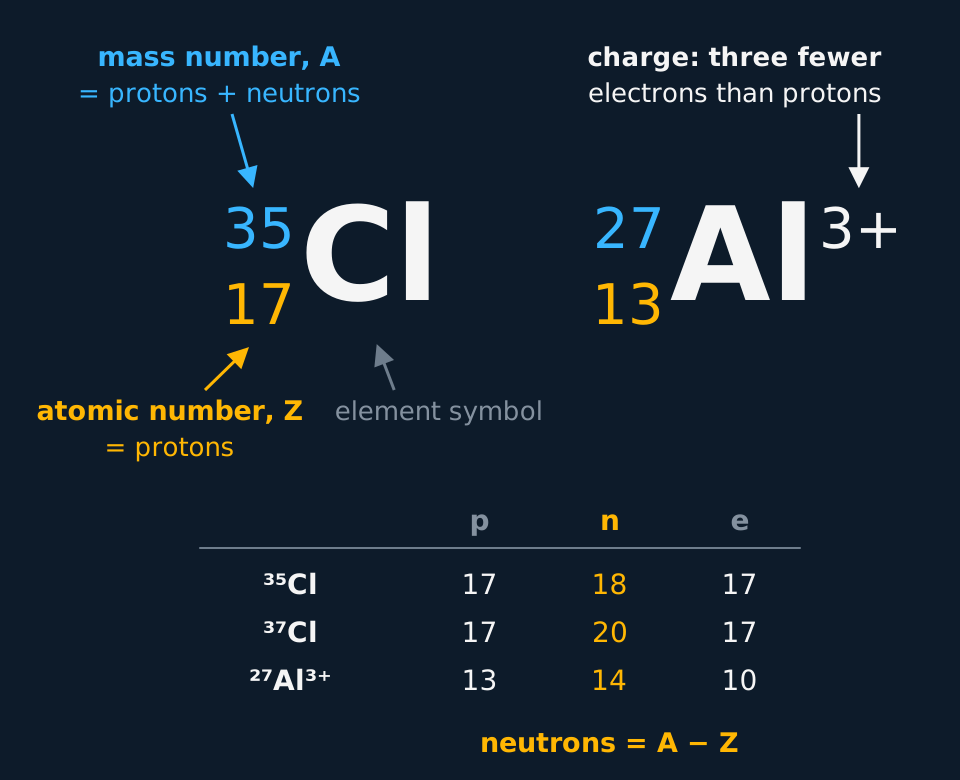
Describe the drawing
The nuclide symbol for chlorine-35 drawn large, with the mass number 35 top left labelled as protons plus neutrons and the atomic number 17 bottom left labelled as protons. Beside it aluminium-27 with atomic number 13 and a 3+ charge top right, labelled as three fewer electrons than protons. Underneath, a table of protons, neutrons and electrons: chlorine-35 has 17, 18 and 17; chlorine-37 has 17, 20 and 17; the aluminium ion has 13, 14 and 10. Neutrons equal A minus Z.
In print the atomic number is often left out, because the symbol already fixes it: ³⁵Cl means chlorine-35, and chlorine is always element 17. The mass number is a count of particles, so it is always a whole number. It is not the relative atomic mass printed on the periodic table, 35.5 for chlorine, which is an average over the isotopes found in nature.
- Atomic number
- The number of protons in the nucleus of an atom, also called the proton number, Z.
- Mass number
- The total number of protons and neutrons in the nucleus of an atom, A.
Counting the particles in three species
Give the numbers of protons, neutrons and electrons in ²⁷Al, ²⁷Al³⁺ and ³²S²⁻. Aluminium is element 13 and sulfur is element 16.
Show the working
Protons come from the atomic number and nothing else: 13 in both aluminium species, 16 in the sulfide ion.
Neutrons are A − Z. For aluminium-27, 27 − 13 = 14, in the atom and in the ion alike, because forming an ion does not touch the nucleus. For sulfur-32, 32 − 16 = 16.
Electrons equal protons in a neutral atom, so ²⁷Al has 13. A 3+ charge means three electrons fewer than protons, so ²⁷Al³⁺ has 10. A 2− charge means two electrons more than protons, so ³²S²⁻ has 18.
In all, ²⁷Al has 13, 14 and 13; ²⁷Al³⁺ has 13, 14 and 10; ³²S²⁻ has 16, 16 and 18. The aluminium ion has the same number of electrons as a neon atom, and the sulfide ion the same as an argon atom.
Isotopes
Chlorine gas from a cylinder is a mixture. About three in every four of its atoms have 18 neutrons and a mass number of 35; the rest have 20 neutrons and a mass number of 37. All of them have 17 protons, so all of them are chlorine. Atoms like these are isotopes: atoms of the same element, with the same number of protons and different numbers of neutrons.
Hydrogen has three. Ordinary hydrogen, ¹H, has a nucleus that is a single proton. Deuterium, ²H, has a proton and a neutron. Tritium, ³H, has a proton and two neutrons, and it is radioactive. Being an isotope says nothing about being radioactive: chlorine-35 and chlorine-37 are both stable, and so is every chlorine atom in a grain of table salt.
Isotopes of an element react identically, and the reason is the electrons. A chemical reaction is a rearrangement of electrons: they are transferred or shared between atoms, and the nucleus takes no part. Two isotopes have the same number of protons, so their atoms have the same number of electrons in the same arrangement. Chlorine-37 gains an electron to form a chloride ion exactly as chlorine-35 does, and forms the same compounds in the same proportions.
2D₂(g) + O₂(g) → 2D₂O(l)Deuterium burns in oxygen to give heavy water, by the same reaction and in the same ratio as ordinary hydrogen.
Physical properties that depend on mass do differ. Heavy water, D₂O, has a density of 1.11 g cm⁻³ and freezes at 3.8 °C, and an ice cube of it sinks in ordinary water. A gas made of a lighter isotope diffuses slightly faster. The differences are largest for hydrogen, where deuterium has twice the mass of ¹H, and are hard to detect for chlorine, where the two isotopes differ in mass by under 6%.
- Isotopes
- Atoms of the same element with the same number of protons but different numbers of neutrons.
Ions
An ion is an atom or group of atoms that has gained or lost electrons and so carries a charge. Losing electrons gives a positive ion, because protons now outnumber electrons; gaining electrons gives a negative ion. The nucleus is unchanged, so an ion has the same atomic number and mass number as the atom it came from.
Mg(g) → Mg²⁺(g) + 2e⁻A positive ion forms: the electrons removed are written as products, so the charge balances, 0 on the left and +2 − 2 on the right.
Cl(g) + e⁻ → Cl⁻(g)A negative ion forms by gaining an electron.
Metals in Groups 1, 2 and 3 form ions with charges of 1+, 2+ and 3+. Non-metals in Groups 6 and 7 form ions with charges of 2− and 1−. In each case the ion has the same number of electrons as the nearest noble gas, so Na⁺, Mg²⁺, Al³⁺, F⁻ and O²⁻ all have ten electrons, like neon. Species with the same number of electrons are isoelectronic. Why those numbers are favoured depends on how the electrons are arranged in shells and subshells.
- Ion
- An atom or group of atoms that carries an overall charge because it has lost or gained electrons.
- Isoelectronic
- Having the same number of electrons, as Na⁺, Ne and F⁻ do.
How the model of the atom changed
The nucleus-and-electrons atom is the latest of several models, and each one replaced the model before it because an experiment gave a result the old model could not explain. John Dalton's atoms of 1803 were solid spheres that could not be divided, a different kind for each element. That model explained why elements combine in fixed ratios by mass, and it stood until somebody found a piece of an atom.
In 1897 J. J. Thomson showed that cathode rays are streams of negatively charged particles far lighter than a hydrogen atom, and that the same particles came out whatever metal the cathode was made of. Atoms contained electrons. Since atoms are neutral, Thomson proposed that the electrons were dotted through a sphere of spread-out positive charge: the plum pudding model.
In 1909 Hans Geiger and Ernest Marsden, working for Ernest Rutherford, fired alpha particles at gold foil about a thousand atoms thick. In a plum pudding atom the positive charge is spread thin, so every alpha particle should pass through with at most a slight deflection. Most did go straight through. About one in eight thousand was deflected by more than 90°, and a few came almost straight back.
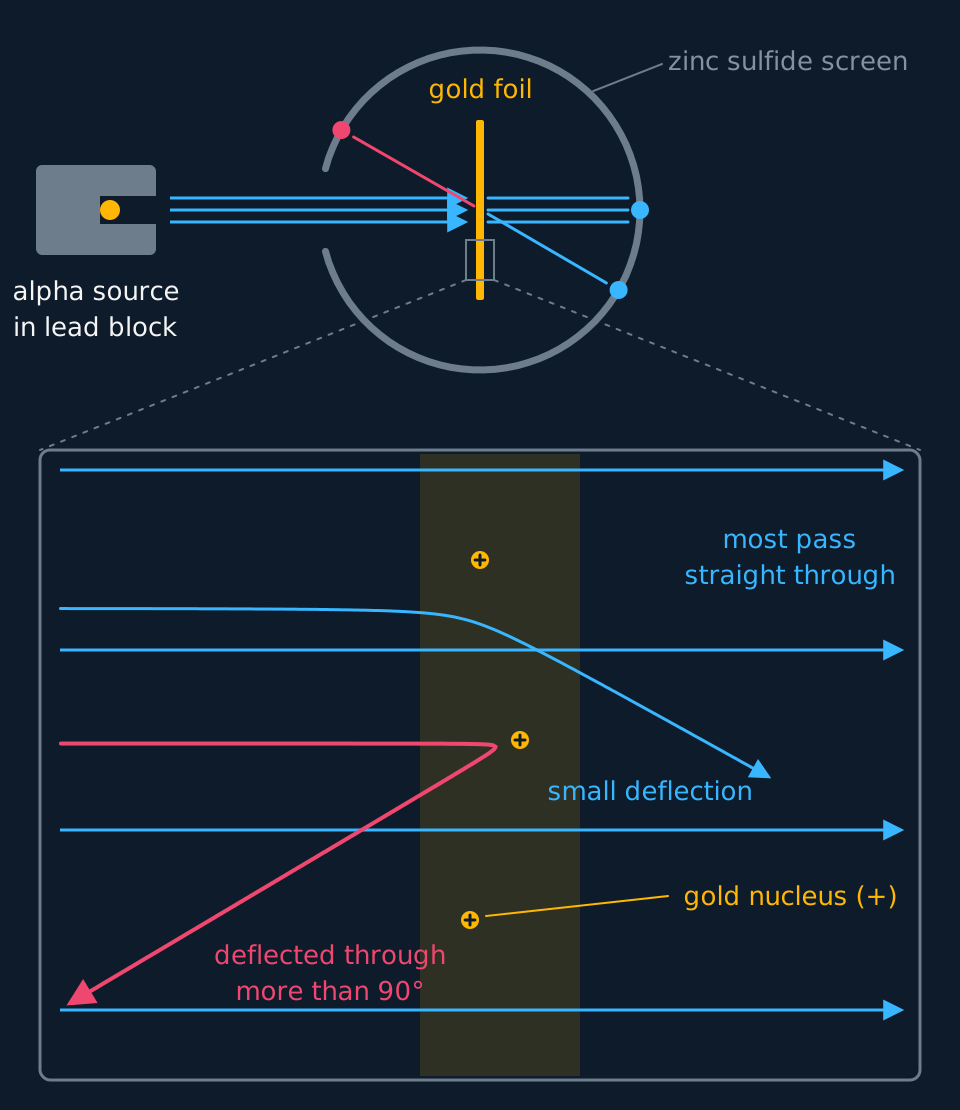
Describe the drawing
Apparatus for alpha scattering: a source in a lead block fires a narrow beam of alpha particles at a thin gold foil, surrounded by a circular zinc sulfide screen where flashes show where each particle lands. A magnified inset of the foil shows three widely spaced gold nuclei marked plus. Four alpha paths pass between them in straight lines, one passing close to a nucleus curves smoothly away through about thirty degrees, and one heading almost straight at a nucleus curves round and back through about one hundred and fifty degrees.
Rutherford's explanation, published in 1911, was the nuclear model. The positive charge and nearly all the mass are concentrated in a tiny nucleus, and an alpha particle is turned sharply only if it passes very close to one. Most of the atom is empty, so most alpha particles met nothing. The electrons were placed around the nucleus, but the model said nothing about how they were arranged.
Niels Bohr supplied an arrangement in 1913. Heated hydrogen gives out light of only a few exact wavelengths, a line spectrum rather than a continuous rainbow. Bohr proposed that the electron can occupy only certain orbits of fixed energy, and that light is given out when it drops from one to a lower one, the energy difference fixing the wavelength. Fixed energy levels are the shells of GCSE chemistry.
Two further changes produced the model used at A level. From 1926 quantum mechanics replaced Bohr's circular orbits with orbitals, regions of space where an electron is likely to be found, and these explain the s, p and d subshells of electron configuration. In 1932 James Chadwick found the neutron, which accounted for the mass a nucleus has beyond its protons: a helium nucleus has a charge of +2 but a mass of 4.
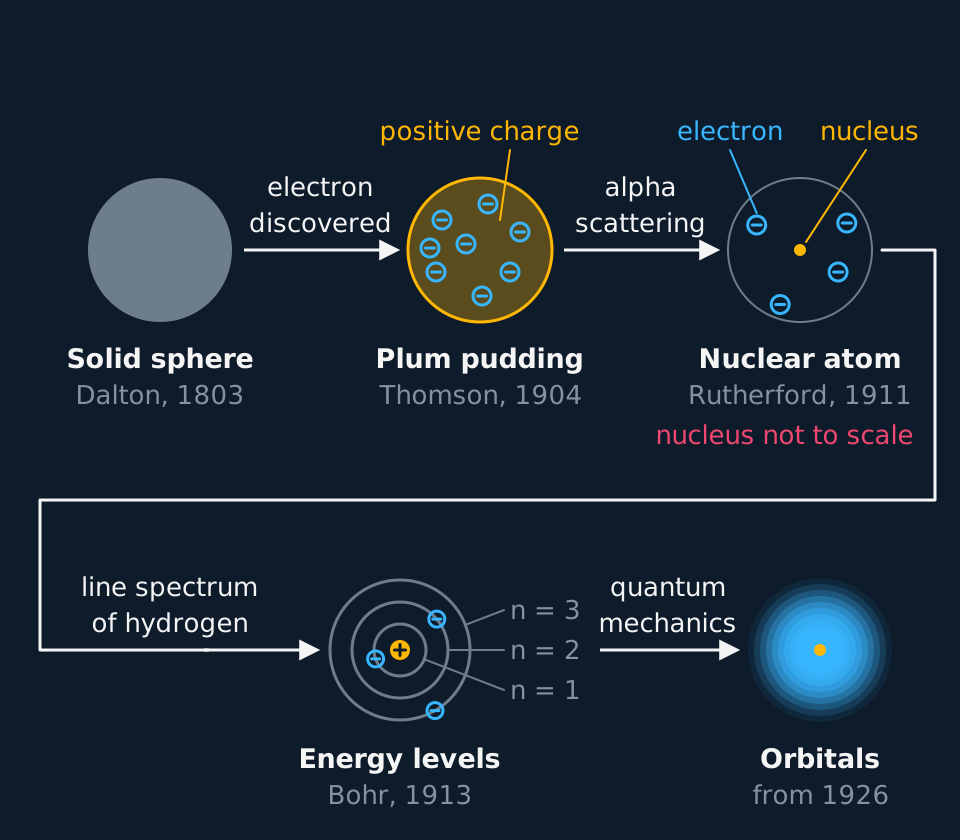
Describe the drawing
Five atom models in date order, joined by arrows labelled with the evidence that changed them. Dalton's 1803 solid sphere; Thomson's 1904 plum pudding, a sphere of spread-out positive charge with electrons scattered through it; Rutherford's 1911 nuclear atom, a tiny positive nucleus with electrons far out and mostly empty space; Bohr's 1913 atom with electrons on three circular orbits labelled n equals 1, 2 and 3; and the orbital model from 1926, a fuzzy cloud densest near the nucleus. The arrows read electron discovered, alpha scattering, line spectrum of hydrogen, and quantum mechanics.
| Model | Evidence that led to it | What it could not explain |
|---|---|---|
| Solid sphere (Dalton, 1803) | Elements combine in fixed ratios by mass | Electrons coming out of atoms |
| Plum pudding (Thomson, 1904) | The discovery of the electron in 1897 | Alpha particles deflected through large angles |
| Nuclear atom (Rutherford, 1911) | Alpha particles scattered by gold foil | Line spectra, and how the electrons are arranged |
| Energy levels (Bohr, 1913) | The line spectrum of hydrogen | The spectra of atoms with more than one electron |
| Orbitals (from 1926) | Quantum mechanics and detailed spectra | Nothing examined at A level |
Each new model kept what the old one got right. Bohr's shells are still the quickest way to count electrons, and his idea that an electron can have only certain energies is the basis of ionisation energies and of the flame colours of metal ions. What changed each time was the part of the model an experiment had shown to be wrong. That is how any scientific model is tested: it makes a prediction, an experiment checks the prediction, and a model that fails is revised.
TRY IT: A prediction the plum pudding model got wrong
Suggest what Geiger and Marsden would have observed if the plum pudding model had been correct, and explain why.
Check your answer
In the plum pudding model the positive charge is spread through the whole atom and the electrons are very light, so no part of a gold atom holds enough concentrated charge or mass to turn a fast alpha particle sharply.
Every alpha particle would have passed through the foil, deflected by a small angle at most, and none would have come back towards the source.
The few that did come back are the result that needed a small, dense, positive nucleus to explain it.
Other boards: beams of particles in an electric field
Cambridge examines how beams of protons, neutrons and electrons behave in an electric field, in its statement 1.1.5; the other three boards do not, though the same link between charge, mass and motion runs the time-of-flight mass spectrometer. A narrow beam of particles passing between two parallel metal plates, one charged positive and one negative, bends. A beam of protons curves towards the negative plate and a beam of electrons towards the positive plate. A beam of neutrons goes straight on, because a particle with no charge feels no force in an electric field. The direction of the bend gives the sign of the charge.
The size of the bend depends on charge and mass together. A larger charge means a larger force and more deflection; a larger mass means the same force changes the particle's direction less. For particles entering the field at the same speed, the angle of deflection is proportional to charge ÷ mass. An electron's charge is the same size as a proton's and its mass is 1840 times smaller, so an electron beam is bent about 1840 times as much as a proton beam, in the opposite direction.
| Proton | Neutron | Electron | |
|---|---|---|---|
| Relative charge ÷ relative mass | +1 | 0 | −1840 |
| Direction of deflection | Towards the negative plate | None: it goes straight on | Towards the positive plate |
| Size of deflection | Small | None | About 1840 times the proton's |
Thomson's discovery of the electron was this measurement. Cathode rays bent towards a positive plate, so they were negatively charged, and they bent so far that their charge ÷ mass had to be far larger than that of a hydrogen ion: the particles were much lighter than any atom.
Comparing the deflection of four beams
Beams of ¹H⁺, ²H⁺, ⁴He²⁺ and ⁴He⁺ ions enter the same electric field at the same speed. The ¹H⁺ beam is deflected through 2.0°. Predict the direction and angle of deflection of the other three.
Show the working
Deflection is proportional to charge ÷ mass, using relative values. For ¹H⁺ the ratio is 1 ÷ 1 = 1, and that corresponds to 2.0°.
For ²H⁺ the ratio is 1 ÷ 2 = 0.5, so the angle is 0.5 × 2.0° = 1.0°. Doubling the mass at the same charge halves the bend.
For ⁴He²⁺ the ratio is 2 ÷ 4 = 0.5, so the angle is also 1.0°. Twice the charge and four times the mass give the same ratio as the deuterium ion, and the two beams follow the same path.
For ⁴He⁺ the ratio is 1 ÷ 4 = 0.25, so the angle is 0.5°.
Both ²H⁺ and ⁴He²⁺ are deflected through 1.0° and ⁴He⁺ through 0.5°, all towards the negative plate, because all three are positive. A beam of electrons in the same field would bend towards the positive plate, far more sharply than any of them.
In the exam
- The scheme for isotopes has two marks: the same number of protons, and a different number of neutrons. 'Different mass' is not accepted for the second, because it does not separate isotopes from different elements.
- Isotopes react alike because they have the same number of electrons in the same arrangement, and chemical reactions involve electrons. The scheme accepts 'same electron configuration' for the first part.
- For a particle count in an ion, take the protons from the atomic number first, then the electrons from the charge: a positive charge means fewer electrons than protons, and the neutrons are unchanged.
- Each gold foil observation earns its mark only with its meaning: most went straight through, so the atom is mostly empty space; a few were deflected through large angles, so the positive charge is in a small, dense nucleus.
Check yourself
Tritium, ³H, and helium-3, ³He, both have a mass number of 3. A student says they are isotopes because they have the same mass. Explain whether the student is right, and give the numbers of each particle in each atom.
Answer
The student is wrong. Isotopes are atoms of the same element, so they must have the same atomic number. ³H has 1 proton and ³He has 2, so they are different elements.
³H has 1 proton, 3 − 1 = 2 neutrons and 1 electron. ³He has 2 protons, 3 − 2 = 1 neutron and 2 electrons.
Tritium's isotopes are ¹H and ²H: one proton each, as in tritium, with a different number of neutrons. Same mass number with different atomic numbers means different elements.
Questions
Question 16 marksAQA
Explain how experimental evidence changed the model of the atom from Dalton's solid sphere to Bohr's energy levels.
Mark scheme
Indicative content
- Dalton's atoms were solid, indivisible spheres, which explained fixed combining ratios but not particles coming out of atoms
- Thomson found that cathode rays are negative particles far lighter than any atom, so atoms contain electrons
- atoms are neutral, so Thomson proposed the plum pudding model: electrons dotted through a sphere of spread-out positive charge
- in the gold foil experiment most alpha particles passed straight through, but a few were deflected through more than 90°
- Rutherford concluded that the positive charge and nearly all the mass are in a tiny, dense nucleus, with the atom mostly empty space
- the line spectrum of hydrogen showed that its electron has only certain energies, so Bohr placed electrons in fixed energy levels
Levels
- Level 3 (5–6 marks) every step from Dalton to Bohr is present with the evidence that forced each change: cathode rays and the electron, the plum pudding model, the alpha scattering results and the nucleus, and the hydrogen line spectrum and energy levels; the order is right and each model is linked to its evidence
- Level 2 (3–4 marks) three or four models appear in order with evidence for most of the changes; one link is asserted rather than argued, such as a nucleus with no reason drawn from the few alpha particles that bounced back
- Level 1 (1–2 marks) two or three models are listed, often with alpha scattering said to have revealed the electron, and no evidence for why each model changed
Question 24 marks
Deduce the numbers of protons, neutrons and electrons in one ³⁹K⁺ ion and in one ¹²⁷I⁻ ion. Potassium is element 19 and iodine is element 53.
Mark scheme
- B1 ³⁹K⁺ has 19 protons, from the atomic number, and 39 − 19 = 20 neutrons
- B1 ³⁹K⁺ has 18 electrons, one fewer than its protons because the charge is +1
- B1 ¹²⁷I⁻ has 53 protons and 127 − 53 = 74 neutrons
- B1 ¹²⁷I⁻ has 54 electrons, one more than its protons because the charge is −1
Question 34 marks
Explain what is meant by the term isotopes, and why chlorine-35 and chlorine-37 have the same chemical properties.
Mark scheme
- B1 isotopes are atoms of the same element, with the same number of protons
- B1 they have different numbers of neutrons; reject 'different mass' alone
- B1 the two isotopes have the same number of electrons, in the same arrangement or electron configuration
- B1 chemical reactions involve the electrons, not the nucleus, so the isotopes react in the same way
All 16 questions with mark schemes, the other 13 set out in full on the question page.
Worth remembering
- 'Different masses' does not define isotopes: two different elements can share a mass number.
- Count the electrons in an ion from its protons: a 2+ ion has two fewer, so Mg²⁺ has 10 electrons, not 14.
- 35.5 is a relative atomic mass, not a mass number; a mass number is always a whole number.
- 'Same number of protons' does not explain identical chemistry; the electron arrangement does.
- A model named without the experiment that replaced it answers only half of a question on how the model changed.
CHECK YOUR PROGRESS
Rate how confident you are with each objective for this lesson. Ratings are saved in this browser, on this device, unless you sign in.
- State the relative mass, relative charge and position in the atom of the proton, the neutron and the electron.
- Use atomic number and mass number to find the numbers of protons, neutrons and electrons in an atom or an ion.
- Define isotopes, and explain why the isotopes of an element have the same chemical properties but can differ in physical properties.
- Deduce the charge on an ion from its numbers of protons and electrons, and write its symbol.
- Predict the direction and relative size of the deflection of beams of protons, neutrons, electrons and ions in an electric field.
- Describe how the model of the atom changed as new evidence appeared, from the plum pudding to the nuclear atom, energy levels and orbitals.
Open the full revision checklist to see every objective in the curriculum in one place.
Practise this lesson
WORKBOOK
The questions from this topic, on paper with room to work, and a separate book of mark schemes. Free to use; please do not redistribute or sell.
Used later in Electron configuration: shells, subshells and orbitals · Ionisation energies and the evidence for subshells