Chemistry › Atomic structure › Electron configuration: shells, subshells and orbitals
Electron configuration: shells, subshells and orbitals
The electrons in an atom occupy shells, each shell divides into s, p, d and f subshells, and each subshell is made of orbitals that hold two electrons each. The order the subshells fill, with 4s before 3d, gives the configuration of every atom and ion up to krypton, and the shape of the periodic table follows from it.
Key terms Every definition in atomic structure, lesson by lesson
Before this Protons, neutrons, electrons and isotopes – a neutral atom has as many electrons as protons · Protons, neutrons, electrons and isotopes – Bohr's energy levels and the orbitals that replaced his orbits
COMMON MISCONCEPTION
Electrons fill shells two, then eight, then eight, and that is all there is to the arrangement.
Shells are divided into subshells, s, p, d and f, and the third shell holds 18 electrons, not 8. Its 3d subshell is filled after 4s, which is lower in energy, so potassium is [Ar] 4s¹ and scandium is [Ar] 3d¹ 4s². The 2, 8, 8 pattern only describes the first 18 elements.
What you should be able to do
- State the number of orbitals in s, p, d and f subshells and the number of electrons each subshell can hold.
- Describe the shapes of s and p orbitals.
- Write the full and shortened electron configurations of the atoms from hydrogen to krypton, filling 4s before 3d.
- Apply the Pauli principle and Hund's rule to draw electrons in boxes and count the unpaired electrons in an atom or ion.
- Write the configurations of ions, removing 4s electrons before 3d electrons, and give the configurations of chromium and copper.
- Identify the block of an element from its electron configuration.
Why 2, 8, 8 breaks: shells, subshells and orbitals
The GCSE rule fills electron shells 2, 8, 8, and it describes the first eighteen elements well. At potassium it stops working. Potassium, element 19, puts its outer electron in the fourth shell although the third holds only eight, and calcium puts its twentieth there too. From scandium, element 21, electrons go back into the third shell, which by zinc holds eighteen. The rule breaks because a shell is not a single energy level.
The shells are numbered n = 1, 2, 3, 4 outwards from the nucleus, and an electron in a higher shell has more energy and is on average further from the nucleus. The shell is the main energy level of GCSE; at A level each one is divided further.
The spectra of atoms with more than one electron showed that a shell is not a single level. Each shell divides into subshells, labelled s, p, d and f, with slightly different energies. The first shell has only an s subshell; the second has s and p; the third has s, p and d; the fourth has s, p, d and f. A subshell is named by its shell number and its letter, so 3p is the p subshell of the third shell.
Each subshell is made of orbitals. An orbital is a region of space around the nucleus where there is a high probability of finding an electron, and it holds two electrons at most. An s subshell has one orbital, a p subshell three, a d subshell five and an f subshell seven, so they hold 2, 6, 10 and 14 electrons.
| Subshell | Orbitals | Most electrons it holds | First shell to have one |
|---|---|---|---|
| s | 1 | 2 | n = 1 |
| p | 3 | 6 | n = 2 |
| d | 5 | 10 | n = 3 |
| f | 7 | 14 | n = 4 |
Adding up the subshells gives the shell capacities: 2 for the first shell, 2 + 6 = 8 for the second, 2 + 6 + 10 = 18 for the third and 32 for the fourth, which is 2n² each time. The third shell is not full at 8: it is merely the point at which 3s and 3p are full, and the next subshell in energy, 4s, belongs to the fourth shell.
- Shell
- A main energy level in an atom, numbered n = 1, 2, 3 outwards from the nucleus, holding up to 2n² electrons.
- Subshell
- A division of a shell made of orbitals of equal energy, labelled s, p, d or f.
- Orbital
- A region of space around the nucleus where there is a high probability of finding an electron; it holds up to two electrons, with opposite spins.
- Electron configuration
- The arrangement of the electrons of an atom or ion in shells and subshells, written for example as 1s² 2s² 2p⁶.
The shapes of s and p orbitals
An orbital has no sharp edge, so its shape is drawn as the surface inside which the electron spends most of its time. An s orbital is a sphere centred on the nucleus. The 2s orbital is a larger sphere than 1s, and 3s is larger again, which is the orbital version of a higher shell being further out.
A p orbital is a dumbbell: two lobes on opposite sides of the nucleus, meeting at the nucleus. The three p orbitals of a subshell have the same shape and the same energy, and they point along three axes at right angles to each other, so each is labelled by its axis, x, y or z.
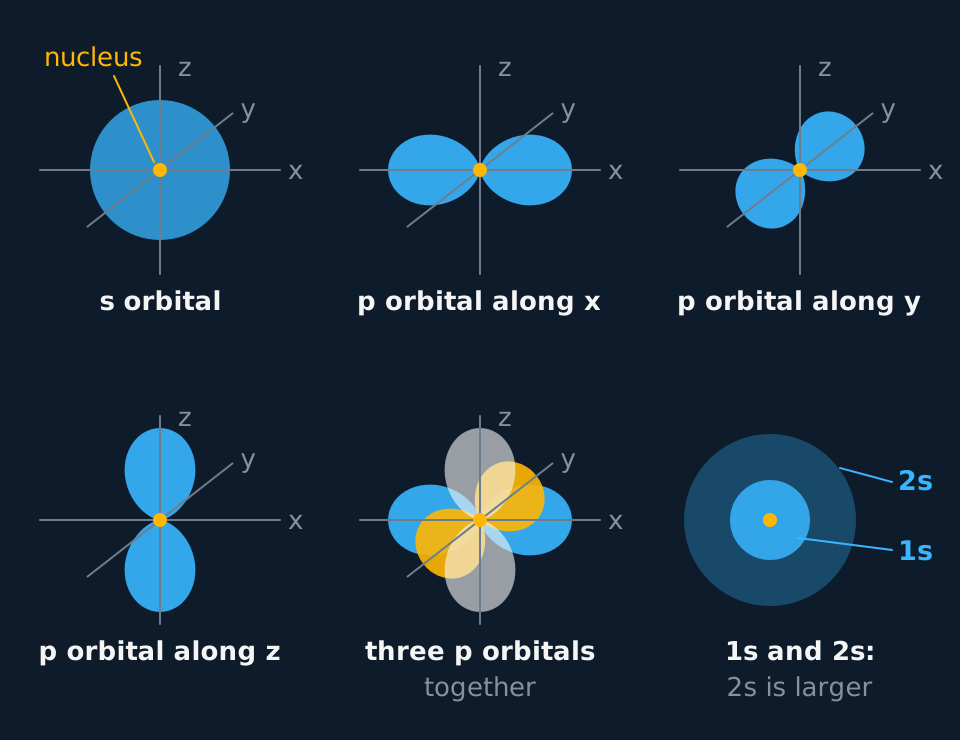
Describe the drawing
Six small panels with the nucleus at the origin of x, y and z axes. An s orbital is a sphere. A p orbital along x, one along y and one along z each have two teardrop lobes meeting at the nucleus on opposite sides. A fifth panel shows the three p orbitals together at right angles, in three colours, and a sixth shows 1s and 2s as concentric spheres with 2s the larger.
The d orbitals have more complicated shapes, most of them with four lobes. Their shapes matter for the colours of transition metal compounds; for writing electron configurations, only their number, five, is needed.
The order of filling
Electrons go into the lowest-energy subshell available. Up to argon the order is the expected one: 1s, 2s, 2p, 3s, 3p. Then it breaks the shell pattern. The 4s subshell is lower in energy than 3d in potassium and calcium, so their outer electrons go into 4s, and only from scandium onwards does 3d fill. After 3d comes 4p, which is complete at krypton.
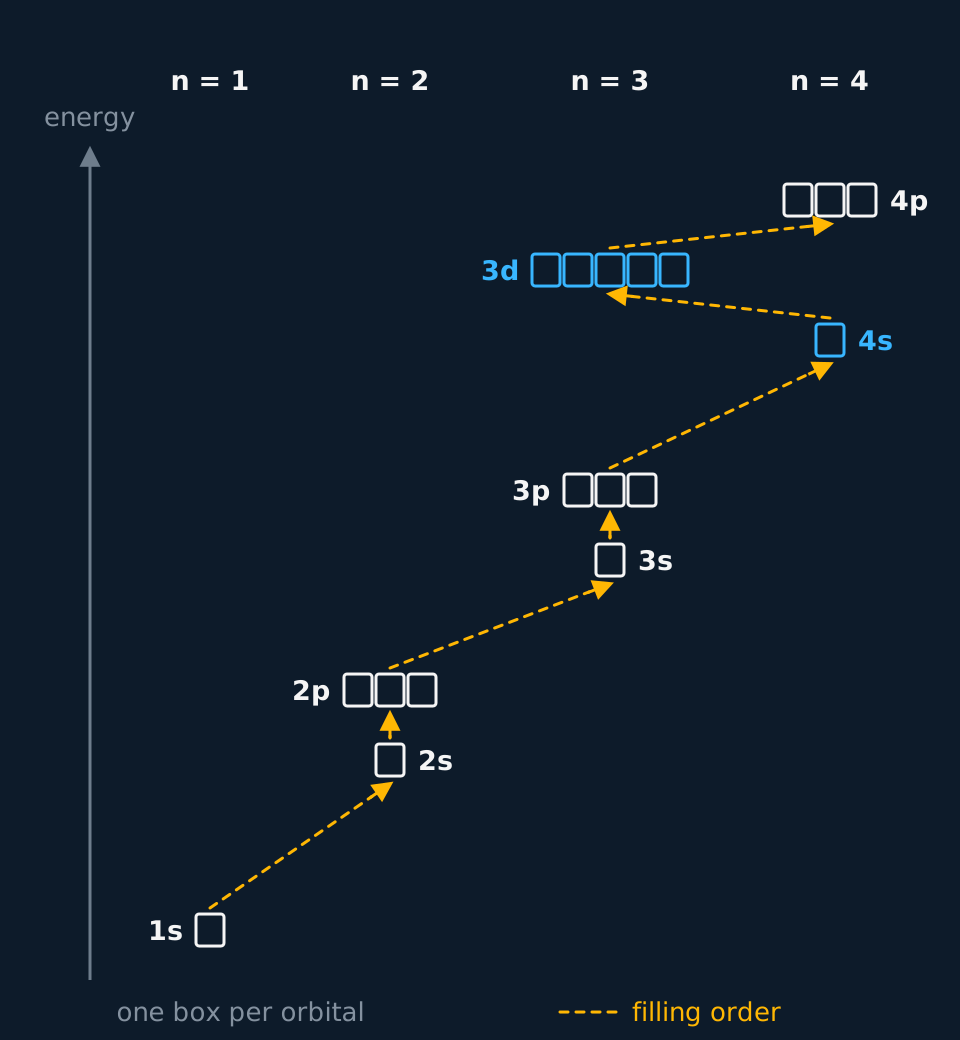
Describe the drawing
Energy-level diagram with energy increasing upwards and subshells drawn as rows of empty boxes, one box per orbital, in columns for shells n equals 1 to 4. From the bottom: 1s; then 2s and 2p; then 3s and 3p; then a large gap up to 4s, with 3d only a little above 4s and 4p just above 3d. A dashed arrow threads the subshells in filling order: 1s, 2s, 2p, 3s, 3p, 4s, 3d, 4p.
1s < 2s < 2p < 3s < 3p < 4s < 3d < 4pThe order of filling to krypton, lowest energy first.
The reason 4s comes below 3d lies in the shapes of the orbitals. A 4s electron spends part of its time very close to the nucleus, inside the inner shells, where it is barely shielded and is strongly attracted. A 3d electron does not get that close. In potassium and calcium the 4s orbital is therefore the lower in energy, even though it belongs to the fourth shell.
Two rules decide how electrons go into the orbitals of a subshell. Electrons have a property called spin, with two possible values, drawn as an arrow pointing up or down. The Pauli principle says that two electrons in the same orbital must have opposite spins, so an orbital holds two and no more. Hund's rule says that electrons occupy the orbitals of a subshell singly, with parallel spins, before any orbital takes a second electron, because two electrons repel each other less in separate orbitals than in the same one.
An electrons-in-boxes diagram shows both rules. Each box is an orbital and each arrow an electron. Nitrogen has three 2p electrons, one in each 2p orbital with parallel spins; oxygen's fourth 2p electron has to pair up.
| Atom | 1s | 2s | 2p |
|---|---|---|---|
| Nitrogen | ↑↓ | ↑↓ | ↑ | ↑ | ↑ |
| Oxygen | ↑↓ | ↑↓ | ↑↓ | ↑ | ↑ |
The same rules apply in a d subshell. Iron, [Ar] 3d⁶ 4s², has six 3d electrons to place in five orbitals. Five go in singly with parallel spins, and the sixth pairs with one of them, so an iron atom has four unpaired electrons. The Fe³⁺ ion, [Ar] 3d⁵, has one electron in every 3d orbital and five unpaired.
A configuration is written as each subshell in turn, with its number of electrons as a superscript: sodium is 1s² 2s² 2p⁶ 3s¹. The inner part that matches a noble gas can be shortened to that gas's symbol in square brackets, so sodium is [Ne] 3s¹ and iron is [Ar] 3d⁶ 4s². Writing 3d before 4s groups the subshells by shell. Some books write 4s first, in filling order; both describe the same atom.
- Pauli principle
- No orbital holds more than two electrons, and two electrons in the same orbital must have opposite spins.
- Hund's rule
- Electrons fill the orbitals of a subshell singly, with parallel spins, before any orbital takes a pair.
Three configurations
Write the full electron configurations of phosphorus (Z = 15), calcium (Z = 20) and arsenic (Z = 33), and give the shortened form of each.
Show the working
Phosphorus has 15 electrons. 1s² 2s² 2p⁶ holds 10, 3s² holds 2 more, and the last 3 go into 3p, one in each orbital by Hund's rule. Phosphorus is 1s² 2s² 2p⁶ 3s² 3p³, or [Ne] 3s² 3p³.
Calcium has 20. Up to 3p⁶ accounts for 18, and the next subshell in energy is 4s, not 3d, so the last two go there. Calcium is 1s² 2s² 2p⁶ 3s² 3p⁶ 4s², or [Ar] 4s².
Arsenic has 33. After the 18 of [Ar], 4s² takes 2 (20 in all), 3d¹⁰ takes 10 (30), and 3 remain for 4p. Arsenic is 1s² 2s² 2p⁶ 3s² 3p⁶ 3d¹⁰ 4s² 4p³, or [Ar] 3d¹⁰ 4s² 4p³.
Check each by adding the superscripts: 15, 20 and 33. Phosphorus and arsenic both end in p³, and both are in Group 5.
Chromium, copper and the ions of transition metals
Two atoms before krypton do not follow the order. Chromium would be expected to be [Ar] 3d⁴ 4s², and is [Ar] 3d⁵ 4s¹. Copper would be expected to be [Ar] 3d⁹ 4s², and is [Ar] 3d¹⁰ 4s¹. In each, one 4s electron is in 3d instead, giving chromium a half-filled 3d subshell with one electron in each orbital and copper a full one. The 4s and 3d subshells are so close in energy that these arrangements are the more stable. Learn the two as facts: no other element up to krypton does this.
For an ion, start from the atom's configuration and add or remove electrons. For the s- and p-block elements this is direct: Na⁺ is 1s² 2s² 2p⁶, the same as neon, and Cl⁻ is 1s² 2s² 2p⁶ 3s² 3p⁶, the same as argon.
Transition metals need care. The 4s subshell fills before 3d, but when the atom forms an ion the 4s electrons are lost first. Once the 3d subshell holds electrons, the 4s electrons are the outermost and the highest in energy, so they are the easiest to remove. Iron is [Ar] 3d⁶ 4s²; Fe²⁺ is [Ar] 3d⁶ and Fe³⁺ is [Ar] 3d⁵.
Copper and its two ions
Write the shortened electron configurations of Cu, Cu⁺ and Cu²⁺. Copper is element 29.
Show the working
Copper is one of the two exceptions: [Ar] 3d¹⁰ 4s¹, which is 18 + 10 + 1 = 29 electrons.
Cu⁺ has lost one electron, and it comes from 4s: [Ar] 3d¹⁰.
Cu²⁺ has lost two. With 4s already empty, the second comes from 3d: [Ar] 3d⁹.
[Ar] 3d⁸ 4s¹ for Cu²⁺ is wrong: it takes both electrons from 3d and leaves the 4s electron, which is the first to go.
Hund's rule then says how many of those d electrons are unpaired, which matters later for the colours and magnetism of transition metal compounds.
Cobalt and its ions in boxes
Cobalt is element 27. Write the shortened configurations of Co, Co²⁺ and Co³⁺, and give the number of unpaired electrons in each.
Show the working
Co: [Ar] holds 18, 4s fills next with 2, and the remaining 7 go into 3d. Co is [Ar] 3d⁷ 4s², and 18 + 7 + 2 = 27.
The 4s pair is paired. In 3d, five electrons go in singly with parallel spins, and the sixth and seventh pair up in two of the orbitals. Three orbitals are left with one electron each: Co has 3 unpaired electrons.
Co²⁺ loses the two 4s electrons first, so it is [Ar] 3d⁷. The 3d subshell is unchanged, so Co²⁺ also has 3 unpaired electrons.
Co³⁺ loses one more electron, now from 3d, and is [Ar] 3d⁶. Six electrons in five orbitals means one pair and four singles: 4 unpaired electrons.
Removing an electron can raise the number of unpaired ones: Co³⁺ has more than Co²⁺, because the electron lost came from a pair.
The blocks of the periodic table
The periodic table is the order of filling laid out flat. Each element sits in a block named after the subshell its highest-energy electron enters. Groups 1 and 2, with helium, form the s block; Groups 3 to 7 and 0 form the p block; the ten columns from scandium to zinc are the first row of the d block; and the lanthanides and actinides form the f block. The widths of the blocks, 2, 6, 10 and 14, are the capacities of the subshells.
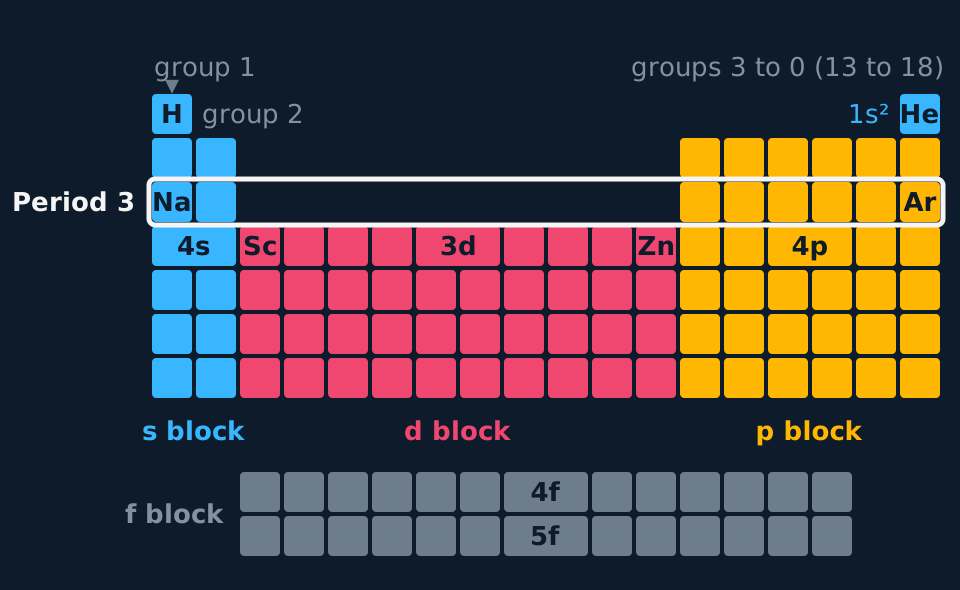
Describe the drawing
An outline periodic table of seven periods with its cells shaded by block: the s block in cyan covers groups 1 and 2 plus hydrogen and helium; the d block in coral is the ten columns from scandium to zinc and below, sitting between groups 2 and 3; the p block in amber is groups 3 to 0; and the f block in grey is two separate rows of fourteen beneath the table. Across period 4 the blocks are tagged 4s, 3d and 4p, and the f rows 4f and 5f. Helium sits above neon but is shaded s block, noted 1s squared. Period 3, sodium to argon, is outlined in a heavy line.
Two facts follow from the layout. The outer configuration is the same all the way down a group: every Group 2 element ends in s², every Group 7 element in s² p⁵. And the period an element is in is the number of its highest occupied shell, which is why potassium, with its outer electron in 4s, starts Period 4.
The outer configuration is also what makes a group a family. Lithium, sodium and potassium each end in a single s electron, which each loses readily to form a 1+ ion, and so all three react with water alike. Fluorine and chlorine each end in s² p⁵, one electron short of a full p subshell, and each gains one electron to form a 1− ion. Mendeleev grouped the elements by their properties in 1869, almost thirty years before the electron was discovered; the configurations explain why his groups worked.
- Block
- A region of the periodic table in which the highest-energy electron of each element is in the same type of subshell, s, p, d or f.
TRY IT: Placing an element from its configuration
An element has the configuration 1s² 2s² 2p⁶ 3s² 3p⁶ 3d¹⁰ 4s² 4p⁴. Identify its block, group and period, name the element, and write the configuration of its 2− ion.
Check your answer
The highest-energy electrons are in 4p, so it is a p-block element. The highest occupied shell is n = 4, so it is in Period 4.
The outer shell holds 4s² 4p⁴, six electrons, so it is in Group 6. The superscripts add up to 34, so Z = 34: selenium.
Se²⁻ gains two electrons into 4p: 1s² 2s² 2p⁶ 3s² 3p⁶ 3d¹⁰ 4s² 4p⁶, the same configuration as krypton.
Other boards: ground states, quantum numbers and group numbers
Cambridge calls the shell number n the principal quantum number and uses that term in its questions, and it asks for the ground state configuration by name. A sodium atom normally has its outer electron in 3s, the lowest-energy arrangement open to it: its ground state. In a sodium street lamp the electric discharge lifts that electron into 3p, an excited state. It soon falls back to 3s, and the energy difference leaves as yellow light of one wavelength, 589 nm. A configuration written without comment is always the ground state.
- Principal quantum number
- The number n of the shell an electron occupies, 1, 2, 3 and so on outwards from the nucleus.
- Ground state
- The lowest-energy electron configuration of an atom or ion, with each electron in the lowest available orbital.
- Excited state
- A configuration in which one or more electrons occupy a higher-energy orbital than in the ground state.
OCR and Cambridge number the p-block groups 13 to 18, where AQA numbers them 3 to 7 and 0, so a Group 7 element on one paper is a Group 17 element on the other. Edexcel sets the configurations of scandium to zinc and their ions a second time, in its transition metals topic, where the 4s-first rule for ions is examined again alongside the colours and oxidation states it explains.
In the exam
- A configuration earns its mark only when every subshell is present with its superscript and the superscripts add up to the number of electrons. The scheme accepts 4s written before 3d or after it.
- For the ion of a d-block element, remove the 4s electrons first. The scheme rejects [Ar] 3d³ 4s² for Fe³⁺; the answer is [Ar] 3d⁵.
- Define an orbital as a region of space with a high probability of finding an electron, holding up to two electrons with opposite spins. 'A path an electron follows' describes Bohr's orbit, not an orbital, and is not accepted.
- A block is named by the subshell of the highest-energy electron: selenium is in the p block because its last electron enters 4p.
Check yourself
Vanadium is element 23. Write the electron configurations of a vanadium atom and of a V³⁺ ion, and explain why a student who wrote V³⁺ as [Ar] 4s² is wrong.
Answer
Vanadium has 23 electrons. [Ar] accounts for 18, 4s fills next with 2, and the last 3 go into 3d. V is [Ar] 3d³ 4s².
V³⁺ has lost three electrons. The two 4s electrons go first, then one 3d electron, so V³⁺ is [Ar] 3d².
[Ar] 4s² is what results from removing the three 3d electrons and keeping the 4s pair, as if 4s were an inner subshell. Once 3d is occupied, the 4s electrons are the highest in energy and are removed first.
Questions
Question 16 marks
Explain, in terms of subshells and their energies, why the third shell holds only eight electrons from argon to calcium although it can hold eighteen, and why the GCSE pattern of 2, 8, 8 fails from scandium onwards.
Mark scheme
Indicative content
- each shell divides into subshells: the third shell has 3s, 3p and 3d, holding 2, 6 and 10 electrons, 18 in all
- from sodium to argon only the 3s and 3p subshells fill, so argon is 2, 8, 8 with its 3d subshell still empty
- in potassium and calcium the 4s subshell is lower in energy than 3d, so the nineteenth and twentieth electrons go into 4s
- a 4s electron spends part of its time close to the nucleus, inside the inner shells, where it is barely shielded, lowering its energy
- from scandium the 3d subshell fills, so scandium is [Ar] 3d¹ 4s², with nine electrons in its third shell, not eight
- by zinc the third shell holds eighteen electrons, 2n² for n = 3, so 2, 8, 8 fits only the first twenty elements
Levels
- Level 3 (5–6 marks) the subshells of the third shell and their capacities, the filling of 4s before 3d in potassium and calcium with the reason in terms of energy and penetration, and the filling of 3d from scandium with the electron configuration are all present
- Level 2 (3–4 marks) 4s is said to fill before 3d, so potassium and calcium add electrons to 4s and 3d fills from scandium; the capacities of the subshells, why 4s is lower in energy, or a configuration such as scandium's does not appear
- Level 1 (1–2 marks) the third shell is said to be full at eight, or 3d to fill before 4s in potassium, with no energy order and no configurations
Question 24 marks
State the number of orbitals in an s, a p and a d subshell, and describe the shapes of an s orbital and of a p orbital.
Mark scheme
- B1 an s subshell has one orbital and a p subshell three
- B1 a d subshell has five orbitals, holding up to ten electrons
- B1 an s orbital is spherical, centred on the nucleus
- B1 a p orbital is a dumbbell, two lobes on opposite sides of the nucleus, and the three lie at right angles
Question 34 marks
Deduce the number of unpaired electrons in each of Ti²⁺, Cr³⁺, Ni²⁺ and Zn²⁺. Their atomic numbers are 22, 24, 28 and 30.
Mark scheme
- B1 Ti²⁺ is [Ar] 3d², with 2 unpaired electrons
- B1 Cr³⁺ is [Ar] 3d³, with 3 unpaired electrons
- B1 Ni²⁺ is [Ar] 3d⁸: five singles then three pairs, leaving 2 unpaired electrons
- B1 Zn²⁺ is [Ar] 3d¹⁰, with every orbital full and 0 unpaired electrons
All 16 questions with mark schemes, the other 13 set out in full on the question page.
Worth remembering
- Fill 4s before 3d: potassium is [Ar] 4s¹, not 2, 8, 9 or [Ar] 3d¹.
- Fe³⁺ written [Ar] 3d³ 4s² is wrong: an ion loses its 4s electrons first.
- An orbital is a region of high probability, not a path an electron follows.
- Chromium as 3d⁴ 4s² and copper as 3d⁹ 4s² are the predicted forms, not the real ones.
- Superscripts that do not add up to the number of electrons sink the whole configuration, however good the order.
CHECK YOUR PROGRESS
Rate how confident you are with each objective for this lesson. Ratings are saved in this browser, on this device, unless you sign in.
- State the number of orbitals in s, p, d and f subshells and the number of electrons each subshell can hold.
- Describe the shapes of s and p orbitals.
- Write the full and shortened electron configurations of the atoms from hydrogen to krypton, filling 4s before 3d.
- Apply the Pauli principle and Hund's rule to draw electrons in boxes and count the unpaired electrons in an atom or ion.
- Write the configurations of ions, removing 4s electrons before 3d electrons, and give the configurations of chromium and copper.
- Identify the block of an element from its electron configuration.
Open the full revision checklist to see every objective in the curriculum in one place.
Practise this lesson
WORKBOOK
The questions from this topic, on paper with room to work, and a separate book of mark schemes. Free to use; please do not redistribute or sell.
Used later in Ionic bonding and ionic lattices · Covalent, dative covalent and metallic bonding · Shapes of molecules and ions · Periodicity: trends across Period 3 and the blocks of the table