Chemistry › Atomic structure › Ionisation energies and the evidence for subshells
Ionisation energies and the evidence for subshells
Ionisation energy is the energy needed to pull electrons off gaseous atoms, and it is the strongest evidence for the arrangement of electrons in shells and subshells. Its fall down a group, its rise across Period 3 with dips at aluminium and sulfur, and the jumps in successive ionisation energies are all explained by the same three factors: nuclear charge, distance and shielding.
Key terms Every definition in atomic structure, lesson by lesson
Before this Electron configuration: shells, subshells and orbitals – the order the subshells fill, and 3p higher in energy than 3s · Electron configuration: shells, subshells and orbitals – Hund's rule and paired electrons in a p orbital · Protons, neutrons, electrons and isotopes – a positive ion forms when an atom loses electrons
COMMON MISCONCEPTION
Ionisation energy goes up steadily across a period, so every element has a higher value than the one before it.
The rise across a period has two dips. Aluminium is below magnesium because its outer electron is in 3p, higher in energy than 3s. Sulfur is below phosphorus because its fourth 3p electron is paired, and the repulsion in the pair makes it easier to remove. The dips are the evidence for subshells and orbitals.
What you should be able to do
- Define first ionisation energy, and write equations with state symbols for the first, second and third ionisations of an element.
- Explain how nuclear charge, distance from the nucleus and shielding affect an ionisation energy.
- Explain the decrease in first ionisation energy down a group.
- Explain the general increase across Period 3, and the dips at aluminium and sulfur, in terms of subshell energy and spin-pair repulsion.
- Use successive ionisation energies to deduce the group of an element and the number of electrons in each shell.
- Calculate the energy needed to form a gaseous ion from successive ionisation energies, and use them to explain the charge an element's ion carries.
First ionisation energy
The energy it takes to remove an electron from an atom varies fivefold across the first twenty elements. Potassium gives up its outer electron for 419 kJ mol⁻¹; neon needs 2081 kJ mol⁻¹. Much of the difference between a metal that reacts violently with water and a gas that reacts with nothing comes down to that one quantity, and its pattern across the periodic table is the evidence for shells and subshells.
The first ionisation energy is the energy required to remove one electron from each atom in one mole of gaseous atoms, forming one mole of gaseous 1+ ions. For sodium:
Na(g) → Na⁺(g) + e⁻First ionisation of sodium, +496 kJ mol⁻¹. The atom and the ion are both gaseous, and one electron is removed per atom.
The gaseous state is part of the definition. In a solid or a liquid, energy would also be needed to separate the atoms from each other, and the value would no longer belong to the atom alone. Ionisation energies are always positive: the electron is attracted to the nucleus, so energy must be put in to pull it away. They are quoted per mole; the energy to ionise a single atom is the molar value divided by the Avogadro constant, 6.96 × 10⁻¹⁹ J for one potassium atom.
Removing a second electron, from the 1+ ion, is the second ionisation energy, and so on. Each equation removes one electron from a gaseous ion that carries one more positive charge.
Na⁺(g) → Na²⁺(g) + e⁻Second ionisation of sodium, +4562 kJ mol⁻¹.
An equation that starts from the atom, Na(g) → Na²⁺(g) + 2e⁻, is the sum of the first two ionisations. It is not the equation for the second ionisation energy.
- First ionisation energy
- The energy required to remove one electron from each atom in one mole of gaseous atoms to form one mole of gaseous 1+ ions.
- Second ionisation energy
- The energy required to remove one electron from each ion in one mole of gaseous 1+ ions to form one mole of gaseous 2+ ions.
- Successive ionisation energies
- The energies needed to remove the electrons of an atom one at a time, first, second, third and so on.
- nth ionisation energy
- The energy required to remove one electron from each ion in one mole of gaseous (n − 1)+ ions to form one mole of gaseous n+ ions.
Three factors
Three things decide how strongly the nucleus holds the electron being removed. The first is nuclear charge: more protons attract every electron more strongly, at a given distance. The second is distance from the nucleus: attraction falls with distance, so an electron in a higher shell is held less strongly. An electron in a higher-energy subshell of the same shell, 3p rather than 3s, is on average slightly further out as well.
The distance is measured as the atomic radius, half the distance between the nuclei of two bonded atoms of the same element. It cannot be found for one isolated atom, because the electron cloud has no sharp edge.
The third is shielding. Electrons in inner shells lie between the nucleus and the outer electron and repel it, cancelling part of the nuclear attraction. Electrons in the same shell shield each other only a little.
The three often pull in different directions. Down a group the nuclear charge rises, which alone would raise the ionisation energy, but distance and shielding rise too and outweigh it. Across a period the electron removed is in the same shell each time, so distance and shielding change little and the rising nuclear charge decides the trend.
- Nuclear charge
- The total positive charge of the nucleus, equal to the number of protons in it.
- Atomic radius
- Half the distance between the nuclei of two bonded atoms of the same element.
- Shielding
- The repulsion of an outer electron by the electrons in inner shells, which reduces the attraction of the nucleus it feels.
Down a group
| Group 1 | First IE / kJ mol⁻¹ | Group 2 | First IE / kJ mol⁻¹ |
|---|---|---|---|
| Li | 520 | Be | 900 |
| Na | 496 | Mg | 738 |
| K | 419 | Ca | 590 |
| Rb | 403 | Sr | 550 |
| Cs | 376 | Ba | 503 |
First ionisation energy decreases down every group. Down Group 2, from beryllium to barium, the outer electron is removed from 2s, 3s, 4s, 5s and then 6s. Each of these is in a shell further from the nucleus, with one more full shell of electrons inside it to shield it. The nuclear charge rises from +4 to +56, but the extra protons are almost all cancelled by the extra inner electrons. The greater distance and shielding decide the trend: the outer electron is held less strongly, and less energy removes it.
The trend is one reason reactivity increases down Groups 1 and 2. Each reaction of these metals begins with the loss of outer electrons, and the lower the ionisation energy, the more readily that happens. Barium reacts with cold water more vigorously than calcium, and magnesium barely reacts with cold water at all.
Read the table across as well as down. In every period the Group 2 value is higher than the Group 1 value: 738 kJ mol⁻¹ for magnesium against 496 for sodium. Both electrons come from the same s subshell at much the same distance, and magnesium has one more proton, so its electron is held more strongly. That is the start of the rise across a period.
Across Period 3
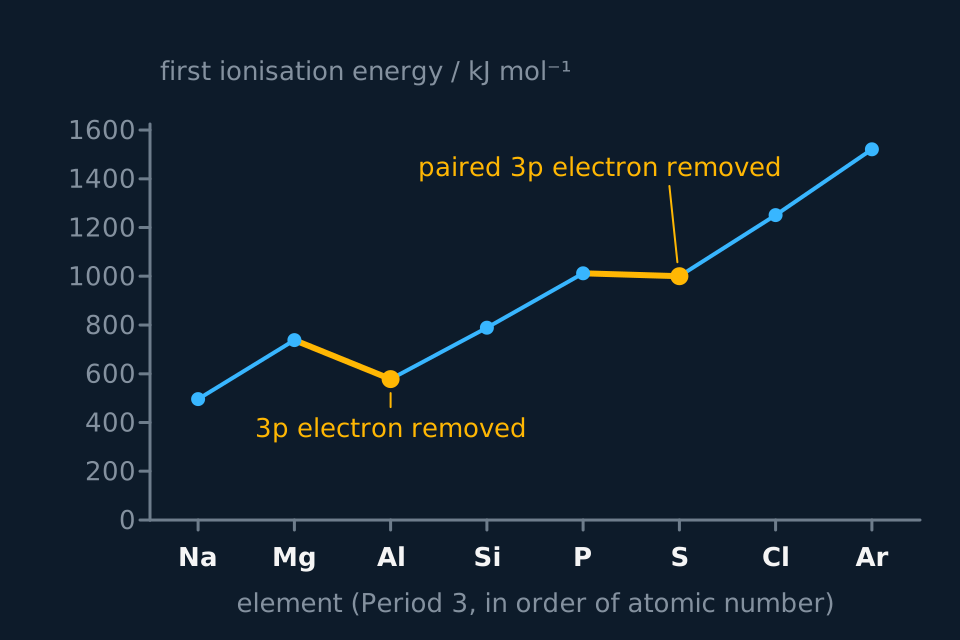
Across Period 3 the first ionisation energy rises from 496 kJ mol⁻¹ at sodium to 1521 kJ mol⁻¹ at argon. Each element has one more proton than the one before, and each new electron goes into the third shell, at much the same distance from the nucleus and shielded by the same inner electrons, 1s² 2s² 2p⁶. The increasing nuclear charge pulls the outer electrons in more strongly, the atomic radius decreases, and more energy is needed to remove an electron.
Describe the drawing
Line graph of first ionisation energy in kilojoules per mole for the Period 3 elements sodium to argon: Na 496, Mg 738, Al 578, Si 789, P 1012, S 1000, Cl 1251 and Ar 1521. The general trend rises, but the line falls from magnesium to aluminium, labelled 3p electron removed, and falls slightly from phosphorus to sulfur, labelled paired 3p electron removed.
The first dip is at aluminium, 578 kJ mol⁻¹ against magnesium's 738. Magnesium's outer electron is removed from 3s; aluminium's is the single electron in 3p. The 3p subshell is higher in energy than 3s, so its electron is on average slightly further from the nucleus, and the 3s electrons partly shield it. Less energy is needed to remove it, despite aluminium's extra proton.
The second dip is at sulfur, 1000 kJ mol⁻¹ against phosphorus's 1012. Both lose a 3p electron, so subshell energy is not the cause. Phosphorus, 3p³, has one electron in each 3p orbital. Sulfur, 3p⁴, has two electrons paired in one of them. Two electrons in the same orbital repel each other, and that spin-pair repulsion makes one of the pair easier to remove.
| Atom | 3s | 3p | First IE / kJ mol⁻¹ |
|---|---|---|---|
| Phosphorus | ↑↓ | ↑ | ↑ | ↑ | 1012 |
| Sulfur | ↑↓ | ↑↓ | ↑ | ↑ | 1000 |
- Spin-pair repulsion
- The repulsion between two electrons in the same orbital, which makes one of them easier to remove than an unpaired electron.
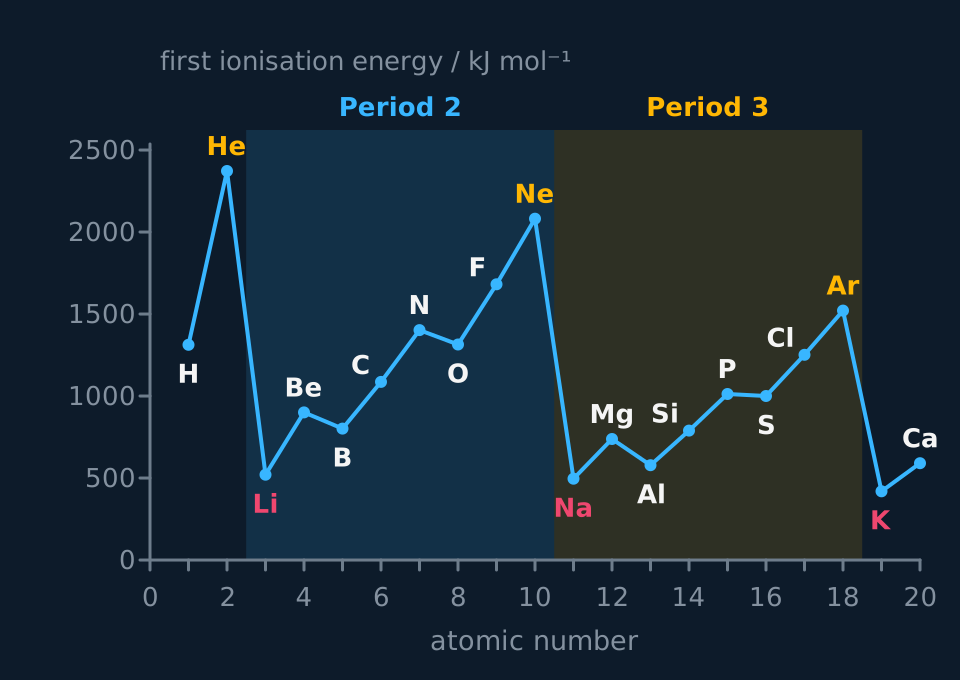
These dips are the evidence that shells divide into subshells. If the third shell were a single level, the values would rise smoothly from sodium to argon. Period 2 shows the same two dips in the same places, at boron, the first 2p electron, and at oxygen, the first paired 2p electron.
The biggest fall on a graph of first ionisation energies is not inside a period but between two: from argon, 1521 kJ mol⁻¹, to potassium, 419 kJ mol⁻¹. Potassium's outer electron is the first in the fourth shell, further out than any electron in argon and shielded by three inner shells. Every period begins with a fall of this kind and ends at a noble gas.
Describe the drawing
Line graph of first ionisation energy against atomic number from 1 to 20, each point labelled with its element symbol. Helium is highest at 2372 kilojoules per mole; neon at 2081 and argon at 1521 are the next peaks, and each is followed by a steep fall to lithium, sodium or potassium at the troughs. Periods 2 and 3 are shaded as two bands and show the same pattern: a general rise with small dips at Group 3 and Group 6.
The two dips in Period 2
The first ionisation energies of Period 2, in kJ mol⁻¹, are: Li 520, Be 900, B 801, C 1086, N 1402, O 1314, F 1681, Ne 2081. Explain why the value for boron is lower than for beryllium, and why the value for oxygen is lower than for nitrogen.
Show the working
Beryllium is 1s² 2s²; boron is 1s² 2s² 2p¹. The electron removed from boron is in 2p, a subshell of higher energy than the 2s from which beryllium's is removed.
The 2p electron is on average further from the nucleus and is partly shielded by the 2s electrons, so less energy is needed to remove it, even though boron has one more proton.
Nitrogen is 1s² 2s² 2p³, with one electron in each 2p orbital. Oxygen is 1s² 2s² 2p⁴, with two electrons paired in one 2p orbital.
The paired electrons repel each other, so one of them is removed with less energy. That outweighs oxygen's extra proton, and oxygen's first ionisation energy is lower than nitrogen's.
Successive ionisation energies
Removing the electrons from an atom one at a time gives its successive ionisation energies. Each is larger than the one before, because each electron is removed from an ion that is more positive: the same nuclear charge holds fewer electrons, which repel each other less and are pulled closer. The size of each step is what shows the shells.
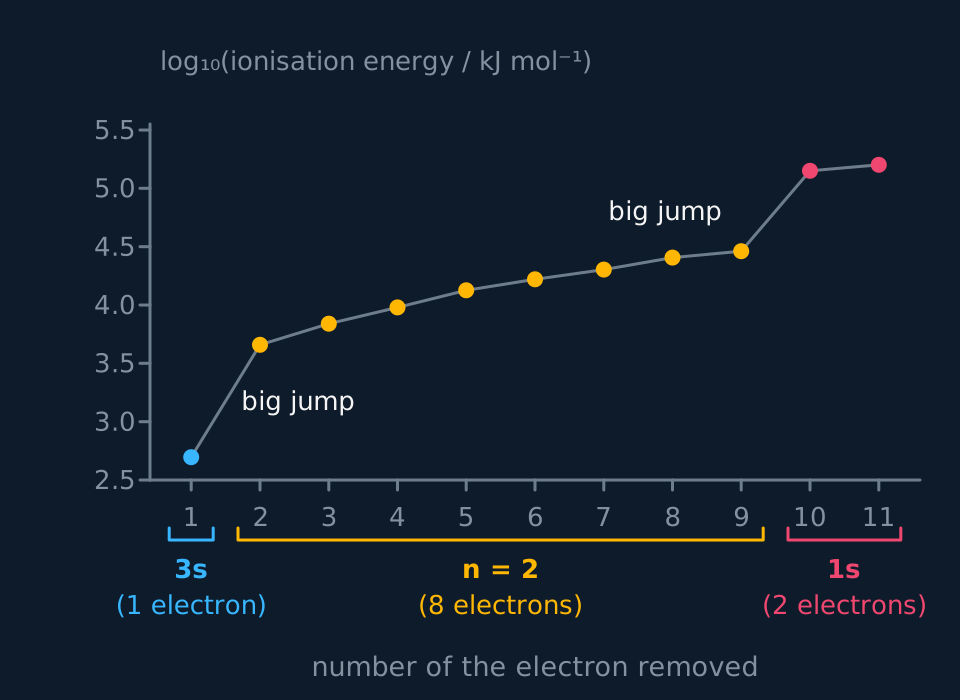
Sodium's first ionisation energy is 496 kJ mol⁻¹ and its second is 4562 kJ mol⁻¹, more than nine times as large. The first electron comes from 3s, alone in the third shell. The second comes from 2p, in a shell closer to the nucleus with only the two 1s electrons to shield it, and it leaves an ion that is already positive. Every Group 1 element shows a jump of this kind between its first and second values, because each has one electron outside a full shell.
Describe the drawing
Graph of log to base ten of ionisation energy against the number of the electron removed, for all eleven electrons of sodium. The first point is low at 2.70; a big jump leads to the second at 3.66, then eight points climb gently to 4.46; a second big jump leads to the tenth and eleventh at 5.15 and 5.20. Brackets beneath group them as 3s with 1 electron, n equals 2 with 8 electrons, and 1s with 2 electrons.
The values run from 496 to 159,076 kJ mol⁻¹, too wide a range for an ordinary scale, so they are plotted as log₁₀. On the log graph the shells stand out: one electron is easy to remove, the next eight are progressively harder, and the last two, from 1s, take far more again.
The reasoning runs both ways. From aluminium's configuration, 1s² 2s² 2p⁶ 3s² 3p¹, the shape of its graph of thirteen successive ionisation energies can be predicted before it is seen: three values close together, a large jump, eight values rising steadily, a second large jump, and the last two highest of all.
A Group 3 element from a log graph
The first six ionisation energies of element X, read from a graph of log₁₀(ionisation energy / kJ mol⁻¹) against the number of the electron removed, are 2.76, 3.26, 3.44, 4.06, 4.17 and 4.26. Identify the group X is in, and identify X if it is in Period 3.
Show the working
Find the differences between neighbouring values: 0.50, 0.18, 0.62, 0.11 and 0.09. The largest, 0.62, falls between the third and fourth ionisations.
A difference of 0.62 in log₁₀ means the fourth ionisation energy is 10 to the power 0.62, about 4.2 times the third. The other steps are factors of 1.2 to 3.2.
Three electrons come off before the jump, so the fourth is removed from a shell closer to the nucleus. X has three electrons in its outer shell: it is in Group 3.
In Period 3 that is aluminium, [Ne] 3s² 3p¹. The step after the first electron, 0.50, is larger than the one after the second, 0.18, because the first comes from 3p and the next two from 3s. And 10 to the power 2.76 is 575, close to aluminium's 578 kJ mol⁻¹.
Successive ionisation energies also explain the charge an ion carries. Making a 3+ ion means paying for three ionisations in turn, and the sum is the energy for the whole change.
Al(g) → Al³⁺(g) + 3e⁻Not an ionisation energy itself: its energy change is the sum of the first three.
The energy to make Al³⁺, and why it stops there
The first four ionisation energies of aluminium are 578, 1817, 2745 and 11577 kJ mol⁻¹. Calculate the energy needed to turn one mole of gaseous aluminium atoms into gaseous Al³⁺ ions, and explain why aluminium does not form Al⁴⁺ ions in its compounds.
Show the working
Al(g) → Al³⁺(g) + 3e⁻ is the first, second and third ionisations one after another, so their energies add.
Energy = 578 + 1817 + 2745 = +5140 kJ mol⁻¹.
A fourth electron would cost a further 11577 kJ mol⁻¹, more than four times the third. It would come from 2p, in the second shell, closer to the nucleus and shielded only by 1s², and it would be removed from an ion that is already 3+.
The energy released when Al³⁺ forms bonds or a lattice repays the 5140 kJ mol⁻¹. Nothing repays a further 11577 kJ mol⁻¹, so aluminium's compounds contain Al³⁺ and no ion of higher charge.
TRY IT: An element from five numbers
The first five ionisation energies of an element in Period 3, in kJ mol⁻¹, are 738, 1451, 7733, 10543 and 13630. Identify the element, and explain why the third value is so much larger than the second.
Check your answer
The largest jump is between the second value, 1451, and the third, 7733: the third is more than five times the second, while the second is about twice the first. Two electrons are in the outer shell, so the element is in Group 2: magnesium.
The first two electrons come from 3s. The third comes from 2p, in a shell closer to the nucleus and shielded only by the 1s electrons, so it is held far more strongly. It is also removed from a 2+ ion.
The jump marks the change of shell, which is the evidence that magnesium's twelve electrons are arranged 2, 8, 2.
Other boards: spin-pair repulsion as a fourth factor
Cambridge lists a fourth factor beside nuclear charge, distance and shielding: spin-pair repulsion between two electrons in the same orbital. A Cambridge answer on any ionisation energy is expected to consider all four, and to say when pairing applies: it lowers the energy needed only where the electron removed shares its orbital. AQA, OCR and Edexcel use the same idea for one feature, the dips at oxygen and sulfur.
In the exam
- An ionisation equation needs (g) on both sides and one electron removed per step: the third ionisation of aluminium is Al²⁺(g) → Al³⁺(g) + e⁻. The scheme does not award the mark if the state symbols are missing.
- Down a group, the scheme looks for three things: the outer electron is further from the nucleus, it is more shielded, and these outweigh the increase in nuclear charge.
- For aluminium, name the subshells: the electron is removed from 3p, which is higher in energy than 3s. For sulfur, state that two electrons are paired in one 3p orbital and repel each other. 'Half-filled subshell is stable' is not accepted for sulfur.
- With successive ionisation energies given, state where the largest jump falls, then count the electrons removed before it to give the group.
Check yourself
The first ionisation energy of helium is 2372 kJ mol⁻¹ and that of lithium is 520 kJ mol⁻¹. The second ionisation energy of lithium is 7298 kJ mol⁻¹. Explain these three values.
Answer
Helium's two electrons are both in 1s, close to the nucleus, with no inner electrons to shield them. Its first ionisation energy is the highest of any element.
Lithium's first electron is in 2s, a shell further out, shielded by the full 1s² shell. Its nuclear charge is higher, +3 against +2, but the extra distance and shielding outweigh it, so only 520 kJ mol⁻¹ is needed.
Lithium's second electron comes from 1s, as helium's did, but now with a nuclear charge of +3 and from a positive ion, so it takes 7298 kJ mol⁻¹, far more than helium's 2372.
Questions
Question 16 marks
Explain the pattern in the first ionisation energies of the Period 3 elements given in the table.
| Element | Na | Mg | Al | Si | P | S | Cl | Ar |
|---|---|---|---|---|---|---|---|---|
| First IE / kJ mol⁻¹ | 496 | 738 | 578 | 789 | 1012 | 1000 | 1251 | 1521 |
Mark scheme
Indicative content
- the general rise from sodium to argon follows the nuclear charge, which increases by one proton from each element to the next
- the electron removed is in the third shell each time, at a similar distance and shielded by the same inner electrons
- the outer electrons are therefore attracted more strongly, the atomic radius falls, and more energy is needed to remove one
- aluminium is lower than magnesium because its electron is removed from 3p, a subshell higher in energy than 3s
- the 3p electron is on average further from the nucleus and partly shielded by the 3s electrons, outweighing the extra proton
- sulfur is lower than phosphorus because two of its 3p electrons are paired in one orbital and repel, so one is removed more easily
Levels
- Level 3 (5–6 marks) the general rise is explained through nuclear charge with similar shielding and the same shell, and both exceptions are explained correctly, aluminium through the higher-energy 3p subshell and sulfur through the paired electrons repelling; all three parts of the pattern are addressed with the table's values used
- Level 2 (3–4 marks) the general rise is explained along with one of the two dips, or both dips are named and one explanation stops short
- Level 1 (1–2 marks) the rise across the period is put down to nuclear charge; the dips are ignored, or the sulfur dip is put down to more shielding rather than to the repulsion between paired 3p electrons
Question 24 marks
State what is meant by the first ionisation energy of an element, and give the equations, with state symbols, for the first and second ionisations of calcium.
Mark scheme
- B1 the energy required to remove one electron from each atom in one mole of atoms
- B1 the atoms are gaseous, and one mole of gaseous 1+ ions is formed
- B1 Ca(g) → Ca⁺(g) + e⁻
- B1 Ca⁺(g) → Ca²⁺(g) + e⁻; reject Ca(g) → Ca²⁺(g) + 2e⁻
Question 34 marks
Deduce the group of an element from its first five ionisation energies, given in the table, and identify the element if it is in Period 2.
| Ionisation | 1st | 2nd | 3rd | 4th | 5th |
|---|---|---|---|---|---|
| Energy / kJ mol⁻¹ | 1086 | 2353 | 4620 | 6223 | 37831 |
Mark scheme
- B1 the largest jump is between the fourth and fifth values: the fifth is about six times the fourth
- B1 four electrons are removed before the jump, so there are four in the outer shell: Group 4
- B1 the fifth electron comes from the first shell, closer to the nucleus and unshielded
- B1 the Group 4 element in Period 2 is carbon
All 20 questions with mark schemes, the other 17 set out in full on the question page.
Worth remembering
- Leaving out (g), or writing Na(g) → Na²⁺(g) + 2e⁻ for the second ionisation energy, is the wrong equation.
- 'More protons' down a group, without distance and shielding outweighing them, explains nothing.
- For aluminium, say that the electron removed is in 3p, which is higher in energy than 3s, as well as further out.
- For sulfur, place the pair in one 3p orbital before saying that paired electrons repel.
- The group is the number of electrons removed before the largest jump, not the number of the ionisation after it.
CHECK YOUR PROGRESS
Rate how confident you are with each objective for this lesson. Ratings are saved in this browser, on this device, unless you sign in.
- Define first ionisation energy, and write equations with state symbols for the first, second and third ionisations of an element.
- Explain how nuclear charge, distance from the nucleus and shielding affect an ionisation energy.
- Explain the decrease in first ionisation energy down a group.
- Explain the general increase across Period 3, and the dips at aluminium and sulfur, in terms of subshell energy and spin-pair repulsion.
- Use successive ionisation energies to deduce the group of an element and the number of electrons in each shell.
- Calculate the energy needed to form a gaseous ion from successive ionisation energies, and use them to explain the charge an element's ion carries.
Open the full revision checklist to see every objective in the curriculum in one place.
Practise this lesson
WORKBOOK
The written questions from this topic, on paper with room to work, and a separate book of mark schemes. The 5 questions that are set on a diagram stay on this page, where the diagram can be drawn. Free to use; please do not redistribute or sell.
Used later in Ionic bonding and ionic lattices · Lattice enthalpy and Born–Haber cycles · Periodicity: trends across Period 3 and the blocks of the table · Group 2: trends down the group and reactions with water