Chemistry › Atomic structure › Time-of-flight mass spectrometry and relative atomic mass
Time-of-flight mass spectrometry and relative atomic mass
A time-of-flight mass spectrometer turns particles into positive ions, gives every ion the same kinetic energy and times it over a fixed distance: the lighter the ion, the sooner it arrives. The spectrum it produces gives the masses and abundances of an element's isotopes, the relative atomic mass that follows from them, and the relative molecular mass of a compound.
Key terms Every definition in atomic structure, lesson by lesson
Before this Protons, neutrons, electrons and isotopes – mass number and what an isotope is · Protons, neutrons, electrons and isotopes – a positive ion forms when an atom loses electrons
COMMON MISCONCEPTION
The relative atomic mass of chlorine is 35.5 because that is how heavy a chlorine atom is.
No chlorine atom has a mass of 35.5. Chlorine is about 75% ³⁵Cl and 25% ³⁷Cl, and 35.5 is the mean of those masses weighted by abundance: (35 × 75 + 37 × 25) ÷ 100. A mass spectrum of chlorine atoms shows peaks at m/z 35 and 37 in a 3 : 1 ratio, and nothing at 35.5.
What you should be able to do
- Describe the four stages of a time-of-flight mass spectrometer, including both electron impact and electrospray ionisation.
- Explain why every ion leaves the acceleration stage with the same kinetic energy, and why lighter ions reach the detector first.
- Calculate the flight time of an ion from KE = ½mv² and t = d/v, and the ratio of the flight times of two ions.
- Calculate a relative atomic mass from the isotopic masses and abundances in a mass spectrum, and an abundance from a relative atomic mass.
- Interpret the molecular ion peaks of chlorine and bromine as combinations of isotopes.
- Use the M+1 peak to calculate the number of carbon atoms in a molecule, and the M+2 peak to identify chlorine or bromine in an organic compound.
What a mass spectrum shows
The mass spectrum of chlorine shows, among other lines, two tall ones: one at 35 and one at 37, the first about three times the height of the second. No line appears at 35.5. The 35.5 on the periodic table is not the mass of any chlorine atom. It is the mean mass of a very large number of them, weighted by how common each isotope is.
The horizontal axis of a spectrum is m/z, the mass of an ion divided by its charge, with mass on the scale where an atom of carbon-12 is exactly 12. Almost every ion the instrument makes carries a charge of +1, so m/z is the relative mass of the ion. The vertical axis is the abundance, given either as a percentage of all the ions or as a height relative to the tallest peak. Each peak is one isotope, or one combination of isotopes in a molecule.
- Relative isotopic mass
- The mass of an atom of an isotope relative to one twelfth of the mass of an atom of carbon-12.
- Relative atomic mass
- The weighted mean mass of an atom of an element relative to one twelfth of the mass of an atom of carbon-12, Ar.
- Relative molecular mass
- The weighted mean mass of a molecule relative to one twelfth of the mass of an atom of carbon-12, Mr.
- m/z
- The mass of an ion divided by its charge, equal to the relative mass of the ion when its charge is +1.
The four stages
Every time-of-flight instrument does four things in the same order, inside a vacuum. The vacuum matters: an ion that hit an air molecule on the way would be slowed or knocked off course and would arrive at the wrong time, or not at all.
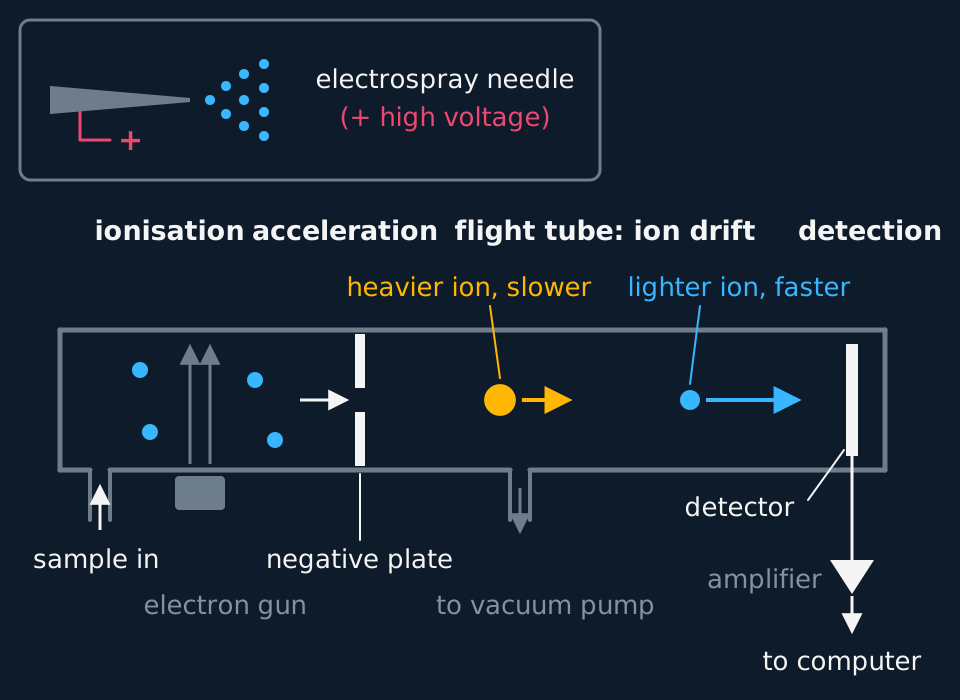
Describe the drawing
A time-of-flight mass spectrometer drawn as one long horizontal tube. From left to right: the sample enters the ionisation chamber, where an electron gun fires electrons across it; ions are accelerated towards a negatively charged plate with a hole in it; they then drift along a long field-free flight tube, where a small light ion with a long speed arrow is ahead of a larger heavy ion with a short one; and they strike a detector at the far end wired through an amplifier to a computer. A pipe leads to a vacuum pump. An inset shows electrospray ionisation, a fine needle at high positive voltage spraying charged droplets. There is no magnet.
Ionisation comes first, because only a charged particle can be accelerated by an electric field. In electron impact, the sample is vaporised and bombarded with high-energy electrons from an electron gun, which knock one electron off each particle they hit.
X(g) + e⁻ → X⁺(g) + 2e⁻Electron impact: the incoming electron and the one knocked out both leave.
In electrospray ionisation, the sample is dissolved in a volatile solvent such as methanol and forced through a fine hollow needle held at a high positive voltage. The spray is a mist of charged droplets, and as the solvent evaporates each molecule is left carrying an extra proton.
X(g) + H⁺ → XH⁺(g)Electrospray: the ion detected is one unit heavier than the molecule, so its peak is at Mr + 1.
Electron impact is used for elements and for compounds of low Mr. It is violent enough to break many molecules into fragments. Electrospray is gentle, so it is used for large molecules such as proteins, which survive it whole.
| Electron impact | Electrospray | |
|---|---|---|
| The sample | Vaporised first | Dissolved in a volatile solvent |
| How the ion forms | An electron is knocked off: X⁺ | A proton is gained: XH⁺ |
| Mass of the ion detected | Mr | Mr + 1 |
| Fragmentation | Common | Little |
| Used for | Elements and small molecules | Large molecules such as proteins |
In the acceleration stage the positive ions are attracted towards a negatively charged plate and pass through a hole in it, gaining kinetic energy from the electric field. Every ion with a charge of +1 gains the same kinetic energy, whatever its mass. That fact is what makes timing possible.
Ion drift takes place in the flight tube, where there is no electric field, so each ion keeps the speed it left with. Equal kinetic energy means a light ion travels faster than a heavy one, and the ions separate by mass as they drift.
Detection ends the flight. Each positive ion hits a negatively charged plate and gains an electron from it. The flow of electrons to the plate is a current, and the size of the current is proportional to the number of ions arriving, so it measures abundance. A computer records the current against arrival time and converts each time to an m/z value.
- Electron impact ionisation
- Ionisation in which high-energy electrons from an electron gun knock an electron off each gaseous particle, forming a 1+ ion.
- Electrospray ionisation
- Ionisation in which a solution of the sample is sprayed from a needle at a high positive voltage, so that each molecule gains a proton, forming XH⁺.
Relative atomic mass from a spectrum
A relative atomic mass is a weighted mean: each isotopic mass counts in proportion to how common it is. Multiply each m/z by its abundance, add the products, and divide by the total abundance.
Ar = Σ(isotopic mass × abundance) ÷ Σ(abundance)
The relative atomic mass of magnesium
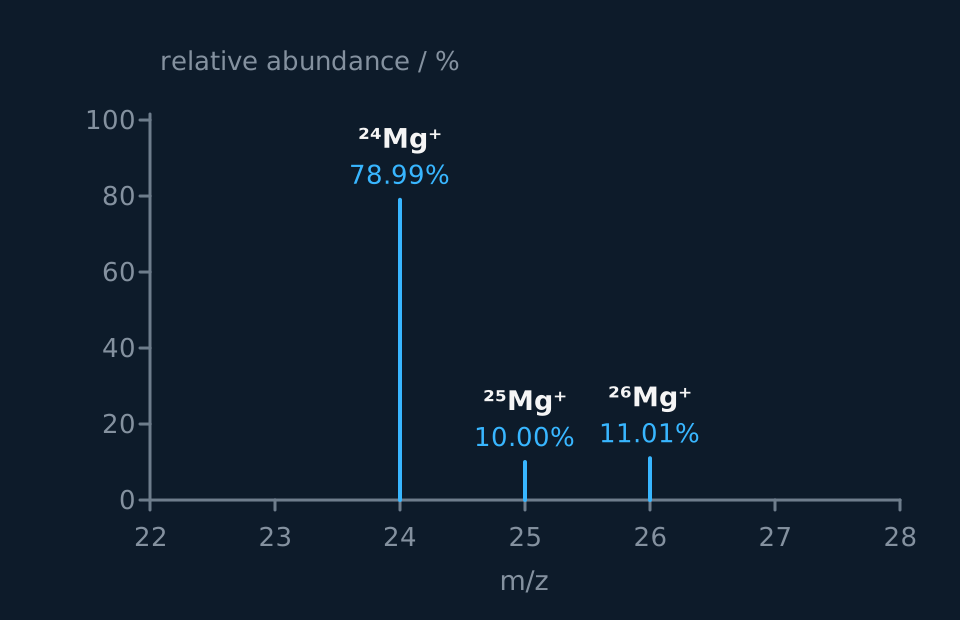
A mass spectrum of magnesium shows three peaks: m/z = 24 with an abundance of 78.99%, m/z = 25 with 10.00% and m/z = 26 with 11.01%. Calculate the relative atomic mass of magnesium to one decimal place.
Show the working
Multiply each isotopic mass by its abundance: 24 × 78.99 = 1895.76; 25 × 10.00 = 250.00; 26 × 11.01 = 286.26.
Add the products: 1895.76 + 250.00 + 286.26 = 2432.02.
Divide by the total abundance. The percentages add up to 100.00, so Ar = 2432.02 ÷ 100.00 = 24.3202.
Ar(Mg) = 24.3 to one decimal place, as on the periodic table. The answer lies between 24 and 26 and close to 24, as it must when nearly four atoms in five are magnesium-24.
Abundances are not always percentages. Many spectra give heights relative to the tallest peak, set at 100, and then the divisor is the sum of the heights, not 100. A spectrum of gallium might show heights of 100 at m/z = 69 and 66.4 at m/z = 71: Ar = (69 × 100 + 71 × 66.4) ÷ 166.4 = 69.8. Dividing by 100 instead would give 116, which is not between the two isotopic masses and cannot be right.
A relative atomic mass can also identify an element. The value of 69.8 from those two peaks is closest to gallium's on the periodic table, 69.7. The small difference comes from using whole-number isotopic masses. With the relative isotopic masses read to two decimal places, 68.93 and 70.92, the same abundances give 69.7.
The same equation runs backwards. Copper has Ar = 63.5 and isotopes of mass 63 and 65. Writing x for the percentage of copper-63, 63x + 65(100 − x) = 6350, so 6500 − 2x = 6350 and x = 75. On these whole-number masses copper is 75% copper-63 and 25% copper-65.
Timing the flight
Kinetic energy and speed are linked by the equation from GCSE physics, and the time follows from distance and speed.
KE = ½mv²m in kg, v in m s⁻¹, KE in J. Every 1+ ion in the flight tube has the same KE.
t = d ÷ vd is the length of the flight tube in m and t the flight time in s.
Rearranging the first equation gives v = √(2KE/m), and substituting into the second gives t = d√(m/2KE). With KE and d the same for every ion, t is proportional to √m: an ion four times as heavy takes twice as long. The m in these equations is the mass of one ion in kilograms, found by dividing the molar mass in kg mol⁻¹ by the Avogadro constant.
Flight times of the two chlorine ions
In a time-of-flight spectrometer every ion is given a kinetic energy of 4.00 × 10⁻¹⁶ J, and the flight tube is 1.20 m long. Calculate the flight time of a ³⁵Cl⁺ ion, and the ratio of the flight time of a ³⁷Cl⁺ ion to that of a ³⁵Cl⁺ ion. L = 6.022 × 10²³ mol⁻¹.
Show the working
Mass of one ³⁵Cl⁺ ion. The molar mass is 35.0 g mol⁻¹, which is 0.0350 kg mol⁻¹, so m = 0.0350 ÷ (6.022 × 10²³) = 5.812 × 10⁻²⁶ kg. The mass of the missing electron is negligible.
Speed. v = √(2KE/m) = √(2 × 4.00 × 10⁻¹⁶ ÷ 5.812 × 10⁻²⁶) = √(1.376 × 10¹⁰) = 1.173 × 10⁵ m s⁻¹.
Time. t = d ÷ v = 1.20 ÷ (1.173 × 10⁵) = 1.023 × 10⁻⁵ s, which is 1.02 × 10⁻⁵ s to three significant figures.
Ratio. At constant KE and d, t is proportional to √m, so t(³⁷Cl⁺) ÷ t(³⁵Cl⁺) = √(37 ÷ 35) = 1.03. The heavier ion arrives about 3% later, 1.05 × 10⁻⁵ s after it set off. Working out the second time in full and dividing gives the same ratio by a longer route.
Two checks catch most slips in these calculations. The mass of one ion is of the order of 10⁻²⁶ to 10⁻²⁵ kg; a mass near 10⁻²³ means grams were not converted to kilograms. And flight times in these instruments are a few microseconds, so an answer in whole seconds or in nanoseconds needs checking.
Molecules and the molecular ion
When an electron strikes a molecule, the first ion to form is the whole molecule less one electron: the molecular ion, M⁺. Its m/z is the relative molecular mass, so the peak furthest to the right of a spectrum gives Mr, apart from a very small peak one unit beyond it from molecules containing a carbon-13 atom. Some molecular ions then break apart, and the pieces give peaks at lower m/z.
Cl₂(g) + e⁻ → Cl₂⁺(g) + 2e⁻The molecular ion of chlorine forms by electron impact.
The same reading applies to a compound. Ethanol, CH₃CH₂OH, gives its molecular ion peak at m/z = 46 by electron impact, so its Mr is 46; by electrospray the peak is at 47, from CH₃CH₂OH₂⁺. The fragment peaks at lower m/z show how the molecule is built, and reading them belongs to organic analysis. For an element made of atoms rather than molecules, such as magnesium, there are no fragments and every peak is an isotope.
Chlorine shows why an element can give more than two peaks. A Cl₂ molecule contains two atoms, each of which is chlorine-35 or chlorine-37, so there are three possible molecules: ³⁵Cl–³⁵Cl with Mr 70, ³⁵Cl–³⁷Cl with Mr 72, and ³⁷Cl–³⁷Cl with Mr 74. The spectrum shows M⁺ peaks at 70, 72 and 74, and also peaks at 35 and 37 from Cl⁺ ions made when some molecular ions split.
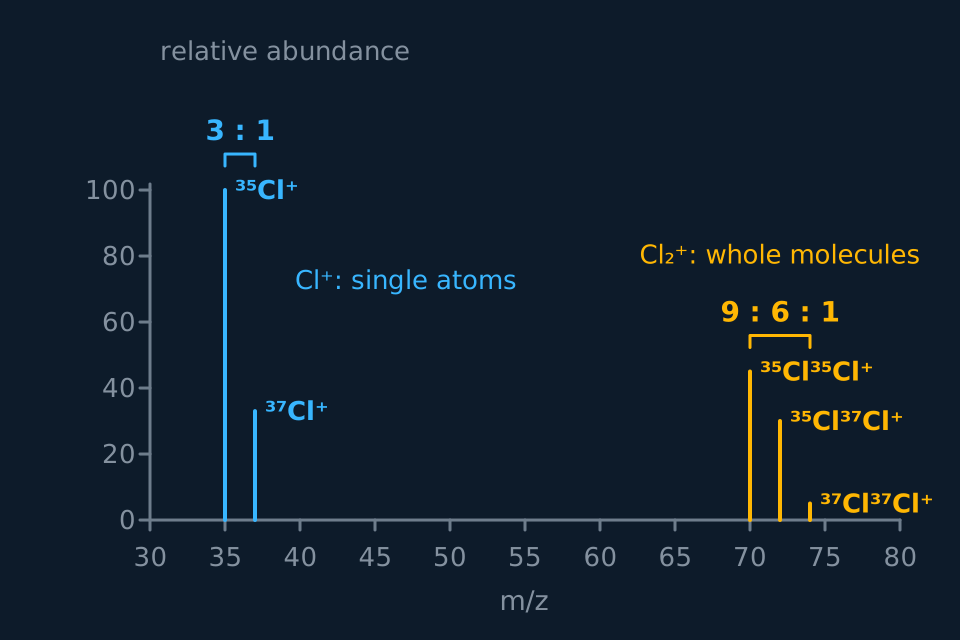
Describe the drawing
Mass spectrum of chlorine with m/z from 30 to 80. Two cyan lines for single chlorine atom ions, at 35 with height 100 and at 37 with height 33, bracketed as a 3 to 1 ratio. Three amber lines for chlorine molecule ions, at 70 with height 45 from two chlorine-35 atoms, at 72 with height 30 from one of each, and at 74 with height 5 from two chlorine-37 atoms, bracketed as a 9 to 6 to 1 ratio.
The heights of the three follow from the 3 : 1 ratio of the atoms. The chance that an atom is chlorine-35 is ¾, and chlorine-37 ¼. Two chlorine-35 atoms: ¾ × ¾ = 9/16. Two chlorine-37 atoms: ¼ × ¼ = 1/16. One of each can happen two ways, 35 then 37 or 37 then 35: 2 × ¾ × ¼ = 6/16. The peaks at 70, 72 and 74 are therefore in the ratio 9 : 6 : 1.
| Element | Mass number | Abundance / % |
|---|---|---|
| Chlorine | 35 | 75.53 |
| Chlorine | 37 | 24.47 |
| Bromine | 79 | 50.69 |
| Bromine | 81 | 49.31 |
| Magnesium | 24 | 78.99 |
| Magnesium | 25 | 10.00 |
| Magnesium | 26 | 11.01 |
- Molecular ion
- The ion formed when a whole molecule loses one electron, M⁺, whose m/z gives the relative molecular mass.
TRY IT: The molecular ion peaks of bromine
Bromine has two isotopes, bromine-79 and bromine-81, in almost equal amounts. Predict the m/z values and relative heights of the molecular ion peaks of Br₂, and calculate Ar of bromine from the abundances in the table.
Check your answer
Each atom in Br₂ is ⁷⁹Br or ⁸¹Br, with a chance of about ½ each. ⁷⁹Br–⁷⁹Br has Mr 158, ⁷⁹Br–⁸¹Br has 160 and ⁸¹Br–⁸¹Br has 162.
The chances are ½ × ½ = ¼ for 158, 2 × ½ × ½ = ½ for 160 and ¼ for 162, so the peaks are in the ratio 1 : 2 : 1, with the middle one tallest.
Ar = (79 × 50.69 + 81 × 49.31) ÷ 100 = 7998.62 ÷ 100 = 80.0 to three significant figures. The data sheet gives 79.9 because the true isotopic masses are 78.92 and 80.92, not whole numbers.
Other boards: the M+1 and M+2 peaks
AQA examines the instrument itself: the four stages, and the flight-time calculation. OCR, Edexcel and Cambridge ask for a spectrum to be read and calculated from instead, and Cambridge adds two readings of the molecular ion region of an organic compound, the carbon count from the M+1 peak and the halogen from the M+2 peak.
Carbon has two stable isotopes: carbon-12, and carbon-13, which is about 1.1% of all carbon atoms. Most molecules of an organic compound contain only carbon-12 and give the molecular ion peak, M. A few contain one carbon-13 atom, and they give a small peak one unit higher, the M+1 peak.
The more carbon atoms a molecule has, the more chances it has to include a carbon-13, so the M+1 peak grows with the number of carbons. Each carbon has a 1.1% chance of being carbon-13, so in a molecule with n carbons the M+1 peak is close to n × 1.1% of the height of the M peak. Rearranged, that counts the carbons.
n = (100 × height of M+1 peak) ÷ (1.1 × height of M peak)n is the number of carbon atoms in one molecule. The two heights can be in any units, as long as both are in the same ones.
Counting carbons from the M+1 peak
A hydrocarbon gives a molecular ion peak at m/z = 86 with a relative height of 40.0, and an M+1 peak at m/z = 87 with a relative height of 2.64. Calculate the number of carbon atoms in one molecule, and deduce the molecular formula.
Show the working
n = (100 × 2.64) ÷ (1.1 × 40.0) = 264 ÷ 44.0 = 6.0.
A molecule holds a whole number of atoms, so it has 6 carbon atoms.
Six carbons account for 6 × 12 = 72 of the Mr of 86, leaving 86 − 72 = 14 for hydrogen, which is 14 hydrogen atoms.
The formula is C₆H₁₄, which fits the alkane formula CₙH₂ₙ₊₂ with n = 6.
Chlorine and bromine leave a different mark. An organic compound with one chlorine atom gives two molecular ion peaks two units apart: M from the molecules containing chlorine-35, and the M+2 peak from those containing chlorine-37, in the ratio 3 : 1. Chloromethane, CH₃Cl, gives peaks at m/z = 50 and 52.
With one bromine atom the two peaks are almost equal in height, because bromine-79 and bromine-81 are almost equally abundant: bromoethane, C₂H₅Br, gives peaks at 108 and 110. A molecule with two chlorine atoms gives M, M+2 and M+4 in the ratio 9 : 6 : 1, for the same reason as Cl₂. A pair of peaks two units apart in a ratio of 3 : 1 or 1 : 1 is the quickest sign of a halogen in a spectrum.
- M+1 peak
- A small peak one m/z unit above the molecular ion peak, from molecules that contain one carbon-13 atom.
- M+2 peak
- A peak two m/z units above the molecular ion peak, from molecules that contain chlorine-37 or bromine-81 in place of the lighter isotope.
In the exam
- For acceleration, the scheme awards the mark for an electric field giving every ion the same kinetic energy. A time-of-flight instrument has no magnet, and 'deflected by a magnetic field' is not accepted.
- For detection, the scheme gives three marks: each ion gains an electron at the detector, this produces a current, and the current is proportional to the abundance.
- For electrospray, write the equation with the proton gained, X(g) + H⁺ → XH⁺(g), and give the mass of the ion detected as Mr + 1.
- An Ar answer must lie between the lightest and heaviest isotopic masses. Divide by the sum of the abundances, and give the answer to the precision asked, usually one decimal place.
- A flight-time answer starts from the mass of one ion in kilograms, molar mass in kg mol⁻¹ divided by the Avogadro constant, before KE = ½mv² is used.
Check yourself
In one spectrometer a ²⁴Mg⁺ ion takes 8.47 µs to reach the detector. Calculate the time taken by a ²⁶Mg⁺ ion in the same instrument, and explain why a ²⁴Mg²⁺ ion, which has a charge of +2, arrives sooner than either.
Answer
At the same kinetic energy and distance, t is proportional to √m, so t(²⁶Mg⁺) = 8.47 × √(26 ÷ 24) = 8.47 × 1.041 = 8.82 µs.
An ion with a charge of +2 gains twice the kinetic energy from the same electric field. With the same mass and twice the KE, its speed is √2 times greater, so it takes 8.47 ÷ √2 = 5.99 µs.
That is the flight time of a 1+ ion of mass 12, which is why a 2+ ion appears on the spectrum at m/z = 24 ÷ 2 = 12.
Questions
Question 16 marks
Explain the five peaks in the mass spectrum of chlorine gas, including the ratios of their heights.
Mark scheme
Indicative content
- chlorine atoms are chlorine-35 and chlorine-37 in a ratio of about 3 : 1, from abundances of about 75% and 25%
- the peaks at m/z 35 and 37 are ³⁵Cl⁺ and ³⁷Cl⁺ ions, formed when some Cl₂⁺ molecular ions break apart
- the heights at 35 and 37 are in the ratio 100 : 33, which is 3 : 1, the ratio of the two isotopes
- the peaks at 70, 72 and 74 are the molecular ions ³⁵Cl–³⁵Cl⁺, ³⁵Cl–³⁷Cl⁺ and ³⁷Cl–³⁷Cl⁺
- the chance of two chlorine-35 atoms is ¾ × ¾ = 9/16, and of two chlorine-37 atoms ¼ × ¼ = 1/16
- the mixed molecule can form two ways, 2 × ¾ × ¼ = 6/16, so the heights 45 : 30 : 5 are in the ratio 9 : 6 : 1
Levels
- Level 3 (5–6 marks) all five peaks are assigned to the correct ions, the 3 : 1 ratio at 35 and 37 is linked to the isotope abundances, and the 9 : 6 : 1 ratio of the molecular ion peaks is derived from the probabilities including the two ways of forming the mixed molecule; the working is shown and the ions carry their charges
- Level 2 (3–4 marks) the atomic and molecular ion peaks are assigned and the 3 : 1 ratio explained; 9 : 6 : 1 is stated without derivation, or derived without the factor of two for ³⁵Cl³⁷Cl⁺
- Level 1 (1–2 marks) 35 and 37 are named as the isotopes or 70 to 74 as Cl₂⁺; the molecular ions are usually given the same 3 : 1 ratio, and the ratios go unexplained
Question 24 marksAQA
State, in order, the four stages of a time-of-flight mass spectrometer, and explain why the instrument is kept under a high vacuum.
Mark scheme
- B1 ionisation first, then acceleration
- B1 ion drift in the flight tube, then detection
- B1 without a vacuum the ions would collide with molecules in the air
- B1 collisions would slow or deflect the ions, so they would arrive at the wrong time or not reach the detector
Question 34 marksAQA
Calculate the flight time of a ²⁴Mg⁺ ion in a spectrometer that gives every ion 2.00 × 10⁻¹⁶ J of kinetic energy and has a flight tube 1.50 m long. L = 6.022 × 10²³ mol⁻¹.
Mark scheme
- M1 mass of one ion = 0.0240 kg mol⁻¹ ÷ 6.022 × 10²³ mol⁻¹ = 3.985 × 10⁻²⁶ kg
- M1 v = √(2KE/m) = √(2 × 2.00 × 10⁻¹⁶ ÷ 3.985 × 10⁻²⁶) = 1.002 × 10⁵ m s⁻¹
- M1 t = d ÷ v = 1.50 ÷ 1.002 × 10⁵; error carried forward from the speed
- A1 t = 1.50 × 10⁻⁵ s, to three significant figures
All 19 questions with mark schemes, the other 16 set out in full on the question page.
Worth remembering
- 'Deflected by a magnetic field' describes a different machine: a time-of-flight instrument accelerates ions with an electric field.
- Dividing by 100 when the abundances are relative heights gives an Ar outside the isotopic masses.
- Convert the mass to kilograms and divide by L before working out a flight time; a mass in grams makes the time about thirty times too long.
- An electrospray peak at Mr + 1 read as Mr names the wrong molecule; subtract the proton.
- The detector current measures abundance; m/z comes from the arrival time, not from the size of the current.
CHECK YOUR PROGRESS
Rate how confident you are with each objective for this lesson. Ratings are saved in this browser, on this device, unless you sign in.
- Describe the four stages of a time-of-flight mass spectrometer, including both electron impact and electrospray ionisation.
- Explain why every ion leaves the acceleration stage with the same kinetic energy, and why lighter ions reach the detector first.
- Calculate the flight time of an ion from KE = ½mv² and t = d/v, and the ratio of the flight times of two ions.
- Calculate a relative atomic mass from the isotopic masses and abundances in a mass spectrum, and an abundance from a relative atomic mass.
- Interpret the molecular ion peaks of chlorine and bromine as combinations of isotopes.
- Use the M+1 peak to calculate the number of carbon atoms in a molecule, and the M+2 peak to identify chlorine or bromine in an organic compound.
Open the full revision checklist to see every objective in the curriculum in one place.
Practise this lesson
WORKBOOK
The written questions from this topic, on paper with room to work, and a separate book of mark schemes. The 5 questions that are set on a diagram stay on this page, where the diagram can be drawn. Free to use; please do not redistribute or sell.
Used later in The mole, the Avogadro constant and molar mass · Empirical and molecular formulae · Test-tube reactions for functional groups, and high-resolution mass spectrometry