Chemistry › Bonding and structure › The four crystal structures and their properties
The four crystal structures and their properties
Salt, magnesium, diamond and iodine are all solids at room temperature, and each behaves differently when heated, connected to a battery or dropped in water. They are the four crystal structures: ionic, metallic, macromolecular and molecular. Knowing which particles a solid is made of and what holds them together predicts its melting point, its conductivity and its solubility, and explains why graphite conducts and ice floats.
Key terms Every definition in bonding and structure, lesson by lesson
Before this Ionic bonding and ionic lattices – the sodium chloride lattice · Covalent, dative covalent and metallic bonding – covalent bonds and the sea of delocalised electrons
COMMON MISCONCEPTION
When ice or iodine melts, the covalent bonds inside the molecules break.
Melting a molecular solid separates whole molecules from each other, against hydrogen bonds in ice and van der Waals forces in iodine. Every O–H and I–I bond is still intact in the liquid and in the vapour. Covalent bonds break on melting only in a macromolecular solid such as diamond or silicon dioxide, and those melt above 1500 °C.
What you should be able to do
- Name the four types of crystal structure and give an example of each.
- Describe the structures of diamond, graphite and silicon dioxide, and explain their melting points, hardness and conductivity.
- Explain why molecular substances such as iodine and ice have low melting points, naming what is overcome on melting.
- Explain why ice is less dense than liquid water.
- Deduce the structure of an unknown solid from its melting point, conductivity and solubility.
Four ways to build a solid
How a solid behaves when it is heated depends on what it is made of and what holds those particles together. Salt, magnesium ribbon and the graphite in a pencil show no change when warmed in a test tube over a Bunsen flame. Grey-black iodine crystals turn within a minute into a purple vapour, which grows dark crystals again on the cool top of the tube.
There are four types of crystal structure. In an ionic crystal the particles are oppositely charged ions. In a metallic crystal they are positive ions in a sea of delocalised electrons. In a macromolecular crystal they are atoms joined by covalent bonds into one network running through the whole crystal. In a molecular crystal they are small molecules, each held together internally by covalent bonds but held to its neighbours only by intermolecular forces.
The first three are giant structures, with the strong bonding running unbroken from one side of the crystal to the other. To melt them, that bonding has to be overcome. A molecular crystal is different: melting separates the molecules from each other, and the covalent bonds inside each molecule stay intact. Intermolecular forces are far weaker than covalent bonds, so salt melts at 801 °C and iodine at 114 °C. Name the force that is overcome: 'the bonds break' for iodine does not earn the mark, because the covalent bonds are not the ones that break.
- Giant structure
- A structure in which the bonding extends throughout the whole crystal, with no separate molecules, as in ionic, metallic and macromolecular crystals.
- Macromolecular crystal
- A giant structure of atoms joined by covalent bonds in a network that extends throughout the crystal; also called giant covalent.
- Molecular crystal
- A regular arrangement of simple molecules held in place by intermolecular forces, with covalent bonds only within each molecule.
- Intermolecular force
- An attraction between separate molecules, much weaker than the covalent bonds within them.
Macromolecular: diamond, graphite and silicon dioxide
Diamond is pure carbon in which every atom is covalently bonded to four others at the corners of a tetrahedron, with bond angles of 109.5°. The network continues in three dimensions to the edges of the crystal. Melting it would mean breaking covalent bonds, four round every atom, and at atmospheric pressure diamond does not melt at all: heated in the absence of air it turns to graphite, and graphite only sublimes, above about 3600 °C. The same rigid network makes it the hardest natural substance, used to tip saws and drills for cutting stone.
All four outer electrons of every carbon atom in diamond are held in bonds between two particular atoms. None is free to move, so diamond does not conduct electricity.
Graphite is pure carbon too, arranged differently. Each atom is bonded to three others in a flat sheet of hexagons, with bond angles of 120°. The fourth outer electron of each atom is delocalised across the sheet, above and below the plane of the atoms. The sheets are stacked 0.335 nm apart, more than twice the C–C bond length of 0.142 nm within a sheet, and they are held to each other only by weak forces.
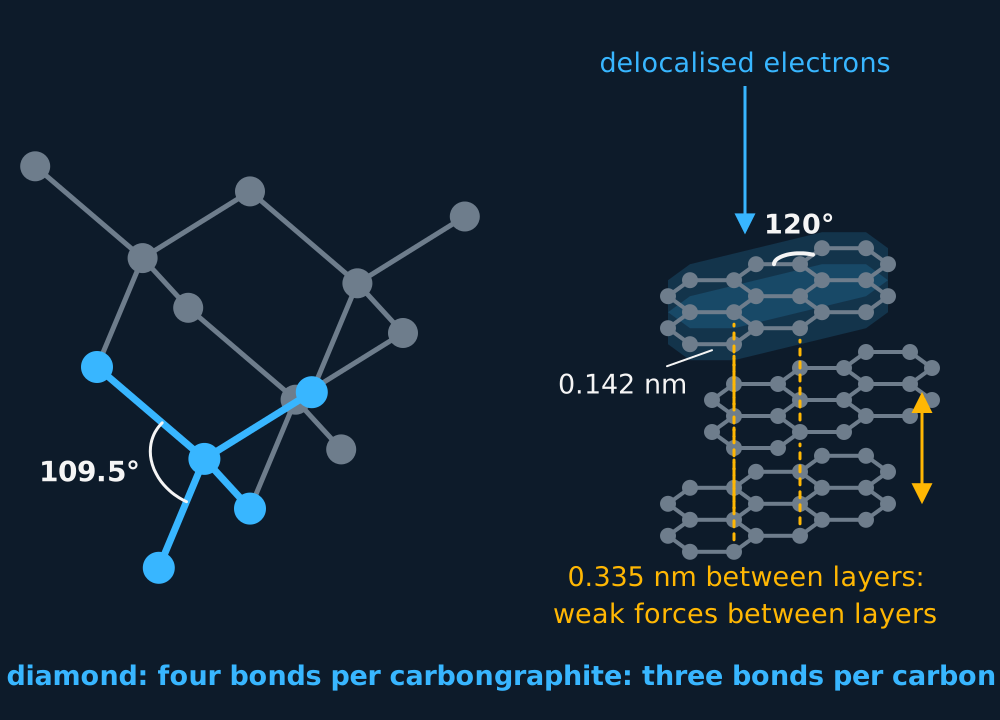
Describe the drawing
Two ball-and-stick structures of carbon. On the left, diamond: fourteen grey atoms in a three-dimensional network, one atom and its four neighbours picked out in cyan with the tetrahedral angle of 109.5° marked. On the right, graphite: three flat layers of fused hexagons seen at an angle, each atom bonded to three others at 120°, alternate layers offset, dashed amber lines between layers marking the weak forces and a spacing of 0.335 nm, an in-layer bond of 0.142 nm, and a faint cyan band above and below the top layer for its delocalised electrons.
That structure gives graphite its mixed properties. The covalent bonds within the layers are strong, so it does not melt below about 3600 °C. The forces between the layers are weak, so the layers slide over each other: graphite is soft, marks paper and is used as a dry lubricant. The delocalised electrons move freely along the layers, so graphite conducts electricity in the direction of the layers and is used for electrodes. It conducts poorly at right angles to them.
The wide spacing between the layers also makes graphite less dense than diamond: 2.26 g cm⁻³ against 3.51 g cm⁻³. Diamond and graphite are allotropes of carbon. A single layer of graphite is graphene, one atom thick, very strong in its own plane and a good conductor, since its delocalised electrons move across the sheet.
Silicon dioxide, the mineral quartz and the main part of sand, is macromolecular as well. Each silicon atom is bonded to four oxygen atoms tetrahedrally and each oxygen atom to two silicon atoms, so the formula SiO₂ is a ratio, as it is for an ionic compound. It melts at about 1710 °C, is hard, does not conduct and does not dissolve in water. Silicon itself has the diamond structure.
Counting the bonds in a diamond
A one-carat diamond has a mass of 0.200 g. Calculate the number of carbon atoms in it and the number of C–C bonds. L = 6.022 × 10²³ mol⁻¹.
Show the working
Amount of carbon = mass ÷ Ar = 0.200 ÷ 12.0 = 0.01667 mol.
Number of atoms = 0.01667 × 6.022 × 10²³ = 1.004 × 10²² atoms.
Each atom makes four bonds, but each bond joins two atoms and would be counted twice, so there are 4 ÷ 2 = 2 bonds per atom.
Number of C–C bonds = 2 × 1.004 × 10²² = 2.01 × 10²², to three significant figures, matching the mass given. The same mass of graphite, with 3 ÷ 2 = 1.5 bonds per atom in its layers, holds 1.51 × 10²² C–C bonds.
- Allotrope
- One of two or more different structural forms of the same element in the same physical state, such as diamond and graphite.
Molecular: iodine and ice
Iodine is made of I₂ molecules. Inside each molecule the two iodine atoms share a pair of electrons in a covalent bond. Between molecules there are only induced dipole–dipole forces, the weakest kind of intermolecular force, though with 106 electrons in every molecule they are strong enough to keep iodine solid at room temperature. The molecules pack in a regular lattice, so the solid is crystalline.
Warming iodine gently overcomes the forces between the molecules and the solid sublimes to a purple vapour. The I–I bonds are not affected: the vapour is still I₂, and it condenses back to the same crystals.
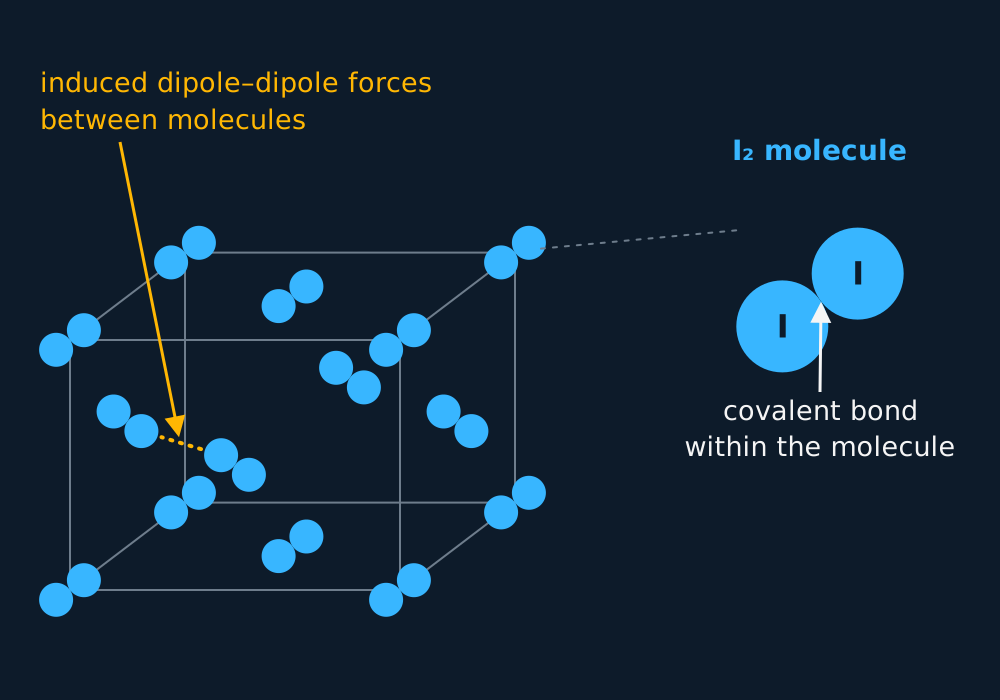
Describe the drawing
A thin rectangular box drawn in perspective with a cyan dumbbell-shaped I₂ molecule, two touching spheres, at each of its eight corners and the centre of each of its six faces. The molecules at the corners and on the top and bottom faces tilt one way; those on the four side faces tilt the other. A dotted amber line between two neighbouring molecules marks the induced dipole–dipole forces, and a magnified callout of one molecule marks the covalent bond between its two iodine atoms.
Molecular solids share a set of properties. Their melting and boiling points are low, because only weak intermolecular forces are overcome. They do not conduct electricity as solids or liquids, because the molecules are uncharged and there are no delocalised electrons. They are usually soft. Their solubility depends on the forces they can form with a solvent: iodine dissolves poorly in water but readily in hexane, giving a violet solution.
Ice is a molecular crystal too, but the forces between its molecules are hydrogen bonds, the strongest kind of intermolecular force. In ice every water molecule is hydrogen bonded to four others, two through its own hydrogen atoms and two through its lone pairs. The four neighbours sit at the corners of a tetrahedron, and the result is an open lattice of puckered hexagonal rings with a lot of empty space inside them.
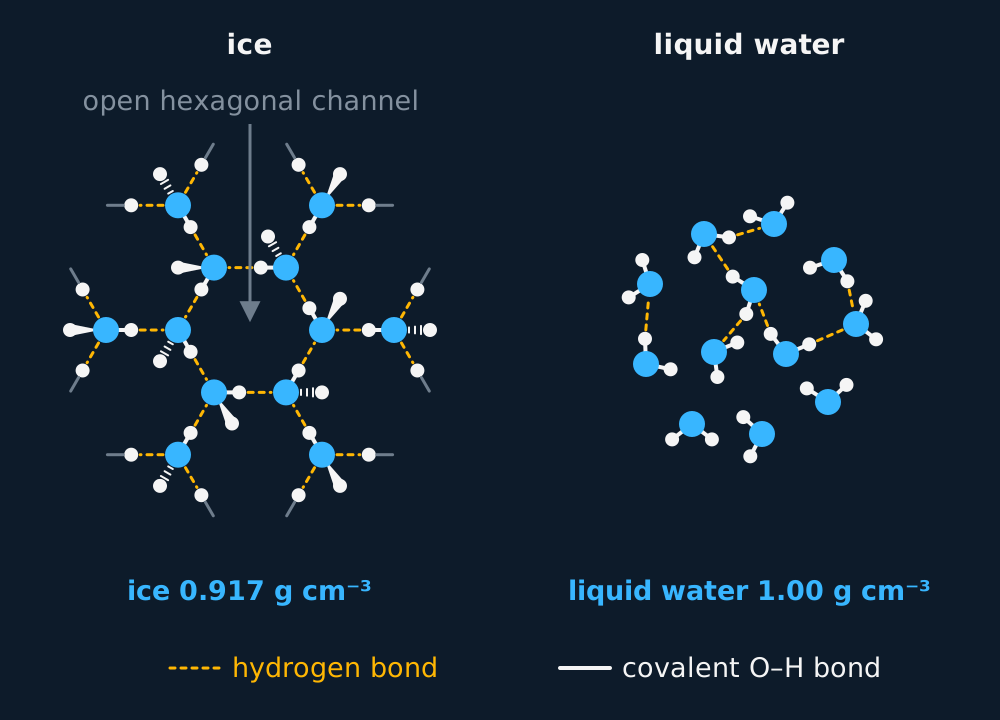
Describe the drawing
Two panels of twelve water molecules each, cyan oxygen atoms with white hydrogens. Ice, on the left: the molecules form a hexagonal ring round an empty central channel, with more rings starting outside it; every oxygen has two covalent O–H bonds and two dashed amber hydrogen bonds, one connection in each panel pointing out of the page as a wedge or a hatched wedge. Liquid water, on the right: the same twelve molecules packed into a smaller area at random angles, some where the channel was, with only a few hydrogen bonds.
When ice melts, some of the hydrogen bonds break, the open lattice collapses and molecules move into the spaces. Liquid water is therefore denser than ice, 1.00 g cm⁻³ against 0.917 g cm⁻³ at 0 °C. Ice floats, and a pond freezes from the top down, the ice insulating the water below it. For almost every other substance the solid is denser than the liquid and sinks in it.
- Sublimation
- The change of state from solid directly to gas, without passing through the liquid.
Energy at a change of state
Melting and boiling are endothermic for every substance, because energy is needed to overcome the forces between the particles. A beaker of crushed ice heated steadily stays at 0 °C until the last of the ice has gone; the temperature then rises, and stops again at 100 °C while the water boils. At each pause the energy going in does not raise the temperature. Freezing and condensing release the same amounts of energy, which is why steam at 100 °C scalds worse than water at 100 °C.
The energy needed per mole is the enthalpy of fusion for melting and the enthalpy of vaporisation for boiling. Both follow the strength of the forces that are overcome, and vaporisation is always the larger. On melting the particles stay in contact and most of the attractions survive, loosened; on boiling every particle is separated from all its neighbours. For water the two values are 6.01 and 40.7 kJ mol⁻¹. Sodium chloride, a giant structure, needs 28 kJ mol⁻¹ just to melt, more than four times water's enthalpy of fusion.
Melting and boiling the same mass of water
Calculate the energy needed to melt 72.0 g of ice at 0 °C, and the energy needed to boil 72.0 g of water at 100 °C. Enthalpy of fusion 6.01 kJ mol⁻¹; enthalpy of vaporisation 40.7 kJ mol⁻¹; Mr of H₂O = 18.0.
Show the working
Amount of water = 72.0 ÷ 18.0 = 4.00 mol.
Melting: 4.00 × 6.01 = 24.0 kJ. Boiling: 4.00 × 40.7 = 163 kJ, both to three significant figures.
Boiling needs 163 ÷ 24.0 = 6.8 times as much energy. Melting breaks only enough hydrogen bonds to collapse the open lattice of ice; boiling breaks the rest, separating the molecules completely. In neither change is an O–H bond broken: breaking every O–H bond in 4.00 mol of water would take about 3700 kJ.
- Enthalpy of fusion
- The enthalpy change when one mole of a solid is converted into a liquid at its melting point.
- Enthalpy of vaporisation
- The enthalpy change when one mole of a liquid is converted into a gas at its boiling point.
Comparing the four structures
Side by side, the four structures differ first in their particles and in the force that has to be overcome to separate them. The melting point and the conductivity follow from those two.
| Ionic | Metallic | Macromolecular | Molecular | |
|---|---|---|---|---|
| Example | Sodium chloride | Magnesium, copper | Diamond, graphite, silicon dioxide | Iodine, ice, C₆₀ |
| Particles | Positive and negative ions | Positive ions and delocalised electrons | Atoms | Small molecules |
| Overcome on melting | Attraction between oppositely charged ions | Attraction between ions and delocalised electrons | Covalent bonds | Intermolecular forces only |
| Melting point | High: NaCl 801 °C | Usually high: Mg 650 °C | Very high: SiO₂ 1710 °C, carbon above 3500 °C | Low: I₂ 114 °C, ice 0 °C |
| Conducts as a solid | No: ions fixed in place | Yes: delocalised electrons move | No, except graphite | No |
| Conducts when molten | Yes: ions free to move | Yes | No | No |
| Soluble in water | Often | No, though some react | No | Usually not; some small polar molecules dissolve |
The energy needed to melt follows the force. Ionic and macromolecular crystals need a great deal, metals usually a lot, molecular crystals little. Metals have a feature of their own: melting only loosens the lattice, since the ions in the liquid are still held by the delocalised electrons, so a metal's boiling point lies far above its melting point. Magnesium melts at 650 °C and boils at 1090 °C.
To identify an unknown solid from data, start with conductivity. A solid that conducts is metallic, or graphite. One that conducts only when molten or dissolved is ionic. If it conducts in neither state, the melting point separates macromolecular, which is very high, from molecular, which is low.
A 'high' melting point covers a wide range, and the ranges for the giant structures overlap. Magnesium melts at 650 °C, below sodium chloride, but tungsten, also metallic, melts at 3422 °C, far above it. Strength depends on the charges and sizes of the particles in each substance, so two substances are compared one against the other, never by the name of the bonding type alone. The gap between any giant structure and a small molecular one, by contrast, is always large.
AQA asks for each structure to be drawn with a stated number of particles, and the drawing must show the bonding, not only the arrangement. For sodium chloride, draw a cube of eight ions with Na⁺ and Cl⁻ alternating at the corners and a key or a charge on each. For a metal, draw a regular arrangement of ions, each with its charge, with electrons in the spaces labelled delocalised. For diamond, one carbon bonded to four others; for graphite, at least two layers of hexagons with the gap between them labelled. For iodine or ice, separate molecules, with the forces between them drawn differently from the bonds within them.
TRY IT: Four unknown solids
Solid A melts at 1083 °C and conducts as a solid. Solid B melts at 801 °C, conducts only when molten or dissolved, and dissolves in water. Solid C melts at 80 °C, does not conduct in either state, and dissolves in hexane but not water. Solid D melts at 1710 °C, does not conduct in either state and dissolves in neither water nor hexane. Identify the structure of each.
Check your answer
A conducts as a solid, so it has delocalised electrons: metallic. B conducts only once its ions are free to move: ionic.
C and D conduct in neither state, so their particles are uncharged and they have no delocalised electrons. C melts at 80 °C, so only weak intermolecular forces are overcome: molecular.
D melts at 1710 °C, so strong covalent bonds must be broken to melt it, and it dissolves in nothing: macromolecular. These are the data for copper, sodium chloride, naphthalene and silicon dioxide.
Other boards: graphene, fullerenes and 'giant covalent'
OCR, Edexcel and Cambridge say giant covalent where AQA says macromolecular; the two terms describe the same structure, and a scheme on either board accepts its own word. OCR and Edexcel also name graphene, the single layer of graphite, and ask why it is strong and conducts.
Cambridge adds a third allotrope of carbon, which is molecular. Buckminsterfullerene, C₆₀, is a closed cage of sixty carbon atoms arranged in twelve pentagons and twenty hexagons, the pattern on a football. Each carbon is bonded to three others, as in graphite, and the remaining electrons are delocalised over the cage. Between one C₆₀ molecule and the next there are only induced dipole–dipole forces: strong for a molecule with 360 electrons, but nothing like the covalent network of diamond.
Solid C₆₀ is therefore soft, turns to vapour at a far lower temperature than diamond or graphite, and dissolves in non-polar solvents such as methylbenzene to give a purple solution. It is a very poor conductor: its delocalised electrons can move round one cage but cannot cross the gap to the next.
| Diamond | Graphite | Graphene | C₆₀ | |
|---|---|---|---|---|
| Structure | Giant three-dimensional network | Giant layers of hexagons | One layer of graphite | Separate molecules, each a closed cage |
| Bonds per carbon | 4 | 3 | 3 | 3 |
| Delocalised electrons | None | One per atom, along the layers | One per atom, across the sheet | Over each cage only |
| Conducts electricity | No | Yes, along the layers | Yes | Very poorly |
| Overcome to melt or sublime | Covalent bonds | Covalent bonds | Covalent bonds | Induced dipole–dipole forces |
- Fullerene
- A molecular allotrope of carbon in which each atom is bonded to three others in a closed cage or tube, such as C₆₀.
In the exam
- The force named must match the structure: ionic bonds, metallic bonding, covalent bonds or intermolecular forces. For iodine or ice, a scheme rejects any answer in which covalent bonds break on melting.
- Graphite's conductivity needs one delocalised electron per carbon atom, moving along the layers; 'free electrons' with no mention of delocalisation may not be credited. For diamond, every outer electron is held in a covalent bond.
- Ice floats because hydrogen bonds hold the molecules in an open lattice, so ice is less dense than liquid water, in which that lattice has partly collapsed.
- The high melting point of diamond or silicon dioxide needs many strong covalent bonds broken. A scheme rejects intermolecular forces in a macromolecular solid, because it has no separate molecules.
- A drawing of a structure is marked on the bonding as well as the arrangement: charges or a key on ions, delocalised electrons labelled in a metal, and the forces between molecules drawn differently from the bonds within them.
Check yourself
Silicon carbide, SiC, melts at about 2700 °C, is extremely hard and does not conduct electricity. Silicon tetrachloride, SiCl₄, melts at −69 °C. Deduce the structure of each and explain the difference in melting point.
Answer
Silicon carbide's very high melting point and hardness mean strong bonds run through the whole solid, and it does not conduct, so those bonds are covalent with no delocalised electrons. It is macromolecular, each atom bonded to four others like the carbon atoms in diamond.
Silicon tetrachloride melts far below room temperature, so very little has to be overcome. It is molecular: separate SiCl₄ molecules, each with four covalent Si–Cl bonds, held to each other by intermolecular forces.
Melting SiC breaks covalent bonds throughout the lattice. Melting SiCl₄ only separates molecules from each other, against far weaker intermolecular forces, and leaves every Si–Cl bond intact.
Questions
Question 16 marks
Explain the order of the melting points given in the table in terms of structure and bonding.
| Substance | Melting point / °C |
|---|---|
| Iodine | 114 |
| Magnesium | 650 |
| Sodium chloride | 801 |
| Silicon dioxide | 1710 |
Mark scheme
Indicative content
- iodine is molecular; melting overcomes only weak induced dipole–dipole forces between I₂ molecules, so its melting point is lowest
- magnesium is a giant metallic lattice of Mg²⁺ ions in delocalised electrons, a strong attraction
- melting a metal only loosens the lattice, as the ions stay attracted to the delocalised electrons in the liquid
- sodium chloride is a giant ionic lattice with strong attractions between oppositely charged ions in all directions
- silicon dioxide is macromolecular, each Si bonded to four O, so melting requires breaking many strong covalent bonds and its melting point is highest
- the three giant structures all melt far higher than iodine because strong bonding must be overcome, not intermolecular forces
Levels
- Level 3 (5–6 marks) all four substances are placed in the right order with the structure and the force or bond overcome on melting correctly identified for each, from the induced dipole forces of iodine to the covalent bonds of silicon dioxide; the answer separates intermolecular forces from bonds and explains why the giant structures melt so much higher
- Level 2 (3–4 marks) three of the four substances are explained with the structure and the force overcome, or all four are named and one explanation is thin
- Level 1 (1–2 marks) one or two structures are named, typically with covalent bonds said to break when iodine melts, and no account of the order
Question 24 marks
Explain why graphite conducts electricity but diamond does not.
Mark scheme
- B1 in graphite each carbon atom forms only three covalent bonds
- B1 the fourth outer electron of each atom is delocalised across the layer
- B1 the delocalised electrons can move along the layers and carry charge
- B1 in diamond all four outer electrons of each carbon are used in covalent bonds, so no electrons are free to move
Question 34 marks
Explain why ice is less dense than liquid water.
Mark scheme
- B1 in ice each water molecule is hydrogen bonded to four others
- B1 the hydrogen bonds hold the molecules in a rigid, open tetrahedral lattice with empty space inside it
- B1 on melting some hydrogen bonds break and the open lattice collapses
- B1 the molecules in the liquid pack more closely, so the same mass occupies a smaller volume
All 21 questions with mark schemes, the other 18 set out in full on the question page.
Worth remembering
- Covalent bonds breaking when iodine or ice melts is wrong: only intermolecular forces are overcome.
- Intermolecular forces in diamond, graphite or silicon dioxide do not exist to overcome.
- Graphite 'has free electrons' without saying they are delocalised in the layers is incomplete.
- Use conductivity to separate ionic, metallic and giant covalent (macromolecular) solids, since all three melt high: only the metal conducts as a solid, and the ionic one only when molten.
- Ice floating is explained by density and the open lattice, not by trapped air.
CHECK YOUR PROGRESS
Rate how confident you are with each objective for this lesson. Ratings are saved in this browser, on this device, unless you sign in.
- Name the four types of crystal structure and give an example of each.
- Describe the structures of diamond, graphite and silicon dioxide, and explain their melting points, hardness and conductivity.
- Explain why molecular substances such as iodine and ice have low melting points, naming what is overcome on melting.
- Explain why ice is less dense than liquid water.
- Deduce the structure of an unknown solid from its melting point, conductivity and solubility.
Open the full revision checklist to see every objective in the curriculum in one place.
Practise this lesson
WORKBOOK
The written questions from this topic, on paper with room to work, and a separate book of mark schemes. The question that is set on a diagram stays on this page, where the diagram can be drawn. Free to use; please do not redistribute or sell.
Used later in Electronegativity, polarity and intermolecular forces · Periodicity: trends across Period 3 and the blocks of the table