Chemistry › Bonding and structure › Ionic bonding and ionic lattices
Ionic bonding and ionic lattices
A grain of table salt is one giant lattice of sodium and chloride ions, with no molecule anywhere in it. The ions form when electrons move from metal atoms to non-metal atoms, and the attraction between their opposite charges holds the lattice together. The size of those charges and the size of the ions decide how strongly, which is why salt melts at 801 °C, conducts only when molten or dissolved, and shatters when struck.
Key terms Every definition in bonding and structure, lesson by lesson
Before this Electron configuration: shells, subshells and orbitals – the outer electrons of s- and p-block atoms · Ionisation energies and the evidence for subshells – why a Group 1 atom loses its outer electron easily · Formulae, equations and state symbols – balancing the charges in an ionic formula
COMMON MISCONCEPTION
Sodium chloride is made of NaCl molecules, each sodium holding on to the chlorine it gave its electron to.
There are no molecules in sodium chloride. Each Na⁺ is surrounded by six Cl⁻ ions and each Cl⁻ by six Na⁺, in a giant lattice that goes on to the edge of the crystal, and every ion attracts all its neighbours equally. NaCl gives the 1 : 1 ratio of ions, and molten or dissolved sodium chloride holds free Na⁺ and Cl⁻, not pairs.
What you should be able to do
- Describe ionic bonding as the electrostatic attraction between oppositely charged ions, and predict the charge on a simple ion from its group.
- Draw dot-and-cross diagrams for ionic compounds such as NaCl, MgO and CaCl₂, showing outer electrons and the charge on each ion.
- Describe the sodium chloride lattice, and explain why its formula is a ratio of ions and not a molecule.
- Explain how the charge and the radius of the ions affect the strength of an ionic lattice, and use that to compare melting points.
- Explain the trends in ionic radius down a group and along an isoelectronic series.
- Explain why ionic compounds are brittle, have high melting points, and conduct electricity when molten or dissolved but not as solids.
Electrons move from metal to non-metal
When a metal reacts with a non-metal, electrons move from the metal atoms to the non-metal atoms, and the product is made of ions. Hot sodium burns in chlorine with a bright yellow flame and gives a white smoke that settles as sodium chloride, the salt on a dinner table. A soft metal that fizzes in water and a green, toxic gas have become a hard, unreactive solid, because each sodium atom has given an electron to a chlorine atom.
2Na(s) + Cl₂(g) → 2NaCl(s)
A sodium atom, 1s² 2s² 2p⁶ 3s¹, has a single electron in its outer shell, removed for only 496 kJ mol⁻¹. A chlorine atom, 1s² 2s² 2p⁶ 3s² 3p⁵, has room for one more electron in its 3p subshell. In the reaction each sodium atom transfers its 3s electron to a chlorine atom. Sodium becomes Na⁺, with the electron configuration of neon, and chlorine becomes Cl⁻, with the configuration of argon.
The full outer shells are a result, not the cause. Making a gaseous Na⁺ and a gaseous Cl⁻ from the two atoms takes more energy than it releases. The energy that makes the reaction so exothermic is released afterwards, when the ions come together and attract each other in the solid. That attraction between opposite charges is the ionic bond.
The charge on a simple ion follows from the group. Metals in Groups 1, 2 and 3 lose one, two and three electrons to form ions of charge +1, +2 and +3. Non-metals in Groups 5, 6 and 7 gain three, two and one electrons to form ions of charge −3, −2 and −1. The formula of the compound balances the charges: Mg²⁺ with O²⁻ gives MgO, Ca²⁺ with two Cl⁻ gives CaCl₂, and Al³⁺ with O²⁻ needs two of one and three of the other, Al₂O₃.
Some ions are groups of atoms, covalently bonded together, that carry an overall charge. Their formulae are learned rather than worked out, and they combine by the same charge-balancing rule. Calcium carbonate is CaCO₃. Ammonium sulfate is (NH₄)₂SO₄, the brackets showing that two whole ammonium ions are needed to balance one sulfate.
| Ion | Formula | Charge |
|---|---|---|
| Sulfate | SO₄²⁻ | −2 |
| Carbonate | CO₃²⁻ | −2 |
| Nitrate | NO₃⁻ | −1 |
| Hydroxide | OH⁻ | −1 |
| Ammonium | NH₄⁺ | +1 |
- Ionic bonding
- The strong electrostatic attraction between oppositely charged ions, acting in all directions through a lattice.
- Ion
- An atom or group of atoms that carries an overall charge because its number of electrons differs from its number of protons.
- Compound ion
- A group of covalently bonded atoms that carries an overall charge, such as SO₄²⁻ or NH₄⁺.
Dot-and-cross diagrams and formula units
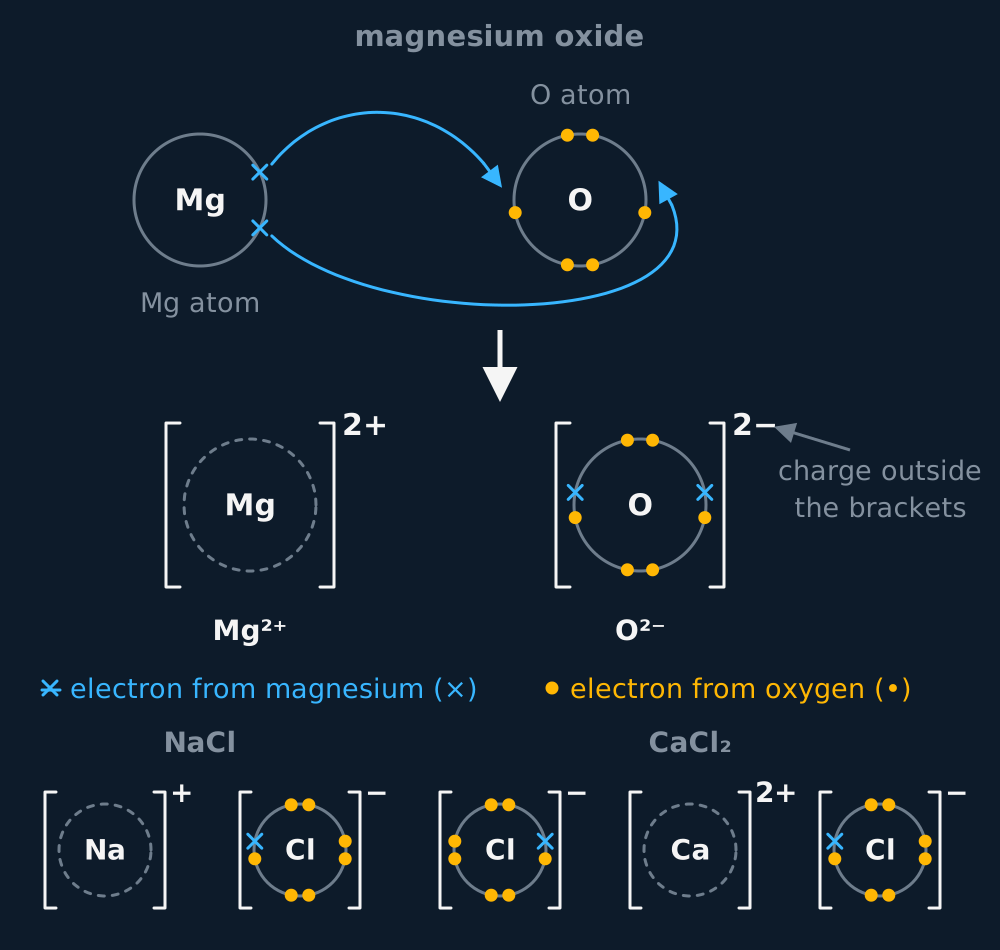
A dot-and-cross diagram shows where the outer electrons go. The electrons of one element are drawn as dots and those of the other as crosses, so that the reader can see which atom each electron came from. Once it has moved, an electron is the same as every other electron; the dot and the cross are bookkeeping.
For an ionic compound, draw each ion separately inside square brackets with its charge outside the top right corner. The metal ion is drawn with an empty outer shell, or with no outer shell at all, and the non-metal ion with a full outer shell of eight, including the electrons it received, drawn in the other symbol. Show outer shells only, unless the question asks for every shell.
Describe the drawing
Dot-and-cross diagrams of outer shells. At the top a magnesium atom with two crosses and an oxygen atom with six dots, two curved arrows carrying the crosses across to oxygen. Below, after transfer, magnesium is an empty-shelled Mg²⁺ ion in square brackets and oxygen an O²⁻ ion whose octet holds six dots and two crosses, each charge written outside its brackets. Along the bottom, sodium chloride as Na⁺ beside Cl⁻, and calcium chloride as Cl⁻, Ca²⁺, Cl⁻, every chloride with seven dots and one cross.
Calcium chloride from its atoms
Describe the dot-and-cross diagram for calcium chloride, and use it to explain the formula CaCl₂.
Show the working
Calcium is in Group 2, with two outer electrons, 4s². Chlorine is in Group 7, with seven outer electrons, 3s² 3p⁵, and one space left in its outer shell.
One calcium atom therefore gives one electron to each of two chlorine atoms. Calcium's electrons are drawn as crosses and chlorine's as dots.
The diagram has three bracketed ions: [Ca]²⁺ with no outer electrons shown, and two separate [Cl]⁻, each with seven dots and one cross in its outer shell.
The positive charge, +2, balances the total negative charge, 2 × (−1). The formula CaCl₂ states that ratio: one calcium ion for every two chloride ions. It does not describe a molecule of three atoms.
Because the formula is a ratio of ions, it also says how many of each ion a sample holds. One formula unit of CaCl₂ is one Ca²⁺ and two Cl⁻, three ions in all, and one mole of CaCl₂ is a mole of formula units. Multiplying the amount by the number of ions in the formula gives the amount of ions.
Counting the ions in aluminium oxide
Calculate the number of aluminium ions, the number of oxide ions and the total number of ions in 5.10 g of aluminium oxide, Al₂O₃. Ar: Al 27.0, O 16.0; L = 6.022 × 10²³ mol⁻¹.
Show the working
Mr of Al₂O₃ = 2 × 27.0 + 3 × 16.0 = 102.0, so the amount of formula units = 5.10 ÷ 102.0 = 0.0500 mol.
Each formula unit holds two Al³⁺ ions, so the number of Al³⁺ ions = 2 × 0.0500 × 6.022 × 10²³ = 6.02 × 10²².
Each formula unit holds three O²⁻ ions, so the number of O²⁻ ions = 3 × 0.0500 × 6.022 × 10²³ = 9.03 × 10²².
Total = 5 × 0.0500 × 6.022 × 10²³ = 1.51 × 10²³ ions, to three significant figures. The charges check: 6.02 × 10²² ions of charge +3 balance 9.03 × 10²² ions of charge −2. No molecule of Al₂O₃ has been counted, because there is none.
- Formula unit
- The group of ions given by the formula of an ionic compound, in the ratio they occur in the lattice; for CaCl₂, one Ca²⁺ and two Cl⁻.
The sodium chloride lattice
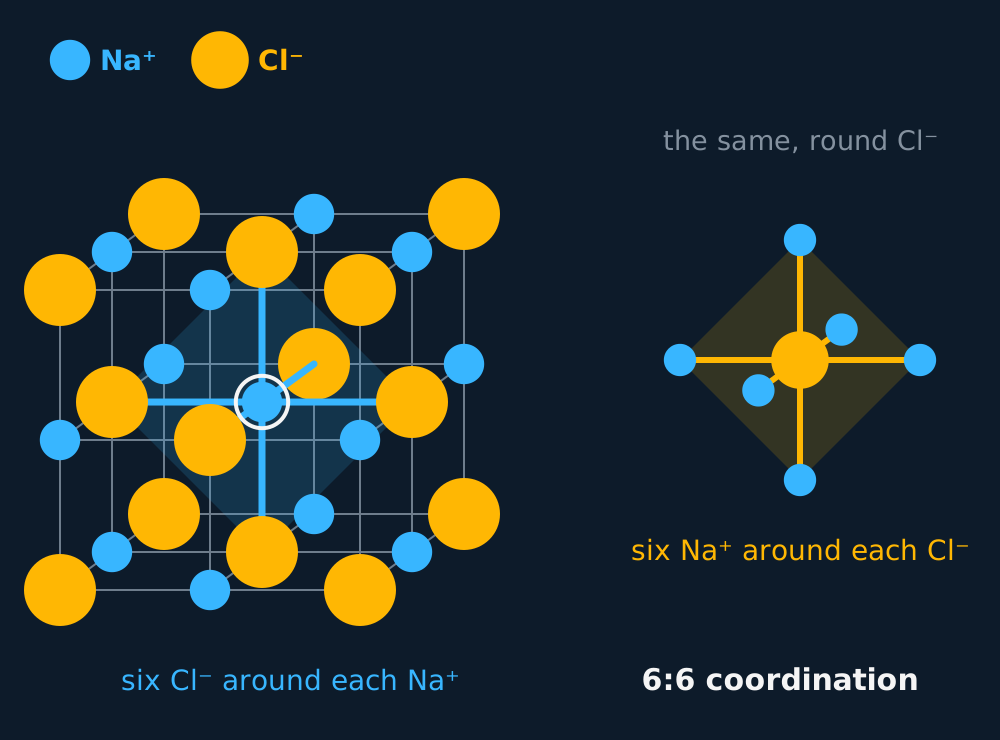
Grains of salt are tiny cubes, and the shape comes from the arrangement of the ions inside. In solid sodium chloride every Na⁺ ion has six Cl⁻ ions around it, one above, one below and four around its middle, and every Cl⁻ ion has six Na⁺ ions around it likewise. The pattern repeats in three dimensions, millions of ions along each edge of a single grain: a giant ionic lattice.
Describe the drawing
A cube of 27 ions in perspective, small cyan sodium ions and large amber chloride ions alternating along every thin grey grid line. The sodium ion at the centre is ringed, and thick cyan lines run from it to its six chloride neighbours, which mark the corners of a faintly shaded octahedron. An inset shows one chloride ion with six sodium ions round it in the same octahedral arrangement: 6:6 coordination.
Each ion attracts all six of its oppositely charged neighbours equally, and is repelled by the ions of its own charge a little further away. No Na⁺ belongs to any one Cl⁻. The formula NaCl therefore records a ratio, one sodium ion for every chloride ion, and 'a molecule of sodium chloride' has no meaning in the solid. The number of nearest neighbours of opposite charge is the coordination number; sodium chloride has 6:6 coordination.
Other ionic compounds pack differently, because their ions differ in size or come in a different ratio. Caesium chloride, with a larger cation, has 8:8 coordination. In calcium fluoride there are two fluoride ions for every calcium ion, so each calcium ion has eight fluoride neighbours and each fluoride ion has four. The sodium chloride arrangement is the one to be able to draw. Say giant ionic lattice and electrostatic attraction between oppositely charged ions; 'ionic molecules' and 'ions held by bonds between pairs' describe a structure sodium chloride does not have.
- Giant ionic lattice
- A regular three-dimensional arrangement of oppositely charged ions, repeated throughout the crystal and held by electrostatic attraction in all directions.
- Coordination number
- The number of nearest neighbours of opposite charge that surround an ion in a lattice; six for each ion in sodium chloride.
Charge and size decide the strength
The attraction between two ions grows with the charges they carry and weakens as their centres move apart. A lattice of doubly charged ions is held far more strongly than one of singly charged ions. A lattice of small ions is held more strongly than one of large ions, because small ions pack with their centres closer together.
Melting points show both effects, since melting means pulling ions out of their fixed positions against that attraction. Sodium chloride and magnesium oxide have the same 6:6 lattice. Magnesium oxide's ions carry charges of +2 and −2, and the pair of them sit closer together than Na⁺ and Cl⁻, so it melts at 2852 °C against 801 °C for sodium chloride. Along the sodium halides the cation stays the same while the anion grows, and the melting point falls at every step.
| Compound | Ions | Melting point / °C |
|---|---|---|
| NaF | Na⁺ and F⁻ | 993 |
| NaCl | Na⁺ and Cl⁻ | 801 |
| NaBr | Na⁺ and Br⁻ | 747 |
| NaI | Na⁺ and I⁻ | 661 |
| MgO | Mg²⁺ and O²⁻ | 2852 |
The strength of a lattice is measured by its lattice enthalpy, found from a Born–Haber cycle in the A-level energetics lessons. A stronger lattice has a lattice enthalpy of larger magnitude, whichever direction a board defines it in.
Ionic radius follows two patterns. Down a group the radius increases, because each ion has one more full shell of electrons than the ion above it: Li⁺ 0.076 nm, Na⁺ 0.102 nm, K⁺ 0.138 nm. A positive ion is smaller than its atom, having lost its whole outer shell. A negative ion is larger than its atom, because the added electrons repel the others and the same nuclear charge now holds more electrons.
Across a period the useful comparison is between isoelectronic ions, which have the same number of electrons. N³⁻, O²⁻, F⁻, Na⁺, Mg²⁺ and Al³⁺ all have the configuration 1s² 2s² 2p⁶. Their nuclear charges rise from +7 to +13. The same ten electrons, in the same shells with the same shielding, are pulled in harder by each extra proton, so the radius falls along the series.
| Ion | N³⁻ | O²⁻ | F⁻ | Na⁺ | Mg²⁺ | Al³⁺ |
|---|---|---|---|---|---|---|
| Protons | 7 | 8 | 9 | 11 | 12 | 13 |
| Electrons | 10 | 10 | 10 | 10 | 10 | 10 |
| Radius / nm | 0.146 | 0.140 | 0.133 | 0.102 | 0.072 | 0.054 |
- Isoelectronic
- Having the same number of electrons, and so the same electron configuration, as another atom or ion.
- Ionic radius
- The radius of an ion in a crystal, found from the distance between the centres of neighbouring ions.
TRY IT: Ranking three lattices
Put potassium chloride, sodium chloride and magnesium oxide in order of increasing melting point, and explain the order. All three have the sodium chloride structure.
Check your answer
The order is KCl (770 °C), then NaCl (801 °C), then MgO (2852 °C).
KCl and NaCl have ions of the same charges, +1 and −1, and the same anion. K⁺ has one more shell than Na⁺, so it is larger, its centre is further from the Cl⁻ centres, the attraction is weaker and less energy is needed to melt the solid.
MgO has ions of charge +2 and −2, so each attraction is much stronger than in either chloride, and its ions are also small. Charge has the larger effect, which is why MgO is so far above the other two.
Properties that follow from the lattice
Every property of an ionic solid follows from the lattice. The melting points are high because many strong attractions, acting in every direction, must be overcome before the ions can move past each other. Melting does not turn the compound into atoms: the liquid is still made of ions, now free to move.
Solid sodium chloride does not conduct electricity. Its ions carry charge but are held in fixed positions, and it has no free electrons. Melt it, or dissolve it in water, and the ions are free to move: Na⁺ towards the negative electrode and Cl⁻ towards the positive one. The liquid or the solution conducts, and the charge is carried by ions, not by electrons.
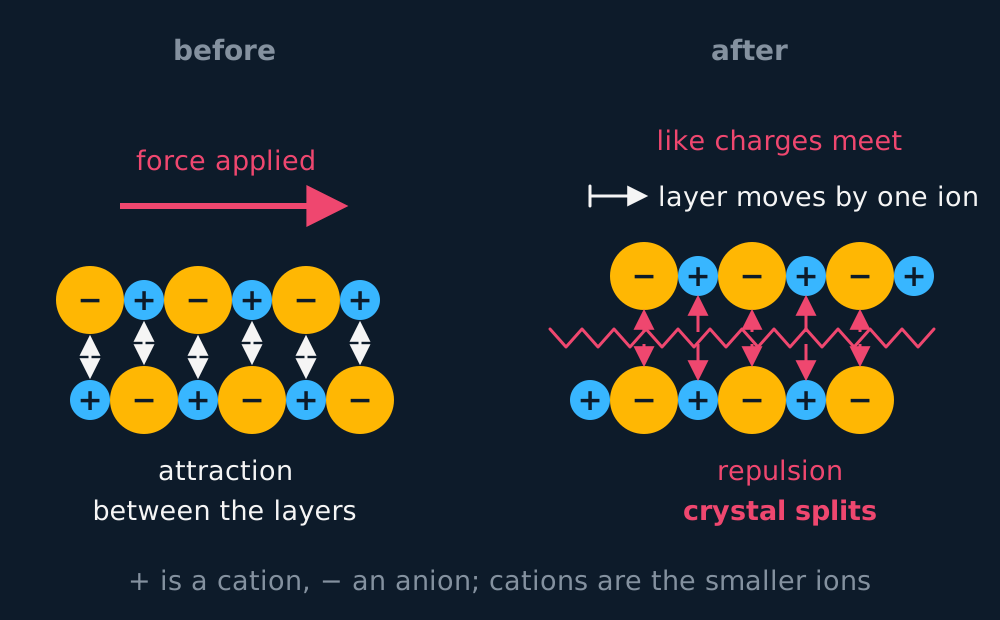
Ionic solids are hard but brittle. A sharp blow can push one layer of ions along by a single ion's width relative to the layer below. Ions of the same charge then sit next to each other across the boundary, they repel strongly, and the crystal splits cleanly along that plane. A metal bends under the same blow; a salt crystal cleaves.
Describe the drawing
Two panels each showing two rows of six touching ions, small cyan positive ions alternating with large amber negative ions. Before: each ion in the top row sits over an ion of opposite charge, with double arrows marking the attraction, and a coral arrow pushes the top row to the right. After: the top row has moved one ion along and lifted, so positive sits over positive and negative over negative, coral arrows push each pair apart, and a jagged crack runs between the rows.
Many ionic compounds dissolve in water. Water molecules are polar: their slightly negative oxygen atoms cluster round cations and their slightly positive hydrogen atoms round anions, and the energy released as the ions are surrounded can make up for the energy needed to break the lattice. Where the lattice is very strong, as in magnesium oxide, it does not, and the compound barely dissolves. Ionic compounds do not dissolve in non-polar solvents such as hexane, whose molecules cannot attract the ions.
Other boards: the evidence for ions
Edexcel asks for two pieces of experimental evidence that the particles in an ionic solid really are ions. The first comes from moving them. A crystal of green copper(II) chromate(VI) is placed in the middle of filter paper soaked in an electrolyte, with a voltage across the paper. A blue colour spreads towards the negative electrode and a yellow colour towards the positive one: blue Cu²⁺ ions and yellow CrO₄²⁻ ions, each attracted to the opposite charge.
The second comes from X-ray diffraction. X-rays scattered by a crystal give a pattern from which the density of electrons at every point can be calculated and drawn as an electron density map: contour lines join points of equal density, like the height contours on a walking map. In sodium chloride the contours form a separate, nearly circular set round each nucleus, and between neighbouring Na⁺ and Cl⁻ centres the density falls almost to zero. Each ion is a separate ball of electrons. Adding up the density gives about 18 electrons round each chlorine and about 10 round each sodium: one electron has moved.
A map of a covalent molecule looks different. The contours of the two atoms merge, and the density stays high in the region between the nuclei, where the shared pair is. The maps also give ionic radii, since the point of lowest density on the line between two ion centres marks where one ion ends and the next begins. AQA, OCR and Cambridge do not ask for either experiment.
- Electron density map
- A contour map, calculated from the X-ray diffraction pattern of a crystal, showing how the density of electrons varies through the structure.
In the exam
- Ionic bonding is defined as 'the electrostatic attraction between oppositely charged ions'. 'Electrons are transferred' describes how the ions form, not the bond, and does not earn the definition mark.
- For conductivity the scheme wants ions, not electrons: ions fixed in the solid, free to move when molten or in solution. Any mention of electrons moving through a molten salt or a solution is not credited.
- Lattice strengths are compared through both factors, the charge on the ions and their radius. For MgO against NaCl, the ions have larger charges and are closer together, so the attraction is stronger and more energy is needed to overcome it.
- A dot-and-cross diagram earns its marks for each ion in square brackets with its charge, the transferred electrons in the other symbol, and the right number of each ion: two Cl⁻ for one Ca²⁺. A shared pair drawn between Ca and Cl is marked as covalent and is not credited.
- Brittleness is explained through repulsion: a displaced layer brings ions of the same charge next to each other and they repel.
Check yourself
Sodium fluoride and magnesium oxide have the same lattice, and all four of their ions are isoelectronic. NaF melts at 993 °C and MgO at 2852 °C. Radii: Na⁺ 0.102 nm, F⁻ 0.133 nm, Mg²⁺ 0.072 nm, O²⁻ 0.140 nm. Explain the difference, and say why the radius of O²⁻ does not spoil the argument.
Answer
Same lattice and same number of electrons per ion, so the two differences that matter are the charges and the distances between the ions.
MgO's ions carry +2 and −2 against +1 and −1 in NaF, so each attraction between neighbouring ions is far stronger and much more energy is needed to free the ions.
O²⁻ is larger than F⁻, but Mg²⁺ is much smaller than Na⁺. What sets the attraction is the distance between the centres of neighbouring ions, the sum of the two radii: 0.212 nm in MgO against 0.235 nm in NaF. The ions in MgO are closer together as well as more highly charged, so both factors point the same way.
Questions
Question 16 marks
Explain, in terms of structure and bonding, the high melting point of magnesium oxide, its electrical conductivity as a solid and when molten, and its brittleness.
Mark scheme
Indicative content
- magnesium oxide is a giant ionic lattice of Mg²⁺ and O²⁻ ions
- there are strong electrostatic attractions between oppositely charged ions in all directions, made stronger by the 2+ and 2− charges
- a great deal of energy is needed to overcome these many strong attractions, so the melting point is high
- as a solid it does not conduct because the ions are fixed in position and there are no delocalised electrons
- when molten the ions are free to move and carry charge, so it conducts
- it is brittle because a displaced layer brings ions of like charge together, they repel and the lattice splits
Levels
- Level 3 (5–6 marks) all three properties are explained from the giant ionic lattice: the strong attraction between 2+ and 2− ions giving the high melting point, the ions fixed in the solid and free when molten for conductivity, and the like charges brought together on displacement for brittleness; ions, not electrons, carry the current in the melt
- Level 2 (3–4 marks) the lattice is identified and two of the three properties are explained, or all three are tackled and one is thin, such as conductivity with nothing said about what carries the charge
- Level 1 (1–2 marks) magnesium oxide is said to be ionic with strong bonds; the molten oxide is typically said to conduct through free electrons, and brittleness is left unexplained
Question 25 marksEdexcel · CAIE
Explain why the ionic radius decreases along the isoelectronic series N³⁻, O²⁻, F⁻, Na⁺, Mg²⁺, Al³⁺, and why it increases down Group 1 from Li⁺ to Na⁺ to K⁺.
Mark scheme
- B1 all six ions have the same number of electrons, ten, in the same arrangement 1s² 2s² 2p⁶
- B1 the number of protons, and so the nuclear charge, increases from 7 to 13 along the series
- B1 with the same shielding, the larger nuclear charge attracts the electrons more strongly and pulls them closer to the nucleus
- B1 down Group 1 each ion has one more occupied shell of electrons
- B1 the outer electrons are further from the nucleus, which outweighs the greater nuclear charge because of the extra shielding; ignore 'more electrons' alone
Question 34 marks
Give the formulae of the ions formed by aluminium and by sulfur, and the formulae of aluminium sulfide, ammonium sulfate and calcium nitrate.
Mark scheme
- B1 aluminium forms Al³⁺ and sulfur forms S²⁻; both needed for the mark
- B1 aluminium sulfide is Al₂S₃, since two Al³⁺ (+6) balance three S²⁻ (−6)
- B1 ammonium sulfate is (NH₄)₂SO₄; reject NH₄₂SO₄ without the brackets
- B1 calcium nitrate is Ca(NO₃)₂, two NO₃⁻ ions for each Ca²⁺ ion; reject CaNO₃₂
All 18 questions with mark schemes, the other 15 set out in full on the question page.
Worth remembering
- 'Molecules of sodium chloride' or 'intermolecular forces' in a salt is a wrong structure.
- Say that the ions move when a molten salt conducts; no electrons carry the current through it.
- Compare lattices by charge and ionic radius together: MgO is stronger than NaCl on both counts.
- A full outer shell is not why the ions form; the energy released as the lattice forms pays for them.
- A dot-and-cross diagram with no brackets or charges on the ions is not credited.
CHECK YOUR PROGRESS
Rate how confident you are with each objective for this lesson. Ratings are saved in this browser, on this device, unless you sign in.
- Describe ionic bonding as the electrostatic attraction between oppositely charged ions, and predict the charge on a simple ion from its group.
- Draw dot-and-cross diagrams for ionic compounds such as NaCl, MgO and CaCl₂, showing outer electrons and the charge on each ion.
- Describe the sodium chloride lattice, and explain why its formula is a ratio of ions and not a molecule.
- Explain how the charge and the radius of the ions affect the strength of an ionic lattice, and use that to compare melting points.
- Explain the trends in ionic radius down a group and along an isoelectronic series.
- Explain why ionic compounds are brittle, have high melting points, and conduct electricity when molten or dissolved but not as solids.
Open the full revision checklist to see every objective in the curriculum in one place.
Practise this lesson
Practise ionic bonding and ionic lattices with 18 original questions and point-by-point mark schemes
WORKBOOK
The questions from this topic, on paper with room to work, and a separate book of mark schemes. Free to use; please do not redistribute or sell.
Used later in The four crystal structures and their properties · Oxidation states and the rules for assigning them · Lattice enthalpy and Born–Haber cycles · The Period 3 oxides: structure, bonding and acid–base character