Chemistry › Bonding and structure › Covalent, dative covalent and metallic bonding
Covalent, dative covalent and metallic bonding
Two hydrogen atoms share their electrons and become a molecule that takes 436 kJ mol⁻¹ to pull apart. A covalent bond is a pair of electrons attracted to two nuclei at once, and it can be doubled, tripled, or supplied entirely by one atom as a dative bond. Metals bond a third way, as a lattice of positive ions held in a sea of delocalised electrons, which is why a copper wire bends and conducts.
Key terms Every definition in bonding and structure, lesson by lesson
Before this Ionic bonding and ionic lattices – the dot-and-cross convention · Electron configuration: shells, subshells and orbitals – counting outer electrons from the group number
COMMON MISCONCEPTION
A dative bond is weaker than an ordinary covalent bond, so in NH₄⁺ you can tell which N–H bond it is.
Once a dative bond has formed it is a shared pair like any other. The four N–H bonds in NH₄⁺ are identical in length and strength, and the ion is a perfect tetrahedron. The arrow in the diagram records where the pair came from, not a difference in the finished bond.
What you should be able to do
- Describe a covalent bond as a shared pair of electrons attracted to the nuclei of both bonded atoms.
- Draw dot-and-cross diagrams for simple molecules, including double and triple bonds and lone pairs.
- Explain how a dative covalent bond forms, show it with an arrow, and identify it in NH₄⁺, H₃O⁺ and Al₂Cl₆.
- Describe metallic bonding as a lattice of positive ions in a sea of delocalised electrons.
- Explain how ionic charge, ionic radius and the number of delocalised electrons affect the strength of metallic bonding.
- Explain why metals conduct electricity, are malleable and have high melting points.
A shared pair held by two nuclei
Hydrogen gas is made of H₂ molecules, and the two atoms in each are held together firmly: breaking one mole of H–H bonds takes 436 kJ. Neither atom has given its electron to the other, since both attract electrons equally. The two electrons spend most of their time in the region between the nuclei, and each positive nucleus is attracted to that negative pair. The pair is attracted to both nuclei at once, and that attraction is the covalent bond.
Covalent bonds form between non-metal atoms, where neither atom loses electrons easily. Each atom usually supplies one electron to each bond, and forms as many bonds as it needs to fill its outer shell: hydrogen forms one, oxygen two, nitrogen three and carbon four. Outer electrons that are not used in bonding stay on their atom in pairs. These lone pairs decide the shapes of molecules, form dative bonds and take part in hydrogen bonding.
- Covalent bond
- A shared pair of electrons between two atoms, attracted electrostatically to the nuclei of both.
- Bonding pair
- A pair of electrons shared between two atoms in a covalent bond.
- Lone pair
- A pair of outer-shell electrons on one atom that is not used in bonding.
Drawing molecules
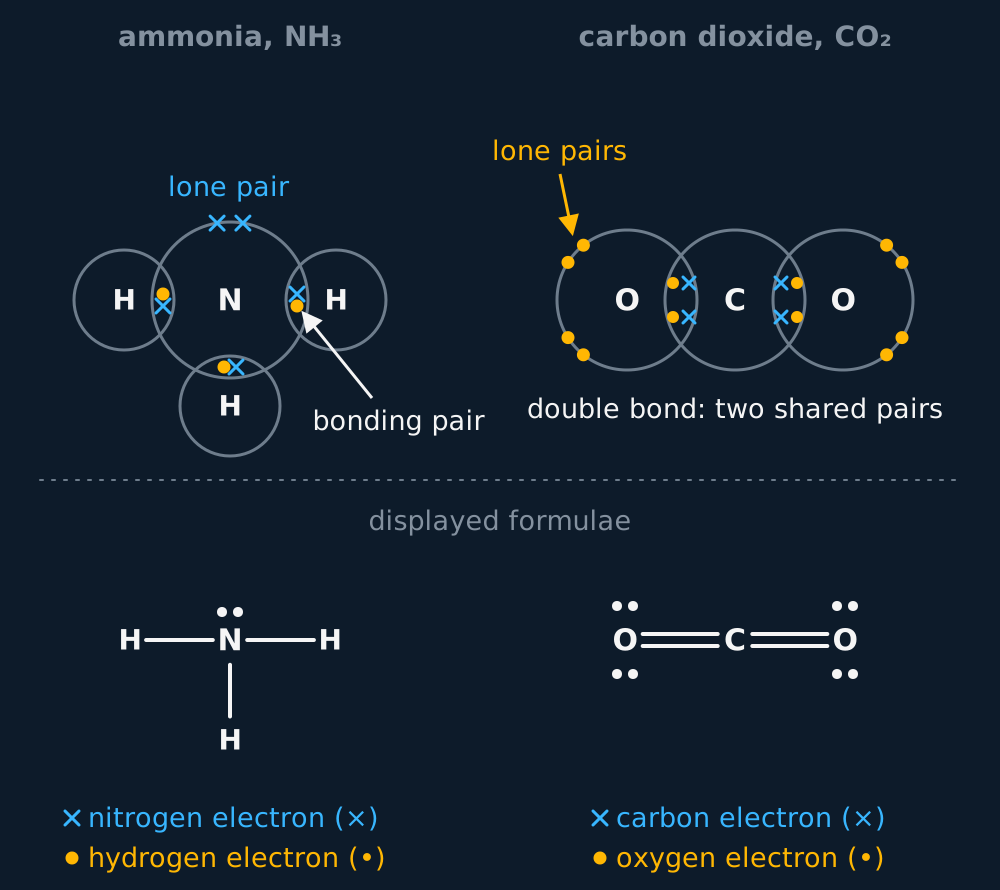
In a dot-and-cross diagram for a molecule, the outer shells of the bonded atoms overlap and the shared electrons sit in the overlap. One atom's electrons are dots and the other's crosses, so each shared pair is one dot and one cross. Circles for the shells are optional; what must be right is the number of electrons in each overlap and the lone pairs on each atom.
Count before drawing. In ammonia, nitrogen has five outer electrons and each hydrogen one. Nitrogen shares one electron with each of three hydrogen atoms, giving three bonding pairs, and its remaining two electrons form a lone pair. Each hydrogen now has two electrons and nitrogen has eight. Water follows the same count: oxygen's six outer electrons give two bonding pairs and two lone pairs. Methane has four bonding pairs and no lone pair. In hydrogen chloride the single bonding pair leaves three lone pairs on chlorine.
Describe the drawing
Two dot-and-cross diagrams with outer shells drawn as overlapping circles. Ammonia: a nitrogen circle overlapped by three hydrogen circles, each overlap holding one cross from nitrogen and one dot from hydrogen, and a lone pair of two crosses at the top of nitrogen. Carbon dioxide: oxygen, carbon and oxygen in a row, each overlap holding two crosses and two dots as a double bond, and two lone pairs of dots on the outer side of each oxygen. Beneath each, its displayed formula.
| Molecule | Bonds made by the central atom | Lone pairs on the central atom |
|---|---|---|
| CH₄ | Four single bonds | None |
| NH₃ | Three single bonds | One |
| H₂O | Two single bonds | Two |
| HCl | One single bond | Three, on chlorine |
| CO₂ | Two double bonds | None |
| N₂ | One triple bond | One on each nitrogen |
A dot-and-cross diagram is a count, not a picture. It shows how many electrons each atom supplies and where the lone pairs are, but it is drawn flat, so it says nothing about the angles between the bonds. Ammonia drawn this way looks like a flat T; the real molecule is a pyramid. The shape comes from the number of bonding pairs and lone pairs the diagram reveals. Draw the shared pair in the overlap and write 'shared pair of electrons' in words; a scheme accepts 'shared pair' but not 'shared electrons', which could be one electron or three.
Double and triple bonds
Two atoms can share more than one pair. In an oxygen molecule each atom has six outer electrons and needs two more, so the atoms share two pairs: a double bond, O=O, with two lone pairs left on each atom. Nitrogen needs three, so N₂ has a triple bond, N≡N, and one lone pair on each atom. In carbon dioxide, carbon shares two pairs with each oxygen, O=C=O, and has no lone pairs of its own.
More shared pairs pull the two nuclei closer and hold them more strongly, so multiple bonds are shorter and stronger than single bonds between the same atoms. The triple bond in N₂, at 945 kJ mol⁻¹, is one of the strongest bonds there is, and the nitrogen in the air reacts with almost nothing.
| Bond | Length / nm | Mean bond enthalpy / kJ mol⁻¹ |
|---|---|---|
| C–C | 0.154 | 347 |
| C=C | 0.134 | 612 |
| C≡C | 0.120 | 838 |
The same link between length and strength runs down a group. As the halogen atom gets larger, the shared pair in its bond to hydrogen is further from the halogen nucleus, the bond is longer, and it is weaker: H–F 562, H–Cl 432, H–Br 366 and H–I 298 kJ mol⁻¹. A hot wire pushed into hydrogen iodide gives violet fumes of iodine at once, while hydrogen chloride is unchanged. The weaker bond breaks more readily, so here bond enthalpy, not polarity, accounts for which of the two reacts.
The full outer shell of eight is a pattern, not a law. Boron in BF₃ shares its three electrons and ends with only six. Elements in Period 3 and below can hold more than eight, because their outer shell has room beyond the s and p orbitals: phosphorus shares all five outer electrons in PCl₅, giving it ten, and sulfur shares all six in SF₆, giving it twelve. Nitrogen, in Period 2, can never do this, so there is NCl₃ but no NCl₅.
A dot-and-cross diagram for carbon dioxide
Describe the dot-and-cross diagram for CO₂ and check that every atom has a full outer shell.
Show the working
Carbon is in Group 4 with four outer electrons, drawn as crosses. Each oxygen is in Group 6 with six, drawn as dots.
Each oxygen needs two more electrons, so it shares two of its dots with two of carbon's crosses. Each overlap therefore holds four electrons, two dots and two crosses: a double bond.
Carbon has used all four of its electrons and now has eight round it, four from each double bond. Each oxygen has its two shared pairs plus its remaining four dots as two lone pairs: eight.
So the diagram shows O=C=O with four electrons in each overlap, two lone pairs on each oxygen and none on carbon.
- Double bond
- Two shared pairs of electrons between the same two atoms, shorter and stronger than a single bond between them.
- Bond length
- The distance between the nuclei of two covalently bonded atoms; for the same pair of atoms, the shorter the bond, the stronger it is.
Dative covalent bonds
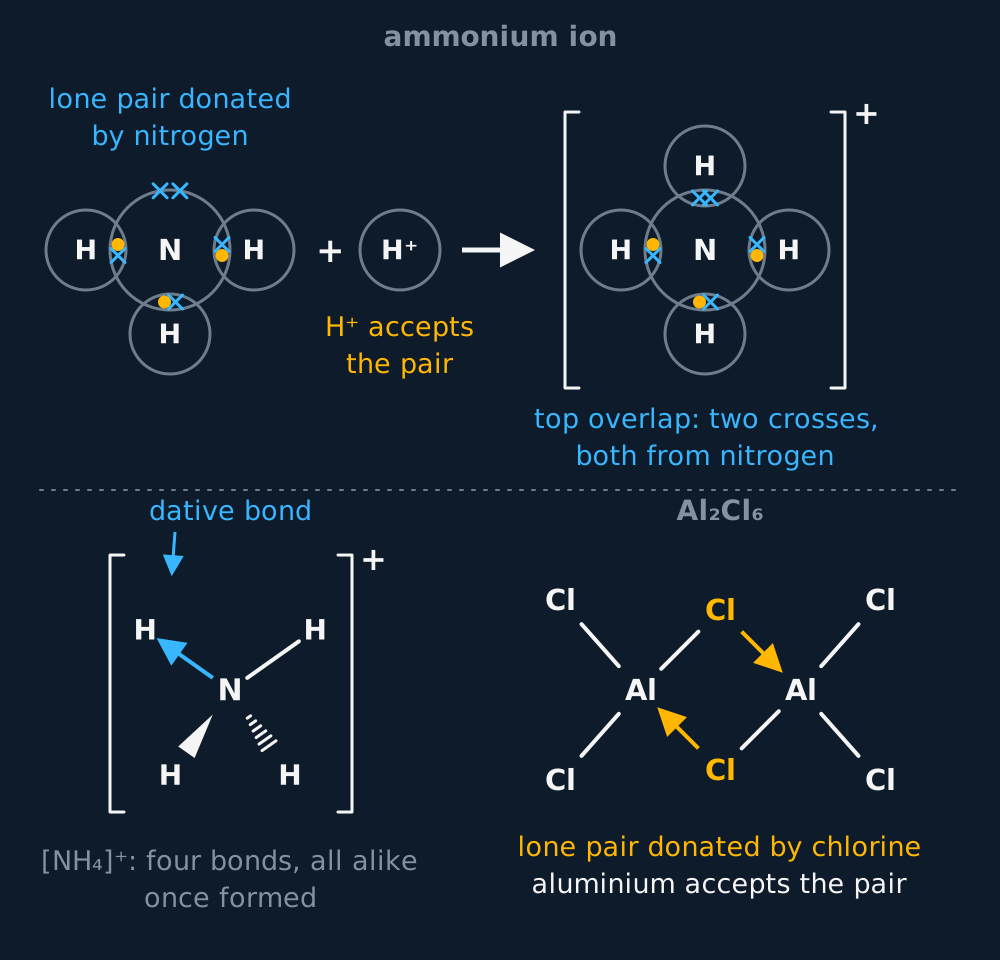
Ammonia dissolves in acid to form the ammonium ion. The nitrogen in NH₃ has a lone pair, and a hydrogen ion, H⁺, has no electrons at all. The lone pair forms a bond to the H⁺, both electrons coming from nitrogen. A covalent bond in which both shared electrons come from the same atom is a dative covalent bond, also called a co-ordinate bond.
NH₃(aq) + H⁺(aq) → NH₄⁺(aq)
A dative bond is drawn as an arrow from the atom that supplies the pair to the atom that accepts it, N→H. The arrow records how the bond formed. Once the ion exists, its four N–H bonds are identical in length and strength, the ion is a regular tetrahedron, and nothing distinguishes the hydrogen that arrived last. The charge belongs to the whole ion and is written outside square brackets.
Describe the drawing
Two panels. In the first, ammonia drawn as dot-and-cross with nitrogen's lone pair of two crosses at the top, plus an empty-shelled H⁺, react to give the ammonium ion in square brackets with a plus charge, whose top overlap holds two crosses; beneath it the ammonium displayed formula with one N–H bond drawn as an arrow from N to H. In the second, Al₂Cl₆: two aluminium atoms with two terminal chlorines each, bridged by two chlorine atoms, each with an ordinary bond to one aluminium and an arrow to the other.
A dative bond needs an atom with a lone pair to give and an atom with an empty orbital to receive it. Water likewise gives a lone pair to H⁺, forming the oxonium ion, H₃O⁺, which is present in every acidic solution. Aluminium chloride is the third example. In AlCl₃ the aluminium has only six outer electrons. In the vapour just above its sublimation temperature, two molecules join: a lone pair on one chlorine of each molecule forms a dative bond to the aluminium of the other, giving Al₂Cl₆, in which each aluminium has eight.
- Dative covalent bond
- A covalent bond in which both electrons of the shared pair come from the same atom; also called a co-ordinate bond.
TRY IT: Boron trifluoride meets ammonia
Ammonia gas and boron trifluoride gas react to form a white solid, H₃NBF₃. Suggest how the two molecules are bonded to each other, and show the bond.
Check your answer
Boron in BF₃ has only six outer electrons, so it has an empty orbital that can accept a pair. Nitrogen in NH₃ has a lone pair.
The nitrogen lone pair forms a dative covalent bond to boron, drawn H₃N→BF₃, with the arrow from nitrogen to boron.
Boron now has eight outer electrons. Nitrogen still has eight, all now in bonding pairs.
Metallic bonding
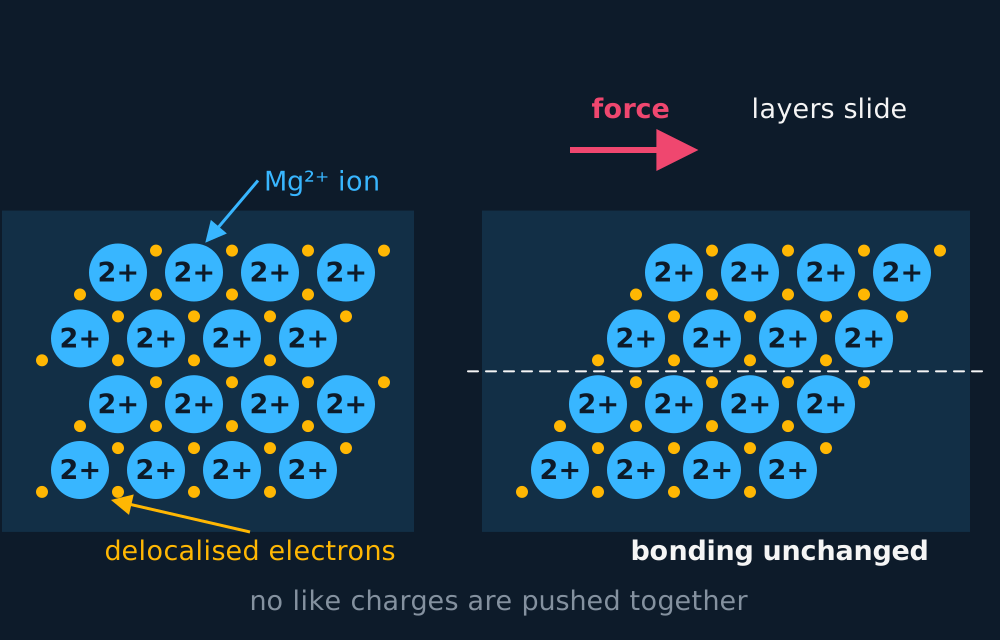
A copper wire bends without snapping and carries a current, and neither fact fits ionic or simple covalent bonding. In a metal, each atom releases its outer electrons into the structure as a whole. What remains is a regular lattice of positive ions, and the released electrons are delocalised: not tied to any one atom, and free to move through the whole lattice. Metallic bonding is the electrostatic attraction between the positive ions and this sea of delocalised electrons.
Describe the drawing
Two panels of a close-packed array of sixteen magnesium ions, each a cyan disc marked 2+, on a lightly shaded background with thirty-two small amber electrons spread evenly between them, two per ion. In the right panel a force has slid the top two rows one ion spacing to the right; the array is still close-packed, the electrons are still spread evenly through it including along the slip, and every ion is still 2+.
The strength of metallic bonding depends on three things that change together across a period. Sodium releases one electron per atom, magnesium two and aluminium three, so the ions carry larger charges, there are more delocalised electrons per ion, and the ions are smaller. The attraction rises along the series, and so does the boiling point: sodium 883 °C, magnesium 1090 °C, aluminium 2519 °C.
Down Group 1 the charge stays at +1 but the ions get larger, so the delocalised electrons are further from the nuclei and the attraction is weaker. The melting point falls: lithium 181 °C, sodium 98 °C, potassium 63 °C. Boiling points show the trend across a period more cleanly than melting points, because melting only loosens a metal lattice and the ions in the liquid are still held in the sea of electrons. Magnesium melts at 650 °C and aluminium at 660 °C, almost the same, while their boiling points differ by over 1400 °C.
The properties follow from the structure. Metals conduct electricity because the delocalised electrons move through the lattice when a potential difference is applied, and the same mobile electrons carry heat. They are malleable and ductile because layers of ions can slide over one another while the electrons move with them, so no bonds break and no like charges are forced together. Most have high melting points because the attraction between ions and electrons is strong and extends through the whole giant lattice.
- Metallic bonding
- The electrostatic attraction between a lattice of positive metal ions and the delocalised electrons around them.
- Delocalised electrons
- Electrons that are not associated with any single atom or bond and are free to move through a structure.
Other boards: σ and π bonds, hybridisation and bond strength
OCR, Edexcel and Cambridge describe a covalent bond by the orbitals that overlap to make it. A σ bond forms when two orbitals overlap end-on, so the shared pair lies directly between the two nuclei. Every single bond is a σ bond: s with s in H₂, s with p in HCl, p with p in Cl₂. Turning one atom about the bond does not change that overlap, so groups joined by a single bond rotate freely.
A π bond forms when two parallel p orbitals overlap sideways, above and below the line between the nuclei. It forms only alongside a σ bond that already holds the atoms close. A double bond is one σ and one π bond; a triple bond is one σ and two π, the two π bonds at right angles to each other. Twisting about a double bond would pull the p orbitals out of line and break the π overlap, which is why a C=C bond does not rotate. AQA does not ask for σ and π in this topic.
The strength of a π bond
Use the mean bond enthalpies C–C 347, C=C 612 and C≡C 838 kJ mol⁻¹ to estimate the strength of the π bond in C=C and of the second π bond in C≡C, and explain the result.
Show the working
C=C is one σ bond and one π bond. Taking its σ part as equal to a C–C single bond, the π bond is worth 612 − 347 = 265 kJ mol⁻¹.
C≡C adds a second π bond to C=C, worth 838 − 612 = 226 kJ mol⁻¹.
Both π bonds are weaker than the σ bond, 347 kJ mol⁻¹, because sideways overlap of p orbitals puts less electron density between the nuclei than end-on overlap does. A double bond is therefore less than twice as strong as a single bond, 612 against 2 × 347 = 694 kJ mol⁻¹, and it is the weaker π bond that breaks when an alkene reacts.
Cambridge takes one step further and explains the directions of the bonds by hybridisation. Carbon's outer shell has one 2s and three 2p orbitals, and none of them points to the corners of a tetrahedron. In methane and ethane the 2s and all three 2p orbitals mix into four identical sp³ hybrid orbitals that do, at 109.5°, and each forms a σ bond. In ethene each carbon mixes the 2s with two 2p orbitals into three sp² orbitals, in a plane at 120°, which form three σ bonds. The third 2p orbital is left unmixed, at right angles to that plane, and overlaps sideways with its neighbour's to make the π bond.
In ethyne, HC≡CH, and hydrogen cyanide, HC≡N, carbon mixes the 2s with one 2p into two sp orbitals at 180°, and its two unmixed 2p orbitals make the two π bonds of the triple bond. HCN therefore has two σ bonds, C–H and the σ part of C≡N, and two π bonds. The number of regions of electron density round the atom fixes the hybridisation, and the angles are the ones electron-pair repulsion predicts: hybridisation describes the same shapes in terms of orbitals.
| Hybrid orbitals | Orbitals mixed | Unmixed 2p orbitals | Angle between σ bonds | Example |
|---|---|---|---|---|
| sp³ | 2s and three 2p | None | 109.5° | CH₄, C₂H₆ |
| sp² | 2s and two 2p | One, forming one π bond | 120° | C₂H₄ |
| sp | 2s and one 2p | Two, forming two π bonds | 180° | C₂H₂, HCN |
- Sigma (σ) bond
- A covalent bond formed by end-on overlap of two orbitals, with the shared pair lying directly between the two nuclei.
- Pi (π) bond
- A covalent bond formed by sideways overlap of two parallel p orbitals, with electron density above and below the line between the nuclei.
- Hybridisation
- The mixing of an atom's s and p orbitals to give a set of identical hybrid orbitals, sp³, sp² or sp, that point along its σ bonds.
Cambridge also asks for two reasons why the nitrogen in the air reacts with almost nothing: the triple bond is very strong, and the molecule is non-polar, with no δ+ or δ− end to attract a reagent. Both are why making ammonia from it needs an iron catalyst, a high temperature and a high pressure. Cambridge and Edexcel ask for bond lengths and bond enthalpies to be used, as with the hydrogen halides, to compare how readily covalent molecules react.
In the exam
- A covalent bond is 'a shared pair of electrons'. The scheme accepts 'shared pair' but not 'shared electrons'; where the question asks why the bond holds, add that the pair is attracted to both nuclei.
- A dative bond is drawn as an arrow from the atom that donates the pair to the atom that accepts it, with both electrons from the donor. An arrow pointing the wrong way is not credited.
- Metallic bonding names both partners in the attraction: the positive ions and the delocalised electrons. 'A sea of electrons' on its own, or 'metal atoms' in place of positive ions, gets no credit from the scheme.
- A metal's conductivity is explained by delocalised electrons that move through the structure and carry charge; malleability by layers of ions that slide over each other.
- Metallic bonding in two metals is compared through the charge on the ions, the number of delocalised electrons and the ionic radius, each with its direction.
Check yourself
Magnesium melts at 650 °C and sodium at 98 °C. Explain the difference, and explain why both metals conduct electricity as solids while solid magnesium chloride does not.
Answer
Magnesium forms Mg²⁺ ions and releases two delocalised electrons per atom; sodium forms Na⁺ and releases one. Mg²⁺ is also smaller than Na⁺.
Higher charge, more delocalised electrons and a smaller ion all make the attraction between ions and electrons stronger in magnesium, so more energy is needed to loosen the lattice and it melts at a higher temperature.
Both metals conduct because their delocalised electrons are free to move through the lattice and carry charge. Solid magnesium chloride has no delocalised electrons, and its ions are held in fixed positions, so nothing that carries charge can move until it is melted or dissolved.
Questions
Question 16 marks
Compare the bonding in solid sodium with the bonding in solid sodium chloride, and use the comparison to explain the differences in their electrical conductivity and in how they respond to a hammer blow.
Mark scheme
Indicative content
- both are giant lattices containing Na⁺ ions, held by electrostatic attraction acting in all directions through the whole structure
- in sodium the Na⁺ ions are attracted to a sea of delocalised electrons, one released by each atom, which belong to no single ion
- in sodium chloride each Na⁺ ion is attracted to the oppositely charged Cl⁻ ions around it, and there are no delocalised electrons at all
- sodium conducts as a solid because its delocalised electrons move through the lattice and carry charge when a potential difference is applied
- solid sodium chloride does not conduct because its ions are fixed in place; it conducts only when molten or dissolved, with ions carrying the charge
- sodium bends because layers of ions slide while the electrons move with them, but sodium chloride shatters because a shifted layer brings like charges together
Levels
- Level 3 (5–6 marks) both structures are compared point for point: the delocalised electrons of sodium against the Na⁺ and Cl⁻ ions of the salt, conductivity in the solid explained for both, and the sliding of metal layers against the shattering of the ionic lattice; every point names both substances
- Level 2 (3–4 marks) metallic and ionic bonding are described and the conductivity difference explained; the hammer blow is answered without the layer argument, or some points speak of one substance only
- Level 1 (1–2 marks) sodium is said to have delocalised electrons or sodium chloride to be ionic; solid sodium chloride is often said to conduct, or both solids to bend under the hammer
Question 24 marks
Explain why magnesium has a higher melting point than sodium.
Mark scheme
- B1 magnesium forms Mg²⁺ ions, sodium forms Na⁺ ions
- B1 magnesium releases two delocalised electrons per atom, sodium one
- B1 Mg²⁺ is smaller than Na⁺
- B1 so the attraction between the positive ions and the delocalised electrons is stronger in magnesium, and more energy is needed to overcome it
Question 34 marks
Explain why metals conduct electricity and why they are malleable.
Mark scheme
- B1 a metal has delocalised electrons that are not attached to any one atom
- B1 the delocalised electrons move through the lattice when a potential difference is applied, carrying charge
- B1 metals are malleable because layers of positive ions can slide over one another
- B1 the delocalised electrons move with the ions, so the bonding is not broken and like charges are not forced together
All 21 questions with mark schemes, the other 18 set out in full on the question page.
Worth remembering
- 'Shared electrons' for a covalent bond is not the definition: it is a shared pair.
- Draw every lone pair on the central atom: nitrogen in NH₃ keeps one, and leaving it off shows six electrons round N.
- Claiming a dative bond is weaker, or can be told apart once made, is wrong.
- Name the positive ions as well as the delocalised electrons in metallic bonding: the bond is the attraction between them.
- Melting points of metals across a period need charge, electron number and size together.
CHECK YOUR PROGRESS
Rate how confident you are with each objective for this lesson. Ratings are saved in this browser, on this device, unless you sign in.
- Describe a covalent bond as a shared pair of electrons attracted to the nuclei of both bonded atoms.
- Draw dot-and-cross diagrams for simple molecules, including double and triple bonds and lone pairs.
- Explain how a dative covalent bond forms, show it with an arrow, and identify it in NH₄⁺, H₃O⁺ and Al₂Cl₆.
- Describe metallic bonding as a lattice of positive ions in a sea of delocalised electrons.
- Explain how ionic charge, ionic radius and the number of delocalised electrons affect the strength of metallic bonding.
- Explain why metals conduct electricity, are malleable and have high melting points.
Open the full revision checklist to see every objective in the curriculum in one place.
Practise this lesson
WORKBOOK
The questions from this topic, on paper with room to work, and a separate book of mark schemes. Free to use; please do not redistribute or sell.
Used later in Mean bond enthalpies · Group 2: trends down the group and reactions with water · Transition metal characteristics and complex formation · Naming and representing organic molecules