Chemistry › Bonding and structure › Shapes of molecules and ions
Shapes of molecules and ions
Methane is a tetrahedron, water is bent and sulfur hexafluoride is an octahedron, and one idea predicts all three: the pairs of electrons round a central atom push each other as far apart as they can. Lone pairs push harder than bonding pairs, closing the angle from 109.5° in methane to 107° in ammonia and 104.5° in water. Counting the pairs gives the shape of any molecule or ion with up to six of them.
Key terms Every definition in bonding and structure, lesson by lesson
Before this Covalent, dative covalent and metallic bonding – bonding pairs, lone pairs and dot-and-cross diagrams · Electron configuration: shells, subshells and orbitals – the number of outer electrons in each group
COMMON MISCONCEPTION
Water is a straight line, H–O–H, because that is how its formula is drawn.
Oxygen in water has four electron pairs, two bonding and two lone, and four pairs arrange tetrahedrally. The two lone pairs repel more strongly than the bonding pairs, so the molecule is bent with an H–O–H angle of 104.5°, not 180°. Carbon dioxide is linear because its carbon has two bonding regions and no lone pairs.
What you should be able to do
- State the principle of electron-pair repulsion, and the order lone pair–lone pair > lone pair–bonding pair > bonding pair–bonding pair.
- Deduce the number of bonding pairs and lone pairs round the central atom of a molecule or ion.
- Name the shape and give the bond angles for molecules and ions with two to six electron pairs, with and without lone pairs.
- Explain why the bond angle falls from 109.5° to 107° to 104.5° along CH₄, NH₃ and H₂O.
- Draw molecules in three dimensions with wedge and dash bonds, showing lone pairs and a labelled bond angle.
Electron pairs push apart
The shape of a molecule is set by the electron pairs round its central atom. Every pair is a region of negative charge, the pairs repel each other, and the molecule takes the shape in which the pairs are as far apart as possible. That is electron-pair repulsion theory, known by its initials as VSEPR, valence shell electron pair repulsion. Four balloons tied together by their necks settle with their ends at the corners of a tetrahedron for the same kind of reason: each is pushed by the other three until none can get further from its neighbours.
The pairs do not all repel equally. A lone pair is held by one nucleus only, so it sits closer to the central atom and spreads more widely round it than a bonding pair, which is drawn out between two nuclei. Lone pairs therefore repel more strongly. The order is lone pair–lone pair repulsion, then lone pair–bonding pair, then bonding pair–bonding pair, and each lone pair squeezes the bonding pairs a little closer together.
The shape is named from the positions of the atoms, not the positions of the electron pairs. Ammonia has four pairs arranged roughly tetrahedrally, but one of them is a lone pair, so its four atoms form a pyramid. Lone pairs decide where the atoms go, and do not appear in the name of the shape.
- Electron-pair repulsion theory
- The theory that the electron pairs round a central atom repel each other and move as far apart as possible, which fixes the shape of the molecule.
- Bond angle
- The angle between two bonds that meet at the same atom.
- Bonding pair
- A pair of electrons shared between the central atom and another atom in a covalent bond.
- Lone pair
- A pair of outer electrons on the central atom that is not shared in a bond, and repels more strongly than a bonding pair.
The five parent shapes
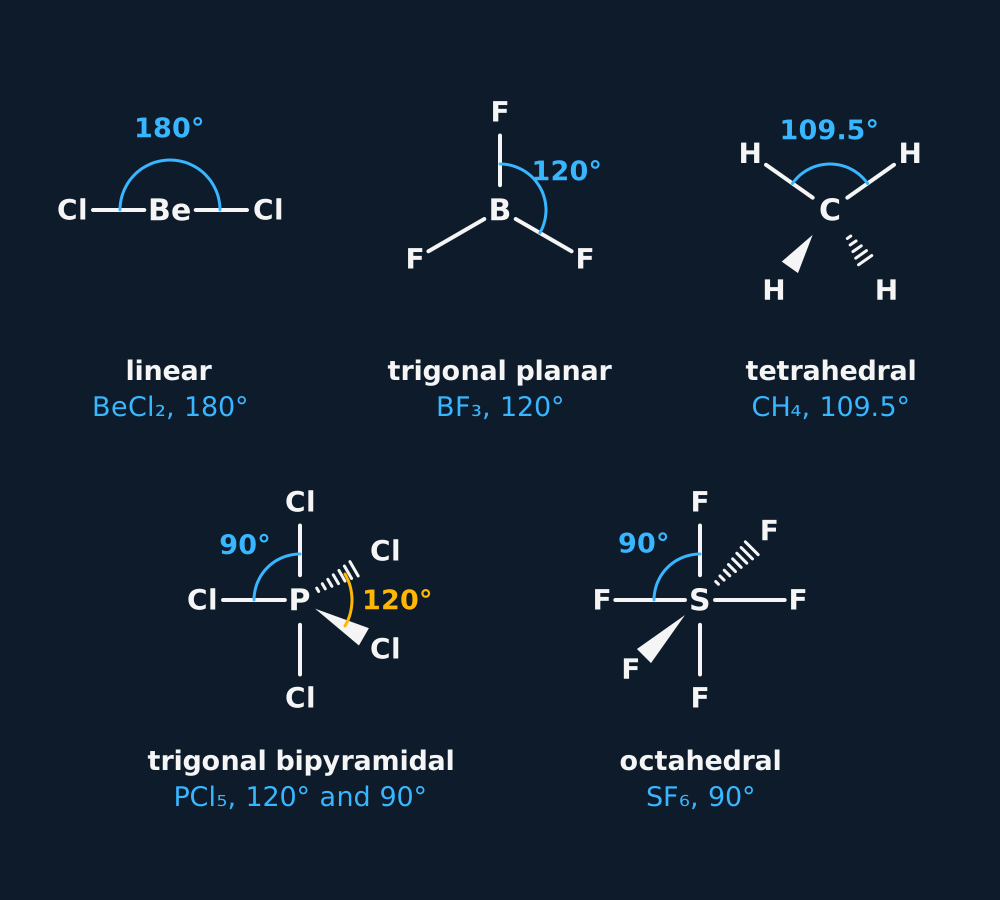
With only bonding pairs round the central atom, five shapes cover two to six pairs. Each is the arrangement that puts the pairs furthest apart.
| Electron pairs | Shape | Bond angle | Example |
|---|---|---|---|
| 2 | Linear | 180° | BeCl₂ |
| 3 | Trigonal planar | 120° | BF₃ |
| 4 | Tetrahedral | 109.5° | CH₄, NH₄⁺ |
| 5 | Trigonal bipyramidal | 120° and 90° | PCl₅ |
| 6 | Octahedral | 90° | SF₆ |
Describe the drawing
Five molecules, each a central atom with bonds and no lone pairs, with the shape name and bond angle beneath. Beryllium chloride is linear at 180°. Boron trifluoride is trigonal planar at 120°. Methane is tetrahedral at 109.5°, drawn with two bonds in the plane, one wedge and one hatched wedge. Phosphorus pentachloride is a trigonal bipyramid with 120° round its middle and 90° to the poles. Sulfur hexafluoride is octahedral at 90°.
In a trigonal bipyramid the five positions are not all the same. Three equatorial positions lie in a triangle round the middle, at 120° to each other, and two axial positions lie above and below, at 90° to the equator. In an octahedron all six positions are equivalent: every angle between neighbouring bonds is 90°, and each bond is at 180° to the one opposite.
Four of the five examples break the octet rule, and the method copes with all of them. Beryllium in BeCl₂ has only four outer electrons round it and boron in BF₃ only six, so they have two and three pairs. Phosphorus in PCl₅ has ten and sulfur in SF₆ twelve, possible because both are in Period 3. Electron-pair repulsion counts pairs, whatever the total.
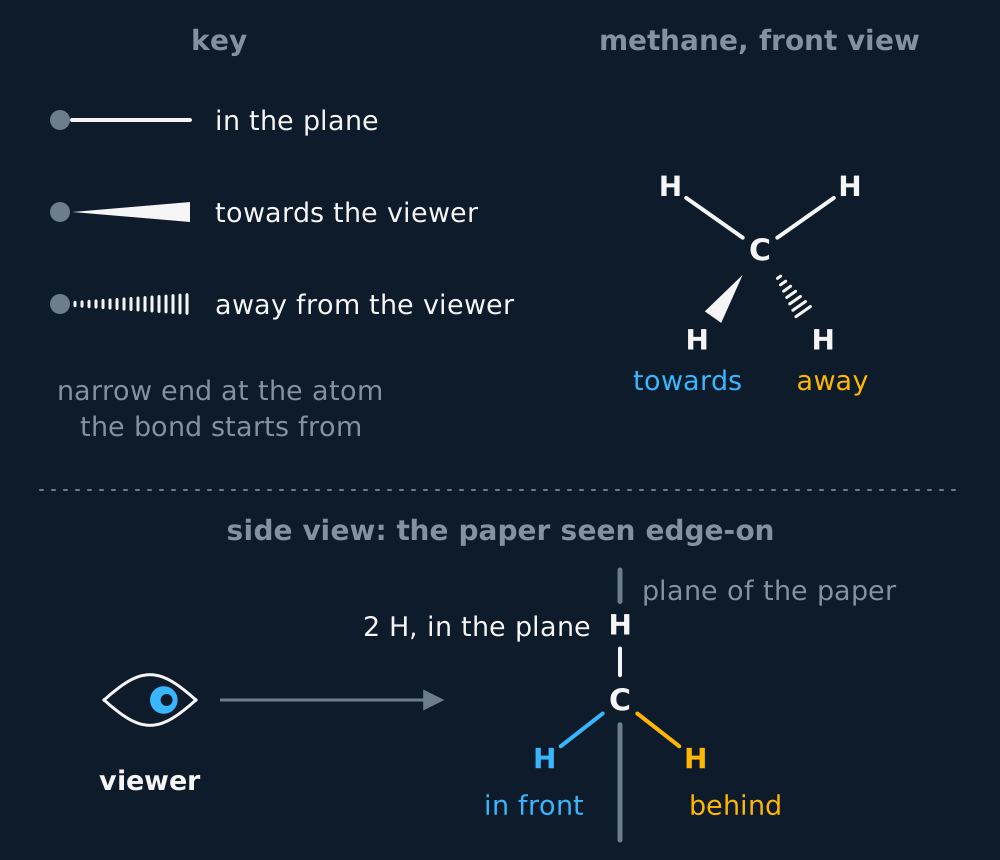
A molecule is drawn in three dimensions on flat paper with three kinds of line. A plain line is a bond in the plane of the paper. A solid wedge is a bond coming out of the paper towards the reader, its narrow end at the central atom. A hatched wedge, or a dashed line, is a bond going back behind the paper. Methane is drawn with two plain bonds in the plane, one wedge and one hatched wedge, and every tetrahedral carbon in organic chemistry is drawn that way.
Describe the drawing
A key of three bond styles: a plain line in the plane of the paper, a solid wedge coming towards the viewer and a hatched wedge going away, each narrow at the atom it starts from. Beside it methane drawn with two plain C–H bonds up-left and up-right, a solid wedge down-left and a hatched wedge down-right. Below, a side view with the paper as a vertical line and an eye on the left: the two plain bonds run up the line, the wedge hydrogen sits in front of it and the hatched hydrogen behind it.
- Wedge bond
- A bond drawn as a solid wedge, showing that it points out of the plane of the paper towards the viewer.
- Dash bond
- A bond drawn as a hatched wedge or dashed line, showing that it points behind the plane of the paper.
- Equatorial position
- One of the three positions in a trigonal bipyramid that lie in a triangle round the central atom, at 120° to each other.
- Axial position
- One of the two positions in a trigonal bipyramid directly above and below the central atom, at 90° to the equatorial positions.
Lone pairs close the angle
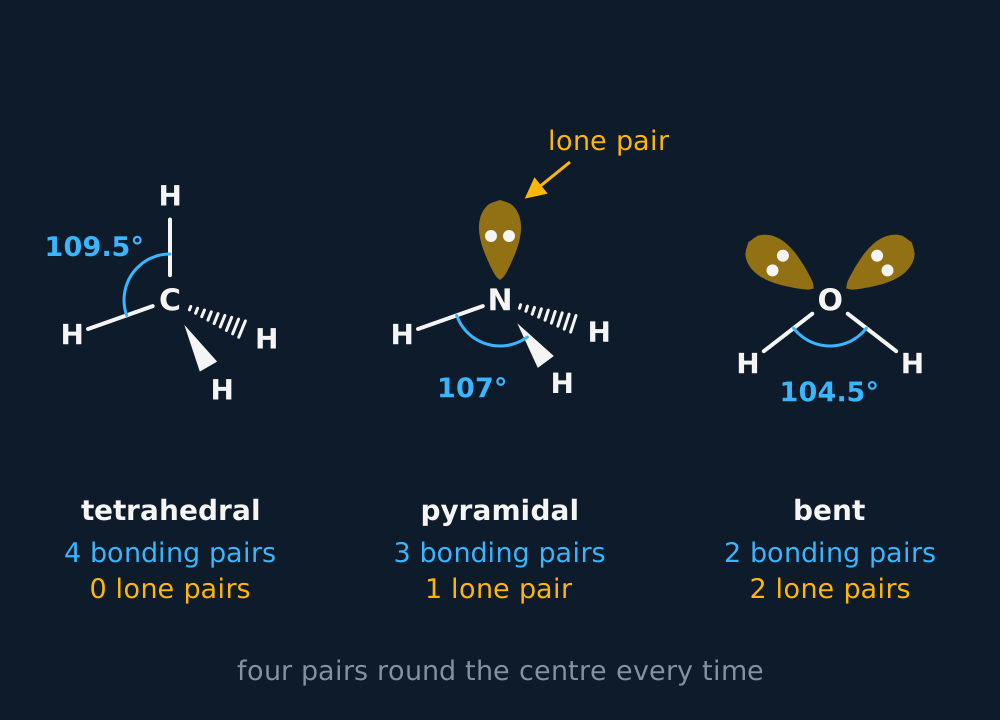
Methane, ammonia and water each have four pairs of electrons round the central atom, so all three are based on a tetrahedron. Methane's four pairs are all bonding pairs and every angle is 109.5°. Ammonia has three bonding pairs and one lone pair. The lone pair repels the bonding pairs more strongly than they repel each other, pushing them together to 107°, and the shape is pyramidal.
Water has two bonding pairs and two lone pairs. The extra repulsion closes the angle further, to 104.5°, and the shape is bent, also called non-linear or V-shaped. Each lone pair takes about 2.5° off the tetrahedral angle.
An answer that explains a shape needs three statements: how many bonding pairs and lone pairs are on the central atom, that electron pairs repel and move as far apart as possible, and, if there are lone pairs, that lone pairs repel more strongly than bonding pairs. The name of the shape and the angle follow from those. Write 'electron pairs repel', not 'bonds repel' or 'atoms repel': the pairs are what the theory is about.
Describe the drawing
Methane, ammonia and water side by side, each drawn from the same tetrahedral arrangement with wedge and hatched bonds. Methane has four C–H bonds and an arc of 109.5°. In ammonia the top position is an amber lone-pair lobe holding two electrons and the arc closes to 107°. Water has two lone-pair lobes at the top and two O–H bonds below with an arc of 104.5°. Beneath each, its shape name and its count of bonding and lone pairs.
Ions follow the same rules. In NH₄⁺ nitrogen has four bonding pairs and no lone pair, so the ion is tetrahedral with angles of 109.5°, exactly like methane, even though one of its bonds formed as a dative bond. In H₃O⁺ oxygen has three bonding pairs and one lone pair, so the ion is pyramidal with angles of about 107°, like ammonia.
A shape can change when a dative bond forms. Boron in BF₃ has three bonding pairs and is trigonal planar, 120°. When ammonia gives its lone pair to boron, forming H₃N→BF₃, boron has four bonding pairs and the bonds round it become tetrahedral, about 109.5°. Nitrogen's lone pair is now a bonding pair, so the H–N–H angle opens from 107° to about 109.5° as well.
With five or six pairs, lone pairs take the positions that keep them furthest from other pairs. In a trigonal bipyramid they go equatorial, where each has two neighbours at 90° rather than three. ClF₃ has three bonding pairs and two lone pairs, both equatorial, and its fluorine atoms form a T-shape with F–Cl–F angles a little under 90°. In an octahedron two lone pairs go opposite each other. XeF₄ has four bonding pairs and two lone pairs, and its four fluorine atoms form a square planar shape with angles of 90°.
| Bonding pairs | Lone pairs | Shape | Bond angle | Example |
|---|---|---|---|---|
| 3 | 1 | Pyramidal | 107° | NH₃, H₃O⁺ |
| 2 | 2 | Bent | 104.5° | H₂O |
| 4 | 1 | Seesaw | about 102° and 173° | SF₄ |
| 3 | 2 | T-shaped | just under 90° | ClF₃ |
| 2 | 3 | Linear | 180° | ICl₂⁻, XeF₂ |
| 5 | 1 | Square pyramidal | just under 90° | BrF₅ |
| 4 | 2 | Square planar | 90° | XeF₄ |
Placing the lone pairs in ClF₃
ClF₃ has three bonding pairs and two lone pairs round chlorine, based on a trigonal bipyramid. Show why both lone pairs take equatorial positions.
Show the working
Repulsion is strongest between pairs at 90°, the smallest angle in the shape, so count the repulsions at 90° in each possible arrangement, starting with the strongest kind, lone pair–lone pair.
One lone pair axial and one equatorial: the two lone pairs are at 90° to each other. A lone pair–lone pair repulsion at 90° rules this arrangement out.
Both lone pairs axial: they are at 180°, but each has three equatorial bonding pairs at 90°, six lone pair–bonding pair repulsions at 90° in all.
Both lone pairs equatorial: they are at 120°, and each has only the two axial bonding pairs at 90°, four lone pair–bonding pair repulsions. That is the fewest, so the lone pairs go equatorial and the three fluorine atoms, two axial and one equatorial, form a T-shape.
A method for any molecule or ion
The shape of any species with one central atom comes from four steps. Count the outer electrons of the central atom, from its group. Add one for each atom joined to it by a single bond, since each of those atoms supplies one electron to its bond. Add one for each negative charge and take away one for each positive charge. Divide by two to get the number of electron pairs: the number of bonds gives the bonding pairs, and the rest are lone pairs.
The shape of SF₄
Deduce the shape of SF₄ and estimate its bond angles.
Show the working
Sulfur is in Group 6 and has six outer electrons. Four fluorine atoms add one each: 6 + 4 = 10 electrons. The molecule is neutral, so there is no adjustment.
10 ÷ 2 = 5 pairs. There are four bonds, so four bonding pairs and one lone pair.
Five pairs are based on a trigonal bipyramid. The lone pair takes an equatorial position, leaving two fluorine atoms equatorial and two axial. The shape is a seesaw, also described as a distorted tetrahedron.
The lone pair repels the bonding pairs more than they repel each other, so the angles close from the parent values: the equatorial F–S–F angle is about 102°, below 120°, and the axial F–S–F angle about 173°, below 180°.
The shape of ICl₂⁻
Deduce the shape of the ICl₂⁻ ion and give its bond angle.
Show the working
Iodine is in Group 7 and has seven outer electrons. Two chlorine atoms add one each, making 9. The ion carries one negative charge, so add one more: 10.
10 ÷ 2 = 5 pairs: two bonding pairs and three lone pairs.
The three lone pairs take the three equatorial positions of the trigonal bipyramid, at 120° to each other, as far apart as they can get. The two chlorine atoms are left in the axial positions, directly opposite each other.
The ion is linear, with a Cl–I–Cl angle of 180°. The three lone pairs sit symmetrically round the middle and push equally on both bonds, so the angle is not reduced. Leaving out the electron from the charge gives 4.5 pairs, the sign that a step has been missed.
Species with the same number of electrons, arranged alike, have the same shape, which gives a quick check. CH₄, NH₄⁺ and BH₄⁻ each have ten electrons and four bonding pairs on the central atom, and all three are tetrahedral at 109.5°. The amide ion, NH₂⁻, has 5 + 2 + 1 = 8 electrons round nitrogen, two bonding pairs and two lone pairs, so it is bent at about 104.5°, like water, with which it is isoelectronic.
TRY IT: Two ions from phosphorus pentachloride
Solid phosphorus pentachloride is made of PCl₄⁺ and PCl₆⁻ ions. Deduce the shape and the bond angle of each ion.
Check your answer
PCl₄⁺: phosphorus has 5 outer electrons, four chlorine atoms add 4, and the positive charge takes 1 away: 8 electrons, 4 pairs, all bonding. The ion is tetrahedral, 109.5°.
PCl₆⁻: 5 + 6 + 1 = 12 electrons, 6 pairs, all bonding. The ion is octahedral, 90°.
Neither ion has a lone pair on phosphorus, so neither angle is reduced from its parent shape.
Double bonds and larger molecules
Double bonds need one change to the method. A double bond holds two pairs, but both point in one direction, so it counts as one region of electron density when deciding the shape. In CO₂, carbon uses all four outer electrons in two double bonds, has no lone pair and two regions, so the molecule is linear, 180°.
In SO₂, sulfur uses four of its six outer electrons in two double bonds and keeps one lone pair. That is three regions, one of them a lone pair, so the molecule is bent, with an angle of about 119°. Adding one electron per bonded atom only works when every bond to the central atom is single; with doubly bonded oxygen atoms, count regions instead.
A double bond holds four electrons, so as a region it repels a little more than a single bond. In ethene the H–C–H angle is 117°, not 120°, because the C=C region pushes the two C–H bonds together. The angle round a doubly bonded carbon is quoted as 120° for the shape; the extra repulsion of the double bond explains a measured value a few degrees smaller.
BF₃, CO₃²⁻ and NO₃⁻ each have 32 electrons. The central atom in each has three regions of electron density and no lone pair, so all three are trigonal planar at 120°.
Larger molecules have more than one central atom, and the method is applied to each in turn. In ethanol, CH₃CH₂OH, both carbon atoms have four bonding pairs, so the bonds round each are tetrahedral at 109.5°. The oxygen has two bonding pairs and two lone pairs, so the C–O–H angle is about 104.5°, as in water. In ethene, CH₂=CH₂, each carbon has three regions, one of them the double bond, so each end is trigonal planar with angles of about 120°, and the whole molecule is flat.
Benzene, C₆H₆, extends the same reasoning round a ring. Each of its six carbon atoms is bonded to two carbons and one hydrogen and has no lone pair: three regions, trigonal planar, 120°. A ring of six such carbons can only be a flat regular hexagon, with every hydrogen in the same plane. Ethyne, HC≡CH, has two regions on each carbon, a single bond and a triple bond, so the molecule is linear, 180°.
- Region of electron density
- A lone pair, a single bond, a double bond or a triple bond, each counted once when deciding the shape round a central atom.
Other boards: hybridisation and analogous species
Cambridge describes the carbons in organic molecules through hybridisation as well as electron-pair repulsion. Four regions of electron density make a carbon sp³ and tetrahedral, as in ethane and ethanol. Three make it sp² and trigonal planar, as in ethene and every carbon of benzene, with the unhybridised p orbital at right angles to the plane forming the π bond. Two, as in ethyne, make it sp and linear. The shapes and angles are the ones VSEPR gives; hybridisation names the orbitals that point along them.
A Cambridge answer on the shape of ethene or benzene is expected to name the hybridisation of each carbon and say that the σ bonds lie in one plane, as well as giving the 120° angle.
Edexcel asks for the shapes of species analogous to the named examples to be predicted from the count of electron pairs, which is what the isoelectronic comparisons do: BH₄⁻ from CH₄, NH₂⁻ from H₂O, and CO₃²⁻ and NO₃⁻ from BF₃.
In the exam
- An explanation of a shape earns its marks for the number of bonding pairs and lone pairs on the central atom, electron pairs repelling to get as far apart as possible, and, where there are lone pairs, lone pairs repelling more than bonding pairs. 'Bonds repel' or 'atoms repel' is not credited.
- Bond angles are given as numbers. Mark schemes usually accept 106° to 108° for pyramidal NH₃ and 104° to 105° for bent H₂O.
- The shape is named from the atoms, not from the electron pairs: NH₃ is pyramidal, and 'tetrahedral' for NH₃ is rejected, although its four pairs are arranged tetrahedrally.
- For an ion, add one electron for each negative charge and take away one for each positive charge before halving. An odd total means a step has been missed.
- A drawn shape uses wedges and dashes, shows any lone pairs on the central atom and labels one bond angle.
Check yourself
Deduce the shape of the ICl₄⁻ ion and give its bond angle. Explain where its lone pairs sit and why the angle is not reduced below the parent value.
Answer
Iodine is in Group 7: 7 outer electrons, plus 4 from the chlorine atoms, plus 1 for the negative charge, 12 electrons, 6 pairs. Four are bonding pairs and two are lone pairs.
Six pairs are based on an octahedron. The two lone pairs repel each other most strongly, so they take positions opposite each other, at 180°, above and below the plane.
The four chlorine atoms are left in a square round the iodine: the ion is square planar, Cl–I–Cl 90°. Each lone pair pushes equally on all four bonds from directly above or below, so the pushes cancel within the plane and the 90° angle is unchanged.
Questions
Question 16 marks
Explain how electron-pair repulsion theory accounts for the bond angles in CH₄, NH₃ and H₂O.
Mark scheme
Indicative content
- each central atom has four pairs of electrons, which repel and get as far apart as possible in a tetrahedral arrangement
- methane has four bonding pairs, all repelling equally, so its angle is 109.5°
- lone pairs repel more strongly than bonding pairs, because they are held by one nucleus and sit closer to it
- ammonia has three bonding pairs and one lone pair, so its bonding pairs are pushed together to 107°
- water has two bonding pairs and two lone pairs, so its angle is closed further to 104.5°
- the shapes are tetrahedral, pyramidal and bent, named from the positions of the atoms
Levels
- Level 3 (5–6 marks) all three molecules are explained from four electron pairs in a tetrahedral arrangement, the greater repulsion of lone pairs is stated with the reason, and the three angles and three shape names are correct
- Level 2 (3–4 marks) two or three angles are correct and lone pairs are said to repel more; the reason lone pairs repel more, the tetrahedral starting point, or a shape name is absent
- Level 1 (1–2 marks) one angle or shape is right; the usual error is to call NH₃ or H₂O tetrahedral, or to say the hydrogen atoms repel each other
Question 24 marks
Explain the shape of an ammonia molecule and why its bond angle is 107°.
Mark scheme
- B1 nitrogen has three bonding pairs and one lone pair
- B1 the four pairs repel and get as far apart as possible, in a roughly tetrahedral arrangement
- B1 the lone pair repels more strongly than the bonding pairs, pushing them closer together than 109.5°
- B1 the shape of the atoms is pyramidal with an angle of 107°
Question 34 marks
Explain the shape of a PCl₅ molecule, giving its bond angles.
Mark scheme
- B1 phosphorus has five outer electrons and five chlorine atoms add one each: ten electrons, five pairs
- B1 all five are bonding pairs, and they repel to be as far apart as possible
- B1 the shape is trigonal bipyramidal
- B1 angles of 120° between the equatorial bonds and 90° between axial and equatorial bonds
All 21 questions with mark schemes, the other 18 set out in full on the question page.
Worth remembering
- 'Bonds repel' or 'atoms repel' in place of electron pairs is not the theory.
- Calling NH₃ tetrahedral names the pairs, not the atoms, and loses the shape mark.
- Add the ion's charge to the electron count before halving: NH₄⁺ has 8 electrons round N, four bonding pairs and no lone pair.
- Count a double bond as one region: CO₂ is linear and SO₂ bent.
- A lone pair placed axial in a trigonal bipyramid gives SF₄ a trigonal pyramid in place of its seesaw.
CHECK YOUR PROGRESS
Rate how confident you are with each objective for this lesson. Ratings are saved in this browser, on this device, unless you sign in.
- State the principle of electron-pair repulsion, and the order lone pair–lone pair > lone pair–bonding pair > bonding pair–bonding pair.
- Deduce the number of bonding pairs and lone pairs round the central atom of a molecule or ion.
- Name the shape and give the bond angles for molecules and ions with two to six electron pairs, with and without lone pairs.
- Explain why the bond angle falls from 109.5° to 107° to 104.5° along CH₄, NH₃ and H₂O.
- Draw molecules in three dimensions with wedge and dash bonds, showing lone pairs and a labelled bond angle.
Open the full revision checklist to see every objective in the curriculum in one place.
Practise this lesson
Practise shapes of molecules and ions with 21 original questions and point-by-point mark schemes
WORKBOOK
The written questions from this topic, on paper with room to work, and a separate book of mark schemes. The question that is set on a diagram stays on this page, where the diagram can be drawn. Free to use; please do not redistribute or sell.
Used later in Ligands, the shapes of complexes, isomerism and ligand substitution · Structural isomerism and E/Z isomerism · Optical isomerism