Chemistry › Chemical equilibria › The equilibrium constant Kc
The equilibrium constant Kc
Ethanol and ethanoic acid mixed in any proportions settle to mixtures in which one ratio of the equilibrium concentrations always comes out the same. That ratio is Kc. It is written from the balanced equation, its units come from the expression, and it can be calculated from the starting amounts with an ICE table. Only a change of temperature changes its value.
Key terms Every definition in chemical equilibria, lesson by lesson
Before this Dynamic equilibrium, Le Chatelier's principle and industrial compromise – the position of equilibrium and how it shifts · Concentration, volumetric solutions and titration calculations – amount in moles from a titre, and concentration as amount divided by volume
COMMON MISCONCEPTION
Adding more reactant pushes the equilibrium to the right, so Kc goes up.
Kc depends on temperature and nothing else. Adding reactant makes the concentration ratio smaller than Kc, so the forward reaction runs faster than the reverse until the ratio is back at Kc; the position moves right and the constant is exactly what it was. For an exothermic reaction, raising the temperature lowers Kc.
What you should be able to do
- Write an expression for Kc from a balanced equation for a homogeneous system, and deduce its units.
- Calculate Kc from equilibrium amounts in a known volume, using an ICE table when only the initial amounts and one equilibrium amount are given.
- Use a value of Kc to calculate an equilibrium amount.
- Explain why changes in concentration and pressure and the addition of a catalyst leave Kc unchanged, and predict from the sign of ΔH how Kc changes with temperature.
- Compare a reaction quotient with Kc to predict which way a mixture will move.
- Write Kc for a heterogeneous equilibrium, leaving out solids and a solvent present in large excess.Edexcel · OCR A
One ratio, whatever the start
At a fixed temperature, one combination of the equilibrium concentrations of a reaction comes out the same whatever mixture the reaction starts from. The evidence came from esterification. Marcellin Berthelot and Léon Péan de Saint-Gilles sealed ethanol and ethanoic acid in glass tubes and left them, sometimes for months, before titrating the acid that remained. From one mole of each, about two-thirds always ended up as ethyl ethanoate and water. Starting from the ester and water gave the same final mixture. Different starting amounts gave different mixtures, but one combination of the concentrations came out the same every time.
CH₃COOH(l) + CH₃CH₂OH(l) ⇌ CH₃COOCH₂CH₃(l) + H₂O(l)Esterification, catalysed by a few drops of concentrated sulfuric acid.
That combination is the equilibrium constant, Kc. It is written from the balanced equation: the concentrations of the products multiplied together on top, those of the reactants on the bottom, and each one raised to the power of its coefficient in the equation. Square brackets mean a concentration in mol dm⁻³, and in Kc they always mean the concentration at equilibrium.
Kc = [C]ᶜ[D]ᵈ ÷ ([A]ᵃ[B]ᵇ)For the equilibrium aA + bB ⇌ cC + dD, with every species in the same phase.
For the ester every coefficient is 1, and Kc is about 4 at room temperature. For the Haber process the 3 in front of hydrogen and the 2 in front of ammonia become powers.
Kc = [CH₃COOCH₂CH₃][H₂O] ÷ ([CH₃COOH][CH₃CH₂OH])
Kc = [NH₃]² ÷ ([N₂][H₂]³)
- Equilibrium constant, Kc
- The concentrations of the products at equilibrium, each raised to the power of its coefficient and multiplied together, divided by the same expression for the reactants, at a stated temperature.
- Equilibrium concentration
- The concentration of a substance, in mol dm⁻³, in a mixture that has reached equilibrium; it is what each term in Kc stands for.
Units, worked out each time
Kc has whatever units its expression gives it, so the units are worked out, not remembered. Replace every concentration with mol dm⁻³ and cancel. For the Haber expression, (mol dm⁻³)² ÷ ((mol dm⁻³) × (mol dm⁻³)³) = (mol dm⁻³)² ÷ (mol dm⁻³)⁴ = (mol dm⁻³)⁻², which is written mol⁻² dm⁶. For the ester, two concentrations on top and two on the bottom cancel completely, and Kc has no units.
| Equilibrium | Kc | Units |
|---|---|---|
| H₂(g) + I₂(g) ⇌ 2HI(g) | [HI]² ÷ ([H₂][I₂]) | None |
| N₂(g) + 3H₂(g) ⇌ 2NH₃(g) | [NH₃]² ÷ ([N₂][H₂]³) | mol⁻² dm⁶ |
| 2SO₂(g) + O₂(g) ⇌ 2SO₃(g) | [SO₃]² ÷ ([SO₂]²[O₂]) | mol⁻¹ dm³ |
| N₂O₄(g) ⇌ 2NO₂(g) | [NO₂]² ÷ [N₂O₄] | mol dm⁻³ |
| PCl₅(g) ⇌ PCl₃(g) + Cl₂(g) | [PCl₃][Cl₂] ÷ [PCl₅] | mol dm⁻³ |
A quick check: add up the powers on top and on the bottom. If the top has n more, the units are (mol dm⁻³)ⁿ, and if the two totals are equal there are no units.
Every species in these equilibria is in the same phase, all gases or all in one liquid mixture, so each is a homogeneous equilibrium, and Kc here is always written for a homogeneous system.
Water is left out when it is the solvent. A litre of dilute solution holds about 55.6 mol of water, and the few thousandths of a mole the reaction makes or uses change that by nothing measurable. For chromate and dichromate, Kc = [Cr₂O₇²⁻] ÷ ([CrO₄²⁻]²[H⁺]²), with units of mol⁻³ dm⁹. In the ester mixture water is one of four liquids present in similar amounts, its concentration changes by a large fraction, and it stays in.
| Amount at equilibrium / mol | N₂ | H₂ | NH₃ |
|---|---|---|---|
| In a 2.00 dm³ vessel | 0.600 | 1.20 | 0.300 |
| Concentration / mol dm⁻³ | 0.300 | 0.600 | 0.150 |
Kc from a table of equilibrium amounts
A 2.00 dm³ vessel holds an equilibrium mixture of nitrogen, hydrogen and ammonia at 700 K, with the amounts in the first row of the table of amounts. Calculate Kc for N₂(g) + 3H₂(g) ⇌ 2NH₃(g) at 700 K, with its units.
Show the working
The powers do not balance, two on top and four on the bottom, so the volume does not cancel. Each amount is divided by 2.00 dm³ first, giving the second row: [N₂] = 0.300, [H₂] = 0.600 and [NH₃] = 0.150 mol dm⁻³.
Kc = [NH₃]² ÷ ([N₂][H₂]³) = 0.150² ÷ (0.300 × 0.600³) = 0.0225 ÷ (0.300 × 0.216) = 0.0225 ÷ 0.0648.
Kc = 0.347 mol⁻² dm⁶, to three significant figures, the units from (mol dm⁻³)² ÷ (mol dm⁻³)⁴.
Check. Putting the amounts in moles straight into the expression gives 0.0868, a quarter of the right value, because the volume, squared, has been left out of the ratio.
The size of Kc says where the position lies. A Kc of 10¹⁰ means the products dominate so completely that the reaction is, in practice, complete. A Kc of 10⁻¹⁰ means almost nothing reacts. A value near 1, as for the ester, means a mixture with plenty of both.
- Homogeneous equilibrium
- An equilibrium in which all the reactants and products are in the same phase.
- Heterogeneous equilibrium
- An equilibrium in which the reactants and products are in more than one phase, such as a solid with a gas.
- Phase
- A part of a system with the same composition and properties throughout: a solid, a liquid, a gas or a solution.
Calculating Kc from an experiment
An experiment rarely measures every equilibrium amount. It gives the amounts mixed at the start and one amount at equilibrium, often from a titration or the depth of a colour. The rest follow from the equation, and an ICE table keeps track: a row for the Initial amounts, a row for the Change, and a row for the Equilibrium amounts. The change row is where the equation enters. The changes are in the ratio of the coefficients, negative for reactants and positive for products.
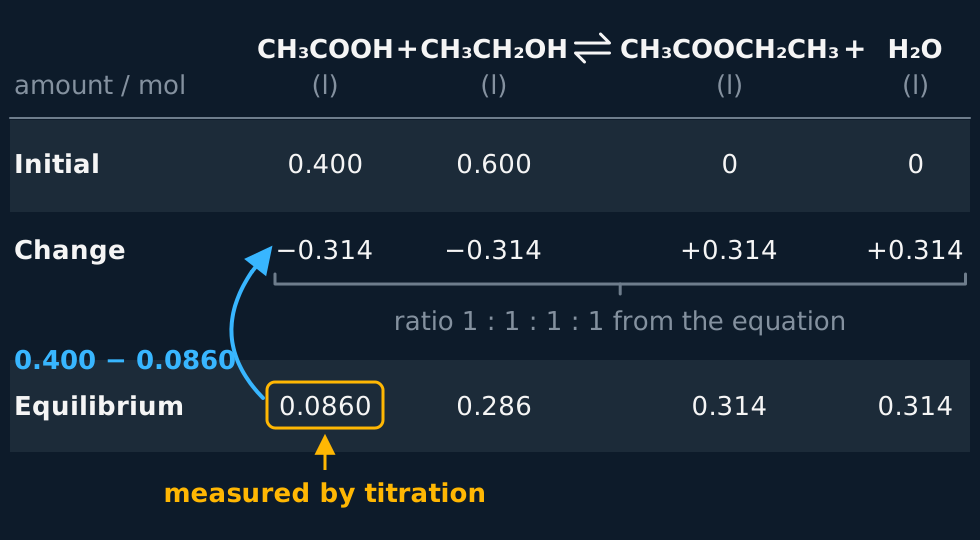
Describe the drawing
An ICE table for ethanoic acid plus ethanol forming ethyl ethanoate and water, the four species heading four columns. The initial row reads 0.400, 0.600, 0 and 0 mol; the change row reads minus 0.314, minus 0.314, plus 0.314 and plus 0.314, bracketed as a 1 to 1 to 1 to 1 ratio from the equation; the equilibrium row reads 0.0860, 0.286, 0.314 and 0.314. The 0.0860 for the acid is boxed as measured by titration, and a curved arrow labelled 0.400 minus 0.0860 runs from it up to the acid's change.
Kc for esterification from the starting amounts
A student mixes 0.400 mol ethanoic acid with 0.600 mol ethanol and a few drops of concentrated sulfuric acid, seals the flask and leaves it at 20 °C for a week. Titration then shows that 0.0860 mol of ethanoic acid remains, after allowing for the catalyst. Calculate Kc.
Show the working
Change. The acid has fallen from 0.400 to 0.0860 mol, so 0.400 − 0.0860 = 0.314 mol has reacted. The equation is 1 : 1 : 1 : 1, so 0.314 mol of ethanol has also reacted and 0.314 mol each of ester and water has formed.
Equilibrium amounts. Ethanoic acid 0.0860 mol; ethanol 0.600 − 0.314 = 0.286 mol; ethyl ethanoate 0.314 mol; water 0.314 mol.
Volume. Each concentration is the amount divided by the same volume V. Two terms on top and two on the bottom means V cancels, so amounts in moles can go straight into the expression.
Kc = (0.314 × 0.314) ÷ (0.0860 × 0.286) = 0.0986 ÷ 0.0246 = 4.01, with no units.
Check. A value close to 4 agrees with Berthelot. Water is included here because it is a product in a mixture of liquids, not a solvent present in vast excess.
The titration needs care. The flask contains sulfuric acid as the catalyst, and the alkali neutralises that as well as the ethanoic acid, so a separate titration of the same amount of catalyst is subtracted. The sample is also run into ice-cold water first, which slows the reaction so that the position does not shift while the alkali is being added. Stopping a reaction in this way, by cooling, diluting or removing a reactant, is called quenching.
- ICE table
- A table of the initial amount, the change in amount and the equilibrium amount of each species, with the changes in the ratio of the coefficients in the equation.
- Quenching
- Slowing a reaction almost to a stop, by cooling, dilution or removing a reactant or catalyst, so that the composition of a sample does not change while it is analysed.
A harder case: hydrogen iodide
Kc for the decomposition of hydrogen iodide, and using it
0.500 mol of hydrogen iodide is sealed in a 2.00 dm³ flask and heated to 764 K. At equilibrium the flask contains 0.0570 mol of iodine. (a) Calculate Kc for 2HI(g) ⇌ H₂(g) + I₂(g) at 764 K. (b) The experiment is repeated with 0.800 mol of hydrogen iodide in the same flask at the same temperature. Calculate the amount of iodine at equilibrium.
Show the working
(a) Change. 0.0570 mol of I₂ has formed, so 0.0570 mol of H₂ has formed too, and the 2 in the equation means 2 × 0.0570 = 0.114 mol of HI has reacted. At equilibrium: HI 0.500 − 0.114 = 0.386 mol, H₂ 0.0570 mol, I₂ 0.0570 mol.
Concentrations, dividing by 2.00 dm³: [HI] = 0.193 mol dm⁻³, [H₂] = [I₂] = 0.0285 mol dm⁻³.
Kc = [H₂][I₂] ÷ [HI]² = (0.0285 × 0.0285) ÷ 0.193² = 0.000812 ÷ 0.0372 = 0.0218. Units: (mol dm⁻³)² ÷ (mol dm⁻³)², so none.
(b) Let x mol of I₂ form. Then H₂ is also x mol and HI is (0.800 − 2x) mol, and the volume cancels as before: x² ÷ (0.800 − 2x)² = 0.0218.
Both sides are perfect squares, so take the square root: x ÷ (0.800 − 2x) = 0.1476. Then x = 0.1181 − 0.2953x, so 1.2953x = 0.1181 and x = 0.0912 mol of iodine.
Check. In both experiments 22.8% of the HI has decomposed (0.114 ÷ 0.500 and 0.182 ÷ 0.800). With the same number of moles of gas on each side, the starting amount does not change the fraction that reacts.
Part (a), laid out as an ICE table:
| Amount / mol | HI | H₂ | I₂ |
|---|---|---|---|
| Initial | 0.500 | 0 | 0 |
| Change | −0.114 | +0.0570 | +0.0570 |
| Equilibrium | 0.386 | 0.0570 | 0.0570 |
| Concentration / mol dm⁻³ | 0.193 | 0.0285 | 0.0285 |
Two slips are easy here. The change for HI is twice the change for I₂, not equal to it, because of the 2 in the equation. And moles go into Kc in place of concentrations only when the volume cancels, which happens only when the powers on top and bottom add up to the same number. For PCl₅ or N₂O₄ the volume has to be used.
Kc belongs to the equation as written. Turned round, H₂(g) + I₂(g) ⇌ 2HI(g) has the expression upside down, so its Kc is 1 ÷ 0.0218 = 45.9 at the same temperature. Halving every coefficient takes the square root of Kc. A value of Kc means nothing without its equation.
What Kc depends on
Adding more ethanol to an ester mixture at equilibrium makes the bottom of the Kc expression larger for a moment, so the ratio of concentrations is smaller than Kc. That ratio, worked out with the concentrations at any moment rather than at equilibrium, is the reaction quotient, Q. While Q is less than Kc, the forward reaction runs faster than the reverse: ethanol and acid are used, ester and water form, and Q rises until it equals Kc again. The position has shifted right and Kc has not changed. This is why Le Chatelier's principle works for concentration.
If Q is greater than Kc, the reverse reaction runs faster until the two are equal. If Q equals Kc, the mixture is already at equilibrium.
Pressure works through concentration. Halving the volume of a mixture of N₂O₄ and NO₂ doubles every concentration. With Kc = 0.0100 mol dm⁻³, [N₂O₄] = 0.0400 and [NO₂] = 0.0200 mol dm⁻³, the doubled values give Q = 0.0400² ÷ 0.0800 = 0.0200 mol dm⁻³, twice Kc. The squared term on top has grown faster than the bottom, so the reverse reaction runs faster, and the mixture moves towards N₂O₄ until Q is 0.0100 again, at [N₂O₄] = 0.0854 and [NO₂] = 0.0292 mol dm⁻³. The position has moved; Kc has not.
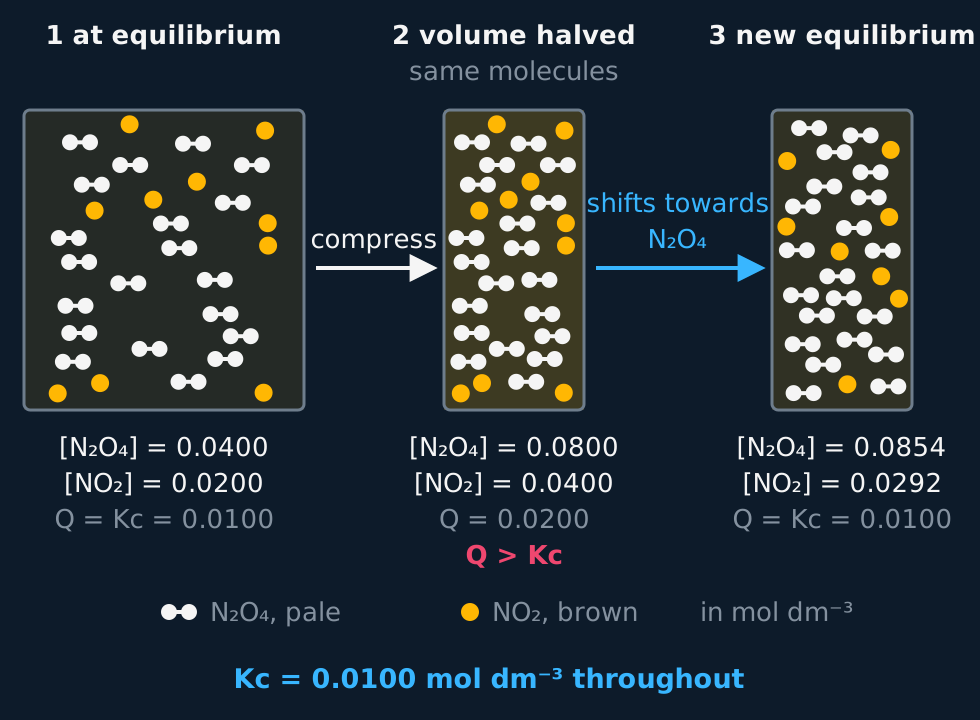
Describe the drawing
Three boxes of gas. The first, at equilibrium, holds 20 linked pairs for dinitrogen tetroxide and 10 single amber discs for nitrogen dioxide, with concentrations 0.0400 and 0.0200 and Q equal to Kc. The second is half as wide and holds the same molecules, so every concentration doubles and Q is 0.0200, marked Q greater than Kc in coral. The third, the same size, has shifted towards dinitrogen tetroxide: 21 pairs and 8 singles, concentrations 0.0854 and 0.0292, and Q back at 0.0100. A line beneath reads Kc equals 0.0100 throughout.
A catalyst speeds up the forward and reverse reactions equally. Kc and the position are both unchanged.
Temperature is the only change that alters Kc. For an exothermic forward reaction, Kc falls as the temperature rises, and the position moves left to match the new, smaller value. For an endothermic forward reaction, Kc rises with temperature. The formation of hydrogen iodide is slightly exothermic, and its Kc falls from about 100 at 500 K to about 43 at 800 K. In an answer, say that Kc 'decreases' or 'increases'; 'Kc changes' does not give the direction the mark is for.
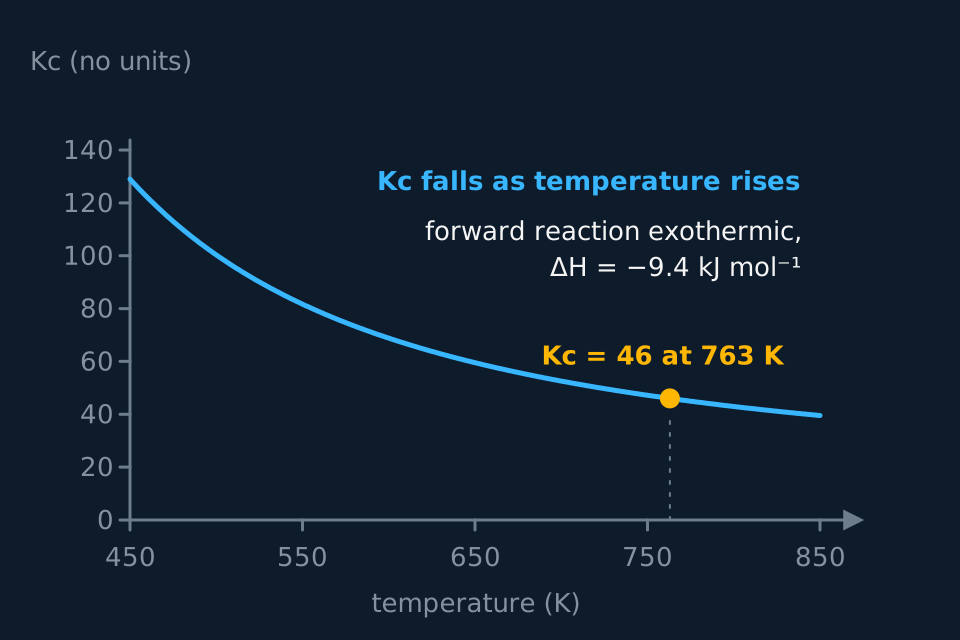
Describe the drawing
Kc for hydrogen plus iodine forming hydrogen iodide plotted against temperature from 450 to 850 kelvin. The cyan curve falls from about 129 at the left, through 100 at 500 kelvin and 53 at 700 kelvin, and flattens as it goes. An amber dot marks Kc equals 46 at 763 kelvin. A note explains that Kc falls as temperature rises because the forward reaction is exothermic, with ΔH of minus 9.4 kJ per mole.
| Change | Position of equilibrium | Kc |
|---|---|---|
| Add a reactant or remove a product | Shifts right | Unchanged |
| Raise the pressure | Shifts to fewer moles of gas | Unchanged |
| Add a catalyst | Unchanged, but reached sooner | Unchanged |
| Raise the temperature, forward reaction exothermic | Shifts left | Decreases |
| Raise the temperature, forward reaction endothermic | Shifts right | Increases |
These rules hold for every equilibrium constant met later, such as the acid dissociation constant Ka: each is written from an equation, changes only with temperature, and controls the position through the comparison of a ratio with the constant.
- Reaction quotient, Q
- The ratio with the same form as Kc but using the concentrations at any moment; it equals Kc only when the mixture is at equilibrium.
TRY IT: Which way will it go
At 20 °C, Kc for the esterification of ethanoic acid with ethanol is 4.0. A mixture is made from 0.200 mol ethanoic acid, 0.200 mol ethanol, 0.500 mol ethyl ethanoate and 0.500 mol water, with a catalyst. Calculate Q and predict which way the reaction goes.
Check your answer
Q has the same form as Kc and the volume cancels: Q = (0.500 × 0.500) ÷ (0.200 × 0.200) = 0.250 ÷ 0.0400 = 6.25.
Q is greater than Kc, so there is too much ester and water for equilibrium. The reverse reaction, hydrolysis of the ester, runs faster than the forward reaction until Q has fallen to 4.0.
The mixture moves to the left: the amounts of ethanoic acid and ethanol rise, and the amounts of ester and water fall.
Other boards: heterogeneous equilibria and partition coefficients
OCR and Edexcel also set Kc for heterogeneous equilibria, in which a solid takes part: Edexcel at AS (10.4), OCR at A level (5.1.2(d)). Iron(II) and silver ions give the standard case. Mixed, they deposit a grey film of silver, but some of each ion is always left, and iron(III) ions added to silver dissolve some of it again.
Fe²⁺(aq) + Ag⁺(aq) ⇌ Fe³⁺(aq) + Ag(s)A heterogeneous equilibrium: three species in solution and one solid.
The silver is left out of Kc. The concentration of a solid is fixed by its density: a lump twice the size holds twice the amount in twice the volume, so the figure never changes as the reaction runs, and it is folded into the constant. Adding more silver does not move the position, provided some is present. A pure liquid on its own is left out for the same reason.
Kc = [Fe³⁺] ÷ ([Fe²⁺][Ag⁺])Units: mol dm⁻³ ÷ (mol dm⁻³)² = mol⁻¹ dm³.
Kc with a solid present
Equal volumes of 0.100 mol dm⁻³ iron(II) nitrate and 0.100 mol dm⁻³ silver nitrate are mixed at 298 K and left to reach equilibrium. The silver is filtered off, and titration of the filtrate with potassium thiocyanate shows [Ag⁺] = 0.0438 mol dm⁻³. Calculate Kc.
Show the working
Mixing equal volumes halves each concentration: [Fe²⁺] = [Ag⁺] = 0.0500 mol dm⁻³ at the start, and [Fe³⁺] = 0.
[Ag⁺] has fallen by 0.0500 − 0.0438 = 0.0062 mol dm⁻³. The equation is 1 : 1 : 1, so [Fe²⁺] = 0.0438 mol dm⁻³ and [Fe³⁺] = 0.0062 mol dm⁻³ at equilibrium.
Kc = 0.0062 ÷ (0.0438 × 0.0438) = 0.0062 ÷ 0.001918 = 3.2 mol⁻¹ dm³, to two significant figures, because the subtraction leaves only two. The silver does not appear.
The silver is filtered off first because the titration removes silver ions; with solid silver present the reverse reaction would replace them and the titre would be too large. The iron(III) in the filtrate is the indicator, turning red with the first drop of thiocyanate in excess.
OCR also sets the practical determination of equilibrium amounts, with the quenched esterification titration as the usual example, and lists as a statement of its own the transfer of these rules to other equilibrium constants such as Ka.
Cambridge adds the partition coefficient (25.2). A solute shaken with two solvents that do not mix, such as water and an organic solvent, spreads between the two layers until it crosses the boundary in each direction at the same rate. At a given temperature the ratio of its concentrations in the two layers is then constant, whatever the amount of solute.
Kpc = [X]organic ÷ [X]aqueousBoth concentrations in the same units, so Kpc has no units.
A Kpc greater than 1 means the solute is more soluble in the organic solvent, as a non-polar or weakly polar solute is; a value below 1 means it prefers water, as an ionic or strongly hydrogen-bonding solute does. A solvent extraction uses this to pull an organic product out of a water layer.
One extraction or two
For an organic product X, Kpc between ethoxyethane and water is 4.00 at 20 °C. A 100 cm³ aqueous solution holds 2.00 g of X. Calculate the mass of X extracted by one 50 cm³ portion of ethoxyethane, and by two 25 cm³ portions used one after the other.
Show the working
One 50 cm³ portion. Let m g pass into the organic layer: (m ÷ 50) ÷ ((2.00 − m) ÷ 100) = 4.00, so 2m = 4.00(2.00 − m), 6m = 8.00 and m = 1.33 g.
First 25 cm³ portion: (m ÷ 25) ÷ ((2.00 − m) ÷ 100) = 4.00, so 4m = 4.00(2.00 − m) and m = 1.00 g, leaving 1.00 g in the water.
Second 25 cm³ portion: the same ratio removes half of what is left, 0.500 g. The two portions together extract 1.50 g, against 1.33 g from one portion of the same total volume.
Two small extractions beat one large one because each extraction takes the same fraction of what remains. One 50 cm³ portion leaves a third of the solute behind; each 25 cm³ portion leaves a half, and two of them leave a half of a half, a quarter. Splitting the solvent further, into three or four portions, extracts more again.
- Partition coefficient, Kpc
- The ratio of the concentrations of a solute in two immiscible solvents at equilibrium, at a stated temperature.
In the exam
- Build the expression from the balanced equation as printed: products over reactants, coefficients as powers, square brackets for concentrations. The scheme gives no credit for an expression with the reactants on top, even with every power right.
- The units of Kc often carry a mark of their own. Work them out from the expression, and where they cancel write 'no units' rather than leaving the space blank.
- From initial amounts, set out the ICE table with the change row in the ratio of the coefficients. The scheme awards method marks for the equilibrium amounts, and an arithmetic slip after them is treated as error carried forward if each line is shown.
- Explaining the effect of adding a reactant, state that Kc is unchanged, that the ratio of concentrations is momentarily below Kc, and that the position shifts right until the ratio equals Kc again. 'Kc increases' is rejected even when the direction of shift is right.
- On a question about temperature, give the direction of the change in Kc from the sign of ΔH, then the shift in position that follows.
Check yourself
A student writes: 'Raising the pressure on the Haber equilibrium makes more ammonia, so it must increase Kc.' Explain what is wrong with the second half of that sentence.
Answer
Raising the pressure does give more ammonia, but it does so without changing Kc. Kc depends only on temperature.
Compressing the mixture raises every concentration by the same factor. Kc = [NH₃]² ÷ ([N₂][H₂]³) has two powers of concentration on top and four on the bottom, so doubling every concentration multiplies the ratio by 2² ÷ 2⁴, a quarter. The ratio is now less than Kc.
While the ratio is less than Kc, the forward reaction runs faster than the reverse, until the ratio is back at Kc. More ammonia has formed and the position has moved right, and Kc is exactly what it was.
Questions
Question 16 marks
Explain how each of these changes affects the position of equilibrium and the value of Kc for 2SO₂(g) + O₂(g) ⇌ 2SO₃(g), ΔH = −197 kJ mol⁻¹: adding more oxygen, raising the pressure, adding a catalyst, and raising the temperature.
Mark scheme
Indicative content
- adding oxygen raises [O₂], so the ratio [SO₃]² ÷ ([SO₂]²[O₂]) falls below Kc and the forward reaction runs faster than the reverse
- the position shifts to the right until the ratio equals Kc again, so more SO₃ forms while Kc itself is unchanged
- raising the pressure raises every concentration by the same factor, and with three moles of gas on the left and two on the right the ratio falls below Kc
- the position shifts right, towards fewer moles of gas, but Kc is unchanged because only a change of temperature changes Kc
- a catalyst increases the forward and reverse rates equally, so neither the position nor Kc changes and equilibrium is only reached sooner
- raising the temperature decreases Kc because the forward reaction is exothermic, so the ratio is now above the new Kc and the position shifts left, lowering the yield of SO₃
Levels
- Level 3 (5–6 marks) all four changes are explained, each with its effect on the position and on Kc stated separately and correctly, and the reasoning uses the ratio compared with Kc rather than Le Chatelier's principle alone; the answer says that only temperature changes Kc and explains why in terms of the exothermic forward reaction
- Level 2 (3–4 marks) three of the four changes are right for both position and Kc, or all four are covered and Kc goes wrong for one of them
- Level 1 (1–2 marks) the shift in position is given for one or two changes, with Kc said to rise when oxygen is added or the pressure raised
Question 25 marksCAIE
Show that two 20.0 cm³ portions of an organic solvent extract more of a solute from 50.0 cm³ of water than one 40.0 cm³ portion does. The water holds 1.00 g of the solute, and Kpc (organic ÷ aqueous) is 9.00.
Mark scheme
- M1 one 40.0 cm³ portion: (m ÷ 40.0) ÷ ((1.00 − m) ÷ 50.0) = 9.00, so 50.0m = 360(1.00 − m)
- A1 m = 360 ÷ 410 = 0.878 g extracted by one portion
- M1 first 20.0 cm³ portion: 50.0m = 180(1.00 − m), so m = 0.783 g, leaving 0.217 g in the water
- M1 second 20.0 cm³ portion takes the same fraction, 180 ÷ 230, of the 0.217 g left, which is 0.170 g
- A1 two portions extract 0.953 g in total, more than the 0.878 g from one portion; error carried forward from M2
Question 34 marks
Give the expression for Kc, and its units, for 2SO₂(g) + O₂(g) ⇌ 2SO₃(g) and for N₂(g) + 3H₂(g) ⇌ 2NH₃(g).
Mark scheme
- B1 Kc = [SO₃]² ÷ ([SO₂]²[O₂]); square brackets are required
- B1 units: (mol dm⁻³)² ÷ (mol dm⁻³)³ = mol⁻¹ dm³; accept dm³ mol⁻¹
- B1 Kc = [NH₃]² ÷ ([N₂][H₂]³)
- B1 units: (mol dm⁻³)² ÷ (mol dm⁻³)⁴ = mol⁻² dm⁶; accept dm⁶ mol⁻²
All 21 questions with mark schemes, the other 18 set out in full on the question page.
Worth remembering
- An expression with the reactants on top is not credited, even with every power right.
- Amounts in moles go straight into Kc only when the powers on top and bottom add up to the same number; otherwise divide by the volume first.
- Double the change for HI: the 2 in 2HI makes its change twice that of I₂.
- 'Kc increases' when a reactant is added is rejected even with the right shift; Kc is unchanged and the ratio is momentarily below it.
- Write 'no units' when the units cancel, rather than leaving the space blank.
CHECK YOUR PROGRESS
Rate how confident you are with each objective for this lesson. Ratings are saved in this browser, on this device, unless you sign in.
- Write an expression for Kc from a balanced equation for a homogeneous system, and deduce its units.
- Calculate Kc from equilibrium amounts in a known volume, using an ICE table when only the initial amounts and one equilibrium amount are given.
- Use a value of Kc to calculate an equilibrium amount.
- Explain why changes in concentration and pressure and the addition of a catalyst leave Kc unchanged, and predict from the sign of ΔH how Kc changes with temperature.
- Compare a reaction quotient with Kc to predict which way a mixture will move.
- Write Kc for a heterogeneous equilibrium, leaving out solids and a solvent present in large excess.Edexcel · OCR A
Open the full revision checklist to see every objective in the curriculum in one place.
Practise this lesson
Practise the equilibrium constant Kc with 21 original questions and point-by-point mark schemes
WORKBOOK
The written questions from this topic, on paper with room to work, and a separate book of mark schemes. The 6 questions that are set on a diagram stay on this page, where the diagram can be drawn. Free to use; please do not redistribute or sell.
Used later in Weak acids, Ka and pKa; Kw and strong bases