Chemistry › Chemical equilibria › Dynamic equilibrium, Le Chatelier's principle and industrial compromise
Dynamic equilibrium, Le Chatelier's principle and industrial compromise
A sealed bottle of sparkling water looks as if nothing is happening inside it, yet gas is dissolving and escaping all the time at the same rate. That balance is a dynamic equilibrium. Le Chatelier's principle predicts which way it moves when the concentration, pressure or temperature changes, and the Haber process shows why a factory settles for a yield well below the best on offer.
Key terms Every definition in chemical equilibria, lesson by lesson
Before this Collision theory, activation energy and the rate of reaction – a reaction goes faster when more collisions have at least the activation energy · The Maxwell–Boltzmann distribution, temperature and catalysts – a catalyst provides a route with a lower activation energy · Enthalpy change, standard conditions and the definitions – the sign of ΔH for an exothermic and an endothermic reaction
COMMON MISCONCEPTION
At equilibrium the reaction has stopped, and there are equal amounts of reactants and products.
Both reactions carry on at equilibrium, at equal rates, so the concentrations stay constant without being equal. The Haber mixture at 450 °C is mostly unreacted nitrogen and hydrogen. The position depends on the reaction and the conditions, and it is rarely 50 : 50.
What you should be able to do
- State the features of a dynamic equilibrium, and explain why one can only be set up in a closed system.
- Use Le Chatelier's principle to predict the effect of a change in concentration, pressure or temperature on the position of equilibrium.
- Explain why a catalyst does not change the position of equilibrium but does change the time taken to reach it.
- Explain the temperature and pressure chosen for the Haber process as a compromise between yield, rate and cost.
- Apply the same reasoning to the Contact process, the hydration of ethene and the synthesis of methanol.
Both directions at once
A reaction that appears to have stopped may still be running, in both directions at once and at the same rate. An unopened bottle of sparkling water shows it. Nothing fizzes, the pressure inside holds steady, and it would look the same after a year on a shelf. Inside, carbon dioxide molecules are leaving the water for the gas above it all the time, and molecules from that gas are dissolving back into the water at the same rate. Unscrew the cap and the gas above escapes into the room. Dissolving can no longer keep pace with escaping, and the drink fizzes until it is flat.
CO₂(g) ⇌ CO₂(aq)The ⇌ arrow shows a change that runs in both directions at once.
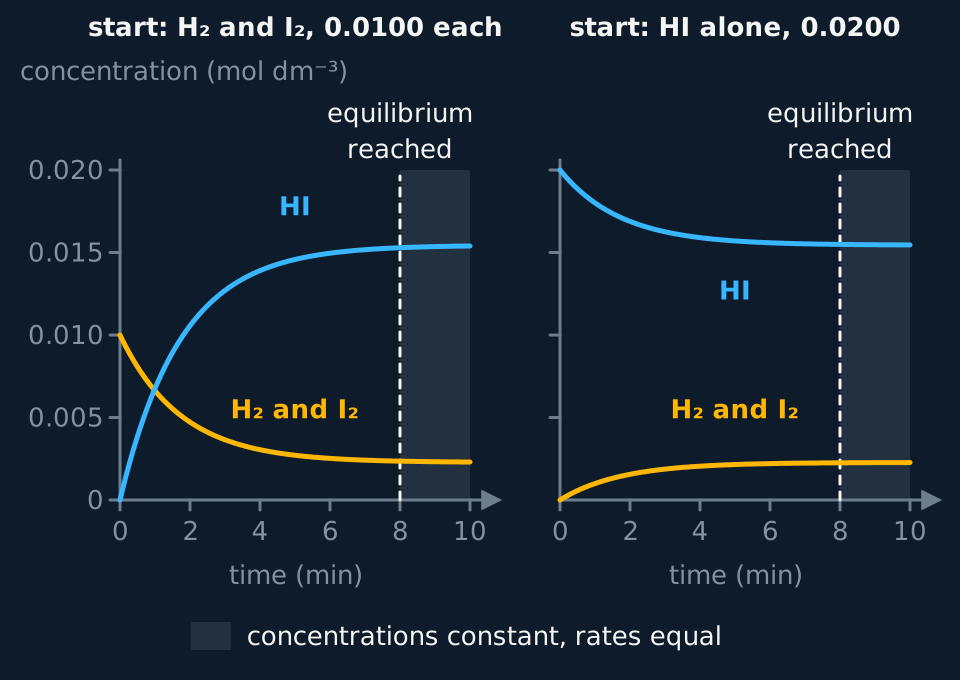
A reversible reaction is one that can go in either direction under the same conditions. Hydrogen and iodine show it well. Hydrogen sealed with purple iodine vapour in a flask at 490 °C loses the purple as colourless hydrogen iodide forms, but it never fades completely: after a few minutes the colour stops changing. Twice that amount of pure hydrogen iodide, sealed in an identical flask at the same temperature, turns purple: the colour deepens and stops at the same shade.
H₂(g) + I₂(g) ⇌ 2HI(g)The forward reaction runs left to right, the reverse reaction right to left.
Describe the drawing
Two graphs of concentration against time for hydrogen, iodine and hydrogen iodide at 490 degrees Celsius. On the left the run starts from hydrogen and iodine at 0.0100 mol dm⁻³ each: their shared amber curve falls and levels at 0.00228 while the cyan hydrogen iodide curve rises from zero and levels at 0.0154. On the right the run starts from hydrogen iodide alone at 0.0200: it falls to 0.0154 while hydrogen and iodine rise to 0.00228. In both, a dashed line at eight minutes marks equilibrium, after which the shaded region shows constant, unequal concentrations at the same heights in both panels.

Describe the drawing
Rate against time for the hydrogen and iodine equilibrium at 490 degrees Celsius, drawn in four stages from a start of hydrogen and iodine only. The amber forward rate starts at 1 and falls as the reactants are used up; the cyan reverse rate starts at zero and rises as hydrogen iodide builds up. Printed values at half a minute, 2, 4 and 10 minutes show the gap closing until both rates level at the same value, about 0.05, at equilibrium, where neither is zero.
The rates explain the levelling. At the start of the first run only the forward reaction can happen, and it is fast because hydrogen and iodine are at their highest concentrations. As they are used up the forward rate falls. Hydrogen iodide builds up, so the reverse reaction, which started from nothing, speeds up. When the two rates are equal, every molecule of hydrogen iodide made is matched by one broken down somewhere else in the flask, and no concentration changes any more.
That state is a dynamic equilibrium. Dynamic means both reactions carry on. The evidence comes from an isotope: add a little iodine made from radioactive iodine-131 to a mixture already at equilibrium, and within minutes the radioactivity turns up in the hydrogen iodide too, although the concentrations of all three substances have not changed. Iodine atoms are still crossing from one side of the equation to the other.
Equal rates do not mean equal amounts. At 490 °C the hydrogen and iodine mixture settles with about three-quarters of the iodine turned into hydrogen iodide; other reactions settle with almost all product or almost all reactant. The position of equilibrium describes those proportions. An equilibrium that lies to the right has mostly products in it; one that lies to the left has mostly reactants.
An equilibrium needs a closed system, one that no substance can enter or leave. Limestone heated in a sealed container decomposes only until the carbon dioxide reaches a fixed pressure, and from then on calcium oxide and carbon dioxide recombine as fast as calcium carbonate breaks down. A lime kiln is open at the top. The carbon dioxide is carried off with the hot gases, the reverse reaction has nothing to work with, and all the limestone decomposes.
CaCO₃(s) ⇌ CaO(s) + CO₂(g)In a sealed container. In an open kiln the arrow becomes →.
- Reversible reaction
- A reaction that can proceed in both the forward and the reverse direction under the same conditions.
- Dynamic equilibrium
- The state of a reversible reaction in a closed system in which the forward and reverse reactions proceed at equal rates, so the concentrations of reactants and products remain constant.
- Closed system
- A system that no substance can enter or leave, although energy may be transferred to or from it.
- Open system
- A system that substances can enter or leave, so a reversible reaction in it cannot reach equilibrium.
- Position of equilibrium
- The relative proportions of reactants and products in a mixture at equilibrium.
Le Chatelier's principle
One rule predicts which way the position of an equilibrium moves when the conditions change. It gives the direction of the shift; the reason for the shift comes from the equilibrium constant. The rule carries the name of Henri Le Chatelier, who stated it in 1884.
- Le Chatelier's principle
- If a system at equilibrium is subjected to a change in conditions, the position of equilibrium shifts in the direction that opposes the change.
Adding a substance shifts the position away from it, and removing one shifts the position towards it. Yellow chromate(VI) ions and orange dichromate(VI) ions are in equilibrium in water. A few drops of dilute sulfuric acid turn the solution orange: the forward reaction uses up the extra hydrogen ions, so the position shifts to the right. Sodium hydroxide removes hydrogen ions as water, and the solution goes back to yellow as the position shifts left to replace them.
2CrO₄²⁻(aq) + 2H⁺(aq) ⇌ Cr₂O₇²⁻(aq) + H₂O(l)Yellow chromate(VI) on the left, orange dichromate(VI) on the right.
A change of pressure moves only equilibria involving gases. The pressure of a gas mixture depends on how many molecules it holds in its volume. When the pressure is raised, the position shifts towards the side with fewer moles of gas, because forming fewer molecules lowers the pressure again. In the Haber equilibrium four moles of gas on the left become two on the right, so a higher pressure gives more ammonia. In the hydrogen iodide equilibrium there are two moles of gas on each side, and pressure has no effect on the position at all. Write 'fewer moles of gas' rather than 'fewer moles': a solid or liquid in the equation does not count.

Describe the drawing
A gas syringe of nitrogen dioxide and dinitrogen tetroxide animated in three stages. At equilibrium the box holds 20 linked pairs for dinitrogen tetroxide and 10 amber discs for nitrogen dioxide, with Q equal to Kc, 0.0100. The piston then halves the volume: the same molecules, every concentration doubled, the brown deeper and Q 0.0200, above Kc. Finally two nitrogen dioxide molecules pair up, leaving 21 pairs and 8 singles, concentrations 0.0854 and 0.0292, and Q back at Kc: the position has moved to the side with fewer moles of gas.
Temperature acts through the enthalpy change. A reversible reaction is exothermic in one direction and endothermic in the other, by the same amount. Raising the temperature shifts the position in the endothermic direction, which takes in heat and opposes the rise. Lowering it shifts the position in the exothermic direction. The sign of ΔH for the forward reaction settles it: if it is negative, heating moves the position to the left and lowers the yield of products. Name the direction, 'the endothermic direction', in an answer; 'the reaction uses up the heat' does not say which way the position moves.
Cobalt(II) chloride gives a clear laboratory test of the temperature rule. In water the cobalt(II) ions are pink [Co(H₂O)₆]²⁺; at a high chloride concentration they become blue [CoCl₄]²⁻, and a solution holding plenty of each looks purple.
[Co(H₂O)₆]²⁺(aq) + 4Cl⁻(aq) ⇌ [CoCl₄]²⁻(aq) + 6H₂O(l)Pink on the left, blue on the right.
Divide one purple solution between three boiling tubes. Stand one in water at about 80 °C, one in iced water, and leave the third in the rack. The hot tube turns blue and the iced one pink, and each goes back to purple as it returns to room temperature, which shows a shift in an equilibrium and not a decomposition. The third tube is the control: each colour is judged against it, because the eye judges a shade badly on its own.
Heating favours the blue side, so the forward reaction is endothermic. Concentration can be tested on the same solution. Concentrated hydrochloric acid added drop by drop turns it blue, as the extra chloride ions shift the position right; water turns it pink again by diluting the chloride. Questions set the same reasoning on coloured equilibria never met before: the colour that appears names the side the position has moved to. Cobalt(II) chloride is toxic and the acid corrosive, so gloves and eye protection are worn.
A catalyst provides an alternative route with a lower activation energy, lowering it by the same amount for the forward and the reverse reaction, so it speeds both up by the same factor. The position of equilibrium does not move. What changes is the time taken to get there, and in a factory a shorter time means more product from the same plant.
- Catalyst
- A substance that increases the rate of a reaction without being changed in chemical composition or amount, by providing an alternative reaction route with a lower activation energy.
| Change | Position of equilibrium | Why |
|---|---|---|
| Add a reactant, or remove a product | Shifts right | The forward reaction uses up the added reactant, or replaces the removed product |
| Raise the pressure (gases only) | Shifts to the side with fewer moles of gas | Fewer molecules exert a lower pressure |
| Raise the temperature | Shifts in the endothermic direction | The endothermic reaction takes in the added heat |
| Add a catalyst | No change | Forward and reverse rates rise by the same factor |
A syringe of brown gas
A sealed gas syringe holds an equilibrium mixture of colourless dinitrogen tetroxide and brown nitrogen dioxide at room temperature. For the forward reaction, N₂O₄(g) ⇌ 2NO₂(g), ΔH = +57 kJ mol⁻¹. Predict and explain what is seen when the plunger is pushed in quickly and held, and when the syringe is then lowered into iced water.
Show the working
Pushing the plunger in halves the volume. Both gases are now twice as concentrated, so the brown darkens at once: the position has not had time to move.
Over the next few seconds the brown fades. The pressure has been raised, so the position shifts to the left, the side with one mole of gas rather than two, and pairs of NO₂ molecules join to form N₂O₄. The colour settles paler than at the dark moment but darker than at the start, because the shift only partly opposes the change.
In iced water the brown fades further. The forward reaction is endothermic, so a fall in temperature favours the exothermic reverse reaction and the position shifts to the left. Warmed in hot water instead, the mixture turns a deeper brown as the position shifts right.
The Haber process and the Contact process: yield against rate
About 180 million tonnes of ammonia are made each year by the Haber process, most of it for fertiliser. Nitrogen comes from the air and hydrogen from natural gas, and they react over an iron catalyst.
N₂(g) + 3H₂(g) ⇌ 2NH₃(g)ΔH = −92 kJ mol⁻¹
Le Chatelier's principle gives a clear answer about yield. The forward reaction is exothermic, so a low temperature shifts the position to the right. Four moles of gas become two, so a high pressure shifts it to the right as well. At 200 °C and 1000 atm the equilibrium mixture would be almost all ammonia.
Describe the drawing
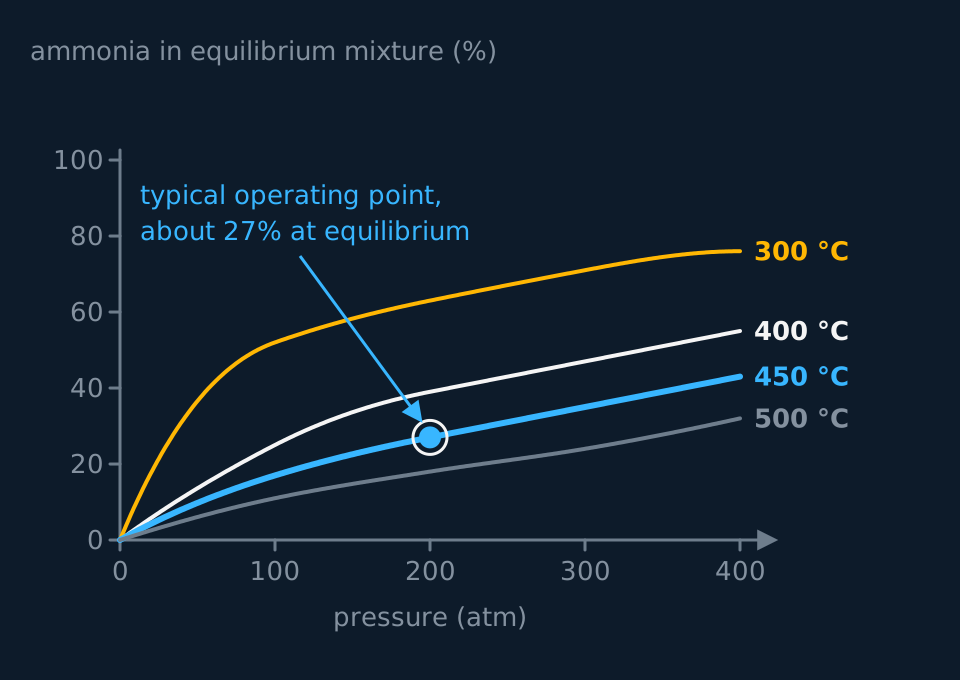
Percentage of ammonia in the equilibrium mixture plotted against pressure from 0 to 400 atmospheres, one rising curve for each of four temperatures. The 300 degree curve is highest, reaching 76 percent at 400 atmospheres; the 400, 450 and 500 degree curves lie successively lower, the 500 degree curve reaching only 32 percent. A ringed dot on the cyan 450 degree curve at 200 atmospheres marks the typical operating point, about 27 percent ammonia at equilibrium.
The plant runs at about 450 °C and 200 atm instead, and the gas leaving the converter is only about 15% ammonia. The temperature is a compromise between yield and rate. At 200 °C few collisions have the activation energy, even on the catalyst, and equilibrium would take far too long to reach. At 450 °C the equilibrium yield is lower, but the reaction is fast enough to make far more ammonia each hour.
The pressure is a compromise between yield and cost. A higher pressure would raise both the yield and the rate, but compressing gas uses a great deal of electrical energy, and every pipe, valve and vessel needs thicker walls to hold it. A leak of hot hydrogen at very high pressure is a serious hazard. Above about 200 atm the extra ammonia no longer pays for the extra plant and energy.
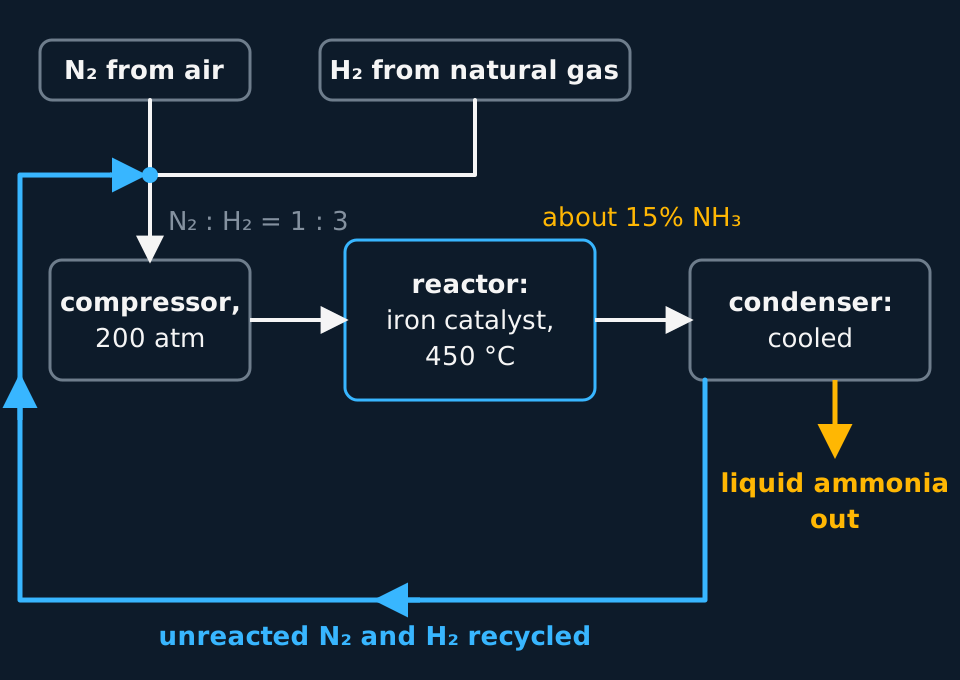
Fifteen per cent per pass is acceptable because nothing is wasted. The hot mixture is cooled, the ammonia condenses to a liquid long before nitrogen or hydrogen would and is run off, and the unreacted gases are pumped back to the converter. Over many passes about 98% of the nitrogen and hydrogen ends up as ammonia.
Describe the drawing
A flow diagram of the Haber process. Nitrogen from air and hydrogen from natural gas join and pass, in a 1 to 3 ratio, into a compressor at 200 atmospheres, then a reactor with an iron catalyst at 450 degrees Celsius. Gas leaving the reactor, about 15 percent ammonia, goes to a cooled condenser, where liquid ammonia drains out downwards. A cyan return line runs from the condenser along the bottom and back up to rejoin the feed before the compressor, carrying the unreacted nitrogen and hydrogen round the loop again.
Energy is the largest running cost. Ammonia plants use about 1 to 2% of the world's energy supply, most of it to make the hydrogen and to compress the gases. The forward reaction gives out heat, and the plant uses it to raise steam rather than losing it to the air. A catalyst that worked fast at a lower temperature would give a higher yield on each pass at the same rate, so less gas would go round the loop to be recompressed, and a lower pressure might do. That is why new catalysts are still being sought for a process over a century old.
The Contact process for sulfuric acid makes the opposite decision about pressure. Its key step, the oxidation of sulfur dioxide, is also exothermic with fewer moles of gas on the right, so Le Chatelier's principle again asks for a low temperature and a high pressure.
2SO₂(g) + O₂(g) ⇌ 2SO₃(g)ΔH = −197 kJ mol⁻¹
The temperature is about 450 °C, the same compromise as in the Haber process: below about 400 °C the vanadium(V) oxide catalyst works too slowly to be useful. The pressure is only 1 to 2 atm, just enough to push the gas through the plant. The gas passes over three or four beds of catalyst and is cooled between them, because the heat released would otherwise warm the gas and shift the position left. Air supplies oxygen in excess, which shifts the position right. By the last bed more than 99% of the sulfur dioxide has been converted, so compression would buy almost nothing and would cost a great deal.
| Haber process | Contact process | |
|---|---|---|
| Equilibrium | N₂(g) + 3H₂(g) ⇌ 2NH₃(g) | 2SO₂(g) + O₂(g) ⇌ 2SO₃(g) |
| ΔH / kJ mol⁻¹ | −92 | −197 |
| Moles of gas | 4 → 2 | 3 → 2 |
| Temperature | About 450 °C: yield against rate | About 450 °C: yield against rate |
| Pressure | About 200 atm: yield against cost and safety | 1 to 2 atm: conversion already above 99% |
| Catalyst | Iron | Vanadium(V) oxide, V₂O₅ |
| Conversion | About 15% a pass; unreacted gas recycled | Above 99% over several beds, cooled between beds |
- Equilibrium yield
- The proportion of the reactants converted into products once the reaction mixture has reached equilibrium.
- Compromise conditions
- Conditions chosen to give an acceptable equilibrium yield at an acceptable rate and cost, where the conditions for the highest yield would make the reaction too slow or the plant too expensive.
Ethanol and methanol
Ethanol for industry is made by hydrating ethene with steam. The forward reaction is exothermic, and two moles of gas become one.
C₂H₄(g) + H₂O(g) ⇌ CH₃CH₂OH(g)ΔH = −45 kJ mol⁻¹, over a phosphoric acid catalyst on silica
The conditions are about 300 °C and 60 to 70 atm. The temperature is again a compromise between yield and rate. The pressure is held down for two reasons: the cost of compression, and the fact that at high pressure ethene polymerises to poly(ethene), which wastes the feedstock. Only about 5% of the ethene reacts on each pass, so the ethanol is condensed out and the ethene recycled, giving an overall conversion of about 95%.
Methanol, a fuel and the starting point for many plastics, is made from carbon monoxide and hydrogen, and the pattern is the Haber pattern again.
CO(g) + 2H₂(g) ⇌ CH₃OH(g)ΔH = −91 kJ mol⁻¹
It runs at about 250 °C and 50 to 100 atm over a catalyst of copper and zinc oxide. Three moles of gas become one, so pressure helps the yield. The reaction is exothermic, so a low temperature helps the yield and slows the rate. An active catalyst is what allows a lower temperature here than in the Haber process.
Four things settle the conditions for any of these plants: the number of moles of gas on each side, the sign of ΔH, the rate at the temperature the yield prefers, and the cost of each extra atmosphere. Le Chatelier's principle settles the first two. The catalyst, the price of energy and the strength of steel settle the rest.
TRY IT: Hydrogen from methane
Hydrogen for the Haber process is made by steam reforming over a nickel catalyst: CH₄(g) + H₂O(g) ⇌ CO(g) + 3H₂(g), ΔH = +206 kJ mol⁻¹. Suggest the temperature and pressure that would give a high equilibrium yield of hydrogen, and say whether a compromise is needed.
Check your answer
The forward reaction is endothermic, so a high temperature shifts the position to the right. Here yield and rate agree: a high temperature also makes the reaction fast, so there is no compromise over temperature. Plants run at about 850 °C, limited by what the steel tubes and the catalyst can stand.
Two moles of gas become four, so a low pressure gives the higher yield.
In practice the pressure is about 30 atm. A higher pressure lets a smaller plant handle the same amount of gas, and the hydrogen is needed at high pressure in the ammonia converter anyway, so some yield is given up to save on compression later.
Other boards: the practical investigation and the named processes
OCR lists the practical investigation of an equilibrium shift as a statement of its own, 3.2.3(d). The cobalt(II) chloride tubes and the chromate and dichromate colours are the usual choices, and an OCR question can ask for the method in full: the control tube kept at room temperature, the hot and iced water baths, the return to the starting colour that shows a reversible shift, and the hazards of cobalt(II) chloride and concentrated hydrochloric acid.
Cambridge names the Haber process and the Contact process in its specification and expects the conditions for each, the reason for each condition, and the reason a compromise is needed. The table of the two processes holds what a Cambridge answer needs, including the two catalysts and the cooling between the Contact process beds.
Edexcel teaches the principle, the effect of a catalyst and the industrial compromise in Topic 10, alongside Kc, so its questions often join a prediction of the shift to a statement about whether Kc changes. The answer is the one Kc teaches: only temperature changes the constant.
In the exam
- An answer on a change in conditions earns its marks for three things: the direction the position shifts, the reason in Le Chatelier's terms (fewer moles of gas, the endothermic direction), and the effect on the yield asked about. Restating the principle on its own earns none of them.
- For pressure, count moles of gas from the balanced equation. The scheme wants 'fewer moles of gas' or 'fewer gas molecules'; a count that includes a solid or a liquid is not credited.
- A catalyst answer is credited in two halves: the forward and reverse rates increase equally, so the position does not change; and equilibrium is reached sooner.
- For an industrial compromise, the temperature mark needs yield set against rate, and the pressure mark needs yield set against cost or safety. 'A high temperature gives a high yield' for an exothermic reaction is not awarded the mark however well the rest is argued.
- Describe dynamic equilibrium as equal forward and reverse rates with constant concentrations. Schemes do not accept 'equal concentrations', which is usually false, or 'the reaction has stopped'.
Check yourself
An ammonia plant runs at 450 °C and 200 atm with an iron catalyst. A new manager proposes cooling the converter to 300 °C, pointing out that the equilibrium yield of ammonia there is more than twice as high. Evaluate the proposal.
Answer
The manager is right about the yield. The forward reaction is exothermic, so lowering the temperature shifts the position of equilibrium to the right. At 200 atm the equilibrium mixture holds roughly 63% ammonia at 300 °C against roughly 27% at 450 °C.
Yield is not output. At 300 °C far fewer collisions have the activation energy, even on the iron catalyst, so the reaction is much slower and the gas leaves the converter far from equilibrium. The mass of ammonia made each hour would fall, not rise.
The plant already recycles unreacted gas, so a low conversion per pass costs little, while a slow rate costs output directly. The proposal should be rejected unless a catalyst far more active at 300 °C were fitted.
Questions
Question 16 marks
Explain why the Haber process, N₂(g) + 3H₂(g) ⇌ 2NH₃(g), ΔH = −92 kJ mol⁻¹, is run at about 450 °C and 200 atm over an iron catalyst with the unreacted gases recycled, with reference to equilibrium yield, rate and cost.
Mark scheme
Indicative content
- the forward reaction is exothermic, so a low temperature would shift the position of equilibrium to the right and give a higher equilibrium yield of ammonia
- at a low temperature too few collisions have energy equal to or greater than the activation energy, even on the catalyst, so the rate and the output per hour would be far too low
- about 450 °C is therefore a compromise between equilibrium yield and rate, accepting a lower yield to make ammonia quickly
- four moles of gas become two, so a high pressure shifts the position to the right, towards fewer moles of gas, and also raises the rate by raising the concentrations
- a very high pressure needs much more energy for compression and thicker, more expensive pipes and vessels, with a greater hazard from leaks, so about 200 atm balances yield against cost and safety
- the iron catalyst raises the forward and reverse rates equally without changing the yield, and recycling the unreacted nitrogen and hydrogen makes about 98% of them into ammonia overall although each pass converts only about 15%
Levels
- Level 3 (5–6 marks) all three conditions are explained, each as a compromise: the temperature between equilibrium yield and rate for the exothermic reaction, the pressure between yield and the cost and hazard of compression, and the catalyst with the recycling that raises the overall conversion
- Level 2 (3–4 marks) temperature and pressure are explained as compromises through Le Chatelier's principle; the catalyst or the recycling is not explained, or one compromise is argued from one side only
- Level 1 (1–2 marks) a low temperature or a high pressure is said to favour ammonia; the catalyst is commonly said to raise the yield, and nothing is weighed against cost or rate
Question 24 marks
Explain, using Le Chatelier's principle, why raising the pressure increases the equilibrium yield of SO₃ in 2SO₂(g) + O₂(g) ⇌ 2SO₃(g) but has no effect on the equilibrium yield of HI in H₂(g) + I₂(g) ⇌ 2HI(g).
Mark scheme
- B1 if a system at equilibrium is subjected to a change in conditions, the position of equilibrium shifts in the direction that opposes the change
- B1 for SO₃ there are three moles of gas on the left and two on the right, so the position shifts right, to fewer moles of gas, which lowers the pressure; allow 'fewer gas molecules'
- B1 for HI there are two moles of gas on each side of the equation
- B1 a shift in either direction would not change the number of gas molecules, so it could not oppose the change in pressure and the yield of HI is unchanged
Question 34 marks
Explain what is seen when the plunger of a sealed syringe containing an equilibrium mixture of N₂O₄ and NO₂ is pulled out quickly and held. N₂O₄(g) ⇌ 2NO₂(g); N₂O₄ is colourless and NO₂ is brown.
Mark scheme
- B1 the brown colour pales at once, because the same molecules now occupy a larger volume, so the concentration of NO₂ falls
- B1 the pressure has decreased, so the position of equilibrium shifts to the right, the side with more moles of gas
- B1 N₂O₄ molecules dissociate into NO₂, which raises the pressure, so the brown colour then deepens again
- B1 the final colour is still paler than at the start, because the shift only partly opposes the change
All 18 questions with mark schemes, the other 15 set out in full on the question page.
Worth remembering
- Count only moles of gas for a pressure shift; a solid or liquid counted among them can pick the other side.
- Write 'shifts in the endothermic direction'; 'the reaction uses up the heat' names no direction.
- 'A high temperature gives a high yield' for an exothermic reaction is not credited however well the compromise is argued.
- A catalyst said to 'increase the yield' is wrong; it shortens the time to reach equilibrium and leaves the position alone.
- Restating Le Chatelier's principle without the direction of the shift and its effect on the yield earns none of the three marks.
CHECK YOUR PROGRESS
Rate how confident you are with each objective for this lesson. Ratings are saved in this browser, on this device, unless you sign in.
- State the features of a dynamic equilibrium, and explain why one can only be set up in a closed system.
- Use Le Chatelier's principle to predict the effect of a change in concentration, pressure or temperature on the position of equilibrium.
- Explain why a catalyst does not change the position of equilibrium but does change the time taken to reach it.
- Explain the temperature and pressure chosen for the Haber process as a compromise between yield, rate and cost.
- Apply the same reasoning to the Contact process, the hydration of ethene and the synthesis of methanol.
Open the full revision checklist to see every objective in the curriculum in one place.
Practise this lesson
WORKBOOK
The written questions from this topic, on paper with room to work, and a separate book of mark schemes. The 2 questions that are set on a diagram stay on this page, where the diagram can be drawn. Free to use; please do not redistribute or sell.
Used later in The electrochemical series and predicting feasibility · Brønsted–Lowry acids and bases, pH and strong acids · Catalysis: heterogeneous, homogeneous and autocatalytic · Alcohols: hydration, fermentation and classification