Chemistry › Chemical equilibria › Kp: equilibria in the gas phase
Kp: equilibria in the gas phase
In a gas mixture each gas presses on the walls as if the others were not there, and its share of the total pressure is its partial pressure. Kp is the equilibrium constant written in partial pressures. It is calculated from mole fractions and the total pressure, it changes only with temperature, and it shows exactly why compressing a gas equilibrium moves the position without touching the constant.
Key terms Every definition in chemical equilibria, lesson by lesson
Before this The equilibrium constant Kc – writing the expression from the equation, and the ICE table · Gases and the ideal gas equation – pV = nRT, so at a fixed volume and temperature the pressure of a gas is proportional to its amount · Dynamic equilibrium, Le Chatelier's principle and industrial compromise – the effect of pressure on the position of equilibrium
COMMON MISCONCEPTION
Raising the pressure moves the equilibrium to the side with fewer moles of gas, so Kp must change as well.
Kp, like Kc, depends only on temperature. Raising the total pressure raises every partial pressure, and where the expression has more pressure terms below than above, the ratio falls below Kp. More of the side with fewer gas moles forms until the ratio equals Kp again, so ammonia's yield rises at high pressure with Kp unchanged.
What you should be able to do
- Calculate the mole fraction and the partial pressure of each gas in a mixture.
- Write an expression for Kp for a gas-phase equilibrium and deduce its units.
- Calculate Kp from partial pressures, and from initial amounts, one equilibrium amount and the total pressure.
- Use a degree of dissociation, or a value of Kp, to find the composition of an equilibrium mixture.
- Explain why Kp changes with temperature but not with the total pressure or a catalyst.
- Write Kp for an equilibrium with a solid present, and convert a value of Kp between atmospheres and kilopascals.CAIE · Edexcel · OCR A
Partial pressure
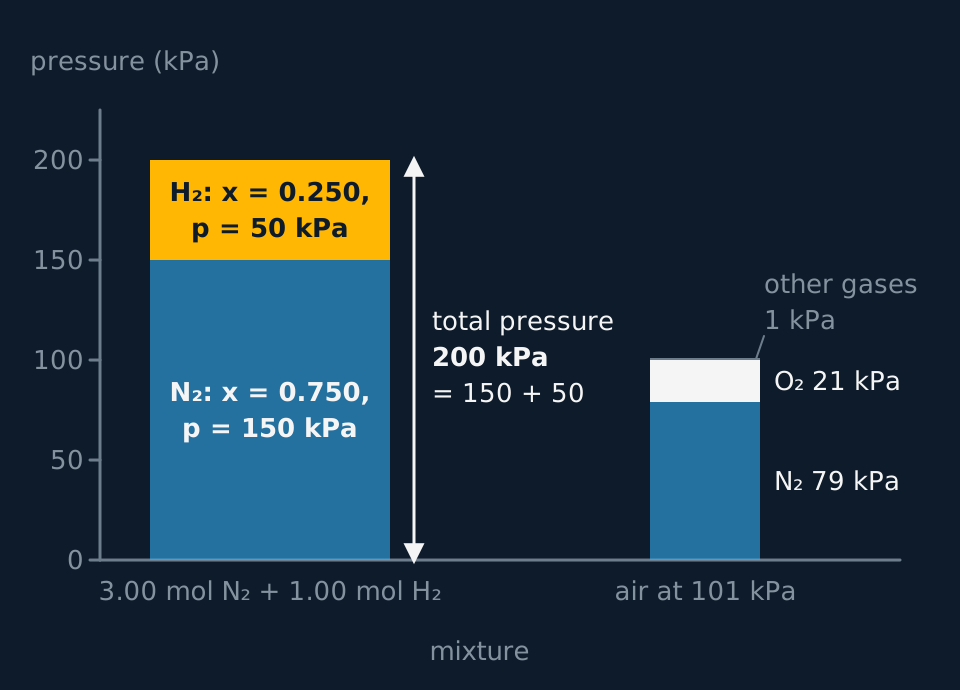
Air at sea level presses at about 101 kPa. Seventy-eight molecules in every hundred are nitrogen, twenty-one are oxygen, and the last one is mostly argon. Each gas behaves as if the others were not there: the nitrogen alone accounts for 78% of the pressure, about 79 kPa, and the oxygen for about 21 kPa. On the summit of Everest the total is about 34 kPa, so a climber breathes oxygen at about 7 kPa, a third of what the lungs are used to.
The fraction of the molecules that belong to one gas is its mole fraction. Pressure comes from molecules hitting the walls, and at a given temperature each molecule contributes the same on average whatever it is, so the partial pressure of a gas is its mole fraction multiplied by the total pressure.
x(A) = amount of A ÷ total amount of gasMole fractions have no units and add up to 1.
p(A) = x(A) × total pressurePartial pressures add up to the total pressure.
A mixture of 3.00 mol of nitrogen and 1.00 mol of hydrogen at 200 kPa has x(N₂) = 3.00 ÷ 4.00 = 0.750, so p(N₂) = 0.750 × 200 = 150 kPa, and p(H₂) = 0.250 × 200 = 50 kPa. The two add up to 200 kPa, as they must.
Describe the drawing
Two stacked pressure bars on a kilopascal axis. The first, for 3.00 mol of nitrogen and 1.00 mol of hydrogen, has a dark cyan nitrogen band from 0 to 150 kPa labelled mole fraction 0.750 and an amber hydrogen band from 150 to 200 kPa labelled mole fraction 0.250, with a bracket beside it reading total pressure 200 kPa equals 150 plus 50. The second, for air at 101 kPa, stacks nitrogen at 79 kPa, oxygen at 21 kPa and a thin sliver of other gases at 1 kPa.
Partial pressure can stand in for concentration. From pV = nRT, the partial pressure of one gas is p = (n ÷ V)RT, so at a fixed temperature it is proportional to that gas's concentration. Pressures are what a chemical engineer measures, and they give an equilibrium constant suited to gases.
- Mole fraction
- The amount in moles of one gas in a mixture divided by the total amount in moles of all the gases.
- Partial pressure
- The pressure that one gas in a mixture would exert if it alone occupied the whole volume; its mole fraction multiplied by the total pressure.
- Total pressure
- The pressure of a gas mixture, equal to the sum of the partial pressures of all the gases in it.
Writing Kp
Kp is built from the equation exactly as Kc is, with the partial pressure of each gas at equilibrium in place of its concentration. For the Haber equilibrium:
Kp = p(NH₃)² ÷ (p(N₂) × p(H₂)³)For N₂(g) + 3H₂(g) ⇌ 2NH₃(g); each p is a partial pressure at equilibrium.
The units come from the expression, as they do for Kc. With pressures in kPa, the Haber Kp has units of kPa² ÷ kPa⁴ = kPa⁻². For the dissociation of N₂O₄ into NO₂ they are kPa² ÷ kPa = kPa, and for the formation of hydrogen iodide they cancel.
| Equilibrium | Kp | Units with p in kPa |
|---|---|---|
| N₂O₄(g) ⇌ 2NO₂(g) | p(NO₂)² ÷ p(N₂O₄) | kPa |
| PCl₅(g) ⇌ PCl₃(g) + Cl₂(g) | p(PCl₃) × p(Cl₂) ÷ p(PCl₅) | kPa |
| 2SO₂(g) + O₂(g) ⇌ 2SO₃(g) | p(SO₃)² ÷ (p(SO₂)² × p(O₂)) | kPa⁻¹ |
| N₂(g) + 3H₂(g) ⇌ 2NH₃(g) | p(NH₃)² ÷ (p(N₂) × p(H₂)³) | kPa⁻² |
| H₂(g) + I₂(g) ⇌ 2HI(g) | p(HI)² ÷ (p(H₂) × p(I₂)) | None |
Questions give pressures in kPa or Pa, and the unit of Kp follows whichever is used: the Haber Kp with pressures in Pa has units of Pa⁻², and its value is a million times smaller than in kPa⁻², because each of the two surplus pressures on the bottom is a thousand times larger. Work the units out from the expression every time rather than carrying them over from Kc.
Every species in these equilibria is a gas. Kp is written only for the gases in an equilibrium, and the expression uses p( ) for a partial pressure, never square brackets, which mean a concentration.
- Kp
- The equilibrium constant for a reaction between gases, written with the partial pressure of each gas at equilibrium in place of its concentration.
Kp from amounts and total pressure
A typical question gives the amounts mixed, one amount at equilibrium and the total pressure. The route has five steps: an ICE table in moles, the total amount at equilibrium, each mole fraction, each partial pressure, and then Kp. The total amount usually changes as the reaction proceeds, because the number of moles of gas changes, so it is worked out from the equilibrium row, not the initial one.
Describe the drawing
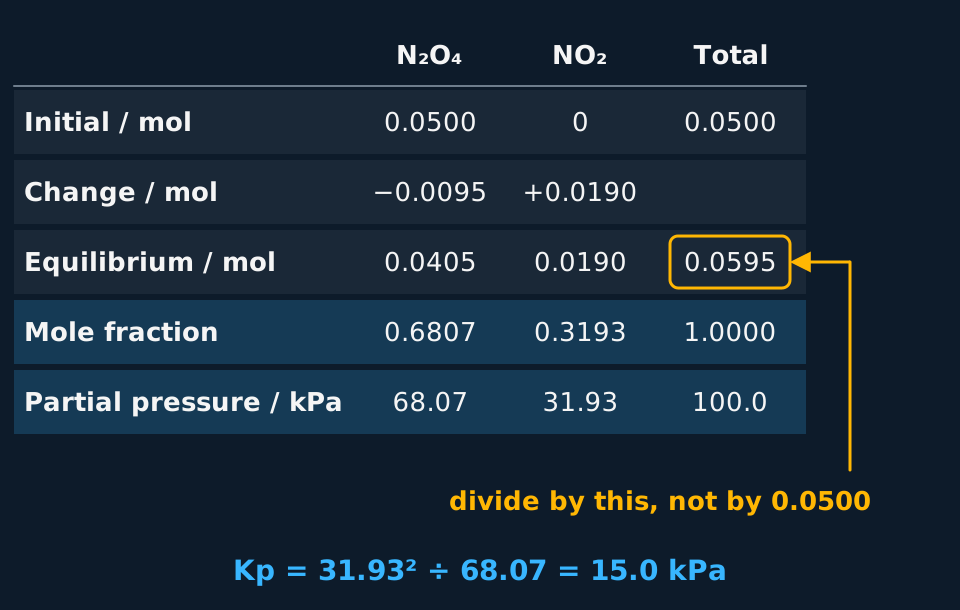
An extended ICE table for dinitrogen tetroxide forming nitrogen dioxide at 298 K and 100 kPa, with columns for N₂O₄, NO₂ and the total. Initial moles 0.0500, 0 and 0.0500; change minus 0.0095 and plus 0.0190; equilibrium 0.0405, 0.0190 and a total of 0.0595, which is boxed with the note divide by this, not by 0.0500. Two extra shaded rows give mole fractions 0.6807 and 0.3193 and partial pressures 68.07 and 31.93 kPa, and beneath the table Kp is worked out as 31.93 squared over 68.07, which is 15.0 kPa.
Kp for dinitrogen tetroxide
A sealed vessel holds 0.0500 mol of N₂O₄ at 298 K. At equilibrium the total pressure is 100 kPa and 0.0405 mol of N₂O₄ remains. Calculate Kp for N₂O₄(g) ⇌ 2NO₂(g) at 298 K.
Show the working
ICE table. N₂O₄ falls by 0.0500 − 0.0405 = 0.0095 mol. The equation is 1 : 2, so NO₂ rises by 2 × 0.0095 = 0.0190 mol. At equilibrium there are 0.0405 mol of N₂O₄ and 0.0190 mol of NO₂.
Total amount at equilibrium = 0.0405 + 0.0190 = 0.0595 mol.
Mole fractions. x(N₂O₄) = 0.0405 ÷ 0.0595 = 0.6807; x(NO₂) = 0.0190 ÷ 0.0595 = 0.3193. They add up to 1.
Partial pressures. p(N₂O₄) = 0.6807 × 100 = 68.07 kPa; p(NO₂) = 0.3193 × 100 = 31.93 kPa. They add up to 100 kPa.
Kp = p(NO₂)² ÷ p(N₂O₄) = 31.93² ÷ 68.07 = 1019.5 ÷ 68.07 = 15.0 kPa. Units: kPa² ÷ kPa = kPa.
Dividing by the initial amount, 0.0500 mol, instead of the equilibrium total gives mole fractions that add up to more than 1 and a Kp that is wrong. The two checks in the working, mole fractions adding up to 1 and partial pressures adding up to the total, catch it.
The same vessel at a different total pressure would settle with different mole fractions and give the same 15.0 kPa: Kp has not changed; the mole fractions have.
The dissociation of phosphorus(V) chloride
20.85 g of PCl₅ is heated to 523 K in a vessel whose pressure is held at 200 kPa. At equilibrium 69.0% of the PCl₅ has dissociated. (a) Calculate Kp for PCl₅(g) ⇌ PCl₃(g) + Cl₂(g) at 523 K. (b) Calculate the percentage dissociated if the total pressure at 523 K is raised to 400 kPa.
Show the working
Amount. M(PCl₅) = 31.0 + 5 × 35.5 = 208.5 g mol⁻¹, so n = 20.85 ÷ 208.5 = 0.100 mol.
ICE table. 69.0% dissociates, so 0.0690 mol of PCl₅ reacts and 0.0690 mol each of PCl₃ and Cl₂ forms. At equilibrium: PCl₅ 0.0310 mol, PCl₃ 0.0690 mol, Cl₂ 0.0690 mol, total 0.1690 mol. One mole of gas has become two, so the total has grown.
Partial pressures. p(PCl₅) = (0.0310 ÷ 0.1690) × 200 = 36.69 kPa; p(PCl₃) = p(Cl₂) = (0.0690 ÷ 0.1690) × 200 = 81.66 kPa.
Kp = p(PCl₃) × p(Cl₂) ÷ p(PCl₅) = 81.66 × 81.66 ÷ 36.69 = 182 kPa, to three significant figures.
(b) The temperature is unchanged, so Kp is still 182 kPa and can be used to find the new composition. Write the degree of dissociation as α. From 1 mol of PCl₅ the equilibrium amounts are (1 − α), α and α, a total of (1 + α). At total pressure P, p(PCl₅) = (1 − α)P ÷ (1 + α) and each product has αP ÷ (1 + α), so Kp = α²P ÷ ((1 + α)(1 − α)) = α²P ÷ (1 − α²).
At 400 kPa: 400α² ÷ (1 − α²) = 182, so 400α² = 182 − 182α², 582α² = 182, α² = 0.313 and α = 0.559. 55.9% dissociates. Doubling the pressure has shifted the position towards PCl₅, the side with fewer moles of gas, while Kp has stayed at 182 kPa.
| Part (a) at 200 kPa | PCl₅ | PCl₃ | Cl₂ | Total |
|---|---|---|---|---|
| Initial / mol | 0.100 | 0 | 0 | 0.100 |
| Change / mol | −0.0690 | +0.0690 | +0.0690 | +0.0690 |
| Equilibrium / mol | 0.0310 | 0.0690 | 0.0690 | 0.1690 |
| Mole fraction | 0.1834 | 0.4083 | 0.4083 | 1.000 |
| Partial pressure / kPa | 36.69 | 81.66 | 81.66 | 200.0 |
Set out in rows, part (a) is the mole-fraction route in full. The first three rows are the ICE table of Kc. The total column is what Kp adds: it grows by 0.0690 mol because one mole of gas becomes two, and every mole fraction is taken from its equilibrium value, 0.1690. The last two rows each carry a check: mole fractions add up to 1, and partial pressures to the total pressure.
The expression α²P ÷ (1 − α²) holds whenever one mole of gas splits into two different gases. When it splits into two molecules of the same gas, as N₂O₄ does, the amount of NO₂ is 2α, the top of the expression carries (2α)², and Kp = 4α²P ÷ (1 − α²). Neither is worth learning by heart: building it from the ICE table each time takes four lines and avoids mixing the two up.
Some questions skip the first steps and give the partial pressures at equilibrium directly, or give the mole fractions and the total pressure. The calculation then starts part-way down the same route. What does not change is that every number substituted into Kp is a partial pressure at equilibrium, never an amount in moles and never a pressure from before the reaction.
- Degree of dissociation
- The fraction of the molecules of a substance that have dissociated when equilibrium is reached, written α.
What changes Kp
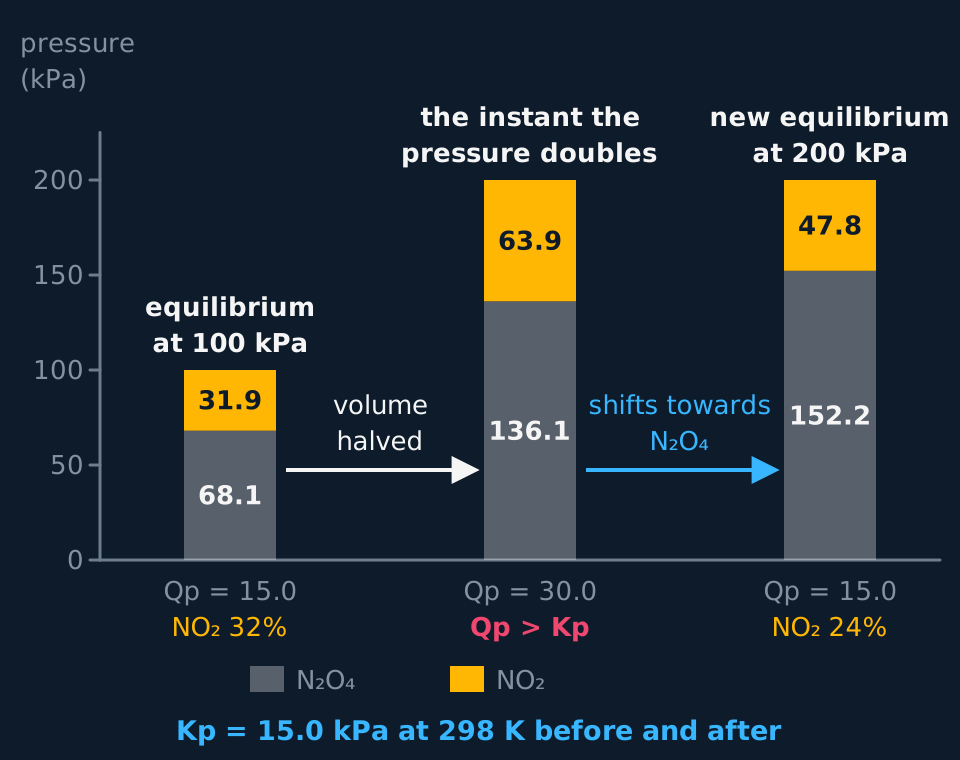
Kp, like Kc, depends only on temperature. The dinitrogen tetroxide example shows what a change of pressure does instead. Double the total pressure to 200 kPa by halving the volume, and at that instant each partial pressure doubles: p(N₂O₄) = 136.1 kPa and p(NO₂) = 63.9 kPa. Put into the Kp expression, they give 63.9² ÷ 136.1 = 30.0 kPa, twice Kp.
That value is the reaction quotient in partial pressures, Qp. It is greater than Kp, so NO₂ molecules pair up faster than N₂O₄ molecules split, and the position shifts left until the ratio is back to 15.0 kPa. The shift removes molecules, so with the total pressure held at 200 kPa, by pushing the plunger a little further in, the new mixture has p(N₂O₄) = 152.2 kPa and p(NO₂) = 47.8 kPa, and 47.8² ÷ 152.2 = 15.0 kPa. Left at the halved volume, the total would settle near 191 kPa instead, with NO₂ still a smaller share.
Describe the drawing
Three stacked bars of partial pressure on a shared kilopascal axis. The first, equilibrium at 100 kPa, has 68.1 kPa of dinitrogen tetroxide under 31.9 kPa of amber nitrogen dioxide, Qp 15.0. The second, the instant the volume is halved, is twice as tall with 136.1 and 63.9 kPa and Qp 30.0, marked Qp greater than Kp. The third, the new equilibrium at 200 kPa after the shift towards dinitrogen tetroxide, has 152.2 and 47.8 kPa and Qp back at 15.0; nitrogen dioxide's share falls from 32 to 24 percent.
Mole fractions show the same thing algebraically. Each partial pressure is x × P, so Kp = (x(NO₂)P)² ÷ (x(N₂O₄)P) = (x(NO₂)² ÷ x(N₂O₄)) × P. At a fixed temperature Kp is fixed, so if P doubles, the ratio of mole fractions must halve, and that can only happen by NO₂ turning into N₂O₄. For the Haber equilibrium the same working gives the mole-fraction ratio multiplied by P⁻², so a higher pressure must raise the share of ammonia. The power of P is the moles of gas on the right minus those on the left.
The squared term is the reason. Doubling every pressure multiplies the top of this expression by four and the bottom by two. In any equilibrium with more moles of gas on one side than the other, the powers do not balance, so a change of total pressure pushes the ratio away from Kp and the position moves until the ratio is restored. With equal moles of gas on each side, the factors cancel and the position does not move. Le Chatelier's principle for pressure follows from this.
A catalyst speeds up both directions equally and changes neither Kp nor the position.
Temperature changes Kp itself. The dissociation of N₂O₄ is endothermic, ΔH = +57 kJ mol⁻¹, so Kp rises with temperature, to roughly thirty times its 298 K value by 350 K. A sealed tube of the gas turns a deeper brown as it is warmed, because the position moves to match the new, larger Kp. For an exothermic reaction such as the Haber process, Kp falls as the temperature rises.
| Change | Kp | Position of equilibrium |
|---|---|---|
| Raise the total pressure | Unchanged | Shifts to the side with fewer moles of gas |
| Add a catalyst | Unchanged | Unchanged, but reached sooner |
| Raise the temperature, forward reaction endothermic | Increases | Shifts right |
| Raise the temperature, forward reaction exothermic | Decreases | Shifts left |
- Reaction quotient, Qp
- The Kp expression evaluated with the partial pressures at any moment; it equals Kp only when the mixture is at equilibrium.
TRY IT: Kp for the Contact process
An equilibrium mixture at 200 kPa contains 0.0400 mol of SO₂, 0.0200 mol of O₂ and 0.340 mol of SO₃. Calculate Kp for 2SO₂(g) + O₂(g) ⇌ 2SO₃(g), with its units.
Check your answer
Total amount = 0.0400 + 0.0200 + 0.340 = 0.400 mol. Mole fractions: SO₂ 0.100, O₂ 0.0500, SO₃ 0.850.
Partial pressures at 200 kPa: p(SO₂) = 20.0 kPa, p(O₂) = 10.0 kPa, p(SO₃) = 170 kPa.
Kp = p(SO₃)² ÷ (p(SO₂)² × p(O₂)) = 170² ÷ (20.0² × 10.0) = 28 900 ÷ 4000 = 7.23 kPa⁻¹. Units: kPa² ÷ (kPa² × kPa) = kPa⁻¹.
Other boards: solids in Kp, and pressures in atmospheres
OCR and Edexcel also set Kp for heterogeneous equilibria, where a solid takes part, and Edexcel's specification, 11.1, states Kp with partial pressures in atmospheres; Cambridge questions often use atmospheres too, and OCR questions sometimes do. One atmosphere is 101.325 kPa, taken as 101 kPa in most questions, and the method does not change.
A solid is left out of Kp. For limestone in a sealed container, Kp = p(CO₂), so at a given temperature the carbon dioxide always settles at the same pressure, whatever the amount of solid. When the gas side holds two gases, the solid is left out twice over: out of the Kp expression, and out of the total amount of gas used for the mole fractions. A solid exerts no pressure on the walls of the vessel, so it has no partial pressure. The blast furnace supplies the standard case, where carbon dioxide rising through hot coke is turned into the carbon monoxide that reduces the iron ore.
C(s) + CO₂(g) ⇌ 2CO(g)ΔH = +173 kJ mol⁻¹. Kp = p(CO)² ÷ p(CO₂); the carbon does not appear.
Kp in atmospheres, with a solid present
0.200 mol of CO₂ is sealed with excess powdered carbon and held at 1025 K. At equilibrium the vessel contains 0.200 mol of CO and the total pressure is 1.50 atm. Calculate Kp for C(s) + CO₂(g) ⇌ 2CO(g) at 1025 K, in atm and in kPa.
Show the working
ICE table. 0.200 mol of CO has formed, and the equation is 1 : 2, so 0.100 mol of CO₂ has reacted. At equilibrium: CO₂ 0.100 mol, CO 0.200 mol. The carbon is not counted.
Total amount of gas = 0.100 + 0.200 = 0.300 mol. Mole fractions: x(CO₂) = 0.333, x(CO) = 0.667.
Partial pressures. p(CO₂) = 0.333 × 1.50 = 0.500 atm; p(CO) = 0.667 × 1.50 = 1.00 atm. They add up to 1.50 atm.
Kp = p(CO)² ÷ p(CO₂) = 1.00² ÷ 0.500 = 2.00 atm. Units: atm² ÷ atm = atm.
In kPa. Each pressure in kPa is 101 times its value in atm, and the units are one power of pressure, so Kp = 2.00 × 101 = 202 kPa.
Raising the pressure shifts this equilibrium to the left, towards one mole of gas from two; the carbon counts for nothing in that comparison. The forward reaction is endothermic, so Kp rises steeply with temperature. In the hottest part of a blast furnace, near atmospheric pressure and far above 1025 K, almost all the carbon dioxide that meets the coke becomes carbon monoxide.
Converting Kp between units needs the power. Kp for the Haber equilibrium at 500 °C is 1.45 × 10⁻⁵ atm⁻². The expression has two more pressures on the bottom than on the top, so the conversion factor is squared: Kp = 1.45 × 10⁻⁵ ÷ 101² = 1.42 × 10⁻⁹ kPa⁻². Dividing by 101 once gives a value about a hundred times too large.
- Atmosphere, atm
- A unit of pressure equal to 101.325 kPa, the mean pressure of the air at sea level.
- Heterogeneous equilibrium
- An equilibrium with species in more than one phase; only the gases appear in Kp, and a solid is left out of both the expression and the total amount of gas.
In the exam
- On a Calculate question about Kp, each stage carries a method mark: equilibrium amounts, total amount, mole fractions, partial pressures, then Kp with its units. An early slip is carried forward, so the later marks can still be awarded if every stage is shown.
- Mole fractions come from the total amount at equilibrium. Mole fractions taken from the starting amount are not credited, and a quick check that they add up to 1 catches the slip.
- For the effect of pressure on Kp the scheme wants two statements: Kp is unchanged because only temperature changes it, and the position shifts to the side with fewer moles of gas. 'Kp increases with pressure' is rejected.
- The units of Kp follow the pressure unit used, raised to the power the expression gives. Write 'no units' when the powers cancel; a unit given where there is none is not accepted.
- Substitute partial pressures only, never amounts in moles or pressures from before the reaction. An expression written with square brackets is a Kc expression and does not earn the Kp mark.
Check yourself
Kp for N₂O₄(g) ⇌ 2NO₂(g) is 15.0 kPa at 298 K, and at 100 kPa the degree of dissociation is 0.190. Calculate the degree of dissociation at 298 K when the total pressure is 50.0 kPa, and explain the difference.
Answer
From 1 mol of N₂O₄, α mol dissociates: N₂O₄ (1 − α) mol, NO₂ 2α mol, total (1 + α) mol. So p(N₂O₄) = (1 − α)P ÷ (1 + α) and p(NO₂) = 2αP ÷ (1 + α).
Kp = p(NO₂)² ÷ p(N₂O₄) = 4α²P ÷ ((1 + α)(1 − α)) = 4α²P ÷ (1 − α²). With P = 50.0 kPa, 200α² = 15.0 − 15.0α², so 215α² = 15.0, α² = 0.0698 and α = 0.264.
At half the pressure a larger fraction dissociates, 0.264 against 0.190. Lower pressure shifts the position towards NO₂, the side with more moles of gas, while Kp stays at 15.0 kPa because the temperature has not changed.
Questions
Question 16 marks
Explain, by writing Kp for N₂(g) + 3H₂(g) ⇌ 2NH₃(g) in terms of mole fractions and the total pressure P, why raising the total pressure at constant temperature increases the proportion of ammonia at equilibrium, and why raising the temperature decreases it. ΔH = −92 kJ mol⁻¹.
Mark scheme
Indicative content
- each partial pressure is the mole fraction multiplied by the total pressure P, so Kp = x(NH₃)²P² ÷ (x(N₂)P × x(H₂)³P³)
- this simplifies to Kp = (x(NH₃)² ÷ (x(N₂)x(H₂)³)) × P⁻², because there are two moles of gas on the right and four on the left
- at constant temperature Kp is constant, so when P rises the ratio of mole fractions must rise by the factor P² to keep Kp the same
- that ratio can rise only if nitrogen and hydrogen react to form ammonia, so the position shifts right and the mole fraction of ammonia increases
- raising the temperature, by contrast, decreases the value of Kp itself, because the forward reaction is exothermic
- the ratio of partial pressures is then larger than the new Kp, so the reverse reaction runs faster and the position shifts left, lowering the proportion of ammonia
Levels
- Level 3 (5–6 marks) Kp is written in mole fractions and simplified to show the P⁻² factor, the constancy of Kp at fixed temperature is used to show that the ratio of mole fractions must rise with P and so ammonia must form, and the temperature effect is explained through the change in Kp itself; every step follows from the one before and the algebra is correct
- Level 2 (3–4 marks) Kp is written correctly in mole fractions and the pressure effect is argued from Kp staying constant; the P⁻² simplification, or the smaller Kp at higher temperature, is not shown
- Level 1 (1–2 marks) Kp is written, or higher pressure is said to favour ammonia because there are fewer moles of gas; Kp itself is usually said to increase with pressure
Question 25 marks
Calculate the partial pressure of each gas in the Haber equilibrium mixture described in the table, and use them to calculate Kp for N₂(g) + 3H₂(g) ⇌ 2NH₃(g).
| Quantity | Value |
|---|---|
| N₂ at equilibrium | 2.00 mol |
| H₂ at equilibrium | 6.00 mol |
| NH₃ at equilibrium | 2.00 mol |
| Total pressure | 2.00 × 10⁴ kPa |
Mark scheme
- M1 total amount = 10.00 mol, so the mole fractions are N₂ 0.200, H₂ 0.600 and NH₃ 0.200
- M1 partial pressures: p(N₂) = 4.00 × 10³ kPa, p(H₂) = 1.20 × 10⁴ kPa, p(NH₃) = 4.00 × 10³ kPa
- M1 Kp = p(NH₃)² ÷ (p(N₂) × p(H₂)³)
- M1 Kp = (4.00 × 10³)² ÷ (4.00 × 10³ × (1.20 × 10⁴)³) = 1.60 × 10⁷ ÷ 6.91 × 10¹⁵
- A1 Kp = 2.31 × 10⁻⁹ kPa⁻², to three significant figures
Question 35 marks
Calculate Kp for CO(g) + 2H₂(g) ⇌ CH₃OH(g) from the experiment described in the table.
| Quantity | Value |
|---|---|
| CO at the start | 1.00 mol |
| H₂ at the start | 2.00 mol |
| CH₃OH at equilibrium | 0.400 mol |
| Total pressure at equilibrium | 5.00 × 10³ kPa |
Mark scheme
- M1 equilibrium amounts: CO 0.600 mol, H₂ 2.00 − 0.800 = 1.20 mol, CH₃OH 0.400 mol
- M1 total amount = 2.20 mol, so the mole fractions are CO 0.273, H₂ 0.545 and CH₃OH 0.182
- M1 partial pressures: p(CO) = 1364 kPa, p(H₂) = 2727 kPa, p(CH₃OH) = 909 kPa
- M1 Kp = p(CH₃OH) ÷ (p(CO) × p(H₂)²) = 909 ÷ (1364 × 2727²)
- A1 Kp = 8.96 × 10⁻⁸ kPa⁻², to three significant figures; error carried forward from M2
All 17 questions with mark schemes, the other 14 set out in full on the question page.
Worth remembering
- Work mole fractions from the equilibrium total; the starting amounts make them add up to more than 1.
- Write p(NH₃), never [NH₃], in a Kp expression: square brackets make it a Kc expression.
- Converting Kp from atm⁻² to kPa⁻² by dividing by 101 once is a hundred times out; the factor carries the power of the units.
- An amount in moles, or a pressure from before the reaction, substituted into Kp is not a partial pressure at equilibrium.
- 'Kp increases with pressure' is rejected; the position shifts and the constant does not.
CHECK YOUR PROGRESS
Rate how confident you are with each objective for this lesson. Ratings are saved in this browser, on this device, unless you sign in.
- Calculate the mole fraction and the partial pressure of each gas in a mixture.
- Write an expression for Kp for a gas-phase equilibrium and deduce its units.
- Calculate Kp from partial pressures, and from initial amounts, one equilibrium amount and the total pressure.
- Use a degree of dissociation, or a value of Kp, to find the composition of an equilibrium mixture.
- Explain why Kp changes with temperature but not with the total pressure or a catalyst.
- Write Kp for an equilibrium with a solid present, and convert a value of Kp between atmospheres and kilopascals.CAIE · Edexcel · OCR A
Open the full revision checklist to see every objective in the curriculum in one place.
Practise this lesson
Practise Kp: equilibria in the gas phase with 17 original questions and point-by-point mark schemes
WORKBOOK
The written questions from this topic, on paper with room to work, and a separate book of mark schemes. The 2 questions that are set on a diagram stay on this page, where the diagram can be drawn. Free to use; please do not redistribute or sell.