Chemistry › Amount of substance › Gases and the ideal gas equation
Gases and the ideal gas equation
A mole of any gas takes up about 24 dm³ in a room at 20 °C, whether it is hydrogen or carbon dioxide, because the molecules are tiny compared with the space between them. The ideal gas equation, pV = nRT, turns a measured volume, pressure and temperature into moles, provided every quantity is in SI units. With a gas syringe and a balance it gives the relative molecular mass of a volatile liquid.
Key terms Every definition in amount of substance, lesson by lesson
Before this The mole, the Avogadro constant and molar mass – n = m ÷ M · GCSE particle model: gas particles far apart and moving randomly
COMMON MISCONCEPTION
A mole of a heavy gas such as carbon dioxide must take up more room than a mole of a light gas such as hydrogen.
At the same temperature and pressure a mole of any gas occupies the same volume, 24.0 dm³ at room temperature and pressure. The molecules are so far apart that their own size does not matter, and pV = nRT has no term for what the gas is. Carbon dioxide is 22 times as dense as hydrogen because each molecule is 22 times heavier.
What you should be able to do
- State the ideal gas equation and the SI unit of each quantity in it.
- Convert volumes from cm³ and dm³ to m³, pressures from kPa to Pa, and temperatures from °C to K.
- Calculate any one of p, V, n and T from the other three.
- Use the molar gas volume of 24.0 dm³ mol⁻¹ at room temperature and pressure, and use gas volumes as reacting ratios.
- Describe the gas syringe method, and calculate the Mr of a volatile liquid from its results.
- Explain the conditions under which a real gas departs from ideal behaviour.
Why every gas behaves alike
Equal volumes of gases at the same temperature and pressure contain equal numbers of molecules, whatever the gas. Two balloons of the same size, one of helium and one of carbon dioxide, at the same temperature and pressure, hold the same number of molecules. The helium balloon floats and the carbon dioxide balloon sinks because a carbon dioxide molecule is eleven times heavier than a helium atom; the count inside is the same.
The reason is the size of the gaps. In a gas at room temperature the molecules are, on average, about ten molecular diameters apart, so the molecules themselves fill around a thousandth of the volume. A gas is almost all empty space. How much space it takes up depends on how many molecules are moving about in it, how fast they move and how hard the walls push back, and hardly at all on what the molecules are.
A gas that behaves exactly like that is an ideal gas: its molecules have no volume of their own and exert no forces on each other except when they collide. Real gases come close at room temperature and pressure. They depart from it at high pressure, where the molecules are pushed close enough for their own volume to count, and at low temperature, near the point where the gas would condense, because intermolecular forces then pull the molecules together.
The kinetic theory of an ideal gas makes five assumptions, and each one is a reason a real gas can fail to be ideal. The molecules move rapidly and randomly, in straight lines between collisions. Their collisions with each other and with the walls are elastic, so no kinetic energy is lost overall. The molecules have negligible volume compared with the container, and there are no forces between them except during collisions. Their mean kinetic energy is proportional to the kelvin temperature.
| Ideal gas | Real gas | |
|---|---|---|
| Volume of the molecules | Negligible compared with the container | Small but real; it counts when the molecules are crowded together |
| Forces between molecules | None, except during collisions | Weak attractions, stronger between polar molecules and those that hydrogen bond |
| At very high pressure | Obeys pV = nRT | The molecules' own volume is a large share of V, so V is larger than pV = nRT predicts |
| At low temperature | Obeys pV = nRT | Slow molecules attract each other, so V is smaller than predicted, and the gas finally condenses |
| Closest to ideal | Always ideal | At high temperature and low pressure |
How nearly ideal a gas is depends on its molecules. Helium atoms are small, with only weak induced dipole–dipole forces between them, so helium stays close to ideal down to a few tens of kelvin. Ammonia and water vapour are polar and form hydrogen bonds, so at the same temperature and pressure they depart from ideal behaviour much further. Larger molecules, with more electrons and stronger induced dipole–dipole forces, also depart further than small ones.
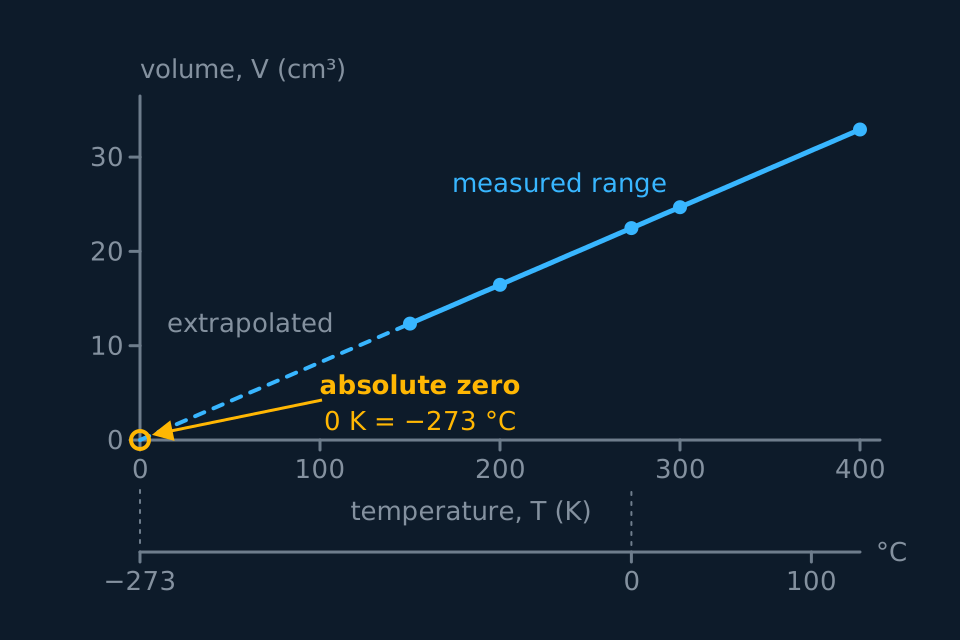
Cool a fixed amount of gas at constant pressure and its volume falls in a straight line. Extend that line and it reaches zero volume at −273 °C. No gas gets there, because every one condenses first, but the temperature is real: it is absolute zero, where particles have the least energy they can have. The Kelvin scale starts from it. A kelvin is the same size as a degree Celsius, so the temperature in K is the temperature in °C plus 273, and 25 °C is 298 K.
Describe the drawing
A graph of volume in cubic centimetres against temperature in kelvin for 0.00100 mol of gas at 101 kPa. A solid cyan straight line runs from 12.3 cubic centimetres at 150 K to 32.9 at 400 K through points at 200, 273 and 300 K, and continues as a dashed extrapolation down to the origin. A second scale beneath the axis gives degrees Celsius, with minus 273 under 0 K and 0 under 273 K, and the origin is labelled absolute zero, 0 K equals minus 273 degrees Celsius.
On the Kelvin scale, volume is proportional to temperature. Going from 300 K to 600 K doubles the volume. Going from 20 °C to 40 °C does not: that is 293 K to 313 K, a rise of under 7%. Any calculation that puts a temperature into a ratio or an equation needs it in kelvin.
- Ideal gas
- A gas whose molecules have negligible volume and no intermolecular forces, so that it obeys pV = nRT exactly.
- Absolute zero
- The lowest possible temperature, 0 K or −273 °C, at which particles have the minimum possible energy.
- Kelvin temperature
- Temperature measured from absolute zero, in K, found by adding 273 to the temperature in °C.
- Avogadro's law
- Equal volumes of all gases at the same temperature and pressure contain equal numbers of molecules.
- Elastic collision
- A collision in which the total kinetic energy of the colliding particles is unchanged.
The ideal gas equation
Pressure, volume, temperature and amount are tied together by one equation, which holds for any gas behaving ideally.
pV = nRTp in Pa, V in m³, n in mol, T in K, R = 8.31 J K⁻¹ mol⁻¹
R is the gas constant, 8.31 J K⁻¹ mol⁻¹, from the data sheet. That value works only with every other quantity in SI units: pressure in pascals, volume in cubic metres, temperature in kelvin. Laboratory data almost never arrives in those units, so every calculation starts by converting.
| Quantity | Symbol | Unit in pV = nRT | Converting from laboratory units |
|---|---|---|---|
| Pressure | p | Pa | kPa × 10³; 1 atm = 101 kPa = 1.01 × 10⁵ Pa |
| Volume | V | m³ | cm³ × 10⁻⁶; dm³ × 10⁻³ |
| Temperature | T | K | °C + 273 |
| Amount | n | mol | mass in g ÷ M |
Describe the drawing
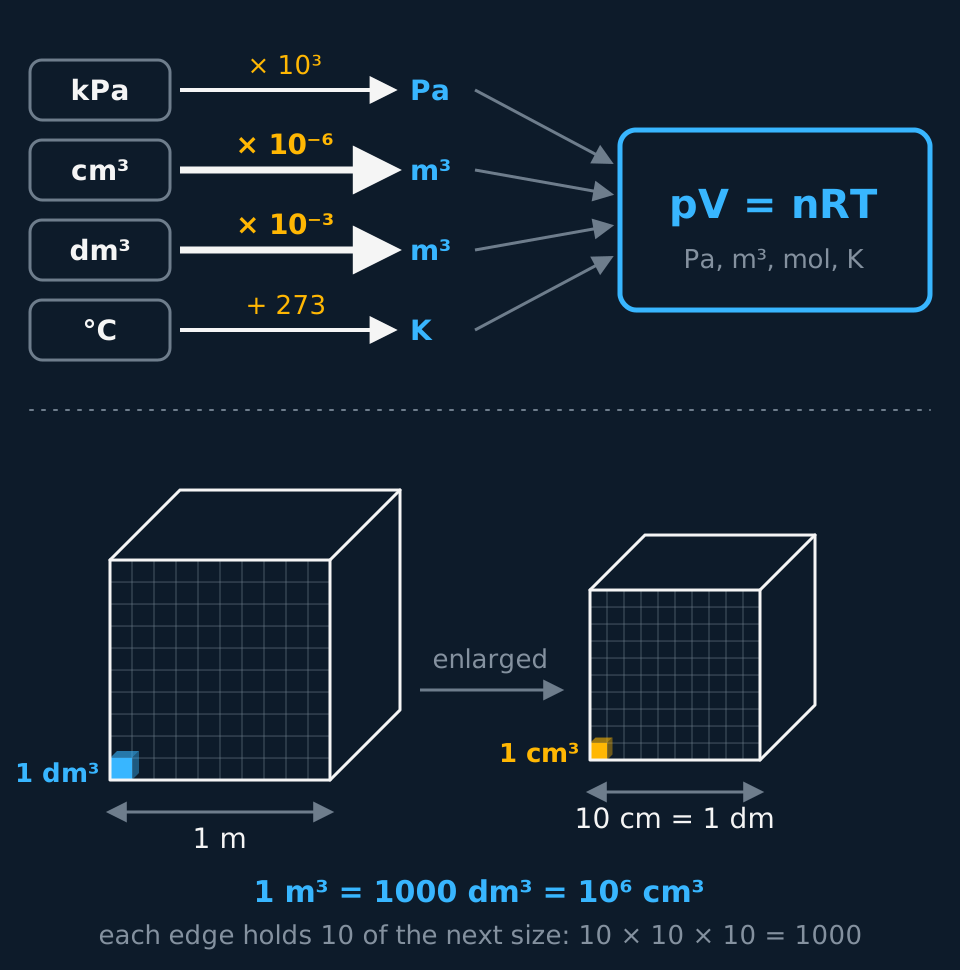
Four boxes on the left, kPa, cubic centimetres, cubic decimetres and degrees Celsius, each with an arrow carrying its conversion: times ten cubed to pascals, times ten to the minus six and times ten to the minus three to cubic metres, drawn heavier, and plus 273 to kelvin. All four lead into a central box reading pV equals nRT in pascals, cubic metres, moles and kelvin. Below, a one metre cube ruled ten by ten has one cubic decimetre cell picked out, and that cell, enlarged and ruled ten by ten, has one cubic centimetre picked out: one cubic metre is 1000 cubic decimetres and a million cubic centimetres.
Volume causes the most trouble. A cubic metre is a cube 100 cm on each side, so it holds 100 × 100 × 100 = 10⁶ cm³. A cubic decimetre, a litre, is a cube 10 cm on each side and holds 1000 cm³, so 1 m³ = 1000 dm³. From cm³ to m³, multiply by 10⁻⁶; from dm³ to m³, multiply by 10⁻³. So 48.0 cm³ is 4.80 × 10⁻⁵ m³. Dividing by 100, as if converting centimetres to metres, gives an answer ten thousand times too large.
The equation rearranges for whichever quantity is missing: n = pV ÷ RT, V = nRT ÷ p, p = nRT ÷ V and T = pV ÷ nR. A pascal times a cubic metre is a joule, which is why R carries the joule. When a volume is wanted in dm³ or cm³, find it in m³ first and convert at the end.
The volume of a quarter of a mole
Calculate the volume occupied by 0.250 mol of gas at 100 kPa and 25 °C.
Show the working
Convert to SI: p = 100 kPa = 1.00 × 10⁵ Pa. T = 25 + 273 = 298 K.
Rearrange: V = nRT ÷ p.
Substitute: V = 0.250 × 8.31 × 298 ÷ (1.00 × 10⁵) = 619.1 ÷ (1.00 × 10⁵) = 6.19 × 10⁻³ m³.
Answer: V = 6.19 × 10⁻³ m³, which is 6.19 dm³ or 6190 cm³, to three significant figures. A check: a quarter of 24 dm³ is 6 dm³, and this gas is a little warmer than 20 °C, so a little more than 6 dm³ is right.
- Ideal gas equation
- pV = nRT, relating the pressure, volume, amount and kelvin temperature of an ideal gas.
- Gas constant
- The constant R in the ideal gas equation, equal to 8.31 J K⁻¹ mol⁻¹.
The molar gas volume
The volume of one mole of gas depends only on the temperature and the pressure, because n = 1 leaves nothing in pV = nRT that belongs to a particular gas. At 20 °C and 101 kPa, V = 1 × 8.31 × 293 ÷ (1.01 × 10⁵) = 0.0241 m³, or 24.1 dm³. That volume, given on data sheets as 24.0 dm³ mol⁻¹, is the molar gas volume at room temperature and pressure, and it is the same for every gas.
n = V ÷ 24.0V in dm³, at room temperature and pressure only
At room temperature and pressure a gas volume converts straight to moles. 1.20 dm³ of carbon dioxide is 1.20 ÷ 24.0 = 0.0500 mol, and 0.0500 mol of any gas occupies 1.20 dm³, which is 1200 cm³. Use it only when a question says the gas is at room temperature and pressure; at any other conditions, use pV = nRT. Some books give room temperature as 25 °C, where the molar volume is 24.5 dm³, but a question that says RTP expects 24.0.
Because equal volumes hold equal amounts, gases react in volumes in the same ratio as the coefficients in the equation, provided the volumes are measured at the same temperature and pressure. In CH₄(g) + 2O₂(g) → CO₂(g) + 2H₂O(l), 50 cm³ of methane needs 100 cm³ of oxygen and makes 50 cm³ of carbon dioxide. The water is a liquid at room temperature and takes up almost no volume, so it drops out of the gas volumes.
A volume of gas that reacts gives the amount that reacts, so a gas volume can stand in for a mass in any reacting calculation. 96.0 cm³ of hydrogen at room temperature and pressure is 96.0 ÷ 24 000 = 4.00 × 10⁻³ mol, and by Mg(s) + 2HCl(aq) → MgCl₂(aq) + H₂(g) it came from 4.00 × 10⁻³ mol of magnesium, 0.0972 g. Measuring gas given off is one of the commonest ways of following a reaction on the bench.
- Molar gas volume
- The volume occupied by one mole of any gas at a stated temperature and pressure, 24.0 dm³ mol⁻¹ at room temperature and pressure.
- Room temperature and pressure
- About 293 K and 101 kPa, the conditions at which the molar gas volume is taken as 24.0 dm³ mol⁻¹.
Finding Mr of a volatile liquid
The ideal gas equation gives a way to find the relative molecular mass of a liquid that boils below about 90 °C. Turn a weighed mass of it into vapour, measure the volume of the vapour, and the equation gives the amount in moles. Mass divided by amount is the molar mass.
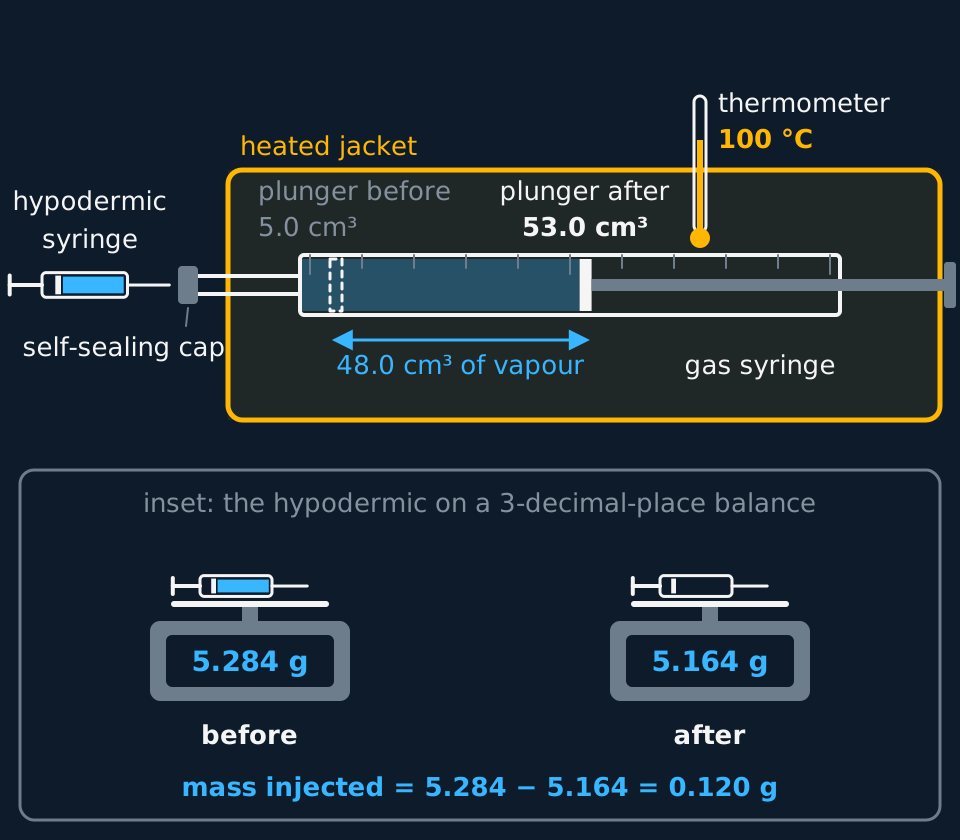
A glass gas syringe is held inside a heated jacket, an oven or a jacket of steam, at a temperature above the boiling point of the liquid, and its reading is noted once it is steady. A small hypodermic syringe is filled with the liquid and weighed.
A few tenths of a cubic centimetre of liquid are injected through a self-sealing rubber cap into the gas syringe, where the liquid vaporises at once and pushes the plunger out. The hypodermic syringe is weighed again, so the mass injected is found by difference, and any liquid left in the needle is not counted. The new gas syringe reading, the temperature of the jacket and the pressure in the room complete the data.
Describe the drawing
A horizontal 100 cubic centimetre gas syringe inside a box-shaped heated jacket, with a thermometer through the top reading 100 degrees Celsius. The nozzle pokes out through the left wall and is closed by a self-sealing rubber cap, and a small hypodermic syringe with its needle points at the cap ready to pierce it. The plunger is drawn dashed at 5.0 cubic centimetres before injection and solid at 53.0 after, with the 48.0 cubic centimetres of vapour between them shaded. An inset shows the hypodermic on a three-decimal-place balance reading 5.284 g before and 5.164 g after, so 0.120 g was injected.
Mr of a volatile liquid
0.120 g of a volatile liquid is injected into a gas syringe held at 373 K. The reading rises by 48.0 cm³ and the pressure is 100 kPa. Calculate the relative molecular mass of the liquid.
Show the working
Convert to SI: V = 48.0 × 10⁻⁶ m³ = 4.80 × 10⁻⁵ m³. p = 1.00 × 10⁵ Pa. T = 373 K already.
Amount of vapour: n = pV ÷ RT = (1.00 × 10⁵ × 4.80 × 10⁻⁵) ÷ (8.31 × 373) = 4.80 ÷ 3099.6 = 1.549 × 10⁻³ mol.
Molar mass: M = m ÷ n = 0.120 ÷ (1.549 × 10⁻³) = 77.5 g mol⁻¹.
Answer: Mr = 77.5 to three significant figures, with no unit. Benzene, C₆H₆, has Mr = 78.0 and boils at 80 °C, so it would be all vapour in a syringe at 373 K and fits the result.
Four things pull the result away from the true value. Liquid that evaporates from the needle tip between weighing and injecting is counted in the mass but never reaches the syringe, so Mr comes out high. A plunger that sticks reads a volume that is too small, which also makes Mr high. Air already in the syringe that has not reached the jacket temperature expands during the measurement and adds to the volume, which makes Mr low.
The fourth is the gas itself. Just above its boiling point a vapour is not ideal: intermolecular forces pull the molecules together, the volume is smaller than pV = nRT predicts, and Mr comes out high. Running the syringe 20 °C or more above the boiling point keeps that small.
TRY IT: Finding a temperature
Calculate the temperature, in °C, at which 0.0200 mol of nitrogen occupies 500 cm³ at 101 kPa.
Check your answer
Convert: V = 500 × 10⁻⁶ = 5.00 × 10⁻⁴ m³; p = 1.01 × 10⁵ Pa.
Rearrange and substitute: T = pV ÷ nR = (1.01 × 10⁵ × 5.00 × 10⁻⁴) ÷ (0.0200 × 8.31) = 50.5 ÷ 0.1662 = 304 K.
In Celsius, 304 − 273 = 31 °C. The equation always returns kelvin, so the change to °C is the last line of the working, never the first.
Other boards: kinetic theory, s.t.p. and combustion volumes
Cambridge asks for the assumptions of the kinetic theory of an ideal gas to be stated in full, as a list a mark scheme can tick: random motion, elastic collisions, negligible molecular volume, no intermolecular forces, and mean kinetic energy proportional to the kelvin temperature. A question on why a real gas deviates then wants two of those assumptions named as the ones that fail.
Cambridge also uses standard temperature and pressure, s.t.p., 273 K and 101 kPa, where the molar gas volume is 22.4 dm³ mol⁻¹. The question always says which conditions apply, and the value follows from pV = nRT either way: with the pressure as 101.3 kPa, 8.31 × 273 ÷ (1.013 × 10⁵) = 0.0224 m³, the 22.4 dm³ printed in the data booklet.
Cambridge uses reacting volumes to find the formula of a gaseous hydrocarbon. A measured volume of it is burned in an excess of oxygen, the gases are cooled to room temperature so that the water condenses, and the gas left is passed through sodium hydroxide solution, which absorbs carbon dioxide. Each change in volume measures one gas.
CxHy(g) + (x + y/4)O₂(g) → xCO₂(g) + (y/2)H₂O(l)x from the carbon dioxide; then y from the oxygen used
A hydrocarbon from gas volumes
10.0 cm³ of a gaseous hydrocarbon is burned with 70.0 cm³ of oxygen, an excess. After cooling to room temperature the gas occupies 55.0 cm³, and after passing through sodium hydroxide solution, 25.0 cm³. All volumes are at room temperature and pressure. Find the formula of the hydrocarbon.
Show the working
Carbon dioxide: the sodium hydroxide absorbs it, so its volume is 55.0 − 25.0 = 30.0 cm³. The 25.0 cm³ left is unreacted oxygen.
Oxygen used: 70.0 − 25.0 = 45.0 cm³.
Ratio: volumes at the same temperature and pressure are in the ratio of moles, so hydrocarbon : O₂ : CO₂ = 10.0 : 45.0 : 30.0 = 1 : 4.5 : 3.
Formula: each molecule gives three CO₂, so x = 3. Then x + y/4 = 4.5, so y/4 = 1.5 and y = 6.
The hydrocarbon is C₃H₆, propene or cyclopropane. A check: 10.0 + 70.0 = 80.0 cm³ of gas became 30.0 cm³ of carbon dioxide and 25.0 cm³ of oxygen, 55.0 cm³, as measured. The rest became liquid water.
Edexcel goes a step further and measures the molar volume itself, in its core practical 1, with calcium carbonate and a gas syringe.
Edexcel core practical 1: the molar volume of a gas
The practical measures the volume of carbon dioxide given off by weighed portions of calcium carbonate reacting with an excess of ethanoic acid, and finds the molar gas volume from a graph of volume against amount.
CaCO₃(s) + 2CH₃COOH(aq) → (CH₃COO)₂Ca(aq) + H₂O(l) + CO₂(g)one mole of carbon dioxide for each mole of calcium carbonate
Apparatus: a 100 cm³ gas syringe in a clamp, joined by delivery tubing to a bung that fits a conical flask; a 50 cm³ measuring cylinder; 1.0 mol dm⁻³ ethanoic acid; powdered calcium carbonate; a three-decimal-place balance and a weighing boat; a thermometer and access to a barometer reading.
| Step | What to do | Why |
|---|---|---|
| 1 | Measure 50 cm³ of ethanoic acid into the conical flask and fit the bung and syringe. Check that the plunger reads zero and moves freely. | The acid is in excess for every portion, so the carbonate always reacts completely |
| 2 | Weigh about 0.050 g of calcium carbonate in the boat and record the mass. | The amount of CaCO₃ fixes the amount of CO₂ |
| 3 | Remove the bung, tip in the carbonate and replace the bung at once. | Gas made before the bung is in is lost |
| 4 | Swirl until the plunger stops moving and record the volume. | The reaction is over when no more gas is made |
| 5 | Reweigh the boat and subtract. | Solid left on the boat never reached the acid |
| 6 | Repeat with fresh acid for about 0.100, 0.150, 0.200 and 0.250 g. | Five points give a line, and a point out of line shows up |
What is measured: the mass of calcium carbonate by difference, the volume of carbon dioxide on the syringe scale to the nearest 1 cm³, and the room temperature and pressure. Each mass becomes an amount with M(CaCO₃) = 100.1 g mol⁻¹, and the gradient of volume against amount is the molar volume.
| Mass of CaCO₃ / g | Amount of CaCO₃ / mol | Volume of CO₂ / cm³ |
|---|---|---|
| 0.050 | 5.00 × 10⁻⁴ | 11.5 |
| 0.100 | 9.99 × 10⁻⁴ | 23.5 |
| 0.150 | 1.50 × 10⁻³ | 35.0 |
| 0.200 | 2.00 × 10⁻³ | 46.5 |
| 0.250 | 2.50 × 10⁻³ | 58.5 |
The line through these points has a gradient of about (58.5 − 11.5) ÷ (2.50 × 10⁻³ − 5.00 × 10⁻⁴) = 2.35 × 10⁴ cm³ mol⁻¹, which is 23.5 dm³ mol⁻¹, about 2% below 24.0.
The main error is gas that is never collected, and it always makes the result low. Carbon dioxide is slightly soluble in water, so some stays in the flask, and some escapes in the moment between adding the solid and fitting the bung. Standing the carbonate in a small tube inside the flask, and tipping it over once the bung is in, removes the second loss. Ethanoic acid is a weak acid and reacts more slowly than hydrochloric acid, so less gas escapes before the bung is in.
Risk assessment. Wear eye protection: ethanoic acid at this concentration irritates the eyes. Clamp the syringe so that it cannot fall, and check the CLEAPSS Hazcards and the school's own risk assessment before starting.
In the exam
- In a pV = nRT calculation each conversion is a step the scheme can credit, and error carried forward applies after a slip: write pressure in Pa, volume in m³ and temperature in K as separate lines.
- An answer in m³ where dm³ was asked for loses the final mark. pV = nRT gives m³; multiply by 10³ for dm³ or by 10⁶ for cm³.
- Use 24.0 dm³ mol⁻¹ only when the question states room temperature and pressure.
- A description of the gas syringe method must weigh the hypodermic syringe before and after injecting and hold the syringe above the boiling point of the liquid; reading the volume of liquid off the syringe does not earn the mass mark.
- Why a real gas is not ideal: the scheme awards 'the molecules have a significant volume' and 'there are attractive forces between the molecules', and gives nothing for 'the gas is not perfect'.
Check yourself
A sealed 2.00 dm³ flask holds 0.0800 mol of gas at 27 °C. Calculate the pressure in kPa. Then find the pressure when the flask is heated to 327 °C, and explain why it does not rise twelvefold.
Answer
Convert: V = 2.00 × 10⁻³ m³ and T = 27 + 273 = 300 K. p = nRT ÷ V = 0.0800 × 8.31 × 300 ÷ (2.00 × 10⁻³) = 9.97 × 10⁴ Pa, which is 99.7 kPa.
At 327 °C, T = 600 K. With n and V fixed, p is proportional to T, and the kelvin temperature has doubled, so the pressure doubles to 199 kPa.
327 ÷ 27 is about 12, but the Celsius scale has its zero at the melting point of ice, not at absolute zero. Pressure is proportional to temperature only on the Kelvin scale, and 600 K is twice 300 K.
Questions
Question 16 marks
Describe how to find the relative molecular mass of a volatile liquid using a gas syringe. Include how the result is calculated and how the method keeps it accurate.
Mark scheme
Indicative content
- hold a gas syringe in a heated jacket at a steady temperature well above the boiling point of the liquid, and record its starting reading
- fill a hypodermic syringe with the liquid and weigh it on a balance reading to three decimal places before injecting
- inject a few tenths of a cubic centimetre through the self-sealing cap, then reweigh the hypodermic syringe so the mass injected is found by difference
- record the gas syringe reading once it is steady, the jacket temperature in kelvin and the atmospheric pressure in pascals
- convert the increase in volume to cubic metres, use n = pV ÷ RT to find the amount of vapour, and divide the mass injected by that amount to give Mr
- running well above the boiling point keeps the vapour close to ideal, and weighing rather than reading a volume of liquid avoids needing its density
Levels
- Level 3 (5–6 marks) the heated gas syringe, weighing the hypodermic syringe before and after injecting, recording volume, temperature in kelvin and pressure in pascals, the use of pV = nRT and the division of mass by amount are all present, and the answer explains why running well above the boiling point and weighing rather than measuring volume keep the result accurate
- Level 2 (3–4 marks) the gas syringe method and pV = nRT are right; the mass is not found by weighing by difference, a unit is left unconverted, or nothing is said about what keeps the result accurate
- Level 1 (1–2 marks) the liquid is vaporised in a gas syringe or pV = nRT is quoted, usually with the volume left in cm³ or the temperature in °C
Question 24 marks
Calculate the relative molecular mass of a volatile liquid from the gas syringe results given in the table. R = 8.31 J K⁻¹ mol⁻¹.
| Measurement | Value |
|---|---|
| Mass of liquid injected | 0.150 g |
| Increase in gas syringe volume | 62.0 cm³ |
| Temperature of the jacket | 363 K |
| Pressure | 101 kPa |
Mark scheme
- M1 V = 62.0 × 10⁻⁶ = 6.20 × 10⁻⁵ m³ and p = 1.01 × 10⁵ Pa
- M1 n = pV ÷ RT = (1.01 × 10⁵ × 6.20 × 10⁻⁵) ÷ (8.31 × 363) = 2.076 × 10⁻³ mol
- M1 M = m ÷ n = 0.150 ÷ 2.076 × 10⁻³
- A1 Mr = 72.3, to three significant figures, with no unit
Question 34 marksCAIE
Calculate the molecular formula of a gaseous hydrocarbon from the combustion volumes given in the table. The hydrocarbon burns completely in excess oxygen, and all volumes are at room temperature and pressure.
| Stage | Volume / cm³ |
|---|---|
| Hydrocarbon | 20.0 |
| Oxygen added | 150 |
| Gas left after cooling to room temperature | 110 |
| Gas left after passing through sodium hydroxide solution | 30.0 |
Mark scheme
- M1 volume of carbon dioxide = 110 − 30.0 = 80.0 cm³, and the 30.0 cm³ left is unreacted oxygen
- M1 volume of oxygen used = 150 − 30.0 = 120 cm³
- M1 hydrocarbon : O₂ : CO₂ = 20.0 : 120 : 80.0 = 1 : 6 : 4, so x = 4 and x + y/4 = 6, giving y = 8
- A1 the molecular formula is C₄H₈
All 19 questions with mark schemes, the other 16 set out in full on the question page.
Worth remembering
- A volume left in cm³ in pV = nRT puts the amount out by a factor of a million.
- Convert to kelvin before pV = nRT or a ratio of temperatures: 50 °C is not twice as hot as 25 °C, since 323 K is not twice 298 K.
- Keep 24.0 dm³ mol⁻¹ for room temperature and pressure; anywhere else, work the volume out from pV = nRT.
- Dividing cm³ by 100 to reach m³ gives an answer ten thousand times too large.
- Leave liquid water out of a reacting-volume ratio: only the gases count.
CHECK YOUR PROGRESS
Rate how confident you are with each objective for this lesson. Ratings are saved in this browser, on this device, unless you sign in.
- State the ideal gas equation and the SI unit of each quantity in it.
- Convert volumes from cm³ and dm³ to m³, pressures from kPa to Pa, and temperatures from °C to K.
- Calculate any one of p, V, n and T from the other three.
- Use the molar gas volume of 24.0 dm³ mol⁻¹ at room temperature and pressure, and use gas volumes as reacting ratios.
- Describe the gas syringe method, and calculate the Mr of a volatile liquid from its results.
- Explain the conditions under which a real gas departs from ideal behaviour.
Open the full revision checklist to see every objective in the curriculum in one place.
Practise this lesson
Practise gases and the ideal gas equation with 19 original questions and point-by-point mark schemes
WORKBOOK
The written questions from this topic, on paper with room to work, and a separate book of mark schemes. The 3 questions that are set on a diagram stay on this page, where the diagram can be drawn. Free to use; please do not redistribute or sell.
Used later in Reacting masses, percentage yield and atom economy · Collision theory, activation energy and the rate of reaction · Kp: equilibria in the gas phase