Chemistry › Working in the laboratory › Apparatus, techniques and safety: the twelve required practicals in outline
Apparatus, techniques and safety: the twelve required practicals in outline
A titration, a reflux and a recrystallisation use a dozen pieces of glassware between them, and each is there for a reason: the pipette for one exact volume, the condenser to keep a volatile liquid in the flask. What each piece is for, how the main techniques are set up, how the hazardous substances of A-level chemistry are handled, and where each of AQA's twelve required practicals is taught.
Key terms Every definition in working in the laboratory, lesson by lesson
Before this Measurement, uncertainty and significant figures in chemistry – the uncertainty of each piece of glassware · GCSE chemistry: filtration, crystallisation and simple distillation
COMMON MISCONCEPTION
A measuring cylinder is as good as a pipette as long as I read the meniscus carefully.
Reading carefully cannot beat the glassware. A measuring cylinder is graduated to a few tenths of a cubic centimetre at best; a pipette delivers its one volume to a few hundredths. The uncertainty is set by how the vessel was made and calibrated, not by the care of the reader, which is why a titration uses a pipette and a burette.
What you should be able to do
- Choose between a pipette, a burette, a volumetric flask and a measuring cylinder for a given volume, and describe how each is used.
- Describe weighing by difference and explain why it records the mass that actually reaches the reaction.
- Describe heating under reflux and simple distillation, and explain when each is used.
- Outline filtration under reduced pressure and recrystallisation for purifying a solid, and the melting point test of its purity.
- Identify the hazards of concentrated acids, bromine, sodium and organic solvents, and give a control measure for each.
- Name the lesson in which each of the twelve required practicals is taught.
Measuring a volume and a mass
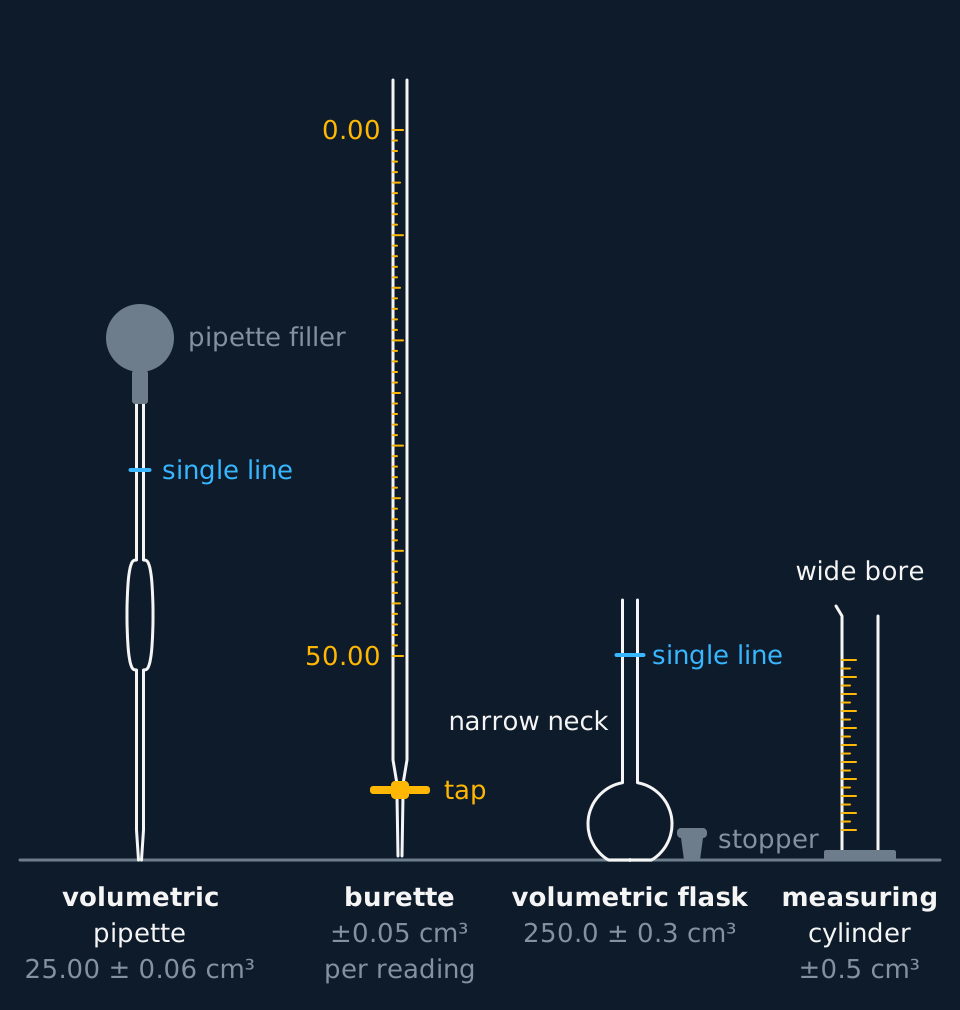
Four pieces of glassware measure a volume of solution: a 25 cm³ pipette, a 50 cm³ burette, a 250 cm³ volumetric flask and a measuring cylinder, and each has a different job. The pipette and the volumetric flask each measure one volume very exactly. The burette measures any volume up to 50 cm³, to ±0.05 cm³ a reading. The measuring cylinder is quick and rough, for volumes where a few per cent does not matter. Reading a cylinder carefully does not close the gap: its bore is wide, so a meniscus misjudged by half a millimetre is a far larger volume than the same slip in the narrow neck of a flask or the stem of a pipette.
Describe the drawing
Four pieces of glassware standing on one bench at the same scale. A volumetric pipette with a bulb in the middle, a single line on its upper stem and a pipette filler on top: 25.00 ± 0.06 cm³. A tall burette with a scale from 0.00 at the top to 50.00 just above its tap: ±0.05 cm³ per reading. A volumetric flask, a round bulb with a long narrow neck carrying a single line and its stopper beside it: 250.0 ± 0.3 cm³. A short, much wider measuring cylinder with a graduated scale: ±0.5 cm³.
| Apparatus | What it measures | Uncertainty | Used for |
|---|---|---|---|
| Volumetric pipette | One fixed volume, delivered | ±0.06 cm³ (25 cm³, class B) | Transferring an exact volume of solution to a conical flask |
| Burette | Any volume up to 50.00 cm³, by difference | ±0.05 cm³ per reading | Adding a solution until the end point, and measuring how much was added |
| Volumetric flask | One fixed volume, contained | ±0.3 cm³ (250 cm³, class B) | Making up a standard solution, or diluting one accurately |
| Measuring cylinder | Any volume up to its capacity | ±0.5 cm³ per reading (100 cm³, marked every 1 cm³) | Adding a reagent in excess, where the exact amount does not enter the calculation |
A pipette is rinsed with distilled water and then with a little of the solution it will hold, so that water left inside cannot dilute it. A pipette filler draws the solution up past the line; nobody pipettes by mouth. Solution is let out until the bottom of the meniscus sits on the line at eye level, and the rest runs into the conical flask. When the flow stops, the tip is touched against the inside of the flask. The last drop stays in the tip, because the pipette is calibrated to deliver its volume with that drop left behind.
A burette is rinsed with the solution it will hold, clamped vertically and filled through a small funnel, which is then taken out so that drips from it cannot add volume mid-titration. A little solution is run through to fill the tip below the tap, because an air bubble there would be counted as titre when it escapes. Readings are taken at eye level from the bottom of the meniscus. Near the end point the solution goes in drop by drop, with the flask swirled after each drop and a white tile beneath it so the colour change is easy to see.
A standard solution is made in a volumetric flask. The weighed solid is dissolved in a beaker in less distilled water than the final volume, and the solution is poured into the flask through a funnel. The beaker, the glass rod and the funnel are rinsed into the flask so that no solute is left behind. Distilled water is added until the meniscus is near the line, then dropwise until its bottom sits on it. The flask is stoppered and inverted several times, because an unmixed solution is not one concentration throughout. The full method is required practical 1.
- Standard solution
- A solution whose concentration is known accurately, made by dissolving a known mass of solute and making it up to a known volume.
Solids are weighed by difference. A weighing bottle containing the solid is weighed, the solid is tipped into a beaker, and the empty bottle is weighed again. If the bottle with solid reads 18.46 g and afterwards 15.91 g, the mass transferred is 2.55 g, uncertain by ±0.02 g because it comes from two readings of ±0.01 g each. Grains left clinging to the bottle are in the second reading, so they are not counted as if they had reached the beaker.
- Weighing by difference
- Finding the mass of solid transferred by weighing its container before and after the transfer and subtracting.
Heating, reflux and distillation
How a mixture is heated depends on what is in it. A water bath holds a set temperature up to just below 100 °C, heats evenly and has no flame, so it is the first choice for flammable organic liquids and for any reaction that must stay at a fixed temperature, such as a rate measurement. An electric heating mantle or a sand bath reaches higher temperatures, also without a flame. A Bunsen burner is for heating a solid in a crucible or a test tube, or an aqueous mixture with nothing flammable nearby.
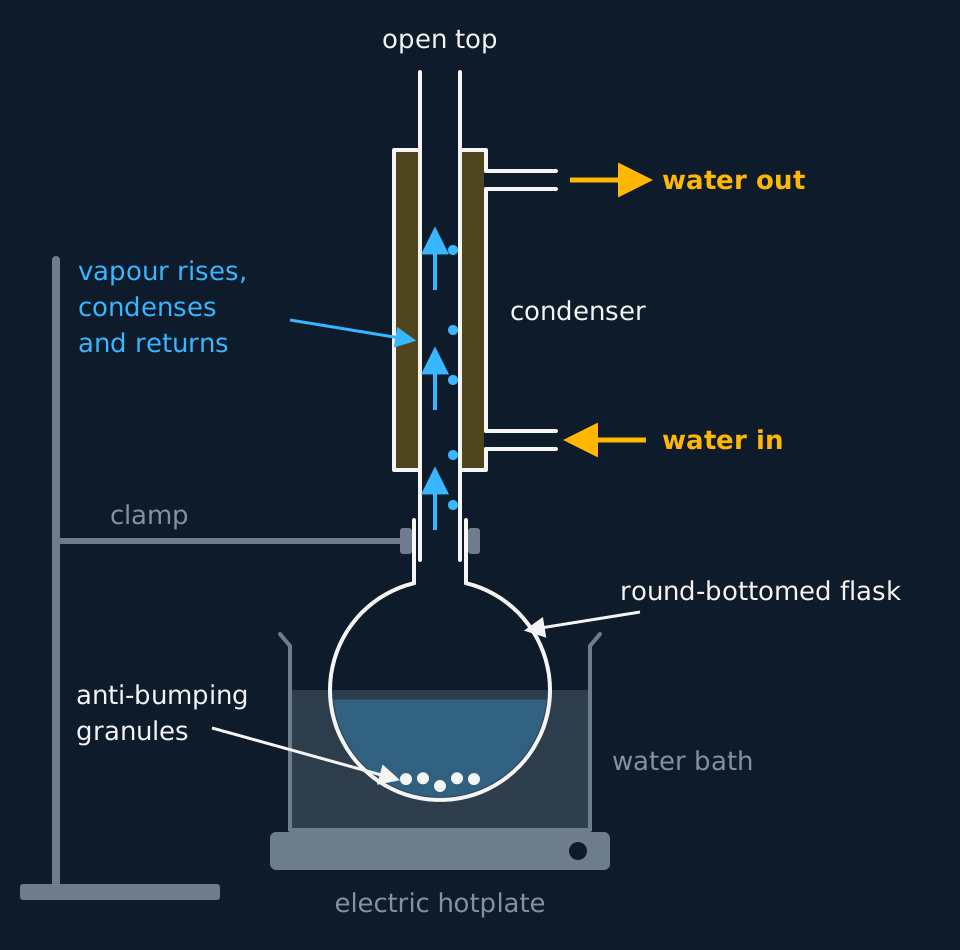
Organic reactions are slow and organic reactants are volatile. Ethanol boils at 78 °C, and heated with acidified potassium dichromate(VI) in an open flask, much of it evaporates before it has time to react. A condenser fitted upright in the neck of the flask stops the loss. Vapour rises into the condenser, is cooled by the water flowing round it, condenses and runs back into the flask. The mixture can then boil for an hour and keep all of its reactants. This is heating under reflux.
Describe the drawing
Heating under reflux. A round-bottomed flask, half full of liquid with anti-bumping granules, sits in a water bath on an electric hotplate, clamped at the neck. A condenser stands upright in the neck with its top open. Cooling water enters the jacket through the lower side tube and leaves through the upper one. Arrows show vapour rising up the inner tube, and drops of condensed liquid run back down into the flask.
Four details of the set-up matter. Water enters the condenser at the bottom and leaves at the top, so the outer jacket fills completely; fed from the top, the water would drain straight through and leave part of the condenser uncooled. The top of the condenser is open, because a sealed apparatus that is heated builds up pressure until it bursts. Anti-bumping granules in the flask give bubbles of vapour somewhere to form, so the liquid boils smoothly instead of in sudden violent surges. And the flask is heated with a water bath or an electric heater, because the vapours are flammable.
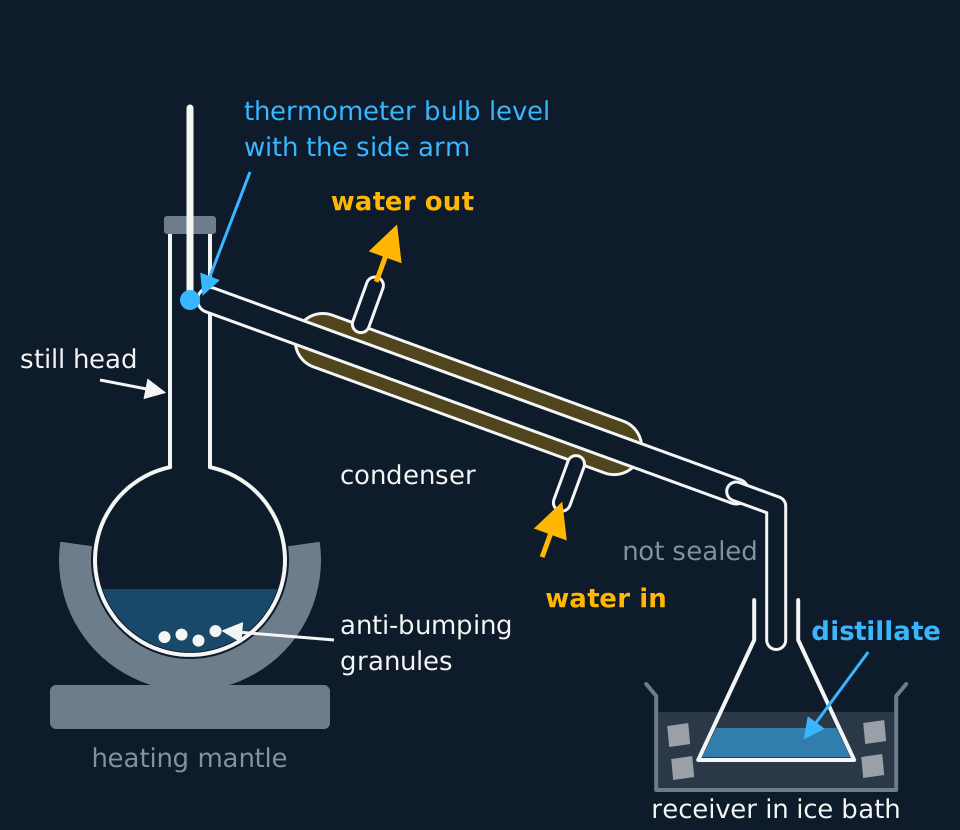
Simple distillation separates a liquid from a mixture by boiling it off and condensing it in another vessel. The vapour passes through a still head into a condenser that slopes down and away from the flask, and the liquid collects in a receiver. A thermometer with its bulb level with the side arm of the still head reads the temperature of the vapour that is leaving, which is the boiling point of whatever is distilling over. The fraction kept is the one that comes over within a degree or two of the product's boiling point.
Describe the drawing
Simple distillation. A round-bottomed flask with anti-bumping granules sits in an electric heating mantle. A still head on the flask carries a thermometer whose bulb is level with the side arm. The side arm leads into a condenser sloping down and away from the flask, with cooling water entering at its lower end and leaving at its upper end. An adapter drops the distillate into a receiving flask standing in an ice bath, with a gap at the neck so the apparatus is not sealed.
The two set-ups give different products from the same reagents. Under reflux, ethanol is oxidised first to ethanal, and the ethanal stays in the flask and is oxidised further to ethanoic acid. In a distillation apparatus, with the oxidising agent added slowly to the warm alcohol, the ethanal, which boils at 21 °C, leaves the flask as soon as it forms and is collected before it can be oxidised again. Distilling a product from a reaction is required practical 5.
- Heating under reflux
- Heating a reaction mixture with a vertical condenser fitted, so that vapours condense and return to the flask and no volatile substance is lost.
- Distillation
- Separating a liquid from a mixture by boiling it and condensing the vapour in a separate vessel.
Choosing reflux or distillation
One student wants to make propanoic acid from propan-1-ol, and a second wants propanal from the same alcohol. Both use acidified potassium dichromate(VI). Explain which set-up each should use.
Show the working
Propan-1-ol is a primary alcohol. Oxidised once it gives the aldehyde propanal; propanal oxidised again gives propanoic acid.
For propanoic acid, the propanal formed first must stay in contact with the oxidising agent. Heating under reflux with excess dichromate(VI) returns any propanal that evaporates to the flask until it has been oxidised to the acid. The acid is then separated from the mixture by distillation.
For propanal, the aldehyde must leave before it is oxidised again. Propanal boils at 48 °C, well below propan-1-ol at 97 °C and propanoic acid at 141 °C, so the student warms the alcohol in a distillation apparatus, adds the oxidising agent dropwise, and collects what distils at around 48 °C.
The acid needs reflux and then distillation, and the aldehyde needs distillation as it forms. The need for complete reaction decides the first; the boiling points decide the second.
TRY IT: Three faults in a reflux set-up
A student heats ethanol with acidified potassium dichromate(VI) in a round-bottomed flask over a Bunsen burner. A condenser is fitted upright with a stopper in its top, and the cooling water enters at the top of the condenser and leaves at the bottom. Identify three faults and explain what each could cause.
Check your answer
The stopper. A sealed apparatus that is heated builds up vapour pressure and can burst. The top of a reflux condenser is left open.
The Bunsen burner. Ethanol vapour is flammable, and a naked flame beneath the flask could ignite any that escapes. A water bath or an electric heating mantle is used instead.
The water flow. Entering at the top, the water drains through without filling the jacket, part of the condenser stays warm, and vapour escapes. Water enters at the bottom and leaves at the top. Anti-bumping granules are not mentioned either, and without them the mixture boils unevenly.
Separating and purifying a solid
Filtration separates a solid from a liquid, and which part is kept decides the method. Under gravity, with a fluted filter paper in a funnel, the liquid runs through slowly; the folds give it more paper to pass through, which speeds it up a little. This is the method when the filtrate, the liquid, is wanted. Under reduced pressure, a Büchner funnel with a flat filter paper sits in a side-arm flask connected to a vacuum pump or water pump. The pressure below the paper falls, air pressure pushes the liquid through quickly, and the solid left on the paper is pulled almost dry. This is the method when the solid is wanted.
A solid made in a reaction is rarely pure. Recrystallisation uses the fact that most solids dissolve far better in a hot solvent than in a cold one. The impure solid is dissolved in the minimum volume of hot solvent, so that the solution will be saturated once it cools. An insoluble impurity is removed by filtering the hot solution through a warmed funnel. As the filtrate cools, the product crystallises. Soluble impurities, present in far smaller amounts, do not reach saturation and stay dissolved.
The crystals are collected by filtration under reduced pressure, washed with a little cold solvent to rinse off the solution clinging to them, and left to dry. Too much solvent at the start leaves more of the product dissolved when the solution is cold, and the yield falls. Washing with warm solvent would redissolve some of the crystals.
A pure solid melts sharply, within a degree or so, at the temperature listed for it in a data book. Impurities lower the melting point and spread it over a range of several degrees. Measuring the melting point is the purity test that ends required practical 10.
A liquid product is purified differently. It is shaken with a solution that removes an impurity, sodium hydrogencarbonate for an acid, in a separating funnel, with the stopper held and the tap opened often to release gas. The two layers settle, the lower one is run off through the tap, and the organic layer, upper or lower according to its density, is dried with an anhydrous salt such as magnesium sulfate, which takes up water, until the liquid is clear. A final distillation collects the product over a narrow range around its boiling point, which is the purity test for a liquid.
- Filtrate
- The liquid that passes through the filter paper during filtration.
- Recrystallisation
- Purifying a solid by dissolving it in the minimum volume of hot solvent and letting the solution cool, so that the product crystallises and soluble impurities stay in solution.
Working safely
A hazard is something that could cause harm. A risk is the chance that harm will actually happen in the way the substance is being used, together with how serious it would be. Concentrated sulfuric acid is a hazard wherever it is. The risk is high when it is poured from a large bottle at face height and low when 2 cm³ is dispensed from a small bottle standing in a tray. A risk assessment lists the hazards, then the control measures that lower each risk.
| Pictogram | Meaning | A-level examples |
|---|---|---|
| Flame | Flammable | Ethanol, propanone, cyclohexane |
| Liquid dripping onto a hand and a surface | Corrosive | Concentrated sulfuric acid, bromine |
| Skull and crossbones | Acutely toxic | Bromine, methanol |
| Exclamation mark | Harmful or irritant | Copper(II) sulfate, dilute ammonia solution |
| Figure with a starburst on the chest | Long-term health hazard | Potassium dichromate(VI), a carcinogen |
| Flame over a circle | Oxidising | Potassium manganate(VII), concentrated nitric acid |
| Dead tree and fish | Hazardous to aquatic life | Copper(II) sulfate, silver nitrate |
A fume cupboard draws air away from the user and out of the building. It is used for anything that gives off a toxic or corrosive gas or vapour: bromine, concentrated hydrochloric and nitric acids, sulfur dioxide, and reactions that release them. Its glass screen is kept as low as the work allows, which also puts a barrier in front of anything that spits.
Concentrated acids burn skin and eyes, and concentrated sulfuric acid releases a great deal of heat as it is diluted. Acid is added slowly to water, never water to acid: a little water dropped onto the concentrated acid boils on contact and spatters acid out of the container. Goggles rather than safety spectacles, and gloves, are worn when dispensing it.
Liquid bromine is dense, red-brown and very volatile. Its vapour is toxic and damages the lungs, and the liquid causes serious burns. It is handled only in a fume cupboard, with gloves, and most school work uses bromine water instead, a dilute solution that gives the same test for an alkene with far less risk.
Sodium reacts vigorously with water, giving hydrogen, which can ignite, and sodium hydroxide, which is corrosive. It is stored under oil to keep air and moisture away, cut on a dry tile, handled with tongs, and used in pieces a few millimetres across behind a safety screen. Leftover scraps are disposed of by adding them to ethanol, which reacts more gently, never by washing them down a sink.
Organic solvents such as ethanol, propanone and cyclohexane are flammable, and their vapours spread along a bench to a flame some distance away. No naked flame is used anywhere near them: they are heated in a water bath or with an electric heater, and kept in small volumes with the stopper on. Many of their vapours are harmful, so larger volumes are handled in a fume cupboard.
These are general precautions. Before any practical, the CLEAPSS Hazcard for each substance and the school's own risk assessment are checked, and where they differ from these general precautions, they are the ones followed.
- Hazard
- A substance, object or activity with the potential to cause harm.
- Risk
- The likelihood that harm from a hazard will occur in the way an activity is carried out, together with how severe that harm would be.
The set practicals, the apparatus list and CPAC
Every board sets a list of practicals that the written papers can ask about: the apparatus, the method, the measurements and the errors. AQA's list is twelve required practicals, the first six in the AS course and the other six A level only; OCR's is twelve PAGs and Edexcel's sixteen core practicals. Each sits with the chemistry it measures. Separately, the practical endorsement is reported alongside the grade as a pass or not classified, judged by the teacher against criteria shared by all the English boards.
| RP | What is done | Taught in | Course |
|---|---|---|---|
| 1 | Make up a volumetric solution and carry out a simple acid–base titration | Concentration, volumetric solutions and titration calculations | AS |
| 2 | Measure an enthalpy change | Measuring an enthalpy change: calorimetry | AS |
| 3 | Investigate how the rate of a reaction changes with temperature | Measuring the rate of a reaction | AS |
| 4 | Test-tube reactions to identify cations and anions in aqueous solution | Halide ions, the silver nitrate test, concentrated sulfuric acid, and chlorine in water | AS |
| 5 | Distil a product from a reaction | Oxidation and elimination of alcohols | AS |
| 6 | Tests for alcohol, aldehyde, alkene and carboxylic acid | Test-tube reactions for functional groups, and high-resolution mass spectrometry | AS |
| 7 | Measure a rate by an initial rate method and by continuous monitoring | Finding orders from initial rates, half-lives and graphs | A level |
| 8 | Measure the EMF of an electrochemical cell | Electrode potentials and the standard hydrogen electrode | A level |
| 9 | Follow the pH as a weak acid reacts with a strong base, and a strong acid with a weak base | Titration curves and choosing an indicator | A level |
| 10 | Prepare a pure organic solid and test its purity; prepare a pure organic liquid | Preparing, purifying and testing an organic solid and liquid | A level |
| 11 | Test-tube reactions to identify transition metal ions in aqueous solution | Reactions of aqua ions with hydroxide, ammonia and carbonate | A level |
| 12 | Separate species by thin-layer chromatography | Chromatography: TLC, column and gas | A level |
Behind the practicals sits a list of apparatus and techniques, lettered AT a to AT l. Every student must use each one by the end of the course, and the twelve practicals are chosen so that between them they cover the list. A practical that asks for a reflux set-up is assessing AT d as well as the chemistry.
| AT | What the student does | Required practicals |
|---|---|---|
| a | Records mass, time, the volume of a liquid or a gas, and temperature with suitable apparatus | 1, 2, 3, 7, 9, 10 |
| b | Heats with a water bath, an electric heater or a sand bath | 3, 5, 6, 10, 11 |
| c | Measures pH with a chart, a pH meter or a pH probe on a data logger | 9 |
| d | Titrates with a burette and pipette; distils and heats under reflux, clamping the glassware; tests for ions and functional groups; filters by gravity or under reduced pressure | 1, 2, 4, 5, 6, 9, 10, 11 |
| e | Makes up a standard solution in a volumetric flask | 1 |
| f | Uses acid–base indicators in titrations of weak and strong acids with weak and strong bases | 1 |
| g | Purifies a solid by recrystallisation, and a liquid with a separating funnel | 10 |
| h | Uses melting point apparatus | 10 |
| i | Uses thin-layer or paper chromatography | 12 |
| j | Sets up an electrochemical cell and measures its voltage | 8 |
| k | Handles corrosive, irritant, flammable and toxic substances safely | All |
| l | Measures a rate by at least two methods, such as an initial rate and continuous monitoring | 7 |
The endorsement is judged against the Common Practical Assessment Criteria, CPAC: five statements that a teacher must see a student meet, consistently and by the end of the course, in the lab book and at the bench. One good practical does not meet a criterion. The teacher looks for it run after run, and the lab book is the evidence.
| CPAC | What the teacher must see | In a titration, for example |
|---|---|---|
| 1 Follows written procedures | A method carried out correctly as written, step by step | Rinsing, filling and reading the burette as the method says |
| 2 Applies investigative approaches | Suitable apparatus and measuring strategies chosen; variables identified and controlled | Choosing a pipette, not a cylinder, for the 25.0 cm³ portion |
| 3 Uses equipment and materials safely | Hazards identified, risks assessed, control measures followed | A pipette filler, goggles, and the alkali's hazard noted |
| 4 Makes and records observations | Accurate, precise and sufficient readings, recorded methodically with units and to the apparatus's resolution | Every burette reading to two decimal places, in a table |
| 5 Researches, references and reports | Data processed with suitable tools; sources found and cited | The indicator's colour change checked and its source given |
Other boards: PAGs, core practicals and research skills
OCR A arranges the same skills as twelve Practical Activity Groups, PAG 1 to PAG 12, and Edexcel as sixteen core practicals. Both are assessed against the same five CPAC criteria and reported as the same pass or not classified. The experiments overlap heavily: titration, calorimetry, rates, test-tube analysis, organic preparation and chromatography appear on every list. Cambridge International has no endorsement and examines practical skill directly, in a laboratory examination, Paper 3, and in a written paper on planning, analysis and evaluation, Paper 5.
OCR's PAG 12 is research skills, and it asks for three things the other boards leave inside CPAC 5. Reading a method critically means checking that it gives every quantity, concentration and condition needed to repeat it, and its hazards. Citing a source means giving enough for a reader to find it: the author, the title, the date, and the publisher or the web address with the date it was read.
Judging a claim means asking who made it, what evidence supports it, whether the data could support it, and whether other workers have checked it. A figure from a supplier's advertisement and a measured value in a peer-reviewed journal do not carry the same weight, and a written PAG 12 task expects that difference to be stated.
In the exam
- For heating under reflux, the scheme awards the mark for vapours condensing and returning to the flask, so the mixture can be heated for a long time without losing volatile reactants or products. 'It stops evaporation' alone does not say where the vapour goes.
- For a volume that enters a calculation, name a volumetric pipette or a burette, with its uncertainty. A measuring cylinder is accepted only for a reagent added in excess.
- Write 'the minimum volume of hot solvent' and give the reason: the solution must be saturated when cold, or product stays dissolved. 'Hot solvent' on its own is not credited.
- Tie each control measure to the hazard it reduces: bromine in a fume cupboard because its vapour is toxic, a water bath for ethanol because its vapour is flammable. Schemes usually ignore 'wear goggles' and 'wear a lab coat' offered on their own.
- A distillation thermometer reads the vapour leaving the flask, so the scheme looks for its bulb level with the side arm, at the entrance to the condenser.
Check yourself
A student makes a standard solution by weighing 2.65 g of sodium carbonate onto a piece of paper and tipping it into a beaker, dissolving it in 100 cm³ of water, pouring the solution into a 250 cm³ measuring cylinder and filling it to the 250 cm³ mark. She then pipettes 25.0 cm³ portions straight from the cylinder. Evaluate the method and say how it should be done.
Answer
The weighing loses solid. Grains left on the paper are counted in the 2.65 g but never reach the beaker. Weighing by difference from a weighing bottle records only the mass that was transferred.
A measuring cylinder is far less exact than a 250 cm³ volumetric flask, ±0.3 cm³, so the volume, and therefore the concentration, is known less well than the pipette and burette that follow would allow. The beaker and rod were not rinsed into the cylinder either, so some sodium carbonate was left behind.
The solution was never mixed. Pipetting straight from an unmixed cylinder gives portions of different concentration, and the titres will not be concordant however carefully the burette is read.
Done properly: weigh by difference, dissolve in a beaker, transfer to a 250 cm³ volumetric flask with all the washings, make up to the line dropwise, stopper and invert several times, then pipette from the flask.
Questions
Question 16 marks
Describe the hazards, and a control measure for each, when a student prepares ethanoic acid by heating ethanol under reflux with potassium dichromate(VI) acidified with sulfuric acid, which she first dilutes from the concentrated acid.
Mark scheme
Indicative content
- concentrated sulfuric acid is corrosive to skin and eyes, so it is dispensed in small volumes wearing goggles and gloves
- diluting the concentrated acid releases a great deal of heat, so the acid is added slowly to the water and never water to the acid
- ethanol is flammable and its vapour spreads along a bench, so the flask is heated with a water bath or electric heater and no naked flame
- potassium dichromate(VI) is a carcinogen and an oxidising agent, so it is handled in small amounts with gloves and any spill is cleared at once
- a sealed apparatus that is heated builds up pressure and can burst, so the top of the reflux condenser is left open to the air
- anti-bumping granules make the mixture boil smoothly, preventing sudden surges that could throw hot acidic liquid out of the flask
Levels
- Level 3 (5–6 marks) all the hazards are identified with a control measure for each: the corrosive concentrated acid and the order of dilution, the flammable ethanol and the heat source, the toxic dichromate(VI), the open top of the reflux condenser and the anti-bumping granules; each control is matched to its hazard rather than listed separately
- Level 2 (3–4 marks) three or four hazards each have a sensible control; the order of dilution, the open top of the condenser, or the flammability of ethanol is left out or matched to the wrong control
- Level 1 (1–2 marks) one or two hazards such as the corrosive acid are named, with controls no more specific than 'wear goggles', or with water poured into the concentrated acid to dilute it
Question 24 marks
Describe how exactly 25.0 cm³ of a solution is transferred into a conical flask for a titration, naming the apparatus used.
Mark scheme
- B1 a 25.0 cm³ volumetric pipette, used with a pipette filler; reject a measuring cylinder or a burette
- B1 rinse the pipette with distilled water and then with the solution it will hold
- B1 draw solution above the line, then release it until the bottom of the meniscus is on the line at eye level
- B1 run the solution into the flask and touch the tip on the inside of the flask, leaving the last drop in the tip
Question 34 marksAQA · OCR A · Edexcel
Suggest which CPAC criterion each of the four lab-book entries given in the table falls short of, and what the student should do instead.
| Entry | What the lab book says |
|---|---|
| 1 | Titres: 23.4, 23.45, 23.5 |
| 2 | Heated the cyclohexane mixture over a Bunsen burner |
| 3 | Used 25 cm³ of acid in run 1 and 30 cm³ in run 2 to speed things up |
| 4 | Melting point of aspirin 135 °C, from a website |
Mark scheme
- B1 entry 1 falls short of recording observations (CPAC 4): every burette reading is recorded to two decimal places, as 23.40 and 23.50
- B1 entry 2 falls short of using equipment safely (CPAC 3): flammable cyclohexane is heated with a water bath or electric heater
- B1 entry 3 falls short of controlling variables (CPAC 2): the volume of acid is kept the same in every run
- B1 entry 4 falls short of referencing (CPAC 5): the source is cited fully enough for a reader to find it
All 17 questions with mark schemes, the other 14 set out in full on the question page.
Worth remembering
- Measure a volume that enters a calculation with a pipette or a burette; a measuring cylinder is too coarse, however carefully it is read.
- Weigh by difference, the container before and after tipping, so that grains left behind on it are not counted.
- A stoppered reflux condenser, or cooling water entering at the top, is a fault to name and correct.
- An aldehyde refluxed before it is distilled has become the carboxylic acid.
- Too much hot solvent, or warm solvent for washing, leaves product dissolved and lowers the yield.
CHECK YOUR PROGRESS
Rate how confident you are with each objective for this lesson. Ratings are saved in this browser, on this device, unless you sign in.
- Choose between a pipette, a burette, a volumetric flask and a measuring cylinder for a given volume, and describe how each is used.
- Describe weighing by difference and explain why it records the mass that actually reaches the reaction.
- Describe heating under reflux and simple distillation, and explain when each is used.
- Outline filtration under reduced pressure and recrystallisation for purifying a solid, and the melting point test of its purity.
- Identify the hazards of concentrated acids, bromine, sodium and organic solvents, and give a control measure for each.
- Name the lesson in which each of the twelve required practicals is taught.
Open the full revision checklist to see every objective in the curriculum in one place.
Practise this lesson
WORKBOOK
The written questions from this topic, on paper with room to work, and a separate book of mark schemes. The 2 questions that are set on a diagram stay on this page, where the diagram can be drawn. Free to use; please do not redistribute or sell.
Used later in Preparing, purifying and testing an organic solid and liquid