Chemistry › Organic analysis › Infrared spectroscopy
Infrared spectroscopy
Each covalent bond vibrates at its own frequency and absorbs infrared radiation of that frequency, so a spectrum shows which bonds a molecule contains. An O–H, a C=O and the fingerprint region below 1500 cm⁻¹ between them tell an alcohol, an aldehyde, an acid and an ester apart, and the same absorption by carbon dioxide, methane and water vapour warms the planet.
Key terms Every definition in organic analysis, lesson by lesson
Before this Electronegativity, polarity and intermolecular forces – hydrogen bonding between O–H groups · Test-tube reactions for functional groups, and high-resolution mass spectrometry – the alcohol, aldehyde, ketone and acid groups
COMMON MISCONCEPTION
Every peak on an infrared spectrum belongs to a bond, so I should label all of them.
Only the peaks above about 1500 cm⁻¹ are assigned to bonds: O–H, N–H, C–H, C=O, C=C. Below 1500 cm⁻¹ the absorptions of the carbon skeleton overlap, and that part of the spectrum is compared with a known spectrum as a whole, not read peak by peak.
What you should be able to do
- Explain why a covalent bond absorbs infrared radiation of a particular wavenumber.
- Identify the functional groups in a compound from its infrared spectrum and the data-sheet table.
- Distinguish an alcohol, an aldehyde or ketone, a carboxylic acid and an ester from their absorptions above 1500 cm⁻¹.
- Describe how the fingerprint region is used to identify a compound by comparison with a database.
- Explain how absorption of infrared by carbon dioxide, methane and water vapour contributes to global warming.
Bonds that vibrate
Infrared spectroscopy identifies the bonds in a compound from the radiation they absorb. A liquid such as ethanol is held as a thin film between two discs of sodium chloride in a beam of infrared radiation; the discs are salt, not glass, because glass absorbs infrared and salt does not. A detector records how much of each wavelength gets through. Some wavelengths pass almost untouched, others are almost completely absorbed, and which ones depends on the bonds in the ethanol.
A covalent bond behaves like two masses on a spring. It stretches and it bends, and it does so at a natural frequency fixed by the strength of the bond and the masses of the two atoms. Infrared radiation of exactly that frequency is absorbed and makes the vibration larger. A light atom or a strong bond gives a high frequency: O–H, N–H and C–H absorb well above 2500 cm⁻¹ because hydrogen is so light, and the double bond of C=O absorbs higher than the single bond of C–O.
Positions are given as a wavenumber, the number of waves per centimetre, in cm⁻¹. It is 1 divided by the wavelength in centimetres, so it rises with frequency. The range that matters runs from 4000 cm⁻¹ down to about 500 cm⁻¹. An absorption at 1700 cm⁻¹, for example, is radiation of wavelength 1 ÷ 1700 = 5.9 × 10⁻⁴ cm, or 5.9 μm.
A vibration absorbs infrared only if it changes the dipole of the molecule. A polar bond such as C=O or O–H has a dipole that grows and shrinks as the bond stretches, so it absorbs strongly. The bonds in N₂ and O₂ join identical atoms and have no dipole to change, so these two gases, which make up 99% of dry air, absorb no infrared at all. Carbon dioxide is a non-polar molecule, but when it bends, or when one C=O stretches as the other shortens, it becomes bent or lopsided for an instant, its dipole changes, and it absorbs.
- Infrared spectroscopy
- A technique that identifies the bonds in a compound from the wavenumbers of infrared radiation that they absorb.
- Absorption
- The removal from the beam of infrared radiation whose frequency matches the vibration frequency of a bond, seen as a dip in transmittance.
- Wavenumber
- The reciprocal of the wavelength, 1/λ, measured in cm⁻¹; it is proportional to the frequency of the radiation.
- Transmittance
- The percentage of the incident infrared radiation at a given wavenumber that passes through the sample.
- Bond vibration
- The stretching or bending of a covalent bond at a natural frequency set by the bond strength and the masses of the bonded atoms.
Reading a spectrum
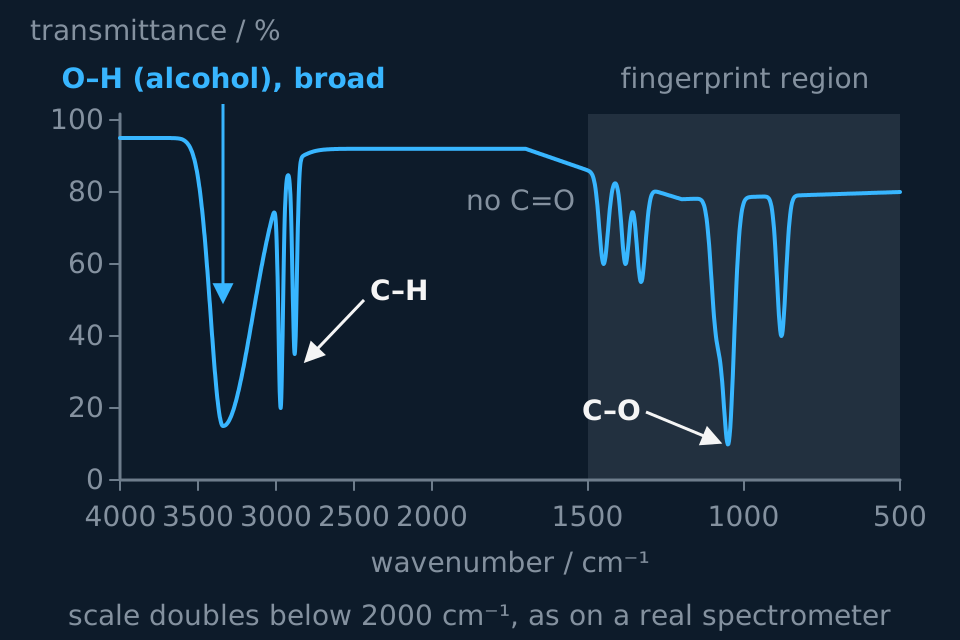
An infrared spectrum is drawn upside down compared with most graphs. The y-axis is transmittance, so a baseline near 100% means nothing absorbed and an absorption is a dip towards zero. The x-axis runs from 4000 cm⁻¹ on the left to 500 cm⁻¹ on the right, so wavenumber falls from left to right.
Describe the drawing
An infrared spectrum of ethanol, transmittance against wavenumber from 4000 on the left to 500 on the right. The trace sits near 95% then drops in a broad smooth dip centred on 3340, the alcohol O–H, followed by two sharp C–H dips just below 3000. It stays high with no C=O dip near 1700, and in the shaded fingerprint region below 1500 a strong C–O dip reaches 10% at 1050.
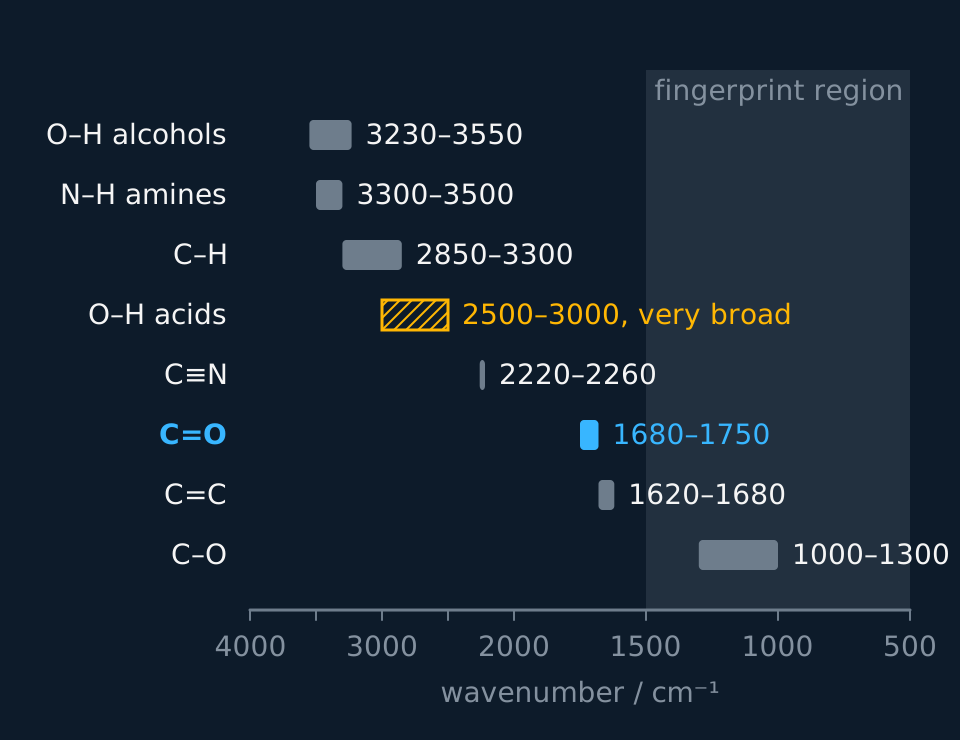
Each absorption is matched against the data-sheet table. The ranges overlap in places, and a question gives the table, so learning the numbers matters less than learning what to look for first.
| Bond | Where it is found | Wavenumber / cm⁻¹ |
|---|---|---|
| O–H | Alcohols | 3230–3550, broad |
| N–H | Amines | 3300–3500 |
| C–H | Most organic compounds | 2850–3300 |
| O–H | Carboxylic acids | 2500–3000, very broad |
| C≡N | Nitriles | 2220–2260 |
| C=O | Aldehydes, ketones, acids, esters | 1680–1750 |
| C=C | Alkenes | 1620–1680 |
| C–O | Alcohols, acids, esters | 1000–1300 |
Describe the drawing
The infrared data-sheet ranges drawn as horizontal bars on a wavenumber axis running from 4000 on the left to 500 on the right, one row each for O–H in alcohols, N–H in amines, C–H, O–H in acids (hatched, very broad), C≡N, C=O in the accent colour, C=C and C–O. Bonds to hydrogen sit on the left; the C–O bar falls inside the shaded fingerprint region below 1500.
Start above 1500 cm⁻¹. Look first for a strong, sharp dip between 1680 and 1750 cm⁻¹: if it is there, the molecule has a C=O. Then look at the region from 2500 to 3550 cm⁻¹ for a broad O–H. Almost every organic compound has C–H, so a C–H absorption on its own says little.
The depth of a dip carries information too. Polar bonds give deep absorptions: C=O, O–H and C–O are usually the strongest in a spectrum. The C=C of an alkene is almost non-polar, so its absorption at 1620–1680 cm⁻¹ is weak and easy to miss, and an alkene is better confirmed with bromine water than with infrared.
The O–H absorption is broad because the O–H groups are hydrogen bonded to one another. Each O–H in the liquid is held a little differently, so the bonds have a spread of strengths and absorb over a spread of wavenumbers. In a carboxylic acid the hydrogen bonding is stronger still, as pairs of molecules form dimers, and the O–H absorption is broader and lower, from 2500 to 3000 cm⁻¹, running into the C–H dips.
Two more bonds in the table are easy to spot. The N–H of an amine absorbs at 3300–3500 cm⁻¹, overlapping the alcohol O–H, but the absorption is narrower because N–H hydrogen bonds are weaker, and a primary amine, with its NH₂ group, often shows two dips rather than one. The C≡N of a nitrile absorbs at 2220–2260 cm⁻¹, where almost nothing else in an organic molecule does, so a sharp absorption there is good evidence of a nitrile on its own.
Assigning the spectrum of ethanoic acid
The infrared spectrum of ethanoic acid shows a very broad absorption from 2500 to 3000 cm⁻¹, trailing towards 3300, with a sharper dip at 2990 cm⁻¹ on top of it, a strong sharp absorption at 1715 cm⁻¹ and a strong absorption at 1290 cm⁻¹. Assign each to a bond.
Show the working
The strong sharp absorption at 1715 cm⁻¹ lies in 1680–1750: C=O.
The very broad absorption from 2500 to 3000 cm⁻¹ is the hydrogen-bonded O–H of a carboxylic acid; its breadth and its low start at 2500 rule out the alcohol O–H.
The dip at 2990 cm⁻¹ is C–H, and 1290 cm⁻¹ is C–O, in 1000–1300.
C=O with a very broad O–H at 2500–3000 is the pattern of a carboxylic acid, which is what ethanoic acid is.
Alcohol, aldehyde, acid or ester
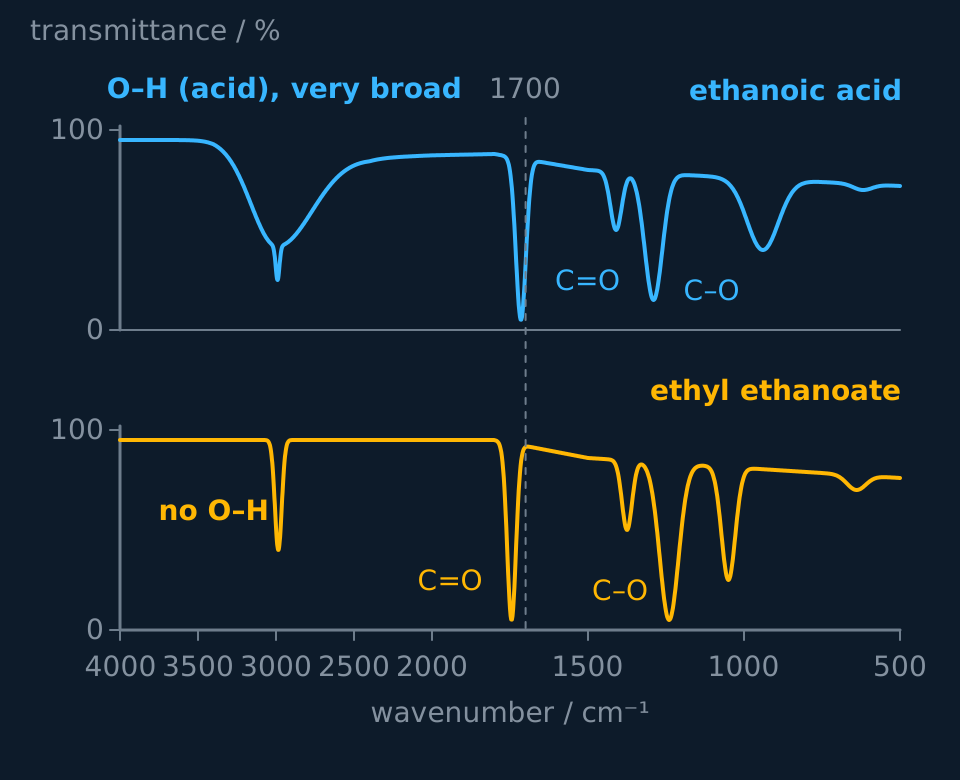
Four functional groups that contain oxygen give four patterns above 1500 cm⁻¹, and the pattern settles the class even when the individual ranges overlap.
| Class | Broad O–H? | C=O at 1680–1750? | C–O at 1000–1300? |
|---|---|---|---|
| Alcohol | Yes, 3230–3550 | No | Yes |
| Aldehyde or ketone | No | Yes | No |
| Carboxylic acid | Yes, very broad, 2500–3000 | Yes | Yes |
| Ester | No | Yes | Yes, strong |
Describe the drawing
Two infrared spectra stacked on the same wavenumber axis from 4000 to 500, with a dashed guide at 1700 running through both. Ethanoic acid, top, has a very broad O–H dip spreading from about 3200 down to 2500, a sharp C=O dip at 1715 and a C–O dip near 1290. Ethyl ethanoate, below, is flat where the acid's O–H was, labelled no O–H, but has an equally deep C=O at 1745 and a strong C–O at 1240.
An aldehyde and a ketone give the same pattern: a C=O and no O–H. The data-sheet ranges do not separate them, so infrared alone, read from the table, cannot say which one is present.
Propanone or propanal
Two samples, both C₃H₆O, each show a strong absorption near 1720 cm⁻¹ and no broad absorption between 2500 and 3550 cm⁻¹. One is propanone and one propanal. Explain what the spectra show and how to tell the samples apart.
Show the working
Both have C=O, in 1680–1750 cm⁻¹, and neither has O–H. That fits an aldehyde or a ketone, and both compounds fit it.
The data-sheet ranges are too wide to split them: propanone absorbs at about 1715 cm⁻¹ and propanal at about 1730 cm⁻¹, both inside the C=O range. Propanal also shows two weak dips near 2820 and 2720 cm⁻¹ from the C–H of the CHO group, below the data sheet's C–H range, which is a clue but not one the table supports.
Two ways decide it. Compare each fingerprint region with reference spectra of propanone and propanal; or warm each sample with Tollens' reagent, where only propanal gives a silver mirror.
TRY IT: An unknown C₄H₈O₂
A compound C₄H₈O₂ absorbs strongly at 1740 cm⁻¹ and at 1240 cm⁻¹, and has C–H absorptions near 2980 cm⁻¹. There is no absorption between 3200 and 3550 cm⁻¹ and nothing broad below 3000 cm⁻¹. Identify the class of compound.
Check your answer
1740 cm⁻¹ is C=O and 1240 cm⁻¹ is C–O, so the molecule has both.
There is no broad O–H at 3230–3550 or at 2500–3000, so it is not an alcohol and not a carboxylic acid.
C=O and C–O without O–H is an ester. Ethyl ethanoate, methyl propanoate and propyl methanoate all fit; the fingerprint region or NMR decides which.
Infrared gives the class of compound and a mass spectrum gives its relative molecular mass. Together they often fix the structure of a small molecule.
An acid of relative molecular mass 74
A compound of carbon, hydrogen and oxygen has a molecular ion at m/z 74. Its infrared spectrum shows a very broad absorption from 2500 to 3000 cm⁻¹ and a strong absorption at 1710 cm⁻¹. Identify the compound, and say what would change if the broad absorption were absent.
Show the working
1710 cm⁻¹ is C=O, and the very broad absorption starting at 2500 cm⁻¹ is the O–H of a carboxylic acid, so the compound contains a COOH group.
COOH has Mr = 12.0 + 2 × 16.0 + 1.0 = 45.0. That leaves 74 − 45 = 29 for the rest of the molecule, which is C₂H₅. The compound is CH₃CH₂COOH, propanoic acid, C₃H₆O₂.
With no broad O–H, but with C=O and a strong C–O at 1000–1300 cm⁻¹, the compound would be an ester of the same formula: methyl ethanoate, CH₃COOCH₃, or ethyl methanoate, HCOOCH₂CH₃. Infrared read from the table cannot choose between those two.
The same patterns follow a reaction as it happens. Oxidise ethanol and take a spectrum of samples as the reaction proceeds. At the start there is a broad O–H at 3230–3550 cm⁻¹ and no C=O. As ethanal forms, a C=O appears near 1730 cm⁻¹ and the alcohol O–H weakens. If oxidation goes on to ethanoic acid, the O–H returns, now very broad and centred lower, at 2500–3000 cm⁻¹. A product with C=O and the alcohol O–H both present has not been fully converted.
The fingerprint region
Below 1500 cm⁻¹ a spectrum is crowded with absorptions from bending vibrations and from the molecule's skeleton vibrating as a whole. They are hard to assign to single bonds, and no attempt is made to assign them. Instead, the pattern is treated as a whole: no two different compounds give the same pattern in this region.
To identify a compound, its spectrum is compared with a database of reference spectra recorded under the same conditions. A match across the whole fingerprint region, peak for peak, identifies it. The same comparison checks purity: a product with absorptions that the reference spectrum lacks contains something else, often unreacted starting material.
- Fingerprint region
- The region of an infrared spectrum below 1500 cm⁻¹, whose pattern of absorptions is unique to a compound.
Infrared in the atmosphere
The Earth's surface, warmed by sunlight, radiates energy back out as infrared. The C=O bonds in carbon dioxide, the C–H bonds in methane and the O–H bonds in water vapour absorb at wavenumbers within that radiation. Each molecule that absorbs then re-emits the energy in a random direction, some of it back towards the surface, so less escapes to space and the lower atmosphere warms. More of these gases means more absorption, which is the link between their concentrations and global warming.
Sunlight arrives mostly as visible light, which these gases do not absorb, so it reaches the ground. The Earth, far cooler than the Sun, radiates at much longer wavelengths, in the infrared, and that outgoing radiation is what is trapped. Water vapour absorbs the most in total, but its concentration is set by temperature and falls as rain. Carbon dioxide and methane are the gases human activity adds to directly, and molecule for molecule methane absorbs far more strongly than carbon dioxide.
Carbon dioxide absorbs in two places: near 2350 cm⁻¹, as one C=O stretches while the other shortens, and near 670 cm⁻¹, as the molecule bends. The Earth's surface, at about 15 °C, emits most of its infrared between about 200 and 1500 cm⁻¹, wavelengths of 7 to 50 μm, so the bending absorption of carbon dioxide sits inside that outgoing radiation. Methane absorbs near 3000 cm⁻¹ and 1300 cm⁻¹, from its C–H bonds stretching and bending.
- Greenhouse gas
- A gas whose molecules absorb infrared radiation emitted from the Earth's surface and re-emit it, warming the lower atmosphere.
- Global warming
- The rise in the mean temperature of the Earth's surface and lower atmosphere caused by increasing concentrations of greenhouse gases.
Other boards: breathalysers and exhaust gases
OCR names breathalysers and the monitoring of pollutants such as carbon monoxide and nitrogen monoxide in its specification. Both measure a concentration from how much infrared a sample absorbs at one chosen wavenumber.
An evidential breathalyser passes infrared through a sample of breath and measures the absorption by the C–H bonds of ethanol near 2950 cm⁻¹; the greater the absorption, the higher the concentration of ethanol. Propanone, which can build up in the breath of a diabetic, also has C–H bonds. The instrument therefore measures at a second wavenumber, near 1050 cm⁻¹, where ethanol's C–O absorbs and propanone does not.
Exhaust gases are monitored the same way. Carbon monoxide absorbs near 2140 cm⁻¹ and nitrogen monoxide near 1880 cm⁻¹, each from the stretching of its polar bond, and carbon dioxide, far more plentiful in exhaust, absorbs at neither wavenumber. An analyser draws exhaust through a cell with a beam of infrared passing through it and measures the absorption at each of these wavenumbers; the greater the absorption, the higher the concentration of that pollutant. Roadside monitors shine a beam across a lane and measure the same absorptions in the exhaust plume of each passing car. In an answer, name the bond that absorbs and say that the absorption rises with concentration.
In the exam
- Name the bond and quote the wavenumber range from the data sheet: 'C=O, 1680–1750 cm⁻¹'. Schemes accept any value inside the data-sheet range, and for O–H they want the group too: 'O–H in an acid'.
- A carboxylic acid needs both the C=O and the very broad O–H at 2500–3000 cm⁻¹ for the identification mark. The C=O alone fits an aldehyde, ketone or ester.
- The fingerprint region is compared with a database of known spectra. Schemes reject an attempt to assign it bond by bond.
- For the greenhouse effect, the scheme wants infrared emitted by the Earth's surface being absorbed, not radiation arriving from the Sun.
- For a breathalyser or an exhaust analyser, name the bond that absorbs, and state that the amount absorbed rises with the concentration.
Check yourself
A student oxidises propan-1-ol with acidified dichromate under reflux and records the infrared spectrum of the product. It has a strong absorption at 1715 cm⁻¹ and a very broad absorption from 2500 to 3000 cm⁻¹. She says the product is propanal. Explain whether she is right.
Answer
She is not. The strong absorption at 1715 cm⁻¹ is C=O, which propanal does have.
The very broad absorption from 2500 to 3000 cm⁻¹ is the O–H of a carboxylic acid. Propanal has no O–H at all, so its spectrum would show nothing broad in that region.
Heating under reflux keeps the aldehyde in the flask, where it is oxidised further. The product is propanoic acid, and both absorptions fit it. To make propanal, the aldehyde has to be distilled off as it forms.
Questions
Question 16 marks
Deduce the structure of compound Z, which contains carbon, hydrogen and oxygen only, from the data in the table. Explain how each technique contributes.
| Technique | Result |
|---|---|
| Mass spectrum | Molecular ion at m/z 88 |
| Infrared | Very broad absorption 2500–3000 cm⁻¹; strong, sharp absorption at 1710 cm⁻¹; strong absorption at 1250 cm⁻¹ |
| Proton NMR | δ 11.8, singlet, 1H; δ 2.3, triplet, 2H; δ 1.4, sextet, 2H; δ 1.0, triplet, 3H |
Mark scheme
Indicative content
- the infrared absorption at 1710 cm⁻¹ is C=O and the very broad absorption from 2500 cm⁻¹ is the O–H of a carboxylic acid, so Z contains COOH
- the molecular ion gives Mr = 88; COOH is 45, leaving 43 for C₃H₇, so the formula is C₄H₈O₂
- the NMR singlet of 1H at 11.8 ppm is in the 10.0–12.0 range and confirms the COOH hydrogen, and the integration totals eight hydrogens
- the triplet of 3H at 1.0 ppm is a CH₃ next to a CH₂, and the triplet of 2H at 2.3 ppm is a CH₂ next to the C=O and next to another CH₂
- the sextet of 2H at 1.4 ppm, in the R–CH₂–R range, is a CH₂ with five neighbouring hydrogens, three on one side and two on the other, so it lies between them
- Z is butanoic acid, CH₃CH₂CH₂COOH; its isomer 2-methylpropanoic acid would show a doublet of 6H and a multiplet of 1H instead
Levels
- Level 3 (5–6 marks) all three techniques are used and the contribution of each is explained: the infrared absorptions identifying COOH, the molecular ion giving Mr and the formula, and every NMR signal assigned with its splitting explained, ending with the structure and the reason the branched isomer is excluded
- Level 2 (3–4 marks) the carboxylic acid is found from the infrared and the molecular ion and the structure is right, with most NMR signals assigned; one splitting pattern is unexplained or the branched isomer is not excluded
- Level 1 (1–2 marks) a C=O or an O–H is picked out, or Mr read off; the n + 1 rule is often applied to the wrong neighbours, and the structure is wrong or missing
Question 26 marks
Explain what the infrared absorptions in the table show about compound T, C₄H₈O₂, which is one of butanoic acid, ethyl ethanoate or methyl propanoate, and why they cannot settle which compound it is.
| Wavenumber / cm⁻¹ | Appearance |
|---|---|
| 2980 | Medium, sharp |
| 1740 | Strong, sharp |
| 1200 | Strong |
| Below 1500 | Many absorptions |
Mark scheme
Indicative content
- the absorption at 1740 cm⁻¹ lies in the range 1680–1750 cm⁻¹ and shows that T contains a C=O bond
- the absorption at 1200 cm⁻¹ lies in the range 1000–1300 cm⁻¹ and shows that T contains a C–O bond
- there is no very broad absorption at 2500–3000 cm⁻¹, so there is no carboxylic acid O–H and T is not butanoic acid
- a C=O and a C–O with no O–H is the pattern of an ester, so T is ethyl ethanoate or methyl propanoate
- the two esters contain exactly the same bonds, so they absorb in the same data-sheet ranges and the table cannot separate them
- the fingerprint region below 1500 cm⁻¹ must be compared with reference spectra of the two esters, and the one that matches identifies T
Levels
- Level 3 (5–6 marks) both absorptions are assigned using the data-sheet ranges, the absence of the broad O–H is used to rule out the acid, the ester is identified from the C=O with C–O, and the answer explains that the two esters have the same bonds and so need their fingerprint regions compared with reference spectra
- Level 2 (3–4 marks) the C=O and C–O are assigned and the acid ruled out; the answer does not say why the table cannot separate the two esters, or does not turn to the fingerprint region
- Level 1 (1–2 marks) the 1740 cm⁻¹ absorption is called C=O, and the compound is then named as the acid, or as one ester with no reason given
Question 34 marks
Explain what happens when a covalent bond absorbs infrared radiation, and why nitrogen and oxygen, which make up most of the atmosphere, absorb none.
Mark scheme
- B1 the radiation absorbed has the same frequency as the natural vibration frequency of the bond
- B1 the energy absorbed increases the vibration of the bond, as stretching or bending
- B1 a vibration absorbs infrared only if it changes the dipole of the molecule
- B1 N₂ and O₂ each join two identical atoms, so the bond has no dipole and stretching it changes none; reject 'they are unreactive'
All 18 questions with mark schemes, the other 15 set out in full on the question page.
Worth remembering
- Labelling every dip is wasted work; assign the strong ones above 1500 cm⁻¹.
- Look past the C–H absorptions, which almost every organic compound shows, to the bonds that identify the group.
- An acid's O–H called an alcohol's, or the other way round, misreads the whole spectrum.
- Infrared read from the table cannot split an aldehyde from a ketone, or two esters from each other.
- Greenhouse gases absorb what the Earth emits, not what the Sun sends.
CHECK YOUR PROGRESS
Rate how confident you are with each objective for this lesson. Ratings are saved in this browser, on this device, unless you sign in.
- Explain why a covalent bond absorbs infrared radiation of a particular wavenumber.
- Identify the functional groups in a compound from its infrared spectrum and the data-sheet table.
- Distinguish an alcohol, an aldehyde or ketone, a carboxylic acid and an ester from their absorptions above 1500 cm⁻¹.
- Describe how the fingerprint region is used to identify a compound by comparison with a database.
- Explain how absorption of infrared by carbon dioxide, methane and water vapour contributes to global warming.
Open the full revision checklist to see every objective in the curriculum in one place.
Practise this lesson
Practise infrared spectroscopy with 18 original questions and point-by-point mark schemes
WORKBOOK
The written questions from this topic, on paper with room to work, and a separate book of mark schemes. The 5 questions that are set on a diagram stay on this page, where the diagram can be drawn. Free to use; please do not redistribute or sell.
Used later in Putting the analysis together: structure from spectra