Chemistry › Organic synthesis › Putting the analysis together: structure from spectra
Putting the analysis together: structure from spectra
No single technique names an unknown compound. Its formula comes from a precise mass or a combustion analysis, infrared finds the functional group, carbon-13 NMR counts the carbon environments and proton NMR shows how the pieces join. Used in that order, each narrows the possibilities left by the one before, and the answer is the one structure that fits all of the evidence.
Key terms Every definition in organic synthesis, lesson by lesson
Before this Test-tube reactions for functional groups, and high-resolution mass spectrometry – the molecular formula from a precise mass · Infrared spectroscopy – the absorptions of O–H, C=O and C–O · Proton and carbon-13 NMR spectroscopy – environments, shift, integration and the n + 1 rule · Empirical and molecular formulae – the formula from combustion masses
COMMON MISCONCEPTION
If the carbon-13 spectrum has the right number of peaks, I have found the structure.
A carbon-13 count gives the number of carbon environments, and several isomers can share it: propan-1-ol and methoxyethane both give three peaks. The structure is settled by combining the molecular formula, the infrared absorptions and the proton environments with their integration and splitting.
What you should be able to do
- Deduce a molecular formula from a precise mass, or from combustion data and the molecular ion.
- Calculate the degree of unsaturation from a molecular formula, and use it to limit the possible structures.
- Identify the functional groups in an unknown from its infrared spectrum.
- Deduce a structure from carbon-13 and proton NMR data, using shift, integration and splitting.
- Explain how symmetry, O–H peaks and integration ratios can mislead an analysis, and check a structure against every piece of evidence.
An order to work in
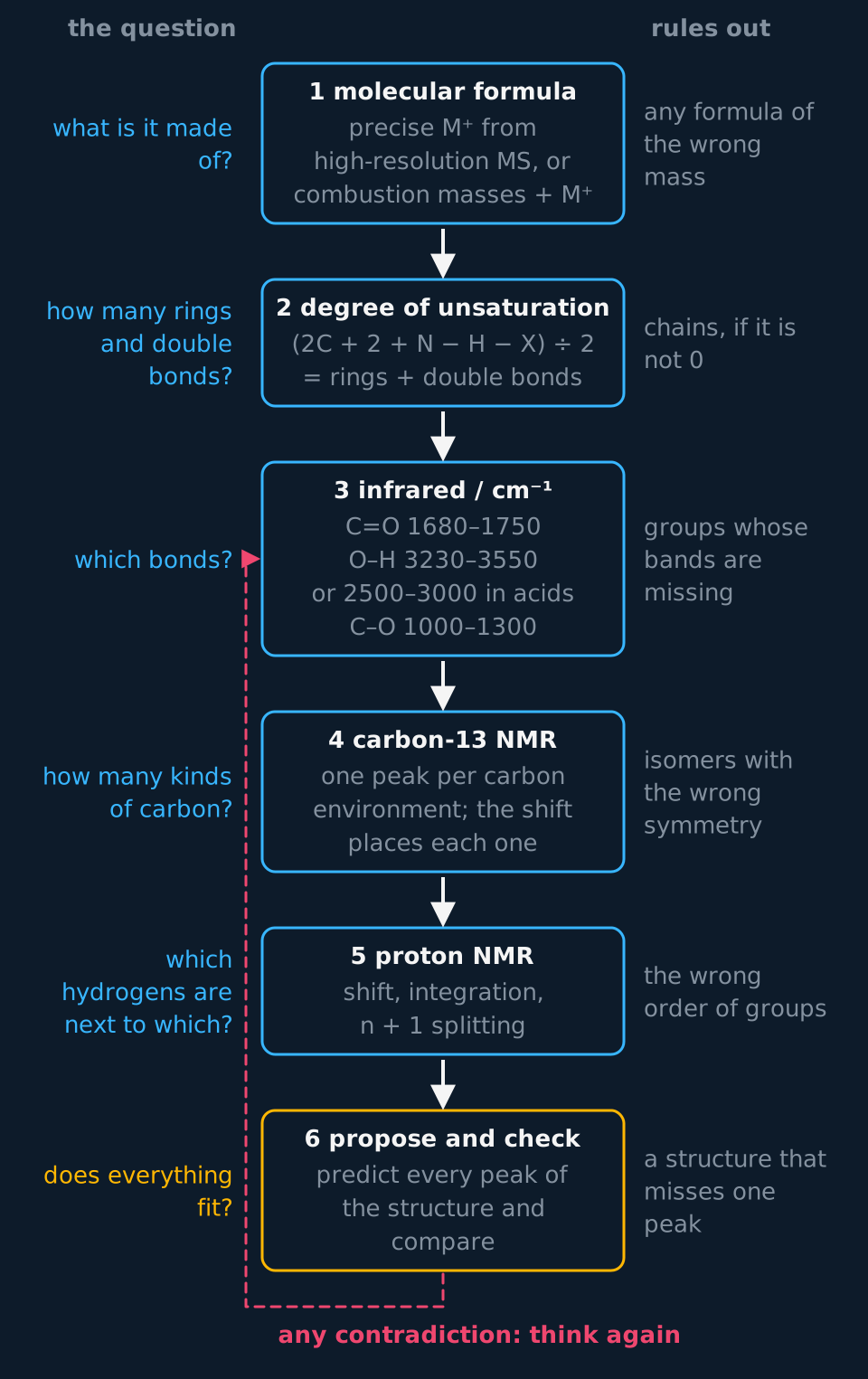
An unknown organic compound is identified by four techniques, each answering a different question about it: how heavy the molecule is and what it is made of, which bonds it contains, how many kinds of carbon it has, and which hydrogens sit next to which. None of them alone gives the structure. Taken in a fixed order, each one rules out structures the one before left standing.
The order is the one in the flow chart. First the molecular formula, from a precise mass or from combustion data with the molecular ion. Then the degree of unsaturation, which says how many rings and double bonds the formula allows. Then infrared, for the functional group. Then carbon-13 NMR, for the number of carbon environments. Then proton NMR, for how the fragments are joined. Last, a structure is proposed and checked against every piece of data, because a structure that fits four results and contradicts a fifth is wrong.
Describe the drawing
A vertical flow chart of six boxes joined by downward arrows: molecular formula from a precise M⁺ or combustion data; degree of unsaturation from (2C + 2 + N − H − X) ÷ 2; infrared, for C=O, O–H and C–O; carbon-13 NMR, one peak per carbon environment; proton NMR, by shift, integration and n + 1 splitting; and propose and check. Left of each box is the question it answers and right of it what it rules out. A dashed coral arrow runs from the last box back up to infrared, labelled any contradiction: think again.
| Technique | What it gives | What it cannot tell |
|---|---|---|
| High-resolution mass spectrometry | Molecular formula from M⁺ to four decimal places | How the atoms are joined |
| Combustion analysis | Empirical formula | The molecular formula, without Mr |
| Infrared | Bonds present: O–H, C=O, C–O, N–H, C≡N | Where in the molecule they are |
| Carbon-13 NMR | Number of carbon environments and their types | How many carbons in each environment |
| Proton NMR | Hydrogen environments, their numbers and their neighbours | Groups with no hydrogens, such as C=O, directly |
Gas chromatography sometimes comes before all of this. If the sample is a mixture, every spectrum is a mixture too, and GC separates it first; in GC–MS each separated component goes straight into a mass spectrometer.
The formula and what it allows
A high-resolution mass spectrometer gives the mass of the molecular ion to four decimal places, and the precise relative atomic masses (¹H 1.0078, ¹²C 12.0000, ¹⁴N 14.0031, ¹⁶O 15.9949) make each formula's mass unique. A molecular ion at 58.0417 is C₃H₆O, not C₄H₁₀ at 58.0780 or C₂H₆N₂ at 58.0530.
Combustion analysis gets there by another method. A known mass of the compound is burned in excess oxygen and the carbon dioxide and water are weighed. All the carbon ends up in the CO₂ and all the hydrogen in the H₂O, and whatever mass is left over is oxygen. That gives the empirical formula; the molecular ion peak in an ordinary mass spectrum then gives the multiple.
The degree of unsaturation follows from the formula. Every ring and every double bond removes two hydrogens from the saturated, open-chain formula CₙH₂ₙ₊₂. For a compound containing C, H and O, the count is (2C + 2 − H) ÷ 2. Oxygen does not change it; each nitrogen adds one to the bracket, and each halogen counts as a hydrogen. C₃H₆O has (6 + 2 − 6) ÷ 2 = 1: one C=O, one C=C or one ring. C₈H₈O has (16 + 2 − 8) ÷ 2 = 5, and five is a strong hint of a benzene ring, which accounts for four, plus one more double bond.
The term itself is not required, and no mark depends on it. The count is worth the ten seconds because it rules out whole families of structure before a spectrum is read.
- Empirical formula
- The simplest whole-number ratio of the atoms of each element in a compound.
- Molecular ion
- The ion formed when a molecule loses one electron, M⁺; its m/z gives the relative molecular mass.
- Degree of unsaturation
- The number of rings plus double bonds in a molecule, found from (2C + 2 + N − H − X) ÷ 2, where a triple bond counts as two.
What each spectrum is read for
In the infrared spectrum, look first between 1680 and 1750 cm⁻¹. A strong absorption there is C=O. Then look from 2500 to 3550 cm⁻¹: a broad absorption from 3230 to 3550 is the O–H of an alcohol, and a very broad one from 2500 to 3000, under the C–H peaks, is the O–H of a carboxylic acid. A C=O with no O–H is an aldehyde, a ketone or an ester; a strong C–O near 1200 as well points to the ester. The fingerprint region below 1500 is for matching against a database, not for assigning bonds.
In the carbon-13 spectrum, count the peaks: each is one carbon environment. Then place them. Above 160 ppm is a C=O, with esters and acids at 160 to 185 and aldehydes and ketones at 190 to 220. From 110 to 160 are aromatic and alkene carbons. From 50 to 90 is a carbon bonded to oxygen. Below 50 is an alkyl carbon.
The proton spectrum carries three readings for every peak. The shift says what the hydrogens are near: a CH₃ on a chain near 1, a hydrogen on a carbon next to C=O at 2.1 to 2.6, a hydrogen on a carbon bonded to an ester oxygen at 3.7 to 4.1, a ring hydrogen near 7 to 8, an aldehyde CHO at 9 to 10, a carboxylic acid at 10 to 12. The integration gives the ratio of hydrogens in each environment. The splitting follows the n + 1 rule: a peak split into n + 1 lines has n hydrogens on the neighbouring carbons.
The n + 1 rule counts hydrogens on adjacent carbon atoms only. A CH₃ bonded to an oxygen, to a C=O carbon or to a benzene ring carbon with no hydrogen has no neighbouring hydrogens to couple with, and gives a singlet. Singlets are as informative as multiplets: each one marks a group cut off from other hydrogens.
- Fingerprint region
- The part of an infrared spectrum below 1500 cm⁻¹, whose pattern is unique to a compound and identifies it by comparison with a database.
- Chemical shift
- The position of an NMR peak, δ in ppm, measured relative to TMS at 0 ppm; it depends on the atom's chemical environment.
- Chemical environment
- A set of atoms that are bonded to identical surroundings, so they absorb at the same chemical shift and give one peak.
- Integration ratio
- The ratio of the areas under the peaks of a proton NMR spectrum, equal to the ratio of the numbers of hydrogens in each environment.
- n + 1 rule
- A proton NMR peak is split into n + 1 lines, where n is the number of hydrogens on the adjacent carbon atoms.
Three analyses
C₃H₆O: a single peak
Compound A has a molecular ion at m/z 58.0417. Its infrared spectrum shows a strong absorption at 1715 cm⁻¹ and nothing broad above 3000. Its carbon-13 spectrum has peaks at 207 and 31 ppm. Its proton spectrum has one peak, a singlet at 2.1 ppm. Identify A.
Show the working
Formula: 58.0417 matches C₃H₆O. Degree of unsaturation (6 + 2 − 6) ÷ 2 = 1, so one double bond or one ring.
Infrared: 1715 cm⁻¹ is C=O, which uses up the one double bond. No broad O–H, so not an alcohol or acid. A is an aldehyde or a ketone.
Carbon-13: three carbons but only two peaks, so two carbons are equivalent. 207 ppm is a ketone or aldehyde C=O; 31 ppm is an alkyl carbon next to C=O.
Proton: a single singlet means all six hydrogens are equivalent, and none has hydrogen neighbours. At 2.1 ppm they are next to C=O. Propanal, CH₃CH₂CHO, would give three proton peaks including one near 9.8 ppm, and three carbon peaks.
A is propanone, CH₃COCH₃: two equivalent methyl groups on either side of a C=O.
The second analysis starts from combustion data, and the proton spectrum has to decide between two esters with the same formula and the same functional group.
C₄H₈O₂: which ester
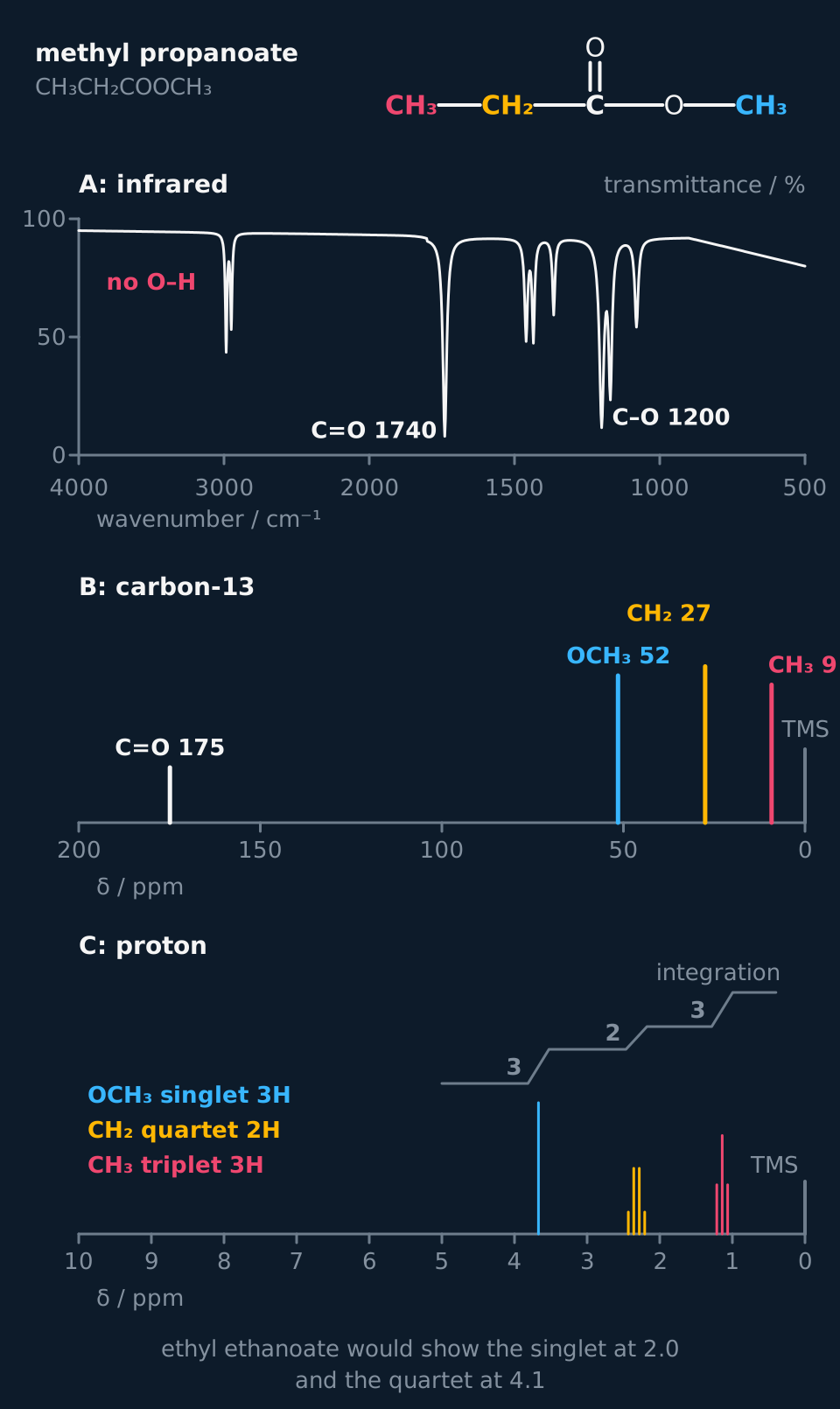
0.880 g of compound B burns completely to give 1.760 g of CO₂ and 0.720 g of H₂O. Its mass spectrum has M⁺ at m/z 88. Infrared: strong absorptions at 1740 and 1200 cm⁻¹, nothing broad above 3000. Carbon-13: 175, 52, 27 and 9 ppm. Proton: δ 3.7, singlet, 3H; δ 2.3, quartet, 2H; δ 1.1, triplet, 3H. Identify B.
Show the working
Carbon: 1.760 ÷ 44.0 = 0.0400 mol CO₂, so 0.0400 mol C, 0.480 g. Hydrogen: 0.720 ÷ 18.0 = 0.0400 mol H₂O, so 0.0800 mol H, 0.0800 g. Oxygen: 0.880 − 0.480 − 0.0800 = 0.320 g, so 0.0200 mol O.
C : H : O = 0.0400 : 0.0800 : 0.0200 = 2 : 4 : 1, so the empirical formula is C₂H₄O, mass 44.0. M⁺ at 88 is twice that, so the molecular formula is C₄H₈O₂, with one degree of unsaturation.
Infrared: C=O at 1740 and C–O at 1200, with no O–H, so B is an ester, not the acid butanoic acid. Carbon-13: four peaks for four carbons, with the ester C=O at 175 and a carbon bonded to oxygen at 52.
Proton: the CH₃ singlet at 3.7 is in the range for hydrogens on a carbon bonded to an ester oxygen, and is a singlet because oxygen carries no hydrogens. The quartet at 2.3 is a CH₂ next to the C=O with a CH₃ beside it; the triplet at 1.1 is that CH₃.
B is methyl propanoate, CH₃CH₂COOCH₃. Its isomer ethyl ethanoate, CH₃COOCH₂CH₃, has the same infrared and the same number of carbon peaks, but its singlet is at 2.0 (next to C=O) and its quartet at 4.1 (next to O). The shifts put each group on the correct side of the ester link.
Describe the drawing
Three spectra of methyl propanoate stacked on one figure, with its structure at the top, the OCH₃ in cyan, the CH₂ in amber and the CH₃ on the ethyl end in coral. A, infrared, transmittance against wavenumber: a deep sharp C=O dip at 1740, a strong C–O dip at 1200 and nothing broad above 3000, so no O–H. B, carbon-13: four lines at 175 for C=O, 52 for OCH₃, 27 for CH₂ and 9 for CH₃, with TMS at 0. C, proton NMR: a singlet at 3.67 for OCH₃, a quartet at 2.32 for CH₂ and a triplet at 1.14 for CH₃, with an integration trace rising in steps of 3, 2 and 3. A note says ethyl ethanoate would show the singlet at 2.0 and the quartet at 4.1.
C₈H₈O: a ring and a ketone
Compound C has M⁺ at m/z 120.0573. Infrared: strong absorption at 1685 cm⁻¹, weak absorptions just above 3000, nothing broad. Carbon-13: six peaks, at 198, 137, 133, 129, 128 and 27 ppm. Proton: δ 7.9, 2H; δ 7.4 to 7.6, 3H; δ 2.6, singlet, 3H. Identify C.
Show the working
Formula: C₈H₈O = 96.0000 + 8.0624 + 15.9949 = 120.0573. Degree of unsaturation (16 + 2 − 8) ÷ 2 = 5: a benzene ring (four) and one more double bond.
Infrared: 1685 cm⁻¹ is C=O, so the fifth degree is a carbonyl. No O–H. Carbon-13: 198 ppm is an aldehyde or ketone C=O; four peaks between 128 and 137 are aromatic carbons; 27 ppm is an alkyl carbon next to C=O.
Eight carbons give six peaks, so there is symmetry. A benzene ring with one substituent has four ring environments: the carbon bearing the substituent, two equivalent ortho carbons, two equivalent meta carbons and one para carbon. Four ring peaks fit a single substituent.
Proton: five ring hydrogens (2H plus 3H) confirm one substituent on the ring. The singlet of 3H at 2.6 is a CH₃ next to C=O with no neighbouring hydrogens. There is no peak between 9 and 10, so the C=O is not an aldehyde.
C is phenylethanone, C₆H₅COCH₃. 4-Methylbenzaldehyde also has six carbon peaks, but it would show an aldehyde hydrogen near 9.9 ppm and only four ring hydrogens.
TRY IT: C₄H₈O
Compound D, C₄H₈O, absorbs strongly at 1715 cm⁻¹ and has no broad absorption above 3000 cm⁻¹. Its carbon-13 spectrum has peaks at 209, 37, 29 and 8 ppm. Its proton spectrum has δ 2.4, quartet, 2H; δ 2.1, singlet, 3H; δ 1.1, triplet, 3H. Identify D, explaining each piece of evidence.
Check your answer
One degree of unsaturation, used by the C=O at 1715 cm⁻¹; no O–H. The carbon peak at 209 ppm is an aldehyde or ketone, and four peaks mean four different carbons.
There is no proton peak at 9 to 10 ppm, so it is a ketone, not butanal. The singlet of 3H at 2.1 is a CH₃ bonded to the C=O. The quartet of 2H and triplet of 3H are an ethyl group, CH₂CH₃, and the CH₂ at 2.4 is also next to the C=O.
D is butanone, CH₃COCH₂CH₃.
Where analyses go wrong
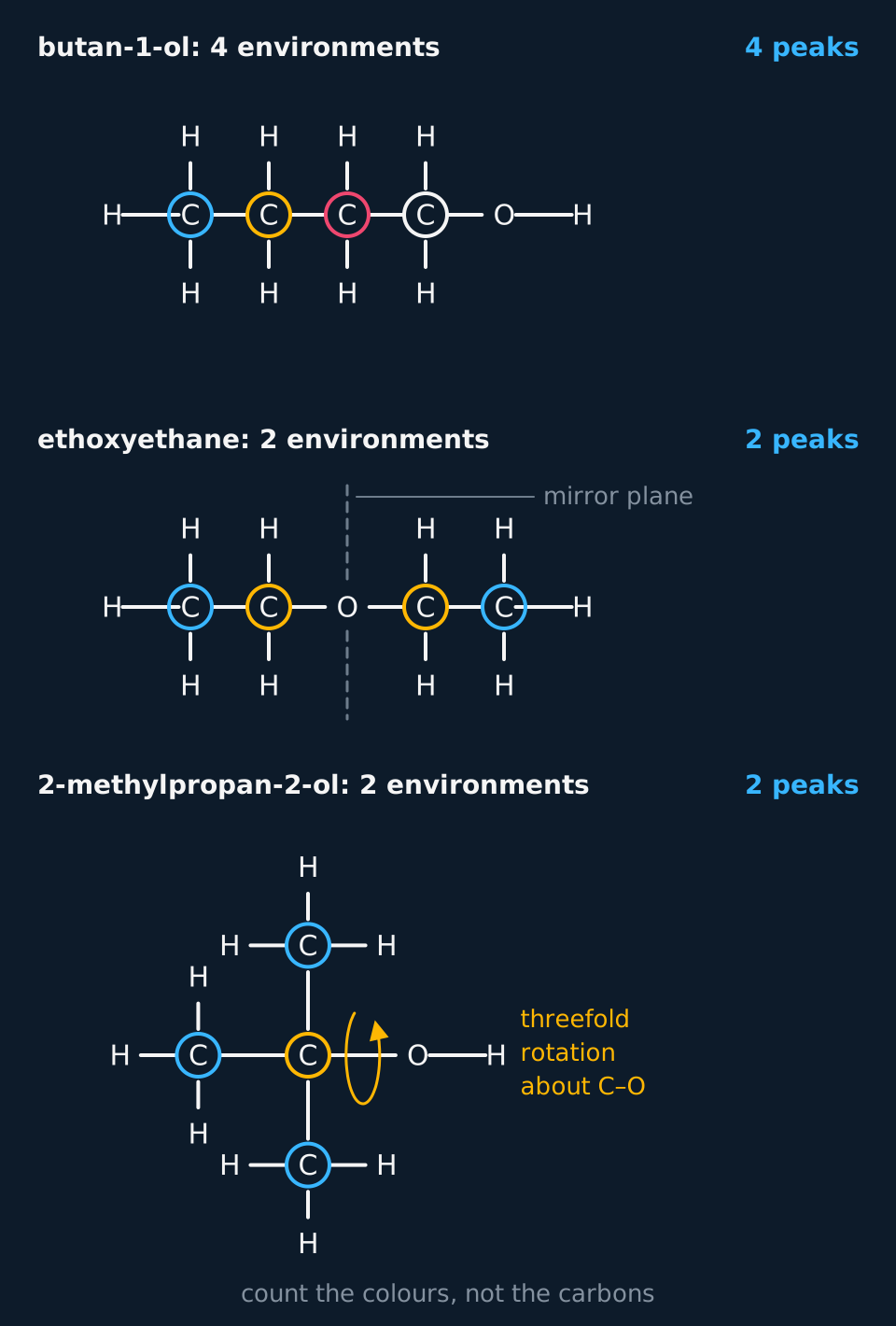
Symmetry is the first thing to look for when a count of peaks seems wrong. Equivalent carbons give one peak, so a molecule can have far fewer peaks than carbons. Every isomer of C₄H₁₀O has four carbons, but butan-1-ol gives four carbon-13 peaks, ethoxyethane gives two and 2-methylpropan-2-ol gives two. Ethoxyethane, CH₃CH₂OCH₂CH₃, is the same on either side of its oxygen, so its two CH₂ carbons are one environment and its two CH₃ carbons are another.
Describe the drawing
Three isomers of C₄H₁₀O drawn at the same scale as displayed formulae with every bond and hydrogen shown, each carbon ringed in a colour for its environment. Butan-1-ol has four carbons in four colours: four peaks. Ethoxyethane has a dashed mirror line through its oxygen, both CH₂ carbons in one colour and both CH₃ carbons in another: two peaks. 2-Methylpropan-2-ol has three methyl carbons in one colour around a central carbon in another, with a curved arrow for the threefold rotation about the C–O bond: two peaks.
A ring makes symmetry harder to spot. A benzene ring with two different groups opposite each other, at positions 1 and 4, has only two kinds of ring hydrogen and four kinds of ring carbon; with the groups at 1 and 2 it has four kinds of ring hydrogen and six kinds of ring carbon. The number of aromatic peaks tells the substitution pattern.
An integration ratio is a ratio, not a count. Peaks in the ratio 3 : 1 for a compound with eight hydrogens mean 6H and 2H, not 3H and 1H. The integration always has to be scaled to the number of hydrogens in the molecular formula.
The hydrogen of an O–H or N–H causes two problems. Its shift is unreliable, anywhere from 0.5 to 5 ppm for an alcohol, depending on the concentration and the solvent. And it usually appears as a singlet, because it exchanges between molecules too fast to couple with its neighbours, and it does not split their peaks either. The CH₂ next to the OH in ethanol is a quartet from the CH₃ alone. Infrared is the surer test for an O–H: a broad absorption at 3230 to 3550 cm⁻¹.
Last comes the check. Draw the proposed structure, count its carbon environments and hydrogen environments, predict the shift and splitting of each, and compare every prediction with the data. Any reading the structure cannot explain means the structure is wrong.
- Equivalent atoms
- Atoms that are interchanged by the symmetry of the molecule, so they share an environment and give a single NMR peak.
Other boards: D₂O, calibration and pollution monitoring
OCR and Cambridge add a test that settles which peak belongs to an O–H or N–H. Shaking the sample with a few drops of D₂O replaces that hydrogen with deuterium, which does not absorb in a proton spectrum, so the peak disappears when the spectrum is run again. A peak that is present in CDCl₃ and gone after a D₂O shake is an O–H or N–H. The other side of the same fact: if a spectrum was run in D₂O, an O–H is not missing from the molecule just because it is missing from the spectrum, and the infrared is where to look for it.
CH₃CH₂OH(l) + D₂O(l) ⇌ CH₃CH₂OD(l) + HDO(l)The OH hydrogen exchanges with deuterium; the C–H hydrogens do not.
OCR also uses gas chromatography to measure how much of a component is present. Standards of known concentration are run under the same conditions and their peak areas plotted against concentration, giving an external calibration graph. The unknown's peak area is then read off the line as a concentration.
OCR examines infrared outside the laboratory as well, in monitoring air pollution. An exhaust analyser passes infrared through the gas and measures the absorbance at a wavenumber where only one pollutant absorbs: near 2140 cm⁻¹ for carbon monoxide and near 1880 cm⁻¹ for nitrogen monoxide. The more of the gas present, the more radiation it absorbs, so the absorbance gives its concentration. A breathalyser works on the same principle, measuring the absorbance of the C–H bonds of ethanol in exhaled breath.
- External calibration
- Finding a concentration by measuring standards of known concentration, plotting the response against concentration, and reading the unknown from the graph.
- D₂O exchange
- Shaking a sample with D₂O replaces the hydrogen of O–H and N–H groups with deuterium, so their proton NMR peak disappears.
In the exam
- A structure question is marked deduction by deduction: the scheme awards a mark for what each absorption, peak, ratio or splitting shows, so a correct structure with no reasoning collects only the structure mark.
- For a singlet, credit goes to 'no hydrogens on the adjacent carbon', or to the group being bonded to O or to a C=O carbon; 'no neighbours' alone is too vague to accept.
- Explain fewer carbon peaks than carbons by naming the equivalent carbons and the symmetry that makes them so.
- An infrared assignment needs the bond and its range from the data sheet, C=O at 1680 to 1750 cm⁻¹; 'a peak near 1700' does not identify the bond.
- Scale an integration ratio to the hydrogens in the molecular formula before assigning groups; a ratio quoted as a count gives the wrong fragments.
Check yourself
An unknown, C₃H₈O, gives three carbon-13 peaks and four proton NMR peaks, one of them a singlet of 1H. Its infrared spectrum has a broad absorption at 3350 cm⁻¹. Explain which isomer it is and why each of the other two isomers is ruled out.
Answer
The degree of unsaturation is (6 + 2 − 8) ÷ 2 = 0, so there is no C=O or ring. The broad 3350 cm⁻¹ absorption is an O–H, so it is an alcohol, and the 1H singlet is that O–H hydrogen.
Propan-2-ol, (CH₃)₂CHOH, has two equivalent methyl carbons, so only two carbon peaks and three proton environments. Methoxyethane, CH₃OCH₂CH₃, has no O–H.
Propan-1-ol, CH₃CH₂CH₂OH, has three carbon environments and four proton environments: CH₃, CH₂, CH₂O and OH. It is propan-1-ol.
Questions
Question 16 marks
Identify compound G, C₈H₈O₂, from the data in the table, explaining how each piece of evidence supports your structure.
| Technique | Data |
|---|---|
| High-resolution MS | M⁺ at m/z 136.0522 |
| Infrared | Strong absorptions at 1725 and 1280 cm⁻¹; weak absorptions just above 3000 cm⁻¹; nothing broad |
| Carbon-13 NMR | Six peaks: 167, 133, 130, 129.6, 128 and 52 ppm |
| Proton NMR | δ 8.0, 2H; δ 7.4 to 7.6, 3H; δ 3.9, singlet, 3H |
Mark scheme
Indicative content
- C₈H₈O₂ matches the precise mass and has a degree of unsaturation of 5, a benzene ring plus one double bond
- infrared: C=O at 1725 and C–O at 1280 cm⁻¹ with no broad O–H, so an ester rather than a carboxylic acid
- carbon-13: 167 ppm is an ester C=O and 52 ppm a carbon bonded to oxygen; four peaks from 128 to 133 are ring carbons
- four ring environments and five ring hydrogens (2H + 3H) show a benzene ring with a single substituent
- the 3H singlet at 3.9 ppm is an OCH₃ on the ester oxygen, with no neighbouring hydrogens
- G is methyl benzoate, C₆H₅COOCH₃; phenyl ethanoate is ruled out because its CH₃ would sit next to C=O near 2.3 ppm
Levels
- Level 3 (5–6 marks) every piece of evidence is used: the formula and its unsaturation, the infrared showing an ester, the carbon-13 shifts, the ring hydrogens and environments showing one substituent, and the OCH₃ singlet, ending with methyl benzoate and the reason phenyl ethanoate is excluded
- Level 2 (3–4 marks) the ester and the benzene ring are identified and methyl benzoate given; one piece of evidence goes unused or phenyl ethanoate is not excluded
- Level 1 (1–2 marks) an ester or a ring is spotted from one piece of data, and the structure is often given as phenyl ethanoate or as a ketone
Question 24 marks
Calculate the molecular formula of a compound of carbon, hydrogen and oxygen from the combustion data in the table.
| Measurement | Value |
|---|---|
| Mass of compound burned | 0.580 g |
| Mass of CO₂ formed | 1.320 g |
| Mass of H₂O formed | 0.540 g |
| m/z of the molecular ion | 58 |
Mark scheme
- M1 C: 1.320 ÷ 44.0 = 0.0300 mol, mass 0.360 g; H: 0.540 ÷ 18.0 = 0.0300 mol H₂O, so 0.0600 mol H, mass 0.0600 g
- M1 O: 0.580 − 0.360 − 0.0600 = 0.160 g, so 0.160 ÷ 16.0 = 0.0100 mol; error carried forward from the C and H masses
- M1 C : H : O = 0.0300 : 0.0600 : 0.0100 = 3 : 6 : 1, so the empirical formula is C₃H₆O, mass 58.0
- A1 the empirical mass equals Mr, so the molecular formula is C₃H₆O
Question 34 marks
Deduce the structure of compound J, C₅H₁₀O₂, an ester, from the proton NMR data in the table, showing how the integration is scaled.
| δ / ppm | Splitting | Relative integration |
|---|---|---|
| 4.1 | quartet | 1.0 |
| 2.3 | quartet | 1.0 |
| 1.25 | triplet | 1.5 |
| 1.1 | triplet | 1.5 |
Mark scheme
- B1 the integrations sum to 5 and the formula has 10 hydrogens, so the ratio scales by 2 to 2H : 2H : 3H : 3H
- B1 two quartets of 2H and two triplets of 3H are two separate ethyl groups, each CH₂ split by a CH₃ and each CH₃ by a CH₂
- B1 the CH₂ at 4.1 ppm is bonded to the ester oxygen and the CH₂ at 2.3 ppm is next to the C=O
- B1 J is ethyl propanoate, CH₃CH₂COOCH₂CH₃; accept a correct displayed formula
All 20 questions with mark schemes, the other 17 set out in full on the question page.
Worth remembering
- Fewer carbon peaks than carbons needs the equivalent carbons named.
- An integration ratio of 3 : 1 in an eight-hydrogen molecule is 6H and 2H.
- A C=O peak does not separate aldehyde from ketone; the 9 to 10 ppm proton does.
- A broad O–H at 2500 to 3000 cm⁻¹ is a carboxylic acid, not an alcohol.
- A structure that contradicts one reading is wrong, however well it fits the rest.
CHECK YOUR PROGRESS
Rate how confident you are with each objective for this lesson. Ratings are saved in this browser, on this device, unless you sign in.
- Deduce a molecular formula from a precise mass, or from combustion data and the molecular ion.
- Calculate the degree of unsaturation from a molecular formula, and use it to limit the possible structures.
- Identify the functional groups in an unknown from its infrared spectrum.
- Deduce a structure from carbon-13 and proton NMR data, using shift, integration and splitting.
- Explain how symmetry, O–H peaks and integration ratios can mislead an analysis, and check a structure against every piece of evidence.
Open the full revision checklist to see every objective in the curriculum in one place.
Practise this lesson
WORKBOOK
The written questions from this topic, on paper with room to work, and a separate book of mark schemes. The 9 questions that are set on a diagram stay on this page, where the diagram can be drawn. Free to use; please do not redistribute or sell.