Chemistry › Acids and bases › Brønsted–Lowry acids and bases, pH and strong acids
Brønsted–Lowry acids and bases, pH and strong acids
Hydrogen chloride is a gas of covalent molecules, yet in water it gives a solution that conducts, fizzes with magnesium and turns litmus red. An acid is a substance that hands a proton to something else, and in solution water is usually what takes it. pH counts those protons on a logarithmic scale, so each step of one unit is a factor of ten in [H⁺].
Key terms Every definition in acids and bases, lesson by lesson
Before this Concentration, volumetric solutions and titration calculations – moles from a volume and a concentration · Dynamic equilibrium, Le Chatelier's principle and industrial compromise – what the ⇌ sign means and what moves an equilibrium
COMMON MISCONCEPTION
A strong acid is a concentrated one, so watering hydrochloric acid down turns it into a weak acid.
Strong means fully dissociated in water; concentrated means many moles per cubic decimetre. Hydrochloric acid at 0.001 mol dm⁻³ is still fully dissociated, so it is a dilute strong acid; ethanoic acid at 10 mol dm⁻³ is a concentrated weak acid. Diluting a strong acid tenfold raises its pH by one unit.
What you should be able to do
- Define a Brønsted–Lowry acid and base, and identify the conjugate acid–base pairs in an equation.
- Distinguish a strong acid from a weak acid by the extent of dissociation, and strength from concentration.
- Write ionic equations for the reactions of acids with metals, carbonates and oxides, and state the basicity of an acid.
- Calculate pH from [H⁺] and [H⁺] from pH, giving pH to two decimal places.
- Calculate the pH of a strong monoprotic acid, of sulfuric acid, and of a strong acid after dilution.
- Calculate the pH of the solution left when a strong acid is mixed with a strong base, with either in excess.
Acids give away protons
An acid is defined by what it does to other particles, not by what it is made of. Hydrogen chloride is a covalent molecule, H–Cl, that does nothing acidic on its own: dissolved dry in methylbenzene it does not conduct electricity and leaves dry blue litmus blue. Dissolved in water, it gives a solution that conducts, fizzes with magnesium and turns litmus red, because the HCl molecules have reacted with the water.
HCl(g) + H₂O(l) → H₃O⁺(aq) + Cl⁻(aq)
Each HCl molecule has passed a proton, H⁺, to a water molecule. A hydrogen atom without its electron is a bare proton, and that does not exist free in water. It bonds at once to a lone pair on the oxygen of a water molecule, forming the oxonium ion, H₃O⁺. Equations usually shorten H₃O⁺(aq) to H⁺(aq). The two mean the same species.
The Brønsted–Lowry theory defines acids and bases by that transfer. An acid is a proton donor and a base is a proton acceptor. Nothing in the definition needs water or hydroxide ions, which is its advantage over the older idea that a base is something that makes OH⁻. Ammonia gas meeting hydrogen chloride gas gives a white smoke of ammonium chloride: an acid–base reaction with no water anywhere.
NH₃(g) + HCl(g) → NH₄Cl(s)HCl donates a proton; NH₃ accepts it.
Most proton transfers can run backwards, and seen that way there is an acid and a base on each side. When ammonia dissolves in water, water donates a proton to ammonia, so water is the acid and ammonia the base. In the reverse reaction NH₄⁺ donates a proton to OH⁻.
NH₃(aq) + H₂O(l) ⇌ NH₄⁺(aq) + OH⁻(aq)
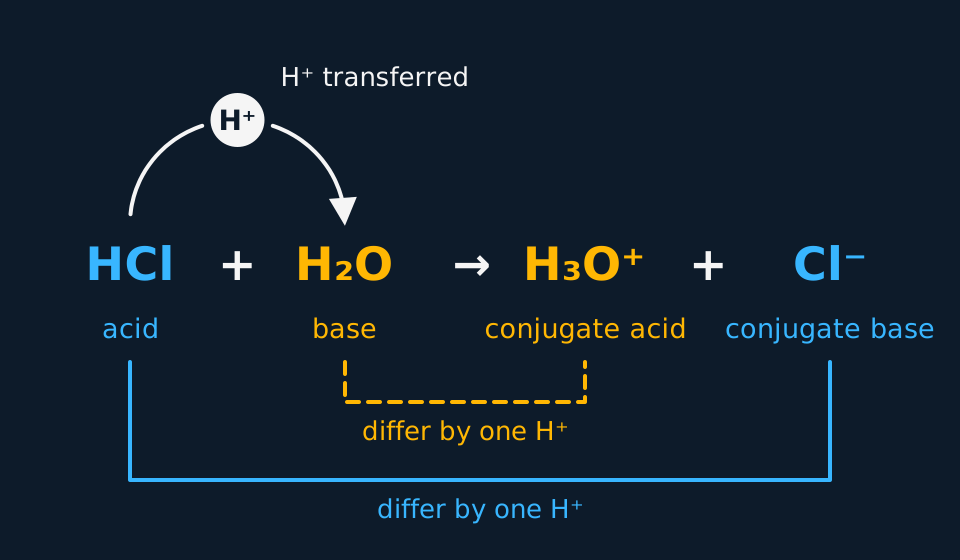
NH₄⁺ and NH₃ differ by one proton. They are a conjugate acid–base pair, NH₄⁺ the conjugate acid and NH₃ the conjugate base. H₂O and OH⁻ are the other pair. To find the pairs in any equation, take a species on the left, add or remove one H⁺, and look for the result on the right. The two members always differ by one proton and so by one unit of charge: H₂SO₄ and HSO₄⁻, HSO₄⁻ and SO₄²⁻. H₂SO₄ and SO₄²⁻ are not a pair, because they differ by two.
Describe the drawing
The equation HCl plus H₂O gives H₃O⁺ plus Cl⁻ written large across the middle. A curved arrow above it carries a circled H⁺ from HCl to H₂O, labelled H⁺ transferred. Beneath the equation HCl is labelled acid, H₂O base, H₃O⁺ conjugate acid and Cl⁻ conjugate base. A dashed amber bracket joins H₂O to H₃O⁺ and a solid cyan bracket joins HCl to Cl⁻, each marked differ by one H⁺.
Water accepted a proton from HCl and gave one to ammonia. A species that can act as either an acid or a base is amphoteric. Water, the hydrogensulfate ion HSO₄⁻ and the hydrogencarbonate ion HCO₃⁻ are the amphoteric species met most often; which way each one acts depends on what it is mixed with.
Use 'proton' or 'H⁺ ion' in a definition. 'Hydrogen donor' names an atom or a molecule, not the particle that moves, and is not the definition.
- Brønsted–Lowry acid
- A species that donates a proton (an H⁺ ion) to another species.
- Brønsted–Lowry base
- A species that accepts a proton (an H⁺ ion) from another species.
- Conjugate acid–base pair
- Two species that differ by one proton, such as NH₄⁺ and NH₃; the one with the extra proton is the conjugate acid.
- Amphoteric
- Able to act as both an acid and a base, as water does when it donates a proton to ammonia and accepts one from hydrogen chloride.
Strong and weak acids
Hydrochloric acid and ethanoic acid at the same concentration, 0.100 mol dm⁻³, behave differently on the bench. Magnesium ribbon fizzes hard in the first and gently in the second, and a pH meter reads 1.00 against 2.88. Both acids have one acidic proton per molecule, and both need exactly the same volume of sodium hydroxide to neutralise them. What differs is how far each has reacted with water before anything else is added.
In hydrochloric acid every HCl molecule has donated its proton, and no HCl molecules remain. An acid that dissociates completely in water is a strong acid, and its equation has a single arrow. Ethanoic acid only partly dissociates. At 0.100 mol dm⁻³ about 13 molecules in every thousand have given up a proton at any moment, and the rest are whole CH₃COOH molecules. It is a weak acid, and its equation is an equilibrium lying well to the left.
CH₃COOH(aq) ⇌ CH₃COO⁻(aq) + H⁺(aq)
The difference shows in the conjugate bases. Cl⁻ is an extremely weak base with almost no tendency to take a proton back, so the forward reaction goes to completion. The ethanoate ion is a far stronger base than Cl⁻ and takes protons back readily, so the reverse reaction matters and an equilibrium is set up. The stronger the acid, the weaker its conjugate base.
Strength and concentration are different properties. Strength is the proportion of molecules that dissociate, a property of the acid. Concentration is the amount of acid in each cubic decimetre, a property of the solution. Diluting hydrochloric acid makes it less concentrated, not weaker: 0.0010 mol dm⁻³ HCl is still completely dissociated. A 2.0 mol dm⁻³ solution of ethanoic acid is concentrated and weak. Keep the two pairs of words apart: 'dilute' and 'weak' are not the same answer.
| Strong acid | Weak acid | |
|---|---|---|
| Examples | HCl, HNO₃, H₂SO₄ (first proton) | Carboxylic acids such as CH₃COOH; HF; carbonic acid |
| Dissociation in water | Complete | Partial: an equilibrium |
| Arrow in the equation | → | ⇌ |
| pH at 0.100 mol dm⁻³ | 1.00 (HCl) | 2.88 (CH₃COOH) |
| [H⁺] compared with the acid concentration | Equal, for a monoprotic acid | Much smaller |
| 0.100 mol dm⁻³ NaOH to neutralise 25.0 cm³ | 25.0 cm³ | 25.0 cm³, the same |
The last row surprises people. As sodium hydroxide removes H⁺ from ethanoic acid, the position of equilibrium shifts to the right and more molecules dissociate to replace what was taken, until every one has reacted. A weak acid holds its protons in reserve, not out of reach, so a given amount of acid needs the same amount of alkali whatever its strength.
The same reserve shows in an acid's other reactions. In each of them the species that reacts is H⁺(aq), and the anion of the acid is a spectator, so one ionic equation serves for every acid.
Mg(s) + 2H⁺(aq) → Mg²⁺(aq) + H₂(g)With a reactive metal.
CaCO₃(s) + 2H⁺(aq) → Ca²⁺(aq) + CO₂(g) + H₂O(l)With a carbonate; a dissolved carbonate reacts as CO₃²⁻(aq).
CuO(s) + 2H⁺(aq) → Cu²⁺(aq) + H₂O(l)With a metal oxide.
The rate of each reaction depends on [H⁺], so magnesium fizzes faster in the hydrochloric acid. The total amount of gas does not: 25.0 cm³ of either acid at 0.100 mol dm⁻³, with magnesium in excess, gives 1.25 × 10⁻³ mol of hydrogen in the end, because the ethanoic acid goes on dissociating as its H⁺ is used. Conductivity separates the two as well. The hydrochloric acid holds about seventy-five times the concentration of ions and conducts far better.
- Strong acid
- An acid that dissociates completely into ions in aqueous solution.
- Weak acid
- An acid that only partially dissociates into ions in aqueous solution.
pH
The concentration of H⁺ in solutions met in the laboratory runs from about 1 mol dm⁻³ in bench hydrochloric acid to about 10⁻¹⁴ mol dm⁻³ in bench sodium hydroxide, a range of a hundred million million. A scale built from those numbers directly would be unreadable, so the logarithm is used. pH is the negative logarithm to base 10 of the hydrogen ion concentration.
pH = −log[H⁺]log is to base 10, and [H⁺] is in mol dm⁻³.
[H⁺] = 10^(−pH)On a calculator, the 10ˣ key, usually shift and log.
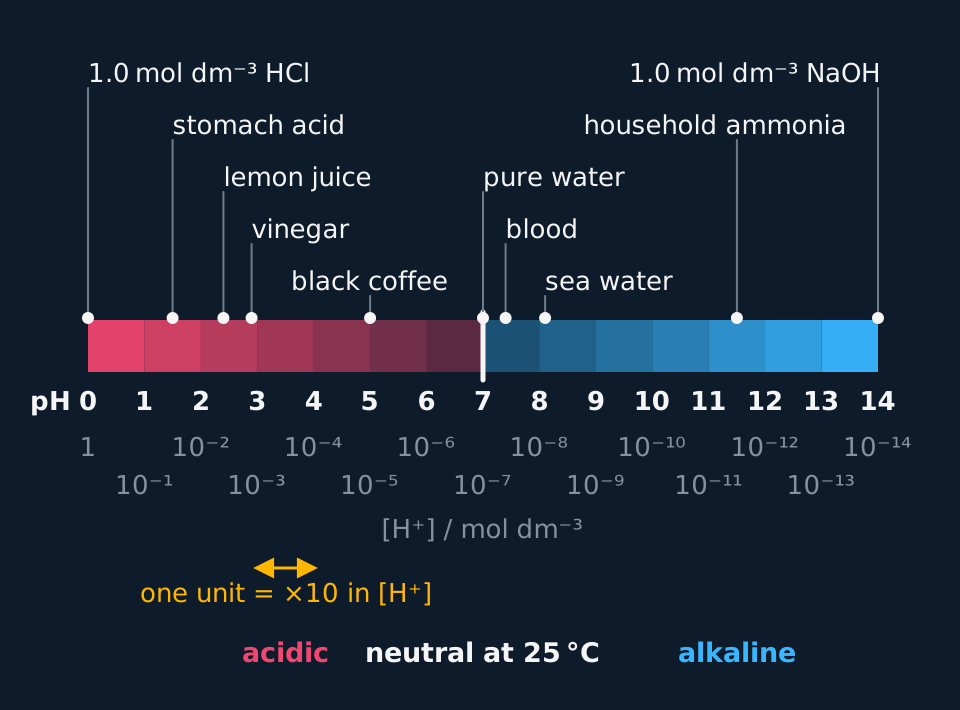
The minus sign makes the numbers positive for ordinary solutions, and the logarithm makes each whole unit of pH a factor of ten in [H⁺]. A solution at pH 2 has ten times the hydrogen ion concentration of one at pH 3, and a hundred times that of one at pH 4. A fall of 0.30 in pH doubles [H⁺], because log 2 = 0.30. Lower pH means higher [H⁺].
Describe the drawing
A horizontal pH scale from 0 to 14, shaded coral at the acidic end, fading to neutral at 7 and deepening to cyan at the alkaline end. Beneath each whole number [H⁺] is given, from 1 mol dm⁻³ at pH 0 to 10⁻¹⁴ at pH 14, and a bracket between 3 and 4 notes that one unit is a factor of ten. Markers above place 1.0 mol dm⁻³ HCl at 0, stomach acid, lemon juice and vinegar between 1.5 and 3, black coffee at 5, pure water at 7, blood and sea water just above 7, household ammonia at 11.5 and 1.0 mol dm⁻³ NaOH at 14.
pH is given to two decimal places. The figures before the decimal point of a logarithm only locate the power of ten, so the number of decimal places in a pH matches the number of significant figures in the [H⁺] it came from. Data to two or three significant figures supports a pH to two decimal places, the precision mark schemes expect.
- pH
- The negative logarithm to base 10 of the hydrogen ion concentration in mol dm⁻³, pH = −log[H⁺].
pH and [H⁺] for a strong acid
Calculate the pH of 0.0250 mol dm⁻³ hydrochloric acid. Then calculate [H⁺] in a solution of pH 2.40.
Show the working
Hydrochloric acid is a strong monoprotic acid. It is completely dissociated and each HCl gives one H⁺, so [H⁺] = 0.0250 mol dm⁻³.
pH = −log(0.0250) = 1.602, so the pH is 1.60.
For the second part the definition runs backwards: [H⁺] = 10^(−2.40) = 3.98 × 10⁻³ mol dm⁻³.
The first solution is 0.80 pH units lower, so its [H⁺] is 10^0.80 = 6.3 times greater, and 0.0250 ÷ 0.00398 = 6.3 agrees.
Dilution, sulfuric acid and basicity
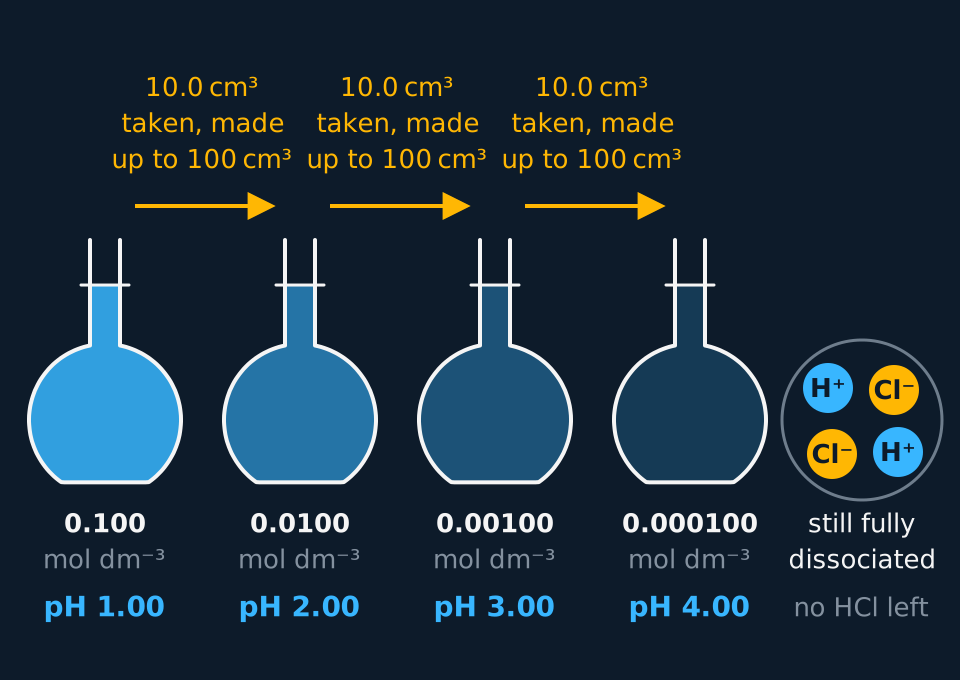
Diluting a strong acid tenfold raises its pH by exactly one unit. 10.0 cm³ of 0.100 mol dm⁻³ hydrochloric acid, pH 1.00, made up to 100.0 cm³ with water holds the same amount of HCl in ten times the volume, so [H⁺] is 0.0100 mol dm⁻³ and the pH is 2.00. A second tenfold dilution gives 3.00.
Describe the drawing
Four 100 cm³ volumetric flasks in a row, each with a graduation mark on its neck and liquid paler than the one before. Arrows between them read 10.0 cm³ taken, made up to 100 cm³. Under the flasks the concentrations are 0.100, 0.0100, 0.00100 and 0.000100 mol dm⁻³ hydrochloric acid, at pH 1.00, 2.00, 3.00 and 4.00. A circular inset beside the last flask shows two H⁺ and two Cl⁻ ions and no HCl molecules, labelled still fully dissociated.
The rule fails as the acid approaches pure water. Water itself supplies H⁺ at 1.00 × 10⁻⁷ mol dm⁻³, so hydrochloric acid diluted to 1.0 × 10⁻⁸ mol dm⁻³ does not have a pH of 8.00; adding water cannot make an acid alkaline. The pH approaches 7 from below and never passes it. A-level questions keep the acid far above 10⁻⁷ mol dm⁻³, where the acid's own H⁺ is the only source worth counting.
At the other end, a strong acid more concentrated than 1.00 mol dm⁻³ has a negative pH: 2.00 mol dm⁻³ HCl gives −log(2.00) = −0.30. Nothing in the definition forbids it.
Sulfuric acid is diprotic: each molecule has two protons to give. The first dissociation is complete, which is what makes sulfuric acid a strong acid. The second, from the hydrogensulfate ion, is only partial.
H₂SO₄(aq) → H⁺(aq) + HSO₄⁻(aq)First dissociation: complete.
HSO₄⁻(aq) ⇌ H⁺(aq) + SO₄²⁻(aq)Second dissociation: partial.
For 0.0500 mol dm⁻³ sulfuric acid, the first dissociation alone gives [H⁺] = 0.0500 mol dm⁻³ and pH 1.30. Both protons fully released would give 0.100 mol dm⁻³ and pH 1.00. The true value, about 1.24, lies between, because roughly 15% of the HSO₄⁻ ions dissociate as well. A question states which assumption to make. Where it treats the acid as fully dissociated, [H⁺] is twice the acid concentration; where it asks for the first dissociation only, [H⁺] equals it.
The number of protons each molecule of an acid can donate is its basicity. HCl, HNO₃ and CH₃COOH are monobasic, or monoprotic; H₂SO₄ is dibasic, and phosphoric(V) acid, H₃PO₄, is tribasic. Not every hydrogen atom counts: ethanoic acid has four, but only the one in the O–H group is given up, and the three on carbon stay where they are.
Basicity counts protons, not strength. Phosphoric acid is weak at each of its three steps, yet with enough sodium hydroxide all three protons react, so one mole of it needs three moles of OH⁻.
H₃PO₄(aq) + 3NaOH(aq) → Na₃PO₄(aq) + 3H₂O(l)
- Basicity
- The number of protons (H⁺ ions) that one molecule of an acid can donate.
- Tribasic acid
- An acid of which each molecule can donate three protons, such as phosphoric(V) acid, H₃PO₄.
Mixing a strong acid with a strong base
When hydrochloric acid and sodium hydroxide are mixed, the reaction that matters is between two ions. Na⁺ and Cl⁻ are spectators.
H⁺(aq) + OH⁻(aq) → H₂O(l)
The reaction goes to completion, so whichever ion is present in the smaller amount is used up. The pH of the mixture depends only on what is left over and on the total volume it is now spread through. The method is four lines: moles of H⁺, moles of OH⁻, the excess, and the excess divided by the combined volume in dm³. Dividing by the volume of the acid alone ignores the water the alkali brought with it and gives a [H⁺] that is too high.
The pH after mixing
30.0 cm³ of 0.100 mol dm⁻³ hydrochloric acid is mixed with 20.0 cm³ of 0.100 mol dm⁻³ sodium hydroxide. Calculate the pH of the mixture.
Show the working
Moles of H⁺ = 0.100 × 30.0 ÷ 1000 = 3.00 × 10⁻³ mol. Moles of OH⁻ = 0.100 × 20.0 ÷ 1000 = 2.00 × 10⁻³ mol.
H⁺ + OH⁻ → H₂O uses 2.00 × 10⁻³ mol of each, leaving 1.00 × 10⁻³ mol of H⁺ in excess.
Total volume = 30.0 + 20.0 = 50.0 cm³ = 0.0500 dm³, so [H⁺] = 1.00 × 10⁻³ ÷ 0.0500 = 0.0200 mol dm⁻³.
pH = −log(0.0200) = 1.70.
The same four lines work for any strong acid and strong base, with one adjustment for a diprotic acid or a base such as Ba(OH)₂: count the moles of H⁺ or OH⁻, not the moles of the compound. 0.0100 mol of barium hydroxide supplies 0.0200 mol of OH⁻.
When the alkali is in excess, the four lines give the leftover [OH⁻], and one more line turns it into [H⁺]. In any aqueous solution at 298 K the product [H⁺][OH⁻] is fixed at 1.00 × 10⁻¹⁴ mol² dm⁻⁶, the ionic product of water, Kw, so [H⁺] = Kw ÷ [OH⁻]. A mixture left with [OH⁻] = 0.0400 mol dm⁻³ has [H⁺] = 2.50 × 10⁻¹³ mol dm⁻³ and a pH of 12.60.
TRY IT: Nitric acid and potassium hydroxide
25.0 cm³ of 0.200 mol dm⁻³ nitric acid is added to 20.0 cm³ of 0.150 mol dm⁻³ potassium hydroxide. Calculate the pH of the mixture.
Check your answer
Moles of H⁺ = 0.200 × 0.0250 = 5.00 × 10⁻³ mol; moles of OH⁻ = 0.150 × 0.0200 = 3.00 × 10⁻³ mol, so 2.00 × 10⁻³ mol of H⁺ is left over.
The total volume is 45.0 cm³, so [H⁺] = 2.00 × 10⁻³ ÷ 0.0450 = 0.0444 mol dm⁻³.
pH = −log(0.0444) = 1.35. Dividing by 25.0 cm³ alone would give 0.0800 mol dm⁻³ and pH 1.10.
Other boards: basicity words and telling acids apart
OCR's specification uses monobasic, dibasic and tribasic, and asks for the ionic equations of acids with metals, carbonates, alkalis and metal oxides; AQA and Edexcel more often write monoprotic and diprotic. The two sets of words mean the same, and an OCR answer on phosphoric(V) acid should call it tribasic.
Cambridge names three ways to tell a strong acid from a weak one at the same concentration: its pH, the rate of its reaction with a metal or a carbonate, and its electrical conductivity. Each measures [H⁺] or the total concentration of ions, and none measures the amount of acid: a titration with alkali gives the same volume for both.
In the exam
- Define an acid as a proton donor and a base as a proton acceptor. The scheme will accept 'H⁺ ion donor' for proton donor, and will reject 'hydrogen donor'.
- Give conjugate pairs as pairs: both members of each, and which is the acid. A pair that differs by two protons, such as H₂SO₄ and SO₄²⁻, is rejected.
- Strong and weak describe the extent of dissociation; concentrated and dilute describe the amount per dm³. The scheme does not credit dilute hydrochloric acid described as 'weak'.
- Give pH to two decimal places. In a mixing calculation, set out the moles of H⁺, the moles of OH⁻, the excess and the total volume as separate lines; each line carries a method mark, and a slip in one is carried forward rather than ending the calculation.
- For sulfuric acid, follow the assumption the question gives: [H⁺] equals the acid concentration for the first dissociation only, and twice it for complete dissociation.
Check yourself
20.0 cm³ of 0.100 mol dm⁻³ sulfuric acid is mixed with 50.0 cm³ of 0.100 mol dm⁻³ sodium hydroxide. Treating the acid as fully dissociated, calculate the pH of the mixture at 298 K, where Kw = 1.00 × 10⁻¹⁴ mol² dm⁻⁶. Then give the pH a student would get by counting one H⁺ for each H₂SO₄.
Answer
Moles of H⁺ = 2 × 0.100 × 0.0200 = 4.00 × 10⁻³ mol; moles of OH⁻ = 0.100 × 0.0500 = 5.00 × 10⁻³ mol. The alkali is in excess by 1.00 × 10⁻³ mol.
The total volume is 70.0 cm³, so [OH⁻] = 1.00 × 10⁻³ ÷ 0.0700 = 0.0143 mol dm⁻³, [H⁺] = Kw ÷ [OH⁻] = 7.00 × 10⁻¹³ mol dm⁻³, and the pH is 12.15.
Counting one H⁺ per H₂SO₄ gives 2.00 × 10⁻³ mol of H⁺, an excess of 3.00 × 10⁻³ mol of OH⁻, [OH⁻] = 0.0429 mol dm⁻³ and a pH of 12.63, half a unit too high.
Questions
Question 16 marks
Discuss a student's claim that 'watering hydrochloric acid down turns it into a weak acid'. Use 0.100 mol dm⁻³ hydrochloric acid diluted tenfold, and 0.100 mol dm⁻³ ethanoic acid of pH 2.88, in your answer.
Mark scheme
Indicative content
- a strong acid is one that dissociates completely in aqueous solution, and a weak acid is one that dissociates only partially
- strength is a property of the acid, the extent of its dissociation, whereas concentration is the amount of acid in each cubic decimetre of solution
- diluting 0.100 mol dm⁻³ hydrochloric acid tenfold gives 0.0100 mol dm⁻³ acid, still completely dissociated, so [H⁺] = 0.0100 mol dm⁻³ and the pH is 2.00
- dilution lowers the concentration and raises the pH, but the acid stays strong because no HCl molecules re-form at any concentration
- 0.100 mol dm⁻³ ethanoic acid has pH 2.88, higher than the 1.00 of hydrochloric acid at the same concentration, because it is only partly dissociated
- the claim is wrong because it confuses 'dilute' with 'weak': the watered-down acid is a dilute solution of a strong acid
Levels
- Level 3 (5–6 marks) strength and concentration are defined and kept apart throughout, the diluted hydrochloric acid is shown to stay fully dissociated with its pH worked to 2.00, the ethanoic acid comparison is used to show what weak actually looks like, and the claim is judged wrong for confusing dilute with weak
- Level 2 (3–4 marks) the strong/weak distinction is stated correctly and the claim is rejected, with one of the two comparisons worked through; the other pH value goes unused, or strength and concentration slide together in places
- Level 1 (1–2 marks) the answer agrees with the claim, or takes the higher pH of the diluted acid as proof that it has turned weak; strength and concentration are used as if they meant the same thing
Question 25 marks
Explain why diluting a solution of a strong acid tenfold raises its pH by one unit, and why hydrochloric acid of concentration 1.0 × 10⁻⁸ mol dm⁻³ does not have a pH of 8.00.
Mark scheme
- B1 the acid is fully dissociated, so a tenfold dilution divides [H⁺] by ten
- B1 pH is a logarithm to base 10, so a factor of ten in [H⁺] changes the pH by exactly one
- B1 water itself dissociates and supplies H⁺ at about 1.0 × 10⁻⁷ mol dm⁻³
- B1 at this dilution the acid supplies less H⁺ than the water does, so the water's H⁺ cannot be ignored
- B1 the total [H⁺] is a little above 1.0 × 10⁻⁷ mol dm⁻³, so the pH is just below 7 and the solution is still acidic
Question 34 marks
State what is meant by a Brønsted–Lowry acid and by a Brønsted–Lowry base, and identify the two conjugate acid–base pairs in NH₃(aq) + H₂O(l) ⇌ NH₄⁺(aq) + OH⁻(aq), saying which member of each pair is the acid.
Mark scheme
- B1 a Brønsted–Lowry acid is a proton donor; allow 'H⁺ ion donor', reject 'hydrogen donor'
- B1 a Brønsted–Lowry base is a proton acceptor, a species that accepts an H⁺ ion
- B1 NH₄⁺ and NH₃ are a conjugate pair, with NH₄⁺ the acid and NH₃ the base
- B1 H₂O and OH⁻ are a conjugate pair, with H₂O the acid and OH⁻ the base
All 18 questions with mark schemes, the other 15 set out in full on the question page.
Worth remembering
- 'Hydrogen donor' in place of 'proton donor' does not define an acid.
- Calling a dilute strong acid 'weak' confuses strength with concentration.
- Add the two volumes before dividing the excess: 25.0 cm³ mixed with 20.0 cm³ is 45.0 cm³ of solution.
- Count two H⁺ per H₂SO₄ when a question treats it as fully dissociated; one halves [H⁺].
- Using the leftover [OH⁻] in −log gives pOH, not pH; Kw is needed first.
CHECK YOUR PROGRESS
Rate how confident you are with each objective for this lesson. Ratings are saved in this browser, on this device, unless you sign in.
- Define a Brønsted–Lowry acid and base, and identify the conjugate acid–base pairs in an equation.
- Distinguish a strong acid from a weak acid by the extent of dissociation, and strength from concentration.
- Write ionic equations for the reactions of acids with metals, carbonates and oxides, and state the basicity of an acid.
- Calculate pH from [H⁺] and [H⁺] from pH, giving pH to two decimal places.
- Calculate the pH of a strong monoprotic acid, of sulfuric acid, and of a strong acid after dilution.
- Calculate the pH of the solution left when a strong acid is mixed with a strong base, with either in excess.
Open the full revision checklist to see every objective in the curriculum in one place.
Practise this lesson
WORKBOOK
The written questions from this topic, on paper with room to work, and a separate book of mark schemes. The 2 questions that are set on a diagram stay on this page, where the diagram can be drawn. Free to use; please do not redistribute or sell.
Used later in The Period 3 oxides: structure, bonding and acid–base character · Metal-aqua ions and the acidity of their solutions · Amines: preparation, basicity and nucleophilic reactions