Chemistry › Group 2 and Group 7 › Group 2: trends down the group and reactions with water
Group 2: trends down the group and reactions with water
Every Group 2 metal has two electrons in an outer s subshell, loses both of them when it reacts, and is +2 in all its compounds. Down the group those two electrons sit further from the nucleus, so the atoms get larger, the ionisation energies fall and the metals react faster with water. Magnesium gives up its two electrons readily enough to be the reducing agent that turns titanium(IV) chloride into titanium metal.
Key terms Every definition in Group 2 and Group 7, lesson by lesson
Before this Ionisation energies and the evidence for subshells – why first ionisation energy falls down a group · Covalent, dative covalent and metallic bonding – positive ions in a sea of delocalised electrons · Oxidation states and the rules for assigning them
COMMON MISCONCEPTION
Going down Group 2 the nucleus gets more protons, so it holds the outer electrons more tightly and the metals get less reactive.
The extra protons are outweighed. Each step down adds a shell, so the outer electrons are further from the nucleus and more shielded, and the first ionisation energy falls, from 900 kJ mol⁻¹ for beryllium to 503 kJ mol⁻¹ for barium. Electrons lost more easily make the metal more reactive.
What you should be able to do
- State the electron configuration of each Group 2 element and explain why the oxidation state is +2 in every compound.
- Explain the trends in atomic radius and first ionisation energy from magnesium to barium in terms of shells, shielding and nuclear charge.
- Describe the trend in melting point, identify magnesium as the exception, and explain the general fall using metallic bonding.
- Write equations with state symbols for the reactions of the Group 2 metals with water and of magnesium with steam, and describe what is seen.
- Explain why magnesium is used to extract titanium, writing the equation and identifying what is oxidised and what is reduced.
- Write equations for the metals with oxygen and dilute acids and for the oxides with water, and explain why the pH rises down the group.CAIE · Edexcel · OCR A
Two outer electrons, one oxidation state
The Group 2 metals react with cold water faster the further down the group they are. Magnesium ribbon in cold water shows only a few small bubbles after an hour, and a little hydrogen collected overnight. A granule of calcium in the same water fizzes at once, turns the water cloudy and warms it. Barium, two rows further down, reacts faster still. The three metals sit in one group, and the difference between them comes from how far their outer electrons are from the nucleus.
Every Group 2 element has two electrons in an outer s subshell: beryllium is [He]2s², magnesium [Ne]3s², calcium [Ar]4s², strontium [Kr]5s² and barium [Xe]6s². When the metals react, each atom loses those two electrons and becomes a 2+ ion with the configuration of the noble gas before it. A Group 2 element therefore has the oxidation state +2 in every one of its compounds: Mg²⁺ in magnesium oxide, Ca²⁺ in limestone, Ba²⁺ in barium sulfate.
Successive ionisation energies show why the charge stops at 2+. For magnesium the first three are 738, 1451 and 7733 kJ mol⁻¹. The first two electrons come from the 3s subshell; the third would come from the full second shell, much closer to the nucleus and far less shielded, and the energy needed jumps more than fivefold. No chemical reaction supplies that much, so Mg³⁺ is never formed.
Ca(s) → Ca²⁺(aq) + 2e⁻The half-equation for a Group 2 metal reacting in water: two electrons lost, and the oxidation state rises from 0 to +2.
Losing electrons is oxidation. In every reaction of the metal itself, then, the Group 2 element is oxidised from 0 to +2, and it acts as a reducing agent: it gives its electrons to the water, oxygen, acid or metal chloride it reacts with. The more easily an atom gives up its two outer electrons, the more reactive the metal and the stronger it is as a reducing agent.
- Oxidation
- The loss of electrons by a species, which raises its oxidation state.
- Reducing agent
- A species that donates electrons to another species, and is itself oxidised in doing so.
Atomic radius and first ionisation energy
Each element down the group has one more occupied shell than the element above it, so its outer electrons are further from the nucleus and the atomic radius increases. A magnesium atom has a radius of 0.160 nm; a barium atom, three shells larger, has a radius of 0.224 nm.
| Electron configuration | Atomic radius / nm | First ionisation energy / kJ mol⁻¹ | Melting point / °C | |
|---|---|---|---|---|
| Be | [He]2s² | 0.112 | 900 | 1287 |
| Mg | [Ne]3s² | 0.160 | 738 | 650 |
| Ca | [Ar]4s² | 0.197 | 590 | 842 |
| Sr | [Kr]5s² | 0.215 | 550 | 777 |
| Ba | [Xe]6s² | 0.224 | 503 | 727 |
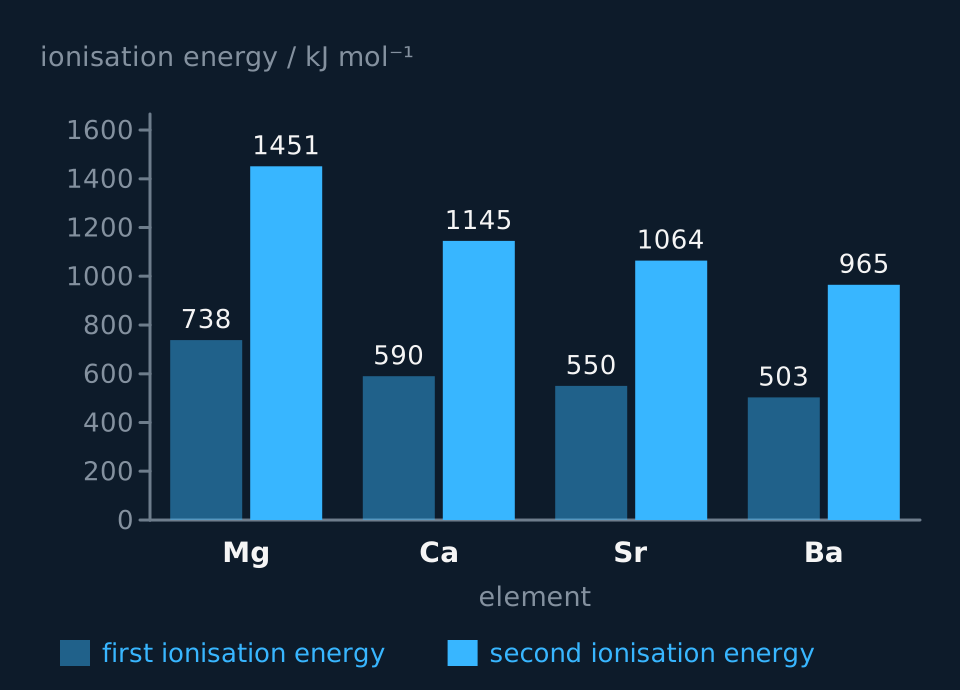
First ionisation energy decreases down the group, from 738 kJ mol⁻¹ for magnesium to 503 kJ mol⁻¹ for barium. Over the same range the nuclear charge rises from 12 to 56, so the fall needs a reason strong enough to outweigh that. The outer electron is in a shell further from the nucleus each time, and there are more filled inner shells between it and the nucleus to shield it. The attraction it feels is weaker, and less energy is needed to remove it.
Describe the drawing
Grouped bar chart of ionisation energy in kilojoules per mole for magnesium, calcium, strontium and barium, two bars per element. The paler first ionisation energy bars fall from 738 to 590, 550 and 503; the darker second ionisation energy bars fall from 1451 to 1145, 1064 and 965, always higher than the first but falling in step with it.
The three marks go to the outer electron being further from the nucleus, its being more shielded by inner shells, and the attraction therefore being weaker. Nuclear charge does increase, and the full answer says so and says that the extra distance and shielding outweigh it. Write 'more shells' or 'more energy levels', not 'bigger atoms' on its own: the size is the result of the extra shell, and the shell is the reason.
- First ionisation energy
- The energy required to remove one electron from each atom in one mole of gaseous atoms to form one mole of gaseous 1+ ions.
- Second ionisation energy
- The energy required to remove one electron from each ion in one mole of gaseous 1+ ions to form one mole of gaseous 2+ ions.
- Shielding
- The repulsion of an outer electron by the electrons in inner shells, which reduces the attraction of the nucleus it feels.
- Atomic radius
- Half the distance between the nuclei of two bonded atoms of the same element.
Calcium against magnesium
Calcium has eight more protons than magnesium, yet its first ionisation energy is 148 kJ mol⁻¹ lower. Explain why.
Show the working
Start with where the electron is removed from. Magnesium loses a 3s electron and calcium a 4s electron, so calcium's outer electron is in a shell further from the nucleus.
Then count what lies between. Calcium's outer electron has three filled shells inside it, magnesium's two, so calcium's is more shielded from the nucleus.
The extra eight protons pull harder, but the greater distance and the extra shell of shielding more than cancel that. The attraction between calcium's nucleus and its outer electron is weaker, so less energy is needed to remove it.
Melting point and the magnesium anomaly
The Group 2 elements are metals with metallic bonding: a lattice of 2+ ions held together by their attraction to a sea of delocalised electrons, two from each atom. Down the group the ions keep the same 2+ charge but get larger, so the delocalised electrons are further from the centre of each ion. The attraction is weaker, less energy is needed to break up the lattice, and the melting point falls: calcium 842 °C, strontium 777 °C, barium 727 °C.
Magnesium does not fit. At 650 °C it melts nearly 200 degrees below calcium, although its ions are smaller. The model of ion size and charge leaves out how the ions are packed, and magnesium packs its ions in a different crystal structure from calcium and strontium. The trend asked for runs from magnesium to barium, and an answer gives the general decrease and names magnesium as the exception, without trying to explain it.
The melting point argument uses the same words as any metal. Say 'the attraction between the positive ions and the delocalised electrons is weaker'. 'Weaker bonds' alone does not say which attraction, and 'weaker forces between atoms' describes a molecular solid, not a metal.
- Metallic bonding
- The electrostatic attraction between a lattice of positive metal ions and a sea of delocalised electrons.
Reactivity and the reactions with water
Reactivity increases down the group. To react, an atom must lose both outer electrons, and the energy needed for that, the first and second ionisation energies together, falls from 2189 kJ mol⁻¹ for magnesium to 1468 kJ mol⁻¹ for barium. The lower that energy, the more readily the metal is oxidised. Barium does have far more protons than magnesium, but they are outweighed by distance and shielding, so more protons does not mean a tighter grip here.
Magnesium reacts very slowly with cold water. A few bubbles of hydrogen form on the ribbon and the water around it turns very slightly alkaline. Magnesium hydroxide is only sparingly soluble, so most of it stays on the metal as a white coating.
Mg(s) + 2H₂O(l) → Mg(OH)₂(s) + H₂(g)
With steam the reaction is fast. Water on mineral wool at one end of a boiling tube is heated to make steam, which passes over heated magnesium ribbon. The magnesium burns with a brilliant white light and leaves a white powder, and the hydrogen can be lit as it leaves the tube. The product is the oxide, not the hydroxide, because magnesium hydroxide does not survive at that temperature.
Mg(s) + H₂O(g) → MgO(s) + H₂(g)
Describe the drawing
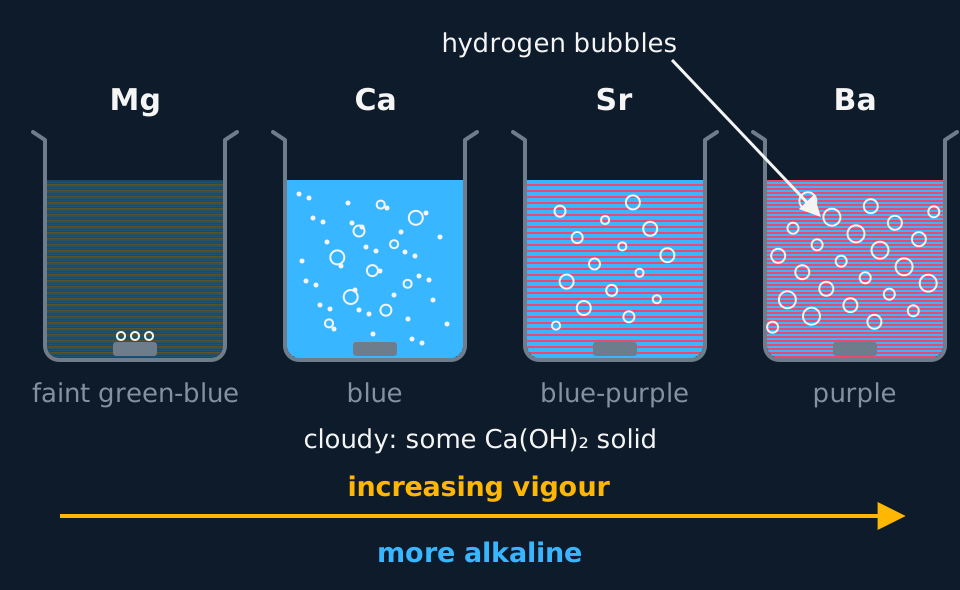
Four beakers of water with universal indicator, each holding the same small piece of metal. Magnesium shows two or three tiny bubbles and barely tinted water; calcium a steady stream of bubbles in cloudy blue water; strontium more bubbles in blue-purple water; barium vigorous fizzing in purple water. An arrow beneath reads increasing vigour, more alkaline.
Calcium fizzes steadily in cold water, the mixture warms, and it turns cloudy white because some of the calcium hydroxide formed comes out of solution as a solid. Strontium reacts faster, and barium vigorously. Each gives hydrogen and a solution of the hydroxide, more alkaline down the group because the hydroxides become more soluble.
Ca(s) + 2H₂O(l) → Ca(OH)₂(aq) + H₂(g)Part of the calcium hydroxide is present as Ca(OH)₂(s), the white cloudiness.
Ba(s) + 2H₂O(l) → Ba²⁺(aq) + 2OH⁻(aq) + H₂(g)The same reaction for barium written as an ionic equation; the hydroxide ions make the solution alkaline.
TRY IT: Strontium in water
Write an equation with state symbols for the reaction of strontium with water. Give the oxidation state of strontium before and after, and describe how the reaction would compare with calcium's under the same conditions.
Check your answer
Sr(s) + 2H₂O(l) → Sr(OH)₂(aq) + H₂(g). Strontium goes from 0 in the metal to +2 in the hydroxide, so it is oxidised and is the reducing agent; hydrogen goes from +1 in water to 0 in H₂.
Strontium's outer electrons are in the fifth shell, further from the nucleus and more shielded than calcium's in the fourth, so they are lost more easily. Strontium fizzes faster than calcium, and the solution is more alkaline, because strontium hydroxide is more soluble than calcium hydroxide.
With oxygen, with dilute acids, and the oxides
Every Group 2 metal burns in oxygen to give a white ionic oxide, MO, made of M²⁺ and O²⁻ ions. Magnesium ribbon held in a Bunsen flame catches light and burns with a dazzling white light, bright enough to harm the eyes if stared at. Calcium burns with an orange-red flame, strontium crimson and barium pale green, the colours their ions give in a flame test. Down the group the metals also tarnish faster in air, and barium is kept under oil.
2Mg(s) + O₂(g) → 2MgO(s)Magnesium goes from 0 to +2 and oxygen from 0 to −2.
Every Group 2 metal fizzes in dilute hydrochloric acid, giving hydrogen and a solution of its chloride, faster down the group. The chloride ions take no part, so the ionic equation has the same form for every metal in the group.
Mg(s) + 2HCl(aq) → MgCl₂(aq) + H₂(g)
Ca(s) + 2H⁺(aq) → Ca²⁺(aq) + H₂(g)The ionic equation, the same in form for each Group 2 metal.
Dilute sulfuric acid shows the sulfate solubility trend at work. Magnesium fizzes in it steadily, because magnesium sulfate is soluble and dissolves away from the metal surface. Calcium fizzes and then slows, and barium hardly reacts at all: their sulfates are sparingly soluble or insoluble, so a layer of solid sulfate forms on the metal and keeps the acid off it. Barium is the most reactive of the three metals, yet here it gives the least hydrogen, because the product, not the metal, decides how far the reaction goes.
Ba(s) + H₂SO₄(aq) → BaSO₄(s) + H₂(g)The barium sulfate stays on the metal as a white coating.
The oxides are basic oxides. The white ash from burnt magnesium, in water with universal indicator, turns the indicator only blue, about pH 10, because a little of the oxide forms sparingly soluble magnesium hydroxide. Calcium oxide, quicklime, reacts vigorously with a little water, hissing and steaming as it crumbles to calcium hydroxide, and in more water the solution reaches about pH 12. Barium oxide gives about pH 13. The pH rises down the group because each oxide forms its hydroxide, and the hydroxides become more soluble down the group.
CaO(s) + H₂O(l) → Ca(OH)₂(s)Slaking lime. The reaction is strongly exothermic.
As bases the oxides also neutralise dilute acids, giving a salt and water and no gas. Magnesium oxide is used in some indigestion remedies for exactly this reason.
MgO(s) + 2H⁺(aq) → Mg²⁺(aq) + H₂O(l)
- Basic oxide
- A metal oxide that reacts with an acid to form a salt and water.
The faster metal gives less gas
Equal masses, 0.500 g, of magnesium and of barium are added to excess dilute hydrochloric acid. Calculate the volume of hydrogen each gives at room temperature and pressure, and explain why barium, which fizzes faster, gives less. Ar values: Mg 24.3, Ba 137.3; molar gas volume 24.0 dm³ mol⁻¹.
Show the working
Both equations, Mg(s) + 2HCl(aq) → MgCl₂(aq) + H₂(g) and Ba(s) + 2HCl(aq) → BaCl₂(aq) + H₂(g), give 1 mol of hydrogen for each mol of metal.
Magnesium: amount = 0.500 g ÷ 24.3 g mol⁻¹ = 2.058 × 10⁻² mol, so volume of H₂ = 2.058 × 10⁻² mol × 24.0 dm³ mol⁻¹ = 0.494 dm³ = 494 cm³.
Barium: amount = 0.500 g ÷ 137.3 g mol⁻¹ = 3.642 × 10⁻³ mol, so volume of H₂ = 3.642 × 10⁻³ mol × 24.0 dm³ mol⁻¹ = 8.74 × 10⁻² dm³ = 87.4 cm³.
Each atom of either metal releases one molecule of hydrogen, but a barium atom is more than five times as heavy as a magnesium atom, so half a gram of barium holds far fewer atoms. Reactivity decides how fast the hydrogen comes off, not how much.
Extracting titanium with magnesium
Titanium is as strong as many steels at little more than half the density, and it does not corrode, so it is used for aircraft frames, jet engine parts and replacement hip joints. Its main ore is rutile, titanium(IV) oxide, TiO₂. Most metal oxides are reduced by heating with carbon, but titanium reacts with carbon to form titanium carbide, TiC, and the carbide makes the metal brittle.
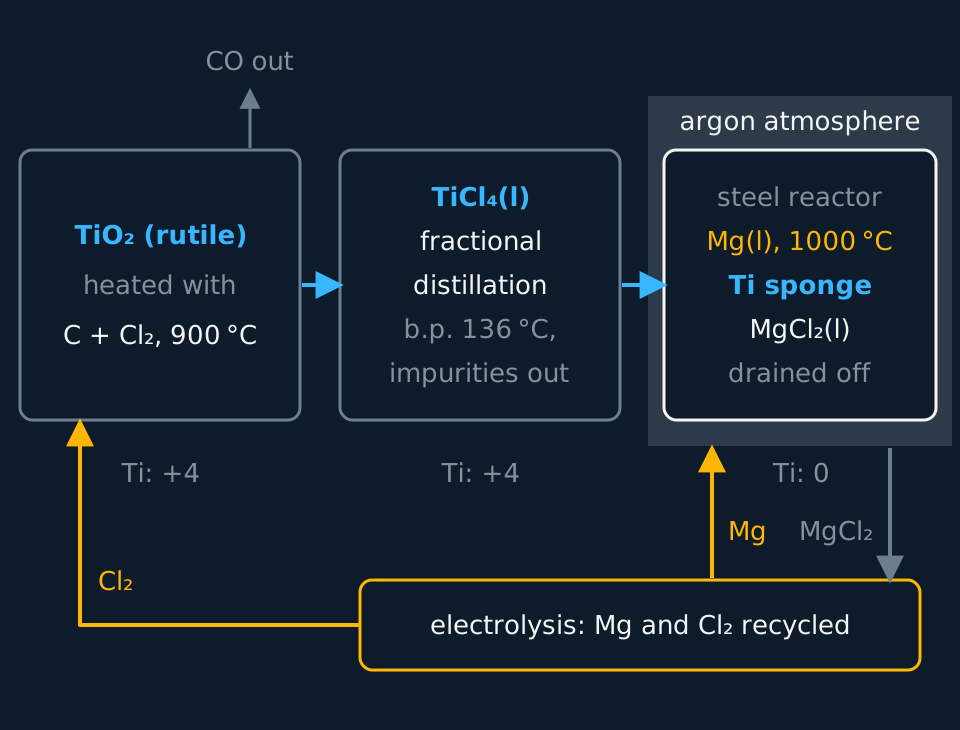
The route that works has two stages. Rutile is heated to about 900 °C with carbon and chlorine, giving titanium(IV) chloride. TiCl₄ is a covalent liquid that boils at 136 °C, so it is purified by fractional distillation. The pure chloride is then reduced by molten magnesium at about 1000 °C in an atmosphere of argon.
TiO₂(s) + 2C(s) + 2Cl₂(g) → TiCl₄(g) + 2CO(g)
TiCl₄(g) + 2Mg(l) → Ti(s) + 2MgCl₂(l)The reduction step. Titanium goes from +4 to 0 and is reduced; magnesium goes from 0 to +2 and is oxidised.
Describe the drawing
Flow diagram of the Kroll process in three boxes. Rutile, titanium dioxide, is heated with carbon and chlorine at about 900 degrees, giving off carbon monoxide; the liquid titanium chloride is purified by fractional distillation; then in a steel reactor under an argon blanket, molten magnesium at about 1000 degrees reduces it to titanium sponge and molten magnesium chloride is drained off to electrolysis, which returns magnesium and chlorine. Titanium's oxidation state is +4, +4, then 0.
Magnesium is the reducing agent: each atom gives two electrons and four are needed for each titanium. The argon matters because at 1000 °C both metals react with the oxygen and nitrogen of air, and titanium contaminated with its oxide or nitride is brittle.
The process is expensive, which is why titanium costs far more than steel although it is the ninth most abundant element in the Earth's crust. It runs as a batch process, each run taking days; it holds high temperatures for long periods; it uses chlorine and argon; and the magnesium has itself been extracted by electrolysis, which takes a large amount of electricity.
- Batch process
- A process in which a fixed quantity of material is converted in one run, the reactor being emptied and refilled between runs.
Magnesium for one tonne of titanium
Calculate the mass of magnesium needed to produce 1.00 tonne of titanium from titanium(IV) chloride. Use Ar values Ti = 47.9 and Mg = 24.3; 1 tonne = 1.00 × 10⁶ g.
Show the working
Amount of titanium = 1.00 × 10⁶ g ÷ 47.9 g mol⁻¹ = 2.088 × 10⁴ mol.
The equation TiCl₄(g) + 2Mg(l) → Ti(s) + 2MgCl₂(l) gives 2 mol of Mg for each mol of Ti, so amount of magnesium = 2 × 2.088 × 10⁴ = 4.175 × 10⁴ mol.
Mass of magnesium = 4.175 × 10⁴ mol × 24.3 g mol⁻¹ = 1.0146 × 10⁶ g = 1.01 tonnes to three significant figures.
A tonne of titanium therefore uses slightly more than a tonne of magnesium, a metal that is itself costly to extract, and part of the reason titanium costs so much.
Other boards: chlorine, and the hydroxides and carbonates with acid
The reactions with water are the ones every board sets; oxygen, dilute acids and the oxides are OCR, Edexcel and Cambridge statements, and the rest are shared less evenly. Edexcel sets the metals with chlorine. Edexcel and Cambridge both set the hydroxides with dilute acids, and Cambridge adds the carbonates, with water and with acid. Each reaction of a metal is the same redox change, the metal going from 0 to +2, and the order down the group is the order water shows.
Heated in chlorine, each metal burns to give its chloride, a white ionic solid. Hot magnesium ribbon lowered into a gas jar of chlorine in a fume cupboard glows white and leaves white magnesium chloride on the walls of the jar. Chlorine is the oxidising agent, going from 0 to −1, and the metal again goes from 0 to +2.
Mg(s) + Cl₂(g) → MgCl₂(s)
The hydroxides neutralise dilute acids too, giving a salt and water. The carbonates are insoluble in water, so they leave its pH almost unchanged, but every one reacts with dilute hydrochloric or nitric acid, fizzing as carbon dioxide is given off, until the solid is used up. With dilute sulfuric acid, calcium and barium carbonates soon stop: a layer of insoluble sulfate coats the solid and keeps the acid off it, exactly as it does on the metals.
CaCO₃(s) + 2HCl(aq) → CaCl₂(aq) + CO₂(g) + H₂O(l)Effervescence; the gas turns limewater milky.
Mg(OH)₂(s) + 2HCl(aq) → MgCl₂(aq) + 2H₂O(l)
| Compound of a Group 2 metal, M | With water | With dilute hydrochloric acid |
|---|---|---|
| The metal, M | M(OH)₂ and H₂, faster down the group; Mg very slow, but MgO with steam | MCl₂ and H₂, fizzing, faster down the group |
| The oxide, MO | M(OH)₂; pH about 10 for Mg rising to about 13 for Ba | MCl₂ and water, no gas |
| The hydroxide, M(OH)₂ | Dissolves more down the group | MCl₂ and water, no gas |
| The carbonate, MCO₃ | Insoluble; no reaction | MCl₂, water and CO₂, fizzing |
- Redox reaction
- A reaction in which one species is oxidised and another is reduced, electrons being transferred from one to the other.
In the exam
- The ionisation energy marks go to more shells, so the outer electron is further away; more shielding; and weaker attraction. The scheme accepts 'more energy levels' for 'more shells'; 'bigger atoms' alone does not say why the electron is further away.
- An answer on melting point that mentions intermolecular forces or molecules gets no credit: the scheme wants metallic bonding, larger ions and weaker attraction to the delocalised electrons.
- Magnesium with steam needs H₂O(g) and MgO(s) in the equation; the cold-water product, Mg(OH)₂, is not accepted for steam.
- For the titanium step, magnesium is oxidised and is the reducing agent, titanium(IV) is reduced, and argon stops both hot metals reacting with oxygen and nitrogen. 'Argon is inert' must go on to say what it prevents.
- Reactivity down the group is explained by electrons lost more easily, the sum of the first two ionisation energies falling; 'the metals get bigger' is a description, not the reason.
Check yourself
Radium is the element below barium in Group 2. Predict how its first ionisation energy compares with barium's, how it reacts with cold water, and the equation for that reaction. Explain each prediction.
Answer
Radium's first ionisation energy is lower than barium's 503 kJ mol⁻¹. Its outer electrons are in the seventh shell, further from the nucleus and shielded by one more filled shell than barium's, so the attraction is weaker, outweighing the larger nuclear charge.
Because its two outer electrons are lost more easily than barium's, radium is oxidised more readily and reacts with cold water more vigorously than barium does, fizzing rapidly as it gives off hydrogen.
Ra(s) + 2H₂O(l) → Ra(OH)₂(aq) + H₂(g). Radium goes from 0 to +2, the oxidation state of every Group 2 element in its compounds, and the hydroxide formed is soluble, so the solution is strongly alkaline.
Questions
Question 16 marks
Explain the trends in atomic radius, first ionisation energy and reactivity with water from magnesium to barium. Include an equation in your answer.
Mark scheme
Indicative content
- atomic radius increases down the group because each element has one more occupied shell of electrons than the element above it
- first ionisation energy decreases down the group although the nuclear charge increases, so less energy is needed to remove an outer electron
- the outer electrons are further from the nucleus and more shielded by inner shells, so they are less strongly attracted, which outweighs the greater nuclear charge
- reactivity with water increases down the group, from a very slow reaction for magnesium with cold water to a vigorous one for barium
- because the sum of the first two ionisation energies falls, the two outer electrons are lost more easily and the metal is oxidised to M²⁺ more readily
- a correct balanced equation with state symbols, for example Ba(s) + 2H₂O(l) → Ba(OH)₂(aq) + H₂(g), or the steam reaction of magnesium
Levels
- Level 3 (5–6 marks) all three trends are stated and each is explained: radius through the added shell, ionisation energy through distance and shielding outweighing nuclear charge, and reactivity through the easier loss of both outer electrons, with a correct balanced equation with state symbols
- Level 2 (3–4 marks) the three trends are stated and two are explained, or all three are explained and the equation is unbalanced or absent
- Level 1 (1–2 marks) one or two trends are stated, typically with the greater nuclear charge given as the reason the outer electrons are lost more easily; no correct equation
Question 24 marks
Give the full electron configurations of a calcium atom and of a Ca²⁺ ion. Then use the ionisation energies in the table to explain why calcium is +2 in all its compounds and never +3.
| Ionisation of calcium | First | Second | Third |
|---|---|---|---|
| Energy / kJ mol⁻¹ | 590 | 1145 | 4912 |
Mark scheme
- B1 calcium atom: 1s² 2s² 2p⁶ 3s² 3p⁶ 4s²
- B1 Ca²⁺ ion: 1s² 2s² 2p⁶ 3s² 3p⁶, the two 4s electrons having been removed
- B1 the first two electrons come from the 4s subshell, but a third would come from the full 3p subshell, closer to the nucleus and less shielded
- B1 the third ionisation energy is more than four times the second, more energy than any reaction supplies, so Ca³⁺ never forms
Question 34 marks
Explain why the melting point decreases from calcium to barium, and identify the element from magnesium to barium whose melting point does not fit the trend.
Mark scheme
- B1 the metals have metallic bonding: a lattice of 2+ ions attracted to delocalised electrons
- B1 down the group the ions are larger with the same 2+ charge, so the delocalised electrons are further from the centre of each ion
- B1 the attraction is weaker, so less energy is needed to break up the lattice; reject any reference to intermolecular forces or molecules
- B1 magnesium does not fit: at 650 °C it melts below calcium, 842 °C, although its ions are smaller; ignore any attempted explanation
All 21 questions with mark schemes, the other 18 set out in full on the question page.
Worth remembering
- More protons down the group is not more grip: distance and shielding win, and the answer must say so.
- Name magnesium as the melting-point exception and do not try to explain it by ion size.
- Magnesium with cold water gives Mg(OH)₂; with steam, MgO. The two equations are not interchangeable.
- Calling magnesium the oxidising agent in TiCl₄ + 2Mg because it is oxidised reverses the terms: it is oxidised, so it is the reducing agent.
- Argon is there to keep oxygen and nitrogen off both hot metals, not to cool or dilute anything.
CHECK YOUR PROGRESS
Rate how confident you are with each objective for this lesson. Ratings are saved in this browser, on this device, unless you sign in.
- State the electron configuration of each Group 2 element and explain why the oxidation state is +2 in every compound.
- Explain the trends in atomic radius and first ionisation energy from magnesium to barium in terms of shells, shielding and nuclear charge.
- Describe the trend in melting point, identify magnesium as the exception, and explain the general fall using metallic bonding.
- Write equations with state symbols for the reactions of the Group 2 metals with water and of magnesium with steam, and describe what is seen.
- Explain why magnesium is used to extract titanium, writing the equation and identifying what is oxidised and what is reduced.
- Write equations for the metals with oxygen and dilute acids and for the oxides with water, and explain why the pH rises down the group.CAIE · Edexcel · OCR A
Open the full revision checklist to see every objective in the curriculum in one place.
Practise this lesson
WORKBOOK
The written questions from this topic, on paper with room to work, and a separate book of mark schemes. The question that is set on a diagram stays on this page, where the diagram can be drawn. Free to use; please do not redistribute or sell.
Used later in Group 7: trends down the group and displacement reactions