Maths › Algebra and functions › Indices and surds
Indices and surds
The laws of indices extend to negative and fractional exponents, so roots can be written and handled as powers. The lesson also covers surds: keeping answers exact, simplifying them, and rationalising denominators.
IN THIS TOPIC
- Use the index laws for every rational exponent, negative and fractional included.
- Simplify a surd by its largest square factor and do surd arithmetic exactly.
- Rationalise a denominator, using the conjugate when the denominator has two terms.
COMMON MISCONCEPTION
√(a + b) = √a + √b.
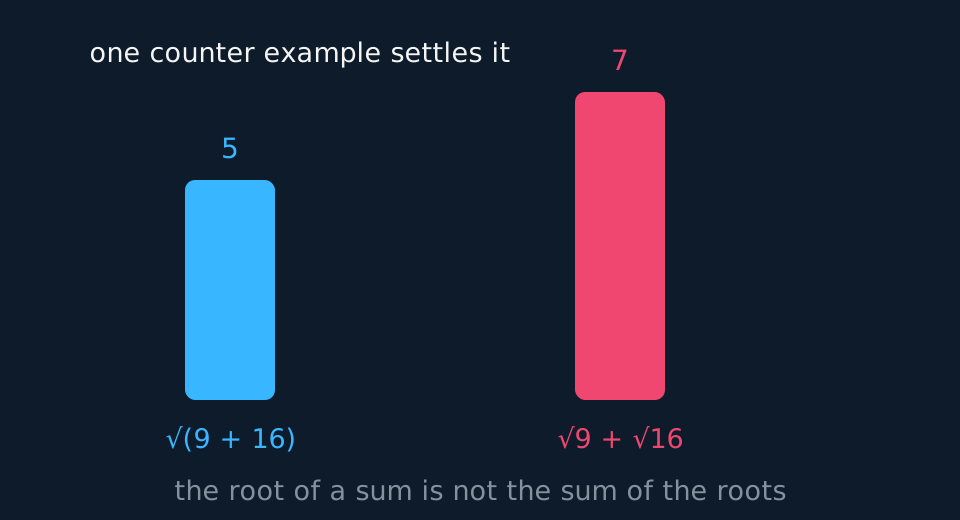
Roots multiply and divide; they never distribute over a sum. √(9 + 16) = √25 = 5, while √9 + √16 = 7. The rule that does hold is √(xy) = √x√y, for x ≥ 0 and y ≥ 0, and read right to left it becomes the simplifying move that pulls the largest square factor out from under the root.
The laws of indices
Everything about powers follows from three laws, and all three are on the must-learn list.
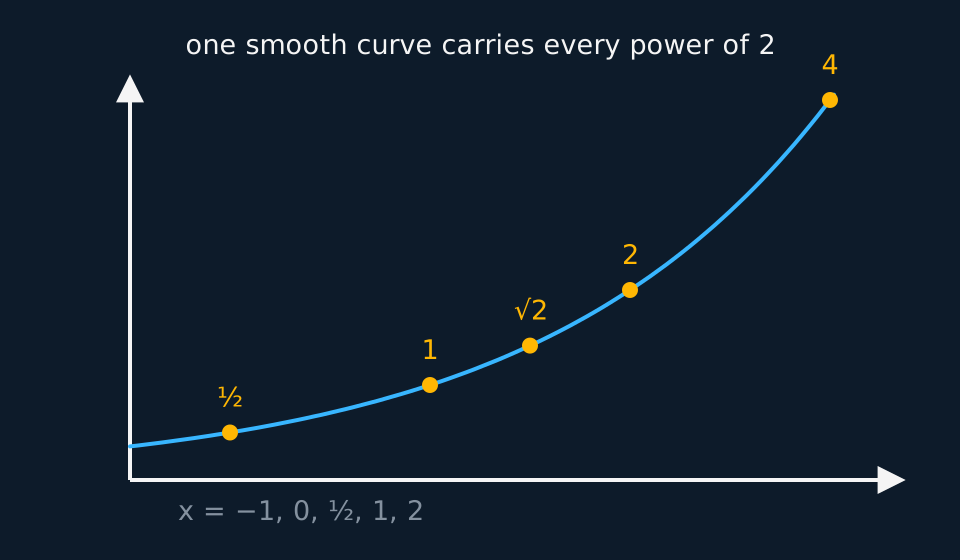
The course extends them to all rational exponents, and the laws force each extension. Dividing a3 by a3 gives a0 by the second law and 1 by common sense, so a0 = 1. One more step and a−n = 1/an. Since (a1/2)2 = a1 by the third law, a1/2 has to be the square root of a, and in general am/n is the nth root of am. Write it whichever way suits the arithmetic.
The condition on the base needs care, because two different claims get filed under one rule. For the laws to run over any real exponent the base must be positive, a > 0, and that is the line to quote. A single rational power is a smaller claim and survives a negative base whenever the exponent m/n, in lowest terms, has an odd n: (−8)1/3 = −2, since (−2)3 = −8, and (−32)3/5 = −8. An even n leaves nothing real, which is why (−4)1/2 does not exist.
Positivity is a condition on the laws, not on the values. Read (−8)1/3 as ((−8)2)1/6 and the third law gives 641/6 = 2, the wrong sign for a number whose cube must be −8. The value was real all along; the shuffling of exponents is what needed a > 0. So evaluate an odd-denominator power of a negative base directly, root first, and keep the index laws for positive bases.
WORKED EXAMPLE
A negative fractional power, unpacked
Evaluate 27−2/3 without a calculator.
Read it outside-in. The minus sign means reciprocal, the 3 underneath means cube root, the 2 on top means square.
27−2/3 = 1/272/3 = 1/(∛27)2 = 1/32 = 1/9.
Take the root before the power. Squaring first requires the cube root of 729, which is the same answer from larger numbers.
Surds, kept exact
A surd is a root left unevaluated, such as √2 or 5√3; writing 1.414… replaces an exact value with an approximation. Give an exact value unless the question requests a decimal approximation. Surds follow from the index laws, and this is the rule used most:
This rule and (√x)2 = x both need non-negative radicands, x ≥ 0 and y ≥ 0. A negative number has no real square root, so √(xy) = √x√y says nothing at all when x or y is negative, even where the left side exists: √((−4)(−9)) = 6, while neither root on the right is a real number. Read the rule right to left and it becomes the simplifying move, pulling the largest square factor out from under the root. Roots do not distribute over addition, and one counterexample proves it. √(9 + 16) = √25 = 5, while √9 + √16 = 7.
WORKED EXAMPLE
Simplifying a surd
Write √48 in the form k√3, and hence simplify √75 − √27.
√48 = √(16 × 3) = √16 × √3 = 4√3.
√75 = √(25 × 3) = 5√3 and √27 = √(9 × 3) = 3√3, so √75 − √27 = 2√3.
Terms in √3 collect like terms in x. Once each surd is fully simplified, surd arithmetic follows the rules of algebra.
Rationalising the denominator
A final answer is conventionally written with no surd in the denominator. For a single surd, multiply top and bottom by it, so 1/√2 becomes √2/2. When the denominator is a sum or a difference, multiply by its conjugate, the same expression with the middle sign flipped. The difference-of-squares identity (√x + √y)(√x − √y) = x − y then wipes the roots out.
WORKED EXAMPLE
The conjugate at work
Express 1/(3 − √2) with a rational denominator.
Multiply top and bottom by the conjugate 3 + √2. The denominator becomes (3 − √2)(3 + √2) = 9 − 2 = 7.
So 1/(3 − √2) = (3 + √2)/7.
The value of the fraction is unchanged, because (3 + √2)/(3 + √2) = 1. The conjugate is chosen so that the cross terms in the denominator cancel.
GUIDED PRACTICE
A fuller fraction
Express (2 + √5)/(3 − √5) in the form (a + b√5)/c, before opening the working.
Show the working
Multiply by (3 + √5)/(3 + √5). Denominator: 9 − 5 = 4.
Numerator: (2 + √5)(3 + √5) = 6 + 2√5 + 3√5 + 5 = 11 + 5√5. So the answer is (11 + 5√5)/4.
Expand the numerator as an ordinary product of brackets; the step specific to this method is the choice of conjugate.
INDEPENDENT PRACTICE
The quadratic you nearly missed
Solve, using algebra and showing each stage of your working, the equation x − 6√x + 4 = 0.
Show the working
Substitute u = √x, so u ≥ 0. The equation becomes u2 − 6u + 4 = 0.
By the quadratic formula, u = (6 ± √20)/2 = 3 ± √5. Both values are positive, so both survive.
Then x = u2 = (3 ± √5)2 = 9 ± 6√5 + 5 = 14 + 6√5 or 14 − 6√5.
The index laws reveal the quadratic in u, surd arithmetic finishes it, and each value of u must be checked against u ≥ 0, since u = √x cannot be negative.
ASSESSMENT FOCUS
- Quote the three index laws in working rather than deriving them. The results a0 = 1 and the negative and fractional powers follow from them.
- Take the root before the power: writing am/n as (nth root of a)m keeps the numbers small enough to evaluate without a calculator.
- State a > 0 when you apply the index laws with a general exponent. A rational power with an odd denominator, such as (−8)1/3 = −2, is still a real number, but it must be evaluated directly rather than shuffled through the laws.
- Simplify each surd fully before collecting terms: take out the largest square factor, then treat 4√3 as you would treat 4x.
- "Show each stage of your working" requires the intermediate lines as well as the answer: name the substitution, show the multiplication by the conjugate, and leave no surd in a final denominator.
CHECK YOURSELF
Evaluate 323/5 without a calculator, and express 6/(√7 − 1) in the form a + √b.
Show a hint
Fifth root first; then the conjugate of √7 − 1 is √7 + 1.
Show the answer
323/5 = (⁵√32)3 = 23 = 8.
Multiply 6/(√7 − 1) by (√7 + 1)/(√7 + 1). The denominator becomes 7 − 1 = 6, so the fraction is 6(√7 + 1)/6 = √7 + 1, which is 1 + √7 in the requested form with a = 1 and b = 7.
Both answers are exact, and no decimal approximation was used at any stage.
Three index laws govern every power, and a fractional exponent denotes a root: am/n is the nth root of am.
Take out the largest square factor; rationalise with the conjugate when the denominator has two terms.
WORKBOOK
Printable practice for this topic: original exam-style questions with room to work, and a fully worked answer book. Free to use; please do not redistribute or sell.
Or read them with their worked answers on the indices and surds questions page.
CHECK YOUR PROGRESS
Rate how confident you feel with each objective for this lesson. Ratings are saved in this browser, on this device, unless you sign in.
- Use the index laws for every rational exponent, negative and fractional included.
- Simplify a surd by its largest square factor and do surd arithmetic exactly.
- Rationalise a denominator, using the conjugate when the denominator has two terms.
Open the full revision checklist to see every objective in the course in one place.