Maths › Exponentials and logarithms › Exponential functions and e
Exponential functions and e
An exponential function has the variable in the exponent, so equal steps in x multiply y by a constant factor. The base e is defined by the property that the gradient of ex equals the value of the function, which is why exponentials with base e model quantities whose rate of change is proportional to their size.
Builds on Indices and surds and Graphs, proportion and transformations.
IN THIS TOPIC
- Sketch y = ax for any positive base except 1, growth and decay alike, with the right asymptote.
- Use the gradient property of ekx, and transform e-curves into the form eax+b + c.
- Recognise when a situation calls for an exponential model, and read its constants.
COMMON MISCONCEPTION
Exponential growth means growing very fast.
Exponential growth need not be rapid: a small value of k gives a slowly changing curve. The defining property is that the rate of change is proportional to the current value, which is what gives P = Aekt, and every unit step in t multiplies the quantity by the same factor.
The family a to the x
The function y = ax, for positive a other than 1, puts the variable up in the exponent. Every unit step in x now multiplies y by a instead of adding anything to it. Every member of the family passes through (0, 1), because a0 = 1 straight from the index laws, and the x-axis is a horizontal asymptote on one side. Which side depends on the base. With a > 1 the curve grows to the right; with 0 < a < 1 it decays, and the two shapes are mirror images because (1/2)x = 2−x. Base 1 is left out because 1x = 1 for every x, so it draws the flat line y = 1, which neither grows nor decays and has no asymptote.
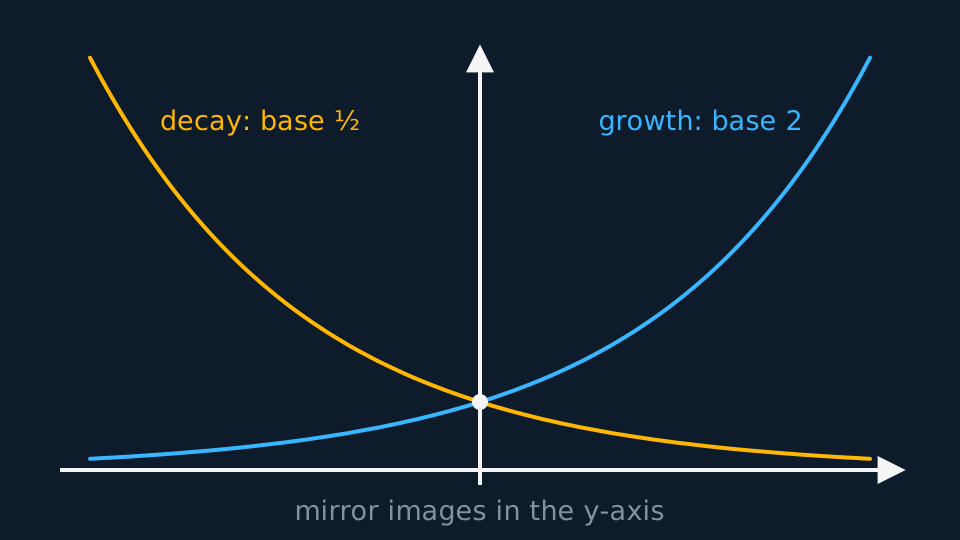
Every exponential function is positive for all real x. The curve approaches the x-axis without meeting it, so ax = 0 has no solution, and a model of the form Aekt never predicts the value zero.
The special base e
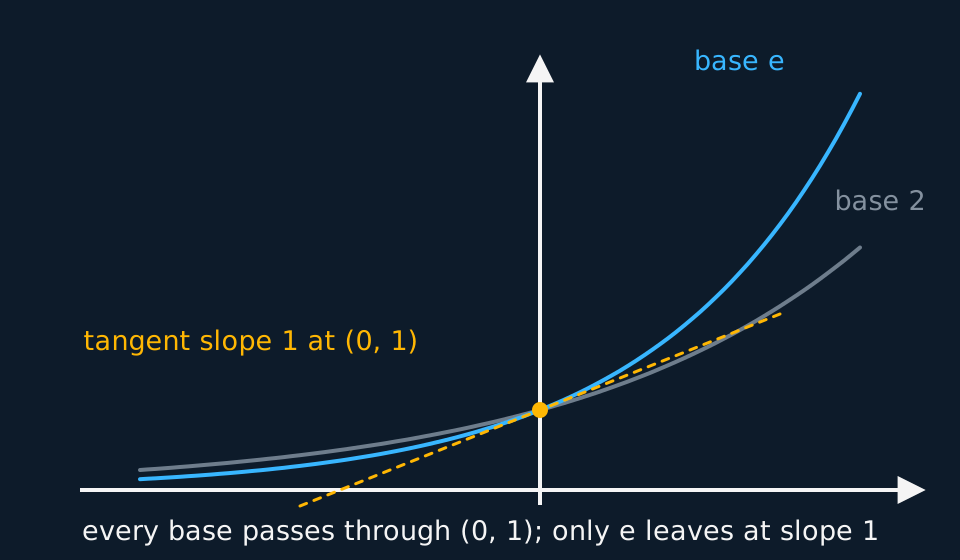
Compare gradients at the point (0, 1) shared by all these curves. Base 2 gives a gradient of about 0.69 there and base 3 about 1.10, so between them is a base whose gradient at that point is exactly 1. That base is e = 2.71828…. The property holds at every point of the curve, and for any multiple of x,
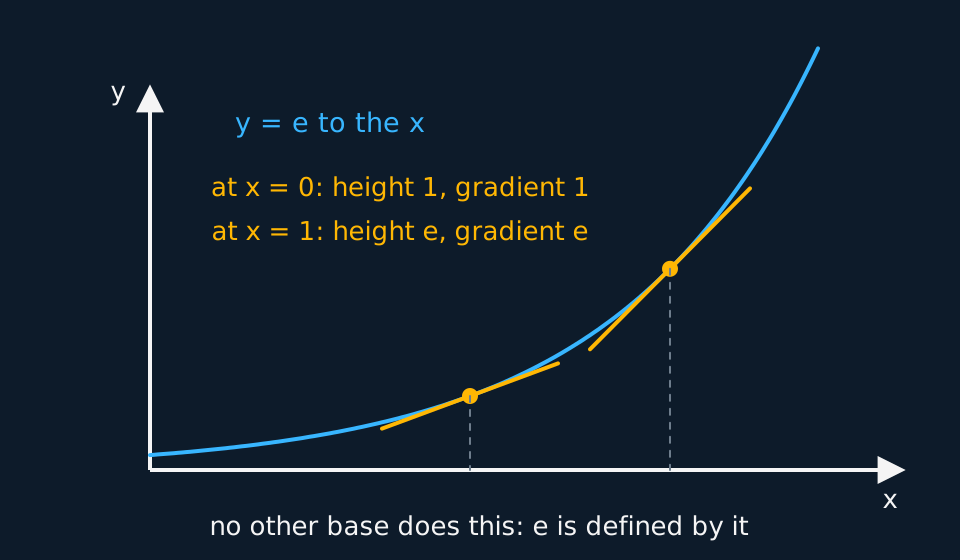
so the gradient of ekx anywhere is k times the height there.
WORKED EXAMPLE
A gradient from the standard property
Find the gradient of y = e2x at the point where x = 1.
The gradient function is 2e2x, straight from the boxed property with k = 2.
At x = 1 that gives 2e2 = 14.8 to 3 significant figures.
The value there is e2 ≈ 7.39, and the gradient is twice that value, which is the property with k = 2 at every point of this curve.
GUIDED PRACTICE
A transformed exponential
Sketch y = e−x − 2, stating the equation of its asymptote and its y-intercept, before opening the working.
Show the working
Build it in two moves from y = ex. The −x reflects in the y-axis and turns growth into decay, then the −2 translates the whole thing down 2.
The asymptote travels with the curve, down to y = −2. The y-intercept is e0 − 2 = −1.
The curve decreases from the upper left, crosses the y-axis at −1, and approaches y = −2 without reaching it. The transformation rules are those of Graphs, proportion and transformations, applied to this function.
Why exponential models use base e
The gradient property explains why these functions model so many quantities. If a quantity's rate of change is proportional to its current value, as for a bacterial population, a sample of decaying atoms or a balance earning compound interest, then it satisfies P = Aekt.
Exponential growth need not be rapid. The defining property is the proportionality, and a small value of k gives a slowly changing curve.
Describe the drawing
The exponential curve with tangents drawn at x equals nought and x equals one. At the first the height is one and the tangent rises one unit for every unit across; at the second the height is e and the tangent is e times as steep. The gradient of the curve at any point is the height of the curve at that point.
INDEPENDENT PRACTICE
Reading a growth model
A population is modelled by P = 500e0.2t, with t in days. Write down the initial population, find P after 5 days, and explain what 0.2 says about the growth.
Show the working
At t = 0 the exponential is 1, so the initial population is 500.
After 5 days, P = 500e1 = 500e ≈ 1360 to 3 significant figures.
The 0.2 is the proportionality constant: at each instant the population grows at 0.2 times its current size per day, which is 100 per day at t = 0 and about 272 per day at t = 5.
A question asking for the “initial” value means the value at t = 0, which is the constant A when the model is written as Aekt.
ASSESSMENT FOCUS
- Label three things on an ax sketch: the point (0, 1), the asymptote, and growth or decay according to whether a > 1 or 0 < a < 1.
- State the gradient property before using it: the gradient of ekx is kekx.
- Transformations of e-curves obey the standard rules, and the asymptote moves with the curve. State its new equation in full.
- In P = Aekt, A is the value at t = 0 and k is the per-unit-time proportionality constant. Interpret both with their units attached.
- ax is positive for all x, so a model Aekt with A > 0 never reaches zero; when asked why, refer to the horizontal asymptote.
CHECK YOURSELF
For the curve y = e3x, write down the gradient function, the gradient at x = 0, and the y-intercept.
Show a hint
The gradient property with k = 3 answers all three parts.
Show the answer
The gradient function is 3e3x, by the property with k = 3.
At x = 0 the gradient is 3e0 = 3, three times the height there.
The y-intercept is e0 = 1, shared by the whole exponential family.
The curve of ax passes through (0, 1) and approaches the x-axis without meeting it.
e is the base for which the gradient of ex equals its value; the gradient of ekx is kekx.
WORKBOOK
Printable practice for this topic: original exam-style questions with room to work, and a fully worked answer book. Free to use; please do not redistribute or sell.
Or read them with their worked answers on the exponential functions and e questions page.
CHECK YOUR PROGRESS
Rate how confident you feel with each objective for this lesson. Ratings are saved in this browser, on this device, unless you sign in.
- Sketch y = ax for any positive base except 1, growth and decay alike, with the right asymptote.
- Use the gradient property of ekx, and transform e-curves into the form eax+b + c.
- Recognise when a situation calls for an exponential model, and read its constants.
Open the full revision checklist to see every objective in the course in one place.