Maths › Algebra and functions › Quadratic functions
Quadratic functions
A quadratic can be written in factorised, completed-square or expanded form, and each form displays something different: the roots, the vertex and the y-intercept respectively. The discriminant gives the number of real roots before any solving is done.
Builds on Indices and surds.
IN THIS TOPIC
- Read roots, vertex and intercept off the three written forms of a quadratic.
- Complete the square when the leading coefficient is not 1.
- Use the discriminant to count real roots.
- Find the values of a parameter that force real, repeated or no roots.
- Solve a quadratic in a function of the unknown by naming the substitution.
COMMON MISCONCEPTION
If b² − 4ac comes out negative, you made a mistake.
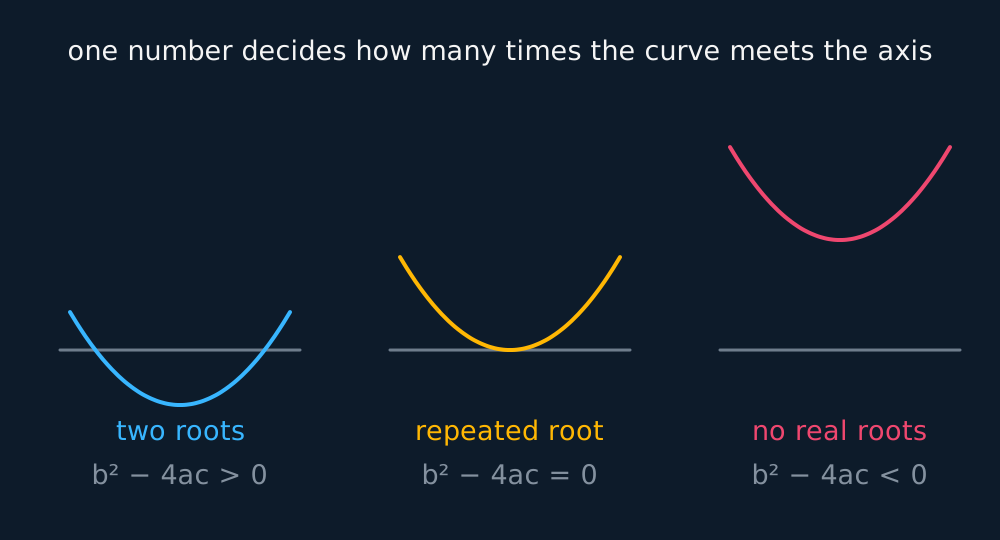
A negative discriminant is a valid result and a complete answer: the equation has no real roots and the parabola does not meet the x-axis. The sign of b2 − 4ac counts the real roots in all three cases, positive giving two distinct roots, zero giving one repeated root, and negative giving none.
Three forms, one parabola
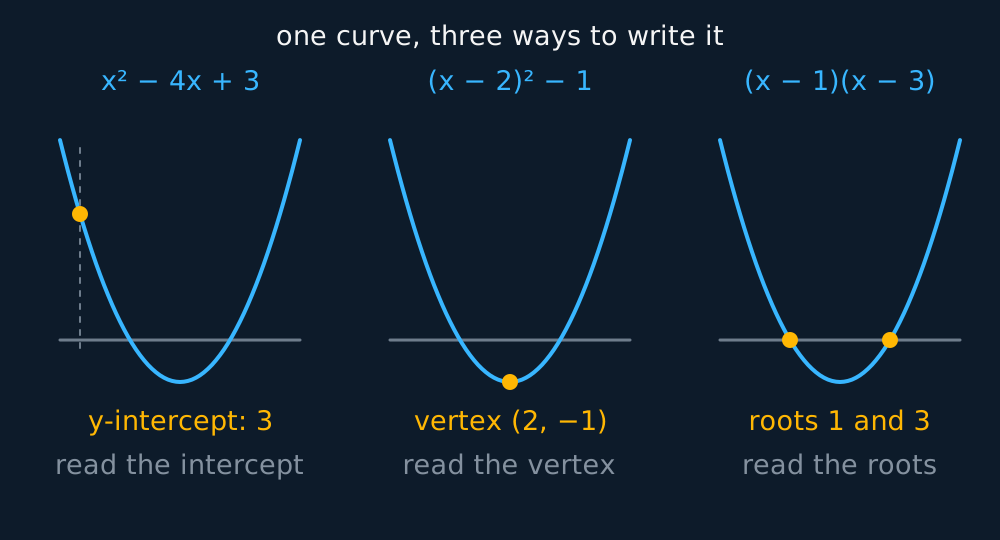
A quadratic function f(x) = ax2 + bx + c draws a parabola, opening upward when a > 0 and downward when a < 0, and each way of writing it answers a different question at sight. The expanded form shows the y-intercept, c. The factorised form shows the roots. Completing the square shows the vertex, because
puts all the x-dependence inside one squared bracket. A square is at its smallest when its bracket is zero, so the vertex sits at x = −b/(2a), and whatever constant is left outside the bracket is the minimum, or maximum, value itself.
Describe the drawing
Three copies of the same computed parabola: the first marks where it cuts the y-axis at 3, which the expanded form displays; the second marks the vertex at 2, minus 1, which the completed square names; the third marks the roots 1 and 3, which the factorised brackets plant. All three forms are checked equal.
Completing the square in practice
With a leading coefficient other than 1 there is one extra step: take the coefficient out of the x terms only, complete the square inside the bracket, then multiply back out.
WORKED EXAMPLE
A leading coefficient of 2
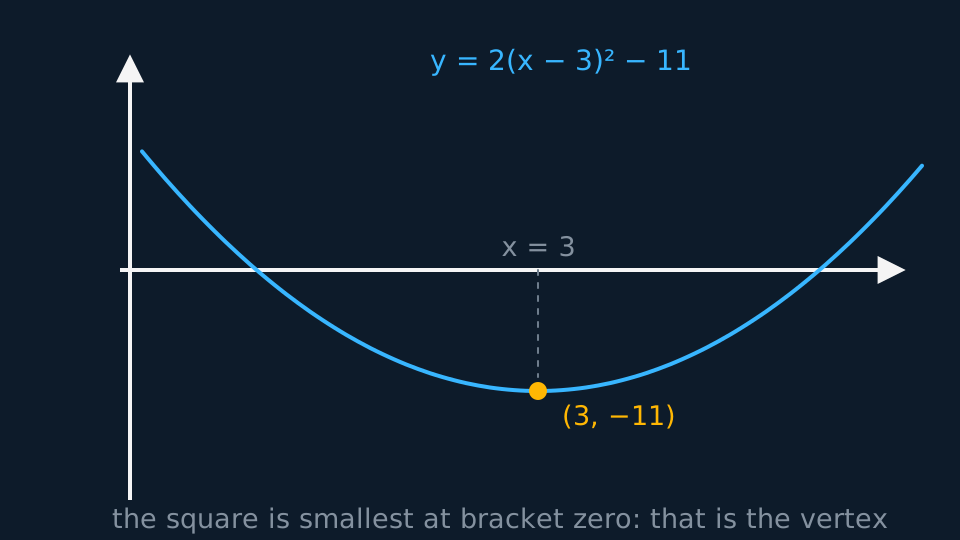
Express 2x2 − 12x + 7 in the form a(x + p)2 + q, and state the minimum point of the curve.
Take the 2 out of the x terms. 2(x2 − 6x) + 7 = 2[(x − 3)2 − 9] + 7.
Distribute. 2(x − 3)2 − 18 + 7 = 2(x − 3)2 − 11.
The bracket is zero at x = 3, so the minimum point is (3, −11). Expanding the answer back checks the result.
The discriminant
The quadratic formula must be learnt:
The quantity under the root, b2 − 4ac, is the discriminant, and its sign gives the number of real roots. Positive: two distinct real roots. Zero: one repeated root. Negative: no real roots. A negative discriminant is a valid result: the parabola does not meet the x-axis.
WORKED EXAMPLE
Choosing k for a repeated root
Find the values of k for which x2 + kx + 9 = 0 has a repeated root.
Repeated root means discriminant zero, so k2 − 4 × 1 × 9 = 0 and k2 = 36.
k = 6 or −6. Two different parabolas, each just touching the axis.
A quadratic containing a parameter with a stated condition on its roots is a discriminant question: translate the condition on the roots into a condition on the sign of b2 − 4ac, then solve.
GUIDED PRACTICE
A condition, not a value
Find the set of values of k for which x2 + 3x + k = 0 has real roots, before opening the working.
Show the working
Real roots means b2 − 4ac ≥ 0, so here 9 − 4k ≥ 0.
So k ≤ 9/4, or {k : k ≤ 9/4} in set notation. The inequality is not strict, because “real roots” includes the repeated root at k = 9/4.
ASSESSMENT FOCUS
- With a ≠ 1, take the coefficient out of the x terms only, complete the square inside the bracket, then distribute back out. Expand your answer to check.
- State the discriminant condition before computing it: “real and distinct roots means b2 − 4ac > 0”.
- “Real roots” includes the repeated case and gives ≥; “distinct real roots” excludes it and gives >. The wording determines which inequality to write.
- For a quadratic in a function of the unknown, write the substitution u = 2x or u = x2 explicitly, translate every value of u back into x, and reject any impossible value with a stated reason.
- Match the tool to the question. Factorise when it is quick, complete the square when a vertex or an exact surd is wanted, and use the formula when nothing factorises.
- A negative discriminant is a complete answer: state “no real roots”. Not every quadratic equation has real solutions.
CHECK YOURSELF
Express 3x2 + 6x − 2 in the form a(x + p)2 + q, state the minimum point, and use the discriminant to say how many real roots 3x2 + 6x − 2 = 0 has.
Show a hint
Take out the 3 first; the discriminant only needs a, b and c.
Show the answer
3(x2 + 2x) − 2 = 3[(x + 1)2 − 1] − 2 = 3(x + 1)2 − 5.
Bracket zero at x = −1, leftover constant −5, so the minimum point is (−1, −5).
b2 − 4ac = 36 + 24 = 60 > 0, so the equation has two distinct real roots, which agrees with a minimum sitting below the axis on an upward parabola.
The completed square gives the vertex, and the constant outside the bracket is the maximum or minimum value.
The sign of the discriminant gives the number of real roots: two, one repeated, or none.
WORKBOOK
Printable practice for this topic: original exam-style questions with room to work, and a fully worked answer book. Free to use; please do not redistribute or sell.
Or read them with their worked answers on the quadratic functions questions page.
CHECK YOUR PROGRESS
Rate how confident you feel with each objective for this lesson. Ratings are saved in this browser, on this device, unless you sign in.
- Read roots, vertex and intercept off the three written forms of a quadratic.
- Complete the square when the leading coefficient is not 1.
- Use the discriminant to count real roots.
- Find the values of a parameter that force real, repeated or no roots.
- Solve a quadratic in a function of the unknown by naming the substitution.
Open the full revision checklist to see every objective in the course in one place.