Maths › Sequences and series › The binomial expansion
The binomial expansion
The binomial theorem expands (a + bx)n for positive integer n, using the coefficients nCr from Pascal's triangle. Where |x| is small the terms in higher powers of x are smaller still, so a truncated expansion estimates a power of a number close to 1, with an error of the order of the first term omitted.
Builds on Indices and surds.
IN THIS TOPIC
- Compute binomial coefficients from Pascal's triangle or from the nCr formula.
- Expand (a + bx)n for positive integer n, and pull out one coefficient without expanding the rest.
- Truncate an expansion to estimate a power of a number close to 1.
COMMON MISCONCEPTION
The coefficient of xr in (a + bx)n is nCr times br.
Each term drags a factor of an−r along with it, so the coefficient of xr is nCr × an−r × br. In (2 + 3x)4 the coefficient of x is 4C1 × 23 × 3 = 96, rather than the 4 × 3 = 12 that dropping the factor would predict. Every term has total degree n.
Coefficients, and the theorem
Expanding (a + b)n means walking along the n brackets, taking either an a or a b from each, and collecting like terms at the end. Count the ways of picking r of those brackets to donate a b and you have the binomial coefficient
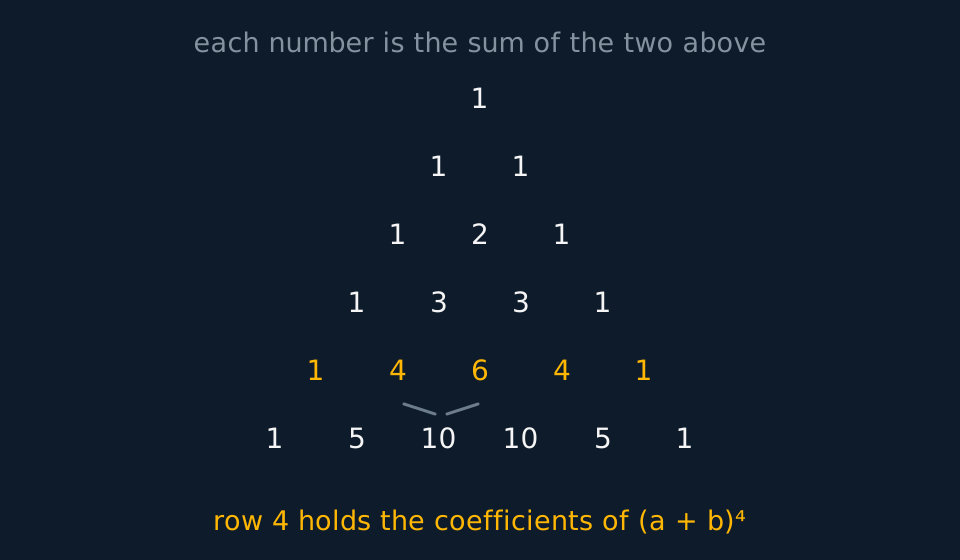
with n! standing for n × (n − 1) × … × 1. The same numbers fill Pascal's triangle, where every entry is the sum of the two above it. Papers write the coefficient three ways, as nCr, as a two-row bracket, and as nCr, and you are expected to recognise all of them. The identical count reappears in binomial probability on the statistics paper.
WORKED EXAMPLE
A coefficient, done properly
Evaluate 10C3.
The formula gives 10!/(3! × 7!). Nearly everything cancels, leaving (10 × 9 × 8)/(3 × 2 × 1) = 720/6 = 120.
The nCr function on a calculator gives the same value, as does row 10 of Pascal's triangle.
Cancel the factorials before multiplying, rather than evaluating 10! in full.
The full statement of the theorem is printed in the formulae booklet.
In each term the power of a decreases as the power of b increases, and every term has total degree n. The coefficients are the entries of row n of Pascal's triangle.
Each term drags its an−r factor along with it, so in (2 + 3x)4 the coefficient of x is 4C1 × 23 × 3 = 96, not the 4 × 3 = 12 that forgetting the factor would predict.
WORKED EXAMPLE
A full expansion, kept tidy
Expand (2 + 3x)4 completely.
Row 4 gives 1, 4, 6, 4, 1. Build each term as (coefficient) × 24−r × (3x)r.
That produces 16, then 4 × 8 × 3x = 96x, then 6 × 4 × 9x2 = 216x2, then 4 × 2 × 27x3 = 216x3, and finally 81x4.
So (2 + 3x)4 = 16 + 96x + 216x2 + 216x3 + 81x4.
Check the expansion at x = 1: the bracket is 54 = 625, and the five terms sum to 16 + 96 + 216 + 216 + 81 = 625.
GUIDED PRACTICE
One coefficient, minus sign included
Find the coefficient of x3 in the expansion of (3 − 2x)5, before opening the working.
Show the working
The x3 term is 5C3 × 32 × (−2x)3 = 10 × 9 × (−8)x3.
The coefficient is −720.
The minus sign is part of the term being raised to the power, so it is cubed with the 2: (−2x)3 = −8x3.
Expansions as approximations
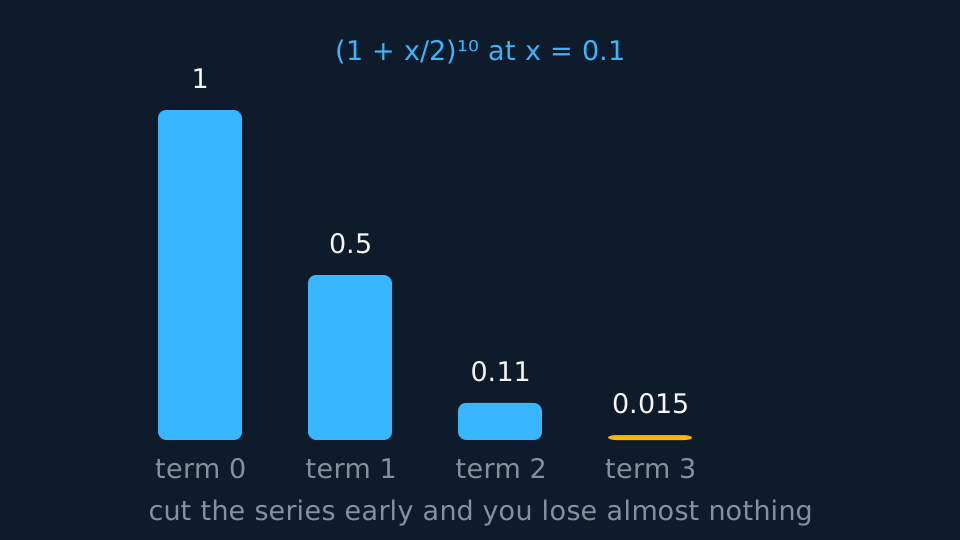
For |x| < 1, successive powers of x decrease in size, so truncating the expansion after two or three terms discards terms that are small compared with those retained. This estimates a power of a number close to 1, with an error of the order of the first term omitted.
WORKED EXAMPLE
Estimating a tenth power by hand
Expand (1 + x/2)10 up to the x2 term, and use the result to estimate 1.00510.
The terms are 1, then 10 × (x/2) = 5x, then 45 × (x/2)2 = 11.25x2.
Setting x/2 = 0.005 means x = 0.01, and the truncation gives 1 + 0.05 + 0.001125 = 1.051125.
The true value is 1.0511401…, so the estimate is inside 0.00002. The x3 term would have contributed about 0.000015, which is the error almost to the digit.
INDEPENDENT PRACTICE
A quick estimate of 1.02⁶
Expand (1 + 2x)6 in ascending powers of x up to the x2 term, and use it to estimate 1.026.
Show the working
The terms are 1, then 6 × 2x = 12x, then 15 × 4x2 = 60x2.
For 1.02 the substitution is 2x = 0.02, so x = 0.01, giving 1 + 0.12 + 0.006 = 1.126.
The true value is 1.12616…, and the difference is the sum of the discarded terms. Quote the estimate to the accuracy the truncation supports rather than to the full calculator display.
ASSESSMENT FOCUS
- State which row of coefficients is being used, then construct each term as coefficient × a-power × (bx)-power, and show that structure in the working.
- Keep the whole of bx inside the power, sign included. (−2x)3 is −8x3.
- “In ascending powers of x” fixes the order of your answer. Start at the constant term and work up.
- For approximation parts, state what x is, substitute it into the truncation, and round once at the very end.
CHECK YOURSELF
Find the first three terms, in ascending powers of x, of (2 − x)5, and use them to estimate 1.9985.
Show a hint
a = 2, b = −1; then 2 − x = 1.998 fixes x.
Show the answer
The terms are 25 = 32, then 5 × 24 × (−x) = −80x, then 10 × 23 × x2 = 80x2.
So (2 − x)5 ≈ 32 − 80x + 80x2, and 1.998 means x = 0.002.
The estimate is 32 − 0.16 + 0.00032 = 31.84032. The true value is 31.840319…, which agrees to every digit shown.
Row n of Pascal's triangle gives the coefficients nCr, and every term of (a + b)ⁿ has total degree n.
For small |x| the terms decrease in size, so a truncated expansion approximates the value, with an error of the order of the first term omitted.
WORKBOOK
Printable practice for this topic: original exam-style questions with room to work, and a fully worked answer book. Free to use; please do not redistribute or sell.
Or read them with their worked answers on the binomial expansion questions page.
USED LATER IN
CHECK YOUR PROGRESS
Rate how confident you feel with each objective for this lesson. Ratings are saved in this browser, on this device, unless you sign in.
- Compute binomial coefficients from Pascal's triangle or from the nCr formula.
- Expand (a + bx)n for positive integer n, and pull out one coefficient without expanding the rest.
- Truncate an expansion to estimate a power of a number close to 1.
Open the full revision checklist to see every objective in the course in one place.