Maths › Differentiation › Rates of change and building differential equations
Rates of change and building differential equations
The chain rule connects linked rates of change, such as the rate of increase of a balloon's radius when its volume increases at a known rate. The topic also covers translating statements about rates into differential equations, which the integration unit then solves.
Builds on Implicit and parametric differentiation and Exponential functions and e.
IN THIS TOPIC
- Connect rates through the chain rule and evaluate them at an instant.
- Translate rate sentences into differential equations, signs and constants included.
- Verify that a given function satisfies a differential equation by differentiating and comparing.
COMMON MISCONCEPTION
If two quantities are linked, their rates of change are equal.
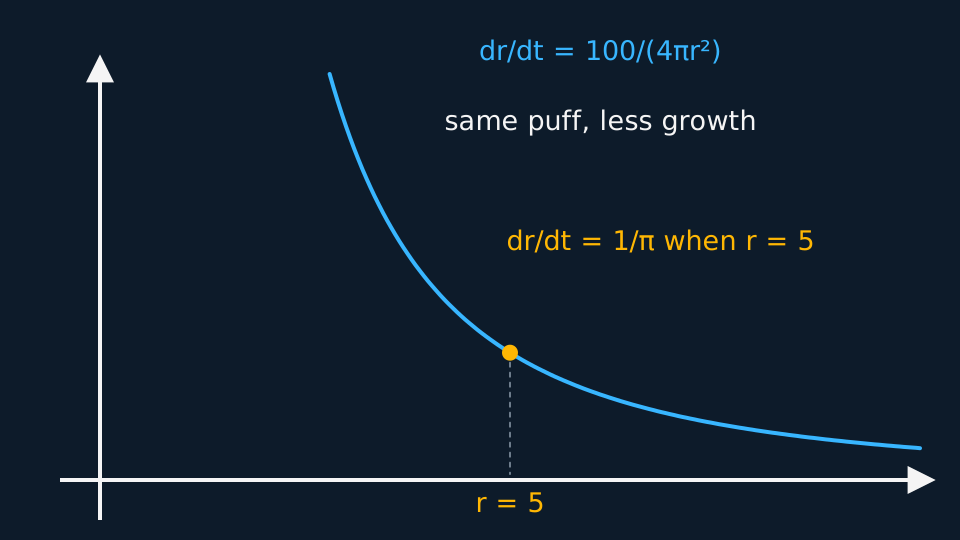
Linked rates are related by the chain rule rather than equal: dV/dt = dV/dr × dr/dt. A balloon inflated at a steady 100 cm3 per second has dr/dt = 100/(4πr2), which is 1/π cm per second at r = 5 and decreases as r grows, because the connecting factor 4πr2, the surface area of the sphere, increases with r.
Connected rates
Quantities linked by a formula have rates linked by the chain rule, so dV/dt = dV/dr × dr/dt for a volume that depends on a radius. Linked rates are not equal rates: the volume can increase at a constant rate while dr/dt decreases, because the connecting factor dV/dr increases with r.
WORKED EXAMPLE
The balloon, timed
A spherical balloon is inflated at a steady 100 cm3 per second. Find the rate at which its radius grows when r = 5 cm.
The link: V = (4/3)πr3, so dV/dr = 4πr2.
The chain: dV/dt = dV/dr × dr/dt, so 100 = 4πr2 × dr/dt.
At r = 5: dr/dt = 100/(100π) = 1/π ≈ 0.32 cm per second.
The connecting factor 4πr2 is the surface area of the sphere, so for a fixed dV/dt the radius increases more slowly as r increases.
GUIDED PRACTICE
A melting cube
An ice cube of side x melts so its volume decreases at a steady 2 cm3 per minute. Find the rate at which x decreases when x = 10 cm, before opening the working.
Show the working
The link: V = x3, so dV/dx = 3x2.
The chain, with the melt written as dV/dt = −2: dx/dt = (dV/dt)/(dV/dx) = −2/(3x2).
At x = 10: dx/dt = −2/300 = −1/150 cm per minute.
The negative signs represent decreasing volume and decreasing side length. Where a question asks for the rate of decrease, give the magnitude and state the direction in words.
Sentences into equations
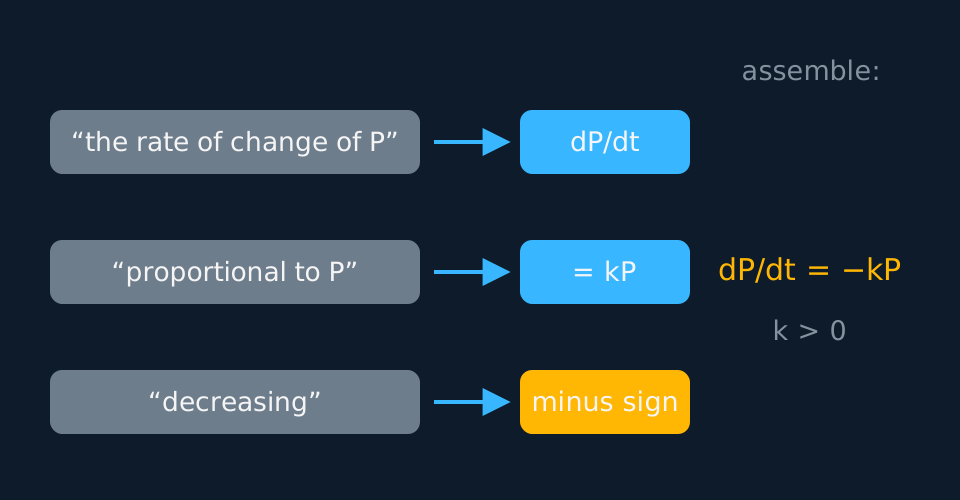
A differential equation states how fast something changes, and building one is translation work, phrase by phrase. “Rate of change of P” becomes dP/dt. “Proportional to” brings in a constant k. “Decreasing” plants a minus sign. The case of a rate proportional to the quantity itself, dP/dt = kP, is the model behind exponential growth and decay.
WORKED EXAMPLE
The mint, modelled
A spherical mint dissolves so that its radius decreases at a rate inversely proportional to the square of the radius. Write a differential equation for r.
“Rate of decrease of r” is −dr/dt, and “inversely proportional to r2” is k/r2.
So −dr/dt = k/r2, that is dr/dt = −k/r2, with k > 0.
State k > 0 alongside the minus sign: together they make dr/dt negative, so r decreases, and the magnitude of dr/dt increases as r decreases.
INDEPENDENT PRACTICE
Verify, do not yet solve
Show that P = 500e0.2t satisfies the differential equation dP/dt = 0.2P.
Show the working
Differentiate: dP/dt = 500 × 0.2e0.2t = 0.2 × 500e0.2t.
The right-hand side is 0.2P, so the equation is satisfied. ∎
Verifying a proposed solution requires differentiation; finding one requires integration, which is covered in Solving differential equations.
ASSESSMENT FOCUS
- Write the connecting formula, differentiate it, then apply the chain rule, in that order.
- Track signs in words and symbols together. A rate of decrease is a negative derivative.
- “Show that P satisfies…” means differentiate and compare. It never means solve.
CHECK YOURSELF
The area of a circular oil slick grows at a steady 12 m2 per hour. Find the rate at which the radius grows when r = 6 m.
Show a hint
A = πr² links them; chain and evaluate.
Show the answer
dA/dr = 2πr, and dA/dt = dA/dr × dr/dt.
So 12 = 2π × 6 × dr/dt, giving dr/dt = 12/(12π) = 1/π ≈ 0.32 m per hour.
The connecting factor here is the circumference 2πr, which increases with r, so dr/dt decreases as the slick spreads.
Linked quantities have rates linked by the chain rule: write the connecting formula, differentiate it, and multiply the rates.
Translate a rate statement term by term: the rate of change becomes a derivative, proportionality introduces a constant k, and a decrease gives a negative sign.
WORKBOOK
Printable practice for this topic: original exam-style questions with room to work, and a fully worked answer book. Free to use; please do not redistribute or sell.
Or read them with their worked answers on the rates of change and building differential equations questions page.
USED LATER IN
CHECK YOUR PROGRESS
Rate how confident you feel with each objective for this lesson. Ratings are saved in this browser, on this device, unless you sign in.
- Connect rates through the chain rule and evaluate them at an instant.
- Translate rate sentences into differential equations, signs and constants included.
- Verify that a given function satisfies a differential equation by differentiating and comparing.
Open the full revision checklist to see every objective in the course in one place.