Maths › Exponentials and logarithms › Logarithms and their laws
Logarithms and their laws
A logarithm is the exponent to which the base must be raised to produce a given number, so the logarithm function is the inverse of an exponential function, and taking logarithms makes an unknown exponent the subject. The three laws of logarithms convert products into sums, quotients into differences and powers into multiples.
Builds on Exponential functions and e.
IN THIS TOPIC
- Convert between exponential and logarithmic statements, in any base and in base e.
- Solve eax+b = p and ln (ax + b) = q by applying the right inverse to the whole side.
- Use the three log laws to combine, split and simplify expressions.
- Solve ax = b, and anything else with the unknown in an exponent.
COMMON MISCONCEPTION
log (x + y) = log x + log y.
The law turns a product into a sum, not a sum into a sum: loga x + loga y = loga xy. In base 10, log 20 = 1.301 while log 10 + log 10 = 2. There is no law for the logarithm of a sum, so factorise anything inside a logarithm before applying one.
The inverse of an exponential
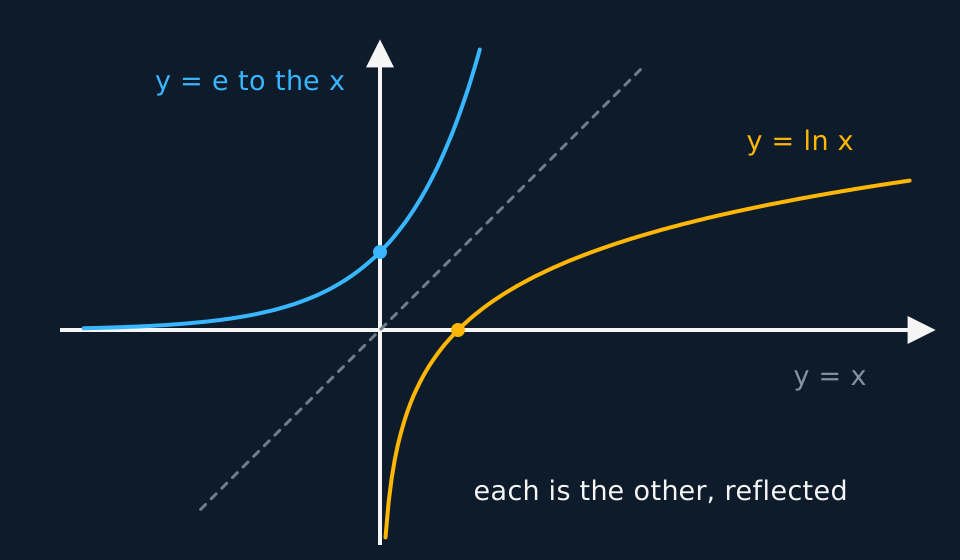
The statement an = x and the statement loga x = n carry the same information. A logarithm is an exponent, read backwards. So log10 1000 = 3 because 103 = 1000, and loga a = 1 for every base the definition allows. Those bases are a > 0 with a ≠ 1, and the number x has to be positive as well, because an is positive for every n and no power of a will ever produce zero or a negative. The logarithm to base e has its own notation, ln x, and it is the inverse of ex.
WORKED EXAMPLE
Undoing e, twice over
Solve e2x+1 = 10, and then ln (3x + 2) = 2, each to 4 significant figures.
For the first, take ln of both sides. 2x + 1 = ln 10, so x = (ln 10 − 1)/2 = 0.6513.
For the second, apply e to both sides. 3x + 2 = e2, so x = (e2 − 2)/3 = 1.796.
Identify which of the two forms is given, apply its inverse to both sides, then rearrange.
The three laws
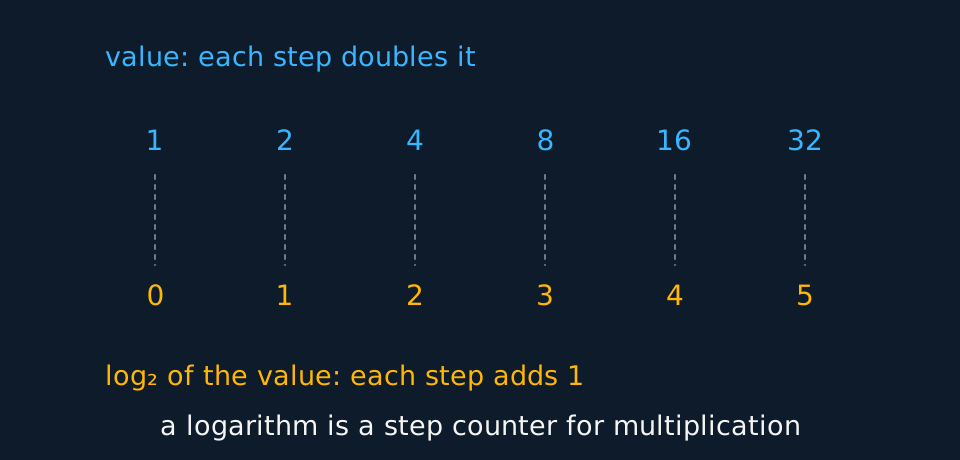
Logs are exponents, so the index laws translate straight into log laws. All three are on the must-learn list,
and the third holds for negative and fractional k as well, so −log x = log (1/x) and ½ log x = log √x. Every x and y in the three laws must be positive, so check the solutions of a logarithmic equation in the original equation and reject any value making an argument zero or negative.
There is no corresponding law for log (x + y). A counterexample in base 10: log 20 = 1.301, while log 10 + log 10 = 2.
WORKED EXAMPLE
Collapsing to a single logarithm
Write 2 log 3 + log 5 − log 15 as a single logarithm.
Move the multiple inside first. 2 log 3 = log 9.
Then combine left to right. log 9 + log 5 = log 45, and log 45 − log 15 = log (45/15).
The expression is log 3.
A numerical check confirms it: 0.9542 + 0.6990 − 1.1761 = 0.4771, which is log 3.
Unknowns in the exponent
When the unknown sits in an exponent and the bases do not match, take logs of both sides. The third law then pulls the unknown down to the front as a multiplier, and ordinary algebra finishes the job.
WORKED EXAMPLE
A mismatched base
Solve 23x−1 = 3, giving the answer to 4 significant figures.
Take logs of both sides. (3x − 1) log 2 = log 3.
So 3x − 1 = log 3/log 2 = 1.585, and x = 2.585/3 = 0.8617.
Any base of logarithm may be used, since the base cancels in the ratio. There is no integer power of 2 equal to 3, so the equation is solved by logarithms rather than by inspection.
GUIDED PRACTICE
Solve for the exponent
Solve 5x = 30, to 4 significant figures, before opening the working.
Show the working
Take logs. x log 5 = log 30, so x = log 30/log 5 = 2.113.
A check on the size of the answer: 52 = 25 and 53 = 125, so x lies between 2 and 3, close to 2.
INDEPENDENT PRACTICE
Logs against a growth model
A population is modelled by P = 500e0.2t, with t in days. Find, to 3 significant figures, the time at which P reaches 10 000.
Show the working
Set 500e0.2t = 10 000, so e0.2t = 20.
Take ln of both sides. 0.2t = ln 20, so t = 5 ln 20 = 15.0 days.
A question asking when a model reaches a stated value is solved this way: isolate the exponential, then apply the logarithm to both sides.
ASSESSMENT FOCUS
- Translate between the two forms before any algebra: an = x is the same statement as loga x = n.
- Name the logarithm law used at each step, so that each combination or separation of logarithms is justified.
- There is no law for log (x + y). Where a sum appears inside a logarithm, factorise it before applying any law.
- For ax = b, take logarithms in any base and divide, keeping the exact ratio until the final rounding.
- ln and e are inverse functions, and each must be applied to a whole side of an equation rather than to individual terms.
CHECK YOURSELF
Express log 4 + log 25 as a single logarithm and evaluate it, then solve e3x = 40 to 3 significant figures.
Show a hint
4 × 25 is a power of 10; then take ln of both sides.
Show the answer
log 4 + log 25 = log 100 = 2, in base 10.
Taking ln of e3x = 40 gives 3x = ln 40, so x = ln 40/3 = 1.23.
Both parts use the same fact: a logarithm returns the exponent.
A logarithm is an exponent: a to the n equals x and log base a of x equals n are one statement.
Logs turn multiplication into addition and bring exponents down as multipliers.
WORKBOOK
Printable practice for this topic: original exam-style questions with room to work, and a fully worked answer book. Free to use; please do not redistribute or sell.
Or read them with their worked answers on the logarithms and their laws questions page.
USED LATER IN
CHECK YOUR PROGRESS
Rate how confident you feel with each objective for this lesson. Ratings are saved in this browser, on this device, unless you sign in.
- Convert between exponential and logarithmic statements, in any base and in base e.
- Solve eax+b = p and ln (ax + b) = q by applying the right inverse to the whole side.
- Use the three log laws to combine, split and simplify expressions.
- Solve ax = b, and anything else with the unknown in an exponent.
Open the full revision checklist to see every objective in the course in one place.