Maths › Trigonometry › Reciprocal and inverse trigonometric functions
Reciprocal and inverse trigonometric functions
Cosecant, secant and cotangent are the reciprocals of sine, cosine and tangent, and dividing the Pythagorean identity by sin²θ or cos²θ turns it into two more identities. Arcsin, arccos and arctan reverse the original three functions, and exist only because the domains of those functions are restricted first.
Builds on Radians, arcs and small angles and Functions, inverses and the modulus.
IN THIS TOPIC
- Work with sec, cosec and cot, including their graphs, asymptotes and ranges.
- Derive and use sec² = 1 + tan² and cosec² = 1 + cot².
- Solve equations that are quadratics in a reciprocal ratio.
- Use arcsin, arccos and arctan with their restricted domains and ranges.
COMMON MISCONCEPTION
arcsin x means 1 over sin x.
arcsin x is the inverse function, the angle whose sine is x; the reciprocal of sin x is cosec x. arcsin accepts inputs in [−1, 1] and returns an angle in [−π/2, π/2], so arcsin (½) = π/6. The notation sin−1 x denotes that inverse function and never the reciprocal.
The reciprocal three
The three reciprocal functions are sec x = 1/cos x, cosec x = 1/sin x and cot x = cos x/sin x. Each is undefined wherever its denominator is zero, so each graph consists of branches separated by vertical asymptotes. The branches do not all look alike. sec and cosec have period 2π and each branch is a U or an upside-down U, turning at a height of 1 or −1 where the parent wave has a maximum or minimum. cot has period π, and on each interval between consecutive asymptotes it decreases from +∞ to −∞, crossing zero halfway. It has no stationary points, so it has no local maximum or minimum.
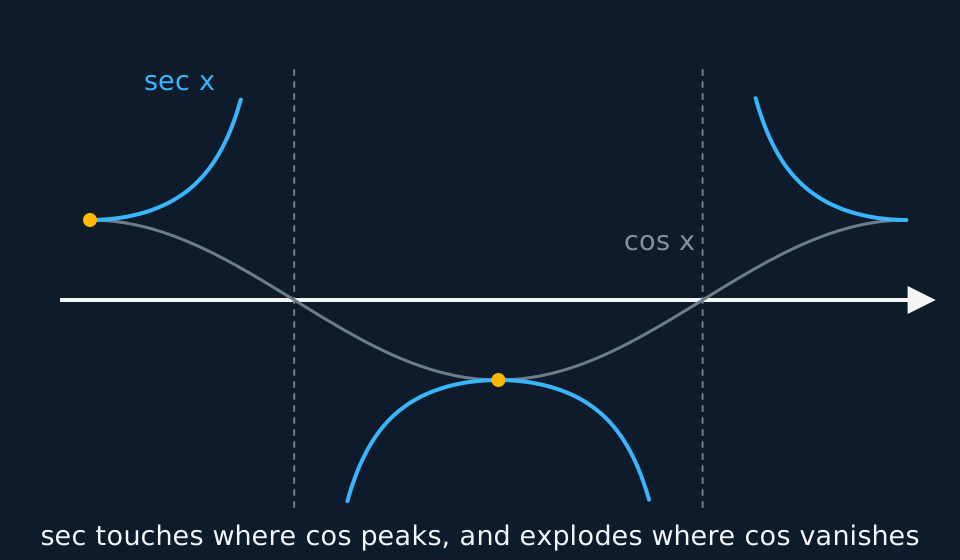
Two consequences are worth recording. Since |cos x| ≤ 1, |sec x| ≥ 1, and neither sec x nor cosec x takes a value strictly between −1 and 1. And cot is defined as cos/sin rather than as 1/tan, because cot (π/2) = 0 while tan (π/2) is undefined.
Two identities from one
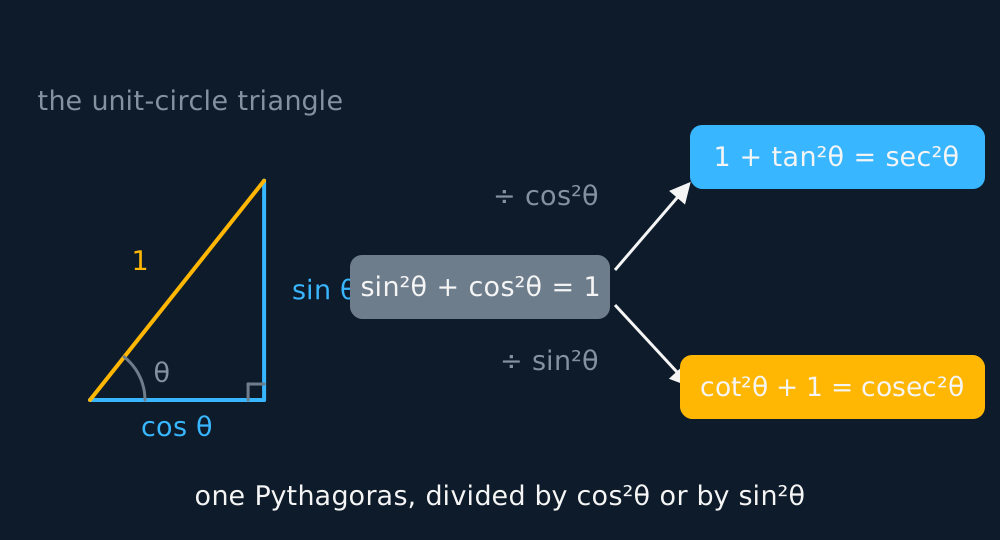
Divide sin²x + cos²x = 1 through by cos²x and one new identity drops out. Divide the same line by sin²x instead and you get the other.
Both must be learnt, and each derivation is a single line. A question may ask for the derivation as well as the result.
Describe the drawing
A right triangle with hypotenuse 1 and legs cos theta and sin theta beside the identity sin squared theta plus cos squared theta equals 1, with two arrows dividing it by cos squared theta into 1 plus tan squared equals sec squared, and by sin squared theta into cot squared plus 1 equals cosec squared: two new identities from one old line.
WORKED EXAMPLE
An exact value through the identity
Given that tan θ = 3/4 with θ acute, find sec θ and cos θ exactly.
sec2 θ = 1 + 9/16 = 25/16, so sec θ = 5/4, positive because θ is acute.
cos θ is its reciprocal, 4/5.
The identity relates the two ratios directly, so neither a triangle nor the angle itself was needed.
GUIDED PRACTICE
A quadratic in cosec
Solve 2cot2 x + cosec x = 1 for 0 ≤ x < 2π, before opening the working.
Show the working
Trade cot² for cosec² − 1. That gives 2cosec2 x + cosec x − 3 = 0, which factorises as (2cosec x + 3)(cosec x − 1) = 0.
cosec x = 1 gives sin x = 1, so x = π/2. cosec x = −3/2 gives sin x = −2/3, so x = π + 0.730 and 2π − 0.730.
Solutions: x = π/2, 3.87, 5.55 (radians, 3 significant figures).
The identity reduced two ratios to one, leaving a quadratic to factorise. The working is in radians because the interval is given in radians.
Running trig backwards
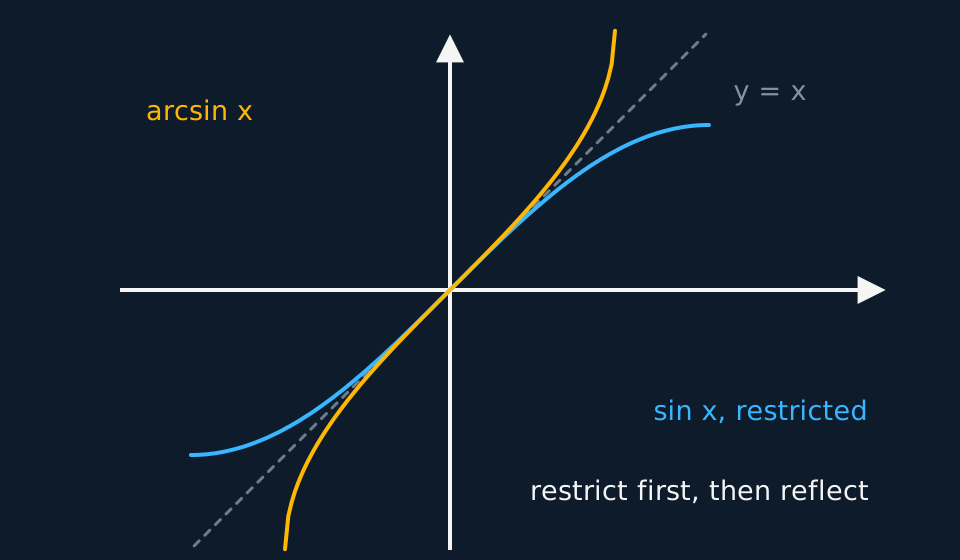
arcsin, arccos and arctan, also written sin−1 and so on, answer the question “which angle has this sine”. Sine is many-one, so an inverse only exists once the domain has been restricted. arcsin and arccos accept inputs in [−1, 1] and nothing outside it, since no angle has a sine of 2. arctan will accept any real number. Their outputs are pinned down too, to [−π/2, π/2] for arcsin, [0, π] for arccos and (−π/2, π/2) for arctan.
sin−1 x denotes the inverse function, not the reciprocal; the reciprocal of sin x is cosec x.
INDEPENDENT PRACTICE
Exact inverses, no calculator
Write down the exact values of arcsin (½), arccos (½) and arctan (−1).
Show the working
arcsin (½) = π/6, the angle in [−π/2, π/2] whose sine is ½.
arccos (½) = π/3, from the range [0, π].
arctan (−1) = −π/4, not 3π/4, because the range of arctan is (−π/2, π/2).
Each answer comes from the exact-value table, and the stated range picks which of the two candidate angles the inverse function returns.
ASSESSMENT FOCUS
- Rewrite sec, cosec and cot in terms of sin, cos and tan the moment an expression stops looking familiar.
- Derive the two squared identities by dividing sin² + cos² = 1 by cos² or by sin². The derivation itself can be examined.
- Quadratics in sec or cosec factorise like any other quadratic. Convert the odd ratio out first so only one remains.
- A value outside the range of the inverse function is not a value of that function, even where its trigonometric ratio is correct. Quote the range when rejecting an angle.
- sin−1 denotes arcsin, and 1/sin denotes cosec; the two are different functions.
CHECK YOURSELF
Given that cosec θ = 3 with θ acute, find cot θ and cos θ exactly.
Show a hint
cosec² = 1 + cot², then cot = cos/sin.
Show the answer
cot2 θ = cosec2 θ − 1 = 8, so cot θ = 2√2, positive for acute θ.
sin θ = 1/3, and cos θ = cot θ × sin θ = 2√2/3.
Check it against Pythagoras: sin² + cos² = 1/9 + 8/9 = 1, as it has to.
sec, cosec and cot are reciprocals of cos, sin and tan, undefined wherever those functions are zero.
Divide the Pythagorean identity by cos² or sin² for the two further identities; restrict the domain before inverting, and the range determines which angle the inverse returns.
WORKBOOK
Printable practice for this topic: original exam-style questions with room to work, and a fully worked answer book. Free to use; please do not redistribute or sell.
Or read them with their worked answers on the reciprocal and inverse trigonometric functions questions page.
CHECK YOUR PROGRESS
Rate how confident you feel with each objective for this lesson. Ratings are saved in this browser, on this device, unless you sign in.
- Work with sec, cosec and cot, including their graphs, asymptotes and ranges.
- Derive and use sec² = 1 + tan² and cosec² = 1 + cot².
- Solve equations that are quadratics in a reciprocal ratio.
- Use arcsin, arccos and arctan with their restricted domains and ranges.
Open the full revision checklist to see every objective in the course in one place.