Maths › Further calculus › Mean values and improper integrals
Mean values and improper integrals
The mean value of a function is its signed integral divided by the interval width. An improper integral is defined through a limit when an endpoint is infinite or the integrand is unbounded at an endpoint or at an interior point. State the limiting process before evaluating it; the integral converges only if the relevant limit is finite.
Builds on Areas and the limit of a sum and Geometric series.
IN THIS TOPIC
- Compute the mean value of a function as the signed integral divided by the interval width.
- Evaluate improper integrals as limits, stating convergence or divergence.
- Settle an exponential or a logarithmic tail with the two standard limits.
- Split an integral at an interior singularity and test each one-sided limit separately.
COMMON MISCONCEPTION
An integral with an infinite limit must give an infinite answer.
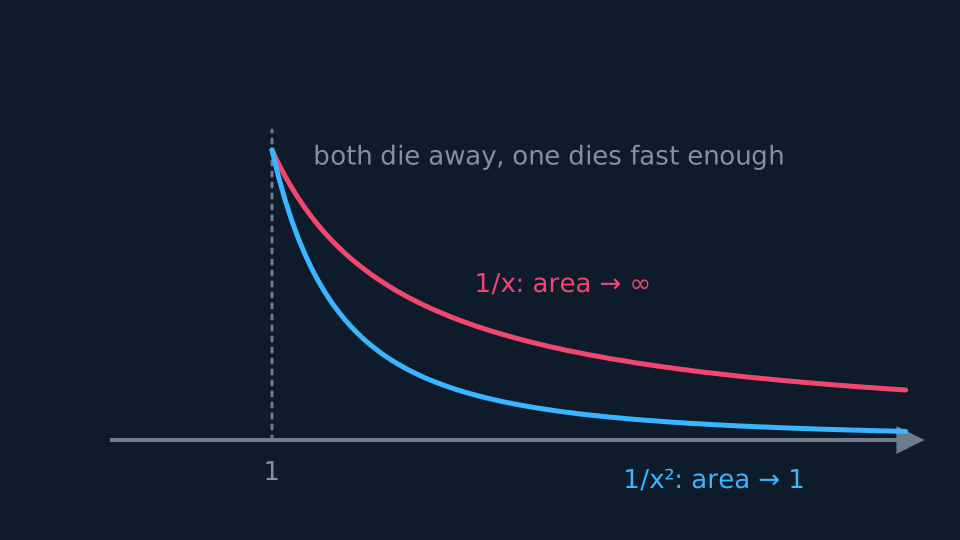
An unbounded region has finite area when the integrand decreases fast enough. Integrate to a letter and take the limit: ∫1/x2 dx from 1 to t is 1 − 1/t, which tends to 1, so that integral converges, while ∫1/x dx from 1 to t is ln t, which is unbounded, so that one diverges. On [1, ∞) convergence of ∫x−p dx needs p > 1.
The mean value of a function
The mean value of f on [a, b] is the signed integral divided by the interval width:
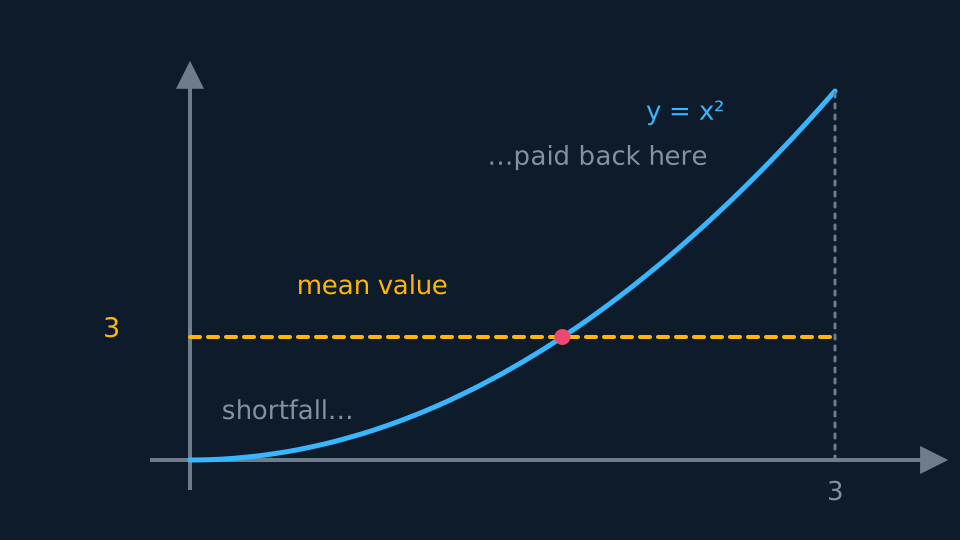
It is a signed average and equals the height of a rectangle with the same signed integral; it need not equal geometric area divided by width, and it is negative when the area below the axis exceeds the area above it. Check the current formula booklet for your awarding organisation.
WORKED EXAMPLE
Mean of a parabola
Find the mean value of f(x) = x² on the interval [0, 3].
∫x² dx from 0 to 3 = [x³/3] = 9.
Mean = 9/(3 − 0) = 3.
The function increases from 0 to 9 on the interval, and the mean value 3 is below the midpoint of that range because x² is small over most of [0, 3].
Improper integrals
An improper integral is one with an infinite endpoint, or one whose integrand is unbounded at an endpoint or at an interior point. Replace the problematic endpoint by a letter, integrate, then take the appropriate one-sided limit. If that limit is finite the integral converges; if it is unbounded, oscillates or otherwise fails to approach a finite value, the integral diverges. An unbounded region can have finite area if the integrand decreases fast enough.
WORKED EXAMPLE
A finite tail
Evaluate ∫ 1/x² dx from 1 to ∞, or show it diverges.
Integrate from 1 to t: [−1/x] = 1 − 1/t.
As t → ∞, 1/t → 0, so the integral converges to 1.
Compare 1/x: [ln x] from 1 to t is ln t, which is unbounded as t → ∞, so that integral diverges, although the two curves are similar on a sketch.
INDEPENDENT PRACTICE
Blow-up at the bottom
Evaluate ∫ 1/√x dx from 0 to 1, treating the lower limit with care.
Show the working
The integrand is unbounded at 0, so integrate from t to 1 first: [2√x] = 2 − 2√t.
As t → 0⁺, 2√t → 0, so the integral converges to 2.
An unbounded integrand can still give a convergent integral, provided it becomes unbounded slowly enough.
Exponential and logarithmic integrands
In the examples above the integrand was a power of x, whose antiderivative is another power with a limit that can be evaluated directly. Two further cases are settled by standard limits: for k > 0, xke−x → 0 as x → ∞, and xkln x → 0 as x → 0⁺. Check the current formula booklet for your awarding organisation.
Each limit states that one factor changes faster than the other: at infinity e−x tends to zero faster than any fixed power of x grows, and at the origin any positive power of x tends to zero faster than ln x tends to −∞. The limits lesson derives both; the value of k affects the working but not the limit. They are used here because the boundary term produced by an integration by parts takes one of these two forms.
WORKED EXAMPLE
An exponential tail
Evaluate ∫ xe−x dx from 0 to ∞, or show it diverges.
Integrate from 0 to t by parts, with u = x and dv = e−xdx: [−xe−x] from 0 to t, plus ∫ e−x dx from 0 to t.
= −te−t + (1 − e−t).
As t → ∞ the first term tends to 0 by the standard limit with k = 1, and e−t → 0, so the integral converges to 1.
Without that limit the working stops at −te−t, an indeterminate form of type ∞ × 0, which does not by itself decide convergence.
WORKED EXAMPLE
A logarithm at the origin
Evaluate ∫ ln x dx from 0 to 1, or show it diverges.
The integrand is unbounded at 0, so integrate from t to 1: [x ln x − x] from t to 1 = (0 − 1) − (t ln t − t).
As t → 0⁺, t ln t → 0 by the second standard limit with k = 1, and t → 0, so the integral converges to −1.
The value is negative because ln x < 0 throughout (0, 1); check the sign against the graph before quoting the answer.
The same integration by parts with xn in place of x gives the reduction formula In = nIn-1 with I₀ = 1, so ∫ xne−x dx from 0 to ∞ equals n factorial for each non-negative integer n. The boundary term vanishes at each step for the same reason as above. This family of integrals gives the mean and variance of an exponential model.
An interior singularity
The singularity need not be at an endpoint. If the integrand is undefined at a point inside the interval, split the integral there and treat each piece as its own one-sided limit. The integral converges only if both pieces do, and its value is then the sum of the two.
WORKED EXAMPLE
Splitting at an interior singularity
Evaluate ∫ 1/x2/3 dx from −1 to 1, or show it diverges.
The integrand is undefined at x = 0, inside the interval, so split there: one integral from −1 to 0 and one from 0 to 1, each improper at 0.
Right piece: ∫ from t to 1 gives [3x1/3] = 3 − 3t1/3, which tends to 3 as t → 0⁺.
Left piece: ∫ from −1 to s gives 3s1/3 + 3, which tends to 3 as s → 0⁻.
Both one-sided limits settle, so the integral converges to 6.
Omitting the split gives an incorrect value. Applying [−1/x] to 1/x² across [−1, 1] gives (−1) − (1) = −2, a negative value for an integrand that is positive wherever it is defined. Splitting correctly, ∫ from t to 1 of 1/x² dx = 1/t − 1, which is unbounded as t → 0⁺. One piece diverges, so the integral diverges; the value −2 arises from applying the antiderivative across a point at which it is not defined.
ASSESSMENT FOCUS
- The mean value is the signed integral divided by the interval width; include the division.
- Write an improper integral with a limit letter and the words 'as t tends to', rather than substituting ∞ directly.
- State 'converges to' or 'diverges' explicitly; the conclusion is part of the answer.
- For ∫x−p dx on [1, ∞), convergence needs p > 1. The case p = 1 diverges, so 1/x sits just outside.
- A tail carrying e−x or ln x needs a standard limit quoted by name: for k > 0, xke−x → 0 at infinity and xkln x → 0 at the origin.
- An integrand undefined inside the interval means splitting there first. Integrating straight across can return a finite number that is wrong: 1/x² across [−1, 1] gives −2 that way.
CHECK YOURSELF
Find the mean value of f(x) = 1/x² on the interval [1, 2].
Show a hint
Integrate to get [−1/x], then divide by the width, which is 1.
Show the answer
∫ 1/x² dx from 1 to 2 = [−1/x] = 1 − 1/2 = 1/2. The width is 1, so the mean value is 1/2.
The mean value is the signed integral divided by the interval width, the height of a rectangle with the same signed integral.
Improper integrals: integrate to a letter, take the appropriate one-sided limit, then state whether it converges or diverges.
A singularity inside the interval splits the integral in two, and it converges only if both halves do.
Exponential and logarithmic cases are settled by the standard limits: xke−x → 0 at ∞, xkln x → 0 at 0.
WORKBOOK
Printable practice for this topic: original exam-style questions with room to work, and a fully worked answer book. Free to use; please do not redistribute or sell.
Or read them with their worked answers on the mean values and improper integrals questions page.
CHECK YOUR PROGRESS
Rate how confident you feel with each objective for this lesson. Ratings are saved in this browser, on this device, unless you sign in.
- Compute the mean value of a function as the signed integral divided by the interval width.
- Evaluate improper integrals as limits, stating convergence or divergence.
- Settle an exponential or a logarithmic tail with the two standard limits.
- Split an integral at an interior singularity and test each one-sided limit separately.
Open the full revision checklist to see every objective in the course in one place.