Maths › Further Mechanics 1 › Hooke's law and elastic strings
Hooke's law and elastic strings
Hooke's law states that the tension in a stretched elastic string or spring is proportional to its extension. The constant of proportionality depends on both the material and the natural length; writing it as λ/l, where λ is the modulus of elasticity, separates out the natural length.
Builds on Forces and Newton's laws and Statics of a particle.
IN THIS TOPIC
- Find a tension, an extension or a modulus given the other two.
- Solve equilibrium problems involving one or more elastic strings.
- State Hooke's law, naming each symbol and the newton as the unit of the modulus.
COMMON MISCONCEPTION
Two strings of the same material with the same modulus give the same tension at the same extension.
Hooke's law is T = λx/l, so the natural length l matters as much as the modulus λ. The gradient of T against x is λ/l, which makes a long string of the same material less stiff than a short one: doubling the natural length halves the tension at the same extension, because that stretch is then a smaller fraction of the string.
Tension proportional to extension
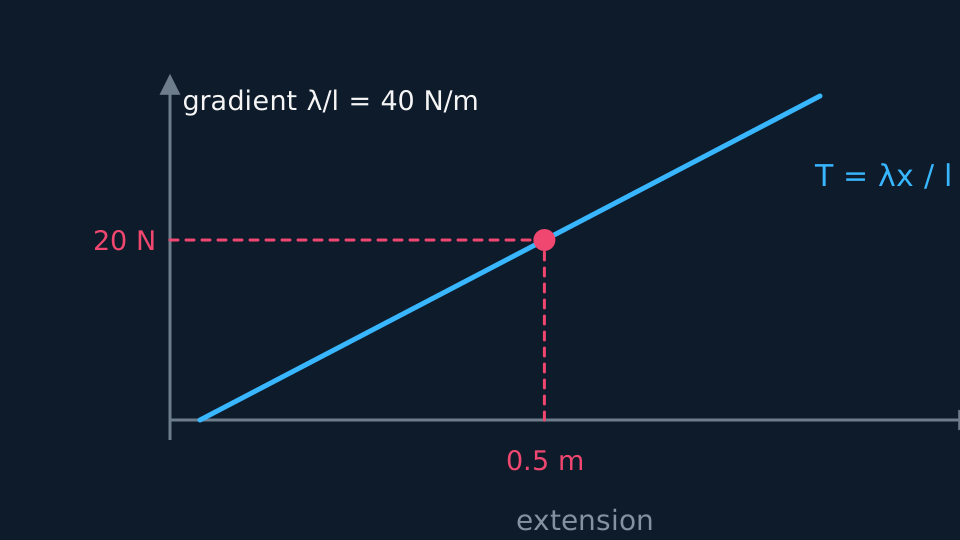
Hooke's law relates the tension T in a stretched elastic string or spring to its extension x.
Pearson Edexcel 9FM0 formulae booklet: not included. Here l is the natural length, the length when unstretched, and λ is the modulus of elasticity, measured in newtons. The gradient of the graph of T against x is λ/l, so a long string of the same material is less stiff than a short one.
A string can only pull, so its tension is zero whenever the distance between its ends is less than the natural length. A spring can also push, giving a thrust with the same formula and x taken as the compression. That difference is why a string must be checked for slackness.
WORKED EXAMPLE
Reading the formula three ways
An elastic string of natural length 1.5 m and modulus 60 N is stretched to a length of 2 m. Find the tension.
The extension is 2 − 1.5 = 0.5 m.
T = 60 × 0.5/1.5 = 20 N.
Doubling the natural length while keeping the modulus would halve this tension, since the same stretch is then a smaller fraction of the string.
Equilibrium with elastic strings
Once the tension is written in terms of the extension, an elastic problem becomes an ordinary statics problem. Resolve, write the equilibrium equations, and substitute λx/l wherever a tension appears. The unknown is usually the extension, so the equation is linear and solves at once.
With two strings, each has its own λ, l and x, and the extensions are linked by the geometry of the arrangement. In the standard arrangement a particle is held between two strings on a horizontal line, so the two stretched lengths add to a fixed total.
GUIDED PRACTICE
A hanging mass
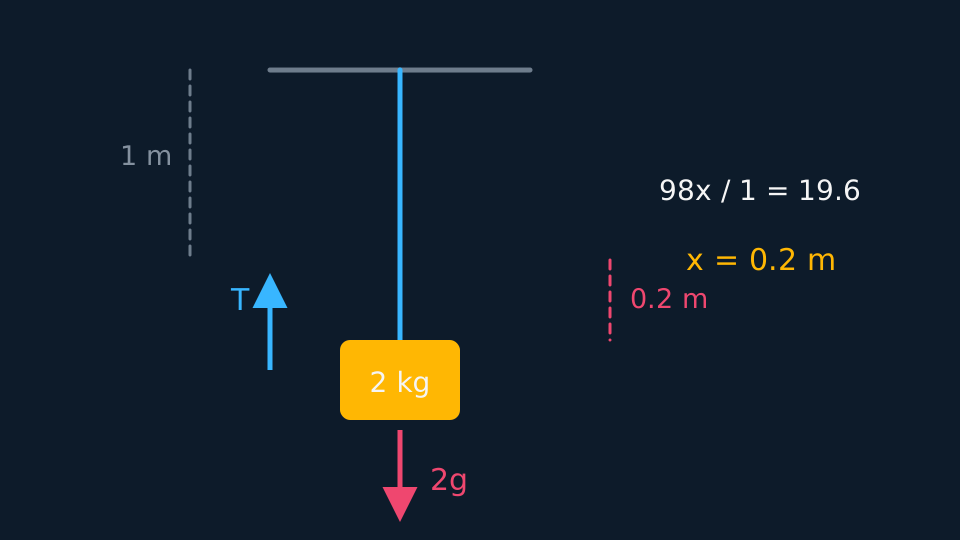
A particle of mass 2 kg hangs in equilibrium at the end of an elastic string of natural length 1 m and modulus 98 N, attached to a fixed ceiling. Find the extension and the total length, taking g = 9.8 m/s².
Show the working
In equilibrium the tension equals the weight: T = 2 × 9.8 = 19.6 N.
Hooke's law gives 98x/1 = 19.6, so x = 0.2 m.
The string is therefore 1.2 m long.
Doubling the mass would double the extension, since the relationship is linear right up to the elastic limit.
ASSESSMENT FOCUS
- Write down l, λ and x separately before substituting. Mixing up the length and the extension is the standard error.
- For a string, check whether it is taut. A slack string has zero tension and drops out of the equation.
- For a spring, allow for a thrust as well as a tension, since a spring can push.
- Modulus is a force in newtons, so a modulus quoted in metres is a misread question.
CHECK YOURSELF
An elastic spring of natural length 0.8 m has modulus 40 N. Find the thrust when it is compressed to a length of 0.6 m.
Show a hint
The compression plays the part of x.
Show the answer
The compression is 0.2 m, so the thrust is 40 × 0.2/0.8 = 10 N, pushing the ends apart.
Hooke's law is T = λx/l, where x is the extension, l the natural length and λ the modulus in newtons.
A string pulls only and has zero tension when slack. A spring also pushes, with the compression in place of the extension.
WORKBOOK
Printable practice for this topic: original exam-style questions with room to work, and a fully worked answer book. Free to use; please do not redistribute or sell.
Or read them with their worked answers on the Hooke's law and elastic strings questions page.
CHECK YOUR PROGRESS
Rate how confident you feel with each objective for this lesson. Ratings are saved in this browser, on this device, unless you sign in.
- Find a tension, an extension or a modulus given the other two.
- Solve equilibrium problems involving one or more elastic strings.
- State Hooke's law, naming each symbol and the newton as the unit of the modulus.
Open the full revision checklist to see every objective in the course in one place.