Maths › Further Mechanics 1 › Work, energy and power
Work, energy and power
Energy methods restate Newton's laws in terms of work rather than force. The work done by the forces acting equals the change in kinetic energy, and when gravity is the only force doing work the total mechanical energy stays the same.
Builds on Forces and Newton's laws and Friction and inclined planes and Lines and planes in three dimensions.
IN THIS TOPIC
- Calculate work done by a force at an angle, and by gravity and friction.
- Apply the work-energy principle to motion on a slope.
- Use conservation of mechanical energy where no resistance acts.
- Use P = Fv to link engine power, driving force and acceleration.
- Find a kinetic energy from a velocity vector as ½m v·v.
- Use v·v = u·u + 2a·s for constant acceleration in a plane, and recognise it as the work-energy principle in vector form.
COMMON MISCONCEPTION
The work done by a force of 20 N moving an object 5 m is always 100 J.
Work is Fd cos θ, with θ the angle between the force and the displacement, so 20 × 5 = 100 J only when the two point the same way. A force at right angles to the motion, such as the normal reaction on a fixed smooth surface, does no work at all, and one partly opposing the motion does negative work.
What counts as work
Work is the component of force along the displacement, times the displacement, so it is Fd cos θ with θ the angle between them. A force perpendicular to the displacement does no work. For motion along a fixed smooth surface, the normal reaction is perpendicular to the instantaneous displacement and therefore does no work; this does not generalise to a moving constraint, such as a surface that is itself accelerating. Fd on its own, with the angle omitted, is also wrong for a force partly opposing the motion, where the work is negative.
Pearson Edexcel 9FM0 formulae booklet: not included; no energy formulae are printed there. Both are measured in joules. Heights for gravitational potential energy are measured from whatever level you choose, so choose one and use it in every total on the page.
When the velocity arrives as a vector, write the kinetic energy as ½m v·v. The scalar product of a vector with itself is the square of its magnitude, so this is the same formula rather than a second one, and it saves finding the speed and then squaring it back. A velocity of 6i − 2j m/s has v·v = 36 + 4 = 40, so a 2 kg body carrying it holds 40 J. Energy is a scalar however the velocity was written, and no direction survives to the answer.
Energy accounting
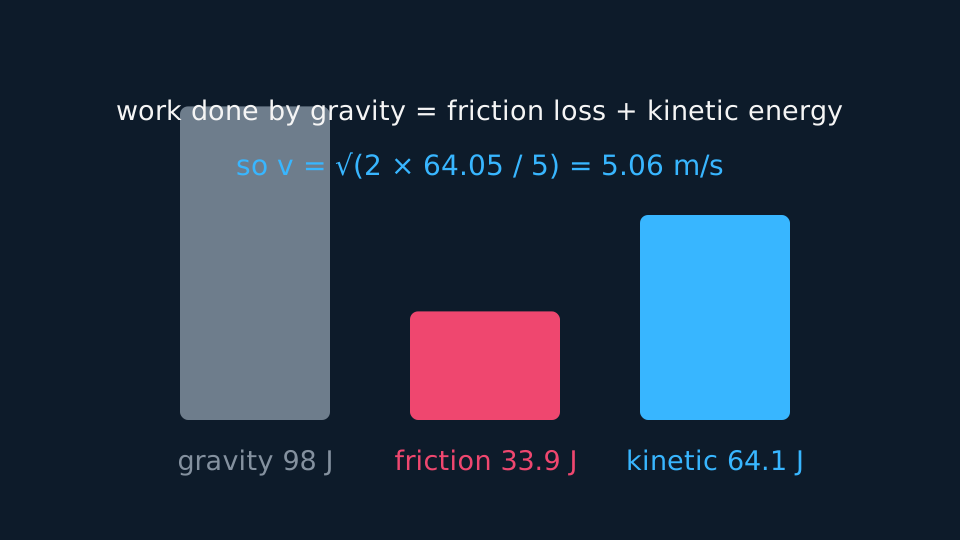
The work-energy principle says the total work done by all the forces equals the change in kinetic energy. On a rough slope that reads as energy released by gravity, minus energy lost to friction, equals kinetic energy gained. Written that way it settles problems that would otherwise need several equations of motion.
When no resistance acts, nothing is lost and the sum of kinetic and gravitational potential energy stays the same throughout. That is conservation of mechanical energy, so say explicitly that the surface is smooth before you use it.
WORKED EXAMPLE
Down a rough slope
A particle of mass 5 kg slides 4 m from rest down a slope at 30° to the horizontal, with coefficient of friction 0.2. Find its speed at the bottom, taking g = 9.8 m/s².
Work by gravity = 5(9.8)(4)sin30° = 98 J.
Normal reaction = 5(9.8)cos30° = 42.4 N, so friction = 8.49 N and the work against it is 8.49 × 4 = 33.9 J.
Kinetic energy gained = 98 − 33.95 = 64.05 J, so ½(5)v² = 64.05 and v = 5.06 m/s.
The same accounting works in a plane, and with a constant acceleration the vectors say it in one line. Put v = u + at and s = ut + ½at² into scalar products: v·v comes out as u·u + 2t(u·a) + t²(a·a), and 2a·s as 2t(a·u) + t²(a·a), so the two agree term for term after the u·u. That leaves v·v = u·u + 2a·s, which is v² = u² + 2as with each square read as a scalar product, and it is the one of the five constant-acceleration formulae that needs a scalar product to cross into vectors.
Multiply it by ½m and the energy statement appears: ½m v·v − ½m u·u = m a·s = F·s, the work done by the constant resultant force over the displacement. So the vector relation is the work-energy principle. Time is the letter this relation leaves out, in vectors just as in one dimension, which is why a question can ask for a kinetic energy from an acceleration and a displacement without mentioning a clock.
WORKED EXAMPLE
Kinetic energy without the clock
A particle of mass 2 kg has velocity u = (6i − 2j) m/s. It moves with constant acceleration a = (i + 3j) m/s² through a displacement s = (14i + 2j) m. Find its kinetic energy at the end of that displacement, and the work done on it.
u·u = 36 + 4 = 40, and a·s = 14 + 6 = 20.
v·v = u·u + 2a·s = 40 + 40 = 80, so the kinetic energy at the end is ½(2)(80) = 80 J.
At the start it was ½(2)(40) = 40 J, so 40 J has been gained.
Check that against the force. F = ma = (2i + 6j) N, and F·s = 28 + 12 = 40 J, the same gain, as the work-energy principle requires.
The speed at the end, if a question wants it, is √80 = 8.94 m/s against 6.32 m/s before. No time was needed at any point.
Power
Power is the rate of doing work, measured in watts. For a vehicle moving at speed v with driving force F:
Pearson Edexcel 9FM0 formulae booklet: not included. At a fixed power the driving force falls as the vehicle speeds up, so the acceleration tails off. Maximum speed arrives when the driving force has dropped to equal the resistance. Setting P/v equal to the resistance solves for it in one line.
GUIDED PRACTICE
A car accelerating
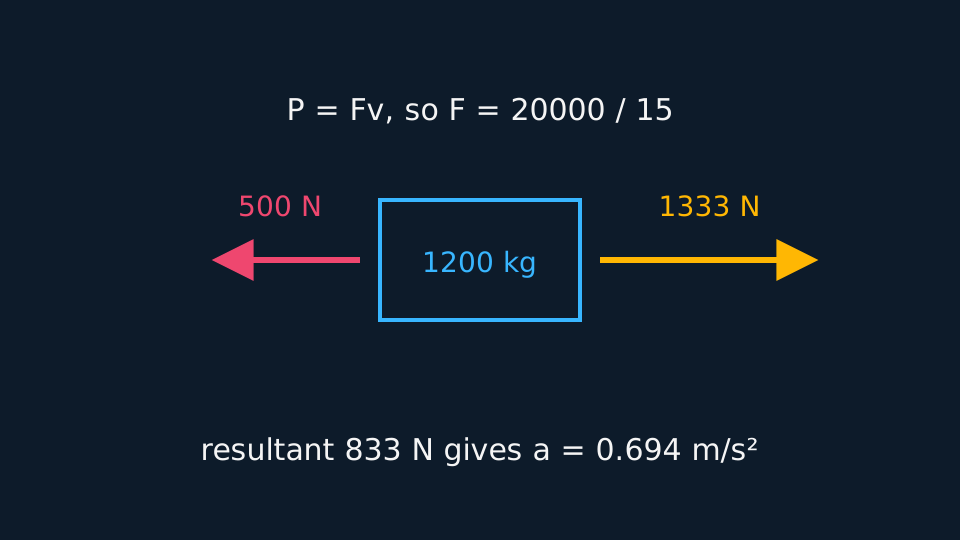
A car of mass 1200 kg works at 20 kW. At the moment its speed is 15 m/s the resistance is 500 N. Find the acceleration, and the maximum speed if the resistance stays at 500 N.
Show the working
Driving force = 20000/15 = 1333 N.
Resultant = 1333 − 500 = 833 N, so a = 833/1200 = 0.694 m/s².
At maximum speed the acceleration is zero, so the driving force equals 500 N: 20000/v = 500 gives v = 40 m/s.
In practice resistance grows with speed, so the real maximum would be lower.
ASSESSMENT FOCUS
- Include cos θ in the work done whenever the force is not along the motion.
- On a fixed surface the normal reaction is perpendicular to the displacement, so it contributes no work term to the energy equation.
- Set out the energy equation as a sentence of terms before substituting numbers.
- For power questions, decide whether the vehicle is accelerating or at maximum speed before writing anything.
- Watch the units. Power in kilowatts must become watts before it meets a force in newtons.
- Given a velocity as a vector, go straight to ½m v·v rather than finding the speed and squaring it back.
- With u, a and s given as vectors and no time in sight, reach for v·v = u·u + 2a·s. Every term in it is a number, so the answer is a scalar.
CHECK YOURSELF
A force of 30 N acts at 60° to the direction of motion while an object moves 8 m. Find the work done.
Show a hint
Only the component along the motion counts.
Show the answer
Work = 30 × 8 × cos60° = 30 × 8 × 0.5 = 120 J, half what the force would do if it acted along the motion.
Work is Fd cos θ, and the work-energy principle says the total work done by all forces equals the change in kinetic energy.
With no resistance, kinetic plus gravitational potential energy stays constant.
Power is P = Fv, so the driving force falls as speed rises, and maximum speed is where it has dropped to equal the resistance.
In vectors, kinetic energy is ½m v·v and constant acceleration gives v·v = u·u + 2a·s, which is the work-energy principle once both sides are multiplied by ½m.
WORKBOOK
Printable practice for this topic: original exam-style questions with room to work, and a fully worked answer book. Free to use; please do not redistribute or sell.
Or read them with their worked answers on the work, energy and power questions page.
USED LATER IN
CHECK YOUR PROGRESS
Rate how confident you feel with each objective for this lesson. Ratings are saved in this browser, on this device, unless you sign in.
- Calculate work done by a force at an angle, and by gravity and friction.
- Apply the work-energy principle to motion on a slope.
- Use conservation of mechanical energy where no resistance acts.
- Use P = Fv to link engine power, driving force and acceleration.
- Find a kinetic energy from a velocity vector as ½m v·v.
- Use v·v = u·u + 2a·s for constant acceleration in a plane, and recognise it as the work-energy principle in vector form.
Open the full revision checklist to see every objective in the course in one place.