Maths › Mechanics › Statics of a particle
Statics of a particle
A particle in equilibrium has zero resultant force, so the components in any direction sum to zero. Resolving in two perpendicular directions gives two equations, and those are enough to find two unknown forces or an unknown angle.
Builds on Friction and inclined planes.
IN THIS TOPIC
- Resolve a set of coplanar forces in two perpendicular directions and set each sum to zero.
- Solve string-and-weight equilibrium problems for unknown tensions.
- Handle equilibrium on rough surfaces, including the least and greatest force that keeps an object still.
COMMON MISCONCEPTION
If a particle is in equilibrium, there are no forces acting on it.
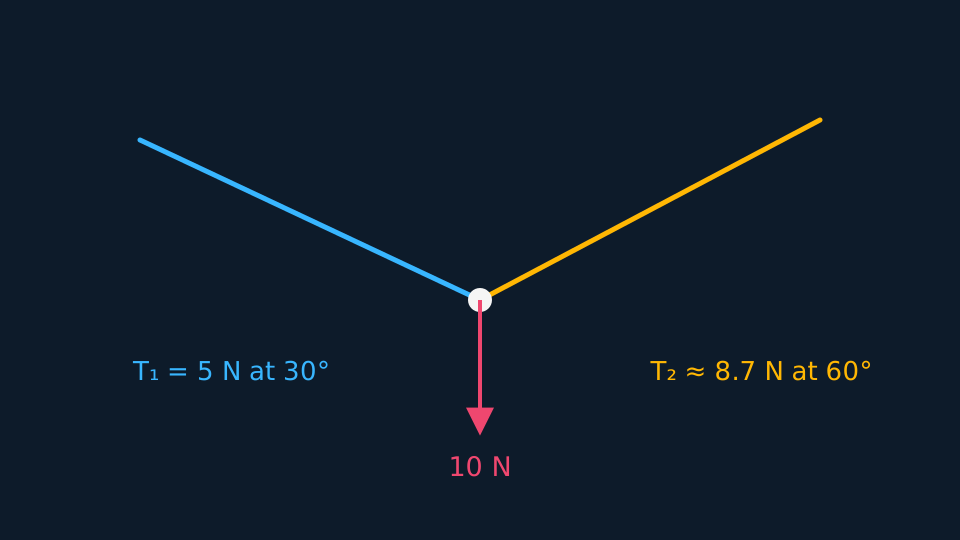
Equilibrium means the resultant force is zero, not that no forces act. In a plane that is two scalar equations, the components summing to zero in each of two perpendicular directions. A 10 N weight hanging on strings at 30° and 60° to the horizontal is in equilibrium under three forces, with tensions 5 N and 5√3 N, and it is their components that cancel.
Two resolved equations
A particle in equilibrium has zero resultant force. In a plane that is two scalar equations: the components sum to zero horizontally and vertically, or along and perpendicular to a slope. Choose the pair of perpendicular directions before resolving; aligning one axis with a force whose direction is awkward reduces the number of components to compute.
WORKED EXAMPLE
A weight on two strings
A 10 N weight hangs from two strings making 30° and 60° with the horizontal. Find both tensions.
Horizontally: T₁ cos 30° = T₂ cos 60°, so T₂ = √3 T₁.
Vertically: T₁ sin 30° + T₂ sin 60° = 10, so 0.5T₁ + 1.5T₁ = 10.
T₁ = 5 N and T₂ = 5√3 ≈ 8.7 N.
The string at 60° to the horizontal has the larger vertical component, so it carries the larger share of the weight; check that the two tensions are consistent with the vertical equation.
Equilibrium with friction
On a rough surface, include friction in the resolved equilibrium equation, with direction opposite to impending motion. In equilibrium, friction takes the value required to balance the other tangential forces, provided |F| ≤ μR. A block resting on a slope with no other applied force is held by friction acting up the slope with magnitude mg sin θ. A question asking for the largest force before slipping is asking about limiting equilibrium, F = μR, together with the same two resolved equations.
Because friction can act either way, a block on a rough slope usually sits still over a range of holding forces, and questions ask for both ends of that range.
Describe the drawing
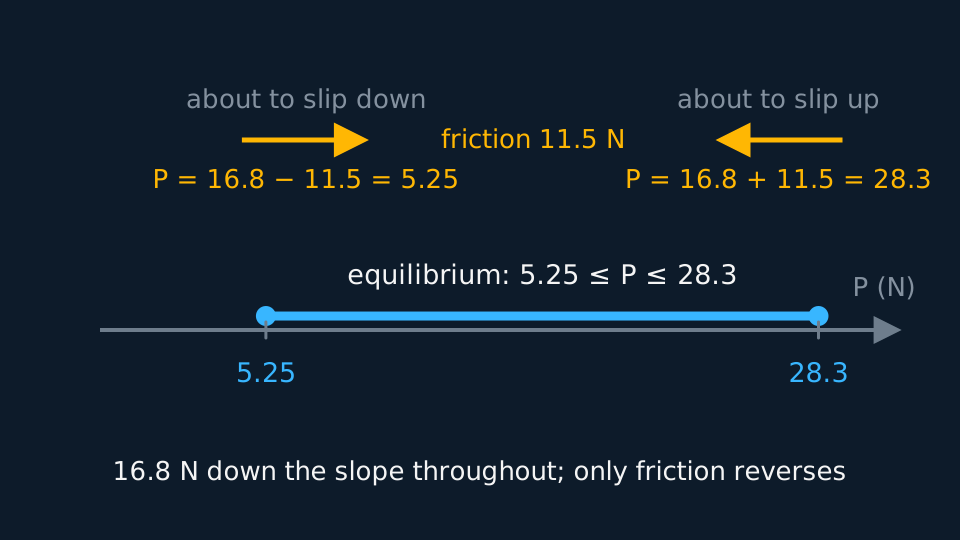
A number line for the holding force P with a thick cyan band from five point two five to twenty-eight point three newtons, the closed range of P for which the block stays still. Above each end an amber friction arrow points the opposite way from the other: at the small P friction acts with the push, at the large P it has reversed to oppose it, while the sixteen point eight newton weight component is unchanged.
WORKED EXAMPLE
The range of a holding force
A 5 kg block rests on a rough slope at 20°, μ = 0.25, held by a force P acting up the slope. Find the least and greatest values of P for equilibrium.
Perpendicular: R = 5g cos 20° = 46.0 N, so μR = 11.5 N. Down the slope, 5g sin 20° = 16.8 N.
About to slip down, friction acts up the slope at full strength: P + 11.5 = 16.8, so P = 5.25 N.
About to slip up, friction reverses: P = 16.8 + 11.5 = 28.3 N.
So equilibrium holds for 5.25 ≤ P ≤ 28.3 N. Draw the friction arrow in each direction before writing the corresponding equation.
Distinguish the two standard requests. To show that equilibrium is possible, show that the friction required satisfies |F| ≤ μR. To find the friction force, resolve; μR gives its value only at limiting equilibrium or while sliding.
ASSESSMENT FOCUS
- Write two resolved equations, each set to zero and each labelled with its direction.
- Choose axes that simplify the components: along and perpendicular to a slope wherever a slope is involved.
- In “on the point of” questions, add F = μR to the two equilibrium equations and solve the three together.
- Tension pulls away from the particle along the string. Reversing that arrow changes the sign in both resolved equations.
CHECK YOURSELF
A particle of weight 20 N on a smooth slope inclined at 30° is held by a string parallel to the slope. Find the tension and the normal reaction.
Show a hint
Resolve along the slope, then perpendicular to it.
Show the answer
Along: T = 20 sin 30° = 10 N.
Perpendicular: R = 20 cos 30° ≈ 17.3 N.
Equilibrium means the components sum to zero in two chosen directions.
Choose axes that simplify the components; friction takes the value the other forces require, up to μR.
WORKBOOK
Printable practice for this topic: original exam-style questions with room to work, and a fully worked answer book. Free to use; please do not redistribute or sell.
Or read them with their worked answers on the statics of a particle questions page.
CHECK YOUR PROGRESS
Rate how confident you feel with each objective for this lesson. Ratings are saved in this browser, on this device, unless you sign in.
- Resolve a set of coplanar forces in two perpendicular directions and set each sum to zero.
- Solve string-and-weight equilibrium problems for unknown tensions.
- Handle equilibrium on rough surfaces, including the least and greatest force that keeps an object still.
Open the full revision checklist to see every objective in the course in one place.