Maths › Further Mechanics 2 › Centre of mass of a discrete distribution
Centre of mass of a discrete distribution
The centre of mass is the point at which a system of masses balances. For separate masses it is a weighted average, and each coordinate is worked out on its own.
Builds on Moments and Statics of a particle.
IN THIS TOPIC
- Find the centre of mass of masses on a line and in a plane.
- Work backwards from a given centre of mass to an unknown mass or position.
- Read the centre of mass physically: a body balances when supported there, and hangs with it directly below the point of suspension.
COMMON MISCONCEPTION
The centre of mass of a set of particles is the average of their positions.
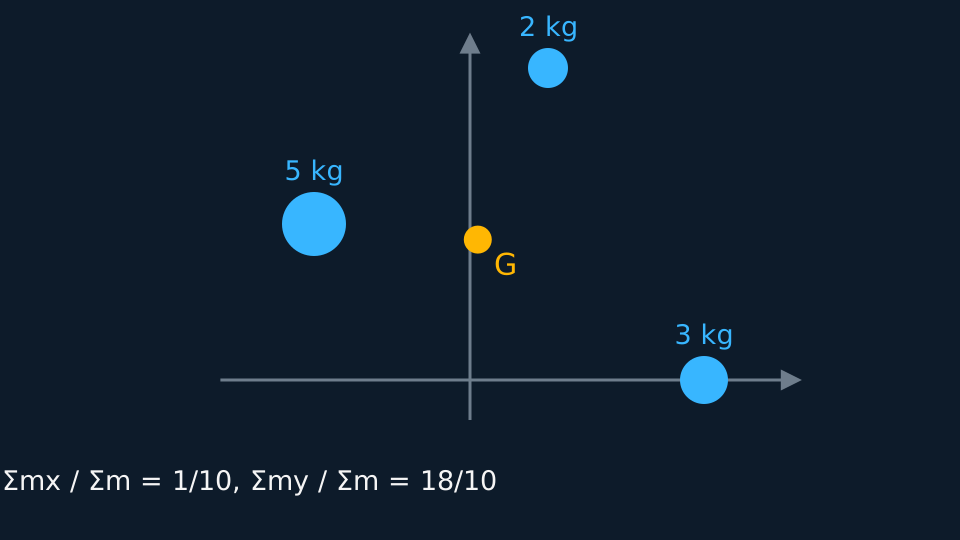
It is the mass-weighted average, Σmx over Σm taken one coordinate at a time, so the point sits nearer the heavier particles. Averaging the positions alone is right only when every mass is equal. Masses of 2, 3 and 5 kg at (1, 4), (3, 0) and (−2, 2) have their centre of mass at (0.1, 1.8), well left of the plain average (0.67, 2).
A weighted average
Take moments about the origin. The sum of the individual moments must equal the moment of the total mass placed at the centre of mass, and that gives one equation per coordinate:
Pearson Edexcel 9FM0 formulae booklet: the centres of mass of seven standard uniform bodies are included; this weighted-average rule is not.
The masses are the weights in the average, so the point sits nearer the heavier particles. Averaging the positions alone is only right when every mass is equal.
Neither coordinate affects the other, so a two-dimensional problem is two one-dimensional problems solved side by side. A table with columns for m, x, mx, y and my keeps the work orderly and makes the arithmetic checkable.
WORKED EXAMPLE
Three masses in a plane
Masses of 2 kg, 3 kg and 5 kg sit at (1, 4), (3, 0) and (−2, 2). Find the centre of mass.
Total mass = 10 kg.
Σmx = 2(1) + 3(3) + 5(−2) = 2 + 9 − 10 = 1, so xG = 0.1.
Σmy = 2(4) + 3(0) + 5(2) = 8 + 0 + 10 = 18, so yG = 1.8.
The point (0.1, 1.8) lies well to the left of the plain average (0.67, 2), pulled there by the 5 kg mass.
Running it backwards
The same equation solves for an unknown mass or an unknown position, and questions often ask for exactly that: where a counterweight should go, or how heavy it must be to bring the centre of mass to a particular point. The equation is linear in each unknown, so one substitution and one rearrangement finish it.
Hold on to the physical meaning while you do it. An object supported at its centre of mass balances, and an object suspended from a point hangs with its centre of mass directly below. Both facts come straight from taking moments, and both get used constantly in the lessons that follow.
GUIDED PRACTICE
Finding a missing mass
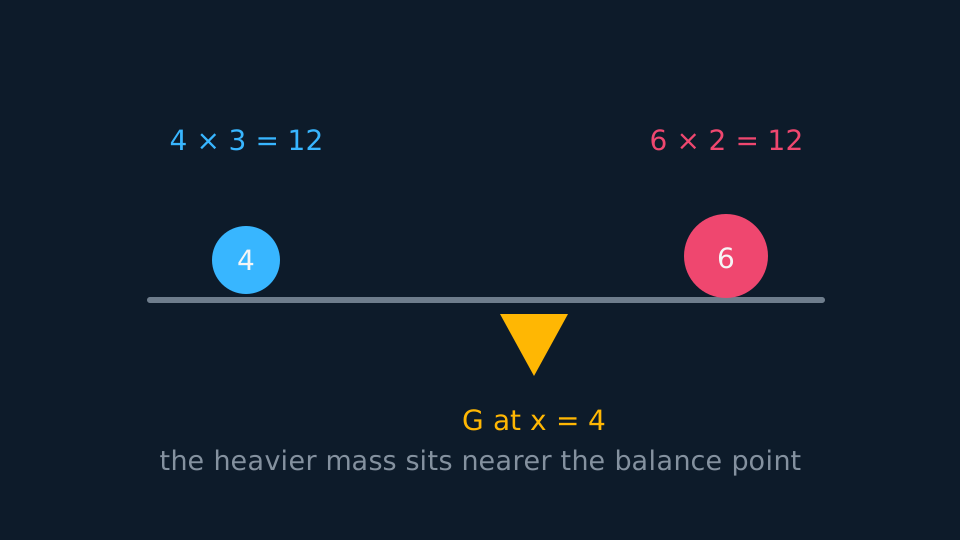
Masses of 4 kg and m kg are placed at x = 1 and x = 6 on a light rod. The centre of mass is at x = 4. Find m.
Show the working
The formula gives (4 × 1 + 6m)/(4 + m) = 4.
Multiplying out: 4 + 6m = 16 + 4m.
So 2m = 12 and m = 6 kg.
Checking: (4 + 36)/10 = 4 as required, and the heavier mass is indeed the closer one to the balance point.
ASSESSMENT FOCUS
- Set the work out in a table, with a column for the moments.
- Do the two coordinates separately and keep the totals distinct.
- Check the answer is no farther out than the outermost masses: the centre of mass lies within their spread, though not necessarily at an occupied point, since two equal masses at the ends of a rod balance at the empty midpoint.
CHECK YOURSELF
Masses of 1 kg, 2 kg and 3 kg sit at x = 0, 2 and 6. Find the centre of mass.
Show a hint
Total moment over total mass.
Show the answer
Σmx = 0 + 4 + 18 = 22, and the total mass is 6, so xG = 22/6 = 3.67 to three significant figures.
The centre of mass is the mass-weighted average of the positions, taken one coordinate at a time, and it follows from moments, so an object balances when supported there and hangs with it below any point of suspension.
WORKBOOK
Printable practice for this topic: original exam-style questions with room to work, and a fully worked answer book. Free to use; please do not redistribute or sell.
Or read them with their worked answers on the centre of mass of a discrete distribution questions page.
CHECK YOUR PROGRESS
Rate how confident you feel with each objective for this lesson. Ratings are saved in this browser, on this device, unless you sign in.
- Find the centre of mass of masses on a line and in a plane.
- Work backwards from a given centre of mass to an unknown mass or position.
- Read the centre of mass physically: a body balances when supported there, and hangs with it directly below the point of suspension.
Open the full revision checklist to see every objective in the course in one place.