Maths › Further Mechanics 2 › Centres of mass of plane figures and frameworks
Centres of mass of plane figures and frameworks
The centre of mass of a composite shape comes from splitting it into pieces with known centres, weighting each by its area, and adding. A removed piece enters the same sum with a minus sign.
Builds on Centre of mass of a discrete distribution and Moments.
IN THIS TOPIC
- Find the centre of mass of a composite lamina.
- Handle a lamina with a piece removed, using a negative area.
- Find the centre of mass of a framework of rods.
- Use symmetry to avoid unnecessary calculation.
- Quote the booklet's standard centre of mass for a single uniform figure.
COMMON MISCONCEPTION
A wire triangle and a triangular lamina of the same shape have the same centre of mass.
A framework weights each rod by its length at its own midpoint, while a lamina weights each piece by its area, so the two distributions generally give different centres. A wire triangle with vertices (0, 0), (4, 0) and (0, 3) balances at (1.5, 1), against the lamina's centroid at (4/3, 1). Enough symmetry can make them agree: an equilateral triangle of wire balances where its lamina does.
Areas as the weights
For a uniform lamina, mass is proportional to area, so the areas become the weights in the same weighted average. Split the shape into rectangles, triangles and circles whose centres you already know, then add. A rectangle's centre is its middle, and every piece harder than that is one of the seven standard bodies listed in the Pearson Edexcel 9FM0 formulae booklet.
WORKED EXAMPLE
A rectangle with a corner cut out
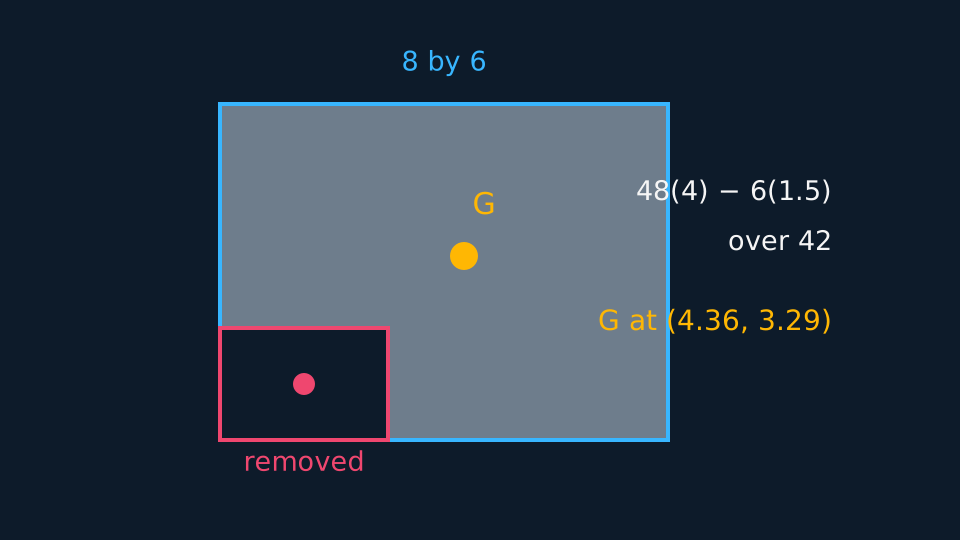
A uniform lamina is an 8 by 6 rectangle with a 3 by 2 rectangle removed from the corner at the origin. Find its centre of mass.
Whole rectangle: area 48, centre (4, 3). Removed piece: area 6, centre (1.5, 1). Remaining area 42.
xG = (48 × 4 − 6 × 1.5)/42 = 183/42 = 4.36.
yG = (48 × 3 − 6 × 1)/42 = 138/42 = 3.29.
Both coordinates have moved away from the removed corner, which is the check to make.
The seven standard centres of mass
Pearson Edexcel 9FM0 formulae booklet: included. The centre of mass of seven standard uniform bodies is listed under Centres of mass. Three of the seven are plane figures.
The angle in those two is 2α, the whole angle at the centre, with α in radians, so a quarter circle has α = π/4 and not π/2. Reading α as the whole angle instead of the half-angle doubles it and gives the wrong distance. The other four are solids, and they appear in the toppling and suspension questions.
Notice the pattern in these two pairs. In each, the shell sits further from the base than the solid, because a shell carries none of its mass in the middle. The booklet lists all four, so understand the pattern rather than memorising it.
Holes and symmetry
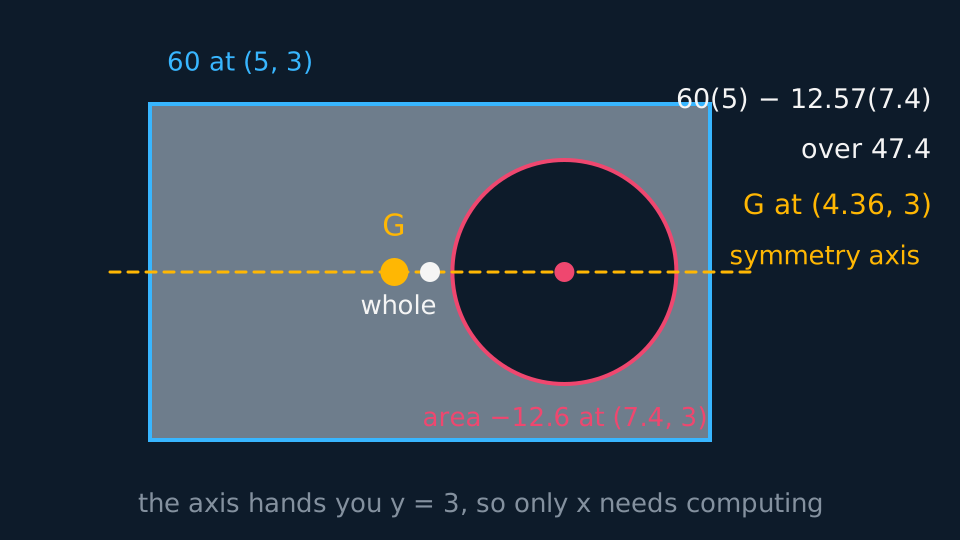
A shape with a hole is handled by subtraction. Treat the missing piece as a negative area acting at its own centre. The arithmetic is unchanged and the sign does the work, which is easier than trying to cut the remaining shape into positive pieces.
Use symmetry before anything else. Any axis of symmetry must contain the centre of mass, so a symmetric shape needs at most one coordinate calculating, and a doubly symmetric one needs none.
Describe the drawing
A wide rectangle with a circular hole punched to the right of its middle, and a dashed horizontal line through the centre of both shapes. Markers sit at the rectangle's centre, at the hole's centre, and at the centre of mass of what remains, which has slid along the dashed symmetry axis away from the hole to four point three six while staying at height three exactly.
Frameworks weight by length
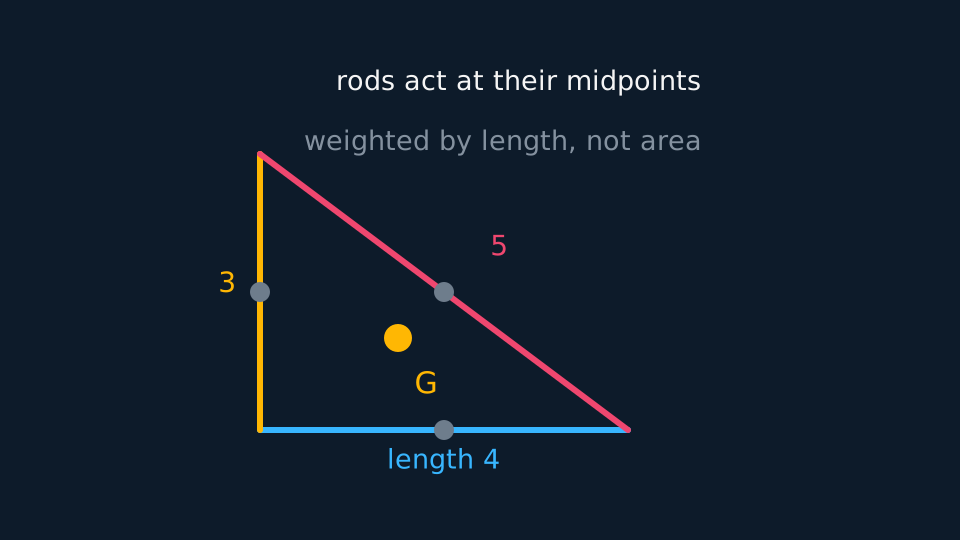
A framework is made of rods, so its mass is spread along lines and not over an area. Each rod acts at its own midpoint with a weight proportional to its length, and the same weighted average follows. The wire and the lamina distribute their mass differently, so their centres need not agree, though enough symmetry can make them coincide: an equilateral triangle of wire balances where its lamina does.
For a lamina the answer is the centroid of the shape; for a framework it is the centroid of the perimeter. A long rod on one side of a framework pulls the centre of mass strongly towards itself, while the same side of a lamina contributes only in proportion to the area near it.
GUIDED PRACTICE
A wire triangle
A uniform wire framework forms a right-angled triangle with vertices at (0, 0), (4, 0) and (0, 3). Find its centre of mass.
Show the working
The rods have lengths 4, 3 and 5, total 12, acting at (2, 0), (0, 1.5) and (2, 1.5).
xG = (4 × 2 + 3 × 0 + 5 × 2)/12 = 18/12 = 1.5.
yG = (4 × 0 + 3 × 1.5 + 5 × 1.5)/12 = 12/12 = 1.
The triangular lamina of the same shape has its centroid at (4/3, 1), so the two differ here.
ASSESSMENT FOCUS
- Tabulate area, x, ax, y and ay, with a negative area for anything removed.
- Look the standard centres up rather than recalling them. A triangle's is two thirds along the median from the vertex, which is a third of the height from the base.
- Use an axis of symmetry to write down one coordinate without working.
- For a framework, weight by length and use midpoints, never areas and centroids.
- State your axes on the diagram and measure every distance from the same edge.
CHECK YOURSELF
A uniform lamina is a 6 by 4 rectangle with a 2 by 2 square removed from one corner. Find the distance of the centre of mass from the long edge nearest the square.
Show a hint
Subtract the square as a negative area.
Show the answer
Areas 24 and −4, so 20 remains. Taking the removed square in the corner at the origin, yG = (24 × 2 − 4 × 1)/20 = 44/20 = 2.2.
For a uniform lamina, weight each piece by its area at its own centre.
The Pearson Edexcel 9FM0 formulae booklet gives the centres of seven standard uniform bodies.
Anything removed goes in with a negative area at its own centre.
For a framework, weight each rod by its length at its own midpoint, so the wire and the lamina of the same shape generally differ.
WORKBOOK
Printable practice for this topic: original exam-style questions with room to work, and a fully worked answer book. Free to use; please do not redistribute or sell.
Or read them with their worked answers on the centres of mass of plane figures and frameworks questions page.
USED LATER IN
CHECK YOUR PROGRESS
Rate how confident you feel with each objective for this lesson. Ratings are saved in this browser, on this device, unless you sign in.
- Find the centre of mass of a composite lamina.
- Handle a lamina with a piece removed, using a negative area.
- Find the centre of mass of a framework of rods.
- Use symmetry to avoid unnecessary calculation.
- Quote the booklet's standard centre of mass for a single uniform figure.
Open the full revision checklist to see every objective in the course in one place.