Moments
A rigid body can turn as well as move, so its equilibrium requires two conditions. The moment of a force about a point is force times perpendicular distance from that point to the line of action, and a beam in equilibrium has both zero resultant force and zero resultant moment. Choosing the point about which to take moments removes the forces acting through it from that equation.
Builds on Statics of a particle.
Used in InkPhysics: Moments and equilibrium.
IN THIS TOPIC
- Calculate moments as force times perpendicular distance, with a consistent sense of rotation.
- Use both equilibrium conditions for beams: forces balance, and moments about any point balance.
- Model uniform and non-uniform beams, and use tilting conditions where a reaction vanishes.
- Take the weight of a rectangular lamina at its point of symmetry, and find the force that puts it on the point of toppling.
- Solve for the forces on a ladder resting on rough ground against a smooth vertical wall, with one declared sense of rotation.
- Decide whether a body slides or topples first by comparing the sliding threshold with the toppling force, and find the coefficient of friction at which the answer changes.
COMMON MISCONCEPTION
A bigger force always has a bigger turning effect.
A moment is force times the perpendicular distance from the point to the force's line of action, so the distance counts for as much as the size. 20 N acting 2 m from a pivot has the same moment, 40 N m, as 40 N acting 1 m from it, and a force whose line of action passes through the point has no moment about it at all.
The turning effect
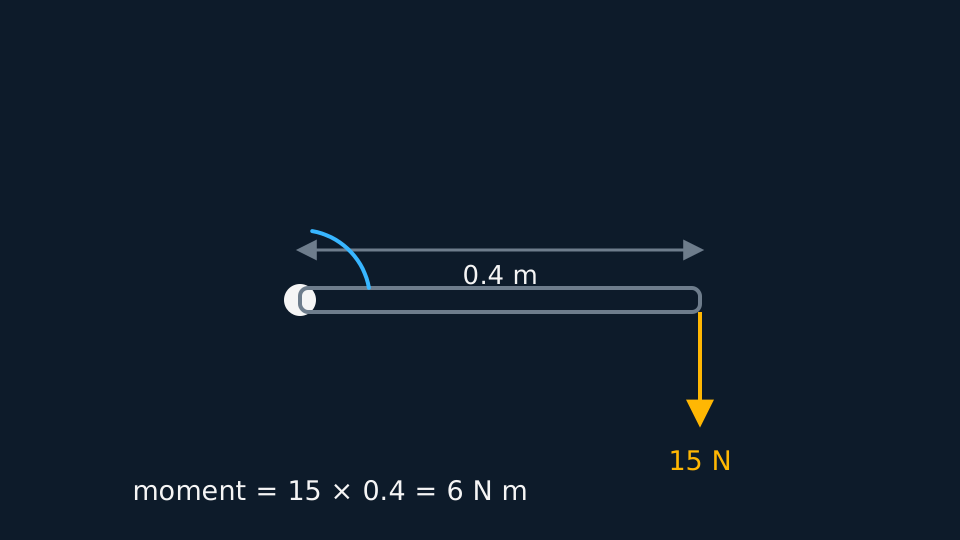
A force's moment about a point measures its turning effect there: force times the perpendicular distance from the point to the force's line of action, measured in newton metres and labelled clockwise or anticlockwise. A force whose line of action passes through the point has zero moment about it. Take moments about a point through which an unknown force acts and that force does not appear in the moments equation.
Equilibrium of a beam
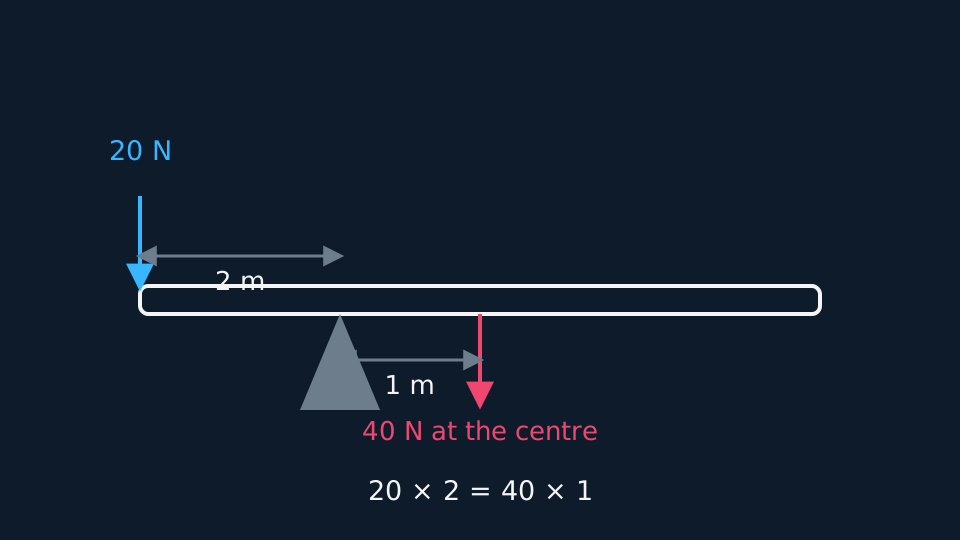
A rigid body in equilibrium satisfies two conditions at the same time. The forces sum to zero, and the moments about any point sum to zero. A uniform beam contributes its own weight at its midpoint.
WORKED EXAMPLE
A beam on two supports
A uniform 6 m beam of weight 120 N rests on supports at 1 m and 5 m from end A. Find the reaction at each support.
Moments about the 1 m support: 120 × 2 = R₂ × 4, so R₂ = 60 N.
Forces vertically: R₁ + 60 = 120, so R₁ = 60 N.
Symmetry check: the supports are placed symmetrically about the centre of the uniform beam, so the two reactions must be equal.
A non-uniform beam carries its weight at an unknown point, and that point is usually what the question wants. Take moments about one support to find it. For a 4 m rod resting on supports at both ends with reactions 30 N and 50 N, the weight is 80 N, and moments about A give 80d = 50 × 4, so the centre of mass is 2.5 m from A. It lies nearer the support with the larger reaction, as the moments equation requires.
Tilting
Tilting is the boundary case. On the point of tilting about one support, the beam is about to lose contact with the other, so that other reaction is zero. State R = 0 first; it supplies the additional equation.
WORKED EXAMPLE
The tilting position of a moving load
A uniform beam AB of length 5 m and weight 200 N rests on supports at C, 1 m from A, and D, 3.5 m from A. A child of weight 300 N walks from A towards B. Find how far from A the child is when the beam is about to tilt.
It tilts about D, so at that moment the reaction at C is zero and the only forces are the weight, the child and R at D.
Take moments about D. The beam's weight acts at 2.5 m from A, which is 1 m on the A side of D: 200 × 1 = 300 × (x − 3.5).
So x − 3.5 = 2/3 and x = 4.17 m from A (3 s.f.).
Check: the answer lies between D and B, which is where tilting about D can occur, and the equation shows that a heavier child reaches the tilting position sooner.
The same idea applies to a flat body toppling about an edge. A rectangular lamina is a flat sheet with no thickness, and a uniform one carries its weight at its point of symmetry, the centre of the rectangle. On the point of toppling about an edge, the normal reaction acts at that edge and there is no contact elsewhere, so taking moments about the edge gives the required equation.
WORKED EXAMPLE
Toppling a lamina
A uniform rectangular lamina ABCD of weight 50 N stands in a vertical plane on rough horizontal ground, with AB = 1.5 m along the ground and BC = 0.9 m vertical. A horizontal force P is applied at D along the top edge, pushing towards C. Find the value of P at which the lamina is about to topple.
The weight acts at the centre of the rectangle, which is 0.75 m horizontally from B and 0.45 m above the ground.
It topples about B, so take moments about B. P acts 0.9 m above B, giving 0.9P, and the weight acts 0.75 m from B on the other side, giving 50 × 0.75 = 37.5 N m.
0.9P = 37.5, so P = 41.7 N (3 s.f.).
That answer assumes it does not slide first. Sliding starts once P exceeds μ × 50, so toppling only happens if μ is at least 41.7/50 = 0.83, and a question quoting a smaller μ is asking about sliding instead.
A ladder against a wall
The other standard setting is a ladder resting on rough horizontal ground with its top against a vertical wall. Four forces act on it: its weight, at the midpoint if it is uniform; the normal reaction R from the ground, vertically up; friction F at the foot, horizontal; and the wall's push S. A smooth wall exerts a force perpendicular to itself, so S is horizontal and there is no friction at the wall; friction acts only at the foot.
Determine the direction of friction before writing the equations. The ladder slips by its foot sliding away from the wall, so friction at the foot acts towards the wall. Then state one sense of rotation: take moments about the foot, counting as positive the sense that would raise the ladder towards the vertical. S acts in that sense and the weight acts against it.
WORKED EXAMPLE
How much friction does the ground need?
A uniform ladder of mass 20 kg and length 6 m rests with its foot on rough horizontal ground and its top against a smooth vertical wall, at 60° to the horizontal. Find the friction at the foot and the least coefficient of friction for which it stays put.
Its weight is 20g = 196 N, acting 3 m along the ladder from the foot.
Vertically: S is horizontal and the weight is the only other vertical force, so R = 196 N.
Moments about the foot: the top is 6 sin 60° = 5.196 m above the ground, and the midpoint is 3 cos 60° = 1.5 m horizontally from the foot. So 5.196S = 196 × 1.5 = 294, giving S = 56.6 N.
Horizontally: F = S = 56.6 N, and since F ≤ μR, the ground must have μ ≥ 56.6/196 = 0.289 (3 s.f.).
The weight and length cancel. For a uniform ladder against a smooth wall the same working gives F/R = 1/(2 tan θ), which is 0.289 at 60°, independent of the mass and length of the ladder.
Two variations occur. A person standing on the ladder contributes one further weight in the moments equation, at their own distance along it; the further up they stand, the larger the value of S and hence the friction required. A non-uniform ladder has its weight at a stated point rather than the midpoint, which changes only that distance.
ASSESSMENT FOCUS
- Choose the point to take moments about so that an unknown is eliminated: taking moments about a support removes its reaction from that equation.
- Write “taking moments about A, clockwise positive” and keep every term's sense consistent with that statement.
- Uniform means the weight acts at the centre. Non-uniform means its position is an unknown to be found.
- On the point of tilting about one support, the other reaction is zero. State that condition first.
- For a ladder, take moments about the foot: this removes both R and F from that equation, leaving S as the only unknown in it.
- A rectangular lamina carries its weight at its centre of symmetry, and on the point of toppling the reaction has moved to the edge it turns about.
CHECK YOURSELF
A uniform 4 m plank of weight 80 N rests on a support at its centre. A child of weight 400 N sits 0.5 m from one end. How far from the centre, on the other side, must a 500 N adult sit to balance it?
Show a hint
The plank's own weight acts at the pivot.
Show the answer
The child sits 1.5 m from the centre: moment 400 × 1.5 = 600 N m.
Balance: 500 × d = 600, so d = 1.2 m from the centre.
Moment = force × perpendicular distance, with a stated sense of rotation.
A beam in equilibrium satisfies two conditions: the forces sum to zero, and the moments about any point sum to zero.
WORKBOOK
Printable practice for this topic: original exam-style questions with room to work, and a fully worked answer book. Free to use; please do not redistribute or sell.
Or read them with their worked answers on the moments questions page.
USED LATER IN
CHECK YOUR PROGRESS
Rate how confident you feel with each objective for this lesson. Ratings are saved in this browser, on this device, unless you sign in.
- Calculate moments as force times perpendicular distance, with a consistent sense of rotation.
- Use both equilibrium conditions for beams: forces balance, and moments about any point balance.
- Model uniform and non-uniform beams, and use tilting conditions where a reaction vanishes.
- Take the weight of a rectangular lamina at its point of symmetry, and find the force that puts it on the point of toppling.
- Solve for the forces on a ladder resting on rough ground against a smooth vertical wall, with one declared sense of rotation.
- Decide whether a body slides or topples first by comparing the sliding threshold with the toppling force, and find the coefficient of friction at which the answer changes.
Open the full revision checklist to see every objective in the course in one place.