Maths › Further Mechanics 2 › Centres of mass by integration
Centres of mass by integration
When a shape has no straight edges to split along, it is divided into strips instead. Each strip is a rectangle with a known centre, and the sum over the strips becomes an integral.
Builds on Centres of mass of plane figures and frameworks and Areas and the limit of a sum.
IN THIS TOPIC
- Find the centre of mass of a lamina bounded by a curve, by integration.
- Find the centre of mass of a solid of revolution.
- Handle a non-uniform body whose density varies with position.
- Use symmetry to reduce the number of integrals needed.
- Find the centre of mass of a composite solid from standard results.
COMMON MISCONCEPTION
For a lamina under a curve, the y coordinate of the centre of mass is found by integrating y against the area, just as x is.
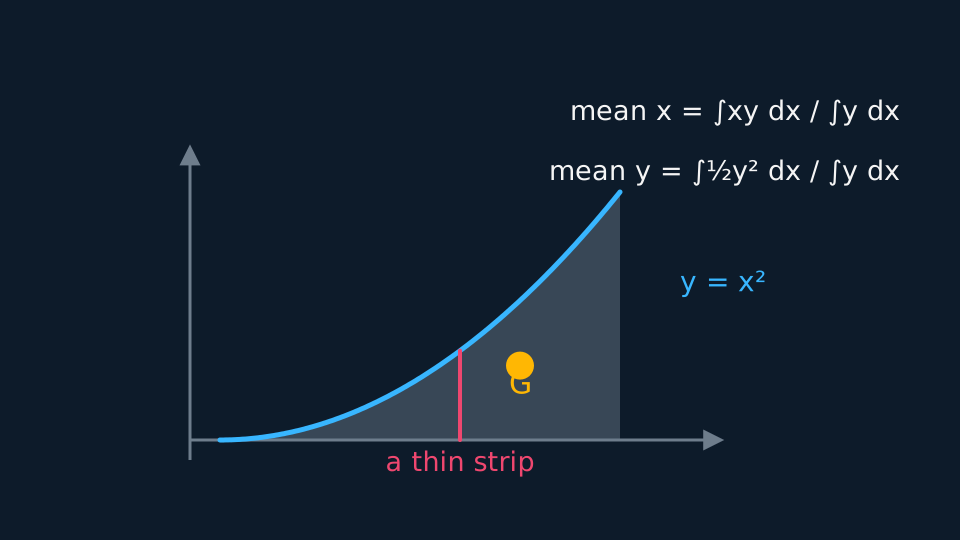
The two coordinates are not symmetric. A vertical strip of height y acts at distance x horizontally but at its own halfway height y/2 vertically, so the moment integrands are xy and y2/2, each divided by ∫y dx. Under y = x2 from 0 to 2 that gives xG = 1.5 and yG = 1.2.
Strips for a lamina
Cut the region into vertical strips of width δx. Each strip is a rectangle to within a vanishing error, of height y, so its area is y δx and its own centre sits at height y/2. Sum the moments, let the width tend to zero, and you have:
Pearson Edexcel 9FM0 formulae booklet: these integration formulae are not included; only the finished results for the standard bodies are, so the method itself has to be reproduced.
The two are not symmetric. For x the whole strip acts at distance x, so the integrand is xy. For y the strip acts at its own halfway height, giving y × y/2, hence the half and the square.
WORKED EXAMPLE
Under a parabola
Find the centre of mass of the uniform lamina bounded by y = x², the x-axis and x = 2.
Area = ∫x² dx from 0 to 2 = 8/3.
∫xy dx = ∫x³ dx = 4, so xG = 4 ÷ 8/3 = 1.5.
∫½y² dx = ½∫x⁴ dx = ½(32/5) = 3.2, so yG = 3.2 ÷ 8/3 = 1.2.
Both lie inside the region, and xG is well right of centre because the area is concentrated there.
Solids of revolution, and varying density
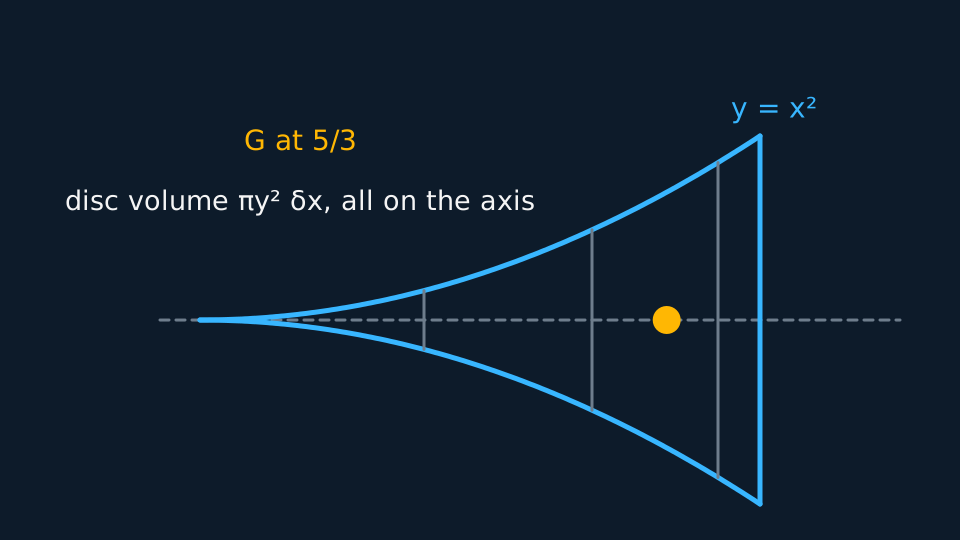
For a solid formed by rotating a curve about the x-axis, cut it into discs of radius y and thickness δx. Each disc has volume πy² δx with its centre on the axis at x, so symmetry puts the centre of mass on the axis and only xG needs finding:
The π cancels, top and bottom. For a non-uniform body the density varies with position, so each element carries a mass ρ dV instead of dV and ρ goes inside both integrals. Nothing else changes.
GUIDED PRACTICE
A solid of revolution
The region under y = x² from x = 0 to x = 2 is rotated about the x-axis. Find the centre of mass of the solid formed.
Show the working
Volume ∝ ∫y² dx = ∫x⁴ dx = 32/5.
Moment ∝ ∫xy² dx = ∫x⁵ dx = 64/6 = 32/3.
xG = (32/3) ÷ (32/5) = 5/3 ≈ 1.67, on the axis by symmetry.
That is further right than the lamina's 1.5, because squaring the radius weights the wide end more heavily still.
Composite solids from standard results
A solid built from pieces whose centres of mass the booklet lists needs no integration at all. Quote the standard result for each piece, weight it by that piece's volume, since a uniform solid's mass is proportional to its volume, and take moments about a convenient plane. The flat face where two pieces join is usually that plane, because the two centres then lie at known distances on either side of it.
WORKED EXAMPLE
A cone on a hemisphere
A uniform solid is a cone of base radius 2 and height 6 joined at its base to the flat face of a hemisphere of radius 2. Find its centre of mass.
Both centres are in the Pearson Edexcel 9FM0 formulae booklet: h/4 above the base for a solid cone, which is 1.5, and 3r/8 from the flat face for a solid hemisphere, which is 0.75.
The solid is uniform, so the masses are in proportion to the volumes: cone ⅓π(2²)(6) = 8π, hemisphere ⅔π(2³) = 16π/3, a ratio of 3 : 2.
Take moments about the common flat face, measuring towards the vertex, so the hemisphere's centre sits 0.75 on the other side: xG = (3 × 1.5 − 2 × 0.75)/5 = 3/5 = 0.6.
Symmetry puts the centre of mass on the axis, and 0.6 above the flat face puts it inside the cone, which is where the greater volume is.
ASSESSMENT FOCUS
- Write down the element you are using, its mass and its own centre, before setting up any integral.
- Remember the half and the square in the y integral for a lamina. The two coordinates are not symmetric.
- For a solid of revolution, say that symmetry puts the centre on the axis instead of integrating for it.
- Quote standard results from the formulae book where the question allows, and say that you are doing so.
CHECK YOURSELF
A uniform lamina lies under y = x from x = 0 to x = 3. Find xG.
Show a hint
Two integrals, then divide.
Show the answer
Area = ∫x dx = 4.5. ∫xy dx = ∫x² dx = 9. So xG = 9/4.5 = 2, which is two thirds of the way along as a triangle's centroid should be.
Cut into strips: xG is ∫xy dx over ∫y dx, but yG is ∫½y² dx over ∫y dx, because each strip acts at its own halfway height.
For a solid of revolution use y² in place of y and take the centre on the axis by symmetry; for a non-uniform body put ρ inside both integrals.
WORKBOOK
Printable practice for this topic: original exam-style questions with room to work, and a fully worked answer book. Free to use; please do not redistribute or sell.
Or read them with their worked answers on the centres of mass by integration questions page.
CHECK YOUR PROGRESS
Rate how confident you feel with each objective for this lesson. Ratings are saved in this browser, on this device, unless you sign in.
- Find the centre of mass of a lamina bounded by a curve, by integration.
- Find the centre of mass of a solid of revolution.
- Handle a non-uniform body whose density varies with position.
- Use symmetry to reduce the number of integrals needed.
- Find the centre of mass of a composite solid from standard results.
Open the full revision checklist to see every objective in the course in one place.